STUDY ON QUANTITATIVE SPECIATION, BY BCR METHOD, OF ZINC
CONTENT FROM RIVER SEDIMENTS
Georgiana Vasile*, Stanescu Bogdan, Tudor Claudia, Elena Mihaila
National Research and Development Institute for Industrial Ecology – ECOIND 90-92 Panduri Road, 050663, Bucharest, sector 5, Romania
*Corresponding author: phone: +40/21/4100377; fax: +40/21/4100575; e-mail: [email protected]
Keywords: sediment, sequential extraction, bioavailability, zinc mobility
An unwanted consequence of human activity and of uncontrolled industrialization is the environment contamination with a lot of pollutants, among them heavy metal anthropogenic pollution having some most serious consequences. A reliable estimation of pollution level is made by studying heavy metal concentrations in the sediments.
In our study the zinc content of the water and river sediments has been investigated, in an area polluted by mining activities, to provide information on the mobility and availability of this element. Sediment and water samples have been collected from signifi cant sites in a former mining area in which with some sterile pits, which represent a major environmental hazard.
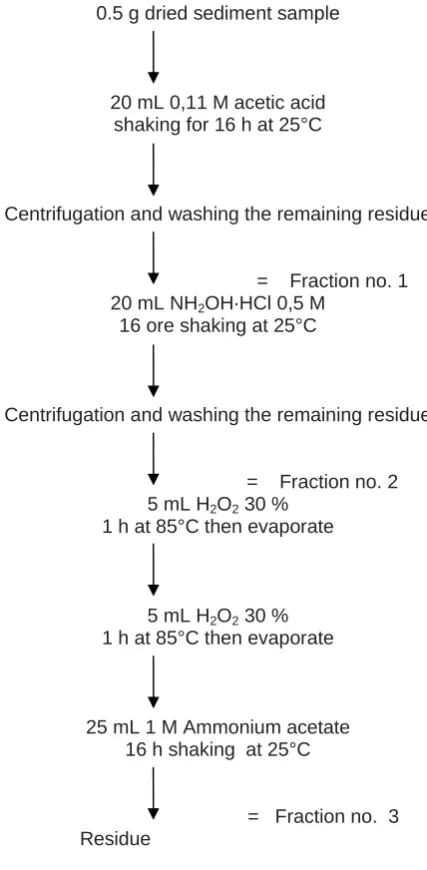
The zinc mobility and bioavailability in the environment was investigated by the three-step sequential extraction procedure, a protocol proposed by the Standards, Measurements and Testing programme (SM & T–formerly BCR) of the European Union. The BCR sequential extraction scheme has the advantage that there are reference materials available with certifi ed and indicative values for the concentrations of selected elements in the particular extraction steps. The BCR procedure enables fractionalization of metal content into the following fractions:
EASILY MOBILIZABLE FRACTION: This fraction contains the specifi cally bound, surface occluded species
•
(sometimes also CaCO3 bound species and metallo-organic complexes with low bonding forces). ORGANICALLY BOUND FRACTION
•
Mn-Fe-and Al-OXIDE BOUND FRACTION
•
RESIDUAL FRACTION: This fraction mainly contains crystalline-bound trace metals and is most commonly
•
dissolved with high concentrated acids and special digestion procedures.
Combination of data from sequential extraction procedures and normalisation approaches provides a good basis to estimate the proportions of the easily and sparingly soluble metal fractions in the samples investigated and to identify the anthropogenic input of metals into the environment.
Introduction
From the pollution types that are to be found in our country, the most prevalent and having powerful effects for the quality of surface waters and of the sediments, is the heavy metals pollution that is to be found especially in the areas having a long ores extraction activity.
Understanding the importance of sediments role in contaminants transport and storage, conduced to an increasing preoccupation of the researchers and of the organisms responsible for the control and the prevention of water pollution, in the pollutant compounds knowledge fi eld.
For an evaluation of heavy metals charge in the sediments, is not suffi cient to determinate their total concentration. The establishment of the metals proportions in easy soluble fractions and in the hard soluble ones is very important.
These fractions evaluation allows the elucidation of their existing dangers and seriousness for the aquatic ecosystems [1].
The signifi cation of speciation analyze as a method for estimating the environment risk was recognized by the Environment Conservation Council from Australia and New Zeeland (ANEZECC), who recommanded the examination of bioaccesible concentrations, where the metals total levels overpass the levels established into the Interimare Quality Criteria for Sediments[2].
For the estimation of the natural and the anthropogenic inputs of the heavy metals in the sediments, are used identifi cation methods by sequential chemical extraction (BCR technique) and normalizations, based on the correlations between the concentrations of the elements present in the tracks, and an element that is naturally present in the investigated environment [3].
Experimental part Study area
The studied Certej River sector is placed on the territory of Certej village, Hunedoara district almost 20 km to Deva, on north direction.
This river sector, named Baiaga Valley, is spreading on a 1 km distance between the confl uence with Bocsa Mare (Coranda) River and the confl uence with Bocsa Mica (Ciongani) River. This rivers tributary to Certej Valley bring a signifi cant contribution of heavy metals pollution, taking into account the fact that in the area between the rivers, on their valleys and also in Baiaga Valley sector, are placed objectives belonging to some mining exploitations having the precious metals extraction activity fi eld. These objectives are represented by open exploitations, underground exploitations and by wastes deposits afferent to them – dumps.
Sampling
The investigations objective was to establish the quality of the sediments of Baiaga River (Certej) upstream and downstream the objectives that generate pollution as a consequence of the activity unrolled in the area, in order to put in bold line a possible accumulation of the pollutants from the water, in the sediments.
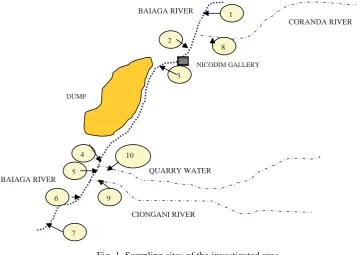
In order to effectuate the experiments the sediments were collected along Baiaga River sector (samples 1-7) and on its affl uent (Coranda River, Nicodim gallery, Ciongani River and quarry water) (samples 8-10) presented in fi gure 1. The samples were collected from the upper layer of the sediment, along with the surrounding water, in order to estimate the natural substance of the studied analytes.
CIONGANI RIVER
CORANDA RIVER
QUARRY WATER
DUMP
BAIAGA RIVER
BAIAGA RIVER
NICODIM GALLERY
2
1
3
4
5
6 9
10
8
7
Fig. 1. Sampling sites of the investigated area
Equipment
Metals concentrations were determined by atomic absorption spectrophotometer in fl ame, to a Nova A 300 instrument (Analytik Jena , Germany), in air- acetylene fl ame.
Zinc extraction from the sediment by the sequential extraction procedure was realized in 50 ml polyethylene tubes. A mechanical shaker was used for samples shaking. Sediment extracts were whizzed to a Rotofi x 32 centrifuge (Hettich, Germany) to 2200 rpm for 20 min.
Reagents
Zinc standard solution was used (1000 ±2 mg dm-3) in 5% HNO
3. Work standardization solutions used for
calibration in analyzing the samples from the sequential extraction, were daily prepared by diluting storage solution with extraction solution. The extractors used in the three extraction steps are: 0,11 M acetic acid; 0,5 M hydroxyl ammonium chloride; 1 M ammonium acetate.
0.5 g dried sediment sample
20 mL 0,11 M acetic acid shaking for 16 h at 25°C
Centrifugation and washing the remaining residue
= Fraction no. 1
20 mL NH2OH·HCl 0,5 M
16 ore shaking at 25°C
Centrifugation and washing the remaining residue
= Fraction no. 2 5 mL H2O2 30 %
1 h at 85°C then evaporate
5 mL H2O2 30 % 1 h at 85°C then evaporate
25 mL 1 M Ammonium acetate 16 h shaking at 25°C
= Fraction no. 3 Residue
Fig. 2 BCR Sequential Extraction Scheme
Work method
In the fi rst step of the scheme are set free the metals connected to carbonates and the ones from the changed fraction. In the second step, are leached the metals connected to iron and manganese amorphous oxides and hydroxides. In the third step (H2O2 30% oxidation, stabilized with acid and 1 M ammonium acetate extraction, pH 2, adjusted with nitric acid ) are separated the metals connected to the organic matter and the sulfates.
The sequential extraction of the heavy metals from the sediment was realized using o,5 g sediment in which was added in a 20 ml whizzing tube, 0,11 M acetic acid. The tube was shaken by rotating it to 30 rpm for 16 hours with a shaker, and then they were whizzed to 2200 rpm for 20 minutes.
The supernatant was passed into 25 ml glass bottles. Then over the sediment in the tubes were added 10 ml bidistilled water. The tubes were shacked for 15 minutes, whizzed, and the supernatant was eliminated.
In each tube was added 20 ml 0,5 M hydroxylamine chlorine hydrate, pH = 2 repeating the shaking, whizzing and washing process.
In the third step in each tube was added 5 ml hydrogen peroxide, the tubes were closed untied on room temperature for an hour and then they were kept on the water bath to 85°C for another hour.
hour. Hydrogen peroxide was evaporated than almost close to dry. After cooling, 25 ml 1M ammonium acetate was added (acidulated to pH 2 with HNO3) repeating the shaking, whizzing and washing.
Results and discussions
The determination of metal total concentration from sediments
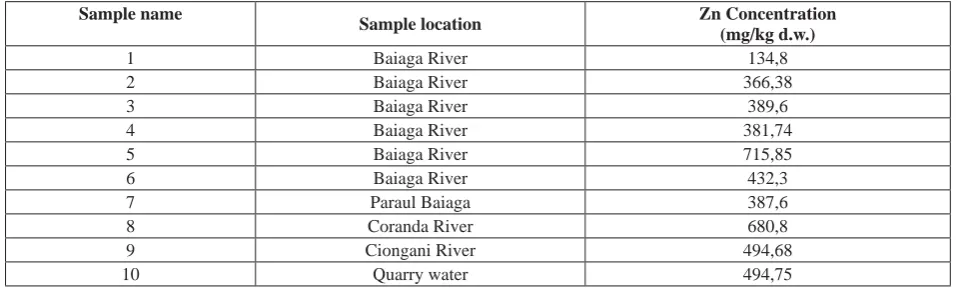
In order to evaluate zinc charge, total concentrations were determinated and it was observed that in all the sediments except the fi rst one, which is situated upstream the objectives that generates pollution as a consequence of the activity deruled in the area, zinc concentrations overpassed the limit value (150 mg kg-1d.w.) established by Romania’s
legislation for zinc in sediments [4].
Table 1
Total concentrations of zinc (mg/kg d.w.) in river sediments determined within FAAS
Sample name
Sample location Zn Concentration
(mg/kg d.w.)
1 Baiaga River 134,8
2 Baiaga River 366,38
3 Baiaga River 389,6
4 Baiaga River 381,74
5 Baiaga River 715,85
6 Baiaga River 432,3
7 Paraul Baiaga 387,6
8 Coranda River 680,8
9 Ciongani River 494,68
10 Quarry water 494,75
Zinc partitioning in sediments
Because only a part of the total quantity of heavy metals from the sediments can be considered bioaccesible, labile, mobile and potentially toxic for the environment, the total concentrations of metals are not enough for the estimation of heavy metals pollution stat. This is the reason for which it was made the study of zinc partitioning in the sediments by applying BCR extraction procedure[5-7].
This procedure allows zinc concentrations partitioninto the following fractions:
Easy soluble fraction: this fraction contains the metal connected to carbonates or absorbed to the surface and
•
metallic-organic complexes in which the metal in weakly connected. The fraction connected to iron or manganese oxides
•
The fraction connected to organic combinations
•
Zinc concentrations from 1-3 steps were summed and compared to the total concentration. The results referring to zinc partition in the sediments from the mining area are presented in fi gure 3.
The dates from fi gure 3 indicate that in the analyzed samples 20-80% of zinc exists as easy soluble fractions, 5-20% of zinc is connected in organic combinations and 3-20% represents zinc fraction connected to the iron and manganese oxides and hydroxides.
Normalization process
This process allows aluminum use, a major constituent of aluminosilicates or iron use, a clay pointing constituent.
In order to evaluate iron and aluminum as candidates for establishing the normalization factors, were determined the total concentrations of these elements. The correlation between iron concentration and aluminum concentration should be linear if the two elements come from natural environment. Because of the mining activities, for iron content is very high for the analyzed samples (5-10 % d.w.) comparing to the aluminum content (0,1-0,3 % d.w.) which indicates the fact that it does not exist a linear dependence between the concentrations of these metals. Because of these reason it wasn’t allowed iron use as a normalization factor, aluminum being choose in this scope, because it was considered that it comes from the natural environment.
In order to establish the natural and the anthropogenic inputs in zinc sediments, the total concentrations of this element were correlated with aluminum concentration in the same sediment sample.
Fig.4. Relationships of Zn with Al in sediments
In fi gure 4 it can be seen that, in the investigated sediments case does not exist a linear dependence of zinc concentrations to aluminum concentration, which indicates the anthropogenic origin of this element because of the mining activities.
Conclusions
Within both methods it was putted into bold line the fact that zinc content induced in the system and accumulated in sediments from the pollution sources generated by mining activities unrolled in the area.
Sequential method allowed the quantifi cation of accessible fraction and therefore able to generate impact to the aquatic ecosystems, and the aluminium normalization method confi rmed the existence of a zinc content over passing the concentrations of the natural environment.
References
SVETE, P. R., MILAC, PIHLAR, B., Ann. Chim. (Rome),
[1] 90, 2000, p. 323.
ANZECC, Guidelines for Fresh and Marine Water Quality, 2000. [2]
DASKALAKIS, D.K., O’CONNOR, T.P., Environ. Sci. Technol.,
[3] 29,1995, p. 470
QUEVAUVILLER, Ph., RAURET, G.J., LO´PEZ-SANCHEZ, F., RUBIO, R.A., URE, MUNTAU, H., Sci. Total [5]
Environ., 205,1997, p. 223.
RAURET, G.J., LO´PEZ-SANCHEZ, F.A., SAHIQUILLO, RUBIO, R.C., DAVIDSON, URE, A., [6]
QUEVAUVILLER, Ph., J. Environ. Monit., 1,1999, p. 57.
RAURET, G.J., LO´PEZ-SANCHEZ, F.A., SAHIQUILLO, BARAHONA, E.M., LACHICA, URE, A.M., [7]