Secure Web Development Based on Vulnerabilities
Ms. Daljit Kaur, Dr. Parminder Kaur
Abstract—This paper is an effort to develop secure web applications based on known vulnerabilities. It has been seen that in the rapid race of developing web applications in minimum time and budget, security is given least importance as consequence of which web applications are developed and hosted with number of vulnerabilities in them. And in this race, one thing is constant that attackers take advantage of weaknesses existing in technology for financial gain and theft of intellectual property. In this proposed method of secure web development, most common vulnerabilities and their occurrence in development process is discussed. Mapping vulnerabilities to the actions needed to take during development process may help developers to understand vulnerability and avoid vulnerabilities in application.
Key Words—Secure web application, web security,web vulnerabilities.
I. I
NTRODUCTIONSince the development of internet, web applications have become very popular, and, nowadays, they are used in every environment, such as medical, financial, military systems. But in the race to develop these online services, web applications have been developed and deployed with minimal attention given to security risks, resulting in surprising number of corporate sites that are vulnerable to hackers [1]. With the rise in web applications for security critical environment, number of attacks against these applications has grown as well. Organizations face more security risks imposed upon them by hackers on achieving fame, glory, profit or information. Malicious hackers are finding out constructively new ways to exploit web applications. According to study conducted by Imperva’s Application Defense Center (ADC), web sites experience an average of 27 attacks per hour or about every two minutes [2]. When sites come under automated attack, the target can experience up to 25,000 attacks per hour or 7 per second [2]. The number of daily web based attacks observed was 93% higher in 2010 than in 2009, according to report by Symantec on attack Kits and malicious websites [3].
Web based attacks are rising consistently and there are number of reasons that make applications so vulnerable. The rise in attack volume in web applications is due to ready availability of attack toolkits, many of which exploit known vulnerabilities [4]. Hacking tools and guides are available on-line, almost anyone can launch attack using these resources. Web applications have become interesting target for many for achieving fame, profit or information.
Hackers continue to focus on web applications because they are easy points of entry and there is valuable of data exchanged in business processes run by applications. Developers are mandated to deliver functionality on time and on budget but not to develop secure applications. Developers are not generally educated in secure code practices. According to CERT/CC, more than 90% of vulnerabilities leak out during development. They are result of ignoring known vulnerabilities found in other systems [5]. Keeping this fact in mind, this paper is an attempt that will help to develop partially secure web applications avoiding vulnerabilities.
The paper is organized in five sections. Section II describes the most common vulnerabilities in web applications. Section III explains the actions proposed to avoid vulnerabilities. Section IV is mapping vulnerability to action and Section V concludes the paper.
II. C
OMMON VULNERABILITIESVulnerability is a hole or weakness in application, which can be design flaw or implementation bug that allows an attacker to cause harm to stakeholders of an application [6]. Almost 80% of web application attacks are from known vulnerabilities [7]. This is shown in figure 2. This section introduces 20 common vulnerabilities and also includes the general description, creation phase of development life cycle. For reference, these vulnerabilities are assigned a code.
WV 1- SQL Injection: SQL injection is a very old approach but it's still popular among attackers. This technique allows an attacker to retrieve crucial information from a Web server's database. Constructing a dynamic SQL statement (constructing SQL queries by string concatenation) with user input may allow an attacker to modify original statement to illegal SQL statement. The cause of this vulnerability is weak input validation and can be avoided by allowing only alphanumeric characters, especially avoid double quote (”), single quote (‘), semicolon (;), colon (:) and dash(-) . Most SQL injection vulnerabilities can be easily fixed by avoiding use of dynamically constructed SQL queries and using parameterized queries or stored procedures instead[8, 9].
and /or script code that is executed by user’s web browser when accessing the vulnerable website. The injected code takes the benefit of trust given by user to vulnerable site These attacks are targeted to all users of web application instead of web application itself [8]. Every technology or language like ASP, PHP, CGI, Perl, Asp.NET, JSP, VB.NET and C# may face this vulnerability [10]. The results of these XSS attacks range from revealing authentication credentials to feeding sensitive information to a remote user or host, propagating the attack to other members or administrators of the site, and creating Man-in-the-Middle attacks such as Phishing attacks. Data validation, data cleansing, disabling scripting languages, limiting cookie access and not saving sensitive data in the cookies reduce the risk of XSS[11].
WV 3- Invoking untrusted mobile code/Malicious file Execution: Malicious File execution flaw could allow attackers the opportunity to include hostile code and data, resulting in devastating attacks, such as total compromise of the server. Uploading and executing code from external sources causes this vulnerability. Malicious file attack can an affect PHP, XML and any framework that accepts filenames or files from users[12]. In case of using such files, demand adequate certificates to ensure safety [11].
WV 4- Weak Cryptography and insecure cryptography storage: Poorly protected data may be used by attackers to steal identity, credit card information or to conduct other crimes. Web applications must properly protect sensitive data such as credit cards, Social Security numbers(SSN) and authentication credential with suitable encryption or hashing . Countermeasure to this flaw is to make proper use of cryptographic functions to protect data and credentials[12]. At coding level, avoid hard coding of data.
WV 5- Information Leakage: Applications can unintentionally leak information about their configuration, internal workings, or violate privacy through a variety of application problems [12]. Attackers can use this weakness to steal sensitive data, or conduct more serious attacks. Error messages should be checked for unnecessary or extra information. Data must be encrypted is another consideration [14].
WV 6- Broken Authentication and Session Management: Broken access and session is due to authentication and authorization flaws. Applications built using custom authentication and session management schemes may have flaws in the areas such as logout, password management, timeouts, remember me, secret question, account update. Such flaws may allow accounts to be attacked and compromise passwords, keys, session
tokens, or exploit implementation flaws to assume users’
identities[12,15]. This flaw is caused when account credentials and session tokens are not protected properly.
WV 7- Cross site Scripting Forgery(CSRF): A CSRF
attack creates forged HTTP requests and tricks a victim into submitting them via image tags, XSS, or other techniques. If the user is authenticated, the attacker succeeds [12]. As browsers send credentials like session cookies automatically, attackers can create malicious web pages which generate forged requests that are indistinguishable from the legitimate ones. Forcing users to log off and checking referrer headers can help but for complete solution include authentication tokens in the body of every request[16].
WV 8- Format string: This vulnerability occurs when the user is able to control format string used in printf style functions. This attack alters the flow of application by using string formatting library features to access other memory space [17]. Attackers can set buffer overflow attack taking control over format string. To avoid this, user input should not be passed to formatting functions directly[10]. Formatting functions should accept only static string as input.
WV 9-Security mis-configuration: A secure web application requires a strong server configuration. A poorly configured server can potentially create multiple security vulnerabilities. A default server may have many features turned on for convenience and may have software packages that are pre-installed and should be removed. Operating a server with a default software setup and configuration may cause multiple security vulnerabilities that may be exploited by hackers. Server configuration is not typically the responsibility of the programmers, and should be addressed by server and network administrators. The host server should be assessed for security issues, which will usually reveal what packages are installed and their versions, missing patches and updates or upgrades, and provide a hit list for which packages should be removed, disabled or correctly configured[10].
WV 10- Failure to restrict URL access: Failure to restrict URL access may enable attackers to forge URLs to access hidden pages or admin pages [12]. Countermeasure to this vulnerability is to check URL access rights or perform access control checks when these pages are requested. In case of violation of URL access, an error page should be return to user.
WV 11- Invalidated Redirects and Forwards:
WV 12- Insufficient Transport Layer Protection:
Protecting network traffic for sensitive communication is necessary as it can be stolen by attackers. Mostly applications don’t encrypt sensitive traffic and even if they do, they use weak algorithms, expired or invalid certificates, or do not use them correctly[12].
WV 13- Brute Force: Brute force attack automates a process of trial and error to guess a person’s user name, password, credit-card number or cryptographic key[17]. In this method unknown value is determined by using automated process to try large number of possible values. To avoid this always select a password with minimum of 8 character alphanumeric and do not use common words and terms as passwords .
WV 14- Content spoofing: Content spoofing is a client side attack by illegal execution of foreign code[17,18]. In this technique attacker can inject malicious payload that is later misrepresented as legitimate content of web application.
WV 15- Buffer Overflow: Buffer Overflow attack is performed by submitting more information than a variable is expecting to receive, causing the“overflow” of data to write over a section of memory where another process may subsequently access and execute it. If the section of overwritten code contains the correct executable content for the process that happens to access it, the results could range from a defunct server or process to a compromised server with associated exploitations. Some web applications components in some languages do not correctly validate user-submitted input and may crash or freeze a server. Languages like Java, C# are good options as they are less vulnerable to buffer overflow attacks. [10]. While coding, input variables should be given appropriate size to reduce this vulnerability.
WV 16- Injection Flaws (LDAP, SSI, XPath):
Injection flaw basically allows to insert specially formulated data, code, , script in order to affect normal execution[13]. Mostly injection flaw attacks occur when user sends some illegal input . LDAP(Light weight directory access Protocol) injection attack exploit web sites by constructing LDAP statements from user supplied inputs. XPath injection constructs queries from user supplied input. SSI (server Side Include) sends code to web server which is then executed locally [17]. To avoid injection flaws user inputs should be validated properly.
WV 17- Denial of Service (DoS): A denial-of-service attack or distributed denial-of-service attack (DDoS attack) is an attempt to make a resource unavailable to its intended users. DoS attackers typically target sites or services hosted on high-profile web servers such as banks, credit card payment gateways etc. One common method of
attack involves saturating the target (victim) machine with external communications requests, such that it cannot respond to legitimate traffic, or responds so slowly as to be rendered effectively unavailable. Preventing DoS and DDoS attacks requires the integration of multiple prevention techniques such as firewalls, routers, switches. Low-volume web environments may make more use of programming-level prevention, but DoS/DDoS prevention is more of a server and network level approach.
WV 18- Directory Indexing and Path Traversal:
Directory indexing is an automatic listing of web server function that shows all files in requested directory if normal base file is not present [17]. Path Traversal allows to track paths used in system files[10]. Best solution is to adequate input validation.
WV19- Improper Error Handling: Many vulnerabilities occur when errors are not handled properly.
A server that is configured to operate in Debug mode may offer considerable information about the error, which may reveal server and application pathways, file names, code segments, server types and versions, and other information. All of these contribute to resources the attacker will use to exploit the web application and server. Once a poorly handled error is discovered, an attacker may iterate man types of errors to collect a wide range of information about the server. Some errors, especially crafted errors by an attacker, may result in denial of service or cause the server to fail in some form. Some security features of the web application may become voided by some error situations, creating yet more vulnerabilities. To counter this, errors should be handled in such a way that system preserves its secure state.[10]. All the expected and unexpected errors should be handled in a proper way and error message generated by application should be issued only as needed void of any extra information[19] .
WV20- Insecure Direct Object References: A direct
Object reference occurs when a reference to an internal implementation object, such as file, directory, or database key is exposed. Applications do not always verify the user is authorized for the target object, resulting in an insecure direct object reference flaw[12]. These flaws can compromise all the data that is referenced by the parameter.
III. A
CTIONS TO AVOID VULNERABILITIESneeded to take during design, coding, testing, configuring and hosting of the web application to avoid most common vulnerabilities. For further references, code is assigned to each action.
Act-1: Only accept input values specified in white list and if user supplies any other input, reject it.
Act-2: When it is not possible to predict exactly type or
form of input use sanitization strategy i.e. use escaping or encoding characters so that it will not affect back end system.
Act-3: Along with validating external boundaries, each
component of application must validate data coming from and going to other components.
Act-4: Make sure that if an attacker manages to cause an
exception, there is no way for execution flow to reach at end of function. Exceptions should be handled properly.
Act-5: Implementing resource locking for shared resources and complete transactions. Understand the thread safety mechanisms provided by development framework and database.
Act-6: A structured approach must be followed for error handling. Sensitive information or technical details like background operation causing exception, stack traces, file system paths should not be disclosed in error messages. Standard HTTP error codes should be handled by application and never returned to users.
Act-7: Sensitive data should be transmitted to remote
storage in an encrypted and authenticated fashion.
Act-8: Choose a proper development framework, programming language with respect to requirements and expected functionality as this decision can mitigate many possible vulnerabilities.
Act-9: Applying least privileges and separating duties.
Act-10 : storing sensitive data using appropriate access control and encryption technique.
Act-11: Secure data transmission by using secure data transfer protocols especially for sensitive data.
Act-12: validating remote codes including data type and
size of uploaded file or attachment.
Act-13: Filter unnecessary requests or decrease requests in
order to avoid DoS or low performance.
Act-14: Inactivity of users for a specific period should
fore the system to log out and login in again.
Act-15: Use library functions instead of using external /
system calls. Avoid invoking operating system calls directly.
Act-16: Simple Coding according to coding standards and
well-defined programming structure.
Act-17: Using validated SSL(secure socket Layer) certificates.
Act-18: In order to ensure that design is implemented in a
correct and secure way, code should be reviewed for
issues like memory allocation and free up , variable initialization. Tools are also available for automated code review.
Act-19: Do not save password directly, encrypt them
using appropriate cryptographic function. For additional level of protection add randomly generated data to user inputted password.
Act-20: Re-authenticate users before any critical transaction is authorized to ensure that if a user session is compromised an attacker would not be able to perform sensitive transaction on behalf of user unless he/she is also in possession of user’s credentials.
Act-21: Locking the account after predefined number of
unsuccessful login attempts and also increasing the response time after each failed login attempt.
Act-22: Minimize the number of authentication interfaces. Act-23: The application should be able to detect if a
single source IP is responsible for multiple authentication failures.
Act-24: Reissue a new token after successful authentication and protect it throughout session’s lifespan.
Act-25: Session tokens need to be unpredictable and sufficiently random. They should be independent on ser credentials. They must expire after a reasonable period.
Act-26: Manage session to user mapping safely on server
side.
Transmit session tokens over secure channel only. Use cookies to store them not query string parameters.
Act-27: Set “Secure” and “HttpOnly ” flags to secure cookies and do not store sensitive information in cookies.
Act-28: Deny access by default unless it is explicitly
granted.
Act-29: Use parameterized queries and avoid string concatenation.
Act-30: Disable the functionality not required by application such as operating system calls, HTTP interfaces, built in compilers, etc.
Act-31: Storing content outside the web root and using
and indexed list of accessible resources instead.
Act-32: Isolate the resource required by the application
from other resources in the underlying server.
Act-33: Store any uploaded content in a directory outside
of web server’s document root or best practice is to store it in database so that it can not get executed by web server.
Act-34: Perform security focused code review. Ensure
that dynamic execution functions such as eval(), include() or those inside templates do not take user-supplied data as inputs without strict validation.
Act-35: Do not use persistent cookies to store sensitive information.
Act-36: Instead o fusing query string, favor requests that
Act-37: Before performing requested operation make sure
that requests are legitimate.
Act-38: Token regeneration should be performed prior to
any significant transaction, after a certain number of requests, as a function of time.
Act-39: Do not rely on client-side security measures.
Security must be enforced by the server.
Act-40: Disable standard HTTP methods that are not used
by application.
Act-41: The Web server should run with minimum
privileges required and must apply security patches.
Act-42: Output validation with respect to type and amount
of outputted information based on security policies.
Act-43: Using stored procedures instead of dynamic SQL. Act-44: Validating function’s return value and calling error/exception handlers if required.
Act-45: Avoid hard coding of data.
Act-46: Re-implementing unsafe functions using standard
library functions.
Act-47: Generating awareness among users and guiding them to differentiate between original and phishing sites.
Act-48: Addressing with arrays instead of direct pointers
manipulation.
Act-49: static creation of external commands in a program
and passing static string which can not be controlled by user, to format string function and checking the number of arguments sent to that function.
Act-50: choose a proper and hard to guess location for temporary files and applying access control mechanisms on them (encrypt if required). Try to create lent side temporary files.
IV. M
APPINGA
CTIONS TOC
LOSEH
OLESThis section shows the actions required to avoid a particular vulnerability in tabular form. This mapping is done in such a way so that it becomes easier for developers to implement it and understand the vulnerability. By incorporating various security actions early in development life cycle, developers can understand the threats faced by application and security risks to which they expose organizations through application.
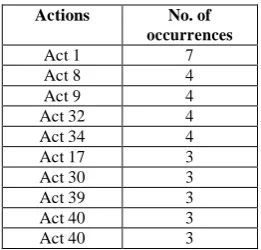
From the table1, it is clear that a vulnerability can be closed by taking number of actions and a single activity can be essential in closing many vulnerabilities. Depending on the action repeated in top 20 web vulnerabilities, table 2 shows the no. of occurrences and most important few actions that are essential to make web application more secure.
Vulnerability Actions Required
WV1 Act1, Act2, Act9, Act29, Act34, Act42, Act43, Act39
WV2 Act1, Act2, Act9, Act34, Act35, Act42 WV3 Act8, Act12, Act17, Act33
WV4 Act10, Act11, Act19, Act45
WV5 Act6, Act11, Act27,Act40, Act41, Act44 WV6 Act7, Act10, Act20, Act24, Act25,
Act26,Act27, Act36 WV7 Act24, Act38
WV8 Act1, Act8, Act9, Act34, Act46, Act49 WV9 Act9, Act28, Act30, Act32, Act39,Act40, Act
41
WV10 Act20, Act37 WV11 Act3, Act17, Act47 WV12 Act7, Act17 WV13 Act21, Act22, Act23
WV14 Act1, Act3, Act12, Act30, Act31, Act32, Act33 WV15 Act1, Act8, Act18, Act48
WV16 Act1, Act5, Act16, Act29, Act34, Act36, Act39, Act49, Act50
WV17 Act5, Act13, Act14, Act15, Act28, Act30, Act32, Act40
WV18 Act1, Act31, Act32, Act44 WV19 Act4, Act6, Act8 WV20 Act16, Act48
Table 1 : Mapping actions to vulnerability
Below are the actions that are commonly overlooked by developers and have given advantage to attackers. And most important thing is training and awareness among developers to implement these actions in development process.
Actions No. of
occurrences
Act 1 7
Act 8 4
Act 9 4
Act 32 4
Act 34 4
Act 17 3
Act 30 3
Act 39 3
Act 40 3
Act 40 3
V. C
ONCLUSION ANDF
UTUREW
ORKImplementation of security in early phases of development life cycle can save time and cost of removing flaws after the software has been developed. Relying on this idea of secure web development, this paper describes most common known vulnerabilities and proposed model for software development.
The activities described in this paper do not grantee absolute secure web applications but can help web applications to fortify against number of attacks. It is very important that web developers keep themselves up to date with new risks which their applications could face and also understand their nature to ensure that the mitigations implemented are effective.
In the future, we can expect more security solutions and more awareness of their implementation.
R
EFERENCES[1] “Why Web application Security is Important”, available at:https://www.wathfire.om/securearea/
[2] Tal Be’ery, Nitzman Amichai Shulman, Robert Rachwald,“Imperva’sWeb application attack Report -2011”available at :http://www.imperva.com
[3] “Threat activity Trends- Web based attack report
2009-10” available at :
http://www.symantec.com/business/threat-report/ [4] Available at :http://www/informationweek.com [5] Nany R Mead, garymcgraw, “a portal for software
security”, published by IEEE computer society, IEEE security & privacy,2005
[6] “What is Vulnerability”available at:
http://www.owasp.org/index.php/category:vulnerability/ [7] Raviv Raz,“Web application security, Cyber Fraud &
Hactivism” available at:
http://chaptersinwebsecurity.blogspot.com/
[8] “Webapps vulnerability report”, from Core Impact professional, Jan2009.
[9] “Web application security: a survey of prevention techniques against SQL Injection”, thesis Stokholm University/Royal Institute of Technology, June 2003. [10] H.M. Shirazi, “A New Model for Secure software
Development”, International Jornal of Intelligent Information tehnology application, 2009.
[11] Michal Howard, David Leblanc, John Vega,“19 Deadly sins of software security, programming flaws and how to fix them”
[12] OWASP top ten project theme page available at: http://www.owasp.org/index.php/OWASP_Top_Ten_Pro ject
[13] “Web app security- managing web app security risks”, CUSIF(web app security working group)-March 2010.
[14] Jay-Evan. J. Tevis, john A. Hamilton, “Methods for prevention, Detection and Removal of Software Security Vulnerabilities”, ACM Southeast Conference’04, Huntsville, AL, USA, April 2-3,2004.
[15] Erez Metula,“Web application attacks”, from 2BSecure. [16] Joe- Walker, “web application security--keeping your
application safe”
[17] “Web App security—how to Minimize Prevalent risk of attacks”available atwww.qualys.com
[18] “White Hat website security statistic Report”, 10thedition
Fall 2010 available atwww.whitehatsec.com