CC S.. =
BY NC ND
http://doi.org/10.5114/bta.2019.90240
Optimal conditions for levan biopolymer production
and its use in the synthesis
of bactericidal levan-ZnO nanocomposite
MOJTABA TARAN1, MAHSA LOTFI2, MOHSEN SAFAEI3*
1Department of Nanobiotechnology, Faculty of Science, Razi University, Kermanshah, Iran
2Laboratory of Microbiology, Department of Biology, Faculty of Science, Razi University, Kermanshah, Iran
3Advanced Dental Sciences Research Laboratory, School of Dentistry, Kermanshah University of Medical Sciences, Kermanshah, Iran
Abstract
With the ever-increasing resistance of pathogens to various antibiotics, it has become critically important to find novel biocompatible antibacterial agents. This research focuses on the optimization of the biological synthesis of levan biopolymer using the Taguchi method in order to produce levan-ZnO nanocomposite. Attempts have been made to synthesize this nanocomposite to improve the antibacterial activity of ZnO nanoparticles. Optimization of growth conditions led to the improved levan-producing capabilities of the Zymomonas mobilis PTCC 1718 strain (57 g/l). Molten salt and in situ methods were applied for the synthesis of ZnO nanoparticles and levan-ZnO nanocomposite, respectively. Ultraviolet-visible (UV-vis) spectroscopy, Fourier transform infrared (FTIR) spectro-scopy, and scanning electron microscopy (SEM) confirmed the formation of levan biopolymer, ZnO nanoparticles, and levan-ZnO nanocomposite. Antibacterial analysis showed that the formation of nanocomposite improved the antibacterial activity of ZnO nanoparticles. The present study has demonstrated that levan-ZnO nanocomposite characterized by the capability to destroy Gram-positive and Gram-negative microorganisms might be utilized as an antibacterial agent in the medical, pharmaceutical, dentistry, and food industries.
Key words: nanocomposite, levan biopolymer, zinc oxide, antibacterial, Zymomonas mobilis, Taguchi method
Introduction
One of the main challenges facing the global commu-nity today is discovering effective therapies for cancer (Mozaffari et al., 2016; Mozaffari et al., 2017), chronic pains (Sharifi et al., 2017), chronic kidney disease (No-mani et al., 2016), autoimmune diseases (Mozaffari et al., 2018), and microbial infections (Taran et al., 2018; Imani and Safaei, 2019). Microbial infections are his-torically considered as major pathogenic factors causing mortality around the world (Li and Webster, 2018). Nowadays, due to the increased bacterial resistance to antibiotics, it has become necessary to find innovative ways of eliminating bacteria. Applying nanoparticle ba-sed materials on the grounds of their features and
bene-fits as antimicrobial compounds has received increasing attention (Beyth et al., 2015; Safaei and Taran, 2017).
Levan is an exopolysaccharide with a molecular weight of 107 Da; it is made up of about 60000 units of fructose. The main chain is formed by β-links (2,6); the branches are generated by β-1,2 bindings (Alegre et al., 2005; Arvidson et al., 2006). Levan biopolymers are ob-tained in different ways, of which one is its production by a wide range of bacteria during the enzymatic trans-fructosylation reaction. Zymomonas mobilis is an impor-tant bacterium in the microbial production of levan bio-polymer. It is a Gram-negative rod-shaped bacterium with a length of 2-6 μm and a width of 1-1.4 μm; it is non-sporulating.
Appropriate viscosity and stability in the face of pH adjustments, water and oil solubility, solubility in organic solvents, heat resistance (melting point temperature of 225EC), high water holding capacity and capacity to hold chemical materials, as well as favorable biological chara-cteristics, has made levan a unique polymer that is indis-pensable in many fields. Levan as an emulsifier, stabi-lizer, an encapsulating agent, and a concentration factor is used in several sectors of medical, pharmaceutical, and food industries (Bekers et al., 2005; Srikanth et al., 2015). It serves as an anti-inflammatory and immuno-modulatory agent, blood plasma substitute, antitumor, antioxidant, and anti-AIDS compound in medication (Ab-del-Fattah et al., 2012; Silbir et al., 2014). Levan biopoly-mer is also applied for drug delivery, improving the flavor of tablets and solubility of capsules, and genera-ting a more rapid medicinal response (Srikanth et al., 2015). The exopolysaccharide is critically important in the industry because of its sweetening and antibacterial characteristics. Byun et al (2014) reported the antibac-terial characteristics of levan compounds with low mole-cular weight. The widespread use of levan in different in-dustries has transformed it into a multipurpose polymer (Srikanth et al., 2015).
ZnO nanoparticles differ from each other in terms of size, shape, and crystal structure. These features depend on substrate type and its concentration, the kind of or-ganic solvents used, applied temperature, and reaction time during synthesis (Altunbek et al., 2014). Zinc oxide is important due to its interesting characteristics such as chemical stability, high UV absorption, photostability, biocompatibility, and diversity of particles structures (Kolodziejczak-Radzimska and Jesionowski, 2014). It is used in different industries such as medical, pharmaceu-tical, cosmetics, textiles, and electronics (Mishra and Adelung, 2018). In recent years, inorganic compounds including metal oxides have received increased attention because of their high stability in harsh conditions and the fact that they are not harmful to humans, animals, and the environment (Stoimenov et al., 2002). Metal oxide nanoparticles (NPs) including ZnO have selective toxicity to bacteria while minimally affecting human cells. The reduced size of ZnO NPs increases their anti-bacterial characteristics (Seil and Webster, 2011).
Nanocomposite is a material consisting of two or more distinct phases where at least one of them is in nanoscale (between 1 to 100 nm). Nowadays, nanocomposites are
the subject of intense research owing to their unique me-chanical, chemical, and physical properties (Camargo et al., 2009). Synthesizing polymeric nanocomposites using NPs can improve the optical and mechanical pro-perties of the components of the nanocomposites; this improvement is because of the strong internal inter-action between the organic polymer and the inorganic nanoparticles which have a large surface area and quan-tum effect (Sato et al., 2008; Safaei et al., 2019).
To our knowledge, no levan-ZnO nanocomposite has been synthesized to date; thus, its antibacterial effects have not yet been evaluated. The goal of this study was to optimize levan biopolymer production at lower costs, synthesize ZnO NPs, and manufacture levan-ZnO nano-composite, as well as investigate its antibacterial effect on
Escherichia coli and Staphylococcus aureus pathogens.
Material and methods
Levan polymer production
The bacterial Zymomonas mobilis PTCC 1718 was provided by the Iranian Research Organization for Sci-ence and Technology (IROST) and incubated at 30EC for 48 h. The grown colonies were transferred to the ino-culating culture media containing sucrose (50 g/l), yeast extract (7 g/l), K2HPO4 (2.5 g/l), (NH4)2SO4 (1.6 g/l), MgSO4@7H2O (1 g/l), and incubated for 24 h at 28EC without air and stirring. The Taguchi method and Quali-tek-4 software were used to predict the best conditions for the production of levan. In this study, the effects of three factors (i.e., sucrose, yeast extract, and potassium phosphate) were investigated at three levels of levan synthesis (Table 1). The medium used for producing levan contained sucrose (150, 200, or 300 g/l), yeast ex-tract (1, 1.5, or 2 g/l), K2HPO4 (0.5, 1, or 1.5 g/l),
(NH4)2SO4 (1 g/l), and MgSO4 7H2O (0.5 g/l). Following 20 min sterilization at 121EC, the medium was inoculated with bacterial culture (2–5%) and kept in an incubator without shaking at 28EC for 48 h. Then, the samples were centrifuged for 10 min at 5000 g. The supernatant was concentrated at 85–90EC in a water bath in order to re-duce the centrifuged volume to 1/3 (Silbir et al., 2014).
Levan polymer extraction
Table 1. The Taguchi design of experiments and levan biopolymer production by Zymomonas mobilis
Experiment
Yeast extract
[g/l] KH[g/l]2PO4 Sucrose[g/l] Levan
[g/l]
1 1.5 2 0.5 1 1.5 150 200 300
1 1 0.5 150 21.66
2 1 1 200 19.00
3 1 1.5 300 57.00
4 1.5 0.5 200 34.33
5 1.5 1 300 26.33
6 1.5 1.5 150 8.16
7 2 0.5 300 41.33
8 2 1 150 11.60
9 2 1.5 200 15.83
of refrigeration. To determine the quantity of levan ex-tracted, the sediments were put in an oven at 80EC to be dried and then weighed (De Oliveira et al., 2007; Dos Santos et al., 2013).
Synthesis of ZnO nanoparticles
ZnO NPs were synthesized using the molten salt me-thod
. For this purpose,
zinc chloride salt (83 g), sodium hydroxide (19.01 g) and potassium hydroxide (19.01 g) were combined, and placed in an oven at 220EC for 45 min; the resulting mix was then cooled down to room temperature. Subsequently, the mix was rinsed in hot distilled water and centrifuged to remove alkali metal salts. The centrifuged sediment was placed in an oven at 100EC for 2 h to remove moisture. Finally, a white color powder containing ZnO NPs was obtained (Sikalidas, 2011).Levan-ZnO nanocomposite synthesis
ZnO NPs were homogenized in deionized water by a sonicator. Then, they were added to the biopolymer matrix in deionized water and placed on a stirrer for 1 h. In the next phase, the samples were transferred to a sonicator bath for 30 min. After oven-drying at 40EC for 48 h, the nanocomposite powder containing levan polymer and ZnO NPs was obtained (Perez-Altamar and Perales-Perez, 2014).
Characterization
The UV-vis spectra were prepared for the synthesized levan biopolymer, ZnO NPs, and levan-ZnO
nanocompo-site in the range 200 to 800 nm by Agilent spectrophoto-meter. The FTIR spectra of the synthesized levan bio-polymer, ZnO NPs, and levan-ZnO nanocomposite were prepared by an alpha spectrometer (Bruker, Germany). SEM images of the levan-ZnO nanocomposite were obtained by a TESCAN scanning electron microscope (Czech Republic).
Antibacterial activity
The antibacterial activity of the levan biopolymer, ZnO NPs, and levan-ZnO nanocomposite on Staphylo-coccus aureus from the Gram-positive bacteria and
Escherichia coli from the Gram-negatives were exami-ned by the disc diffusion method. For this purpose, a su-spension of bacteria with an approximate concentration of 108 CFU (colony forming units)/ml was prepared and
cultured on a nutrient agar medium. Then, four discs containing the levan biopolymer, ZnO NPs, levan-ZnO nanocomposite, and Gentamycin (positive control) were placed on the plates and incubated for 24 h. All the tests were carried out with three experiment repetitions and three replicates of each experiment.
Results
Levan production
experi-Table 2. The main effects of different levels of yeast extract, KH2PO4 and sucrose on levan biopolymer production
by Zymomonas mobilis
Factors Level 1[value] Level 2[value] Level 3[value]
Yeast extract 32.53 22.94 22.92
KH2PO4 32.44 18.98 26.99
Sucrose 13.81 23.05 41.55
Table 3. Estimation of the effects of interacting factor pairs on levan biopolymer production by Zymomonas mobilis
Interacting factor pairs Desirablelevels Severity index[%]
Yeast extract × sucrose (3.1) 29.51
Yeast extract × KH2PO4 (3.1) 5.46
KH2PO4 × sucrose (3.3) 5.39
ment 3, was 57 g/l. In this experiment, the most appro-priate concentrations of the yeast extract, potassium phosphate, and carbon source to produce levan were 1 g/l, 0.5 g/l, and 300 g/l, respectively. The effects of different levels of the yeast extract (1, 1.5, and 2 g/l), KH2PO4 (0.5, 1, and 1.5 g/l), and sucrose (150, 200,
300 g/l) on levan production are presented in Table 2. Level 1 for yeast extract (32.53) and potassium phos-phate (32.44), and level 3 for sucrose (41.55) had the best effect on levan production by Zymomonas mobilis. Estimating the effects of interacting factor pairs on levan biopolymer production by Zymomonas mobilis revealed that the interactions between the yeast extract and su-crose were the most relevant pair influencing the amount of levan produced (29.51%). On the other hand, potassium phosphate and sucrose had the lowest level of interaction (5.39%), which is very close to the inter-action between the yeast extract and potassium phos-phate (5.46%) (Table 3). Table 4 shows the analysis of va-riance (ANOVA) of parameters influencing levan produc-tion by Zymomonas mobilis. Yeast extract as a source of nitrogen and potassium phosphate had no significant ef-fect on the amount of levan produced; sucrose as a carbon source was the main factor affecting the amount of levan (533.450). After evaluating the effect of the studied fac-tors and their interactions, the best conditions for pro-ducing levan biopolymer were determined using the
Ta-guchi method (Table 5). The results showed that carbon source, yeast extract, and potassium phosphate, with a contribution of 15.41, 6.42, and 6.30%, respectively, resulted in the highest production of microbial levan bio-polymer. Based on the prediction by the Taguchi me-thod, level 3 for sucrose (300 g/l) and level 1 for yeast extract (1 g/l) and potassium phosphate (0.5 g/l) were presented as the most suitable levels for producing levan biopolymer.
Characteristics of levan-ZnO nanocomposite and its components
UV-vis spectrophotometry was used to study the opti-cal properties of the synthesized levan biopolymer, ZnO NPs, and levan-ZnO nanocomposite. Absorption mea-surements were done in the range 250 to 600 nm. The observed changes in the peaks indicated that ZnO NPs were coated with levan biopolymers (Fig. 1).
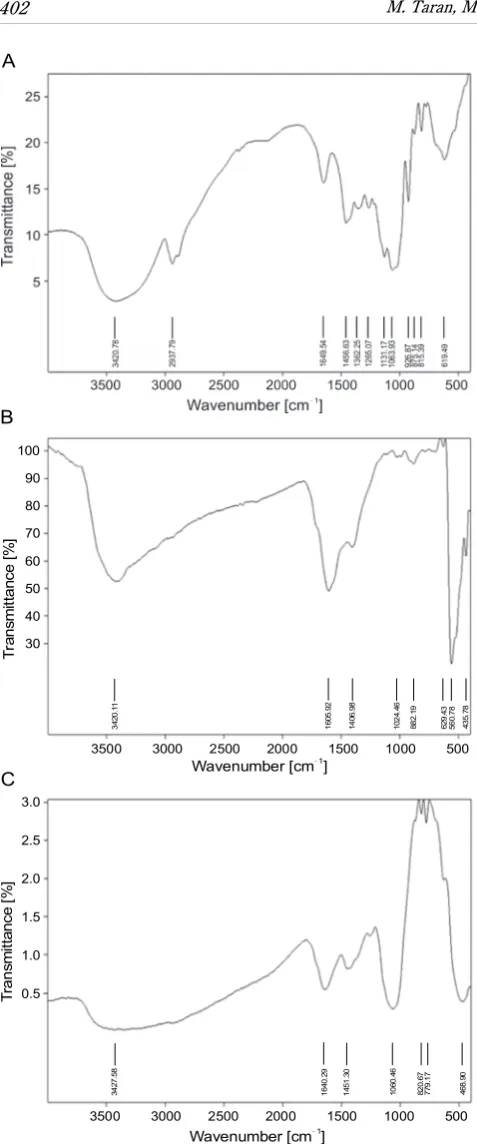
In order to ensure that the production of levan bio-polymer, the synthesis of ZnO NPs, and the formation of levan-ZnO nanocomposite occurred, FTIR spectrums were recorded for each sample (Fig. 2). In the range 900 to 1200 cm!1, the observed peaks were due to C!C,
C!O, C!O!H, and C!O!C bonds. The peak at 1063 cm!1 confirmed the production of levan.
Further-more, the peak at 435 cm!1 confirmed the presence of
ZnO NPs. Considering the observed changes in the peaks of levan-ZnO nanocomposite compared to its com-ponents, the synthesis of nanocomposite was confirmed. The SEM images of ZnO nanoparticles and levan-ZnO nanocomposite are presented in Figure 3. The SEM image of the nanocomposite shows that the ZnO nano-particles were coated on the levan biopolymer and were desirably dispersed within the matrix.
Antibacterial analysis of the levan-ZnO nanocomposite and its components
4.00
3.00
2.00
1.00
0.00
Ab
so
rb
an
ce
[a
.u
.]
Wavelength [nm]
250 300 350 400 450 500 550 600
ZnONps
Levan biopolymer
Levan-ZnO
Table 4. Analysis of variance of the Taguchi experiment results
for levan biopolymer production by Zymomonas mobilis
Factors DOF Sum of squares Variance Pure sum Percent [%]
Yeast extract 2 185.22 92.61 0.00 0.00
KH2PO4 2 275.21 137.61 0.00 0.00
Sucrose 2 1197.63 598.81 893.46 45.53
Table 5. Predicted optimum conditions for levan biopolymer production by Zymomonas mobilis
Factors Level Contribution[%]
Yeast extract 1 6.42
KH2PO4 1 6.30
Sucrose 3 15.41
Total contribution from all factors 28.13
Current grand average of performance 26.14
Biopolymer production at optimum conditions 54.27
Fig. 1. UV-Vis spectroscopic analysis of ZnO nanoparticle,
levan biopolymer, and levan-ZnO nanocomposite
observed in the antibacterial activity level of levan-ZnO nanocomposite and the antibiotic Gentamycin antibiotic (17.66 mm for positive and 15.33 mm for Gram-negative bacteria) against these pathogens (P > 0.05). The decrease in the growth of bacteria in the presence of the levan-ZnO nanocomposite in comparison with its components indicates its improved antibacterial ability in preventing the growth of both pathogens.
Discussion
Wavenumber [cm ]!1 T ran smi tt a nc e [ % ] 100 90 80 70 60 50 40 30 3 420 .1 1 1 605 .9 2 14 06 .9 8 102 4. 46 88 2. 19 629 .4 3 56 0. 7 8 43 5. 78
3500 3000 2500 2000 1500 1000 500
3500 3000 2500 2000 1500 1000 500
Wavenumber [cm ]!1
T ra n smi tt an ce [ % ] 3.0 2.5 2.0 1.5 1.0 0.5 34 27. 58 1 640. 29 1 451 .3 0 10 60. 46 82 0. 67 779 .1 7 468. 90 A B C
Fig. 2. A) FTIR analysis of levan biopolymer, B) ZnO nano
particle, and C) levan-ZnO nanocomposite
systems, sucrose and numerous sources of nitrogen were used; yeast extract was found to be the best source of nitrogen. The authors noted that the maximum pro-duction of levan biopolymer in batch and continuous fermentation systems were 40.2 g/l and 31.8 g/l,
res-pectively. De Oliveira et al. (2007) used molasses, su-crose, and cane extract as a source of carbon to produce levan by Zymomonas mobilis ATCC 31821. The maxi-mum production of levan biopolymer (21.685 g/l) was observed in the treatment containing sucrose while mini-mum production was observed in the presence of molas-ses (2.533 g/l) as the source of carbon. Moreover, ear-lier studies demonstrated that bacterial species and the amount of initial substrate play direct roles in producing levan biopolymer. Levan biopolymer production by Bacil-lus subtilis bacterium was reported to be 14.31 g/l by Shih et al. (2005); while Ghaly et al. (2007) reported that the amount of this biopolymer extraction from Ba-cillus licheniformis was 0.36 l/g. In a study conducted by Khanafari et al. (2010), the amount of extracted biopoly-mer from Bacillus polymyxa was 19.5 g/l.
In the present study, microbial levan biopolymer syn-thesis was optimized as a biodegraded polymer and then used for coating ZnO NPs in the synthesis of an anti-bacterial nanocomposite. By applying FTIR analysis and UV-vis spectroscopy, the synthesis of levan biopolymer, ZnO NPs, and levan-ZnO nanocomposite were confirmed (Fig. 1 and Fig. 2). The desirable antibacterial properties of the synthesized levan-ZnO nanocomposite make it suitable for medical, environmental, food industry, and pharmaceutical applications.
A B
Fig. 3. A) SEM analysis of ZnO nanoparticles and B) levan-ZnO
nano-composite; the image of the nanocomposite shows that the nanoparticles are coated on the biopolymer
Table 6. Comparison of antibacterial activity of levan-ZnO nanocomposite
with ZnO nanoparticles and levan polymer
Factors
Gram-positive bacteria
(Staphylococcus aureus) Gram-negative bacteria (Escherichia coli) zone of inhibition
[mm] zone of inhibition [mm]
ZnO 12.66b 10.33b
Levan 0.00c 0.00c
Levan-ZnO 16.00a 14.66a
Gentamycin 17.66a 15.33a
Standard error of the mean 0.39 0.31
synthesized nanocomposites using two polymers of poly-amide 6) PA6 (and low-density polyethylene) LDPE (as a matrix of ZnO NPs and examined their antimicrobial properties against Escherichia coli and Staphylococcus aureus pathogens. The authors found that PA6-zinc oxide nanocomposite had better antibacterial properties compared to pure ZnO particles (Droval et al., 2008). In another study, Hadory and Shim (2013) synthesized a hybrid compound of ZnO and chitosan using a precipi-tation method. The authors examined the antibacterial activity of this nanocomposite against E. coli and obser-ved that it had the ability to eradicate this bacterium (Haldorai and Shim, 2013). Perez-Altamar and Perales-Perez (2014) successfully synthesized chitosan/cellu-lose-ZnO nanocomposite; they examined its antibacterial activity and reported the ability of this nanocomposite to prevent the growth of E. coli pathogen. Dhillon et al. (2014) synthesized ZnO-chitosan nanocomposite using
two methods of spray drying and depositing. The anti-bacterial effects of the synthesized nanocomposite were examined against the pathogens of Micrococcus luteus,
Candida albicans, and Staphylococcus aureus. The maxi-mum antimicrobial effect against M. luteus and S. aureus
was observed at concentrations of 0.156 to 0.625 mg/ml of the nanocomposite (Dhillon et al., 2014).
nanocompo-site with antibacterial properties has a great potential for use in various fields, for example, in medical, food, pharmaceutical, dentistry, and other industries.
Conclusions
Levan was produced in optimum conditions by Zymo-monas mobilis PTCC 1718. In optimum conditions, the amount of extracted biopolymer was 57 g/l; this study showed that there is a direct relation between sucrose concentration and the production of levan biopolymer. The production of levan biopolymer, the synthesis of nanoparticles, and the formation of nanocomposite were all confirmed by UV, FTIR and SEM analysis. The re-sults of an antibacterial test showed the ability of levan-ZnO nanocomposite in reducing the growth of patho-genic microorganisms of Escherichia coli and Staphylo-coccus aureus. Based on the results of this study, it seems profitable to use levan-ZnO nanocomposite as a practical antibacterial substance in various industries.
References
Abdel-Fattah A.M., Gamal-Eldeen A.M., Helmy W.A., Esawy M.A. (2012) Antitumor and antioxidant activities of levan and its derivative from the isolate Bacillus subtilis
NRC1aza. Carbohydr. Polym. 89(2): 314–322.
Alegre R.M., Wendt R., Rigo M. (2005) Levan production by
isolated mutants of Zymomonas mobilis. Rev. Cienc.
Exatas. Nat. 7(1): 103–112.
Altunbek M., Baysal A., Çulha M. (2014) Influence of surface properties of zinc oxide nanoparticles on their cytotoxicity. Colloids. Surf B. 121: 106–113.
Arvidson S.A, Rinehart B.T., Gadala-Maria F. (2006) Concen-tration regimes of solutions of levan polysaccharide from Bacillus sp. Carbohydr. Polym. 65(2): 144–149.
Bekers M., Upite D., Kaminska E., Laukevics J., Grube M., Vigants A., Linde R. (2005) Stability of levan produced by
Zymomonas mobilis. Process. Biochem. 40(5): 1535–1539.
Beyth N., Houri-Haddad Y., Domb A., Khan W., Hazan R. (2015) Alternative antimicrobial approach: nano-antimicro-bial materials. Evid. Based. Complement. Alternat. Med. 13: 1–16.
Byun B.Y., Lee S.J., Mah J.H. (2014) Antipathogenic activity and preservative effect of levan ($ 2, 6 fructan), a multifunctional polysaccharide. Int. J. Food Tech. 49(1): 238–245. Camargo P.H., Satyanarayana K.G., Wypych F. (2009)
Nano-composites: synthesis, structure, properties and new appli-cation opportunities. Mater. Res. 12(1):1-39.
De Oliveira M.R., Da Silva R.S., Buzato J.B., Celligoi M.A. (2007) Study of levan production by Zymomonas mobilis
using regional low-cost carbohydrate sources. Biochem.
Eng. J. 37: 177–183.
Dhillon G.S., Kaur S., Brar S.K. (2014) Facile fabrication and characterization of chitosan-based zinc oxide nanoparticles and evaluation of their antimicrobial and antibiofilm acti-vity. Int. Nano. Lett. 4: 1–11.
Dos Santos L.F., De Melo B.C., Paiva W.M., Borsato D., Da Silva M.C., Celligoi M.P. (2013) Characterization and opti-mization of levan production by Bacillus subtilis NATTO. Rom. Biotech. Lett. 18(4): 8413–8422.
Droval G., Aranberri I., Bilbao A., German L., Verelst M., Dexpert-Ghys J. (2008) Antimicrobial activity of nanocom-posites: poly (amide) 6 and low density poly (ethylene) filled with zinc oxide. E-Polymers. 8: 1467–1479. Ghaly A.E., Arab F., Mahmoud N.S., Higgins J. (2007)
Pro-duction of levan by Bacillus licheniformis for use as a soil
sealant in earthen manure storage structures. Am. J.
Biochem. Biotechnol. 3: 47–54.
Haldorai Y., Shim J.J. (2013) Chitosan-zinc oxide hybrid com-posite for enhanced dye degradation and antibacterial acti-vity. Compos. Interfaces. 20: 365–377.
Helmlinger J., Sengstock C., Gross-Heitfeld C., Mayer C., Schildhauer T.A., Köller M., Epple M. (2016) Silver nanoparticles with different size and shape: equal cytotoxi-city, but different antibacterial effects. RSC. Adv. 6(22): 18490–18501.
Imani M.M., Safaei M. (2019) Optimized Synthesis of Magne-sium Oxide Nanoparticles as bactericidal agents. J. Nano-technol. 2019: 6063832.
Khanafari A., Roohi A., Taghvaei Gangali S. (2010) Levan bio-polymer production from Bacillus polymixa with viewpoint for usage in medical. Microbial. Biotech. 2: 35–40. Kolodziejczak-Radzimska A., Jesionowski T. (2014) Zinc oxide
from synthesis to application: a review. Materials. 7(4): 2833–2881.
Li B., Webster T.J. (2018) Bacteria antibiotic resistance: New challenges and opportunities for implant associated ortho-pedic infections. J. Orthop. Res. 36(1): 22–32.
Melo I.R., Pimentel M.F., Lopes C.E., Calazans G.M. (2007) Application of fractional factorial design to levan produc-tion by Zymomonas mobilis. Braz. J. Microbiol. 38: 45–51. Mishra Y.K., Adelung R. (2018) ZnO tetrapod materials for
functional applications. Mater. Today. 21(6): 631–651. Mozaffari H.R., Izadi B., Sadeghi M., Rezaei F., Sharifi R.,
Jalilian F. (2016) Prevalence of oral and pharyngeal can-cers in Kermanshah province, Iran: a ten-year period. Int. J. Cancer. Res. 12(3-4): 169–175.
Mozaffari H.R., Payandeh M., Ramezani M., Sadeghi M., Mah-moudiahmadabadi M., Sharifi R. (2017) Efficacy of pali-fermin on oral mucositis and acute GVHD after hemato-poietic stem cell transplantation (HSCT) in hematology malignancy patients: a meta-analysis of trials. Wspolczesna. Onkol. 21(4): 299–305.
Nomani H., Hagh-Nazari L., Aidy A., Vaisi-Raygani A., Kiani A., Rahimi Z., Bahrehmand F., Shakiba E., Mozaffari H.R., Tavilani H., Pourmotabbed T. (2016) Association between GSTM1, GSTT1, and GSTP1 variants and the risk of end stage renal disease. Ren. Fail. 38(9): 1455–1461. Perez-Altamar M., Perales-Perez O. (2014) Fabrication and
characterization of chitosan/cellulose-ZnO nanocomposites
for bactericidal applications. MRS. Symp. Proc. 1685:
690–695.
Rad M., Taran M., Alavi M. (2018) Effect of incubation time,
CuSO4 and glucose concentrations on biosynthesis of
copper oxide (CuO) nanoparticles with rectangular shape and antibacterial activity: Taguchi method approach. Nano Biomed. Eng. 10(1): 25–33.
Safaei M., Taran M. (2017) Fabrication, characterization, and antifungal activity of sodium hyaluronate-TiO2
bionano-composite against Aspergillus niger. Mater. Lett. 207:
113–116.
Safaei M., Taran M., Imani M.M. (2019) Preparation, structu-ral characterization, thermal properties and antifungal acti-vity of alginate-CuO bionanocomposite. Mater. Sci. Eng. C. 101: 323–329.
Sato M., Kawata A., Morito S., Sato Y., Yamaguchi I. (2008) Preparation and properties of polymer/zinc oxide nano-composites using functionalized zinc oxide quantum dots. Eur. Polym. J. 44(11): 3430–3438.
Seil J.T., Webster T.J. (2011) Antibacterial zinc oxide nano-particles in polymer biomaterial composites. MRS. Symp. Proc. 1316: 128–133.
Sharifi R., Khazaei S., Mozaffari H.R., Amiri S.M., Iranmanesh P., Mousavi S.A. (2017) Effect of massage on the success of anesthesia and infiltration injection pain in maxillary central incisors: Double-blind, crossover trial. Dent. Hypo-theses. 8(3): 61–64.
Shih I.L., Yuy T., Shieh C.J., Hsieh C.Y. (2005) Selective pro-duction and characterization of levan by Bacillus subtilis (Natto) Takahashi. J. Agric. Food. Chem. 23: 151–155. Sikalidas C. (2011) Advances in ceramics–synthesis and
cha-racterization, processing and specific applications. InTech, Croatia. ISSN: 978-953-307-505-1
Silbir S., Dagbagli S., Yegin S., Baysal T., Goksungur Y. (2014) Levan production by Zymomonas mobilis in batch and
con-tinuous fermentation systems. Carbohydr. Polym. 99:
454–461.
Srikanth R., Reddy C.H.S., Siddartha G., Ramaiah M.J., Up-puluri K.B. (2015) Review on production, characterization
and applications of microbial levan. Carbohydr. Polym.
120: 102–114.
Stoimenov P.K., Klinger R.L., Marchin G.L., Klabunde K.J. (2002) Metal oxide nanoparticles as bactericidal agents. Langmuir. 18: 6679–6686.
Taran M., Rad M., Alavi M. (2016) Characterization of Ag nanoparticles biosynthesized by Bacillus sp. HAI4 in diffe-rent conditions and their antibacterial effects. J. Appl. Pharm. Sci. 6(11): 94–99.