ISSN: 2394-2231
http://www.ijctjournal.org
Page 55
Improving Energy-Effiency in Wireless Body Area Network for
M-Gear Using Multihop Link Efficient Protocol (MLEP)
1
Ms. Suganya Devi D,
2Ms. Lavanya S
1M.Phil Research Scholar, Department of Computer Science, Auxilium College, Vellore, Tamil Nadu, India 2
Assistant Professor and Head i/c , Department of Computer Science, Auxilium College, Vellore, Tamil Nadu, India
---
************************
---Abstract:
Wireless Sensor Network (WSNs)provides a new model for sensing and spreading information from
different environments, with the possibility to serve numerous and various applications. WSN is prominent
area of research nowadays, because of the potential utilization of sensor networks in different applications.
Wireless sensor network is a collection of various small micro-electro-mechanical devices. These small
devices have sensors, capability of computation, supply of power and the wireless transmitter and receiver.
A body area network (BAN), also referred to as a wireless body are network(WBAN) or a body sensor
network (BSN), is a wireless network of wearable computing devices. BAN devices may be embedded
inside the body, implants, may be surface-mounted on the body in a fixed position Wearable technology or
may be accompanied devices which humans can carry in different positions, in clothes pockets, by hand or
in various bags. The proposed process focus on Wireless body area sensors are used to monitor human
health with energy constraints. Different energy efficient routing schemes are used to forward data from
body sensors to medical server. It is important that sensed data of patient reliably forward to medical
specialist or server for further analysis. To increase the throughput and reliable communication between
sensors and sink, we propose a new scheme. Main advantages of our proposed protocol scheme are to
achieve a longer stability time. Nodes stay alive for longer period and consume less energy. The large
stability period and less energy consumption of nodes, contribute to a high throughput.
---
************************
---I. INTRODUCTION
The Wireless Sensor Network (WSN) is becoming a very popular technology. Wireless networking which is comprised on a number of numerous sensors and they are interlinked or connected with each other for performing the same function collectively or cooperatively for the sake of checking and balancing the environmental factors. This type of networking is called as Wireless Sensor Networking. A Wireless Sensor Network (WSN) consists of a group of self-organizing,[2] lightweight sensor nodes that are used to cooperatively monitor physical or environmental conditions. Commonly monitored parameters include temperature, sound, humidity, vibration, pressure and motion. Each sensor node in a WSN is equipped with a radio transmitter, several sensors, a battery unit and a microcontroller. Because of the size and cost constraints on sensor nodes, they are limited by energy, bandwidth, memory and other resources. Any protocol design for WSNs needs to consider the limitations of sensor nodes carefully. This thesis proposes a Wireless Body Area Network Model (WBAN) for reliable data delivery protocol that aims to provide high reliability with minimal delay and overhead.[5]
Fig.1.1 Wireless Sensor Network
The computing unit consists of a microprocessor. The microprocessor is responsible for managing the communication protocols, processing collected data from the on-board sensors, and performing the power management. Each sensor node has a single communication unit that is able to transmit and receive packets. This unit combines the functionality of both transmitter and receiver. The communication frequencies of the sensor nodes are between 433 MHz (in some early generations of sensor nodes) and 2.4 GHz (the most commonly used frequency). The communication unit has four operational states: transmit, receive, idle and sleep. A sensing unit is usually a sensor
ISSN: 2394-2231
http://www.ijctjournal.org
Page 56
board that consists of one or more sensors. Sensors must haveextremely low power consumption.[7] Some commonly used sensors are temperature sensor, humidity sensor, light sensor, barometer, 2-axis accelerometer, microphone, and GPS receiver. There are two types of memory units based on different needs for storage in a sensor node.
Wireless Body Area Networks
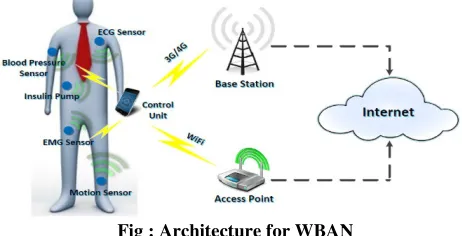
One of the major applications of WSN technology is monitoring of human health [2]. In WBAN, only few sensors are used which are implanted in body or positioned on the body. These tiny sensors placed on patient's body measure vital signs like blood pressure, Glucose level, and pulse rate etcetera. These measured values are then forwarded to the medical server or doctor to further analyze the patient’s condition. Wireless sensors provide continuous monitoring of patient at remote place. Advancement in wireless technology born a new generation of WSN which is suitable for networking on the human body or in the human body.
Fig : Architecture for WBAN
Performance of MAC protocol is enhanced through utilization of low power mechanisms. Different techniques and methods available in literature are used to provide efficient utilization of energy in WBANs, some of them we discussed here.[11] Sensors in WBAN are energy constrains and it is required to run the network for longer period of time with battery capacity constraints. The major aspects to trim down the energy utilization in low power sensor network are to sense data; process that data and then communication with other communication device. When a node communicates with other nodes, it depletes most of its energy. Energy wasted in idle listening, over transmitting, overhead of control packet, collision and fluctuations in traffic.[1]
II. RELATED WORK
We propose an improved MAC protocol by simply changing the frame structure of WBAN system. The simulation results show that the proposed scheme attains a lot of saving of energy consumption of master and each node compared with IEEE 802.15.6 and conventional schemes.Jun Sung Choi, Jeong Gon Kim[1]. Sensor networks are recently rapidly growing research area in wireless communications and distributed network. Sensor network is a densely deployed wireless network of small, low-cost sensors, which can be used in various applications like health, environmental monitoring, military, home, gathering and sensing information in inhospitable locations etc. Wireless sensor networks monitor and control physical environments from remote
locations. Sensor nodes suffer various energy and computational constraints for their low cost feature and ad hoc deployment method. Different application areas of sensor networks consist different technical issues and researchers are currently shedding their lights to resolving these issues. The prominent deficiencies are: energy efficient routing, protocols, localization algorithms and system design. This survey paper will cover up all these open research issues as well as their solutions and will point out and depicts all important fields of sensor networks.Kazi Chandrima Rahman[2].
One of the most important emerging networks applicable in many fields is wireless body area networks (WBANS).In this paper we survey the wireless body area networks (WBANS) and their various applications in healthcare. In this paper a concise survey consisting of the various sections mainly focusing on the paramount aspect of WBANS and it applications in medicine to reduce the need for caregivers and to help the elderly and chronically ill people live an independent life. Emmanuel Davies, Kola Sanjay, J.Mohana [3]. Then we study low-power MAC protocols proposed/investigated for a WBAN with emphasis on their strengths and weaknesses. We also review different power efficient mechanisms for a WBAN. In addition, useful suggestions are given to help the MAC designers to develop a low-power MAC protocol that will satisfy the stringent requirements [4].
Energy Minimization Techniques in MAC Protocol for WBANs
Performance of MAC protocol is enhanced through utilization of low power mechanisms. Different techniques and methods available in literature are used to provide efficient utilization of energy in WBANs, some of them we discussed here[8]. Sensors in WBAN are energy constrains and it is required to run the network for longer period of time with battery capacity constraints. The major aspects to trim down the energy utilization in low power sensor network are to sense data; process that data and then communication with other communication device. When a node communicates with other nodes, it depletes most of its energy. Energy wasted in idle listening, over transmitting, overhead of control packet, collision and fluctuations in traffic.
WBAN has three major approaches to minimize energy utilization.
Low Power Listening
ISSN: 2394-2231
http://www.ijctjournal.org
Page 57
Scheduled Contention
This scheme is the sum of the two mechanisms, scheduling mechanism and contention based mechanisms. It is used to overcome the collision problem as well as scalability issues. The contending nodes in contention based protocols give rise to packet collision because the entire contending node wants to transmit data through channel. Carrier Sense Multiple Access/Collision Avoidance (CSMA/CA) is a contention based prot. Node in CSMA/CA protocol perform Clear Channel Assessment (CCA) before the transmission[1][5]. The scheduling mechanism assigns a time slot or bandwidth to all sensors and all sensors transfer its data only in its own scheduled time slot. It is a contention free mechanism. CSMA/CA is contention based MAC protocol in which Clear Channel Assessment (CCA) is carried out by the nodes before transmission of data. Code division multiple access (CDMA), Frequency Division Multiple Access (FDMA), Time Division Multiple Access (TDMA), Carrier Sense Multiple Access (CSMA) are all scheduling schemes. However, CDMA and FDMA has high overhead of computations and are limited in terms of frequency range so they are not considered good for WBAN. Sensor MAC(S-MAC) is schedule contention based MAC protocol in which the default mode sensor nodes set as low duty mode. Nodes coordinate with their neighbor node in sleeping. The node remains in sleeping mode and become active when data has to transmit. It avoids packet collision, reduce overhearing and idle listening. These features lead to minimize energy consumption[3][10].
III. PREVIOUS IMPLEMENTATIONS
M-GEAR: Gateway-Based Energy-Aware Multi-Hop Routing Protocol
Due to the fact that clustering protocols consume less energy, these protocols for WSNs have gained extensive acceptance in many applications. Many on hand WSN protocols use cluster based scheme at manifold levels to minimize energy expenditures. CH in most cluster based protocol is selected based on a probability. It is not obvious that CHs are distributed uniformly throughout the sensor field. Therefore, it is fairly possible that the selected CHs will be concentrate in one region of the network. Hence, a number of sensors will not find any CHs in their environs. Similarly some protocols used unequal clustering and try to use recourses proficiently on condition that multi-hop routing. Multiple levels clustering hierarchy has following major drawbacks.
• In multiple level schemes, one CH forward data to other CHs which relay data to BS. If relay CH is far away than it is necessary for forwarder CHs to transmit with a bit higher power level.
• In clustering protocols, a member node decides itself whether to a CH or not. It is possible that some distant nodes are selected as CHs. Therefore, these nodes consume lot of energy to forward data to BS hence, they will die early
• Network is divided into regions and aid of gateway node reduces the average transmission distance.
Hence, it saves network energy and prolong network lifetime.
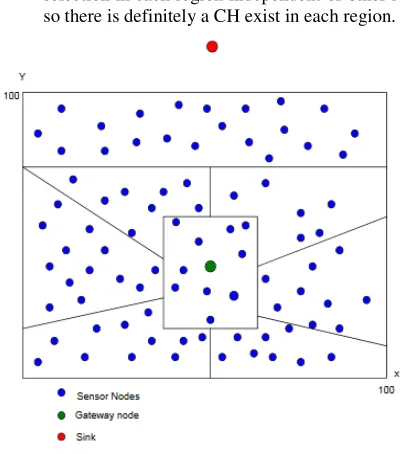
• As network is divided into four logical regions, CH selection in each region independent of other regions so there is definitely a CH exist in each region.
Fig: Network Model
Initial Phase
In M-GEAR, we use homogenous sensor nodes that are dispersed randomly in network area. After employment of nodes, every node forwards its location to the BS. The BS calculates the distance of each node and save all information of the sensor nodes into the node data table. The node data table consists of distinctive node ID, Residual energy of node, and its distance to the BS and gateway node.
Setup Phase
In this segment, we divide the network field into logical regions on the basis of node's distance from gateway node and BS. BS divides the nodes into four different logical regions. Nodes in region-one use direct communication and send their data directly to BS as the distance of these nodes from BS is very short. Similarly nodes near gateway form region-two and send their data directly to gateway. Gateway node aggregates data and forward to BS. These two regions are referred to as non clustered regions. All the nodes away from the gate way node and base station are divided into two equal half regions based on their distance from gateway node, we call them clustered regions. Sensor nodes in each clustered region organize themselves into small groups known as clusters.
Cluster Head Selection
ISSN: 2394-2231
http://www.ijctjournal.org
Page 58
regions and use clustering topology. CHs are elected in eachregion separately. Let ri represent the number of rounds to be a CH for the node S j, we call it epoch. Each node elect itself as a CH once every r i = 1/p rounds. At the start of first round all nodes in both regions has equal energy level and has equal chance to become CH. After that CH is selected on the basis of the remaining energy of sensor node and with a probability p alike LEACH. In each round, it is required to have n x p CHs. A node can become CH only once in an epoch and the nodes not elected as CH in the current round feel right to the set C. The probability of a node to (belong to set C) elect as CH increases in each round. It is required to uphold balanced number of CHs. At the start of each round, a node Si belongs to set C autonomously choose a random number between 0 to 1. If the generated random number for node Si is less than a predefined threshold T(s) value then the node is becomes CH in the current round. The threshold value can be found as:
Where P = the desired percentage of CHs and r = the current round, C = set of nodes not elected as CH in current round. After electing CHs in each region, CHs inform their role to neighbor nodes. CHs broadcast a control packet using a CSMA MAC protocol. Upon received control packet from CH each node transmit acknowledge packet. Nodes finds near CH, becomes member of that CH.
IV. SYSTEM IMPLEMETNATION
INCREASED THROUGHPUT MULTIHOP LINK EFFICIENT PROTOCOL FOR WBAN
Wireless body area sensors are used to monitor human health with energy constraints. Different energy efficient routing schemes are used to forward data from body sensors to medical server. It is important that sensed data of patient reliably forward to medical specialist or server for further analysis. It presents a opportunistic protocol. Proposed scheme facilitate mobility at cost of low throughput and additional cost of relay node. Whenever sink node goes away from transmission range of nodes, it uses a relay node which is used to collect data from sensor nodes. They deploy sink at wrist. As hands are used frequently, sink is mobile most of the time and keep away from the sensors for longer time. It will consume more power of sensor nodes and relay node. Due to the mobility of the sink on hands, more packets will drop, that causes important and critical data to loss. High throughput with limited energy source is one of the key issue in WBANs. To increase the throughput and reliable communication between sensors and sink.
1. our proposed scheme achieve a longer stability time. Nodes stay alive for longer period and consume less energy.
2. The large stability period and less energy consumption of nodes, contribute to a high throughput
Energy Consumption Model
In this topology design, we consider a WBAN scenario in which eight sensor nodes are placed on the human body as shown in fig 1 on next page. The placement of nodes is pre-determined and fixed. Let N is the set of nodes, f is the forwarder node and sink S. Ci is the capacity of the wireless link. The data generated by sensor is denoted by dis, which is routed to sink by sensor node i . According to the position of the sensors and sink on the body, we define the following connectivity parameters
Aif = {1 if i establishes a link with f, 0 otherwise} Afs = { 1 if f establishes a link with S., 0 otherwise} Aif represents the connectivity between i and f. similarly Afs is the connectivity between f and S. Ff is the traffic flow between node i and forwarder. Ffs is the total traffic flow routed between forwarder node and sink. here use minimum energy consumption model presented in represents the total energy consumption of network. our aim to minimize the total energy consumption (Et) of network. Objective function shows the energy consumed by sensor nodes (Es) to transmit data to f and total energy consumed by the forwarder node (Ef ) to transmit and receive data packets. Ft fs and Eda are the flow variable and data aggregation energy parameters, respectively. Flow variable represents the total traffic flow between forwarder node and sink. Forwarder node collects data packets from sensor nodes, aggregates and transfers the to sink.
Initial Phase
In this phase, sink broadcast a short information packet which contains the location of the sink on the body. After receiving this packet, Each sensor node stores the location of sink. After that each sensor node broadcast a information packet which is a short message only contains node ID, its location and its energy status. In this way, all sensor nodes are updated with the location of its neighbours and sink.
Selection of Forwarder
In order to save energy and to enhance network throughput, we proposed a multi hop scheme for WBAN. In this section, we present selection criteria for a node to become next hop or forwarder. To weighing scale energy expenditure among nodes and to trim down energy consumption of network, we elect a new forwarder in each round. Sink node knows the ID, distance and residual energy status of the nodes. Sink computes the cost function of all the node and transmit this cost function to all nodes. On the basis of this cost function each node decides whether to become forwarder node or not. If i is number of nodes than Cost function of i nodes is computed as follows:
ISSN: 2394-2231
http://www.ijctjournal.org
Page 59
to sink Two nodes for ECG and glucose monitoring cannot beelected as forwarder because these two nodes has critical vital data Both the nodes are placed near the sink and forward their data packet direct to sink
Master Cluster Head Selection
Check R.T
Check Squence # Select Hightest Seq#
If Seq # > All other Nodes Then
Check Black List Node
If Black List uncheck Node Then
Elect as CH Else Reject End if
End if
Implementation Algorithm
Step 1: These sensor nodes are energy constrained and the sensor nodes can perform data aggregation in order to use energy efficiently. The energy required to send data depends on the distance between the nodes and the number of bits which are being transmitted. The energy required for receiving also depends on the number of bits being received. The energy requirement of transmitter and receiver can be defined as in below equations.
E
Transmitting= (E
elecx K ) + ( E
amp x K x d
2) ----(1)
E
Receiving= E
elctx k ----(2)
Where Eelec is the energy being dissipated to run the transmitter, Eamp is the energy dissipation of the transmission amplifier, K is the length of the message in bits, d is the distance between transmitter and receiver
Step 2: using direct transmission between the transmitter and receiver
T
ransmitting= (E
elecx K ) + ( E
amp x K x (d/2)
2) ----(3)
Step3: Then the energy required for transmitting data from source node to destination node in the multi hope case will be half that of the direct transmission. In many situations, the data collected by many nodes will be same. In such cases, redundant data transmission can be eliminated by forming group of nodes called clusters and by electing one node among the nodes in the cluster to be cluster head. All nodes can send data to the cluster head where the aggregation of data can takes place
Cluster Heads broadcasts an advertisement message (ADV) using CSMA MAC protocol.
ADV = node’s ID + distinguishable header.
Based on the received signal strength of ADV message, each non-Cluster Head node determines its Cluster Head for this round.
Each non-Cluster Head transmits a join-request message (Join-REQ) back to its chosen Cluster Head using a CSMA MAC protocol.
Join-REQ = node’s ID + cluster-head ID + header.
Cluster Head node sets up a TDMA schedule for data transmission coordination within the cluster.
Prevents collision among data messages.
Energy conservation in non cluster-head nodes.
V EVALUATION RESULT
Cygwin is free software that provides a Unix-like environment and software tool set to users of any modern x86 32-bit and 64-bit versions of MS-Windows (XP with SP3/Server 20xx/Vista/7/8) and (using older versions of Cygwin) some obsolete versions (95/98/ME/NT/2000/XP without SP3) as well. Cygwin consists of a Unix system call emulation library, cygwin1.dll. With Cygwin installed, users have access to many standard UNIX utilities. They can be used from one of the provided shells such as bash or from the Windows Command Prompt.
Additionally, programmers may write Win32 console or GUI applications that make use of the standard Microsoft Win32 API and/or the Cygwin API. As a result, it is possible to easily port many significant UNIX programs without the need for extensive changes to the source code. Cygwin provides all of the components needed to do this in most cases; most POSIX-compliant software, including X11 applications, can easily be ported to MS-Windows using Cygwin.
EXPERIMENTAL RESULT
To create a realistic depiction of a wireless sensor network, a simulation study is performed using Network Simulator NS2. Simulation network consists of many sensor nodes distributed in a grid pattern of 1000×1000 m Each node is equipped with a radio transceiver capable of transmitting a signal over a distance of 250 m on a 2 Mb/s wireless channel. All applications are run on User Datagram Protocol (UDP). The simulated traffic is of Constant Bit Rate (CBR). The sink is assumed to be 250m away from the area
Parameters Used in the energy efficient for
Step1: Current contention window CW: The size of contention window is not fixed, and it can be dynamically changed within a specific range. This parameter is used to record the value of current contention window.
ISSN: 2394-2231
http://www.ijctjournal.org
Page 60
Step3: Maximum of contention window CWmax: The upperlimit of the range of the current contention window, CWmax > CWmin > 0, is fixed from the beginning.
Step4: The initial value of contention window CWinit: CWinit = (CWmin + CWmax)/2, values of CWmax and CWmin will be set in accordance with the network environment.
Step5: Threshold of counter for successful competition SClim: This is the maximum of SC. The current window will change on the basis of the network load when SC reaches its limit. It is fixed from the beginning.
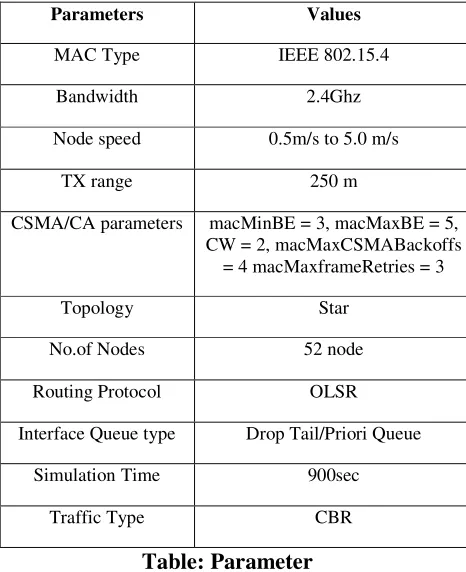
Simulation Parameter
Parameters Values
MAC Type IEEE 802.15.4
Bandwidth 2.4Ghz
Node speed 0.5m/s to 5.0 m/s
TX range 250 m
CSMA/CA parameters macMinBE = 3, macMaxBE = 5, CW = 2, macMaxCSMABackoffs = 4 macMaxframeRetries = 3
Topology Star
No.of Nodes 52 node
Routing Protocol OLSR
Interface Queue type Drop Tail/Priori Queue
Simulation Time 900sec
Traffic Type CBR
Table: Parameter
In addition, since NS-2 is originally targeted to IP networks but WSNs, there are some limitations when apply it to simulate WSNs. Firstly, NS-2 can simulate the layered protocols but application behaviors. However, the layered protocols and applications interact and cannot be strictly separated in WSNs
.
A Wireless Sensor Network (WSN) is a collection of nodes organized into a cooperative network.. Packet modification is a compromised node which modifies all or some of the packets that is supposed to forward. Packet dropping and modification are common attacks that can be launched by an adversary to disrupt communication in Wireless Sensor NetworkFig. Nodes Send Sensed Data to Respective Sink
Many protocols in wireless sensor networks use packet delivery ratio (PDR) as a metric to select the best route, transmission rate or power. PDR is normally estimated either by counting the number of received hello/data messages in a small period of time, i.e., less than 1 second, or by taking the history of PDR into account. The first method is accurate but requires many packets to be sent, which costs too much energy. The second one is energy efficient, but fails to achieve good accuracy
.
Fig : Packet Delivery Ratio
ISSN: 2394-2231
http://www.ijctjournal.org
Page 61
Most of studies only consider that wireless sensornetworks are equipped with only Omni-directional antennas, which can cause high collisions. It is shown that the per node throughput in such networks is decreased with the increased number of nodes. Thus, the transmission with multiple short - range hops is preferred to reduce the interference. However, other studies show that the transmission delay increases with the increased number of hops. Found that using directional antennas not only can increase the throughput capacity but also can decrease the delay by reducing the number of hops.
Energy Consumption Parameters Description
ei: Energy Consumption during Idle mode
es: Energy Consumption during Sleep mode
et: Energy Consumed during Transmitting mode
er: Energy Consumed during Receiving mode
CONCLUSION
Here describe an Energy efficient multi-hop routing protocol using gateway node to minimize energy consumption of sensor network. In this work we divided the network into logical regions. Each region use different communication hierarchy. Two regions use direct communication topology and two regions are further subdivided into clusters and use multi-hop communication hierarchy. Each node in a region elects itself as a CH independent of other region. This technique implies better distribution of CHs in the network. Simulation and result evaluation section shows that our proposed protocol performs well compared to LEACH. In this thesis, we propose a mechanism to route data in WBANs. The proposed scheme uses a cost function to select appropriate route to sink. Cost function is calculated based on the residual energy of node and its distance from sink. Nodes with less value of cost function are elected as parent node. Other nodes become the children of that parent node and forward their data to parent node. Two nodes for ECG and Glucose monitoring forward their data direct to sink as they are placed near sink, also these two nodes cannot be elected as parent node because both sensor node has critical and important medical data. It is not required that these two nodes deplete their energy in forwarding data of other nodes. Our simulation results shows that proposed routing scheme enhance the network stability time and packet delivered to sink. future work for in order to cooperate with periodical relay selection, the real-time residual energy and location information of each node, which is assumed to be known by the coordinator in this research, need to be updated by the coordinator (note that the reason for location information updating is WBAN user mobility).
REFERENCES:
[1] Movassaghi, S.; Abolhasan, M.; Lipman, J.; Smith, D.; Jamalipour, A.Wireless Body Area Network: A Survey. IEEE Commun. Surv. Tutor. 2014, 16, 1658–1686.
[2] Ye, W.; Heidemann, J.; Estrin, D. An Energy-Efficient MAC Protocol for Wireless Sensor Networks. In Proceedings of the 21st Annual Joint Conference of IEEE Computer
Communications Societies (INFOCOM 2002), New York, NY, USA, 23–27 June 2002; pp. 1567–1576.
[3]. El-Hoiydi, A.; Decotignie, J.-D. WiseMAC: An Ultra-Low Power MAC Protocol for the Downlink of Infrastructure Wireless Sensor Networks. In Proceedings of the 9th IEEE Symposium on Computers and Communication (ISCC 2004), Alexandria, Egypt, 28 June–1 July 2004; pp. 244–251. [4]. IEEE Std.802.15.4. In Wireless Medium Access Control (MAC) and Physical Layer (PHY) Specifications for LowData Rate Wireless Personal Area Networks (WPAN); IEEE: Piscataway, NJ, USA, 2006.
[5]. Ullah, S.; Chen, M.; Kwak, K.S. “Throughput and Delay Analysis of IEEE 802.15.6-based CSMA/CA protocol. Med. Syst. 2012, 36, 3875–3891.
[6]. Kartsakli, E.; Lalos, A.S.; Antonopoulos, A.; Tennina, S.; Renzo, M.D.; Alonso, L.; Verikoukis, C. A survey on M2M Systems for mHealth: A Wireless Communications Perspective. Sensors 2014, 14, 18009–18052.
[7]. Cavallari, R.; Martelli, F.; Rosini, R.; Buratti, C.; Verdone, R. A Survey on Wireless Body Area Networks: Technologies and Design Challenges. IEEE Commun Surv. Tutor. 2014, 16, 1635–1657.
[8]. Le, T.T.; Moh, S. Interference Mitigation Schemes for Wireless Body Area Sensor. Sensors 2015, 15,13805–13838 [9]. Bhandari, S.; Moh, S. A Survey of MAC Protocols for Cognitive Radio Body Area Networks. Sensors 2015, 15,9189–9209.
[10]. Lee, W.; Rhee, S.H.; Kim, Y.; Lee, H. An Efficient Multi-Channel Management Protocol for Wireless Body Area Networks. In Proceedings of the International Conference on Information Networking (ICOIN 2009),Chiang Mai, Thailand, 21–24 January 2009; pp. 1–5.
[11]. Kim, B.; Cho, J. A Novel Priority-Based Channel Access Algorithm for Contention-Based MAC Protocol in WBANs. In Proceedings of the 6th International Conference on Ubiquitous Information Management and Communication (ICUIMC 2012), Kuala Lumpur, Malaysia, 20–22 February 2012; pp. 1–5.