http://dx.doi.org/10.9717/JMIS.2015.2.4.295
295
I. INTRODUCTION
Interaction of visual and audio information under the control of interactive software using the latest hardware and software integrates and contains both texts, graphics, audio and video information in the digital domain, in one container object.
The possibility of presenting information flows across multiple information environments - interfaces that provide I / O data of different types of computer, creation, processing and display of information at different levels and structures for the perception of the various organs of the human senses are realized by means of multimedia systems[1,2,3].
Multimedia systems are a necessary part of the process of using information resources of society, and the pace of their development is determined to a large extent the rate of accumulation of professional knowledge.
Acceleration of the dynamics of processes in all spheres of human activity, the complexity of industrial production, social, economic and political life naturally led, on the one hand, a rapid increase in demand for information knowledge, and on the other - to the creation of new tools and technologies to meet these needs. Intensive development of scientific and technological progress and the emergence of modern computer and telecommunication technologies and equipment, capable of storing, processing and provide various types of
discrete-continuous media, the emergence and development of multimedia systems and related methodological innovations radically changed the approach to the implementation of educational activities, to intensify the process training at all levels of education.
Scope of multimedia information systems expands with each passing day. Today, they cover a wide range of applications including classrooms, conference rooms, comprehensive monitoring systems, situational centers and control centers, etc. Development of multimedia systems is characterized by the increasing complexity of their architecture. All processes in multimedia systems are discrete-continuous, as a result, there is a need to develop models of efficient algorithms, software package such automated multimedia systems, which would include the development of online designers, create multimedia courseware, training multikontentov that based on the use of discrete-continuous object class TIAV.
Multimedia product an interactive computer engineering, in which may include music, videos, animations, galleries of pictures and slides, various databases, and etc. The material includes a media product can be provided with drawings, audio, video, text. This is fundamentally different types of information to work with that has its own software environment with the appropriate tools. Business prestige of any company or firm will contribute great electronic business card CD-Card: e-card has a huge storage capacities and presentation of
Multimedia TIAV System
Saida Safibullayevna Beknazarova
1,*Abstract
This article discusses the features and trends of development of the process of implementation of multimedia systems in various fields, research substantiate the basic concepts of multimedia systems, information flow, describes the classification and characterization of information flows and systems. Described container TIAV, which is designed with all the modern features and is aimed at future trends in the field of play.
Key Words: Multimedia system, Information flow, Data flow, Information flow objects, Container TIAV.
Manuscript received August 03, 2015; Revised October 2, 2015; Accepted October 26, 2015. (ID No. JMIS-2015-22) Corresponding Author (*): S. S. Beknazarova, 100052, 35/7, Akkurgan Street,Mirzo Ulugbek region, Tashkent city, Republic of Uzbekistan, [email protected]
1
296
information: text, graphics, sound, video, animation, and many other things that used to fit on a business card were impossible. The functionality of the e-cards is more varied: you can use it not only for representational purposes, but also as a promotional disc, a presentation or a gift. CD-Card-card will provide information more clearly and vividly, and is represented in the form:
- Interactive presentations, animations and videos; - Directories, databases, hypertext documents; - Spreadsheets, charts, slides;
- Due to web-sites and computer programs, etc.
Multimedia systems are a set of information environments - channels, each of which has its own specific form appropriate to its level and purpose.
The main environmental sorted by ascending levels are as follows:
- binary medium comprising instructions for the processor, binary files and data;
- contact medium is a tactile, strain gauge, electrical, and other capacitive touch media employees to enter the mechanical code and a space-time information;
- text environment, which are text data to the user program texts for interpreters, other textual information; - audio streams representing audio files, digital audio series, sets of musical audio and other types of digital audio;
- graphical environment, which are drawing files, photos, and other two-dimensional graphic information; - video streams representing video, dynamic series of graphic information;
- virtual reality, is an interactive 3D-video stream. The use of multimedia systems provides human lightness perception information as the person has significantly different from the computer means and information processing means having a shape perception convenient for humans [4, 5].
If your computer is characterized by discrete binary-form inbinary-formation with electric transmission of inbinary-formation signals (1/0), then the person – multi modal- analog form primarily non-electrical nature (light, sound, pressure, etc.).
Without the creation of such media perception of computer information man is extremely difficult, and even more difficult to transfer multimodal information from one person to another via computer tools.
Therefore, technology and multimedia equipment includes a wide range of different interfaces as input interfaces (sensors - camcorder microphone, touch screen, etc., Converters - ADC, special processors for converting external information) and output interfaces (displays, sound sources and so forth.).
Multimedia systems may be divided into linear (without feedback) and an interactive environment. Analogue of the linear method of presentation can be a movie. The person viewing the document can in no way affect its output. Interactive (nonlinear) mode allows a person presenting information, programs, and networks involved in displaying information interacting in any way with the means of displaying the multimedia data. Participation in this process two or more parties called "interactivity". This way of human-computer interaction to the fullest extent presents in the categories of computer games. Interactive way of presenting multimedia data is sometimes called "hypermedia".
As an example of linear and interactive way to present information, we can consider a situation like holding a presentation. If the presentation was recorded on film or video, and shows the audience, then browsing this presentation are not able to influence its course. In the case of the live presentation, the audience has the opportunity to ask questions Reporter and interact with other manner that allows Reporter deviate from the topic presentation, for example, explaining some of the terms or more elaborate, the controversial part of the report. Thus, live presentation can be presented as an interactive (nonlinear) way of presenting information [1].
Different formats of multimedia data may be used to simplify the perception of information to consumers. For example, to provide information not only in text form, but also illustrate its audio data or video. In the same way modern art can present everyday, ordinary things in a new way.
Various forms of information make it possible to interactive user interaction with information. Online media is increasingly becoming an object-oriented, allowing the user to work on the information without having specific knowledge. Multimedia resource - is an information resource for the basic information presented in the form of multimedia. This modern and extremely convenient mechanism, which does not replace the performance of classical functions, complements and extends the range of services and news for visitors.
For multimedia Internet resources characterized by the following:
- may comprise various types of information (not just text, but also sound, graphics, animation, video, etc.); - have high visibility materials;
- support different file types: text, graphics, audio and video;
http://dx.doi.org/10.9717/JMIS.2015.2.4.295
297
- media because of its clarity, reduces the level of intellectual and psychological barrier between the user and the information process.
Resource of this type makes it possible to quickly report events that are organized, demonstrate panoramic view of the sphere, institution or creative team, seeking feedback from its visitors, to disclose the purpose and materials using modern mechanisms for providing information and facilitate recognition of the object represented by the Internet.
Multimedia systems find their application in various fields, including advertising, arts, entertainment, technology, medicine, mathematics, business, education, research and space-time applications, and other information processes involving humans. Multimedia systems are beginning to be used to develop identification systems in various fields: banking, retail, security, medical, research.
In the technical field of software developers can use multimedia systems in computer simulations of anything: from entertainment to education, such as military or industrial training. Multimedia for software interfaces are often created as collaboration between creative professionals and software developers. To create more user-friendly software eliminates the barrier between the user and the program.
In the industrial sector, multimedia systems are used as a way to present the information to the shareholders, management and colleagues. The multimedia system is also useful in the training of personnel, advertising and product sales worldwide by virtually unlimited web-based technologies.
In geology, archeology, and others, areas of multimedia systems using elements of computer graphics and imaging technology to discover new mineral deposits, explore the internal state of technical objects, inaccessible by other means.
In the production, especially in the mechanical and automotive industries, multimedia systems, primarily used in the design phase, this allows, for example, a product engineer to consider different perspectives, and make other manipulations, before proceeding to production.
In mathematical and scientific research multimedia systems can be used for modeling and simulation of various processes that are costly or unavailable in vivo, such as research related to molecular physics: the creation of a molecular model of a substance, manipulation of one or another substance to receive another substance.
In medicine, using multimedia systems, combined with tomographic technology provides effective study of the human body, its organs; doctors can prepare for operations, maintain patronage, and prescribe treatment using virtual
operations or simulations of the human body, the affected disease, common viruses and bacteria, thus trying to develop techniques to prevent it [1].
In art, the most striking examples of the use of multimedia systems are special effects in film, computer animation, three-dimensional graphics, the use of electronic media collages in museums and others.
In education, multimedia systems are used to create computer-based training courses and reference books, such as encyclopedias and collections. Multimedia courses allow the user to go through a series of presentations, case texts and associated illustrations in various formats of information. Learning theory in the last decade has been greatly developed in connection with the advent of multimedia systems [3]. There are highlighted several areas of research, such as the theory of cognitive load, multimedia training and others. Opportunities for training and education are almost endless. The idea of media convergence is also becoming one of the most important factors in education, especially in higher education. Defined as separate technologies such as voice (and telephony features), database (and derivative applications), video technology, which now share resources and interact with each other, creating a new operational complex, media convergence - is rapidly changing curriculum subjects taught in universities around the world. Newspaper companies are also trying to reach a new phenomenon by introducing it into their work practices.
II. STATEMEMT OF A PROBLEM
Multimedia systems are a necessary part of the process of using information resources of society, and the pace of their development is determined to a large extent the rate of accumulation of professional knowledge.
298
Today, they cover a wide range of applications including classrooms, conference rooms, comprehensive monitoring systems, situational centers and control centers, etc. Development of multimedia systems is characterized by the increasing complexity of their architecture. All processes in multimedia systems are discrete-continuous, as a result, there is a need to develop models of efficient algorithms, software package such automated multimedia systems, which would include online designers design and create multimedia courseware, training multi contents that based on the use of discrete-continuous object class TIAV [5].
III. THE CONCEPT OF THE PROBLEM
DECISION
TIAV- multimedia system - a class of objects consisting of textual, illustrative, video and audio information streams form the basis for the development of multimedia content.
By designing TIAV- multimedia system must meet the following basic requirements: a rational and comprehensive utilization of raw TIAV facilities; ensuring high productivity, achieved the intensification of the process media, the use of high technology, integrated automation control and management of multimedia process; development and use of the necessary software; finding the most economical solutions organization TIAV-entertainment system through the rational use TIAV objects.
The algorithm for choosing the preferred structure TIAV-multimedia system is described, formalization of objectives and principles of modeling TIAV- multimedia system is identified, and algorithm for estimating the parameters of a priority and modeling, statistical tests investigated a method to modeling the multimedia system. In the first phase of the experiment the construction of a conceptual model of a multimedia object (process) its formalization - formulated model built its formal scheme, i.e., the transition from meaningful description of the object to its mathematical model, in other words, the process of formalization.
Mathematical model TIAV- multimedia system is the set of variables u, v, q, x, y, w with the functioning of the law in the form of:
𝑥𝑥(𝑡𝑡) =𝐹𝐹1�𝑢𝑢(𝑡𝑡),𝑣𝑣(𝑡𝑡),𝜃𝜃,𝑡𝑡�,
𝑦𝑦(𝑡𝑡) =𝐹𝐹2�𝑢𝑢(𝑡𝑡),𝑣𝑣(𝑡𝑡),𝜃𝜃,𝑡𝑡�,
𝑤𝑤(𝑡𝑡) =𝐹𝐹3�𝑢𝑢(𝑡𝑡),𝑣𝑣(𝑡𝑡),𝜃𝜃,𝑡𝑡�,𝑡𝑡𝑡𝑡𝑡𝑡 (1)
where q- own system parameters, T - time of the simulation, t - current time, 𝑢𝑢(𝑡𝑡)– - represents the realization of the process u(t) on the interval [0, t], similar to the designated output characteristic y, characteristic of a condition System x and external influence v, w - characteristics of the system (object).
It should be noted that the time t can be considered as a continuous variable, which is the initial time simulation
𝑡𝑡=𝑡𝑡0= 0, where 𝑡𝑡0∈ 𝑡𝑡 , and 𝑡𝑡 ∈(𝑡𝑡0,𝑡𝑡) and
𝑡𝑡0<𝑡𝑡 ∈ 𝑡𝑡 and as a discrete 𝑡𝑡=𝑖𝑖𝑖𝑖,𝑖𝑖= 0,1, … ,𝑀𝑀,𝑀𝑀=
[𝑡𝑡/𝑖𝑖], where D is the discretization step. At the same time, we have a discrete-continuous mathematical model. If a mathematical model contains random moments, we have determined model, otherwise stochastic. In the same way, there are four classes of mathematical models: continuous-deterministic models, discrete-continuous-deterministic models, discrete-stochastic (probabilistic) model of continuous-stochastic model. The first phase of the computer (machine) simulation - this is the stage of construction of the conceptual model, which involves the formalization of the model, i.e., transition from meaningful description of the object of study to its mathematical model.
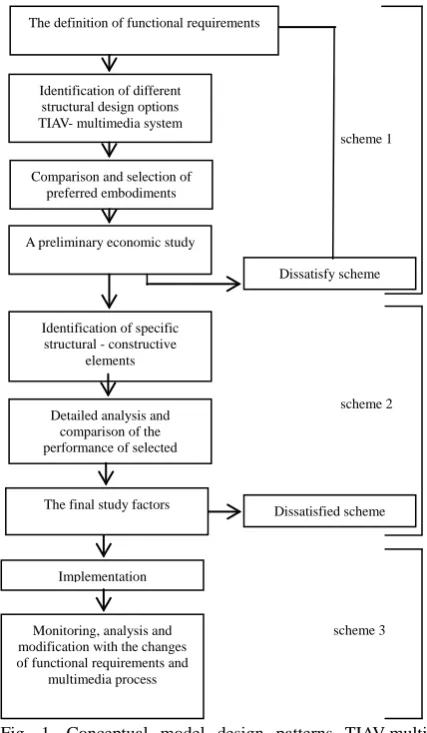
Fig. 1. Conceptual model design patterns TIAV-multimedia system
Comparison and selection of preferred embodiments
The definition of functional requirements
Identification of different structural design options TIAV- multimedia system
A preliminary economic study
Identification of specific structural - constructive
elements
Detailed analysis and comparison of the performance of selected
The final study factors
Implementation
Monitoring, analysis and modification with the changes of functional requirements and
multimedia process
Dissatisfy scheme scheme 1
Dissatisfied scheme scheme 2
http://dx.doi.org/10.9717/JMIS.2015.2.4.295
299
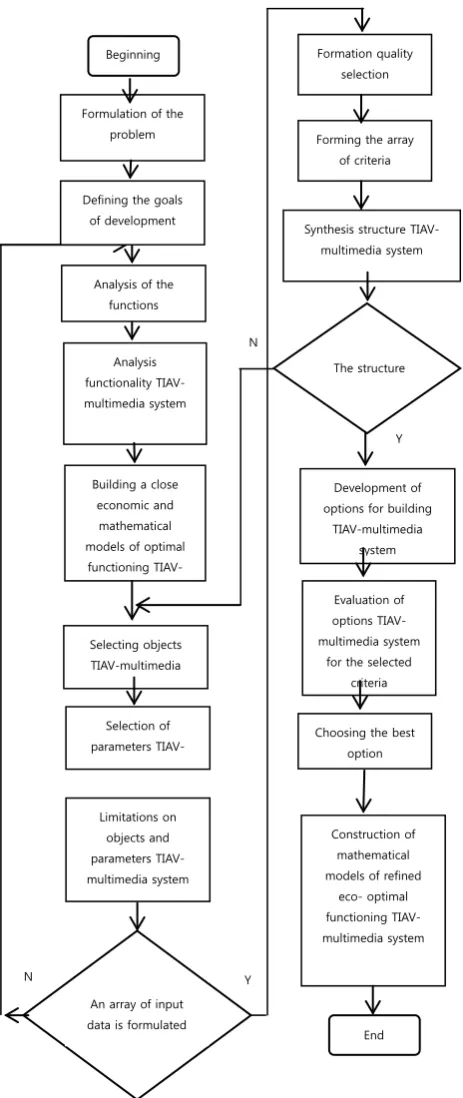
In the figure 2 there is a flowchart for selection of preferred structure TIAV multimedia system. Processes TIAV multivariate systems differ in content and sequence of multimedia operations, and composition of technical means to carry out processing.
When designing TIAV multimedia system it is important to determine the structure of the media process, ordered set of multimedia transitions 𝜑𝜑𝑗𝑗 =𝜑𝜑𝑗𝑗1,𝜑𝜑𝑗𝑗2, … ,𝜑𝜑𝑗𝑗𝑘𝑘, whose impact on the set {ai} leads to the formation of multimedia container A: 𝜑𝜑𝑗𝑗: {𝑎𝑎𝑖𝑖}→ 𝐴𝐴,∀𝜑𝜑𝑗𝑗𝑡𝑡Ф, subject to technical and economic requirements (F-variety of multimedia schemes, satisfy the necessary conditions TIAV processing facilities and production of multimedia content). Typically, the preferred choice of production and technological structure TIAV-multimedia system includes the definition of such schemes and a set of multimedia technologies for implementing them. Implementations that would be paid in the objective extremum of function Ep Sn, as well as the duration of treatment (Zp- the desired effect at the lowest cost to the processing of information resources; Ep-maximum effect by using the given resources).
If the main indicator of the effectiveness of the process is the selection the length of the multimedia processing TIAV facilities, the optimization problem can be formulated as follows:
𝐹𝐹(𝜑𝜑𝑗𝑗) =∑ 𝑓𝑓𝑛𝑛𝑖𝑖=1 (𝜑𝜑𝑗𝑗𝑖𝑖)→ 𝑚𝑚𝑖𝑖𝑛𝑛 (2)
with restrictions on performance Pmin <P <Pmax, cost
technologies Smin <S <Smax occupied by volume hosting Hmin << H <Hmah, reliability of Qmin <Q <Qmax where
𝐹𝐹�𝜑𝜑𝑗𝑗�- the function assigning the processing TIAV facilities; 𝑓𝑓�𝜑𝜑𝑗𝑗𝑖𝑖� - function determines the time of each media operations; i- number of media transitions; j - number of multimedia schemes.
Property flexibility multimedia system is its ability to quickly enough to rebuild their structure to perform a new task in a certain class, taking into account the nature and quality of the original TIAV objects.
We denote by K={zi,i=1,1} class multimedia tasks that
can effectively perform TIAV-entertainment system. The multimedia task zj class K is characterized by the quality and quantity TIAV container property starting TIAV objects T_i, many possible schemes Mjl multimedia processing properties of objects TIAV amount (volume) of processed objects TIAV Nij specified property, which is required for processing a specific planning period:
𝑧𝑧𝑖𝑖=��𝜏𝜏𝑗𝑗,�𝑀𝑀𝑗𝑗𝑗𝑗,𝑗𝑗𝑡𝑡������⃗�𝑁𝑁𝑖𝑖𝑗𝑗1,𝐿𝐿 �;𝑗𝑗= 1,������⃗�𝐽𝐽𝑖𝑖 (3)
To estimate the performance of multimedia tasks zi given TIAV multimedia system, we introduce the factor
𝜂𝜂= 𝑡𝑡𝑖𝑖
𝑡𝑡𝑖𝑖+∆𝑖𝑖 , 𝑡𝑡𝑖𝑖 =𝑚𝑚𝑖𝑖𝑛𝑛 ∑ ∑ 𝜏𝜏𝑤𝑤𝑗𝑗𝑗𝑗𝑁𝑁𝑖𝑖𝑗𝑗𝑗𝑗
𝐿𝐿𝑗𝑗
𝑗𝑗=1
𝐽𝐽𝑖𝑖
𝑗𝑗=1 (4)
𝐿𝐿𝑖𝑖 = 𝑚𝑚𝑖𝑖𝑛𝑛 � � 𝜏𝜏𝑛𝑛𝑗𝑗𝑗𝑗𝐿𝐿𝑗𝑗 .
𝑗𝑗=1
𝐽𝐽𝑖𝑖
𝑗𝑗=1
(5)
Minimization in the formula 1 is carried out by all sorts of options for multimedia partition N_ij schemes in
compliance with the conditions
∑ 𝑁𝑁𝑖𝑖𝑗𝑗𝑗𝑗𝐿𝐿𝑗𝑗=1𝑗𝑗 = 𝑁𝑁𝑖𝑖𝑗𝑗 (6)
and the minimization of (2) -on all sorts of options to streamline the task properties 𝑡𝑡𝑖𝑖 and zi.. There 𝜏𝜏𝑤𝑤𝑗𝑗𝑗𝑗 - the
processing properties of the objects TIAV 𝑡𝑡𝑖𝑖of l-th multi-media network; 𝜏𝜏𝑛𝑛𝑗𝑗𝑗𝑗- Organizational downtime of key technologies in the processing of objects TIAV
𝑡𝑡𝑖𝑖properties of l-th technological scheme. We denote by
∆𝑖𝑖1𝑖𝑖2 duration organizational downtime of key technologies in the transition from a mission assignment (zi1, zi2). Then the coefficient of efficiency of an ordered
pair of tasks (zi1, zi2) will be equal to
𝜂𝜂= 𝑡𝑡𝑖𝑖1+𝑡𝑡𝑖𝑖2
𝑡𝑡𝑖𝑖1+𝑡𝑡𝑖𝑖2+∆𝑖𝑖1+∆𝑖𝑖2+∆𝑖𝑖1𝑖𝑖2 (7)
𝐻𝐻=‖𝜂𝜂𝑖𝑖1𝑖𝑖2‖𝐼𝐼×𝐼𝐼.
The effectiveness of the system TIAV class K described by the matrix 𝐻𝐻=‖𝜂𝜂𝑖𝑖1𝑖𝑖2‖𝐼𝐼×𝐼𝐼diagonal elements coincide with ri.
When using simulation multimedia system are the following main stages (Fig. 6) study developed system: setting boundaries, limitations and gauges the effectiveness of multimedia system to be studied; the formulation of the model - the transition from the real system to a certain logic (abstraction); preparation of input data - select the preferred implementation (informative) ended the data needed to build the model, and present them in an appropriate form; Broadcast models - provide a description of the model; assessment of the adequacy of the model - checking and improving the level of confidence with which we can judge the accuracy of the findings of the actual system obtained at the request of the model; design of experiments, which should give required information and the definition of the method for each series of tests under the plan of the experiment; Experimentation - simulation in order to obtain the desired data; Interpretation - draw conclusions from the data obtained by simulation; implementation - practical use of the model and the simulation results.
The modern development of the information society, advancing the information flow of the material is aimed at removing bottlenecks in a multimedia course. Leading information flow in the opposite direction contains, as a rule, the initial information; outpacing the information flow in the forward direction - these are preliminary reports of the upcoming multimedia process [3].
300
In today's digital world there are many different ways of presenting multimedia information. Of course, in order to convert analog information into digital form, special programs are needed, create a file (it will be called a container), which contains all the text, graphics, audio and video the information.
Fig. 2. The selection algorithm preferred structure TIAV-multimedia system.
Trainer basic file serving to preserve digitally converted analog data (i.e., what people see and hear in
real life). Typically, such a stored text, graphics, audio and video information occupies a large volume, so it is compressed using a variety of audio and video codec. All utilities for working with these files installed with the operating system.
The Code abbreviation for Coder / Decoder - program allows you to convert the recorded information so that it takes up less space. In this case, the file extension can’t be changed, i.e., the basic structure of the container does not change, change the representation of text, graphics, audio and video, but to play the file, "encrypted" with any codec, it is necessary for it to be installed on the user's computer [1]. Container TIAV (text, image, audio, video), Figure3 - a project aimed at creating an open flexible cross-platform (including hardware platform) standard of multimedia container formats and a set of tools and libraries for working with data in this format. This project is a development project MCF, but differs significantly in that based on EBML (Extensible Binary Meta Language - Extensible Binary Meta language) - binary counterparts language XML. Using EBML allows you to expand the format without losing compatibility with older programs.
Fig.3 Scheme container TIAV
IV. REALIZATION OF THE CONCEPT
TIAV is not the format in the truest sense of the word. A container, a kind of packaging, can wrap text, image, video and audio content. Container TIAV designed with all modern features and is aimed at future trends in the field of play. It is built on the principle of EBML, which is analogous to XML only for binary data. Scope TIAV is very versatile. In the package can be consist the big volume audio, video sequences, subtitles, chapters, posters, fonts, descriptions, comments, photo albums and more. This container is compatible with all modern requirements video container
Possible formats that are run inside TIAV: broadcast over the Internet (HTTP and RTP); fast file; robustness; screen menus (both on DVD); splitting a file into chapters (Chapters); toggle subtitles on the fly; switchable audio tracks; modular expandability;
It should be noted that the draft text / image / audio / video content does not include a video compression formats and codecs (such as MP3 or JPEG). This pack may contain a large number of streams text, image, audio,
•Video
•Audio
•Image
•Text
TIAV
Analysis of the functions Formulation of the
problem
Analysis functionality TIAV-multimedia system
Building a close economic and
mathematical models of optimal functioning TIAV-
Selecting objects TIAV-multimedia
Selection of parameters
TIAV-Limitations on objects and parameters TIAV-multimedia system
An array of input data is formulated
Formation quality selection
N
Defining the goals of development
Forming the array of criteria
Synthesis structure TIAV-multimedia system
Development of options for building
TIAV-multimedia system
Evaluation of options TIAV- multimedia system
for the selected criteria
Choosing the best option
Construction of mathematical models of refined
eco- optimal functioning TIAV- multimedia system
The structure N
Y
Y Beginning
http://dx.doi.org/10.9717/JMIS.2015.2.4.295
301
video, allowing a user to store a single file and view the information using resource TIAV multimedia system.
TIAV container is an open project (open standard). This means that for personal use it is absolutely free, and the technical specification of the format of the bit stream is available to anyone, even to companies wishing to build support into their format. The source code of all libraries created by a group of developers of the project TIAV distributed under the LGPL (Library to play, written in C using integer arithmetic, also distributed under the terms of the license BSD) [1, 2].
In TIAV there is support for the adaptation and implementation of libraries for TIAV Open Be OS MEDIAKIT and GSTREAMER (Eng.) (Multimedia environment running GNU / Linux, similar to Microsoft Direct Show for Windows) and a set of DirectShow filters for playback and creation of files in Windows TIAV by TIAV system [1].
Analysis of the quality management multimedia media educational process shows that all solved with the practical problems are multicriteria, ie to select the best alternative to the weighting of all reasonable alternatives, a quality criterion for adequate assessment of their comparison is not enough. At the same time, unfortunately, for the problem of multi-criteria comparison of alternatives are virtually no effective methods of choice. The main difficulty of solving this problem lies in the fact that the results of the choice of the most efficient alternative based on certain criteria do not match. In addition, among the various selection criteria is usually observed contradiction associated with opposite changes their values at the same changes in the control parameters. In this connection, for determining the quality and effectiveness of media educational process is necessary in the formation of a heuristic selection technique, which allows to circumvent these difficulties.
Analysis of the various factors affecting the quality of the container TIAV, showed that the main of them are: providing a container TIAV certain components: media text, images, graphics, audio, video (animation), or if you need a simulation model.
Thus, the rate of assessment quality assurance (K) container TIAV in general terms can be defined according to the following expression:
𝐾𝐾= 𝐹𝐹(Мт, М𝑖𝑖, 𝑀𝑀𝑎𝑎,𝑣𝑣,, 𝑀𝑀𝑎𝑎𝑛𝑛,𝑖𝑖𝑚𝑚) (8)
where Мт, М𝑖𝑖, 𝑀𝑀𝑎𝑎,𝑣𝑣,, 𝑀𝑀𝑎𝑎𝑛𝑛,𝑖𝑖𝑚𝑚- key factors to ensure the quality of the container, respectively media - (text, image is a graphic; AV; animation- simulation model).
An analytical representation of this index can be obtained, for example, on the basis of statistical data by regression analysis. In this case, it will have the following form:
К = a1Мт + a2М𝑖𝑖, + a3𝑀𝑀𝑎𝑎,𝑣𝑣, + a4 𝑀𝑀𝑎𝑎𝑛𝑛,𝑖𝑖𝑚𝑚 + a0 (9)
where ai, i = 1,n-linear regression coefficients determined
by statistical processing; a0- free term, taking into account
other factors that affect the provision of quality container. However, the construction of such a regression model is difficult because of the difficulty of obtaining necessary for this statistic, because the impact of these factors on the quality of the container TIAV is mostly subjective.
Therefore, to assess the level of quality assurance (K *) multimedia process in high school, you can use the following heuristic expression:
𝐾𝐾∗=𝑏𝑏1𝑀𝑀𝑡𝑡∗+𝑏𝑏2𝑀𝑀𝑖𝑖∗+𝑏𝑏3𝑀𝑀𝑎𝑎∗,𝑣𝑣+𝑏𝑏4𝑀𝑀𝑎𝑎𝑛𝑛∗ ,𝑖𝑖𝑚𝑚
∑4𝑗𝑗=1𝑏𝑏𝑗𝑗𝐾𝐾∗ (10)
where К*- Means a quantitative expression of the factor K; bj - boost factor j-th factor to ensure the quality of the
container TIAV, defined by experts.
Thus, to assess the level of quality container TIAV all included in the model of the factors necessary to present a quantitative manner. Use one of the methods to quantify these factors with the following corresponding coefficients. Presentation of information in visual form (images, animation, video), as well as symbolic (text, charts, tables, diagrams) in a container TIAV help to better understand the material provided, according to the respondents, the choice of the most effective, successful perceived multimedia products (media texts, audio, video, animation), the representation of media information in the form of a media text were equally, more than 2/3 of the respondents appreciated the use of images in the feed of media course, highlighted the value and ease of perception media content saturated videos; animations, audio accompaniment. By analyzing the diagram it can be concluded that it is advisable to use the design of media courses, media text, image, video and animation based on two criteria, first the full perception of the information, and secondly, in accordance with the costs for their production, based on the chart data it can be seen that the level of the full perception of the new media course saturated already using video and animation, using the same simulation models is costly, but ineffective, as is clearly happening glut of supply of new material of media course, so it is advisable to take into account the point of optimum use in the construction of container media material of TIAV [1,2].
III. CONCLUSION
The main advantages of container TIAV include:
- Keeping a simultaneous text and graphic information;
- The content of the audio tracks in different languages;
- The ability to extract audio and video data without special editors;
302
- Enhanced storage overhead;
- Broadcasting over the Internet (for those interested: the protocols HTTP, RTP);
- Robustness (According to the manufacturer); - Modular expandability;
- The packaging does not use compression protocol, the files in the container TIAV can store a large number of information flows.
Scope of multimedia information systems expands with each passing day. Today, they cover a wide range of applications including classrooms, conference rooms, comprehensive monitoring systems, situational centers and control centers, etc. Development of multimedia systems is characterized by the increasing complexity of their architecture. All processes in multimedia systems are discrete-continuous, as a result, there is a need to develop models of efficient algorithms, software package such automated multimedia systems, which would include the development of online designers, create multimedia courseware, training multi contents that based on the use of discrete-continuous object class TIAV [1, 5].
REFERENCES
[1] S. S. Beknazarova, Discrete-continuous processes in TIAV multimedia system, LAP LAMBERT Academic Publishing GmbH & Co. KG, Saarbrucken, Germany, pp. 57, 2015,
[2] R. Loops and Yu Loops, Secrets Excellence. Cool Edit Pro 2, BHV - St. Petersburg, 2004.
[3] Greeks AS Digital video, Tutorial on the computer, Peak – Russia, 2004
[4] Means of automated information systems and technologies [electronic resource] // Finam: [site].
[1999-2012].
[5] S. S. Beknazarova, Models and software media educational portal, LAP LAMBERT Academic Publishing GmbH & Co. KG, Saarbrucken, Germany, pp. 17, 2012.
Authors
Beknazarova Saida Safibullayevna is