This study investigated cardiovascular reactivity of hypertensive adults during periods of emotional stress. Two types of instructions were given at different moments, to the same subject, either to express or to suppress feelings during role-play. Expressing, but not inhibiting, emotions elicited significantly higher reactivity during responding to negative scenes, followed by responding during the positive interactions. Blood pressure increases in both expressing and inhibiting conditions, were also found during the instruction periods. Results indicated that socially demanding situations represent a stressor whose effects may vary depending on whether or not respondents regulate expression of emotions. It is suggested that the difficulty in expressing emotions found in some hypertensive individuals may have the function of controlling or reducing blood pressure reactivity. Keywords: cardiovascular reactivity, hypertension, interpersonal stress, expression of emotions, inhibition of emotions
En este estudio investigamos la reactividad cardiovascular de adultos hipertensos durante períodos de estrés emocional. Se dieron dos tipos de instrucciones en diferentes momentos al mismo sujeto: que expresara o que suprimiera sus emociones durante un juego de roles. Al expresar, pero no al inhibir, las emociones elicitaron reactividad significativamente más alta cuando los sujetos respondían a escenas negativas, seguido de su respuesta durante interacciones positivas. También se encontraron incrementos en la presión sanguínea durante los períodos de instrucción, tanto en las condiciones de expresión como en las de inhibición. Los resultados indicaron que las situaciones socialmente exigentes representan un estresor cuyos efectos pueden variar en función de si los sujetos regulan la expresión de sus emociones. Se sugiere que la dificultad en la expresión de emociones encontrada en algunos individuos hipertensos puede tener la función de controlar o reducir la reactividad de la presión sanguínea.
Palabras clave: reactividad cardiovascular, hipertensión, estrés interpersonal, expresión de emociones, inhibición de emociones
Cardiovascular Reactivity in Hypertensives: Differential
Effect of Expressing and Inhibiting Emotions during
Moments of Interpersonal Stress
Marilda E. Novaes Lipp, Márcia M. Bignotto Pereira,
Ana Paula Justo, and Thania M. Gomes de Matos
Pontifícia Universidade Católica de Campinas, São Paulo, Brazil
This study was supported by the Conselho Nacional de Desenvolvimento Científico e Tecnológico- CNPq (Grant 523204/95-7). The authors would like to thank Dr. Armando de Miguel (Hospital e Maternidade Celso Pierro) for the cardiological evaluation of the participants and Mr. Edward Lipp for his careful editing of the manuscript.
Correspondence concerning this article should be addressed to Marilda E. Novaes Lipp, Ph.D., Rua Tiradentes, 289, Conj. 91, Guanabara, Campinas, São Paulo, Brazil 13023-190. Telephone and Fax: 55 19 3234-0288. E-mail: [email protected]
Cardiovascular reactivity, defined as blood pressure elevations in the presence of certain stressful events or situations (Pickering, 1987), is understood to reflect the physiological changes from a resting or baseline state in response to some type of psychological or physical challenge or stressor (Manuck, Kasprowicz, Monroe, Larking, & Kaplan, 1989). It has been considered as having a significant function in the etiology of coronary artery diseases (Lovallo & Gerin, 2003), of atherosclerosis (Schwartz et al., 2003), and of cancer (Loures, SantÁnna, Baldotto, Sousa, & Nóbrega, 2002). Chronically elevated physiological responses to psychological stress may increase risk of cardiovascular disease (Blascovich & Katkin, 1993; Lovallo & Wilson, 1992), and some authors (Light, Sherwood, & Turner, 1992; Treiber et al., 2003) have discussed the hypothesis that excessive cardiovascular reactivity could be involved in the development of essential arterial hypertension. Studies of the underlying process of cardiovascular reactivity have shown a relationship between blood pressure increases and tests that involve mental challenge (Schneider, Jacobs, Gevirtz, & O’Connor, 2003), dealing with rage or frustration (García-León, Reyes del Paso, Robles, & Vita, 2003), or speaking in public (Keltikangas-Järvinen & Heponiemi, 2004). Research in this area usually makes use of the cold pressor test (Isowa, Ohira, & Murashima, 2004), computer tasks (Janssen, Spinhoven, & Brosschot, 2001), or psychosocial stressors (Kamarck & Lovallo, 2003; Fritz, Nagurney & Helgeson, 2003). Some authors have utilized tasks that elicit an emotional response in the laboratory. In this regard, Dayton and Mikulas (1981) showed that simply imagining being the victim of aggression is sufficient to induce peripheral vasoconstriction and elevations in blood pressure, and Dimsdale, Stern, and Dillon (1988) demonstrated substantial blood pressure increases in subjects who were interviewed about personal problems, as an experimental task. Increases in cardiovascular activity were also observed by utilizing other emotional stressors, such as, public speaking (Al’Absi, Bongard, Buchanan, & Pincomb, 1997), engaging in conflict resolution behavior (Lassner, Matthews, & Stoney, 1994), or discussing areas of disagreement (Smith, Limon, Gallo, & Ngu, 1996). The appropriateness of using stressful tasks in the study of blood pressure reactivity finds support in the literature, although some authors (Light et al., 1992) have concluded that high cardiovascular reactivity has prognostic value for the subsequent development of arterial hypertension only if there is a family history of hypertension, and also if emotional stress is present at high levels in the subject’s life. However, the physiological mechanisms by which social interactions might contribute to the development of hypertension remain to be determined. As the cardiovascular system is tuned to adjust its activity when the person faces psychological stressors (Egloff, Wilhelm, Neubauer, Mauss & Gross, 2003), cardiovascular reactivity is often selected as a measure of emotional arousal. Role-playing techniques may be especially well suited to systematic study of
cardiovascular responses to social stress, as observed by Morrison, Bellack, and Manuck (1985) in their work with borderline hypertensive adults, in which they found increases in blood pressure during role-play in the laboratory involving socially disagreeable situations. Many authors have addressed the role of emotions in health in general, and especially with regard to variations in blood pressure. It has been demonstrated that different emotions can produce increases in either systolic or diastolic blood pressure, or in both (James, Yee, Harshfield, Blank, & Pickering, 1986). Notably, increases in systolic pressure were found to be inversely correlated with the expression of happiness (Spielberger, Crane, Kearns, Pellegrin, & Rickman, 1991; Holt-Lunstad, Uchino, Smith, Olson-Cerny, & Nealey-Moore, 2003).
pressure, why is it that an association between hypertension and suppression of emotions is so often found? Survival instinct would probably lead these patients to express, and not to regulate, their emotions so as to have less sympathetic arousal. Analysis of the literature shows that studies on this matter test the effects of different styles of emotion regulation in different individuals (Mendes, Reis, Seery, & Blascovich, 2003). It would be necessary to study the effects of expressing and suppressing emotions in the same hypertensive individual and to verify which of these two conditions has a greater effect on blood pressure reactivity. To the best of our knowledge, the present study is the first designed to test the effects of expression and inhibition of different emotions on blood pressure reactivity in the same person during controlled conditions in the laboratory.
The present work aimed at verifying whether the cardiovascular reactivity of hypertensive individuals differs significantly in situations where they are required to express or to suppress feelings during socially stressful interactions. This is important because it has been suggested that the nature of social interactions can have a strong effect on ambulatory blood pressure levels (Holt-Lunstad et al., 2003). The main hypothesis tested in this study was that an association would be found between emotion expression and higher cardiovascular reactivity. It was predicted that, when requested to express or to suppress emotion-focused responses, under social stress, hypertensive individuals would show greater reactivity to the expressing condition. The second hypothesis concerned the effects of content of the interactions, in that it was expected that social challenges would be associated with greater blood pressure reactivity than positive interactions. A third hypothesis was that negative contents would elicit greater reactivity during the expressing condition due to an interaction effect between the suppression or expression behavior and the type of scene presented.
The goals of this study were to examine the cardiovascular reactivity of hypertensive adults during simulated stressful social events in the laboratory and to investigate whether expressing or inhibiting emotions during simulated social challenges or positive interactions elicit differential cardiovascular reactivity. It also aimed to verify whether the emotional contents of the interactions produce different levels of reactivity. Additionally, it intended to investigate a possible interaction between the type of the scene presented (positive or negative) and the condition of expressing or inhibiting emotions.
Method
Participants
Eighty adults (28 men and 52 women) between 21 and 65 years of age (M = 42.1, SD = 1.3 years) were recruited from the surrounding community to participate in a study,
run by a university psychology graduate program in Brazil, on the effects of stress. They had been diagnosed as mild hypertensives (systolic blood pressure between 140 and 159 mmHg and diastolic pressure between 90 and 99 mmHg). None was taking antihypertensive medication at the time of testing.
Apparatus and Instruments
Finger blood pressure and heart rate were monitored continuously in each subject during the laboratory session via the Finapres methodology (Model 2350, Ohmeda, Denver, CO). A small finger cuff equipped with an infrared photoplethysmograph measured arterial blood volume under the cuff around the middle finger of the nondominant hand, maintained at heart level by resting the hand on an adjustable table. The finger cuff was attached to a small box containing a pneumatic valve, connected to a source of compressed air, an electropneumatic transducer, and the electronics for the plethysmograph. The volume clamp-point was periodically adjusted to allow the cuff pressure to continuously reflect intra-arterial pressure. Systolic, diastolic, and mean pressures and heart rate were recorded every 10 seconds in a dedicated computer. Data were screened for multivariate outliers.
Experimental tasks. The experimental task consisted of
participating in two role-playing sessions that involved various common transactions between individuals. Two audiotapes were used. In each instance, an audiotape presented one of the two series of four narrated situations. The first two situations (positive scenes) did not involve social challenges. The positive scenes referred to expressing appreciation for a neighbor’s new car and thanking a friend for a favor. The two social challenges included conflictive contents in that they focused on infringement of the subject’s rights. These scenarios followed Rathus’ (1973) analysis of the components of assertive behavior: that is, they were designed to evoke (a) forceful, goal-oriented responses, (b) expression of negative affects, (c) disagreement, or (d) discontinuation of disagreeable interactions. One of the dialogues concerned an attempt to return defective merchandise to a store that refused to accept it. The other one involved being informed at the last moment that an important date was being broken without a legitimate reason. The two sets of scenarios differed with regard to their explicit content; however; they were similar in terms of the messages they conveyed.
Procedure
nondominant hand, which then rested on an adjustable platform at heart level.
The technician left the room and the subject remained alone for a 10-min rest period. After this time, a female investigator entered the room together with the technician that operated the audio equipment. The experimental session was divided into two parts with a 20-min break between them to allow the participants to get up, walk around, and rest. Each part of the experimental session included a 10-min initial rest period (BL 1), the role-playing of four scenes, and a final 10-min rest period (BL2). Two types of instructions were given in a counterbalanced fashion: either to suppress or to express the feelings that could arise during the role-playing. Suppression was defined as inhibiting emotion-expressive behavior while emotionally aroused (Gross & Levenson, 1993). Forty participants were instructed, at the beginning of the first part of the session, to suppress the expression of emotions and to act as politely as possible even if this was not the way they wished to respond (inhibit condition). The tape-recorded instructions given to these 40 subjects were:
As we explained to you earlier, this is a role-play situation where you are going to interact with one of our associates. Please listen to the descriptions of each scenario and be as polite as possible. Try not to express, during the role-play, any feelings that you might experience. That is, as you interact, try to behave in such a way that a person watching you would not know you are feeling anything at all.
At the beginning of the second part of the experimental session, these 40 participants were instructed to express their feelings freely. The following instructions were given at this time:
As we explained to you earlier, this is a role-play situation where you are going to interact with one of our associates. Please listen to the descriptions of each scenario and feel free to express any feelings that you might have. That is, as you interact, try to behave in such a way that a person watching you would know how you are feeling.
The remaining 40 subjects heard the instructions in the reverse order. All subjects participated in the two conditions (inhibiting or expressing), varying only which instruction was heard first. After listening to each audiotape, the subject was requested to interact with the experimenter. During the negative scenarios, the participant and the experimenter engaged in a dialogue in which the latter took an opposing orientation and made standard comments to evoke verbal responses by the subject. During the positive scenarios, the experimenter made simple comments. At the conclusion of each role-play task, the experimenter and the technician left the room, and the subject remained alone for a 10-min interval. The technician then returned to remove the finger
blood-pressure sensor. The second part of the experimental session took place 20 min later, allowing the participant to rest. The total experimental session lasted an average of 90 min.
Data Analysis
Results were analyzed as a function of every moment of the experimental session, which consisted of two baseline periods— an initial (BL1) and a final one (BL2)—response to two positive scenes (PR) and two negative/challenging scenes (NR), each preceded by a period in which the person heard the description of positive (PI) or negative scenes (NI) to be answered. Blood pressure measures during the listening periods (PI or NI) were continuously registered during the time the participants were listening to the descriptions of the scenes. The means of these measures were used to calculate reactivity scores to the listening conditions.
Inspection of the blood pressure data typically indicated parallel variations in systolic, mean, and diastolic pressures during the experimental period. Analysis of the cross-correlation function showed a significant cross-correlation between systolic and diastolic pressures at all experimental sessions (r = .924). The measure selected to categorize each subject was, therefore, mean arterial pressure (MAP).
Blood pressure reactivity scores were calculated for each subject as the difference between the means of MAP during each type of scene, and the last 3 min of the immediately preceding rest interval. Reactivity scores were also calculated for the listening periods. In this way, an index of reactivity of MAP for every moment of the experiment was obtained. The same procedure was adopted for the heart rate (HR) data.
To facilitate data analysis, a combined reactivity score was calculated for the two neutral/positive scenes and another one for the negative/challenging scenes, in such a way that five experimental moments resulted (PI, PR, NI, NR, and baseline BL). The significance of the differences in mean levels between the responses to each experimental moment was tested using repeated measures analyses of variance for two factors of independent measures (positive/negative scenes and expressing/inhibiting conditions) and for one factor with repeated measures (the five experimental moments). The interaction between the type of the scene and the experimental condition was also evaluated. Multiple comparisons were made by using the Post hoc Tukey-Kramer test employing a .01 level of confidence.
Results
Sequence Effects
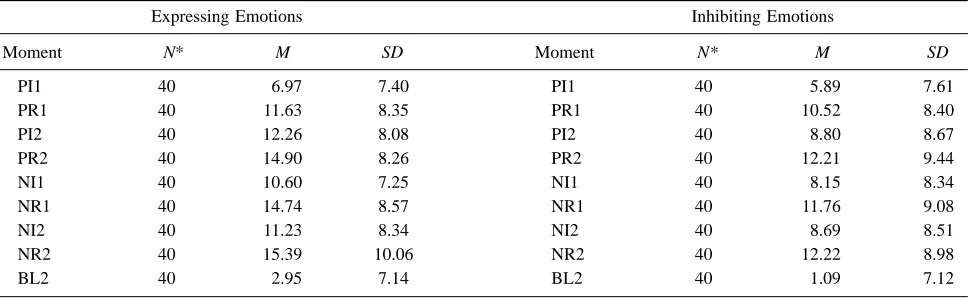
Analyses of the data showed that telling subjects to express first or second did not have a significant effect on reactivity scores, F(1, 38) = 3.86, p = .057 for expressing first and F(1, 38) = 1.32, p = .258 for first inhibiting. Considering that there was no significant difference in sequence effects, data from the two expressing conditions (expressing first and expressing last) were combined in one score, in the same way that data from the two inhibiting conditions were also combined in another score. Thus, there were 40 observations for each experimental moment (PI1, PR1, PI2, PR2, NI1, NI2, NR2), one for each of the 40 participants. Table 1 shows means and standard deviations for expressing and inhibiting emotions in every experimental moment. In further analyses, the reactivity scores for the two positive scenes were combined, as was done with the scores for the two negative ones.
One of the objectives of this study was to investigate whether blood pressure reactivity was affected by the emotional content of the interactions. Repeated analyses of variance revealed that social challenges evoked greater reactivity scores than the positive scenarios, as shown by the significant difference found in MAP reactivity scores during the different moments of the role play, F(4, 156) = 43.948, p < .0001, in the expressing condition (14.74 ± 8.57 mmHg for negative and 11.63 ± 8.35 mmHg for positive scenes) and in the inhibiting condition as well (MAP reactivity scores in negative scenes equal to 11.76 ± 9.08 mmHg ) or to positive scenes (MAP reactivity scores equal to 10.52 ± 8.40 mmHg, F(4, 156) = 41.165, p < .0001. This indicated a significant effect of the type of experimental condition in effect at the time, that is, if the interaction was
positive, or negative, or if the subjects were just listening to the descriptions of the scenes.
To examine whether telling subjects to express or to inhibit feelings during the interactions produced a differential effect on blood pressure, reactivity scores during the two conditions were compared. It was found that reactivity was greater for subjects while they responded during the negative scenes when compared with the other moments of role-play, both in the inhibiting and in the expressing conditions.
Considering only the data for the part of the experimental session that required the expression of emotions, the Tukey-Kramer multiple comparisons test revealed significant differences, such as between mean MAP reactivity to positive (11.63 ± 8.35 mmHg) as opposed to negative scenes (14.74 ± 8.57 mmHg), with the negative scenes eliciting a greater reactivity (p < .001); and between the time the subjects were listening to the descriptions of the scenes, either positive (6.96 ± 7.40mmHg) or negative (10.60 ± 7.25 mmHg ) and the last baseline period (2.95 ± 7.14 mmHg), indicating emotional activity preparatory to the scenes.
In the inhibiting condition, when subjects were required not to express what they felt, there was no significant difference in responding to negative scenes (11.76 ± 9.08 mmHg ) or to positive scenes (10.52 ± 8.40 mmHg) , but the differences between listening to negative or positive scenes were significant when compared with baseline 2 MAP reactivity (1.09 ± 7.12 mmHg). Results indicated that inhibiting feelings during positive or negative interactions did not produce a differential effect on blood pressure reactivity; however, the expression of feeling produced different effects, depending on the emotional content of the interaction, in that responding to challenges elicited greater blood pressure reactivity. Analyses revealed a significant interaction effect between
Table 1
Means and Standard Deviations of Map Reactivity during the Nine Moments of the Experimental Session for the Two Conditions: Expressing and Inhibiting Emotions
Expressing Emotions Inhibiting Emotions
Moment N* M SD Moment N* M SD
PI1 40 6.97 7.40 PI1 40 5.89 7.61
PR1 40 11.63 8.35 PR1 40 10.52 8.40
PI2 40 12.26 8.08 PI2 40 8.80 8.67
PR2 40 14.90 8.26 PR2 40 12.21 9.44
NI1 40 10.60 7.25 NI1 40 8.15 8.34
NR1 40 14.74 8.57 NR1 40 11.76 9.08
NI2 40 11.23 8.34 NI2 40 8.69 8.51
NR2 40 15.39 10.06 NR2 40 12.22 8.98
BL2 40 2.95 7.14 BL2 40 1.09 7.12
Note. Moment: PI1 = Instruction positive scene 1; PR1 = Responding positive scene 1; PI2 = Instruction positive scene 2; PR2 = Responding positive scene 2; NI1 = Instruction negative scene 1; NR1 = Responding negative scene 1; NI2 = Instruction negative scene 2; NR2 = Responding negative scene 2; BL2 = Baseline 2.
expressing/inhibiting emotional response and the type of the scene presented, F(1, 79) = 3.95, p = .050, with the negative scenes eliciting a significant greater blood pressure reactivity.
Heart Rate (HR) Reactivity
Comparison of the heart rate reactivity in the two conditions (expressing or inhibiting emotions) in positive and in negative scenes was performed using repeated analyses of variance. Results showed that there was not a significant difference in HR reactivity for responding in the negative scenes both while subjects expressed or while they inhibited emotions, F(1, 79) = 2.67, p = .106. Similarly, there was no significant difference for responding in the positive scene during the periods of inhibition or expressing emotions, F(1, 79) = 2.67, p = .106. Repeated two-factor analyses of variance showed no significant interaction effects between type of scene (positive or negative) and expressing/suppressing emotions response condition, F(1, 79) = 0.02, p = .896. These findings revealed a stable pattern of heart rate activity, not subject to fluctuations as a function of the experimental conditions or type of scene used and no interaction effect between type of scene and the conditions of expressing or inhibiting emotions.
Discussion
The results of this study confirm that role-play of conflictive social interactions can be associated with substantial elevations in blood pressure, in the absence of comparable changes in heart rate, and that the content of the interactions determines the magnitude of the response, as previously shown by Lipp and Anderson (1999). These authors also made use of role-play of social interactions but did not investigate the effects of emotion regulation. The present study showed that expressing negative feelings during simulated social challenges has a greater effect on blood pressure than inhibiting them in similar situations. Type of scene and the required response interact to yield greater blood pressure reactivity when subjects are required to express emotions during situations that represent social challenges. In this research, participants were subjected to emotional stress and were requested to inhibit the expression of their emotions half of the time in which they were engaged in a role-play situation that involved both positive and conflictive scenarios. During the other half of the session, they were free to express their feelings as they wished. All participants had the diagnosis of mild hypertension, and were so selected on the basis of the literature, which indicates that chronically elevated physiological responses to psychological stress may increase risk of cardiovascular disease.
Our findings lend support to the three hypotheses presented. An association was found between emotion expression and higher cardiovascular reactivity, and blood pressure reactivity was greater during the social challenges.
It had been predicted that, when requested to express or to suppress emotion-focused responses, under social stress, hypertensive individuals would show greater reactivity to the expressing condition, especially during negative interactions. This hypothesis was also confirmed. In fact, whenever requested to express feelings, either negative or positive, the participants’ MAP showed increases, as also happened during the period in which they listened to the description of the scenes and prepared themselves for the interactions. It was interesting to observe that this happened even when the scene described was positive in nature, involving simply the expression of a compliment. The MAP during the listening periods that preceded both positive and negative scenes was significantly higher than the MAP during the final baseline, showing that just listening to interpersonal situations when participation was required was stressful for the subjects. Similar findings were reported by Egloff, Wilhelm, Neubauer, Mauss, and Gross (2002) in a study on the effects of anxiety that showed changes in blood pressure during both speech preparation and delivery.
matter. It is important to note that we did not tell the participants how to feel, in that they were required to suppress the expression of emotions or to express them freely. This may have given rise to subjacent emotions, such as anger, which is often mentioned in the literature as having an important association with blood pressure increases (Scuteri, Parsons, Chesney, & Anderson, 2001). It is suggested that future studies attempt to investigate whether arbitrarily denying or allowing adults to express emotions has a differential effect on blood pressure reactivity, as the expression of emotional stress. It is also necessary to investigate whether this effect varies depending on blood pressure levels of the participants at the beginning of the experiment.
Another finding that requires further investigation is the fact that our participants did not show increased reactivity of HR, while they had increases in MAP; apparently the emotional stress elicited by expressing or inhibiting feelings does not generate reactivity in HR.
Results support the hypothesis proposed by Lipp (2004), who postulated that the difficulty in expressing emotions attributed to hypertensive adults may have a function that is not yet understood. If, when expressing emotions, the blood pressure rises significantly, then it is understandable that hypertensives would avoid expressing emotions. It may be that an alert mechanism exists, not perceptible to others and maybe difficult for hypertensive persons to describe, that serves as a protective system signaling that it would be more comfortable or safer to respond in a less emotional way. This possibility has implications for the psychological work done with hypertensive patients. The difficulty in expressing emotions in this population should be understood taking into account its protective function.
Despite the possible limitations, this study may be useful in helping to clarify why so many hypertensive individuals exhibit difficulty in expressing emotions during social interactions.
Future studies should investigate experimentally how gender and personality traits may affect changes in cardiovascular functioning during moments of interpersonal stress. Additionally, a normotensive comparison group should be included in other researches to verify if the results are specific to hypertension. Although we regard the role-play task as a well-suited paradigm for investigating the effects of stress and emotion on cardiovascular functioning, replications using other scenarios are clearly warranted.
References
Al’Absi, M., Bongard, S., Buchanan, T., & Pincomb, G.A. (1997). Cardiovascular and neuroendocrine adjustment to public speaking and mental arithmetic stressors. Psychophysiology, 34, 266-275.
Alexander, F. (1939). Psychological aspects of medicine. Psychosomatic Medicine, 1, 7-18.
Blascovich, J., & Katkin, E.S. (Eds.). (1993). Cardiovascular reactivity to psychological stress and disease. Washington, DC: American Psychological Association.
Bonanno, G.A., Keltner, D., Holen, A., & Horowitz, M.J. (1995). When avoiding unpleasant emotions might not be such a bad thing: Verbal-autonomic response dissociation and midlife conjugal bereavement. Journal of Personality and Social Psychology, 69, 975-989.
Dayton, M.P., & Mikulas, W.L. (1981). Assertion and non-assertion supported by arousal reduction. Journal of Behavior Therapy and Experimental Psychiatry, 12, 307-309.
Dimsdale, J.E., Stern, M.J., & Dillon, E. (1998). The stress interview as a tool for examining physiological reactivity. Psychosomatic Medicine, 50, 64-71.
Egloff, B., Wilhelm, F., Neubauer, D.H., Mauss, I.B., & Gross, J.J. (2002). Implicit anxiety measure predicts cardiovascular reactivity to an evaluated speaking task. Emotion, 2, 3-11. Egloff, B., Wilhelm, F., Neubauer, D.H., Mauss, I.B., & Gross, J.J.
(2003). Cardiovascular reactivity and development of preclinical and clinical disease states. Psychosomatic Medicine, 65, 46-62. Fritz, H.L., Nagurney, A.J., & Helgeson, V.S. (2003). Social interactions and cardiovascular reactivity during problem disclosure among friends. Personality and Social Psychology Bulletin, 29, 713-725.
García-León, T.H.E., Reyes del Paso, G.A., Robles, H., & Vita, J. (2003). Relative effect of harassment, frustration, and task characteristics on cardiovascular reactivity. Journal of Psychophysiology, 47, 159-173.
Goldstein, H.S., Edelberg, R., Meier, C.F., & Davis, L. (1988). Relationship of resting blood pressure and heart rate to experienced anger and expressed anger. Psychosomatic Medicine, 50, 321-329.
Gross, J.J. (1998). Antecedent- and response-focused emotion regulation: Divergent consequences for experience, expression, and physiology. Journal of Personality and Social Psychology, 74, 224-237.
Gross, J.J, & Levenson, R.W. (1993). Emotional suppression: Physiology, self-report, and expressive behavior, Journal of Personality and Social Psychology, 64, 970-986.
Holt-Lunstad, J., Uchino, B.N., Smith, T.W., Olsen-Cerny, C., & Nealey-Moore, J.B. (2003). Social relationships and ambulatory blood pressure structural and qualitative predictors of cardiovascular function during everyday social interactions. Health Psychology, 22, 388-397.
Isowa, T., Ohira, H., & Murashima, S. (2004). Reactivity of immune, endocrine and cardiovascular parameters to active and passive acute stress. Biological Psychology, 65, 101-120.
James, G., Yee, L., Harshfield, G., Blank, S., & Pickering, T. (1986). The influence of happiness, anger, and anxiety on blood pressure of borderline hypertensives. Psychosomatic Medicine, 48, 502-508.
Julius, M., Harburg, E., Cottington, E.M., & Johnson, E.H. (1986). Anger coping styles, blood pressure and all-cause mortality: A follow-up in Tecumseh, Michigan (1971-1983). American Journal of Epidemiology, 124, 220-223.
Kamarck, T.W., & Lovallo, W.R. (2003). Cardiovascular reactivity to psychological challenge: Conceptual and measurement considerations. Psychosomatic Medicine, 65, 9-21.
Keltikangas-Järvinen, L., & Heponiemi, T. (2004). Vital exhaustion, temperament, and cardiac reactivity in task-induced stress. Biological Psychology, 65, 121-135.
Labott, S.M., Ahleman, S., Wolever, M.E., & Martin, R.B. (1990). The physiological and psychological effects of expression and inhibition of emotion. Behavioral Medicine, 16, 182-189. Lassner J.B., Matthews, K.A., & Stoney, C.M. (1994). Are
cardiovascular reactors to a social stress also reactors to social stress? Journal of Personality and Social Psychology, 66, 69-77. Light, K.C., Sherwood, T.H.E., & Turner, J.R. (1992). High cardiovascular reactivity to stress: The predictor of later hypertension development. In J.R. Turner, A. Sherwood, & K.C. Light (Eds.), Individual differences in cardiovascular response to stress (pp.281-293). New York: Plenum. Lipp, M.E.N. (2004). Stress no Brasil: Pesquisas Avançadas.
Campinas, Brasil: Papirus.
Lipp, M.E.N., & Anderson, D.E. (1996). Different measures of assertiveness in adults. Estudos de Psicologia, 13, 19-26. Lipp, M.E.N, & Anderson, D.E. (1999). Cardiovascular reactivity
to simulated social stress. Stress Medicine, 15, 249-257. Loures, D.L., SantÁnna, I., Baldotto, C.S.R., Sousa, E.B., & Nóbrega,
A.C.L. (2002). Estresse mental e o sistema cardiovascular. Arquivos Brasileiros de Cardiologia, 78, 525-530.
Lovallo, W.R., & Gerin, W. (2003). Psychophysiological reactivity: Mechanisms and pathways to cardiovascular disease. Psychosomatic Medicine, 65, 36-45.
Lovallo, W.R., & Wilson, M.F. (1992). A biobehavioral model of hypertension development. In R.J. Turner, A. Sherwood, & K.C. Light (Eds.), Individual differences in cardiovascular responses to stress (pp. 265-280). New York: Plenum. Manuck, S.B., Kasprowicz, A.L., Monroe, S.M., Larkin, K.T., &
Kaplan, J.R. (1989). Psychophysiologic reactivity as a dimension of individual differences. In. N. Schneiderman, S.M. Weiss, & P.G. Kaufmann (Eds.), Handbook of research methods in cardiovascular behavioral medicine (pp. 365-382). New York: Plenum.
Mendes, W.B., Reis, H.T., Seery, M.D, & Blascovich, J. (2003). Cardiovascular correlates of emotional expression and suppression: Do content and gender context matter? Journal of Personality and Social Psychology, 84, 771-792.
Morrison, R.L., Bellack, A.S., & Manuck, S.B. (1985). Role of social competence in borderline essential hypertension. Journal of Consulting and Clinical Psychology, 53, 248-255. Perini, C., Muller, F.B., & Buhler, F.R. (1991). Suppressed
aggression accelerates early development of essential hypertension. Journal of Hypertension, 9, 499-503.
Pickering, T.G. (1987). Blood pressure monitoring outside the clinic for investigating the role of behavioral factors in hypertension.
In S. Julius & D.R. Basset (Eds.), Handbook of hypertension, Vol. 9: Behavioral factors in hypertension (pp. 162-175). New York: Elsevier.
Rathus, S.A. (1973). A 30-item schedule for assessing assertiveness. Journal of Behavioral Therapy, 4, 398-406.
Roter, D.L., & Ewart, C.K. (1992). Emotion inhibition in essential hypertension: Obstacle to communication during medical visits? Health Psychology, 11, 163-169.
Schneider, G.M., Jacobs, D.W., Gevirtz, R.N., & O’Connor, D.T. (2003). Cardiovascular haemodynamic response to repeated mental stress in normotensive subjects at genetic risk of hypertension: Evidence of enhanced reactivity, blunted adaptation, and delayed recovery. Journal of Human Hypertension, 17, 829-840.
Schwartz, A.R., Gerin, W., Davidson, K.W., Pickering, T.G, Brosschot, J.F., Thayer, J.F., Christenfeld, N., & Liden, W. (2003). Toward the causal model of cardiovascular responses to stress and the development of cardiovascular disease. Psychosomatic Medicine, 65, 22-35.
Scuteri, A., Parsons, D., Chesney, M.A., & Anderson, D.E. (2001). Anger inhibition potentiates the association of high end-tidal CO2with blood pressure in women. Psychosomatic Medicine,
63, 470-475.
Smith, T.W., Limon, J.P., Gallo, L.C., & Ngu, L.Q. (1996). Interpersonal control and cardiovascular reactivity: Goals, behavioral expression, and the moderating effects of sex. Journal of Personality and Social Psychology, 70, 1012-1024. Spielberger, C., Crane, R.S., Kearns, W.D., Pellegrin, K.L., & Rickman, R.L. (1991). Anger and anxiety in essential hypertension. In C. Spielberger & I.G. Sarason (Eds.), Stress and Emotion (Vol. 14, pp. 266-283). New York: Hemisphere. Steptoe, A. (1993). Stress and the cardiovascular system: A psychosocial perspective. In S.C. Stanford & P. Salmon (Eds.), Stress: From synapse to syndrome (pp. 119-141). London: Academic Press.
Treiber, F.A., Kamarck, T., Scheneiderman, N., Sheffield, D., Kapuku, G., & Taylor, T. (2003). Cardiovascular reactivity and development of preclinical and clinical disease states. Psychosomatic Medicine, 65, 46-62.
Vogele, C., Jarvis, A., & Cheeseman, K. (1997). Anger suppression, reactivity, and hypertension risk: Gender makes a difference. Annals of Behavioral Medicine, 19, 61-69.
Vogele, C., & Steptoe, A. (1993). Anger inhibition and family history as modulators of cardiovascular responses to mental stress in adolescent boys. Journal of Psychosomatic Research, 37, 503-514.
Weiner, H. (1977). Psychobiology and human disease. New York: Elsevier.
Wolf S., Cardon, P.V., Shepherd, E.M., & Wolff, H.G. (1955). Life stress and essential hypertension. Baltimore: Williams & Wilkins.