Exploring the Effect of Thermo-mechanical Processing on
Total Elongation of a Novel Biomedical Titanium Alloy
Mohsin Talib Mohammed
1,2*, Zahid A. Khan
2, Geetha M.
3, Arshad Noor Siddiquee
21 Mechanical Engineering Department, Faculty of Engineering, Kufa University, Najaf, Iraq (Ph.D Scholar in
2 Mechanical Engineering Department, Jamia Millia Islamia (A Central University), New Delhi-110025, India. 3 Centre for Biomaterials Science and Technology, SMBS, VIT University, Vellore-632 014, India.
* Corresponding author. Tel.: 0091-9560924684; email: [email protected] Manuscript submitted January 10, 2015; accepted May 28, 2015.
Abstract: The aim of this paper is to investigate the influence of different thermo-mechanical processing (TMP) parameters on the fracture plasticity (total elongation to failure) of a novel near β alloy Ti-20.6Nb-13.6Zr-0.5V (TNZV). The TMP scheme comprised of hot working above and below β phase, solutionizing treatment above and below β phase coupled with different cooling rates. Factorial design of experiment was used to systematically collect data for total elongation to failure. Validity of assumptions related to the collected data was checked through several diagnostic tests. The analysis of variance (ANOVA) was used to determine the significance of the main and interaction effects. Finally, optimization of the TMP process parameters was also done to achieve optimum values of the total elongation. The results indicated that the working temperature at 850 0C, solution treatment temperature at 850 0C and water quenching is the optimum combination of TMP parameters and their levels to yield the optimum elongation.
Key words: Titanium alloys, biomedical applications, elongation, ANOVA.
1.
Introduction
Titanium (Ti) and its alloys are considered to be the material of choice for replacing or repairing failed hard tissues (structural biomedical applications) as these materials present excellent biocompatibility, high strength to density ratio, outstanding corrosion resistance as well as low Young's modulus [1]-[3].
safe Ti-based alloys for biomedical applications depending upon its ability to achieve biological passivity and capacity of reducing the Young's modulus [10].
The mechanical properties depend strongly on the alloy composition, processing history, heat treatment conditions which decide the varieties of microstructures [11]. Metastable-β Ti alloys respond to thermal treatment and thermo-mechanical processing (TMP) and various micro-structural constituents like the size, shape and the amount of the various phases can be modified by varying the TMP parameters. However, the influence of thermal treatment and TMP on micro-structural features of as-cast Ti–Nb–Zr alloy system and in turn on its mechanical is scarcely reported. Majumdar et al. studied the role of TMP on microstructure and mechanical properties of Ti–13Nb-13Zr alloy (TNZ) [12]. Their results clearly revealed the dependence of the mechanical properties on the cooling rate after solution treatment.
Recently, novel biomedical Ti alloys with superior mechanical properties have attracted special attention from engineers and materials scientists. Therefore, we have designed a new Ti alloy (TNZV) consisting of titanium-niobium (Nb)-zirconium (Zr) based alloy containing small amounts of vanadium (V) to be suitable for biomedical applications. Nb, Zr and V, having a β-phase stabilizing effect for Ti alloys, were chosen to control microstructure desirably. In view of the fact that V is associated with toxicity, a minimal concentration of V is used in the developed alloy. Recent studies carried out by the authors of this paper have investigated the effect of TMP on microstructure, mechanical properties and electrochemical behavior of the TNZV alloy [13]-[16]. It has been found that the TNZV alloy shows good mechanical and corrosion properties and thus it is recommended as prospective implantable material. In this study, microstructure control was carried out by performing hot working in β phase field as well as in (α + β) field followed by heat treatment at β phase field and also at (α + β) field . The samples heat treated at different temperatures were subjected to different cooling rates. Analysis of Variance (ANOVA) is one of the most frequently used statistical techniques which is used to evaluate the effect of TMP parameters on the requisite properties of biomedical Ti alloys. It appears from the reported literature that very few researchers have applied the statistical technique to investigate the effect of TMP parameters on the mechanical properties of biomedical Ti alloys. In this paper, an attempt has been made to statistically analyze the effect of TMP parameters on the total elongation to failure (e%) of a new TNZV alloy. The results are explained with the help of firm technical discussions derived and co-related to micro-structure.
2.
Experimental Procedures
The alloy in the present investigation was cast using the facility available at Defense Metallurgical Research Laboratory (DMRL), India using mixture of sponge Ti with Nb powder and Zr chips as raw materials. The Ti-20.6Nb-13.6Zr-0.5V (TNZV) alloy was prepared using the non-consumable vacuum arc melting technique and obtained in the form of 600 g pancakes. The pancakes were re-melted three times to ensure compositional homogeneity, so obtaining compact and homogenous ingots with neither weight loss nor oxidation. The composition of the alloy was analyzed and the same in wt% is given in Table 1.
Table 1. The Chemical Composition (wt%) of TNZV Alloy Used in this Study
Ti (Wt %) Nb (Wt%) Zr (Wt%) V (Wt%) Fe (Wt%)
Balance 20.6 13.6 0.5 0.14
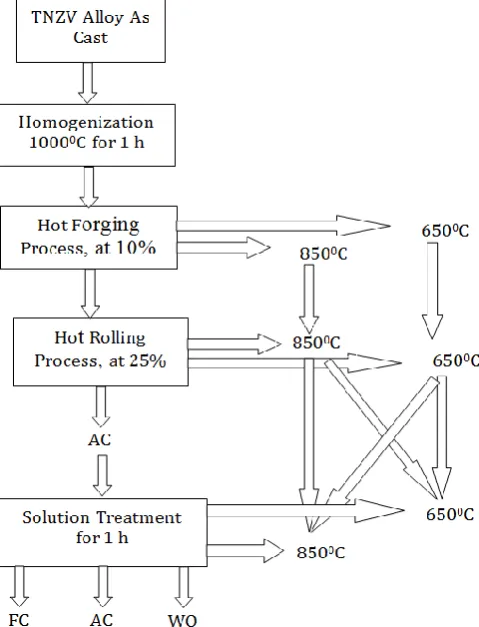
alloy was measured to be 6950C. Subsequently, the homogenized samples were given 10% reduction by forging at above 8500C and below 6500C (the β transition temperature) and later directly subjected to a reduction of 25% by rolling at the same temperatures and were finally air cooled to room temperature. After entire plastic working was accomplished, the alloy remained free from any of the metal working defects which indicated that the entire metal working process was performed successfully. The hot deformed TNZV samples were also solution treated at 8500C (above β transus) and 6500C (below β transus) for 1h in a dynamic argon atmosphere; this was followed by furnace cooling (FC), air cooling (AC), and water quenching (WQ). The entire TMP scheme of TNZV alloy is shown in Fig. 1.
Fig. 1. Flow chart depicting the schedule for thermo-mechanical processing
The composition of the major and trace elements was determined using X-Ray Fluorescent (XRF) Spectrometer (Oxford- X Srata, model: ISIS 1559). Microstructure analysis of the heat treated samples was carried out using an optical microscope (Carl Zeiss with Clemax Software version 3) and field emission scanning electron microscope (FE-SEM,NOVA NANO SEM 450 FEI, Netherlands) at 2 kV. For this, the metallographic samples were prepared using standard techniques for Ti and its alloys [17]. The samples were ground to 1200 grit with silicon carbide (SiC), followed by final polishing to a mirror finish using 0.5µm diamond paste. The metallographically polished samples were etched with Kroll’s reagent (10 vol% HF and 5 vol% HNO3 in water). Room temperature X-ray diffraction analysis was carried out using an X-ray Diffractometer, Philips, Holland, PW 1830 with Cu Kα radiation (wavelength 1.54056°A) at an accelerating voltage of 40 kV and a current of 30 mA.
tensile specimens with dimensions: 10 mm width, 4 mm in thickness and a gage length of 25 mm were precisely machined using Wire Electrical Discharge Machine (Wire- EDM). After machining, tensile specimens were polished using SiC waterproof papers of up to #2500 grit and the gage length of the specimens was mechanically polished using a diamond paste with a particle size 0.5 μm.
3.
Design of Experiments
In this study, three TMP parameters i.e. hot working temperature, solution treatment temperature and type of cooling were considered. Two levels each for working temperature and solution treatment temperature and three levels of type of cooling was considered. Table 2 shows the TMP parameters and their levels.
Table 2. Experimental Factors and Their Levels
Factor Symbol Unit Level-1 Level-2 Level-3
Working temperature A 0C 650 850
Solution treatment
temperature B
0C 650 850
Cooling type C Furnace
cooling (FC) cooling(AC) Air quenching Water
(WQ)
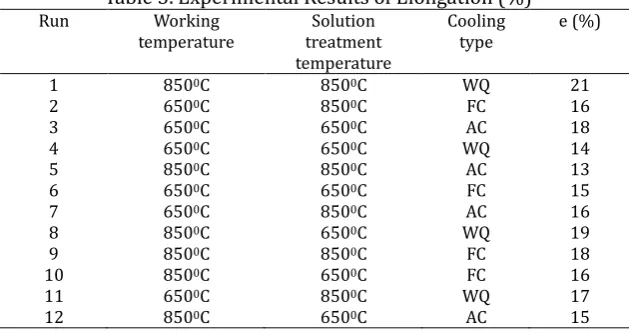
A general Factorial Design of experiment was used to investigate the effect of TMP parameters on the response variable i.e. e%. The general factorial design and the experimental results for e% are shown in Table 3.
Table 3. Experimental Results of Elongation (%)
Run Working
temperature treatment Solution
temperature
Cooling
type e (%)
1 8500C 8500C WQ 21
2 6500C 8500C FC 16
3 6500C 6500C AC 18
4 6500C 6500C WQ 14
5 8500C 8500C AC 13
6 6500C 6500C FC 15
7 6500C 8500C AC 16
8 8500C 6500C WQ 19
9 8500C 8500C FC 18
10 8500C 6500C FC 16
11 6500C 8500C WQ 17
12 8500C 6500C AC 15
4.
Results and Discussion
4.1.
Micro-structural Analysis of as Cast TNZV Alloy
The microstructure observations of the as-cast present TNZV alloy which is called as “near- β- alloy” performed using optical microscopy (OM) and SEM. These micro-structural tests showed the presence of fine needle like α phase (acicular α) in former β-phase matrix with segregation of α phase on grain boundaries (Fig. 2 (a-b)). For each former β-grain, twelve different crystal orientations of the α precipitates (variants) are available according to the Burgers relationship [18], which links particular crystal directions and planes of both phases:
These phase constitutions were identified from XRD spectra as shown in Fig. 2(c). XRD profiles revealed peaks corresponding to only α and β phases in as-cast TNZV alloy.
Fig. 2. Microstructure of as-cast TNZV alloy: (a) Scanning Electron Microstructure (SEM), (b) X-ray diffraction profiles
4.2.
Statistical Analysis of Experimental Results
The experimental results shown in Table 3 were analyzed through Design-Expert 6.5.0 software. Analysis of variance (ANOVA) was employed to find the effects of TMP parameters on the response variable. The details of the analysis are given in the following sections:
4.2.1. Analysis of total elongation
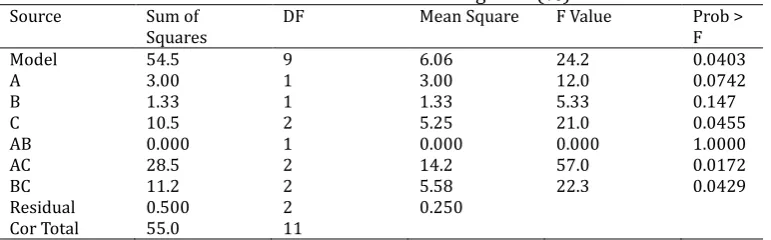
In general, high mechanical properties are supposed to be contradictory aspects for specific solid materials, particularly for metals and alloys in biomedical applications. The high mechanical properties are necessary for the implants to meet the requirements of complex stresses including tension, compression, bending and torsion which the implants are subjected to during the routine activities. Moreover, the high elongation of metallic materials for biomedical applications is required to be more than 10 % [19]. The results of analysis of variance (ANOVA) for e% of TNZV alloy after TMP are shown in Table 4 which shows the sum of squares (SS), degrees of freedom (DF), mean squares (MS), F-values (F-VAL.) and "Prob > F" values. It may be noted that values of "Prob > F" less than 0.0500 indicate that the main factor and the interaction between factors significantly affect the response variable. It can be seen from Table 4 that the model is significant. Further, Table 4 also shows that within the range investigated, the cooling type (C) and two way interactions (AC) and (BC) have significant effect on the e%. However, working temperature (A), solution treatment temperature (B) and one way interaction (AB) do not significantly affect the e%.
Table 4. ANOVA Results of Elongation (%)
Source Sum of
Squares DF Mean Square F Value Prob > F
Model 54.5 9 6.06 24.2 0.0403
A 3.00 1 3.00 12.0 0.0742
B 1.33 1 1.33 5.33 0.147
C 10.5 2 5.25 21.0 0.0455
AB 0.000 1 0.000 0.000 1.0000
AC 28.5 2 14.2 57.0 0.0172
BC 11.2 2 5.58 22.3 0.0429
Residual 0.500 2 0.250
Cor Total 55.0 11
The microstructure of the investigated TNZV alloy depends essentially upon both the hot working process and the subsequent heat treatment sequences. In the present study, thermo-mechanical processing was carried out by performing 10% forging plus 25% rolling at above β transus (8500C) and below it (6500C). The hot working at 8500C is considered to be an effective process which produces dynamical recrystallization (DRX) with equiaxed structure [12], while hot working at 6500C with heavy working (>30%) creates structure consisting of elongated grains in the direction of working [20] with simultaneous nucleation of α phase during the plastic working [12]. It is expected that hot working in the α + β phase field produces low angle tilt boundary which serves as nucleation sites of α phase during subsequent cooling.
It is reported that partitioning of alloying elements occurs during solution treatment at below transus temperature along with β to α transformation [12], [21], [22]. The distribution of the alloying elements depends upon their solubility, diffusion rate, as well as the time allowed for diffusion to take place [23]. Therefore, β phase becomes enriched with Nb, Zr and V elements during this treatment which reduces the martensite start temperature (Ms) of the untransformed β to below room temperature [22] and thus no martensite was created on water quenching from 6500C. The microstructure with suppressed martensite formation with high amount of α phase results in significant decrease in the elongation.
Fig. 3. Microstructure of the TNZV alloy deformed at 8500C and solution treated at 8500C for 1h followed by water quenching (a) scanning electron microstructure (20000X) [13], [16], (b) Optical microstructure
[13]
the formation of orthorhombic α′′ martensite after water quenching from 8500C. It is reported that the orthorhombic structure of α′′ phase are obtained because Ti/Nb one-to-one correspondence between the atoms associated with the phase change (leading to the final hexagonal structure) could not complete due to water quenching which results in formation of orthorhombic α′′ phase [34]. Therefore, it is expected that the formation of soft β and α′′ martensite phases in the microstructure of water quenched samples plays an important role in producing higher elongation compared with other heat treated samples. It is pointed out [12], [32] that the martensitic structure possesses better ductility (elongation) which is in good agreement with the present elongation result of water quenched samples. On the other hand, any increase in the volume fraction of α phase leads to significant decrease in ductility. Fig. 3 shows the presence of martensitic phase in samples which were water quenched from above β transus temperature (8500C).
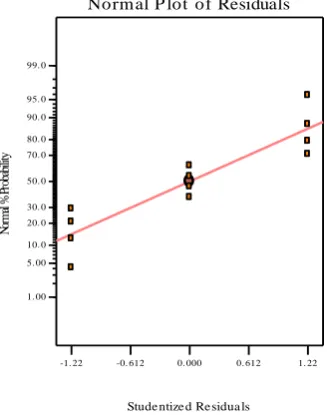
Fig. 4 presents the normal probability plot of the residuals for elongation. This plot reveals that the residuals either fall on a straight line or are very close to the line implying that the errors are distributed normally.
Fig. 4. Normal probability plot for elongation
Fig. 5 does not reveal any outlier which also implies that the errors are normally distributed.
Fig. 5. Plot of outlier T for elongation
DESIGN-EXPERT Plo t Elo n g atio n
Stude ntize d Re sidua ls
N or m al % P ro ba bi lit y
Normal P lot of Residuals
-1. 22 -0. 612 0. 000 0. 612 1. 22
1. 00 5. 00 10. 0 20. 0 30. 0 50. 0 70. 0 80. 0 90. 0 95. 0 99. 0
DESIGN-EXPERT Plo t Elo n g atio n
Run Num be r
O
ut
lie
r
T
Out lier T
-3. 50 -1. 75 0. 000 1. 75 3. 50
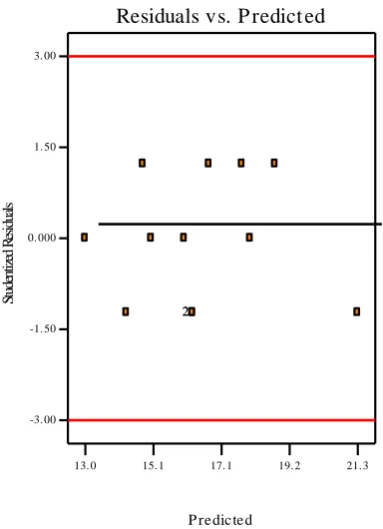
Fig. 6 shows the standardized residuals with respect to the predicted values of elongation. The residuals do not show any obvious pattren and are distributed in both positive and negative directions. This implies that the model is adequate and there is no reason to suspect any violation of the independence or constant variance assumption.
Fig. 6. Plot of residuals vs. predicted for elongation
Fig. 7 shows the effect of varying the working temperature on elongation. It can be seen from Fig. 7 that an increase in the working temperature does not cause a significant increase in the elongation.
Fig. 7. Effect of working temperature on elongation
DESIGN-EXPERT Plo t Elo n g atio n
2 2
P redicted
St
ud
en
tiz
ed
R
es
id
ua
ls
Residuals vs. P redict ed
-3. 00 -1. 50 0. 000 1. 50 3. 00
13. 0 15. 1 17. 1 19. 2 21. 3
DES IGN-EXP ERT P lo t Elo n g atio n X = A: Ho t Wo rk in g Temp eratu re
Desig n P o in ts
Actu al F acto rs
B: S o lu tio n Treatmen t Temp eratu re = Lev el 1 o f B C: Co o lin g Rate = Lev el 1 o f C
A: Hot Working Temperature
E
lo
ng
at
io
n
One Factor Plot
Level 1 of A Level 2 of A
13 15 17 19
Fig. 8 shows the effect of variation in the solution treatment temperature on the elongation. It can be seen from Fig. 8 that an increase in the solution treatment temperature does not result in a significant increase in the elongation.
Fig.8. Effect of solution treatment temperature on elongation
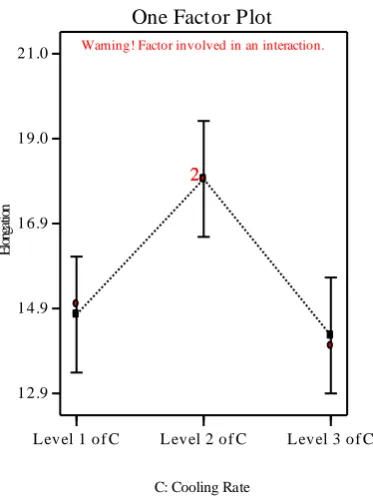
Fig. 9 shows the effect of the cooling type on the elongation which reveals a significant change in
the elongation and the elongation is maximum in case of air cooling and minimum in case of water
quenching.
Fig. 9. Effect of cooling type on elongation
DESIGN-EXPERT Plo t
Elo n g atio n
X = B: So lu tio n Treatmen t Temp eratu re
Desig n Po in ts
Actu al Facto rs
A: Ho t Wo rk in g Temp eratu re = Lev el 1 o f A C: Co o lin g Rate = Lev el 1 o f C
B: Solution Treatm ent Tem perature
E
lo
ng
at
io
n
One Fact or P lot
L e ve l 1 of B L e ve l 2 of B 13. 0
15. 0 17. 0 19. 0
21. 0 W arning! Facto r involved in an interaction.
DES IGN-EXP ERT P lo t Elo n g atio n X = C: Co o lin g Rate
Desig n P o in ts
Actu al F acto rs
A: Ho t Wo rk in g Temp eratu re = Lev el 1 o f A B: S o lu tio n Treatmen t Temp eratu re = Lev el 1 o f B
C: Cooling Rate
E
lo
ng
at
io
n
One Factor Plot
Level 1 of C Level 2 of C Level 3 of C
12.9 14.9 16.9 19.0
21.0 Warning! Factor involved in an interaction.
4.2.2 Optimization of total elongation
The objective of the optimization is to find the best combination of TMP parameters within the working temperature range from 6500C to 8500C; the solution treatment temperature range from 6500C to 8500C, and a type of cooling range from FC to WQ. The optimized TMP parameters are such that they give maximum value of the elongation. Fig. 10 shows the optimum value of TMP parameters that yields maximum value of the elongation.
It can be seen from Fig. 10 that the working temperature(8500C , solution treatment temperature (8500C), and cooling (water quenching) results in the optimum value of the elongation (e%=21). The elongation of metals is closely related to its microstructure and hence the microstructure evolved after thermal and TMP is expected to influence the elongation considerably. Amongst all heat treatment conditions, the samples which are solution treated in the β field (at 8500C) after hot working at 8500C followed by water quenching established higher elongation owing to the presence of martensite and β phases in the microstructure which led to increase in the elongation significantly. Therefore, the formation of martensite with insufficient amount of α phase in the microstructure as shown in Fig. 3 leads to increase in elongation after water quenching from 8500C.
Fig. 10. Ramp function graph for elongation after Thermo-mechanical processing
The microstructure of the optimized value of elongation contrasts with the experiment condition (Experimental run 5 shown in Table 3) in which lowest elongation was obtained. The micro-graphs of both (Fig. 3 and Fig. 11 respectively) clearly reveal that in case of optimum elongation the martensite phase is significant whereas the α phase is more in the microstructure of the samples which have lowest elongation. The microstructure of air cooled samples consisted Widmanstätten α laths (basketweave arrangement) that was composed of different variations of α plates within prior β grains [12], [30]. In other words, the microstructure of air cooled samples showed the presence of fine α-β structure within pre-existing β grains. The micrograph for the worst elongation samples is shown in Fig. 11.
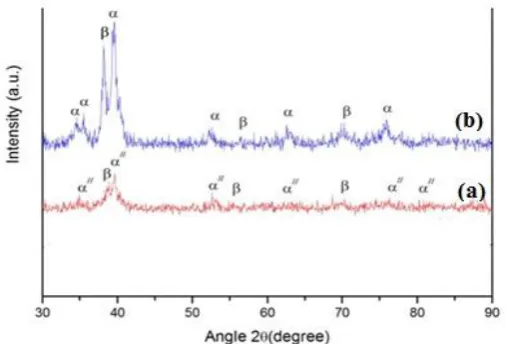
For getting an in-depth understanding, the above phase constitutions in the microstructures of both water quenched and air cooled TNZV alloy samples were identified using XRD spectra as shown in Fig. 12. The presence of peaks of α and β phases in air cooled TNZV samples was observed while martensite was identified in water quenched samples.
Fig. 12. X-ray diffraction profiles of TNZV alloy, (a) deformed at 8500C and solution treated at 8500C for 1h followed by water quenching (WQ), (b) deformed at 8500C and solution treated at 8500C for 1h followed by
air cooling (AC).
5.
Conclusion
The strive for the search of compatible biomaterials is the need of the day. Development of new biomaterials, understanding their behavior during typical thermo-mechanical processing is an effective methodology to address to this issue. In line with the urge of the day novel Ti based bio-material was developed and a comprehensive study on its thermo-mechanical processing was performed and the effect of thermo-mechanical processing on microstructure and the total elongation to failure of near-β Ti–20.6Zr–13.6Nb-0.5V alloy for biomedical applications has been statically investigated. Based on the analysis of the results, following conclusions are drawn:
1.The microstructure of the thermo-mechanically treated TNZV alloy consisted mainly of equiaxed/elongated α, β phases with different morphologies and metastable martensite phase depending upon the heat treatment conditions.
2.Martensitic transformations played a significant role in increasing the total elongation to failure of all heat treated samples.
As per the results of the study the total elongation to failure of the investigated TNZV alloy suggests that the alloy is appropriate for biomedical applications.
Acknowledgment
Mohsin Talib Mohammed would like to sincerely acknowledge the financial assistance provided by the Government of Iraq, Ministry of High Education and Scientific Research. He would also like to thank the Indian Council of Cultural Relations (ICCR), New Delhi, India for supporting him during the period of his Ph.D program. Many thanks to Defense Metallurgical and Research Laboratories-Hyderabad, India for helping us with manufacturing cast Ti alloy.
References
[1] Wang, K. (1996). The use of titanium for medical applications in the USA. Mater Sci. Eng. A,, 213, 134-137.
[2] Long, M., & Rack, H. J. (1998). Titanium alloys in total joint replacement–a materials science perspective. Biomaterials, 19, 1621–1639.
[3] Niinomi, M. (2003). Recent research and development in titanium alloys for biomedical applications and healthcare goods. Science and Technology of Advanced Materials, 4, 445-454.
[4] Karthega, M., Raman, V., & Rajendran, N. (2007). Influence of potential on the electrochemical behaviour of β titanium alloys in Hank’s solution. Acta Biomater, 3, 1019-1023.
[5] Raabe, D., Sander, B., Friak, M., Ma, D., Neugebauer, J. (2007). Theory-guided bottom-up design of β-titanium alloys as biomaterials based on first principles calculations: theory and experiments. Acta
Mater., 55, 4475-4487.
[6] Niinomi, M. (2002). Recent metallic materials for biomedical applications. Met Mater Trans A, 33, 477–486.
[7] Mohsin, T. M., Zahid, A., & Arshad, N. (2012). Influence of thermal and thermo-mechanical treatments on mechanical compatibility of biomedical titanium alloys: A review. International Review of
Mechanical Engineering, 6(7), 1388-1401.
[8] Abdel-Hady, M., Hinoshitaa, K., Morinagaa, M. (2006). General approach to phase stability and elastic properties of β-type Ti alloys using electronic parameters. Scr. Mater., 55, 477-480.
[9] Been, J., & Grauman, J. S. (2000). Titanium and Titanium Alloys, New York: John & Wiley, Inc.
[10]Yang, G., & Zhang, T. (2005). Phase transformation and mechanical properties of the Ti50Zr30Nb10Ta10 alloy with low modulus and biocompatible. J. Alloys Compd., 392, 291-294.
[11]Ding, R., Guo, Z. X., & Wilson, A. (2002). Microstructural evolution of a Ti-6Al-4V alloy during thermomechanical processing. Mater. Sci. Eng. A, 327, 233-245.
[12]Majumdar, P., Singh, S. B., Chakraborty, M. (2011). The role of heat treatment on microstructure and mechanical properties of Ti–13Zr–13Nb alloy for biomedical load bearing applications. J. Mech. Behav.
Biomed. Mater., 4, 1132-1144.
[13]Mohsin, T. M., Zahid, A., Geetha, M., & Arshad, N. (2014). Micro-hardness and Young's modulus of a thermo-mechanically processed biomedical titanium alloy. Biomaterials and Biomedical Engineering, 1, 107-120.
[14]Mohsin, T. M., Zahid, A., Geetha, M., & Arshad, N. (2015). Microstructure, mechanical properties and electrochemical behavior of a novel biomedical titanium alloy subjected to thermo-mechanical processing including aging, J. Alloys Compd., 634, 272–280.
new metastable β-titanium biomedical alloy, Bull. Mater. Sci., 38, 247–258.
[16]Mohsin, T. M., Zahid, A., Geetha, M., & Arshad, N., Influence of thermomechanical processing on biomechanical compatibility and electrochemical behavior of new near beta alloy, Ti-20.6Nb-13.6Zr-0.5V, International Journal of Nanomedicine.
[17]Kuhn, H., & Medlin, D. (1972). Mechanical testing and evaluation. Metals Handbook. 8, ASM International, OH.
[18]Burgers, W. (1934). On the process of transition of the cubic-body-centered modification into the hexagonal-close-packed modification of zirconium. Physica, 1, 561–586.
[19]Niinomi, M. (1998). Mechanical properties of biomedical titanium alloys. Mater. Sci. Eng. A., 243, 231-236.
[20]Freese, H. L., Volas, M. G., & Wood, J. R., (2001). Titanium in Medicine. In: Brunette, D.M., Tengvall, P., Texfor, M., Thomsen, P. (Eds.), New York: Springer.
[21]Boyer, R., Welsch, G., & Collings, E. W. (1994). Materials Properties Hand Book: Titanium Alloys (1st ed.). ASM International, OH.
[22]Tang, X., Ahmed, T., & Rack, H. J. (2000). Phase transformations in Ti–Nb–Taand Ti–Nb–Ta–Zr alloys. J.
Mater. Sci., 35, 1805–1811.
[23]Mansur, A., Azdiar G. A., Dmytro S. G., Orest I. M., & Elena P. V. (2012). Microstructure evolution and alloying elements distribution between the phases in powder near-β titanium alloys during thermo-mechanical processing. J Mater Sci., 47, 7013–7025.
[24]Banerjee, D., & Krishnan, R. V. (1981). Challenges in alloy design: Titanium for the aerospace industry. In: Ranganathan, S., Arunachalam, V. S., Cahn, R.W. (Eds.), Alloy Design. Indian Academy of Sciences, Bangalore.
[25]Majumdar, P. (2012). Effects of heat treatment on evolution of microstructure of boron free and boron containing biomedical Ti–13Zr–13Nb alloys. Micron, 43, 876–886.
[26]Collings, E. W., (1984). Physical metallurgy of titanium alloys. ASM, Metals Park, OH.
[27]Ahmed, T. & Rack, H. J. (1996). Martensitic transformations in Ti-(16–26 at %) Nb Alloys. J Mater Sci.,
31, 4267–4276.
[28]Hao, Y. L., Niinomi, M., Kuroda, D., Fukunaga, K., Zhou, Y. L., Yang, R., & Suzuki, A. (2002). Young’s modulus and mechanical properties of Ti-29Nb-13Ta-4.6Zr in relation to α′′ martensite. Metallurgical
and Materials Transactions A, 33, 3137-3144.
[29]Mantani, Y., & Tajima, M. (2006). Phase transformation of quenched α′′ martensite by aging in Ti–Nb alloys. Mater Sci Eng A, 438–440, 315–319.
[30]Banumathy, S., Prasad, K. S., Mandal, R. K., & Singh, A. K. (2011). Effect of thermomechanical processing on evolution of various phases in Ti-Nb alloys. Bull. Mater. Sci., 34, 1421-1434.
[31]Taekyung, L., Yoon-Uk, H., & Chong, S. L. (2013). Microstructure tailoring to enhance strength and ductility in Ti-13Nb-13Zr for biomedical application. Scripta Materialia, 69, 785-788.
[32]Moffat, D., & Larbalestier D. (1088). The competition between martensite and omega in quenched Ti-Nb alloys. Metall. Mater. Trans. A., 19, 1677-1686.
[33]Geetha, M., Singh, A. K., Muraleedharan, K., Gogia, A. K., & Asokamani, R. (2001). Effect of thermomechanical processing on microstructure of a Ti-13Nb-13Zr alloy. J. Alloys Compd., 329, 264-271.
Mohsin Talib Mohammed is lecturer of mechanical engineering at Kufa university in Najaf city, Iraq. His major research interest includes engineering materials properties, heat treatment of metals, composite materials, and biomaterials. He has published 19 articles in reputed journals. He received his M. Sc. (Metal Engineering) and B. Sc. (Production and Metallurgical Engineering) both from University of Technology in Baghdad, Iraq.
Zahid A. Khan is professor of Industrial and Production Engineering at Jamia Millia Islamia in New Delhi, India. His major research interest includes environmental ergonomics, human-computer-interaction, and optimization of design & process parameters using the Taguchi design of experiment, quality engineering, and ANN & Fuzzy modeling. He has published more than 70 articles in reputed journals. He received his Ph.D. from Jamia Millia Islamia. He also received M. Sc. (Industrial and Production Engineering) and B. Sc. (Mechanical Engineering), both from Aligarh Muslim University, India.
Geetha Manivasagam is currently heading the Centre For Biomaterials Science and Technology, an Interdisciplinary centre consisting of members from various disciplines such as Mechanical, Chemistry, Electrical and Biotechnology. She is also a professor in School of Mechanical and Building Sciences at VIT University in Vellore, India. She is working in the area of Ti based biomedical alloys for the past 16 years. She has published nearly 55 papers in reputed international journal and presented several invited talks in both international and national conferences and nearly 40 papers in national and International conferences.

![Fig. 3. Microstructure of the TNZV alloy deformed at 8500C and solution treated at 8500C for 1h followed by water quenching (a) scanning electron microstructure (20000X) [13], [16], (b) Optical microstructure [13]](https://thumb-us.123doks.com/thumbv2/123dok_us/7920.2000462/6.595.136.459.319.481/microstructure-deformed-solution-followed-quenching-electron-microstructure-microstructure.webp)
![Fig. 11. Microstructures of the TNZV alloy deformed at 8500C and solution treated at 8500C for 1h followed by air cooling (a) scanning electron microstructure (20000X) [16], (b) optical microstructure [16]](https://thumb-us.123doks.com/thumbv2/123dok_us/7920.2000462/10.595.138.460.310.556/microstructures-deformed-solution-followed-scanning-electron-microstructure-microstructure.webp)