Corrective Feedback and Iranian EFL Learners'
Spoken Complexity and Accuracy
Farahman Farrokhi
Department of English Language & Literature, University of Tabriz Tabriz, Iran
Mohammad Zohrabi
Department of English Language & Literature, University of Tabriz Tabriz, Iran
Mohammad Hassan Chehr Azad1
Department of English Language & Literature, University of Tabriz Tabriz, Iran
Abstract
One of the possible negative consequences of the corrective feedback (CF), as a way of focus on form, can be a trade-off between the learners' spoken complexity and accuracy, due to their attentional limitations. Consequently, the purpose of the current study was to investigate the effects of the different CF types on Iranian EFL learners' spoken complexity and accuracy and the trade-off between them. To this end, four preintermediate intact classes were randomly selected as the delayed explicit metalinguistic CF, intensive recast, extensive recast, and control groups. All groups' participants participated in spoken reproduction tasks for six sessions and their errors were treated differently. Then, the data were transcribed, coded for the complexity and accuracy, and statistically analyzed. The results indicated that different CF types had insignificant effects on the complexity of the spoken production. However, the delayed explicit metalinguistic CF group significantly increased the spoken specific accuracy. Considering the trade-off between the spoken complexity and accuracy, it was revealed that the correlations between them was statistically insignificant and different CF conditions had no significant effect on it. These findings suggest that CF, of the delayed explicit metalinguistic type, can be an effective way for the development of the spoken specific accuracy of the Iranian EFL learners. In addition, its development has no negative effects on their spoken complexity.
Keywords: Corrective Feedback, Focus on Form, Spoken Complexity, Spoken Specific Accuracy, Trade-off Hypothesis
Received on December 17, 2017 Accepted on October 1, 2018
1. Introduction
ensure comparable levels of accuracy. Accordingly, "one of the methodological macro-options for focus on form is corrective feedback options" (Ellis, 2008, p. 869). Indeed, CF, as an effective way to promote noticing, is considered conducive to L2 learning and grammar development (Ammar & Spada, 2006; Ellis, Loewen, & Erlam, 2006; Golshan, 2013; Li, 2010; Lyster, 2004; Rassaei, 2015; Sheen, 2007). It can also develop learners' spoken accuracy. However, the accuracy development might be at the expense of the fluency and complexity development because of their attentional limitations. There have been several studies (Ansarin & Chehrazad, 2015; Farrokhi & Chehrazad, 2012; Hoseini Fatemi & Harati, 2014; Maftoon & Kolahi, 2009; Rahimpour, Salimi, & Farrokhi, 2012; Salimi, 2015) which investigated the effects of different CF conditions on the EFL learners' spoken accuracy. There have also been a limited number of studies (Rahimi & Vahid Dastjerdi, 2012; Sato & Lyster, 2012; Seyed Motahari & Ghasemi Nik Manesh, 2014) examining the effects of the CF on the complexity and accuracy. However, to the researchers' knowledge, no studies have investigated the effects of the CF on EFL learners' complexity and accuracy and the trade-off between them. Therefore, this study has been an attempt to accomplish this.
2. Literature Review
2.1 Focus on Form
and Williams (1998), the current interest in focus on form is inspired by the findings of the immersion and naturalistic acquisition studies (Harley & Swain, 1984) that suggest when classroom second language learning is entirely experiential and meaning focused, some linguistic features do not develop to the target like level. Consequently, it seems as if a certain amount of explicit focusing on language form may be necessary. Indeed, according to Long (1991), "focus on form overtly draws students' attention to linguistic elements as they arise incidentally in lessons whose overriding focus is on meaning or communication" (pp. 45-46). Doughty (200) also noted that "the factor that distinguishes focus on form from other pedagogical approaches is the requirement that focus on form involves learners briefly and simultaneously attending to form, meaning, and use during one cognitive event" (p. 211).
2.2 Corrective Feedback (CF) and Noticing Hypothesis
According to Ellis (2008, p. 869), "one of the methodological macro-options for focus on form is CF". The following definition is suggested by Ellis, Loewen, and Erlam, (2006, p. 340).
Corrective feedback takes the form of responses to learner utterances that contain an error. These responses can consist of (a) an indication that an error has been committed, (b) provision of the correct target language form, and (c) metalinguistic information about the nature of the error, or any combination of these.
attention to form and as a stimulus for noticing. In addition, it gives them an opportunity to make a cognitive comparison between their interlanguage and the given input (Ellis, 1994). It can also help them engage in focused input analysis (N. Ellis, 2005). However, according to Sato and Lyster (2012), "this line of thought is specifically applicable to input-providing CF such as recasts, but less to output-prompting types of CF that do not provide target-like models with which learners can compare their erroneous utterance" (p. 593).
2.3 Recasts
Recasts are CF types which have received the most attention, due to the theoretical and practical reasons (Ellis, 2008). Lyster and Ranta (1997, p. 46) defined them as "the teacher's reformulation of all or part of a student's utterance, minus the error". Regarding their importance, Van Patten (1990) argued that L2 learners cannot simultaneously attend to and process both form and meaning, but they can consciously focus on form if the input is easily comprehended. Indeed, since recasts keep the meaning fixed and put the correct and incorrect utterances together, they are thought to free up processing resources by allowing the learner to attend to the form of the utterance. In addition, Doughty and Varela (1998) claimed that they are "potentially effective, since the aim is to add attention to form in a primarily communicative task rather than to depart from an already communicative goal in order to discuss a linguistic feature" (p. 114).
extensive recasts occur when the feedback is not limited to a single target structure and learners receive feedback on many structures that occur incidentally during the instruction. It should be also mentioned that when intensive recasts are provided, the number of recasts focused on a single target structure is likely to be higher than when extensive recasts are provided and they can be considered as an explicit feedback (Kamiya, 2015). On the other hand, extensive recasts are directed at different structures, and they can be considered as an implicit feedback.
The findings of the previous studies have indicated that both intensive and extensive recasts can be effective. Some of these studies (Ammar & Spada, 2006; Doughty & Varela, 1998; Han, 2002; Iwashita, 2003; Leeman, 2003; Lyster, 2004; Mackey & Goo, 2007; Nicholas, Lightbown, & Spada, 2001; Sheen, Wright, & Moldawa, 2009) have supported the effectiveness of the intensive recasts. Some of them (Loewen & Philip, 2006), in contrast, have documented the effectiveness of the extensive recasts. However, there have been few studies which were based on the simultaneous comparison of the effectiveness of both intensive and extensive recasts. In some of these studies, there were no significant differences between these two types of recasts. For example, Ellis, Sheen, Murakami and Takashima (2008) compared the effects of intensive and extensive recasts and showed that there was no statistically significant difference between their effects on the development of English articles. A meta-analysis, conducted by Russell and Spada (2006), also showed that there was no difference between intensive and extensive CF showing that intensive recasts were more effective than extensive recasts.
2.4 Explicit CF
an error was committed". The following example is taken from Ellis (2009a, p. 9).
L: On May.
T: Not On May. In May. We say "It will start in May".
2.5 Metalinguistic CF
According to Ellis (2008, p. 227), metalinguistic feedback refers to "an utterance that provides comments, information, or request related to the well-formedness of the learner's utterance".
L: I go to Paris last year.
T: Went. You should use simple past tense.
2.6 Aspects of the Spoken Production
There is an agreement among SLA researchers (Ellis & Barkhuizen, 2005; Skehan, 1996, 1998; Skehan & Foster, 2001) that L2 proficiency and L2 performance are multi-componential constructs consisting of three principal dimensions of complexity, accuracy, and fluency (CAF). One aspect of the spoken production, relevant to this study, is the spoken complexity. Skehan (1996) defined it as “the utilization of interlanguage structures that are cutting edge, elaborate, and structured”. The other aspect of the spoken production, relevant to the current study, is the accuracy which is defined by Ellis (2003, p. 339) as “the extent to which the language produced in performing a task conforms with target language norms" (p. 46).
2.7 Working Memory
is possible to focus on during meaning-oriented communication. A multiple resource model of working-memory, on the other hand, proposes that there are separate resource pools, auditory and visual, with competition for resources taking place within but not between pools (Ellis, 2008). This model predicts that while learners will struggle to attend simultaneously to meaning and form in the auditory medium, they would experience no difficulty in attending to one aspect of language in the auditory medium and another in the visual medium.
2.8 Trade-off Hypothesis
the nature of the trade-offs and balancing these aspects of performance should be thoroughly considered.
Considering the nature of the trade-off, different studies, particularly planning studies, have advanced different and, at times, conflicting proposals. For example, Foster and Skehan (1996) have argued that trade-off is between accuracy and complexity. Skehan and Foster (1997) also reported a trade-off between accuracy and complexity in a study focusing on the effect of planning during three oral tasks. Finally, Skehan (2009) suggested that accuracy and complexity rarely go together.
2.9 The Purpose of the Study
To contribute to the literature on the effects of the presence, absence, or type of corrective feedback (CF) on the spoken complexity and accuracy and the trade-off between them, the main focus of the study was twofold. The first one was to examine the different effects of different corrective feedback (CF) types on Iranian EFL learners' spoken complexity, clauses/AS-units, and specific accuracy, error free simple past tense. The second one was to figure out whether there was a trade-off between the spoken complexity and accuracy and how it would be affected by different CF types, and which CF type would have the most significant influence on balancing their developments. To attain these, the following research questions were formulated.
1)What are the differences among the presence or absence, type, focus, and timing of CF types' effects on Iranian EFL learners' spoken complexity, clauses/AS-units?
2)What are the differences among different CF types' effects on Iranian EFL learners' specific spoken accuracy, error free simple paste tense? 3)What is the trade-off between Iranian EFL learners' spoken complexity
3. Method
3.1 Design of the Study
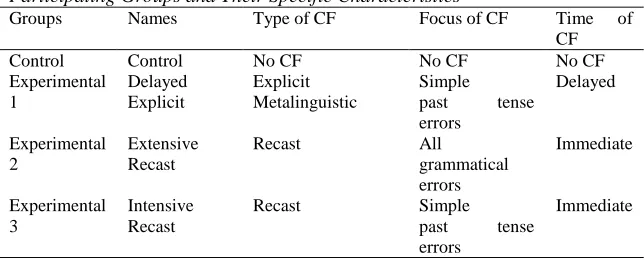
The study has been a quasi-experimental study. Its independent variable was CF with three levels of intensive recast, extensive recast, and delayed explicit metalinguistic feedback. The dependent variables of the study were spoken complexity, operationalized as clauses per AS-units, and specific accuracy, operationalized as error free simple past. Four pre-intermediate intact classes were randomly selected and assigned into the control, delayed explicit metalinguistic, extensive recast, and intensive recast groups. The participating groups are shown in Table 1.
Table 1
Participating Groups and Their Specific Characteristics
Groups Names Type of CF Focus of CF Time of
CF
Control Control No CF No CF No CF
Experimental 1
Delayed Explicit
Explicit Metalinguistic
Simple
past tense errors
Delayed
Experimental 2
Extensive Recast
Recast All
grammatical errors
Immediate
Experimental 3
Intensive Recast
Recast Simple
past tense errors
Immediate
3.2 Participants
fairly homogenous pre-intermediate group of learners. To verify their initial homogeneity, a Key English Test (KET) was used and the test results were analyzed via a one-way ANOVA, with the alpha set at .05, which revealed no significant initial differences among the groups (F = .28, p =.87).
3.3 Target Structure
The grammatical structure selected for the study was simple past tense, due to the fact that it is introduced early in textbooks and preintermediate level learners are likely to be familiar with. However, gaining full control of it might be difficult, even for intermediate or advanced level learners (Ellis et al., 2006). This can also be true about Iranian EFL learners. That is, as a result of their exposure to this structure in their textbooks, based on task-based language teaching, they have some knowledge about it. However, they usually have difficulty using it accurately in their production. In other words, the purpose was not to examine whether CF would assist the learning of a completely new structure. It was to examine whether it would enable learners to gain greater control over a structure they have already partially mastered. Another reason that it was chosen as the target structure was related to the fact that drawing learners' attention to the accurate use of a specific structure would be at the expense of the complexity and fluency of their productions.
3.4 Procedure
the randomly selected intact classes were randomly assigned to the control, intensive (focused) recast, extensive (unfocused) recast, and delayed explicit metalinguistic CF groups. One week before the commencement of the study, KET was administered to verify their initial homogeneity.
The main process was carried out during six instructional sessions, each divided into two halves. The first half, which was based on the institute' term program, studying the lessons was roughly the same among all experimental and control groups and lasted about 45 minutes. The other half was devoted to the main process of the current study and was audio recorded for subsequent analyses. It began by assigning a story from Steps to Understanding (Hill, 1988) to all the participants of groups. Indeed, while within group stories were different due to the prevention of the practice effect, between-group stories were the same in each of these instructional sessions. In other words, in each of these sessions, participants within each group were to read a different story, summarize it and retelling it to the class. Between group participants, in contrast, were to read the same stories. To ensure that all participants had sufficient time to complete the task, all groups' participants were given five min and asked to read, summarize and plan it. When they completed the task of summarizing and planning of their individualized stories, they were asked to orally reproduce and retell it to the whole class.
control group's participants orally reproduced and retold their stories to the whole class without receiving any CF.
In addition to the differences between the experimental groups and the control group which were based on the presence or absence of CF, all the experimental groups were also different based on the focus and types of the CF and the time it was provided. In the intensive recast group, the CF was immediately and intensively provided on the participants' simple past tense errors during their oral reproductions. In other words, as soon as they made simple past tense errors on their oral reproductions of their stories, they were provided with CF of the recast type. In the extensive recast group, unlike the focused recast group, the recast was extensively provided on all errors of their oral reproductions of the stories. In the delayed explicit metalinguistic corrective feedback group, in contrast, there was no immediate reaction to the participants' errors and the type of the CF was explicit and metalinguistic. That is, during their story reproductions, the simple past tense errors were not immediately corrected and the CF was provided at the end of their story reproductions. At the end of each participant's oral reproduction, he presented the simple past tense errors on the board, corrected explicitly, and provided some metalinguistic explanations for all participants of the group. This process of story summarizing, its spoken reproduction, and error treatment lasted for six sequential sessions. Then, the recorded spoken data of all participants during six instructional sessions were transcribed and coded by the researchers focusing on spoken complexity and accuracy.
was divided by the number of AS-units they produced. The coding of the spoken specific accuracy, which was based on previous studies (Ahmadian, 2012; Crookes, 1989; Ellis & Barkhuizen, 2005; Fotos & Ellis, 1991; Kawauchi, 2005; Wigglesworth, 1997), was based on the extent to which the participants produced English simple past tense verb forms correctly in obligatory contexts.
After the first identification of the measurement units and calculation of the different indices of complexity and accuracy, there was a need to measure the intra-rater reliability, the reliability of the researchers' scoring. To this end, to calculate intra-rater reliability, the researchers recoded and recalculated different CAF indices in a different order. The intra-rater reliability using Cronbach’s alpha was .88. In addition to the measurement of intra-rater reliability, there was a need to measure interrater reliability. To this end, another researcher, one of the researchers' colleagues, independently coded 15% of the data. The inter-rater reliability using Cronbach’s alpha was α = .83.
4. Data Analysis
First, the descriptive statistics were calculated. Then, two one-way ANOVAs and a post-hoc test, LSD, were used to analyze the participants' spoken complexity, clauses per AS-units, and specific spoken accuracy, error free simple past tense, during six sessions. Then, a 2 × 2 correlation matrix was created with Pearson correlation coefficients to study the relationship between the complexity, clauses per AS-units, and the specific accuracy, error free simple past tense. Finally, to study the effects of the CF conditions on the relationships between the complexity and the accuracy, other 2×2 correlational matrices were created for each of the participating groups' complexity and accuracy measurements in sessions one and six.
5. Results
are presented. In addition, the delayed extensive metalinguistic CF group is briefly considered as delayed explicit.
5.1 Complexity
The results of the descriptive statistics of all groups' spoken complexity, clauses/AS-units, in sessions one and six are given in Table 2.
Table 2
Descriptive Statistics of Groups' Spoken Complexity in Sessions 1 and 6
Sessions N Mean SD
95% CI
Lower Bound Upper Bound Session1 Control 16 1.71 .51 1.45 1.98
Delayed Explicit 17 1.68 .72 1.31 2.05 Extensive Recast 16 1.61 .49 1.35 1.87 Intensive Recast 15 1.66 .44 1.42 1.90 Session6 Control 18 1.70 .76 1.33 2.08 Delayed Explicit 18 1.45 .28 1.32 1.59 Extensive Recast 11 1.54 .43 1.26 1.83 Intensive Recast 14 1.54 .38 1.33 1.76
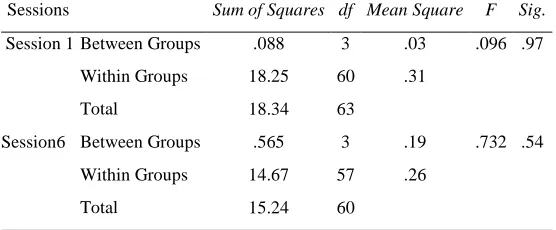
As it is shown, in all groups, except the control group, the number of clauses/AS-units of session six were lower than those of session one. In addition, the number of clauses/AS-units that the control group's participants produced was more than that of the other groups. In addition, the results of the one-way ANOVAs used to analyze the participants' spoken complexity in sessions one and six are displayed in Table 3.
Table 3
Inferential Statistics of Groups' Spoken Complexity, Clauses/AS-Units, in Sessions 1 and 6
Sessions Sum of Squares df Mean Square F Sig.
Session 1 Between Groups .088 3 .03 .096 .97
Within Groups 18.25 60 .31
Total 18.34 63
Session6 Between Groups .565 3 .19 .732 .54
Within Groups 14.67 57 .26
As it is illustrated, in both sessions one and six of the study there were insignificant differences among all groups (p > 0.05). In other words, although they were different with respect to the production of the number of clauses/AS-units, these differences were not big enough to reach a statistical significance.
5.2 Accuracy
The descriptive statistics of all the groups' specific accuracy scores, error free simple past tense, in sessions one and six is given in Table 4.
Table 4
Descriptive Statistics of Groups' Specific Spoken Accuracy in Sessions 1 and 6
Sessions N Mean SD 95% Confidence Interval
Lower Bound Upper Bound
Session 1 Control 16 64.75 17.96 55.19 74.32
Delayed Explicit
17 67 25.04 54.13 79.88
Extensive Recast
16 57.75 19.42 48.41 68.10
Intensive Recast
15 62 17.17 52.50 71.50
Session 6 Control 18 61.56 22.74 50.26 72.86
Delayed Explicit
18 80.94 17.35 72.32 89.58
Extensive Recast
11 57.36 17.16 45.84 68.90
Intensive Recast
14 65.50 17.25 55.55 75.46
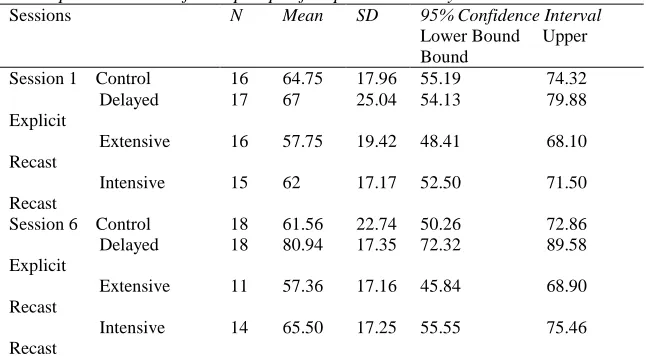
As it is shown, in all groups except the control and the extensive recast groups, the specific accuracy measurement of session six was bigger than that of session one. In addition, the delayed explicit group had the highest mean in session 6.
Table 5
One-way ANOVA of Specific Spoken Accuracy Sum of
Squares df
Mean
Square F Sig.
Session1 Between Groups
776.86 3 258.96 .630 .60
Within Groups
24650 60 410.84
Total 25426.86 63 Session6 Between
Groups
5075.49 3 1691.83 4.66 .006*
Within Groups
20711.44 57 363.36
Total 25786.92 60
Note. *p < .05.
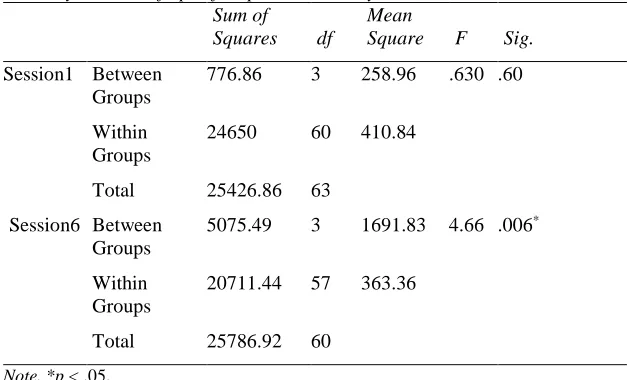
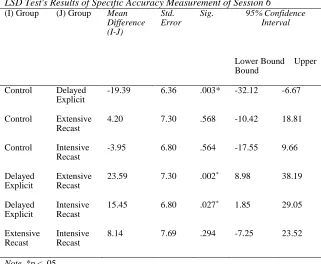
As it is illustrated, there were insignificant differences among all groups in session one (p > 0.05). In session six, in contrast, the differences among groups were significant (F3, 57 = 4.66, p =.006). Having realized that there
Table 6
LSD Test's Results of Specific Accuracy Measurement of Session 6
(I) Group (J) Group Mean
Difference (I-J)
Std. Error
Sig. 95% Confidence
Interval
Lower Bound Upper Bound
Control Delayed
Explicit
-19.39 6.36 .003* -32.12 -6.67
Control Extensive
Recast
4.20 7.30 .568 -10.42 18.81
Control Intensive
Recast
-3.95 6.80 .564 -17.55 9.66
Delayed Explicit
Extensive Recast
23.59 7.30 .002* 8.98 38.19
Delayed Explicit
Intensive Recast
15.45 6.80 .027* 1.85 29.05
Extensive Recast
Intensive Recast
8.14 7.69 .294 -7.25 23.52
Note. *p < .05.
accuracy of the spoken production.In other words, the delayed explicit CF group statistically outperformed the other groups with respect to the production of error free simple past tense. In addition, although the other groups were also different from one another, these differences were not big enough to reach a statistical significance.
5.3 The Results of the Correlational Analyses of the Complexity
and Accuracy Measurements in sessions 1 and 6
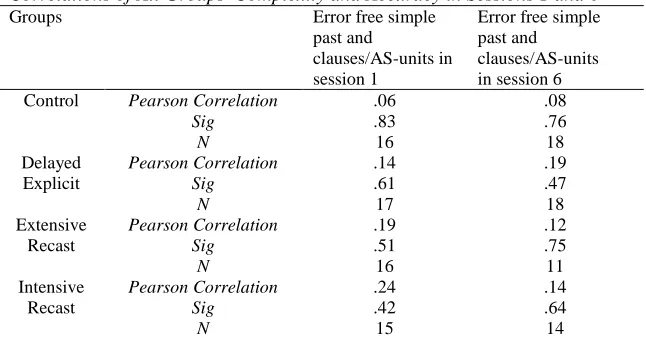
The results of the correlations of the complexity, clauses/AS-units, and specific accuracy, error free simple past tense, of all groups in sessions one and six are presented in Table 7.
Table 7
Correlations of All Groups' Complexity and Accuracy in Sessions 1 and 6
Groups Error free simple
past and
clauses/AS-units in session 1
Error free simple past and clauses/AS-units in session 6
Control Pearson Correlation
Sig N .06 .83 16 .08 .76 18 Delayed Explicit Pearson Correlation Sig N .14 .61 17 .19 .47 18 Extensive Recast Pearson Correlation Sig N .19 .51 16 .12 .75 11 Intensive Recast Pearson Correlation Sig N .24 .42 15 .14 .64 14
As it is demonstrated, all correlations were positive and insignificant. In other words, different CF conditions had insignificant effects on the correlations between the spoken complexity and specific accuracy.
5.4 The Results of the Test of the Trade-off Hypothesis
Table 8
Correlations of the CAF Indices
Error free simple past Clauses/AS-units Error free simple past
N 95% CI
Lower Upper
1 403
1 1
.05 403
-.15 .10 Clauses/AS-units
N 95% CI
Lower Upper
.05 403
-.15 .10
1 403
1 1
As it is demonstrated, the correlation between specific accuracy, error free simple past, and complexity, clauses/AS-units, was positive, small and insignificant.
6. Discussion
There were two broad purposes for the study. The first one was to investigate the effects of the presence or absence, the type, the focus, and the timing of the CF on EFL learners' spoken complexity and accuracy. The other one was to study the presence or absence of the trade-off between the spoken complexity and accuracy and how it can be affected by different CF conditions. Considering the first purpose, three research questions were asked.
enough to reach a statistical significance. Different CF types lowering, albeit insignificantly, the spoken complexity, clauses/AS-units, can be explained with respect to the trade-off hypothesis. Another relevant reason for these results is based on Krashen's (1982, pp.74-75) claim that "error correction is a serious mistake since it has the immediate effect of putting the student on the defensive with the result that the learner seeks to eliminate mistakes by avoiding the use of complex constructions". The other explanation is based on the nature of the units the complexity is based on and when it can be learned (Vercellotti, 2012). Vercellotti (2012) suggested clauses/AS-units serves as an indicator of complexity if learners have acquired subordinate constructions (Ellis & Barkhuizen, 2005). Consequently, given the participants of the study were preintermediate level, they were not proficient enough to produce it and the presence or absence and type of CF had insignificant effects on it. The results are consistent with Rahimi and Dastjerdi's (2012) study in which they investigated the effects of two types of CF, immediate and delayed, on female intermediate EFL learners’ oral production and showed that there were no significant differences between their effects on EFL learners' spoken complexity.
errors. The other factor is related to its timing. That is, while in this group CF was provided after they finished the task of spoken reproduction, in other groups the CF was immediately provided. All these factors together, explicit and metalinguistic CF type, focus on simple past tense, and its delayed nature, have made this CF the most salient, and, consequently, the easiest for the participants to notice. In addition, metalinguistic clues help learners identify the nature and locus of the errors, especially errors for which they already have metalinguistic knowledge (Ammar & Spada, 2006).
The results of the study provide support for the claim that embedding CF within communicative activities is more effective than participation in such activities without CF. They are also consistent with previous claims for the efficacy of the focus on form (Doughty & Williams, 1998; Long, 1996; Long & Robinson, 1998; Skehan, 1996; Spada & Lightbown, 1993). In addition, they lend support to Carroll and Swain’s (1993) study in which the learners who received CF in the form of showing them the location of the error plus metalinguistic information acquired dative alternation. They are also in line with Carroll's (2001) study which showed the superiority of the explicit correction with metalinguistic information over recasts. They are also consistent with Sheen's (2007) and Ellis et al.'s (2006) studies which reported the beneficial effects of metalinguistic correction over recasts. They are also in line with Rassaei and Moinzadeh's (2014) study which revealed that learners were less successful at interpreting recasts as corrective feedback compared with metalinguistic corrective feedback. They also support previous studies' (Ellis, 2001; Spada, 1997) conclusion that the explicit techniques work for second language acquisition more than the implicit techniques.
information over the other CF types concerns the deeper understanding of the rule (Golshan, 2013). Consequently, it can be suggested that since explicit correction with metalinguistic information helps learners develop awareness at both levels, noticing and understanding, it can be a better candidate for the promotion of the second language learning.
The other purpose of the study was to examine the presence or absence of the trade-off between the spoken complexity and accuracy and how it can be affected by different CF conditions.Considering the nature of the trade-off, the results of the correlational analyses, based on all groups' spoken production in all sessions of the study, revealed a positive and insignificant correlation between specific accuracy, error free simple past, and complexity, clauses/AS-units. With respect to the CAF measurements of the current study, these results are in contrast with the trade-off hypothesis that "committing attention to one area, other things being equal, might cause lower performance in others" (Skehan, 1998, p. 112). With respect to the effects of the different CF conditions on the trade-off between complexity and accuracy, the results of the correlational analyses revealed a positive and insignificant correlation between the complexity and specific accuracy in all groups and in both sessions one and six. In summary, different CF conditions had no significant effects on the correlation between different aspects of the spoken production. They are inconsistent with studies (Foster & Skehan, 1996; Skehan, 2009; Skehan & Foster, 1997)which revealed a trade-off betweencomplexity and accuracy.
7. Conclusion
Regarding the limitations of the study, the length of treatments was very short and took only six sessions. In addition, all the CF types were input providing. Another limitation was related to the target of the study which was the simple past tense. Further research needs to be done to address these limitations.
and communication-oriented instruction is highly beneficial to EFL learners. The results of this study also suggest that the integration of focus on form, through the provision of the CF, into meaning-based activities can positively affect L2 learning when it has a particular linguistic focus. Based on the findings, it can be concluded that a CF type which is delayed and explicit and which provides metalinguistic clues and results in deeper understanding is much more effective than the one which is lacking some or all of these features to develop the EFL learners' spoken specific accuracy. However, the provision of any CF type has no significant effect on the EFL learners' spoken complexity. Considering the relationship between the complexity and accuracy, it can be suggested that there is no significant trade-off between them. In addition, CF has no significant effect on their relationships. The results of the current study provide support for Lightbown and Spada's (1990) claim that "accuracy, fluency, and overall communicative skills are probably best developed through instruction that is primarily meaning focused but in which guidance is provided through timely form focused activities and correction in context" (p. 443).
References
Ahmadian, M. J. (2012). The effects of guided careful online planning on complexity, accuracy, and fluency in intermediate EFL learners' oral production: The case of English articles. Language Teaching Research, 16(1), 1-21.
Ahmadian, M. J., & Tavakoli, M. (2010). The effects of simultaneous use of careful online planning and task repetition on accuracy, complexity, and fluency in EFL learners' oral production. Language Teaching Research, 15(1), 35-59.
Ammar, A., & Spade, N. ( 2006 ). One size fits all? Recasts, prompts, and L2 learning. Studies in Second Language Acquisition, 28, 543-574.
Ansarian, A. A. & Chehr Azad, M. H. (2015). Differential effects of focused and unfocused recasts on the EFL learners' oral accuracy. Colomb. Applied. Linguist. J., 17(1), 86-97.
Carroll, S. (2001). Input and evidence:The raw material of second language acquisition. Amsterdam: Benjamins.
Crookes, G. (1989). Planning and interlanguage variation. Studies in Second Language Acquisition, 11, 367-383.
Dougthy, C, J., & Varela, E. (1998). Communicative focus on form. In C. J. Doughty & J. Williams (Eds.), Focus on form in classroom second language acquisition (pp. 114-138). New York: Cambridge University Press.
Dougthy, C. J., & Williams, J. (1998). Pedagogical choices in focus on from. In C. J. Doughty & J. Williams (Eds.), Focus on from in classroom second language acquisition (pp. 197-261). New York: Cambridge University Press.
Ellis, N. (2005). At the interface: Dynamic interactions of explicit and implicit language knowledge. Studies in Second Language Acquisition, 27, 305 – 352.
Ellis, R. (1991). Second language acquisition and language pedagogy. Clevedon: Multilingual Matters.
Ellis, R. (1994). A theory of instructed second language acquisition. In N. Ellis (Ed.), Implicit and explicit learning of languages (pp. 79-114). San Diego, CA: Academic Press.
Ellis, R. (2001). Investigating form-focused instruction. Language Learning, 51(1), 1-46.
Ellis, R. (2003). Task based language learning and teaching. Oxford: Oxford University Press.
Ellis, R. (2008). The study of second language acquisition. Oxford: Oxford University Press.
Ellis, R. (2009). Corrective feedback and teacher development. L2 Journal, 1(1), 3-18.
Ellis, R., & Barkhuizen, G. (2005). Analyzing learner language. Oxford: Oxford University Press.
Ellis. R., Loewen, S., & Erlam, R. (2006). Implicit and explicit corrective feedback and the acquisition of L2 grammar. Studies in Second Language Acquisition, 28, 339-358.
Ellis, R., Sheen, Y., Murakami, M., & Takashima, H. (2008). The effects of focused and unfocused written corrective feedback in an English as a foreign language context. System, 36, 353-371.
Farrokhi, F., & Chehr Azad, M. H. (2012). The effects of planned focus on form on Iranian EFL learners' oral accuracy. World Journal of Education, 2(1), 70-81.
Foster, P., & Skehan, P. (1996). The influence of planning and task type on second language performance. Studies in Second Language Acquisition, 18, 293-323.
Foster, P., Tonkyn, A., & Wigglesworth, G. (2000). Measuring spoken language: A unit for all reasons. Applied Linguistics, 21, 354-375.
Fotos, S., & Ellis, R. (1991). Communication about grammar: A task-based approach. TESOL Quarterly, 25, 605-628.
Gass, S. M., & Varonis, E. M. (1994). Input, interaction, and second language production. Studies in Second Language Acquisition, 16, 283-302.
Han, Z. (2002). A study of the impact of recasts on tense consistency in L2 output. TESOL Quarterly, 36, 543-72.
Harley, B., & Swain, M. (1984). The interlanguage of immersion students and its implications for second language teaching. In A. Davis, C. Criper, & A. Howatt (Eds.), Interlanguage (pp. 291-311). Edinburg: Edinburg University Press.
Hill, L. A. (1988). Steps to understanding. Oxford: Oxford University Press. Hoseini Fatemi, A., & Harati, N., A. (2014). The impact of recast versus
prompts on the grammatical accuracy of Iranian EFL learners' speech. Theory and Practice in Language Studies, 4, 532-543.
Iwashita, N. (2003). Negative feedback and positive evidence in task-based interaction: Differential effects on L2 development. Studies in Second Language Acquisition, 25, 1-36.
Kamiya, N. (2015). The effectiveness of intensive and extensive recasts on L2 acquisition for implicit and explicit knowledge. Linguistics and Education, 29, 59–72.
Kawauchi, C. (2005). The effects of strategic planning on the oral narratives of learners with low and high intermediate L2 proficiency. In Ellis, R. (Eds.), Planning and task performance in a second language (pp. 143-164). Amsterdam: Benjamins.
Krashen, S. (1982). Principals and practice in second language acquisition. Oxford: Pergamon.
Leeman, J. (2003). Recasts and second language development: Beyond negative evidence. Studies in Second Language Acquisition, 25, 37-63. Li, S. (2010).The Effectiveness of corrective feedback in SLA: A
meta-analysis. Language Learning, 60, 309-365.
Lightbown, P., & Spada, N. (1990). Focus-on-form and corrective feedback in communicative language teaching: Effects on second language learning. Studies in Second LanguageAcquisition, 12, 429-448.
Loewen, S. (2011). Focus on form. In E. Hinkel (Ed.), Handbook of research in second language teaching and learning (pp. 576-592). London: Routledge.
Loewen, S., & Philp, J. (2006). Recasts in the adult English L2 classroom: Characteristics, explicitness, and effectiveness. Modern Language Journal, 90, 536-556.
Long. M. H. (1991). Focus on form: A design feature in language teaching methodology. In K. De Bot, R. Ginsberg, & C. K. Kramsch (Eds.), Foreign language research in cross-cultural perspective (pp. 39-52). Amsterdam: Benjamins.
Long, M. H. (1996). The role of the linguistic environment in second language acquisition. In W. Ritchie & T. Bhatia (Eds.), Handbook of second language acquisition (pp. 413-468). San Diego, CA: Academic Press.
Long, M. H., & Crookes, G. (1992). Three approaches to task based syllabus design. TESOL Quarterly, 26, 27–56.
Long, M. H., & Robinson, P. (1998). Focus on form: Theory, research, and practice. In C. Doughty & J. Williams (Eds.), Focus on form in classroom second language acquisition (pp. 15-41). New York: Cambridge University Press.
Lyster, R., & Ranta, L. (1997). Corrective feedback and the learner uptake: Negotiation of form in communicative classrooms. Studies in Second Language Acquisition, 19, 37-66.
Mackey, A., & Goo, J. (2007). Interaction research in SLA: A meta-analysis and research synthesis. In A. Mackey (Ed.), Conversational interaction in second language acquisition: A collection of empirical studies (pp. 407-452). Oxford: Oxford University Press.
Maftoon, P., & Kolahi, S. (2009). The impact of recasts on the syntactic accuracy of Iranian EFL university students’ oral discourse. The Journal of Applied Linguistics, 2(2), 160-178.
Nicholas, H., Lightbown, P., & Spada, N. (2001). Recasts as feedback to language learners. Language Learning, 51, 719-758.
Rahimi, A., & Vahid Dastjerdi, H. (2012). Impact of immediate and delayed error correction on EFL Learners’ Oral Production: CAF. Mediterranean Journal of Social Sciences, 3(1), 45-54.
Rahimpour, M., Salimi, A., & Farrokhi, F. (2012). The effect of planned vs. unplanned form-focused strategies on L2 learners' accuracy in oral task performance. Education Research Journal, 2, 247-252.
Rassaei, E. (2015). Oral corrective feedback, foreign language anxiety and L2 development. System, 49, 98-109.
Rassaei, E., & Moinzadeh, A. (2014). Recasts, metalinguistic feedback, and learners' perceptions: a case of Persian EFL learners. Innovation in Language Learning and Teaching, 8(1), 39-55
Robinson, P. (2003). Individual differences, cognitive abilities, aptitude complexes, and learning conditions in second language acquisition. Second Language Research, 17, 368-92.
Russell, J., & Spada, N. (2006). The effectiveness of corrective feedback for second language acquisition: A meta-analysis of the research. In J. Norris & L. Ortega (Eds.), Synthesizing research on language learning and teaching (pp. 131-164). Amsterdam: Benjamins.
Saeedi, P. (2015). Unguided strategic planning, task structure, and L2 oral performance: Focusing on complexity, accuracy, and fluency. Journal of Applied Linguistics and Language Research, 2, 263-274.
Salimi, A. (2015).The Effect of Focus on Form and Task Complexity on L2 Learners’ Oral Task Performance. Advances in Language and Literary Studies, 6(6), 54-62.
Sample, E., & Michel, M. (2014). An exploratory study into trade-off effects of complexity, accuracy and fluency in young learners' oral task repetition (Special issue). TESL Canada Journal, 31(8), p. 23-46.
Sato, M., & Lyster, R. (2012). Peer interaction and corrective feedback for accuracy and fluency development: monitoring, practice and proceduralization. Studies in Second Language Acquisition, 34, 591-626. Schmidt, R. (1990). The role of consciousness in second language learning.
Applied linguistics, 11, 129-158.
Schmidt, R. (1995). Consciousness and foreign language learning: A tutorial on the role of attention and awareness in learning. In R. Schmidt (Ed.), Attention and awareness in foreign language learning (pp. 1-63). Honolulu, HI: University of Hawaii, Second Language Teaching & Curriculum Center.
Seyed Motahari, M., & Ghasemi Nik Manesh, A. (2014).The comparative effect of explicit corrective feedback and clarification request feedback on impulsive and reflective EFL learners’ oral fluency. International Journal of Enhanced Research in Educational Development (IJERED), 2 (2), 32-42.
Sheen, Y. (2007). The effects of corrective feedback, language aptitude, and learner attitudes on the acquisition of English articles. In A. Mackey (Ed.), Conversational interaction in second language acquisition: A collection of empirical studies (pp. 301-322). Oxford: Oxford University Press.
Sheen, Y., Wright, D., & Moldawa, A. (2009). Differential effects of focused and unfocused written correction on the accurate use of grammatical forms by adult ESL learners. System, 37, 556-569.
Skehan, P. (1996). A framework for the implication of task based instruction. Applied Linguistics, 17, 38-61.
Skehan, P. (1998). A cognitive approach to language learning. Oxford, UK: Oxford University Press.
Skehan, P. (2009). Modelling second language performance: Integrating complexity, accuracy, fluency, and lexis. Applied Linguistics, 30, 510-532.
Skehan, P., & Foster, P. (1997). Task type and task processing conditions as influences on foreign language performance. Language Teaching Research, 1, 185-211.
Skehan, P., & Foster, P. (2001). Cognition and Tasks. In P. Robinson (Ed.), Cognition and Second Language Instruction (pp. 183-205). Cambridge: Cambridge University Press.
Spada, N. (1997). Form-focused instruction and second language acquisition: A review of classroom and laboratory research. Language Teaching, 30 (2), 73-87.
Spada, N., & P. Lightbown (1993). Instruction and the development of questions in L2 classrooms. Studies in Second Language Acquisition, 15, 205-224.
Van Patten, B. (1990). Attending to form and content in the input. Studies in Second Language Acquisition, 12, 287-301.
Vercellotti, M. L. (2012). Complexity, accuracy, and fluency as properties of language performance: The development of the multiple subsystems over time and in relation to each other (Unpublished doctoral dissertation). University of Pittsburgh, USA.