ISSN: 2333-6048 (Print), 2333-6056 (Online) Copyright © The Author(s). All Rights Reserved. Published by American Research Institute for Policy Development DOI: 10.15640/jmpp.v7n1a4 URL: https://doi.org/10.15640/jmpp.v7n1a4
Fraud Risk and Earnings Management
Ni Nyoman Ayu Suryandari
1, Anik Yuesti
2& I Made Suryawan
3Abstract
Earnings management is an effort made by management with the aim of managing financial statements within the limits permitted by accounting principles with the aim of the manager's personal interests. The purpose of this study was to examine the effect of fraud risk factors on earnings management behavior. Variables that are thought to influence earnings management are financial stability, financial targets, external pressure, effective monitoring, organizational structure, and auditor switching. The samples obtained were 37 companies registered in 2014-2017 using multiple regressions. The results showed that the variables of financial stability, external pressure, effective monitoring, organizational structure and auditor switching did not affect earnings management while the financial target variables negatively affected earnings management.
Keywords: Fraud, fraud triangle, earnings management, pressure, rationalization.
I. Introduction
According to the Association of Certified Fraud Examiners (ACFE), fraud is an act of fraud or error made by an individual or entity who knows that this error canharming individuals or entities or other parties. The practice of fraudulent financial statements or commonly referred to as fraud always seizes public attention. Research related to earnings management and fraud triangle has been investigated, including Bedard and Johnstone (2004), Lou and Wang (2009), Perols and Lougee (2011). The idea related to the Fraud Triangle was first created by Donald R. Cressey (1953) introduced in the professional literature on SAS No.99, explaining three factors that are cause in any fraud situation that describe the risk factors of fraud that occur. Using this fraudulent triangle approach will greatly help the company in preventing fraudulent financial statements. Based on the concept of fraud triangle, Statement on Auditing Standard No. 99 requires external auditors to use 42 (forty two) red flags when detecting fraudulent financial statements (Rustiarini, Suryandari, and Nova 2017). The Fraud triangle consists of three general conditions that are present when fraud occurs, namely pressure, opportunity, and rationalization (Tuannakotta 2010: 207).
First, pressure is the drive to commit fraud where this pressure includes lifestyle, economic demands and so on. In general, pressure arises because of needs or financial problems, but many are also just encouragement by greed. According to Skousen et al (2009), the pressure factor can be proxied by financial stability, financial targets and external pressure. Second, opportunity is a condition that allows fraud to occur due to weak internal control and poor supervision management. Skousen et al (2009), opportunity factors can be proxied by effective monitoring, and organizational structure. Third, rationalization, namely the existence of attitudes, characters or a series of ethical values that allow certain parties to commit fraud. Rationalization is an attitude of rational justification made by fraud perpetrators to justify their actions. Rationalization is a personal reason that can justify a person's actions even though the act is actually wrong. Rationalization is the most difficult part of the fraud triangle (Skousen et al, 2009). According to Skousen et al (2009), the rationalization factor can be proxied by auditor switching. Auditor switching is often done by companies to reduce the possibility of detecting fraudulent financial statements because the replacement auditor is deemed not to understand the true condition of the company.
1 (Mahasaraswati University Denpasar) E-mail: [email protected]
2 (Mahasaraswati University Denpasar)
II. Literature Review and Hypotheses Formulation Agency Theory
Agency theory states that if there is a separation between the owner as principal and the manager as the agent running the company, agency problems will arise because each of these parties will always try to maximize the utility function. There are two types of agency relationships, namely between managers and shareholders and between managers and lenders (Jensen and Meckling, 1976).
Agency theory has the assumption that each individual is solely motivated by his interests, giving rise to a conflict of interest between the principal and the agent. The motivated principal enters into a contract to prosper him with ever-increasing profitability. Agents are motivated to maximize fulfillment of their economic and psychological needs, among others in terms of obtaining investments, loans and compensation contracts. Conflict of interest is increasing especially since the principal cannot monitor the CEO's activities on a daily basis to ensure that the CEO works according to the wishes of the shareholders.
Financial stability and earnings management
Financial stability is a condition that describes a company's financial condition that is stable. Companies prefer a stable financial condition because stable financial conditions will reflect the low risk of investing in the company. When a company is in a stable condition, the value of the company will increase in the view of stakeholders. Thus companies try to improve good company prospects, one of them is by manipulating or manipulating information relating to financial statements. The results of research conducted by Skousen et al (2009), show that financial stability has a positive effect on earnings management. The hypotheses developed are as follows:
H1: Financial stability has a positive effect on earnings management.
Financial Target and earnings management
In carrying out its operations, managers are required to show the best performance in order to achieve the planned targets. Return on assets is a profitability ratio that is used to measure the effectiveness of a company in generating profits by utilizing its assets (Skousen et al. 2009). Return on assets are often used in assessing the performance of managers in determining bonuses, wage increases, and others. With the existence of these financial targets, managers try to achieve them in various ways, one of which is to do earnings management. The results of the study by Skousen et al (2009), that financial targets have a positive effect on earnings management. The hypotheses developed are as follows:
H2: Financial targets have a positive effect on earnings management.
External Pressure and earnings management
External pressure which is proxied by a debt to equity ratio reflects the share of equity of the company used to pay the company's debt. The more debt that is borne by the company, the company is faced with a high risk and financial burden that will reduce the profitability of the company. With the high risk that may be borne by investors, investors will expect the company to have a good performance with the use of the debt. The results of the study conducted by Skousen et al (2009) found that external pressure has an effect on earnings management. The hypotheses developed are as follows:
H3: External Pressure has a positive effect on Earnings Management
Effective Monitoring and earnings management
One component that plays an important role in the process of implementing good corporate governance is the existence of an audit committee. The role of the audit committee in ensuring the quality of corporate financial reporting has been in the spotlight since an accounting scandal took place in public's attention. With the supervision of the audit committee, management will feel closely monitored and not free to find ways to do earnings management so as to reduce fraud. Skousen et al. (2009), adding that fraud incidents will decrease if the company has an audit committee. The hypotheses developed are as follows:
H4: Effective Monitoring has a negative effect on earnings management.
Organizational Structure and earnings management
The change in the structure of the board of directors is usually followed by earnings management practices because approaching the end of their term of office, management will maximize the year-end bonus. Earnings management can also be done when management cannot reach the company's targets which have an impact on shifting positions. Seventy-five percent of fraud cases, operating and financial decisions are dominated by one person. The results of the study by Skousen et al. (2009) found that organizational structure has a positive effect on earnings management. The hypotheses developed are as follows:
H5: Organizational structure has a positive effect on earnings management.
Auditor Switching and earnings management
The auditor is an important party whose duty is to supervise financial statements. Because the audit results in the form of auditor opinion are very influential and are used by stakeholders, the appointment of an auditor (KAP) becomes very important. Companies that are indicated to commit fraud often make auditor changes. This is because the substitute auditor still does not understand the condition of the company as a whole, besides that the limited audit process period is an obstacle in the audit process to detect hidden fraud (Skousen et al., 2009). The results of research conducted by Nauval (2014) indicate that auditor turnover has a positive effect on earnings management. The hypotheses developed are as follows:
H6: Auditor turnover has a positive effect on earnings management
III. Research Method Data and Samples
The initial sample in this study is the annual report of manufacturing companies listed on the Indonesia Stock Exchange during the 2014-2017 period totaling 143. After issuing companies due to unavailability of data (29) and financial statements not presented in rupiah (28), and companies that do not distributing dividends (49) a sample of 37 company annual reports is obtained.
Variable Measurement Earnings Management
Earnings management is proxied by discretionary accruals, which is a way to reduce earnings reporting that is difficult to detect through manipulation of accounting policies related to accruals (Scott, 2000).
Financial stability
Financial stability is an unstable condition of the company. This financial instability creates pressure for management because it causes the performance of their company to look down on stakeholders. Gagola (2011) states that fraud can be done by noting fictitious sales. The additional balance of the fictitious sales will increase the balance of trade receivables so that the company's income will increase as well. Financial stability in this study is proxied by sales to accounts receivable.
Financial target
In carrying out its operations, company managers are required to display the best performance in achieving the planned targets. Financial targets can be proxied by return on assets (ROA). Skousen et al. (2009) states that return on assets (ROA) is used to measure the effectiveness of a company in generating profits by utilizing its assets.
External pressure
External pressure arises because management feels pressure due to the obligations / requirements or expectations of third parties. To overcome this pressure, companies need additional debt or external funding sources to remain competitive, including funding research and development or capital expenditures (Skousen et al., 2009). To meet these debt requirements, it often brings management to report high profitability so that it is not uncommon for companies to commit financial reporting fraud by increasing profits. External pressure can be proxied by a debt equity ratio (DER).
Effective monitoring
Organizational structure
Companies need someone to lead, control, and make decisions in managing the company. The instability of a company's organizational structure with the high turnover of senior manager positions and board of directors will be an important matter to note (Skousen et al, 2009). The organizational structure variable in this study uses a dummy variable where if there is a change in the board of directors it is coded 1, whereas if there is no change in the directors of the company then coded 0.
Auditor Switching
Several studies indicate that audit failure incidents increase when auditor switching occur in the company (Skousen et al., 2009). This is because the new independent auditor still does not understand the condition of the company as a whole besides that the limited audit process period is an obstacle in the audit process to detect hidden fraud. Auditor switching is measured using a dummy variable where auditor switching is given number 1 and if there is no auditor switching during the research period, the number is 0.
Data analysis technique
The relationship between fraudulent financial statements and fraud triangle with multiple linear regression models is as follows:
EM = α + β1SK+β2TK+β3KI+β4EM+β5SO+β6PA+e Information:
EM = Profit Management SK = Financial stability TK = Financial target KI = External pressure EM = Effective monitoring SO = Organizational structure PA = Auditor change
e = Error
IV. Results and Discussion Classic assumption test Normality test
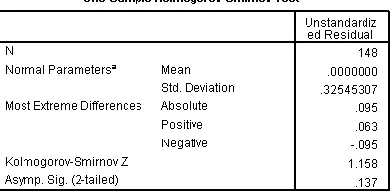
Table 1 Normality Test Results
Multicollinearity Test
Table 2 Multicollinearity Test Results
Based on table 2 above, it can be explained that the tolerance value of each independent variable is above 10 percent and the value of the variance inflaction factor (VIF) of all independent variables is less than 10, which means there are no symptoms of multicollinearity between independent variables.
Autocorrelation Test
Table 3 Autocorrelation Test Results
Therefore du <dw<4-du or 1,8163 <1,983 <2,1837, it can be concluded that there is no autocorrelation.
Heteroscedasticity Test
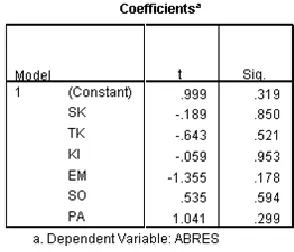
Table 4 Heteroscedasticity Test Results
Based on table 4 above, the results of heteroscedasticity test show the significance value of each independent variable greater than 0.05, so that it can be stated that in this regression model there are no symptoms of heteroscedasticity.
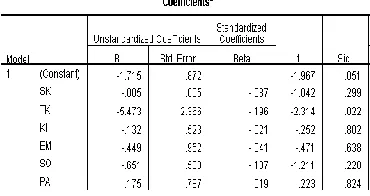
Table 5 Multiple Linear Regression Test Results
Based on table 5 above, the regression equation used in this study is as follows: EM = -1,715 - 0,005SK-5.473TK - 0,132KI-0,449EM-0,651SO+0,175PA
Coefficient of Determination
Table 6 Determination Coefficient Test Results
Based on table 6 above, it can be explained that the Adjusted R Square value is 0.028 or 2.8 percent.
Hypothesis testing
Table 8 Hypothesis Testing Results
Financial Stability to Earnings Management
The first hypothesis states that financial stability proxied by sales to accounts receivable has a positive effect on earnings management. Based on the results of hypothesis testing has a regression coefficient of -0.005 with a significant value of 0.299 so that financial stability does not affect earnings management, thus the first hypothesis is rejected.
This means that the high or low level of financial stability in the company does not cause management to do earnings management to improve financial stability in the company. There are other factors outside the company that affect financial stability such as the business environment and government policies. Because the business environment becomes factors outside the company that can pose a threat opportunity for the company. The company will also look at the conditions of other companies in the same industry. When the condition of the company decreases and this also happens to similar companies, the company will not do earnings management. The results of this study contradict the research of Skousen et al. (2009), which shows that financial stability has a positive effect on earnings management.
Financial Targets towards Earnings Management
The test results show a regression coefficient of -5,473 with a significant value of 0.022 financial target variables that are proxied by return on assets (ROA) negatively affect earnings management, thus the hypothesis is rejected. The higher the financial target achieved by the company, the more monitored by stakeholders so that it will minimize earnings management actions. The results of the study contradict the study of Skousen et al. (2009) which found that financial targets had a positive effect on fraudulent financial statements.
External Pressure on Earnings Management
The third hypothesis states that external pressure proxied by a debt equity ratio (DER) has a positive effect on earnings management. Based on the hypothesis test shows the value of coefficients of -0.132 with a significant value of 0.802, while the external pressure variable that is proxied by DER does not affect earnings management, so the third hypothesis is rejected.
This shows that companies with high debt tend to make earnings management so that the company's financial statements look attractive. But for companies that have low debt, it is also possible to do earnings management to meet the terms of the debt agreement so that it looks good in the eyes of creditors.
The results of this study contradict the research conducted by Skousen et al (2009), who found that external pressure has a positive effect on fraudulent financial statements.
Effective Monitoring of Earnings Management
The fourth hypothesis states that effective monitoring proxied by an audit committee that is an expert in the financial field has a negative effect on earnings management. Based on the test results of the coefficients value of -0.449 with a significant value of 0.638 so that effective monitoring does not affect earnings management and the fourth hypothesis is rejected.
This is because the formation of an audit committee that has expertise in the field of finance that should be able to assist supervision of the board of commissioners is only mandatory, where audit committees who are experts in finance only carry out tasks based on orders from the board of commissioners. In addition, although the number of audit committees with financial backgrounds has been high, the audit committee has not carried out effective supervision because the audit committee of financial experts does not have full authority so that the presence or absence of an audit committee has no effect on earnings management.
Organizational Structure of Earnings Management
The fifth hypothesis states that the organizational structure that is proxied by the change of directors has a positive effect on earnings management. Based on the results of data processing the value of coefficients was -0.651 with a significant value of 0.228 indicating that the organizational structure had no effect on earnings management, so the fifth hypothesis was rejected.
A company will certainly have the opportunity to replace its leaders because companies need leaders who can always control and make decisions on the company. Therefore, in each leader turnover so as not to have an impact on the company's activities that have existed in the previous period, a system is needed where everything will be better if the work is done transparently and controlled so that it does not allow the company to do earnings management. In other words, changes or changes in the composition of the board of directors can occur because of the transfer of authority and receipt from the old directors to the general meeting of shareholders (GMS) to be handed over to the new directors. This change was driven by the desire to improve company performance through changes in directors who were considered more competent than previous directors. Therefore individual abilities measured by changes in the board of directors have no effect on fraudulent financial statements.
The results of this study contradict the research conducted by Skousen et al. (2009) who found that organizational structure has a positive effect on fraudulent financial statements.
Auditor Switching of Earnings Management
There are several factors that have caused the company to make auditor switching, among others, the desire to conduct opinion shopping, the Law on Public Accountant Services as well as related to the needs of companies to look for KAP that can provide much better audit quality. If the company wants to do opinion shopping, this will improve earnings management, but if the company's goal is to improve the quality of financial statements, then auditor switching will actually reduce earnings management. So that the company does not always make auditor switching solely to make earnings management. This research contradicts Nauval's (2014) study, which shows that auditor turnover has a positive effect on fraudulent financial statements.
V. Conclusion, Limitation, Suggestion Conclusion
Based on the results of the analysis above, conclusions can be taken as follows:
Financial stability that is proxied by sales to accounts receivable does not affect earnings management. This means that the high or low level of financial stability in the company does not cause management to do earnings management. Many things are considered by management, especially from outside the company that affect financial stability such as the business environment and government policies. Because the business environment becomes factors outside the company that can pose a threat opportunity for the company. As if when a company has low financial stability it turns out that companies engaged in the same industry also experience the same thing, so indirectly the company's financial situation is not in a stable state does not cause concern for management will lose investor confidence that has an impact on company prospects others also experience the same thing.
Financial targets negatively affect earnings management. The higher the financial target achieved by the company, the company will be monitored by stakeholders so that the company will be more careful in deciding what actions to take so that it can minimize management's desire to commit financial report fraud.
External pressure proxied by (DER) does not affect earnings management. Companies that have high debt ratios tend to do earnings management related to the high burden that must be borne by the company so that it will reduce its profitability. The low profitability is what drives management to make earnings management to still be able to attract investors to invest. However, for companies that have low debt, they are also likely to do earnings management to meet the terms of the debt agreement so that it looks good in the eyes of creditors.
Effective monitoring proxied by audit committees who are experts in finance does not affect earnings management. This is because the formation of an audit committee that has expertise in the field of finance that should be able to help oversee the company is only mandatory where the audit committee of financial experts only performs tasks based on orders from the board of commissioners. Although the number of audit committees with a financial background is high, the audit committee has not carried out oversight effectively because the audit committee of financial experts does not have full authority so that the presence or absence of an audit committee has no effect on earnings management.
Organizational structure does not affect earnings management. A company is likely to make a change of leader because the company needs leaders who are able to control and make ethical decisions in the company. This change was driven by the desire to improve company performance through changes in directors who were considered more competent than previous directors. Therefore individual abilities measured by changes in the board of directors have no effect on fraudulent financial statements.
Auditor switching does not affect earnings management. There are several factors that have caused the company to make auditor switching, among others, the desire to conduct opinion shopping, the Law on Public Accountant Services as well as related to the needs of companies to look for public accounting firm that can provide much better audit quality. So that the company does not always make auditor switching solely to make earnings management.
Limitations and Suggestions
Based on the conclusions outlined in this study, the following suggestions are conveyed:
In addition, in this study it was proven that financial stability, external pressure, effective monitoring, organizational structure and auditor switching did not affect earnings management. The next researcher is advised to add relevant variables by positioning as moderating variables so that it will be seen whether these variables can trigger earnings management.
Reference
ACFE.2008.Fraud Examiners. Report to the Nation on Occuptional Fraud and Abuse. Amrizal.2004.Pencegahandan Pendeteksian Kecuranganoleh Internal Auditor.
http://www.bpkp.go.id/public/upload/unit/investigasi/files/…/cegah_deteksi.pd
Bedard, Jean C and Johnstone, Karla M. 2004. Earnings Manipulation Risk, Corporate Governance Risk, and Auditors' Planning and Pricing Decisions. The Accounting Review. Volume 79 Issue 2. April 2004. https://doi.org/10.2308/accr.2004.79.2.277diaksestanggal 14 April 2019.
Lou, Y.-I., & Wang, M.-L. (2009). Fraud Risk Factor Of The Fraud Triangle Assessing The Likelihood Of Fraudulent Financial Reporting. Journal of Business & Economics Research (JBER), 7(2).
https://doi.org/10.19030/jber.v7i2.2262. diaksestanggal 14 April 2019.
Creesey, D. 1953.Other People’s Money: a Study in the Social Psychology of Embezzlement. Glencoe, IL : Free Press.
Gagola,Antonius.2011 AnalisisFaktorResiko yang MempengaruhiKecenderunganPelaporanKeuangan Perusahaan Publik di Indonesia.TesisS2. Magister SainsAkuntansi UNDIP.
Nauval, Mohammad. 2014. AnalisisFaktor-Faktor yang BerpengaruhTerhadapKecenderungan Financial Statement Fraud dalamPerspektif Fraud Triangle.JurnalEkonomi. UniversitasBrawijaya.
Rustiarini, Ni Wayan, Ni Nyoman Ayu Suryandari, and I Kadek Satria Nova. 2017. “RED FLAGS AND FRAUD PREVENTION ON RURAL BANKS.” Buletin Ekonomi Moneter Dan Perbankan.
https://doi.org/10.21098/bemp.v19i2.629.
Scott, William R. 2000. Financial Accounting Theory.USA : Prentice-Hall
Skousen, Christopher J., Kevin R. Smith, and Charlotte J. Wright. 2009. “Detecting and Predicting Financial Statement Fraud: The Effectiveness of The Fraud Triangle and SAS No.99”. Journal of Advances in Financial Economics, Vol. 13, pp. 53-81.
Summers, S. L., dan Sweeney, J. T. 1998.Fraudulently Misstated Financial Statements and Insider Trading: An Empirical Analysis.The Accounting Review, 73, 131-146.
Tunakotta, Theodorus M. 2010. AkuntansiForensikdan Audit Investigatif.Jakarta :SalembaEmpat.
Perols, Johan L and Lougee, Barbara A. 2011. The relation between earnings management and financial statement fraud. Advances in Accounting Volume 27, Issue 1, June 2011, Pages 39-53.