Validation of Prediction Models
for Estimating the Moisture Content of
Small Diameter Stem Wood
Johanna Routa, Marja Kolström, Johanna Ruotsalainen, Lauri Sikanen
Abstract
Moisture is the most important factor influencing the quality and calorific value of fuel wood. Drying models for estimating the optimal storage time based on average moisture change in fuel wood stacks stored outdoors have been developed for different stem wood piles. Models are an easy option for making an estimate of the moisture content of an energy wood pile if compared with sampling and measuring the moisture of samples. In this study, stem wood models were validated against data from forest companies. Fourteen reference piles of covered pine stem wood and 8 piles of uncovered pine stem wood were studied. The results of the validation are promising. The difference between the measured and modelled moisture was on average only 0.3% with covered piles and 2.5% with uncovered piles. The models presented can be implemented in every location in Finland, because the Finnish Meteorological Institute has a database for interpolated meteorological observations covering the whole country in a 10 km x 10 km grid. For international use, model parameters need to be estimated case by case, but it should also be possible to implement the approach itself worldwide.
Keywords: energy wood, quality, storing, natural drying, model validation
1. Introduction
Thinning is a harvesting method mostly used in
Europe and within plantations all over the world. Thinning wood is a typical raw material for the pulping industry as well as for energy and biorefining in the Nordic countries. Especially in Finland, thinning wood from young stands has been increasingly used for energy. In 2010–2013 it was the major source of forest chips for energy (Torvelainen et al. 2014).
Increased use of forest biomass for energy and rising transportation costs are forcing biomass suppliers towards better moisture content (MC) management in the supply chain. Biomass fuel quality is often defined by the calorific value, and lower moisture content results in increasing calorific value (Hartmann and Kaltschmidt 2001, Stokes et al. 1987).
Natural drying is used to reduce the moisture content
of energy wood after cutting and during storage.
Storing time at the roadside depends on the need for energy wood. The supply of energy wood operates year round, but the demand is notable from October to March (Andersson et al. 2002).
After tree cutting, wood starts to react with the surrounding microclimate (Routa et al. 2015). In Nordic conditions, the moisture content of wood drops rapidly in the spring. In late August and September, evaporation usually decreases, and the moisture content of the wood increases. In some cases, it can even be higher than the »green« moisture right after cutting. Maximizing natural drying and minimizing re-moistening are key elements in the quality management of energy wood (Routa et al. 2012). The timing of the operations in relation to the seasons is crucial in order to maximize the quality and monetary value of the energy wood.
important parameters are evaporation, precipitation, humidity, temperature, solar radiation and wind conditions (Routa et al. 2015). In addition, the material, size and shape of the energy wood pile and the location of the pile, also affect the drying process.
The latest research methodology for monitoring moisture change has been the constant weighing of piles in racks built on load cells (Erber et al. 2012, 2014).This methodology allows moisture changes to be monitored in much more detail than previous sampling methods. The method also gives the moisture of the whole pile, which is challenging in determening the use of sampling methods (Röser et al. 2011). Measurements can be taken automatically and as often as needed. This also enables an exact investigation of the effect of weather on energy wood storage and its moisture content.
In the 1980s, the first ideas of using models to predict the moisture content of wood were presented. Stokes et al. (1987) published their models for soft and hardwoods in south eastern USA. Also, for example, Liang et al. (1996), Gigler et al. (2000), Filbakk et al. (2011), Murphy et al. (2012), Erber et al. (2012) and Dong-Wook and Murphy (2013) have developed different drying models for different species. All approaches to fuel wood moisture content modelling have one common target variable: moisture contents
or rather the alteration in moisture content during a
specific period. The alteration can be explained by a large variety of explanatory variables, such as meteorological variables, parameters of storing, material type and duration of storage. Today’s practice is to measure the moisture content of wood chips when they arrive at the heating plant, but for efficient planning of operations the information is available too late. With the prediction models, it is possible to have an estimation of the moisture content of fuel in advance and plan supply operations so that the fuel is transported to the heating plant in a timely manner.
The objective of this study was to develop a model to forecast the energy wood moisture content and validate the model. Changes in moisture content were linked to weather conditions and microclimate. The model should be easy to apply to the planning systems in operational stage and that is why the model should be quite simple and quick to calculate. To verify fuel wood drying models, reference piles are a good option. Samples must be taken from the piles, which should consist of similar material as regards assortment and tree species. The models developed were validated against real life data from forest companies.
2. Material and methods
2.1 Experimental designAt Mekrijärvi Research Station of the University of Eastern Finland (62°46’N, 30°59’E), two drying racks for round wood with continuous measuring systems were built for research purposes in March, 2012 (Fig. 1). The purpose of the racks is to simulate energy wood storage at the roadside in the forest after cuttings. The racks are similar to those used on timber trucks to carry logs, and their size is 2.5 m in width, 2.6 m in length and 2.8 m in height. As the piles in the racks are quite small compared with real storage in the field, there are cover papers at the bottom and sides of the racks to avoid them drying too quickly. The small diameter energy wood stems of pine were piled up by a machine into the metal racks at the end of March 2012. In the system, four load cells continuously measure the weight of the pile in the rack. These four cells are connected to a junction box, which is connected onwards to a weighing transmitter. Data of weight are stored in a file that can be utilized for data management.
At the Mekrijärvi Research Station, there is a well-equipped meteorological station operated by the Finnish Meteorological Institute (FMI), which provides data on relative air humidity (%), air temperature (°C), wind speed (m/s), wind direction (°), solar radiation (W/m2) and rainfall (mm), air pressure (hPa), ground
temperature (°C), rainfall intensity (mm/h), visible distance (m), height of clouds (m) and snow depth (cm). The meteorological data is collected by a data logger. The weather data can also be obtained from grid data. The FMI provides gridded weather data for the whole of Finland. This data set consists of weather observations (e.g. temperature, humidity, precipitation), which have been interpolated to a 10 km x 10 km grid using the Kriging interpolation method (Venäläinen and Heikinheimo 2002).
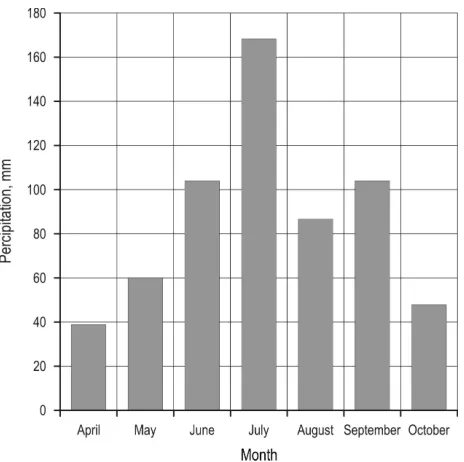
The mean annual precipitation in this area is 668 mm, and the mean annual temperature 2.1 °C. The mean snow depth in the Mekrijärvi area is approx. 45–65 cm in the winter months. In the winter of 2012–2013, snow depth was close to the average and the permanent snow cover period was typical. The drying season (from April to October 2012) was unfavourable for wood drying. The mean temperature (9.5 °C) for these seven months was somewhat lower than the long term average mean temperature (9.8 °C) (Drebs et al. 2002). Most of the precipitation occurred in July (163.8 mm) and June (104 mm), a total of 605.3 mm during the investigation period (Fig. 2), which is almost 50% more than the long term average of 439 mm. In the latter part of the drying season (from April to the beginning of June 2013), the precipitation was in total 156.3 mm. The long term averages (1971–2000) were taken from the nearby station at Ilomantsi Kirkonkylä, because there were no data from the Mekrijärvi station, which was founded in 1999. The Ilomantsi Kirkonkylä station is located only 11.6 km from Mekrijärvi, and therefore represents the same climate conditions.
The moisture content is determined based on weight changes in the energy wood storage pile. When the weight of the pile decreases, the moisture content of the material decreases, and when the weight increases, the moisture content of the material increases. The weight of snow on the pile is a challenge for moisture content estimates, because the weight of snow does not indicate changes in the moisture content of the material.
2.2 Study material and sampling method
Small size stems were cut at the end of October, 2011. They were piled onto a roadside storage in the field right after cutting. From this storage, the stems were transported to the racks at the research station at the end of March 2012. So the material was in storage for five months under winter conditions in the field.
When the stems were piled onto the racks, six sample stems from each pile were randomly selected. Five of the sample stems were pine and one of them birch. Three sample discs were taken from each sample stem; one from the bottom of the stem, one from the middle of the stem and one from the top of the stem. All of these sample discs were taken because variation of the moisture content within the stem could be significant (Kärkkäinen 2003). In total 18 discs presented one pile in order to determine moisture content at the beginning of the storage period under study. The moisture content (wet basis) was determined using the oven dry method (EN 14774-2). Sampling was carried out in accordance with the solid biofuel standard EN 14778.
The weight changes in these two piles were similar during the summer of 2012. In early September, the other pile was covered with a cover paper manufactured by Walki. The width of the paper was 4 metres. The paper is developed for this purpose, and it should keep the rain and snow away from the pile. The paper can be chipped with energy wood and combusted at a heating plant.
After the storage period, it was assumed that the moisture content varies within the pile. When the piles were unloaded, the material from each pile was chipped using a big drum chipper. The samples for the moisture content analysis were taken from the chips and they were taken from the top, the middle and the bottom of the pile. The fourth sample was a mix of the previous three samples. All the samples were analysed using the oven dry method. At the end of the storage period, we had four measurements of the moisture content per pile.
2.3 Validation data
The validation data for covered small diameter pine stem wood has been collected in central Finland during 2010–2011. The sampled piles were selected so as to represent the average energy wood storages in Finland. The materials of the piles were typical of first thinning. Most of the stands were harvested as an integrated energy and pulpwood harvesting, where all the pulp wood diameter wood (diameter >6 cm) was taken as pulp wood, and the rest of them were collected for
energy wood. All the storage piles were covered with the Walki cover paper. The size of the roadside storages varied from 17 m3 to 295 m3. The energy wood was
driven to the Äänekoski power plant and chipped there. The moisture samples were taken from piled chips; 6–8 samples were taken with ladle sampling to a big plastic tub. All the samples were spilled onto a table, where they were mixed and then the moisture samples were collected from nine points by hand to a duplicate plastic bag (5 litres). The plastic bags were delivered immediately to the laboratory, where the moisture content was measured using the oven dry method (EN 14774-2). Sampling was carried out in accordance with the solid biofuel standard EN 14778.
Uncovered pine stem wood was delivered by the Tornator Company. The stems were from cuttings made 2–21 months before. Eight test piles were chipped at the Fortum power plant on 10th of November 2014. The
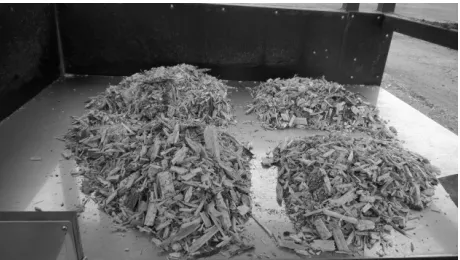
moisture samples were taken from the chip piles. Five samples were taken with ladle sampling to a big plastic tub, and all samples were spilled onto a table, where chips were divided into four parts (Fig. 3). One part was put into a duplicate plastic bag (5 litres). Plastic bags were delivered immediately to the laboratory, where the moisture content was measured using the oven dry method. Sampling was carried out in accordance with the solid biofuel standard EN 14774.
2.4 Data analysis
At first, data from continuous measurements was prepared for the analysis. The running mean of the weight of the piles (average of ten previous measurements), the moisture content and the daily moisture change for each day were calculated. The data from 1st of April to the end of October was used,
and the winter months were excluded. The weather parameters were interpolated to the grid, and then the evaporation was calculated using the Penman-Monteith equation (Penman-Monteith 1981) by the Finnish
Meteorological Institute. The interpolation method is explained in detail in Venäläinen and Heikinheimo (2002), except that the precipitation is obtained mainly from the weather radar network and the radiation parameters are nowadays taken from a weather model because of the lack of radiation measurements and synoptic cloud observations. Net evaporation (mm) was calculated by subtracting precipitation from the reference evaporation.
Different modelling approaches were tested; the linear regression model, multiple linear regression model and non-linear model. Temperature, precipitation, evaporation, wind speed and humidity were used as determining variables. Also, net evaporation was tested. Net evaporation means the difference between evaporation and precipitation. In fact, this variable contains all the most important weather parameters that affect energy wood drying.
The target variable is the moisture content alteration per day in % on a wet basis (DMC=daily moisture change). The analyses were performed with IBM SPSS Statistics version 20.
A Mann-Whitney test was used to compare the difference between measured and modelled moisture contents with IBM SPSS Statistics version 20, using the
critical level at p<0.05. The Mann-Whitney test is considered to be one of the most powerful non-parametric tests especially testing differences in the location of the distribution (Ranta et al. 1992).
3. Results
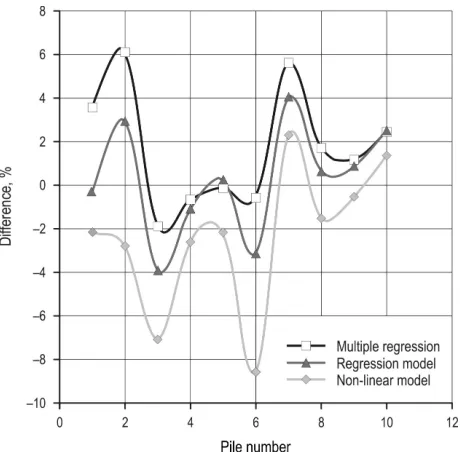
3.1 Results of modellingStand models and roadside storage models for small diameter stem wood were developed using three different approaches: linear regression, multiple linear regression and non-linear regression. In statistics, the non-linear regression model has the best statistical values (Table 1). When these models were applied to validation data of covered pine piles, it was
Fig. 3 Moisture samples taken from chip piles
Table 1 Statistical details of different models
Test values Linear regression model
Multiple linear regression model
Non-linear regression model
F 784.7 171.3 355.5
p 0.000 0.000 0.000
R2 0.705 0.726 0.766
found that the linear regression model gives the most reliable results (Fig. 4).
Linear regression models were chosen because they appeared to be most functional, and the structure of the model was simple and understandable. For model form, the simplest regression model was chosen with one determining variable, net evaporation (Table 2).
Using the models starts with determining the moisture content of fresh wood. For that reason, average moisture of fresh wood, depending on the cutting month, is presented in Table 3 (Hakkila 1962, Gislerud 1974, Kärkkäinen 1976, Nurmi 1999, Hillebrand and Nurmi 2001, 2007, Nurmi and Lehtimäki 2011 and Routa, unpublished data). After cutting, the stems are stored and the model can be applied to estimate the daily change of the moisture content, and with that estimate the current moisture content of the wood material within the pile.
3.2 Model validation
The moisture content estimation is made by the model acquired from the rack experiment. The result is compared to the moisture content of the reference pile.
3.2.1 Covered stem wood model
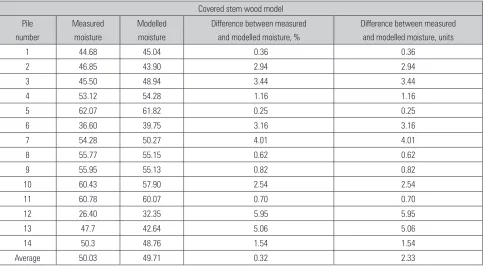
The validation results against covered stem wood model are shown in Table 4 and Fig. 5. The difference between the measured and the modelled moisture content varied from 0.4 to 5.95% in 14 different piles.
Fig. 4 Difference between measured and modelled moisture with different model types, pine stem wood, covered
Table 2 Drying models for covered and uncovered stem wood stored on roadside
Roadside storage models
DMC=Coef*(evaporation–precipitation)+const. Moisture content (i)=moisture content(i–1)–DMC
Model Coef. Const. R2 SE Pine birch mix, covered 0.062 0.051 0.70 0.2
Pine birch mix, uncovered 0.062 0.039 0.64 0.2
Table 3 Moisture of fresh stem wood depending on the cutting month in Finland
Moisture content of fresh stem wood, monthly, %
Species Jan Feb March April May June July Aug Sep Oct Nov Dec
Pine 57 57 57 56 56 55 55 57 57 57 57 57
Birch 45 45 45 46 48 42 42 42 42 44 45 45
On average, the difference was only 0.3%. A statistical test was carried out (Mann-Whitney test) and the difference between the measured and modelled value was not statistically significant (p=0.7)
3.2.2 Uncovered stem wood model
The validation results against the uncovered stem
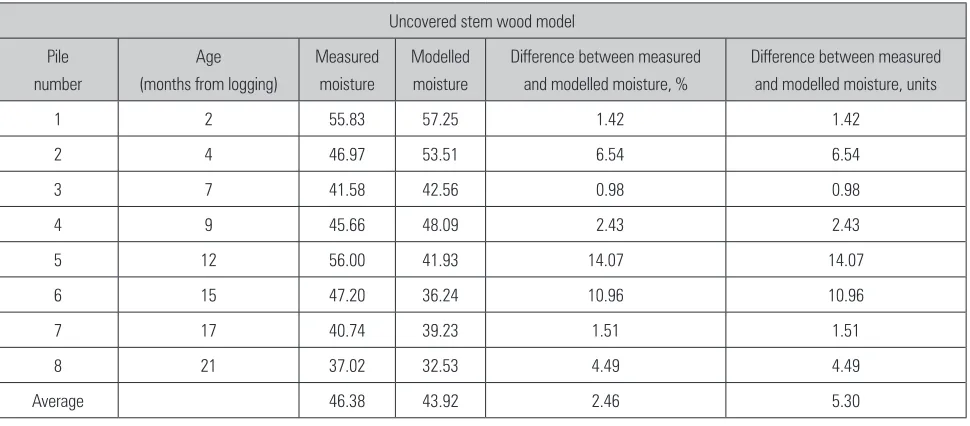
wood model are shown in Table 5 and Fig. 6. The difference between the measured and the modelled moisture content varied from 1 to 14% in 8 different piles. On average, the difference was 2.5%. The difference between the measured and the modelled value was not statistically significant (p=0.6). In this experiment, the age of the energy wood piles varied from 2–21 months. It can be seen that the oldest piles, which had been stored during the winter, have the highest difference between the modelled and the measured moisture content. The moisture content of energy wood increases during the winter, when the evaporation is really low, and in springtime melted snow increases the moisture of the pile especially in storage piles without a cover. It is a very site-specific situation, and it is hard to model how much the moisture increases, but the average amount of 5% has been used.
4. Discussion
In this study, a forecast model for the moisture content of small size stems in roadside storage in both
cases, uncovered and covered piles, have been developed. With the detailed experimental data, the non-linear regression model produced the best statistical values. However, when the models were
Table 4 Measured and modelled moisture content, difference, % and difference in % units of 14 different covered energy wood piles
Covered stem wood model Pile
number
Measured moisture
Modelled moisture
Difference between measured and modelled moisture, %
Difference between measured and modelled moisture, units
1 44.68 45.04 –0.36 0.36
2 46.85 43.90 2.94 2.94
3 45.50 48.94 –3.44 3.44
4 53.12 54.28 –1.16 1.16
5 62.07 61.82 0.25 0.25
6 36.60 39.75 –3.16 3.16
7 54.28 50.27 4.01 4.01
8 55.77 55.15 0.62 0.62
9 55.95 55.13 0.82 0.82
10 60.43 57.90 2.54 2.54
11 60.78 60.07 0.70 0.70
12 26.40 32.35 –5.95 5.95
13 47.7 42.64 5.06 5.06
14 50.3 48.76 1.54 1.54
Average 50.03 49.71 0.32 2.33
validated with the imprecise data from real life, the
linear regression model gave nearly similar estimations
for the moisture content as did observations from the field. For practical use, the linear-regression model was selected, a factor of which is net evaporation.
The models presented can be implemented at every location in Finland, because the Finnish Meteorological Institute has a database for interpolated meteorological observations covering the whole country in a 10 km x 10 km grid. For international use, model parameters needs to be estimated case by case, but it should also be possible to implement the approach worldwide.
Using accurate weather observations for modelling moisture changes in a single place would be preferred, especially from a scientific perspective. However, nowadays the weather observation network is relatively sparse in most countries to represent different areas well. For example, in Finland radiation measurements, which are needed to calculate the evaporation, are only made at a few stations.
Therefore, using gridded data, despite its limitations, is the best option when intended for wide use for the forecast models. With this application, the moisture models, which now use only weather observations and present history, could in the future be relatively easily connected to numerical weather forecast models.
The initial moisture content of wood is important for the accuracy of the estimation. If initial moisture is not measured, there is a risk that it differs from the average table value given in Table 3. The difference
will then remain through the storing process and can cause imprecise information of the moisture content.
Winter is a challenging period for the estimation procedure because of the ice and snow. It is difficult to estimate how big a proportion of the snow, for example, ends up in the heating plant and then increases the final moisture value of the pile. In the validation data of this study, there were two piles uncovered (piles 5 and 6), which were stored over the winter, and the difference of the moisture content between the measured and the modelled value is large, i.e. 11% and 14%. This might be due to the snow in the winter season, which has considerably increased the moisture content of the pile.
Data for the forecast models originates from automated monitoring in the spring, summer and autumn, so the daily moisture alteration during winter cannot be estimated by those models. Therefore, this application is recommended to be used from April to October in Finland. It can be assumed that the moisture content of fuel wood increases in the springtime when melted snow penetrates the stacks. When energy wood storages are stored at the roadside over the winter, the calculation has to be stopped during the period from 1 November to 31 March. The calculation starts again on 1 April with moisture content that has been achieved with the model by 31 October. If the storage is uncovered, the moisture content of storage should be increased during the winter period by approximately 5% units.
Measuring the moisture content in different phases of supply chain is challenging. Exact moisture
Table 5 Measured and modelled moisture content, difference, % and difference in % units of 8 different uncovered energy wood piles
Uncovered stem wood model
Pile number
Age (months from logging)
Measured moisture
Modelled moisture
Difference between measured and modelled moisture, %
Difference between measured and modelled moisture, units
1 2 55.83 57.25 –1.42 1.42
2 4 46.97 53.51 –6.54 6.54
3 7 41.58 42.56 –0.98 0.98
4 9 45.66 48.09 –2.43 2.43
5 12 56.00 41.93 14.07 14.07
6 15 47.20 36.24 10.96 10.96
7 17 40.74 39.23 1.51 1.51
8 21 37.02 32.53 4.49 4.49
monitoring based on the weight changes of racks, used in this study, is possible only for a limited number of cases. Quality of the real life observations can easily be questioned, because the variation of observations in one truck load is remarkable, and sampling is seldom done according to good scientific principles.
The practitioners of the forest energy business have stated that their requirement of the moisture estimate accuracy for enterprise resource planning purposes would be ±5% of the moisture content. In this study, 77% of observations meet this limit.
5. Conclusions
Modelling is an easy option to make an estimate of the moisture content of an energy wood pile if compared with sampling and measuring the moisture of samples. Models are also a considerably more reliable method for allocation and prioritisation of piles than the »educated guesses« used earlier. In practice, piles are often kept in storage too long »just to be sure« that they are dry enough. This increases storages levels and due to that, the capital costs of supply. In addition, dry matter losses increase due to too long storage times.
Some forest companies have already started to use models as a part of their Enterprise Resource Planning (ERP) systems, and the feedback has been encouraging; models work well enough to give added value. A need for further development is still recognized, especially concerning the varying weather conditions in autumn. Some fuel chip reception stations on heating plants are
already using automated continuous moisture
metering. If the chain of custody is proof, this information can be used effectively for future development of models.
Acknowledgements
The work was supported by the European Regional Development Fund, the Finnish Funding Agency for Technology and Innovation (TEKES) (Laava project), the Sustainable Bioenergy Solutions for Tomorrow (BEST) research program coordinated by FIBIC Ltd. and CLEEN Ltd., and the European Union Seventh Framework Programme, INFRES – project [grant number 311881, 2012–2015]. We also thank Tornator Ltd., Stora Enso Ltd., Metsä Group Ltd. UPM Ltd., JL-Tuote Ltd. and Fortum Ltd, and the intellectual support of B.Sc. Janne Immonen and B.Sc. Mika Auvinen is gratefully acknowledged. Special thanks go to the research team of Mekrijärvi Research Station for implementing the drying rack experiments.
6. References
Andersson, G., Asikainen, A., Björheden, R., Hall, P.W., Hud-son, J.B., Jirjis, R., Mead, D.J., Nurmi, J., Weetman, G.F., 2002: Production of forest energy. In: Bioenergy from Sustainable Forestry. Guiding Principles and Practice. Edited by Rich-ardson J., Björheden R., Hakkila P., Lowe A.T., Smith C.T. Kluwer Academic Publishers, The Netherlands, 344 p. Dong-Wook, K., Murphy, G.E., 2013: Forecasting air drying rates of small Douglas-fir and hybrid poplar stacked logs in Oregon, USA. International Journal of Forest Engineering 24(2): 137–147.
Drebs, A., Nordlund, A., Karlsson, P., Helminen, J., Rissanen, P., 2002: Tilastoja Suomen ilmastosta 1971–2000. Ilmastoti-lastoja Suomesta: 1, Ilmatieteen laitos, Helsinki, 100 p. Erber, G., Kanzian, C., Stampfer, K., 2012: Predicting mois-ture content in a pine logwood pile for energy purposes. Silva Fennica 46(4): 555–567.
Erber, G., Routa, J., Kolström, M., Kanzian, C., Sikanen, L., Stampfer, K., 2014: Comparing two different approaches in modelling small diameter energy wood drying in logwood piles. Croatian Journal of Forest Engineering 35(1): 15–22. Filbakk, T., Hoibo, O., Dibdiakova, J., Nurmi, J., 2011: Mod-elling moisture content and dry matter loss during storage of logging residues for energy. Scandinavian Journal of For-est Research 26(3): 267–277.
Gigler, J., van Loon, W.K.pP, Seres, I., Meerdink, G., Cou-mans, W.J., 2000: PH – Postharvest Technology: Drying char-acteristics of willow chips and stems. Journal of Agricultur-al Engineering Research 77(4): 391–400.
Gislerud, O., 1974: Heltreutnyttelse. II. Biomasse og biomas-seegenskaper hos tynningsvirke av gran, furu, bjork og or. Norsk Institutt for skogforskning, Rapport 6: 1–59.
Hakkila, P., 1962: Polttohakepuun kuivuminen metsässä. Communicationes Instituti Forestalis Fenniaie 54(4): 1–82. Hartmann, H., Kaltschmitt, M., 2001: Energie aus Biomasse: Grundlagen, Techniken und Verfahren, Springer Verlag, Berlin–Heidelberg–New York, 770 p.
Hillebrand, K., Nurmi, J., 2001: Hakkuutähteen laadunhal-linta. VTT Energia. Raportteja 2/2001, 51 p.
Kärkkäinen, M., 1976: Puun ja kuoren tiheys ja kosteus sekä kuoren osuus koivun, kuusen ja männyn oksissa. Silva Fen-nica 10(3): 212–236.
Kärkkäinen, M., 2003: Puutieteen perusteet. Metsälehti-kustannus, Hämeenlinna, 451 p.
Liang, T., Khan, M.A., Meng, Q., 1996: Spatial and temporal effects in drying biomass for energy. Biomass and Bioenergy 10(5): 353–360.
Murphy, G., Kent, T., Kofman, P.D., 2012: Modeling air dry-ing of sitka spruce (Picea sitchensis) biomass in off forest stor-age yards in Ireland. Forest Products Journal 62(6): 443–449. Nurmi, J., 1999: The storage of logging residue for fuel. Bio-mass and Bioenergy 17(1): 41–47.
Nurmi, J., Hillebrand, K., 2007: The characteristics of whole-tree fuel stocks from silvicultural cleanings and thinnings. Biomass and Bioenergy 31(6): 381–392.
Nurmi, J., Lehtimäki, J., 2011: Debarking and drying of downy birch (Betula pubescens) and Scots pine (Pinus sylves -tris) fuelwood in conjunction with multi-tree harvesting. Bio-mass and Bioenergy 35(8): 3376–3382.
Stokes, B.J., Watson, W.F., Miller, D.E., 1987: Transpirational drying of energywood, ASAE paper No. 87-1530, St. Joseph, MI: American Society of Agricultural Engineers, 13 p. Ranta, E., Rita, H., Kouki, J., 1992: Biometria. Yliopistopaino, Helsinki, 569 p.
Routa, J., Kolström, M., Ruotsalainen, J., Sikanen, L., 2012: Forecasting moisture changes of energy wood as a part of
logistic management. In: Special issue. Abstracts for interna-tional conferences organized by LSFRI Silava in cooperation with SNS and IUFRO. Mezzinatne 25: 33–35.
Routa, J., Kolström, M., Ruotsalainen, J., Sikanen, L., 2015: Precision Measurement of Forest Harvesting Residue Mois-ture Change and Dry Matter Losses by Constant Weight Monitoring. International Journal of Forest Engineering 26(1): 71–83.
Röser, D., Mola-Yudego, B., Sikanen, L., Prinz, R., Gritten, D., Emer, B., Väätäinen, K., Erkkilä, A., 2011: Natural drying treatments during seasonal storage of wood for bioenergy in different European locations. Biomass and Bioenergy 35(10): 4238–4247.
Torvelainen, J., Ylitalo, E., Nouro, P., 2014: Puun energiakäyt-tö Suomessa. Metsätilastotiedote 31/2014. Suomen virallinen tilasto. Metsäntutkimuslaitos, 7 p.
Venäläinen, A., Heikinheimo, M., 2002: Meteorological data for agricultural applications. Physics and Chemistry of the Earth 27(23): 1045–1050.
Received: March 13, 2015 Accepted: May 6, 2015
Authors’ address:
Johanna Routa, PhD.* e-mail: [email protected] Lauri Sikanen, PhD.
e-mail: [email protected]
Natural Resources Institute Finland, Luke P.O. Box 68, FI-80101 Joensuu
FINLAND
Marja Kolström, PhD. e-mail: [email protected]
University of Eastern Finland, School of Forest Sciences
P.O. Box 111, FI-80101 Joensuu FINLAND
Johanna Ruotsalainen, MSc. e-mail: [email protected]
Finnish Meteorological Institute, Aviation and Military Services
Yliopistonranta 1 F, 70210 Kuopio FINLAND