INTERNATIONAL JOURNAL OF OCCUPATIONAL HYGIENE
Copyright © 2011 b Iranian Occupational Health Association (IOHA) y IJOH 3: 6-11, 2011
O
ORRIIGGIINNAALL AARRTTIICCLLEE
Development and Evaluation of a New
Questionnaire for Rating of
Cognitive Failures at
Work
TEIMOUR ALLAHYARI1*, NARMIN HASSANZADEH RANGI2, YAHYA KHOSRAVI3, FARID ZAYERI4 1
Department of Occupational Health, Health Faculty, Urmia University of Medical Sciences, Urmia, Iran; 2Department of Occupational Health, Health Faculty, Shahid Beheshti University of Medical Sciences, Tehran, Iran; 3Department of Occupational Health, Faculty of Medicine, Tarbiat Modares University, Tehran, Iran; 4Department of Biostatistics,
Faculty of Paramedical Sciences, Shahid Beheshti University of Medical Sciences, Tehran, Iran.
Received June 17, 2010; Revised August 7, 2010; Accepted August 30, 2010
This paper is available on-line at http://ijoh.tums.ac.ir
ABSTRACT
Cognitive-based human errors have major contribution to performance and safety in working environment. This study designed to develop a measurement tool in order to evaluate this type of errors in the occupational settings. An Occupational Cognitive Failure Questionnaire (OCFQ) was developed. Content validity of the OCFQ was performed using a quantitative approach. Reliability of questionnaire was assessed by internal consistency and test-retest methods. A preliminary list of 35-items was prepared as a starting point. After evaluation of validity, five items were rejected. The new measurement instrument with 30-items was finally developed. The content validity index (CVI) for the final OCFQ was found acceptable (CVI=0.7). Results show that final OCFQ was internally consistent (α=96) and intraclass correlation coefficients (ICC) was 0.99. Measurement of cognitive failure in the workplace requires a valid and reliable tool. In respect to probable outcomes of cognitive failures occurrence at work, the present study suggested that OCFQ would be a useful instrument for measurement of cognitive failure in the working environment.
Keywords:Cognitive failure, Questionnaire, OCFQ, Workplace
INTRODUCTION
Cognitive errors play an important role in accidents and safety behavior [1, 2]. Cognitive failure is defined by Martin (1983) as a "cognitively based error that occurs during the performance of a task that the person is normally successful in executing" [ 3]. Cognitive failure was named as such to encompass numerous types of execution lapses: 1) lapses in attention (i.e., failures in perception), 2) memory (i.e., failures related to information retrieval), and 3) motor function (i.e., the
performance of unintended actions, or action slips [ 2]. Cognitive failure is defined by Wallace, Kass, and Stanny (2002) as a mistake or failure in the performance of an action that the person is normally capable of completing. They additionally noted that the ability to complete the task is present, but rather something else interferes with the successful completion of the task. Wallace and colleagues stated that interference stems from one of three categories: memory, distractibility, and physical blunders [ 4].
To date, only one measure has been developed to investigate explicitly one's proneness for committing a cognitive failure: the Cognitive Failure Questionnaire [ 1]. This measure was developed to assess everyday
*
Corresponding author: Teimour Allahyari, Email: [email protected]
failures in perception, memory, and motor function. Following the work of Broadbent et al. (1982), Wallace et al. proposed the meaning of cognitive failures at work and developed the first tools for rating this type of errors: Workplace cognitive failure scale (WCFS) [ 5]. However, such as other human performance measures, cognitive failures requires further studies and different measurement tools for specific domains. Thus, it is necessary that recent researches focus on role of cognitive failures in the industrial workplace accidents.
The present study was designed to develop a new measurement tool in order to evaluate cognitive failures in the industrial workplaces.
MATERIAL AND METHODS
Questionnaire development
Identifying the content domain of the questionnaire
First, content domains of the questionnaire were identified. Lawshe (1975) has suggested that the content domains must firstly be identified before the steps to determine content and construct reliability and validity can be applied [ 6]. A review of the literature such as Broadbent et al. (1982) and Wallace (2004) [ 1, 7] was performed in order to define the content domain of questionnaire (i.e., cognitive failure).
Identifying specific categories of content domain
Cognitive failures are defined as failures in perception, memory, and motor functioning, in which the action does not match the intention [ 1]. Thus, cognitive failures include numerous types of execution lapses: lapses in attention (i.e., failure in perception), memory (i.e., failures related to information retrieval), and motor function (i.e., the performance of unintended actions, or action slips) [ 12]. Based on this definition, the four factors determined as content domain of new questionnaire as Memory, Attention, Action, and estimation (such as depth, distance, and weight). In this step, Chadwick's guideline (1984) was followed in the analysis of content domain and extraction of some items [8].
Modifying items and developing a preliminary questionnaire
A panel was comprised of participants in the Iranian South Pars Gas Company industrial field. Ten experts who represented operator workers, service workers, foreman, supervisors, safety experts and researchers were identified and invited to participate. In this step, in order to development more items, one item related to any factor was presented to panel members. Then they were asked to write the similar cases that occur during their tasks and working environment. Consequently, draft of the questionnaire was constructed as it met the following requirements:
1) Include all the most important of the cognitive failures that was identified in step 2.1.2, 2) All
developed items cluster into intended categories, and 3) All developed items match with occupational cognitive failures.
Developed effectiveness of the draft questionnaire
Whereas the items developed by limit and specific members, regarding the importance of co-operation likelihood and enhancement of effective responses, Leedy and Ormrod's (2001) Guideline and Henerson's et al. (1987) suggestions were used as well [ 9, 10].
Determining the content validity model
Holsti (1969) describes content analysis any technique used for the purpose of making inferences by objectively and systematically identifying specific characteristics of message [ 11]. In this study, in order to determination of content validity, Lawshe (1975) and Chadwick et al. (1948) approaches were chosen. In the Lawshe model, a questionnaire was developed and structured to guide and allow panelists to indicate clearly their judgments on the essentiality of the inclusion of different items in a model. Participant experts were then requested to write the corresponding code in the spaces provided next to each item under the “judgment” block the different responses and codes were: E- Essential, U- Useful but not essential and N- Not necessary [ 7].
Model modification
In the present study, Lawshe model was chosen. For preventing different misunderstanding related to Lowshe's codes as noted by Henerson and improving response process, a different 5- point likert scale (i.e., 1= strongly disagree; 5= strongly agree) as used by Leedy and Ormrod's (2001) guideline [ 9] was chosen. This scale for larger range and clear phrases was better one.
Identifying experts willing to act as panelists to validate the draft questionnaire
Table 1. Composition of panel of experts
Expert type Number Cognition Science Specialist 3 Safety Specialist 1
Ergonomist 2 Psychologist 2 Total 8
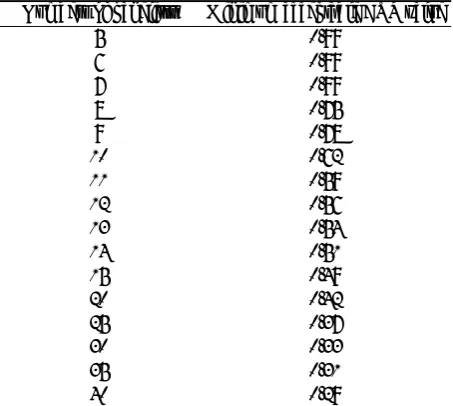
Table 2. Minimum values of CVR and CVRt for different numbers of panelists: One Tailed Test, P-Value=0.05 (6)
Minimum acceptable CVR value Numbers of panelists
0.99 5
0.99 6
0.99 7
0.75 8
0.78 9
0.62 10
0.59 11
0.56 12
0.54 13
0.51 14
0.49 15
0.42 20
0.37 25
0.33 30
0.31 35
0.29 40
and their consensus needs to reflected in a Content Validity Rate (CVR) value higher than 0.62. This value could also be loosely related to the opinion of Chadwick et al. (1984), who proposed that a reliability coefficient of 0.6 or above for a content analysis would be regard as acceptable [ 6, 9]. The maximum of sixteen panelists were decided on by doubling the minimum number of panelists, with a view to making provision for an eventuality where a number of panelists failed to complete or return questionnaires. The validity of the model could also be judged more effectively if more than ten panelists were to return questionnaires. Twenty experts who represented safety expert, cognition expert, ergonomic expert, and psychologist were subsequently identified and telephonically invited to participate. Panelists were deemed to be experts for proposes of this research if they possessed at least a PhD, or equivalent. Prior learning was also recognized for purposes of determining the value of a qualification. An expert must have been actively involved cognitive failure issues in the period between 2000 and 2009 and preferably for longer than ten years in total. All panelists must also have been willing to dedicate approximately one hour of their free time to complete the questionnaire. Of the twenty experts who were initially approached, sixteen agreed to participate in the research. Eight experts returned a correctly completed questionnaire. This amounted to a return rate of fifty percent. The panelist expert field presented in Table1.
Capturing data and performing mathematical and statistical analysis
The judgments of the panelists were captured on a personal computer. Microsoft Access and Microsoft Excel were used for this purpose. Statistical and mathematical calculations were performed on a personal computer using Microsoft Excel.
Quantifying of consensus among panelists
The consensus among penelists on the necessity to include a specific component can be quantified by determining the content validity ratio (CVR) [ 6]. The following formula was used for this purpose:
Eq. 1: CVR= (ne-n/2)/ (n/2)
ne is the number of panelists indicating ”essential” (This variable may be replaced by another eg.”n
The utility of the CVR can be derived from the following characteristic:
When fewer than half say” essential”, the CVR is negative.
When half say ”essential” and half do not , The CVR is zero
When all say ”essential” the CVR is computed to be 1.00.(It is adjusted to 0.99 for ease of manipulation)
When the number saying” essential” is more than half, but less than all, the CVR is somewhere between zero and 0.99 [ 6].
Interpretation of the CVR value of judgments on components is given in Table 2.
The following asseumptions can be made when interpreting the CVR according to Lowshe (1975):
1- When all panelists disagree on the essentiality of an item is not truly essential.
2- When all panelists fully agree that an item is essential, they could be either all wrong or all right. Since they are viewed as experts, it must be concluded that not all of them can be wrong and the item can be considered essential.
3- In doubtful cases the following two assumptions, which are consistent with established psychophysical principles, can be made:
Any item or performance, which is perceived to be”essential” by more than half of the panelists, has some degree of content validity.
The more panelists (beyond 50%) who perceive the item as”essential” the greater the extent or degree of its content validity.
4-It might sometimes be necessary to weight the CVR computed for different items. Lawshe (1975) cautions that the rating concept, or weighting, is not compatible with the content validity analysis method as described above, since the rationale in the content validity method rests on both logical considerations and empirical evidence. Authors have identified several n = the
criteria that may be used to establish assigned to CVRS. Some of these criteria are relevance, importance, usefulness and time spent [ 6].
Table 3. Means and CVR values of the respective judgments and acceptation or rejection results
Item no. CVR Mean Accept/Reject
1- Did you forget frequently called phone numbers of your workplace departments? 0.5 1.5 Accept 2- Did you find you couldn't remember the steps or sequences of daily work procedures? 0.75 1.7 Accept 3- Did you go to one place or department of your workplace and forget why you went? 1 2 Accept 4- Did you forget where put your tools or equipment? 1 2 Accept 5- After you started working, did you realize that you were not using personal protective
equipment? 0.5 1.5 Accept
6- Did you ask your colleagues to remember you take some notes of what you do? 1 2 Accept 7- Did you forget the names of equipment/tools? 0.75 1.7 Accept 8- After a meeting, did you realize that you never discussed the main topic for which you
called the meeting? 0.75 1.7 Accept
9- Did you have to return home or workplace because you forgot something? 0.75 1.7 Accept 10- Did you forget to pass along a message to somebody? 0.75 1.7 Accept 11- Did you feel as though you have forgotten to turn off a light or lock the door when
leaving your office? 0.75 1.7 Accept
12-Did you fail to pay attention to alarms, voice messages, displays? 1.8 0.75 Accept 13- Did you stare (or zone out) when you should be listening to something? 0 1.3 Reject
14- Did you lose your attention to work because of irregular noise or colleagues passing? 0.5 1.5 Accept 15-Did you fail to realize the time while you were looking at clock at once? 0.5 1.7 Accept 16- Did you ask for the same information twice (such as times, names, or dates) twice date
during the same conversation because you forgot the answer? 1 2 Accept 17- Did you lose your concentration after starting a task because of day dream? 0.5 1.5 Accept 18 -Did you distract during studying a manual because of noises? 0.75 1.8 Accept 19 -Did you couldn't to do simple physical tasks during speaking with phone? 0.5 1.5 Accept 20 -Did you lose your focus during doing several simple works simultaneously? -0.75 1.1 Reject 21- Did you delay starting your work because you lost focus? 0.5 1.6 Accept 22- Did you forget words that already have told or a task that you have already completed? 0.5 1.6 Accept 23- Did you fail to find where you placed an object for work? 0.5 1.5 Accept 24 -Did you slip on the street or at your workplace? -0.75 1 Reject 25 -Did you accidentally drop your tools or equipment suddenly? 0.5 1.6 Accept 26- Did you accidentally throw away tools or parts? 0 1.3 Reject 27- Did you press the wrong button or controls on a computer or piece of equipment? 1 2 Accept 28- Did you go to wrong department for handling a specific task? 0.5 1.6 Accept 29 -Did you put a tool in the wrong place? 0.75 1.7 Accept 30- Did you find you chose the wrong method for a task that you have frequently
0.5 1.6 Accept performed in the past?
31 -Did you turn on or turn off a device incorrectly? 0.75 1.8 Accept 32-Did you leave your keys or mobile phone in the lock or desk? 1 2 Accept 33- Did you hit something or somebody accidentally? 0.75 1.8 Accept 34- Did you have difficulty in estimating weight, distance or depth? 0.5 1.5 Accept 35 - Did you find you confuse right and left when giving directions 0.25 1.3 Reject
Determination of acceptation or rejection criteria
To select items of final questionnaire, the following criteria were applied:
1. Accept unconditionally if CVR is equal to or larger than 0.75. This value applies to 8 panelists in accordance with table 2 of CVR values.
Calculation of the respective judgments means
For purpose of computing the mean for each item, the following conversion was done for the values
reflected in the questionnaire: mean of judgments is higher than 1.5. A value of higher 2. Accept if CVR is between 0 and 0.75 and the than 1.5 would indicate that the mean of judgments is closer to the value of “Strongly Agree or Agree” judgments than to the value of “No idea” judgments. A CVR value of 0 indicates that the panel has undecided and that not less than fifty percent of the panel believed that the item is “Strongly Agree or Agree”.
Strongly Agree or Agree - was replaced by 2 No idea - was replaced by 1
Finally, the CVI for the final OCFQ was found to be 0.7 in the present study.
3. Reject if CVR is less than 0 and the mean is lowers than 1.5. This means that it will be impossible to include any item that was not judged to be essential by at least half of the panel, or any item possessing a mean of judgments that is closer to “Strongly Disagree or Disagree” than to “Strongly Agree or Agree”.
Internal consistency
As noted previously, the internal consistency of the measuring instrument was evaluated by the
Cronbach's alpha
. Results show that final OCFQ was internally consistent in the present study (α=96).Quantifying and interpretation of the content validity of the final questionnaire
Repeatability
The content validity index (CVI) is simply a mean of the CVR values of items retained in the validated procedure, model, test, or format. It presents the commonality of judgments regarding the validity, or applicability of the final procedure, model, test, or format being researched. The overall content validity will be higher if the value of the CVI is closer to 0.99 and vice versa [
To determine test-retest reliability, intraclass correlation coefficients (ICC) were used; values of 0.50 and higher indicate reasonable reliability. Results show that the ICC was 0.99.
DISCUSSION
6]. Serious lapses and failures are common in working
life. For preventing, probable outcomes of these types of errors, we need a valid measure. The present study designed to develop the specific questionnaire for occupational cognitive failure evaluation and its validity and reliability. In order to improving reliability, a combined panel consisted of both the field study experts and the industrial practitioners were invited, while the majority of previous research conducted on student participants, which may have interferences in validation process of occupational cognitive failure measures [ Eq. 2
numbers
Retained
CVR
CVI
n1
Internal consistency and Repeatability of the final questionnaire
Internal consistency
In the present study, an occupational sample consisting of fulltime employee (n=260) staffed in the Iranian South Pars Gas Company was chosen randomly and they were requested to complete the final questionnaire. Internal consistency was evaluated with Cronbach's alpha coefficient.
1, 4]. Additionally, for improving the response process, the Likert scale was used [ 9] because we believe that there are many misunderstanding related to lawshe's codes.
In the present study, one of the famous content validity approaches (CVR) was conducted and the results showed that the final OCFQ was a valid and reliable instrument that could be used in measurement and predicting safety performance of working population. However, future research should attempt to evaluate construct validity of this version. While the present study examined internal consistency and repeatability in industrial workplace, more specific workplaces and participants may be required. On the other hand, whereas the OCFQ can be used to identification of latent failures in the long chains of accident, future research is needed to examine which cognitive failures actually predict safety behavior and accidents in organizations.
Repeatability
Repeatability or test-retest reliability was evaluated by the Pearson correlation coefficient.
RESULTS
Draft OCFQ
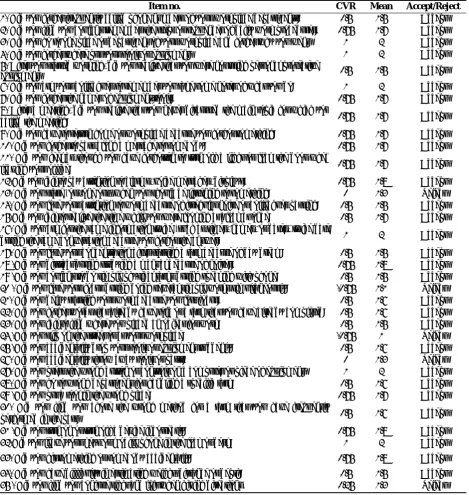
As described in the previous section, a draft 35-item questionnaire was created as shown in Table 3.
Means and CVR values of the respective judgments and acceptation or rejection results
The means and individual CVR values of the judgments were calculated and the results were compared with the corresponding criteria. For every item, means and CVR values and acceptation or rejection results are given in Table 3.
CONCLUSION
Measurement of cognitive failure in the occupational settings requires a valid and reliable instrument. Occupational Cognitive failure questionnaire (OCFQ), which showed an acceptable validity and reliability, can be regarded a useful, valid and reliable tool for this mean.
CVI results and introduction of final OCFQ
In this study, after evaluation of validity, five items were rejected. The new measuring instrument with 30-items was developed. The CVI for this new measuring instrument was calculated by Eq. 2:
ACKNOWLEDGEMENTS
This article was supported by Iranian South Pars Gas Company (SPGC). The authors would like to thank Dr. Steven J. Kass and Mrs Farahnaz Askarpour, SPGC (phase 1&2) HSE manager, for their valuable advices 70
. 0 30
75 .
20
numbers retained
and comments. The authors declare that there is no conflict of interests.
REFERENCES
1. Broadbent, Cooper, Fitzgerald, & Parkes. The cognitive failures questionnaire (CFQ) and it correlates. British Journal of Clinical Psychology 1982; 21: 1-16.
2. Reason, J. T. Skill and error in everyday life. In M. Howe (Ed.), Adult learning .London: Wiley, 1997.
3. Martin, M. Cognitive failure: Everyday and laboratory performance. Bulletin of Psychonomic Society 1983; 21: 97-100. 4. Wallace, J. C. & Vodanovich, S. J. Can accidents and industrial
mishaps be predicted? Investigating Workplace Performance and Cognitive Failure. Journal of Business and Psychology 2002; 17: 503-514.
5. Craig Wallace. Development and Validation of a Work-Specific Measure of Cognitive Failure: Implications for Occupational Safety. Journal of Occupational and Organizational Psychology 2005; 78: 615-632.
6. Lawshe, C. H. A quantitative approach to content validity. Personnel Psychology 1975; 28: 563-575.
7. Wallace, J. C. Confirmatory factor analysis of the cognitive failures questionnaire: evidence for dimensionality and construct validity. Personality and Individual Differences 2004; 37: 307– 324.
8. Chadwick, B. A., Bahr, H. M., & Albrecht, S. L.Social science research methods, Prentice-Hall, Englewood Cliffs, 1984. 9. Leedy, P., Ormrod, F. Practical research: Planning and design. 6
th Edition. New Jersey: Pearson Education, Inc. 2001.
10. Henderson, M., & Freeman, C.P.L. A self-rating scale for bulimia: The "BITE." British Journal of Psychiatry 1987; 150: 18-24.
11. Holsti, O. R. Content analysis for the social sciences and humanities. Reading, MA: Addison-Wesley Publishing Company, 1969.