International Journal of Applied Exercise Physiology
2322-3537 www.ijaep.comVol.6 No.3
Received: April 2017 , Accepted: August 2017 , Available online: October 2107
Gesture based Human Computer Interaction for Athletic Training
Mehdi Khazaeli
1 *, Chadi El Kari
1, Jacob Baizer
2, Leili Javadpour
11
Assistant professor of Engineering and Computer Science, University of the Pacific, Email :{mkhazaeli, celkari,
ljavadpour}@pacific.edu,
2Student in Computer Science program Email: [email protected]
ABSTRACT:
The invention of depth sensors for mobile devices, has led to availability of relatively inexpensive high-resolution depth and visual (RGB)
sensing for a wide range of applications. The complementary nature of the depth and visual information opens up new opportunities to solve
fundamental problems in object and activity recognition, people tracking, 3D mapping and localization, etc. One of the most i nteresting
challenges that can be tackled by using these sensors is tracking the body movements of athletes and providing natural interaction as a result. In this study depth sensors and gesture recognition tools will be used to analyze the position and angle of an athlete’s body parts thought out an
exercise. The goal is to assess the training performance of an athlete and decrease injury risk by giving warnings when the trainer is performing a
high risk activity.
KEY WORDS Motion Analysis, Injury Risk, Kinematic
INTRODUCTION
The invention of depth sensors for mobile devices, has led to
availability of relatively inexpensive high-resolution depth and visual
(RGB) sensing for a wide range of applications including biomechanics
analysis. The complementary nature of the depth and visual information
in the activity sensor opens up new opportunities to solve fundamental
problems in object and activity recognition, people tracking, 3D
mapping and localization, etc. One of the most interesting challenges
that can be tackled by using the activity sensor is tracking the body
movements of users and providing natural interaction as a result.
Human body tracking has many applications in areas of digital
animation for entertainment, education, biomechanics analysis for
clinical and sports applications, etc.
In recent years, many algorithms have been proposed to address the
problem of human parts detection, pose estimation and body tracking
from 3D data. Earlier research show focus on the use of time-of-flight
range cameras (TOF). Recent technological advances have led to the
development of depth cameras that allow acquiring depth and 3D
images in real-time with no need for multi-camera systems.
The focus of this research is to use the Microsoft Kinect as a clinical
assessment tool which can assist rehabilitation, biomechanics and
training, regular exercise, and ergonomic methods. In biomechanics,
having knowledge on the position and orientation of a user is vital when
assessing attention, performance, injury risk and joint loading. The
focus of scientists in this area has always been on obtaining information
GESTURE BASED HUMAN COMPUTER INTERACTION VOL. 6 (3)
tracking and gesture analysis play a central role in ergonomics andbiomechanical engineering. Through this scientific exploration,
attempts can be made to reduce the risk of musculoskeletal injury or
possibly study the system for performing ergonomic assessments. One
of the frequently used exercise in strength & conditioning programs is
the Olympic snatch. Snatch requires athletes to lift the weight
explosively. The biomechanics of this technique is similar to activities
such as running and jumping. Researchers have studies the lift
extensively by examining Olympic weightlifters to get insight on this
exercise. However it is difficult to acquire kinematic and kinetic
parameters. Thus, an understanding of the movement would be very
valuable for coaches [1].
Current devices that are capable of measuring spatiotemporal and
kinematic variables are expensive. Emerging of low cost sensors that
capture motion has provided a clinically feasible alternative for
biomechanical validation of weightlifting.
Originally created for gaming, the Microsoft Kinect V2 enables 3D
motion capturing. In particular, the Kinect has a depth sensor with a
resolution of 512 x 424 pixels which provides depth information for
each pixel using TOF [2]. It is possible to obtain the 3D coordinates of
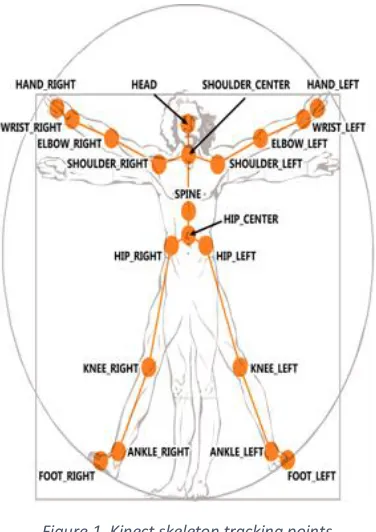
25 body joints via randomized decision trees forests [3] as shown in the
following Figure.
Figure 1. Kinect skeleton tracking points
Previous research studied the feasibility of using the Kinect as
clinical assessment tool and found that the Kinect and Kinect V2
systems. In particular, in spinal cord injuries rehabilitation, the Kinect
was compared with an expensive high precision optical system and was
found to be an accurate low-cost and easy to use alternative [4]. The Kinect was found to be a valid tool for assessing spatiotemporal
components of gait [5,6] but it is unable to accurately assess lower limb
kinematics [7,8]. In order to bypass the lower extremities inaccuracy a
technique that relies on knee joint relative angle has been proposed to detect foot-off and foot contact during the gait cycle [9]. The Kinect
was successfully used for the classification of human movement during active video game play in relationship to fundamental movement skill
[10].
The purpose of this study is twofold. First, this study assesses the
ability of the Kinect, a low-cost easy to use device, to accurately acquire kinematic and kinetic parameters during the Snatch lift.
A second purpose of this study to classify movement frames into 6
phases of the snatch and then assign a score to each frame that indicates
the deviation from good form.
METHODS
The Kinect V2 allows us to retrieve the 3D coordinates of the body
joints. We use these coordinates to obtain the angles between various joints as follows:
The joint angles were determined as follows:
Knee joint angle for each leg was calculated using the Cartesian coordinates of the hip, knee and ankle joints. Hip joint angle was calculated using the Cartesian
coordinates of the hip, knee and shoulder center joints. Back joint angle was calculated using the Cartesian
coordinates of the hip, should center and a unit vector.
GESTURE BASED HUMAN COMPUTER INTERACTION VOL. 6 (3)
62
Let𝑣
𝑖𝑗
⃗⃗⃗⃗
be vectors in 3-D space between joints i and j where i, j ∈{shoulder, hip, knee} and𝑢⃗
𝑖𝑗be their unit vectors (Figure 2). We compute the angles of joints using the following:
Figure 3. Kinect skeleton tracking map
The analysis focused on the pulling phase from the beginning of the
barbell lift-off to the second pulling phase, turnover and rising above
head. The different phases of the snatch are explained in the following.
1. First Pull: This phase begins with the barbell at rest on the ground and ends when the knees reach their first
maximum extension.
2. Transition: At this stage the knees are flexed and pushed toward the barbell. This phase ends at maximum knee
flexion.
3. Second pull: This phase begins when the knees reach maximum flexion during the transition phase. By the end
of this phase, the displacement of the hips, knees and
ankles are maximum extension range of motion.
4. Turnover: This phase begins at maximum knee extension and ends when the barbell reaches its maximum height.
The lifter begins moving the body downward to be
positioned underneath the barbell.
5. Catch: This phase is when the lifter locks the arms and stabilizes the barbell overhead while slowing its
downward movement.
6. Rising: This phase follows the catch and is when the lifter
rises from the squat position to stand fully erect at the
completion of the lift.
The joint angle: in Figure 4, the angular displacements of the ankle, knee and hip joints in the sagittal plane were calculated.
EXPERIMENTAL SETUP
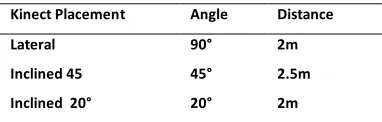
A Kinect sensor was placed at the following distances and angles
from the subjects which were healthy athletes familiar with Olympic weightlifting.
Table2. The experimental setup
Kinect Placement Angle Distance
Lateral 90° 2m
Inclined 45 45° 2.5m
Inclined 20° 20° 2m
A frontal placement of the Kinect did not yield accurate measurement
of all angles. Each subject executed four snatches. The video is
recorded in 30 frame per second. We determined that the most accurate
data (compared to a multi-camera system) is the 2nd configuration (Inclined 45° at a distance of 2.5m)
After filtering and removing noise the remaining frames were
classified into each of the 6 positions. The features generated for each frame are: the angular displacements of the ankle, knee, hip and back
joints. We used time series segmentation using Hidden Markov Model
to label each frame.
Image processing is used to identify the location of barbell and
determine the bar path in respect to the vertical line. We used bar path,
amount of time spend in each phase of the lift and joint angles to
determine the risk level of the subject in each position.
Figure 4. Phases of snatch
STATISTICAL RESULTS
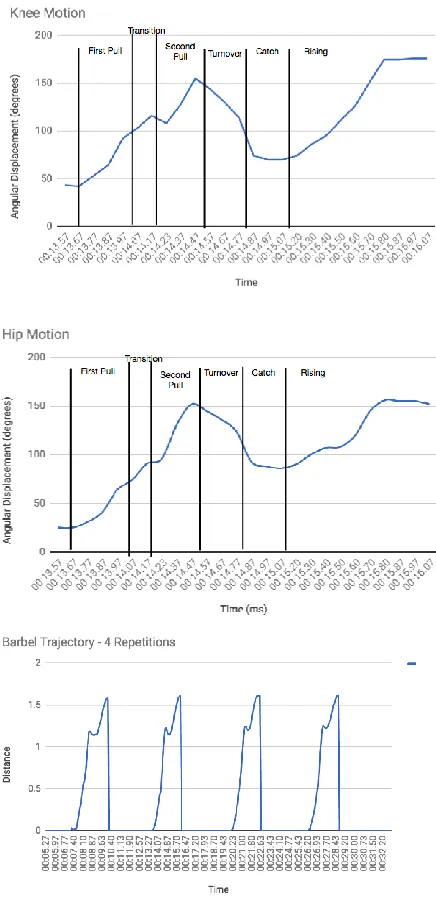
The following charts (Figure 5) show the angular displacement of the
hip and knee as well as the trajectory of the barbell during the Snatch. The kinematic variables of the snatch were calculated and used to
GESTURE BASED HUMAN COMPUTER INTERACTION VOL. 6 (3)
Figure 5. Angular displacements
The motion results on knees and hips are in line with previous
literature and data from an optical motion tracking system, however the information gain of ankles motion was low and inaccurate. This is due
to noisy data stemming from lower extremities inaccurate tracking by
the Kinect as indicated in [7,8].
Once the video for skeleton tracking was recorded and annotated, the classification and feature ranking were performed. Classification
analysis was performed using Naive Bayes and Support Vector
Machine (SVM). 10-fold cross validation was used to evaluate the predictive models. By using both methods, a better understanding of
the classification accuracy and speed boundaries for the data can be
determined.
The annotated training set has a high class imbalance. To address this
issue, SMOTE oversampling technique was used. As can be seen in
Table 2, both classifiers performed well on the classification task. The data has been classified in 6 different clusters and the results show
promise for this type of classification task.
Table2. Classification result
Naïve Bayes SVM
Precision Recall FMeasure Precision Recall FMeasure
First Pull 0.773 0.85 0.81 0.692 0.9 0.783
Transition 0.21 0.15 0.175 0.05 0.08 0.06
Second
Pull 0.692 0.56 0.621 0.733 0.69 0.71
Turnover 0.867 1 0.929 0.917 0.85 0.88
Catch 0.727 1 0.842 0.7 0.88 0.778
Rising 1 0.84 0.914 0.941 0.84 0.889
Weighted
AVG 0.817 0.81 0.808 0.789 0.8 0.791
Results of the feature analysis using the information gain ranking
technique can be seen in Table 3. From these results, it can be seen that
the hand and hip positions have the highest contribution to classification accuracy. Additionally, it can be seen that back and knee
features have a higher contribution than time. Time series was used to
identify the correlation of time feature in segmentation however that did not have an impact on the accuracy of the model. In the future work
Hidden Markov Model and sliding window approach will be used.
In addition, the algorithm is able to assess each frame against predetermined rules for a health snatch. Healthy snatch will be
identified using a rule–based algorithm based on displacement from
centroid of clusters regarding of weight category, gender, and age of
lifters and rules based on physics of lifting. For each class, the pulling style might be different for example taller lifters may need to extend the
knees somewhat more to bring the bar past the knees properly.
This added validity and reliability is beneficial to assessing the
variables that have previously been identified and correlate to the injury level of lifter. For example the angle of the back should remain more or
less constant during the first pull, the hips and knees should be fully extended during the second pull, rules regarding speed and accuracy of
both barbell path and turnover etc… a deviation from these rules in any
frame will result in an alert flag and an unhealthy classification for that
frame.
Feature ranking was performed using information gain based feature
GESTURE BASED HUMAN COMPUTER INTERACTION VOL. 6 (3)
64
Table3. Feature ranking
Rank Score Feature
1 0.78 LeftHandYPos
2 0.77 RightHandYPos
3 0.74 RightHandXPos
4 0.7 LeftHipAngle
5 0.67 RightHipAngle
6 0.63 BackAngle
7 0.59 LeftHandZPos
8 0.57 LeftHandXPos
9 0.53 RightHandZPos
10 0.5 RightKneeAngle
11 0.47 LeftKneeAngle
12 0.37 Time
13 0.35 RightLiftAngle
DISCUSSION
The kinematics of snatch lifting were analyzed using Kinect and
provide insight into this technique. In this paper the Kinect was used to
track skeleton joins of athletes performing snatch. Machine learning was used to classify the 6 phases of this technique. The proposed
approach gave promising results for a systematic assessment the
training performance. In conclusion, the Kinect sensor can potentially be an effective clinical tool for evaluating knee and hip joint kinematics
and some spatiotemporal variables during lift. Given the advances in
depth sensor technology and ease of data acquisition and processing,
the Kinect can be a feasible and cost-effective alternative to the expensive marker-based 3DMA systems for use in clinic and at-home