Eukaryon
Eukaryon
Volume 6 Evolving Connections
Article 38
3-1-2010
The Effects of Cyclopamine Administration on Chick Embryo
The Effects of Cyclopamine Administration on Chick Embryo
Development
Development
Daryn Cass
Lake Forest College
Christopher Jackson
Lake Forest College
Follow this and additional works at:
https://publications.lakeforest.edu/eukaryon
Disclaimer:
Eukaryon is published by students at Lake Forest College, who are solely responsible for its
content. The views expressed in Eukaryon do not necessarily reflect those of the College.
Articles published within Eukaryon should not be cited in bibliographies. Material contained
herein should be treated as personal communication and should be cited as such only with the
consent of the author.
Eukaryon, Vol. 6, March 2010, Lake Forest College
Primary Article
The Effects of Cyclopamine Administration on Chick Embryo Development
Daryn Cass and Christopher Jackson*
Department of Biology Lake Forest College Lake Forest, Illinois 60045
Introduction
Cyclopamine (11-deoxojervine) is a chemical derived from the plant Veratrum californicum and is known to induce cyclopia when ingested. Cyclopia is a birth defect that is characterized by the absence of median facial structures and holoprosencephaly (an undivided forebrain), which arise from abnormal patterning of the ventral neural tube. This defect is sometimes observed in the offspring of cattle that graze in a field in which Veratrum californicum is present. Cyclopamine was often ingested by humans in the past, because it is similar in appearance to the plant hellebore, which is occasionally given to women to prevent cramps, vomiting, and nausea during pregnancy (1).
Cyclopamine works by preventing Sonic hedgehog (Shh) signaling, which is necessary for many aspects of development, including those mentioned above. Cyclopia can also occur by mutations in the Shh gene. The incidence of cyclopia occurs in about one in 250 embryos, and one in 16,000 newborns. Inhibition of Shh signaling is not the only way to induce holoprosencephaly. A number of environmental factors are also known to elicit holoprosencephaly related malformations. Preconceptual diabetes, retinoic acid exposure, maternal alcohol consumption, and cholesterol synthesis inhibitors can all lead to varying severities of holoprosencephaly phenotypes (2).
Shh signaling can be inhibited in several ways. A mutation in the Shh gene will cause the whole signaling pathway to not occur, because Shh is not made. The Shh pathway works by binding Shh to the patched protein, located on the membrane of a cell. When this happens, the smoothened protein, which is normally inhibited by patch, becomes uninhibited and releases the Ci protein from microtubules. The Ci protein enters the nucleus and acts as a transcriptional activator of particular genes. When Shh does not bind to patched, smoothened protein, it cannot be activated and the pathway cannot take place (3). Cyclopamine prevents Shh signaling by binding to a particular part of the smoothened protein called the heptahelical bundle, preventing it from functioning and allowing for the release of Ci protein from the microtubules (4).
Another way for Shh signaling to be inhibited is through cholesterol synthesis inhibitors, as mentioned above. Cholesterol is of extreme importance to this pathway. It is necessary for the catalytic cleavage of the Shh protein but is also crucial in Shh’s function as a paracrine factor. Cholesterol binds to the active N-terminus of the Shh protein and allows it to diffuse over a wide area. Without cholesterol, this diffusion is severely hampered (3). While some argue that cyclopamine works by these mechanisms as well, others have shown that its teratogenic effects are solely due to interaction with the smoothened protein (5). Cyclopamine is also known to have clinical applications, mainly in instances in which Shh signaling needs to be inhibited. It is used in the treatment of medulloblastomas, which is the most common malignant brain tumor in children. The ________________________________________________
*This author wrote the paper for Biology 342: Developmental Biology taught by Dr. Pliny Smith.
malignant growth of these tumors can be halted by inhibiting the Shh signaling pathway with cyclopamine in mice and humans (6).
In our experiment, we wanted to determine the effects of cyclopamine administration on craniofacial development and observe to what extent cyclopamine induces cyclopia in developing chick embryos. Shh is necessary for patterning of the neural ventral tube, as mentioned above. The ventral pattern is imposed by the notochord, which releases Shh. Formation of the ventral midline is also mediated by Shh released from the floor plate of the neural tube once this is formed (7). Commissural neurons help set up and cross the ventral midline in order to coordinate left and right motor activities. While Shh is not the only molecule involved in this process, it is crucial for guiding the commissural neurons and setting up the ventral midline. As a consequence of this, holoprosencephaly can occur (3). Also, the separation of the eye field into two bilateral fields depends on the secretion of Shh from the prechordal plate. When this is not released, Pax6 cannot be inhibited and the visual field will not be divided into two eyes. Because of the necessity of Shh signaling in the above mentioned events, we propose that inhibition of Shh signaling will lead to cyclopia and holoprosencephaly in cyclopamine treated animals.
Another role of Shh signaling is in osteogenesis, or bone formation. Endochondral ossification is the type of bone formation by which the vertebrae, limbs and ribs develop. This type of bone formation requires the formation of cartilage, which is later turned into bone. The ventral part of the somite becomes the sclerotome. Shh induces sclerotome cells to express Pax1, which signals mesenchymal cells to become cartilage. The somites give rise to the vertebrae and limbs, so when somites cannot properly develop in order to give rise to cartilage, bone formation of the vertebrae and ribs cannot take place. We will stain cyclopamine treated chicks using alcian blue, a cartilage stain, in order to see if rib and vertebrae development can take place. We hypothesize that this will not happen due to the non specification of the somites.
Methods
Thirty fertilized chicken eggs were obtained from Phil’s Fresh Eggs. Eggs were incubated in a 13°C incubator until ready for treatment. Eggs spent ten days in the incubator before treatment began. 1 mg of cyclopamine was obtained from Sigma Aldridge. Cyclopamine was prepared and administered at doses comparable to the protocol of Incardona et al (1). Cyclopamine was complexed with 2-hydroxypropyl-ß-cyclodextrin (HBC) in order to make the cyclopamine dissolve in Dulbecco’s phosphate buffered saline (DPBS). Cyclopamine-HBC was produced by suspending 1 mg of cyclopamine in 1 ml of 45% HBC in sterile DPBS and stirring for 3 hours at 60°C. After this, the solution was stored at room temperature and treatment began.
sterile Ringer’s solution in order to prevent infection from occurring. Eggs were closed using a glass coverslip and tape in order to prevent drying out of the egg. They were placed back in the incubator and allowed to further develop. 17 eggs were treated and 13 were not windowed at all, serving as controls. Eggs were held up to a bright light to check for blood vessel formation and viability after 48 hours. Chicks were allowed to further develop until they reached the 11 day stage. At this point, viable chicks were removed from their eggs and placed in TCA for alcian blue staining. The alcian blue staining procedure was performed as described in class (8).
Eggs were incubated in a 25°C incubator for 5-6 hours until they reached stage one of development. At this point, eggs were removed from the incubator and some of the egg white was removed by inserting a syringe into the blunt side of the egg and extracting the fluid. Following this, eggs were windowed and the embryo was located. 5µg of cyclopamine was delivered to the embryos in a 5µl solution of HBC-DPBS, which was simply dropped onto the vitelline membrane using a pipette. Eggs were given a few drops of sterile Ringer’s solution in order to prevent infection from occurring. Eggs were closed using a glass coverslip and tape in order to prevent drying out of the egg. They were placed back in the incubator and allowed to further develop. 17 eggs were treated and 13 were not windowed at all, serving as controls. Eggs were held up to a bright light to check for blood vessel formation and viability after 48 hours. Chicks were allowed to further develop until they reached the 11 day stage. At this point, viable chicks were removed from their eggs and placed in TCA for alcian blue staining. The alcian blue staining procedure was performed as described in class (8).
A second group of eggs was treated as well. 30 eggs were obtained, and 10 were treated at stage one, when embryos were 5-6 hours old. 10 more embryos were treated at stage nine of development, when embryos were 28 hours old. For this second group of animals, a small hole was made in the vitelline membrane into which the 5µl cyclopamine solution was injected. Chicks were placed back in the incubator until they reached day 11 of development. These were also removed and processed for alcian blue staining. Remaining control eggs were placed back in the 13°C incubator to prevent them from reaching full gestation and hatching.
Results
Overall Viability after Treatment
After chicks were treated with cyclopamine and placed in the incubator, they were checked for viability 48 hours after treatment by being held up to a bright light to check for blood vessel formation. 17 embryos were originally windowed, but only 15 of these were treated, because an embryo was not detected in 2 of the eggs windowed. Of the 15 embryos treated, 4 appeared to be viable after 48 hours. 9 of the 13 control eggs were viable at this point. At day 11 of development, chicks were removed from their eggs and processed for alcian blue staining. The 4 treated chicks were used for staining, as well as 4 control animals. Before the staining process was even started, it was not difficult to identify the treated animals from the control animals. All of the control animals appeared to be normal 11 days old chicks (Figure 1.A). Animals treated with cyclopamine, however, were much smaller than normal 11 day chicks and were hardly identifiable as such (Figure 1.B-E). The body length of an 11 day control animal was approximately 2.2 cm compared to about 1 cm for the treated chicks (Figure 1). In the second group of animals, where 10 were treated at stage 1 and 10 were treated at stages 9-10, we also
Figure 1.A-E. 11 day control embryo stained with alcian blue(A). cyclopamine treated, underdeveloped 11 day embryos stained with alcian blue (B-E).
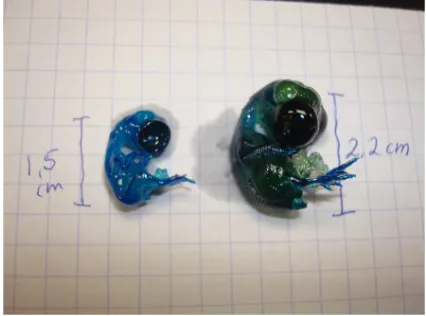
checked for viability after 2 days. At this point, 2 of the chicks treated at stage 1 and 2 of the chicks treated at stage 9 were viable. Most of the chicks, however, failed to establish circulation and experienced arrested development. At day 11, none of the embryos treated at stage 1 were viable. The black coloration of the matter in the egg was an indication of this. Both of the animals treated in stage 9 were viable after 11 days and were processed for alcian blue staining at this point. One of these chicks, like the original 4 treated animals, was not nearly developed to the correct size of an 11 day embryo. However, one of the chicks developed slightly larger (body length of about 1.5 cm), but not to the size of a control 11 day chick (Figure 2). These chicks were also processed for alcian blue staining.
Figure 2. Cyclopamine treated chick with cyclopia (left) and control embryo (right), both stained with alcian blue.
Alcian Blue Staining
Figure 3. 11 day embryo with cyclopia stained with alcian blue.
Figure 4. 11 day control embryo, stained with alcian blue.
and very little in the spinal cord (Figure 3). In comparison, the control 11 day chicks showed alcian blue staining throughout (Figure 4), indicating that cartilage had formed in all the correct regions.
Incidence of Cyclopia
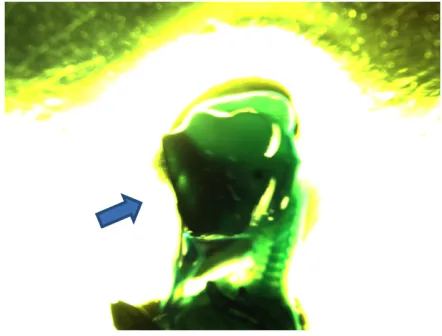
Cyclopia was observed in one of the chicks treated at stage 9, the same one that developed further than the other treated animals. This can clearly be seen in Figure 5, which shows a frontal view of a control 11 day embryo stained with alcian blue that clearly has two eyes and a treated 11 day embryo that only has one eye. This can be seen in Figure 6. This embryo’s one eye is not exactly in the middle of its head but more off to the right side. It was not possible to see other facial abnormalities in this chick, and we were not able to tell if it had holoprosencephaly or not. Some of the treated animals appeared to have only one eye, but since they were so small and did not develop correctly, this was hard to tell. Perhaps if they had developed further, cyclopia would have been observed in these animals as well.
Discussion
From our experiment, we were able to confirm certain aspects of our hypothesis. We believed that inhibition of Shh signaling with cyclopamine could prevent correct patterning of the ventral tube, leading to a variety of facial
Figure 5. Frontal view of 11 day control embryo stained with alcian blue, with two eyes indicated by arrows.
Figure 6. Frontal view of 11 day treated chick with cyclopia, stained with alcian blue. Arrow indicates the presence of only one eye.
malformations, including holoprosencephaly and cyclopia. While cyclopia was only induced in one of the cyclopamine treated chicks with certainty, we believe that if some of the others had developed further, they might have been shown to have had cyclopia as well. The success rate of our experiment was low. We expected to see more chicks develop to the same stage as the stage 9 treated embryo with cyclopia. Perhaps the low success rate was due to a too high of dose of cyclopamine. Much of the literature explored used this dose; one paper mentioned that any dose higher than 5µg was lethal to chicks in all cases. However, lower doses did induce cyclopia as well (9). Another difference in viability could also be due to the way cyclopamine was administered. In the first group of animals, we simply use a pipette to transfer the cyclopamine onto the vitelline membrane. However, when the success rate using this method was low, we injected cyclopamine through a hole in the vitelline membrane. We cannot say whether this was a better method or not. There was no survival of chicks in the stage 1 administration group, and only two chicks survived in the stage 9 administration group. However, there was one chick with cyclopia in this group. It seems that treating chicks at stage 9 is more successful in general, but this experiment would need to be repeated in order to confirm this.
clearly see alcian blue staining, it was very clear that there was very little cartilage formation of the rib cage and vertebrae. As we proposed in our hypothesis, we think this is due to the fact that the somites, from which the vertebrae and ribs arise, did differentiate correctly due to aberrant Shh signaling.
Our experiment was limited in several ways. First of all, when we ran the first group of eggs, they had been sitting in the 13°C incubator for an extended amount of time. Ideally, we would have treated the eggs as soon as they had arrived. The longer the eggs spend fertilized but in an environment with too low of a temperature for them to grow, the less the eggs will start to develop once placed in a warm enough environment. However, for the second group of animals we ran, we did not experience a higher success rate of development, and we treated these eggs almost as soon as they arrived. Another limitation was the way we handled the control eggs. These were left untreated as well as unwindowed. Therefore, it is not possible to compare viability rates between the treated and control eggs. Windowing the eggs can be stressful to them and can cause damage, including death. While we tried to clean the eggs and supplies we touched with a 70% alcohol solution, the windowing process cannot be completely sterile.
Embryos that were treated may have died not due to the effects of cyclopamine but due to the windowing process. For example, the egg yolk could have been punctured while removing liquid from the egg, or a bacterial infection could have taken over due to the use of contaminated syringes or pipettes. Another difference between the treated and control eggs was the use of HBC. While HBC was merely used to make cyclopamine more soluble in DPBS, it could have affected chick development in some way. This is unlikely, but the control eggs should have been windowed and treated with HBC-DPBS in order to ensure more reliable results.
Conclusion
While the incidence of cyclopia in our experiment was very low, we were able to establish that Shh signaling is crucial for chick development in more ways than we addressed in this experiment. We were able to observe that Shh signaling is crucial for the differentiation of the eye and of the ventral midline. Absence of Shh signaling can lead to holoprosencephaly and cyclopia. We also confirmed that Shh signaling is necessary for cartilage and consequent bone formation of the vertebrae and ribs. The fact that Shh signaling controls somite differentiation is most likely the reason why these structures did not develop correctly.
Note: Eukaryon is published by students at Lake Forest College, who are solely responsible for its content. The views expressed in Eukaryon do not necessarily reflect those of the College. Articles published within Eukaryon should not be cited in bibliographies. Material contained herein should be treated as personal communication and should be cited as such only with the consent of the author.
References
1. Incardona, J. P., Gaffield, W., Kapur, R. P., & Roelink, H. (1998). The teratogenic veratrum alkaloid cyclopamine inhibits sonic hedgehog signal transduction. Development (Cambridge, England), 125(18), 3553-3562.
2. Edison, R., & Muenke, M. (2003). The interplay of genetic and environmental factors in craniofacial morphogenesis: Holoprosencephaly and the role of cholesterol. Congenital Anomalies, 43(1), 1-21.
3.Gilbert, S.F. (2006). Developmental Biology, eighth edition. Sinauer. Chapters 6 and 13.
4. Chen, J. K., Taipale, J., Cooper, M. K., & Beachy, P. A. (2002). Inhibition of hedgehog signaling by direct binding of cyclopamine to smoothened. Genes & Development, 16(21), 2743-2748.
5. Incardona, J. P., Gaffield, W., Lange, Y., Cooney, A., Pentchev, P. G., Liu, S., et al. (2000). Cyclopamine inhibition of sonic hedgehog signal transduction is not mediated through effects on cholesterol transport. Developmental Biology, 224(2), 440-452.
6. Bar, E. E., & Stearns, D. (2008). New developments in medulloblastoma treatment: The potential of a cyclopamine-lovastatin combination. Expert Opinion on Investigational Drugs, 17(2), 185-195.
7. Fan, C. M., & Tessier-Lavigne, M. (1994). Patterning of mammalian somites by surface ectoderm and notochord: Evidence for sclerotome induction by a hedgehog homolog. Cell, 79(7), 1175-1186.
8. Smith, P. Alcian blue staining protocol.