A Novel DOA Estimation Approach for Unknown Coherent
Source Groups with Coherent Signals
S. Shirvani Moghaddam*(C.A.), Z. Ebadi** and V. Tabataba Vakili***
Abstract: In this paper, a new combination of Minimum Description Length (MDL) or Eigenvalue Gradient Method (EGM), Joint Approximate Diagonalization of Eigenmatrices (JADE) and Modified Forward-Backward Linear Prediction (MFBLP) algorithms is proposed which determines the number of non-coherent source groups and estimates the Direction Of Arrivals (DOAs) of coherent signals in each group. First, the MDL/EGM algorithm determines the number of non-coherent signal groups, and then the JADE algorithm estimates the generalized steering vectors considering white/colored Gaussian noise. Finally, the MFBLP algorithm is applied to estimate DOAs of coherent signals in each group. A new Normalized Root Mean Square Error (NRMSE) is also proposed that introduces a more realistic metric to compare the performance of DOA estimation methods. Simulation results show that the proposed algorithm can resolve sources regardless of QAM modulation size. In addition, simulations in white/colored Gaussian noises show that the proposed algorithm outperforms the JADE-MUSIC algorithm in a wide range of Signal to Noise Ratios (SNRs).
Keywords: DOA, EGM, JADE, MDL, MFBLP, RMSE.
1 Introduction1
In wireless communications, electromagnetic waves experience fading and multipath phenomena which introduce coherent signals in receiver. Coherent signals leads to rank deficiency in the spatial covariance matrix. Therefore, some second-order-statistics-based subspace methods, such as MUltiple SIgnal Classification (MUSIC) and Estimation of Signal Parameters via Rotational Invariance Techniques (ESPRIT), fail to correctly resolve the signals, thus the estimation of the Direction Of Arrival (DOA) is not possible [1, 2].
To overcome this problem, many effective methods, such as spatial smoothing [3], Maximum Likelihood (ML) [4], deflation approach [5], method in [6] and method based on Matrix Pencil (MP) [7], are proposed. The spatial smoothing algorithm is based on a preprocessing scheme, which divides an original array into several overlapping subarrays, computes covariance
Iranian Journal of Electrical & Electronic Engineering, 2015. Paper first received 18 Jan. 2014 and in revised form 26 Oct. 2014. * The Author is with the Faculty of Electrical Engineering, Shahid Rajaee Teacher Training University (SRTTU), 16788-15811, Lavizan, Tehran, Iran.
** The Author is with the Department of Electrical Engineering, Tehran South Branch, Islamic Azad University, Tehran, Iran. *** The Author is with the Department of Electrical Engineering, Iran University of Science and Technology (IUST), Narmak, Tehran, Iran E-mails: [email protected], [email protected] and [email protected].
matrix for each subarray, and then applies high-resolution methods to the covariance matrices in order to resolve the signals [3]. In the deflation approach, uncorrelated signals are first estimated and then eliminated and finally coherent signals will be resolved [5]. A different technique presented in [6] utilizes symmetric configuration of Uniform Linear Array (ULA) and constructs non-Toeplitz matrix to resolve signals. The proposed method in [7] utilizes idea of MP on the spatial samples of the data. The MP method can find DOA of coherent signals without spatial smoothing. However, spatial smoothing requires more sensors for preprocessing and the ML approach is computationally intensive. The deflation approach has significant loss of array aperture, because it cannot utilize all the constructed Toeplitz matrices [5] and [8]. Also, the method in [6] suffers from burdensome computation and shortcoming of MP is its requirement for high Signal to Noise Ratio (SNR). Many other efforts based on Fourth Order Cumulants (FOC), such as Steering Vectors DOA (SV-DOA) [9], modified MUSIC [10], methods in [11-14], have been also made for DOA estimation of coherent signals. SV-DOA, first, estimates the steering vectors blindly and then, it utilizes Modified Forward-Backward Linear Prediction (MFBLP) to estimate DOA using the estimated vectors. Modified MUSIC in [10], utilizes switching matrix to construct a new covariance matrix. Method in [11], first,
constructs the data vector which contains all DOA information. Then, it constructs rotation matrix and finally estimates signal DOAs. In [12], Joint Approximate Diagonalization of Eigenmatrices (JADE) and MUSIC were combined, as JADE-MUSIC, to estimate source groups containing coherent signals. Method represented in [13], first, estimates the independent signals, and then eliminates them. Finally, it constructs FOC matrix of coherent signals and also resolves them. Method in [14], combines two algorithms, JADE and MFBLP, to estimate signals. However, SV-DOA requires a large number of snapshots. Computational complexity of the proposed methods in [10] and [12] is relatively high due to spatial spectrum calculation and peak searching. Moreover, the ESPRIT method [11] needs special array geometry [11] and the proposed method in [13] requires a large number of snapshots.
All above mentioned DOA estimation algorithms suppose that the number of coherent and/or non-coherent signals is known or it is determined, approximately. In order to evaluate the number of sources, Wax and Kailath suggested the use of the Minimum Description Length (MDL) criterion [15]. Also, many other criteria such as Eigenvalue Gradient Method (EGM) [16] and Eigen Increment Threshold (EIT) [17] were proposed. The EGM criterion, first computes eigenvalues of auto-correlation matrix, then it determines the number of sources by checking the difference between neighbor eigenvalues. The EIT method utilizes a threshold to evaluate the eigenincrement between neighbor eigenvalues. According to the simulation results in [18] for MDL and EGM methods, the MDL is more appropriate for AWGN channel but EGM is suitable for colored noise.
In this paper, we extend the work in [14] for estimating signal groups. Unlike [14], the number of signal groups is considered to be unknown. In the proposed approach, first MDL/EGM is used to detect the number of coherent signal groups with considering white/colored Gaussian noise. Then, generalized steering vectors are estimated with the JADE algorithm. Finally, MFBLP algorithm is used to estimate DOAs. We also compare the performance of the proposed scheme with JADE-MUSIC equipped with MDL and EGM techniques to determine the number of signal groups.
Here we use notations (.)T, (.)*, E(.), (.)# and (.)H
which denote transpose, conjugate, expectation value, pseudo inverse and conjugate transpose, respectively. Also, vectors are denoted by bold small letters and matrices are denoted by bold capital letters.
This paper is organized as follows. In Section 2, the signal model for coherent signals is described. Section 3 presents MDL and EGM criteria. In Section 4, steering vector estimation and estimating DOAs with MFBLP algorithm are summarized. In Section 5, simulation results are presented. These results include comparison
of DOA estimation performance of [12] and the proposed algorithm. Finally, conclusions are drawn in Section 6.
2 Signal Model
Let us assume that N signals; si(k); i=1, 2, …, N,
impinge on an M-element antenna array from directions
θi. Then, the received signal is
, 1, 2, … , (1) where Ns is the number of snapshots and A is the array
response (manifold) matrix given by:
… (2) We suppose that a uniformly spaced linear sensor array is used. So, the steering vector, α(θk), can be
expressed as follows.
1 … (3)
where d and are sensor inter-element spacing and signal wavelength, respectively. In Eq. (1), sis a vector
of signals:
… (4) and n is a vector of additive Gaussian noise.
… (5) Since the fourth-order cumulants of Gaussian signals are zero [19], we assume that signals are statistically independent and they are non-Gaussian zero-mean complex random processes with symmetric distribution. Also, we suppose that there are K statistically independent groups that each group contains G coherent signals. Hence, source vector is given by:
… (6) and
… (7) For instance
∑ . (8) where, αm is a complex scalar that describes the gain
and phase associated to path in coherent signals. Therefore, G signals will be appeared as a single signal that it arrives from new θef direction.
3 Determining the Number of Sources
An MDL criterion is used to determine the number of independent groups in AWGN scenario. The MDL criterion cannot determine the number of sources in colored noise scenario [18]. So, EGM criterion is used for this purpose in colored noise scenario.
3.1 MDL Criterion
Steps of MDL are presented as follows [15]: 1) Form the array covariance matrix as follows
(9)
2) The number of groups is determined as the value of k {0, 1, 2, …, M} that minimizes MDL
log ∏1 ∑ 1
2 2
(10)
where 1> 2>…> M are eigenvalues of the covariance
matrix .
3.2 EGM Criterion
Steps of EGM are presented as follows [16].
1) Find the average eigenvalues of the covariance
matrix R.
∆ (11) 2) Calculate the gradients of all neighbor eigenvalues.
∆ ; 1, … , 1 (12)
3) Find i0 which is the smallest that satisfies ∆ i≤∆ .
The number of sources is i0-1.
4 Steering Vector Estimation using JADE Algorithm
JADE algorithm is applied to estimate the generalized steering vectors. It is summarized as follows [12].
1) Compute whitening matrix W. Whitening process can be expressed as follows
(13) 2) Form fourth-order cumulants of Z(t) as follows.
, , ,
(14) 3) Jointly diagonalize the set { zr, Mzr, r = 1, 2, …, D}
by a unitary matrix U that eigenpairs { zr, Mzr}
corresponds to the D largest eigenvalues. 4) Estimate the array response matrix
′ (15)
in which W† is Moore-Penrose inverse of whitening
matrix.
Eq. (3) can be expressed as follows.
1 … (16)
with
(17) where f is the carrier frequency of signals and c is the speed of wave propagation.
JADE algorithm proposed by Cardoso is an ICA method which has been successfully applied to the beam-forming and DOA estimation. By using JADE
algorithm, the array response vectors can be estimated without any prior knowledge about the array manifold.
5 DOA Estimation Using MFBLP Algorithm
In this paper, MFBLP algorithm is used to estimate DOA of sources. MFBLP algorithm is summarized as follows [9].
1) Choose L for each M×1 estimated steering vector â
that L must satisfy Eq. (18). In each â, there are G
coherent signals. Then, form matrix Q and vector h.
Q is 2(M-L)×L matrix and h is 2(M-L)×1 vector which are shown below.
(18) …
…
…
(19)
… … (20)
2) Compute a singular value decomposition of Q as: (21) Then, set L-G smallest singular values on the diagonal of D to 0 and name new matrix Σ. Dimension ofΣ is the same as the dimension of D.
3) Compute g as follows
# (22)
Then, find roots of the polynomial as
1 (23)
H(o) has L zeros, oi=bejωk; i =1, 2, …, L. G zeros of
H(o) lie on unit circle, i.e., b=1. So, G unknown frequencies ωk are determined. Finally, θk can be
computed by using Eq. (17).
6 Proposed Algorithm
A novel approach to jointly determine the number and DOA estimation of coherent signals in non-coherent groups is proposed as a combination of MDL/EGM, JADE and MFBLP. In the proposed algorithm, MDL and EGM methods are utilized to determine the number of non-coherent groups for white noise and colored noise, respectively. Therefore, a decision stage is utilized to determine the kind of noise. If the power of noise at all frequencies is constant then noise is white, otherwise, noise is nonwhite or colored. In other word, the auto-correlation function of a white noise process with a variance of σ2 is a delta function. The steps of the
proposed algorithm are illustrated in Table 1.
Table 1 Summary of the proposed DOA estimation method.
Given A received signal
Step 1. Apply MDL/EGM method to and determine
the number of non-coherent source groups.
Step 2. Estimate generalized steering vectors with JADE algorithm.
Step 3. Use MFBLP algorithm to estimate DOAs.
7 Simulation Results
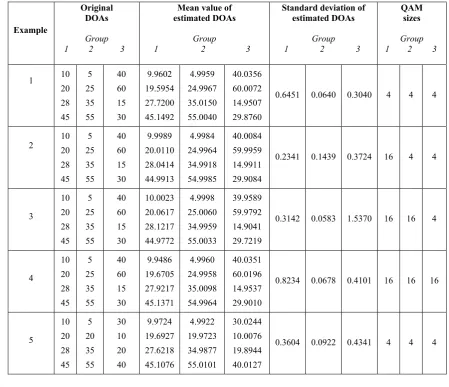
In this section, several sets of simulation results are provided to demonstrate the performance of the proposed algorithm. JADE-MUSIC algorithm is selected to be a comparative method. In all simulations, a uniform linear array with relative inter-element spacing (d/λ=0.5) is considered and 12 signals impinge on the array is considered. Three source groups of coherent signals are considered which their multipath fading coefficients are [1, -0.6426+0.7266j, 0.8677+0.0632j, 0.7319-0.1639j], [1, -0.8262+0.4690j, 0.1897-0.8593j, 0.2049-0.7630] and [1, -0.1681-0.9045j, -0.7293-0.1750j, 0.6102+0.1565j], respectively [12]. Simulations are organized in three sections. In section A, we consider five examples. The results of these examples are summarized in Table 2. In sections B and C, the new approach is compared with JADE-MUSIC algorithm in two scenarios of AWGN and colored noise.
These algorithms are simulated in MATLAB 7.11 software. A PC with an Intel Core i5-2400, 3.1 GHz CPU, and 4 GB RAM is used to run computer codes. Computational time of the JADE-MUSIC algorithm for estimation of DOAs of three groups of coherent signals in SNR=10 dB is 968.906828 seconds. However, this time for the proposed algorithm is 95.567817 seconds. So, computation time of our algorithm is about 10 times less than computation time of the JADE-MUSIC algorithm in similar conditions.
7.1 Five Examples
In this Section, 5 examples show the effectiveness of the proposed method. Two metrics, mean value and standard deviation of DOA estimation for each group are defined as:
∑ θ k (24)
∑ ∑ θ k (25)
where θi contains G signal of one group (i.e., N signals
of all groups) and θiest (k) is the estimate of θi for the k
-th Monte Carlo trial and L is -the number of Monte Carlo trials.
In examples 1-4, we consider three groups of coherent signals from [10°, 20°, 28°, 45°], [5°, 25°, 35°,
55°], [40°, 60°, 15°, 30°] and AWGN noise, N s=3000,
SNR=10 dB and M=10. Also, 1000 Monte-Carlo runs are made and modulation type is changed for each group. Examples 1-4 show that the standard deviation of each group depends on its QAM modulation size.
In example 5, it is assumed that three groups of coherent signals coming from [10°,20°,28°,45°],
[5°,20°,35°,55°] and [30°,10°,20°,40°]. In other word,
three independent signals approach the array from
exactly the same direction (i.e., 20°) and two
independent signals approach from direction 10°. This
algorithm can estimate DOAs relatively well because coherent signals in each group are combined to form a steering vector. It means, three steering vectors are distinct from each other.
7.2 Comparison of Proposed Method and JADE-MUISC Considering AWGN
In this section, it is assumed that three groups of coherent signals approach the array of sensors at [10°,
20°, 28°, 45°], [5°, 20°, 35°, 55°] and [30°, 10°, 20°, 40°],
respectively. Modulation size of each coherent signal group is 4-QAM and SNR=10 dB.
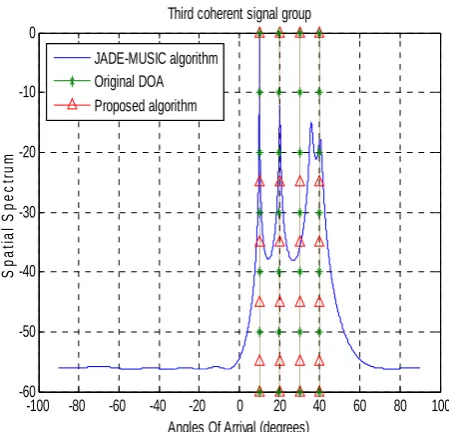
The MUSIC spectrums for each group by
JADE-MUSIC algorithm are shown in Figs. 1-3. As depicted in Fig. 1, JADE-MUSIC can resolve the first coherent signal groups. But, Figs. 2 and 3 show that JADE-MUSIC algorithm cannot resolve one and two signals of the second and third groups, respectively. However, estimated DOAs by the proposed algorithm is more accurate with respect to JADE-MUSIC algorithm.
To better compare the two algorithms, Root Mean Square Error (RMSE) is utilized as the performance metric. RMSE is defined as follows:
∑ ∑ θ k (26)
where θiest(k) is the estimate of for the k-th Monte
Carlo trial, N is the total number of signals, and L is the number of Monte Carlo trials. To calculate RMSE, according to previous works [1, 3, 6, 9, 12], it is considered that one original DOA is estimated two times when the number of estimated DOAs is less than that of original DOAs. However, the algorithm cannot resolve those DOAs, so RMSE is not an accurate performance measure; especially, when two original DOAs are close to each other. For example, when two sources coming from 20° and 25° and the algorithm
could not resolve 25°, then it is considered that
algorithm estimates 20° two times. It means, a new
metric is needed to accurately show the performance of DOA estimation algorithms. We propose a new performance metric referring it as Shirvani-Ebadi Normalized RMSE (SE-NRMSE), in this paper.
Table 2 Mean value and standard deviation of estimated DOAs for different QAM modulation sizes (Ns=3000, SNR=10 dB, L=1000, M=10). Example Original DOAs Group 1 2 3
Mean value of estimated DOAs
Group
1 2 3
Standard deviation of estimated DOAs
Group 1 2 3
QAM sizes
Group 1 2 3
1 10
20 28 45 5 25 35 55 40 60 15 30 9.9602 19.5954 27.7200 45.1492 4.9959 24.9967 35.0150 55.0040 40.0356 60.0072 14.9507 29.8760
0.6451 0.0640 0.3040 4 4 4
2 10 20
28 45 5 25 35 55 40 60 15 30 9.9989 20.0110 28.0414 44.9913 4.9984 24.9964 34.9918 54.9985 40.0084 59.9959 14.9911 29.9084
0.2341 0.1439 0.3724 16 4 4
3 10 20 28 45 5 25 35 55 40 60 15 30 10.0023 20.0617 28.1217 44.9772 4.9998 25.0060 34.9959 55.0033 39.9589 59.9792 14.9041 29.7219
0.3142 0.0583 1.5370 16 16 4
4 10 20 28 45 5 25 35 55 40 60 15 30 9.9486 19.6705 27.9217 45.1371 4.9960 24.9958 35.0098 54.9964 40.0351 60.0196 14.9537 29.9010
0.8234 0.0678 0.4101 16 16 16
5 10 20 28 45 5 20 35 55 30 10 20 40 9.9724 19.6927 27.6218 45.1076 4.9922 19.9723 34.9877 55.0101 30.0244 10.0076 19.8944 40.0127
0.3604 0.0922 0.4341 4 4 4
Fig. 1 MUSIC spectrum for the first coherent signal group. Fig. 2 MUSIC spectrum for the second coherent signal group.
-100 -80 -60 -40 -20 0 20 40 60 80 100
-50 -40 -30 -20 -10 0
Angles Of Arrival (degrees)
S p a tia l S p e c tr u m
First coherent signal group
JADE-MUSIC algorithm Original DOA Proposed algorithm
-100 -80 -60 -40 -20 0 20 40 60 80 100
-60 -50 -40 -30 -20 -10 0
Angles Of Arrival (degrees)
S p a ti a l S p ec tr um
Second coherent signal group
JADE-MUSIC algorithm Original DOA Proposed algorithm
Fig. 3 MUSIC spectrum for the third coherent signal group
To define SE-NRMSE, consider that the algorithm resolves sources, where H<N. It is assumed that if |θiest-θij|<Thj; i=1, 2, …, G, and j=1, 2, …, K,the
algorithm can resolve the signals. It is also assumed that the total number of angles that satisfy |θiest-θij|<Thj is not
greater than H, θij is the i-th θ in the jth group and Thj is
threshold for the j-th group of coherent signals. In other word, Thj is defined as half of the difference between
two nearest angles in the jth group. Thereby, NMSEij is
calculated by Eq. (27). Note that 0≤NMSEij≤1. In Eq.
(27), if θiest=θij then NMSEij=0 and if θiest=θij±Thj then 1.
; 1, … , , 1, … , (27)
(28) If |θiest-θij|≥Thj; i=1, 2, …, G and j=1, 2, …, K, so the
algorithm could not resolve the signals. The total number of angles that satisfy |θiest-θij|≥Thj is H-F. Then
NRMSEij is given by Eq. (29).
; 1, … , (29) DOA estimation algorithm also could not resolve N-H signals, especially in low SNRs and/or small number of snapshots. So, NRMSEij of these signals is calculated
by Eq. (29) again. Thereby, NRMSE for each Monte Carlo trial is calculated by Eq. (30).
√
1 1 ∑ ; 1,2, … ,
(30)
where NMSE(f) is the f-th element of nmse in Eq. (28). Finally, the total SE-NRMSE is defined as
∑ (31)
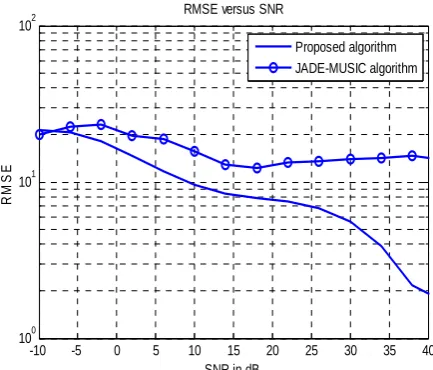
RMSE and SE-NRMSE versus SNR are shown in Figs. 4 and 5, respectively. In these simulations, 200 Monte-Carlo runs with Ns=2000 are made. As shown in
Fig. 4, when SNR increases from -2 dB, the proposed algorithm begins to demonstrate smaller RMSE than the JADE-MUSIC algorithm. When SNR is below -2 dB, RMSE of the proposed algorithm is a bit more than RMSE of the JADE-MUSIC algorithm. To clearly show the performance, SE-NRMSE is plotted for both algorithms in Fig. 5. It illustrates that SE-NRMSE of the proposed algorithm is less than SE-NRMSE of JADE-MUSIC algorithm in all SNR values.
Fig. 4 RMSE versus SNR for AWGN scenario.
Fig. 5 SE-NRMSE versus SNR for AWGN scenario.
-100 -80 -60 -40 -20 0 20 40 60 80 100
-60 -50 -40 -30 -20 -10 0
Angles Of Arrival (degrees)
S
p
at
ia
l S
pec
tr
um
Third coherent signal group
JADE-MUSIC algorithm Original DOA Proposed algorithm
-10 0 10 20 30 40
10-1 100 101 102
RMSE versus SNR
SNR in dB
R
M
SE
Proposed algorithm JADE-MUSIC algorithm
-10 -5 0 5 10 15 20 25 30 35 40
10-2 10-1 100
NRMSE versus SNR
SNR (dB)
SE
-N
R
M
SE
Proposed algorithm JADE-MUSIC algorithm
7.3 Comparison of the Proposed Method and JADE-MUSIC Considering Colored Noise
In this section, it is assumed that three groups of coherent signals approach the array of sensors at [0°,10°,20°,28°], [25°,33°,10°,19°] and [30°,8°,19°,26°],
respectively. Modulation size of each coherent signal group is 4-QAM, SNR = 10 dB and noise is colored Gaussian. As we know, the power spectral density of the colored noise is not uniform across the entire frequency spectrum. Hence, the colored Gaussian additive noise is generated by passing the AWGN through a first-order auto regressive (AR1) filter with coefficient . Correlation coefficient α, is 0.7 and 200 Monte-Carlo runs with Ns = 2000 is made.
Fig. 6 shows that MDL criterion cannot detect the number of coherent signal groups in colored Gaussian noise scenario. It also shows that the detection probability of EGM criterion is 100 %, in SNR ≥ -2dB. So, in SNR ≤ -2dB, it is assumed that the number of coherent signal groups is known and in SNR ≥ -2dB , the number of independent groups is detected by EGM, exactly. Hence, in colored noise scenario, EGM is selected as the determiner of the number of source groups.
As shown in Fig. 7, RMSE of the proposed algorithm in SNR>-6 dB is lower than JADE-MUSIC algorithm and vice versa. Fig. 8 shows that, in wide range of SNRs the proposed algorithm demonstrates a smaller SE-NRMSE than the JADE-MUSIC algorithm.
In Table 3, the effect of correlation coefficients on RMSE and SE-NRMSE of two algorithms is investigated. Three levels of SNR, low, moderate and high are equal to -10, 10 and 30 dB, respectively. For each SNR, α is 0.1, 0.3, 0.5 and 0.8. As reported in this table, in low and moderate SNRs, RMSE of the proposed algorithm is higher than RMSE of the JADE-MUSIC algorithm.
Fig. 6 Detection probability versus SNR for AWGN scenario.
Fig. 7 RMSE versus SNR for colored noise scenario.
Fig. 8 SE-NRMSE versus SNR for colored noise scenario.
Table 3 RMSE and SE-NRMSE for JADE-MUSIC and
proposed algorithms in different correlation coefficients
(Ns = 2000, M = 10).
α SNR (dB)
JADE-MUSIC Proposed Algorithm
RMSE NRMSE SE- RMSE NRMSE
SE-0.1 -10
10 30
5.5764 5.2157 5.5731
0.9324 0.9230
0.9228
7.4890 9.0826 3.8195
0.7810 0.5004 0.3972
0.3 -10
10 30
8.6095 4.963 5.3064
0.9533 0.9234 0.9223
13.8726 11.1608 3.8171
0.8808 0.5561 0.3911
0.5 -10
10 30
13.161 5.2537 5.3998
0.9654 0.9272 0.9221
22.3197 14.4367 3.4659
0.8491 0.6323 0.3997
0.8 -10
10 30
13.749 8.2846 5.3258
0.9746 0.9517 0.9241
23.8089 18.0275 5.6303
0.8824 0.8846 0.4214
-10 0 10 20 30 40
0 20 40 60 80 100
D
e
tec
ti
on P
robab
ili
ty
SNR in dB Detection Probability versus SNR
EGM criterion MDL criterion
-10 -5 0 5 10 15 20 25 30 35 40 100
101 102
RMSE versus SNR
SNR in dB
RM
S
E
Proposed algorithm JADE-MUSIC algorithm
-10 -5 0 5 10 15 20 25 30 35 40 10-0.4
10-0.3 10-0.2 10-0.1
NRMSE versus SNR
SNR (dB)
SE
-N
R
M
SE
Proposed algorithm JADE-MUSIC algorithm
In high SNRs, RMSE of the proposed algorithm is lower than that of the JADE-MUSIC algorithm. Also, Table 3 shows that SE-NRMSE of the proposed algorithm is lower than that of the JADE-MUSIC algorithm, in low, moderate and high SNRs regardless of α.
8 Conclusion
In this paper, we proposed a new algorithm for DOA estimation of source groups with coherent signals by combining MDL/EGM, JADE and MFBLP algorithms. MDL criterion was used to determine the number of independent groups in AWGN scenario, JADE algorithm was utilized to estimate the steering vectors, and finally MFBLP algorithm was applied to each steering vectors to estimate DOAs. It should be noted that instead of MDL, the EGM criterion was used to detect the number of groups in colored noise scenario.
Also, a new normalized RMSE performance metric was suggested which showed the performance of each algorithm more accurately. To evaluate the performance of the proposed algorithm and also compare the numerical results with conventional JADE-MUISC algorithm, several Monte-Carlo simulations were run in both AWGN and colored noise channels. Simulation results show that, for different QAM modulation sizes of coherent signals, the proposed method can completely resolve sources. When AWGN is considered, in SNR larger than -2 dB RMSE of the proposed algorithm is less than RMSE of JADE-MUSIC algorithm and in wide range of SNRs, NRMSE of the proposed algorithm is less than SE-NRMSE of JADE-MUSIC algorithm. Also, simulation results show the effect of colored Gaussian noise on RMSE and SE-NRMSE. In SNR larger than -6 dB, RMSE, and in wide range of SNRs, SE-NRMSE of new algorithm is less than JADE-MUSIC algorithm. It also shows that, in low, moderate and high SNRs, in all coefficient correlation ranges, the proposed algorithm shows lower SE-NRMSE. Besides above mentioned superiorities of the new proposed method, it needs 10 times lower computational complexity compared to the JADE-MUSIC algorithm.
References
[1] Y. Zhang and Z. Ye, “Efficient method of DOA
estimation for uncorrelated and coherent signals”,
IEEE Antennas and Wireless Propagation Letters, Vol. 7, No. 1, pp. 799-802, 2008.
[2] F. M. Han and X. D. Zhang, “An ESPRIT-like
algorithm for coherent DOA estimation”, IEEE
Antennas Wireless Propagation Letters, Vol. 4, pp. 443-446, Dec. 2005.
[3] S. U. Pillai, “Forward/backward spatial
smoothing techniques for coherent signal
identification”, IEEE Transactions on Signal
Processing, Vol. 37, No. 1, pp. 8-15, January 1989.
[4] P. Stoica, B. Ottersten, M. Viberg and R. L.
Moses, “Maximum likelihood array processing
for stochastic coherent sources”, IEEE
Transactions on Signal Processing, Vol. 44, No. 1, pp. 96-105, Jan. 1996.
[5] X. Xu, Z. Ye, Y. Zhang and C. Chang, “A
deflation approach to direction of arrival estimation for symmetric uniform linear array”,
IEEE Antennas and Wireless Propagation Letters, Vol. 5, No. 1, pp. 486-489, Dec. 2006. [6] Z. Ye and X. Xu, “DOA estimation by exploiting
the symmetric configuration of uniform linear
array”, IEEE Transactions on Antennas and
Propagation, Vol. 55, No. 12, pp. 3716-3720, Dec. 2007.
[7] N. Yilmazer, J. Koh, and T. K. Sarkar,
“Utilization of a unitary transform for efficient computation in the matrix pencil method to find the direction of arrival”, IEEE Transactions on Antennas and Propagation, Vol. 54, No. 1, pp. 175- 181, Jan. 2006.
[8] Y. Zhang, Z. Ye and C. Liu, “An efficient DOA
estimation method in multipath environment”,
Signal Processing, Vol. 90, No. 2, pp. 707-713, February 2010.
[9] N. Yuen and B. Friedlander, “DOA estimation in multipath: An approach using fourth-order
cumulants”, IEEE Transactions on Signal
Processing, Vol. 45, No. 5, pp. 1253-1263, May 1997.
[10] Z. Zhou-Hua, “The fourth order cumulants based modified MUSIC algorithm for DOA in colored
noise”, Proceedings of the Asia-Pacific
Conference on Wearable Computing Systems, pp. 345-347, 2010.
[11] Y. L. Xu, H. Sh. Zhang and J. S. Zhan, “A signal-subspace-based ESPRIT-like algorithm for coherent DOA estimation”, Proceedings of the 5th International Conference on Wireless Communications, Networking and Mobile Computing (WiCom '09), pp. 1-4, 2009.
[12] Y. Zhang, Z. Ye and X. Xu, “Multipath DOA and fading coefficients estimation using fourth-order cumulants”, Proceedings of the 9-th International Conference on Signal Processing (ICSP2008), pp. 374-377, Oct. 2008.
[13] Z. Ye and Y. Zhang, “DOA estimation for
non-Gaussian signals using fourth-order cumulants”,
IET Microwaves, Antennas & Propagation, Vol. 3, No. 7, pp. 1069-1078, October 2009.
[14] Z. Jia and Y. Jing-Shu, “Blind DOA estimation based on JADE algorithm in multipath environment”, Proceedings of the International Conference on Computing, Control and Industrial Engineering (CCIE), pp. 141-144, June 2010. [15] M. Wax and T. Kailath, “Detection of signals by
information theoretic criteria”, IEEE
Transactions on Acoustics, Speech and Signal
Processing, Vol. 33, No. 2, pp. 387- 392, Apr. 1985.
[16] Q. Zhang, Y. Yin and J. Huang, “Detecting the number of sources using modified EGM”,
Proceedings of the 2006 IEEE Region 10 Conference, TENCON 2006, pp. 1-4, Nov. 2006. [17] F. Chu, J. Huang, M. Jiang, Q. Zhang and T. Ma,
“Detecting the number of sources using modified
EIT”, Proceedings of the International
Conference on Industrial Electronics and Applications (ICIEA), pp. 563-566, May 2009.
[18] S. Shirvani Moghaddam and S. Jalaei,
“Determining the number of coherent/correlated sources using FBSS-based methods”, Frontiers in Science, Vol. 2, No. 6, pp. 203-208, 2012. [19] P. Chevalier, A. Ferreol and L. Albera, Classical
and modern direction-of-arrival estimation, Academic Press, 2009.
Shahriar Shirvani Moghaddam
received the B.Sc. degree from Iran University of Science and Technology (IUST), Tehran, Iran and M.Sc. degree from Higher Education Faculty of Tehran, Iran, both in Electrical Engineering, in 1992 and 1995, respectively. Also, he received the Ph.D. degree in Electrical Engineering from Iran University of Science and Technology (IUST), Tehran, Iran, in 2001. He has published more than 70 refereed international scientific journal and conference papers, 2 text books on digital communications and one book chapter on MIMO systems. Since 2003, he has worked at the Faculty of Electrical Engineering, Shahid Rajaee Teacher Training University (SRTTU), Tehran, Iran. He was nominated as the best researcher and the best teacher in the SRTTU University in 2010 (2012, 2013) and 2011 (2013), respectively. Currently, he is an associate professor in Digital Communications Signal Processing (DCSP) research laboratory of SRTTU. His research interests include power control and beam-forming in MIMO and cellular relay networks, cognitive radio communications, adaptive antenna array beam-forming and direction of arrival estimation.
Z. Ebadi received the B.Sc. degree
from Islamic Azad University Arak Branch, Iran and M.Sc. degree from Islamic Azad University Tehran South Branch, Iran both in Electrical Engineering, in 2008 and 2012, respectively. She is lecturer in several Institutes of Higher Education. Her research interests include Direction of Arrival (DOA) estimation of wideband and narrowband signals, determining the number of radio sources, antenna beam-forming, and channel estimation of wireless communication systems.
Vahid Tabataba Vakili received the
B.Sc. degree from Sharif University of Technology, Tehran, Iran, in 1970, the M.Sc. degree from the University of Manchester, Manchester, U.K., in 1973, and the Ph.D. degree from the University of Bradford, Bradford, U.K., in 1977, all in Electrical Engineering. In 1985, he joined the Department of Electrical Engineering, Iran University of Science and Technology, Tehran. In 1997, he was promoted as Professor. He has served as the Head of the Communications Engineering Department and as the Head of postgraduate studies. His research interests are in the areas of mobile cellular systems, interference cancellation for CDMA systems, ultra-wideband communication systems, satellite communication systems, and space-time processing and coding.