Please cite this article as: H. R. Mollaei, R. Tavakkoli-Moghaddam, A. Toloie-Eshlaghy, A New Multi-objective Model for Multi-mode Project Planning with Risk,International Journal of Engineering (IJE),IJE TRANSACTIONS B: Applications Vol. 31, No. 5, (May 2018) 770-779
International Journal of Engineering
J o u r n a l H o m e p a g e : w w w . i j e . i rA New Multi-objective Model for Multi-mode Project Planning with Risk
H. R. Mollaeia, R. Tavakkoli-Moghaddam*b, A. Toloie-Eshlaghya
a Department of Industrial Management, Science and Research Branch, Islamic Azad University, Tehran, Iran b School of Industrial Engineering, College of Engineering, University of Tehran, Tehran, Iran
P A P E R I N F O
Paper history: Received 24October2017
Received in revised form 02December2017 Accepted 04Januray2018
Keywords: Project Scheduling Risk based Project Planning
Discrete Time–Cost–Quality-risk Trade-off Evolutionary Algorithm
A B S T R A C T
The aim of this problem is to choose a set of project activities for crashing in such a way that the expected project time, cost and risk are minimized and the expected quality is maximized. In this problem, each project activity can be performed with a specific executive mode. Each executive mode is characterized with four measures, namely the expected time, cost, quality and risk. In this paper, linear relationships between time and cost, and between time and quality are omitted and the problem of the expected time-cost-quality trade-off is considered in a probabilistic and discrete state (DTCQRTP). Then, to make the problem more real, the combination of four measures are considered as uncertain for each executive mode. It means that the time, cost, quality or risk (or all of them) of each activity in each executive mode is considered as the expected numbers (probabilistic means). After modeling four-objective problems, a test problem with nine activities is presented and solved by the non-dominated sorting genetic algorithm (NSGA-II). In order to improve the results and speed of the proposed algorithm in accessing Pareto solutions, a new hybrid algorithm, called MEM-NSGA, is presented that gives better solutions than the original NSGA-II at the same conditions.
doi: 10.5829/ije.2018.31.05b.12
1. INTRODUCTION1
The main function of project management is to achieve the main goals of project implementation, including the earliest accomplishment date, the most acceptable quality and the least cost [1].
A time-cost trade-off problem has been focused on the reduction of project duration by crashing of the duration of each activity from the late of 1950s. The researcher of this field has used linear programming models [2, 3] and nonlinear programing models [4, 5] to solve time-cost trade-off problems. When the time-cost tradeoff is linear for each activity, this relationship can be demonstrated as a line on a graph that shows the relationship between time and cost of the activity [6]. The cost of the activity completion changes linearly between the normal and crashed time.
Crashing the time should be done cautiously if the quality of project completion is important, and
*Corresponding Author Email: [email protected] (R. Tavakkoli-Moghaddam)
sometimes it is necessary to improve the quality of the project by increasing the time [4]. In these cases, it is necessary to do preventive actions to avoid redundancy and corrections. The project will be successful if the project outcomes satisfy the expectations of the project owner. The durability of the project outcomes is important for the project owner and the results should be satisfying, so it is not enough to complete the project based on a deadline, a pre-determined budget, and the execution quality is very important.
Researchers believed that quality is an important factor in project planning, so they have developed linear programming models considered time, cost and quality simultaneously. Babo and Suresh [7] developed five limitations with a lower bound for quality in their studies. In two other studies, modeling and solving of the time-cost-quality trade-off problem was proposed [8, 9].
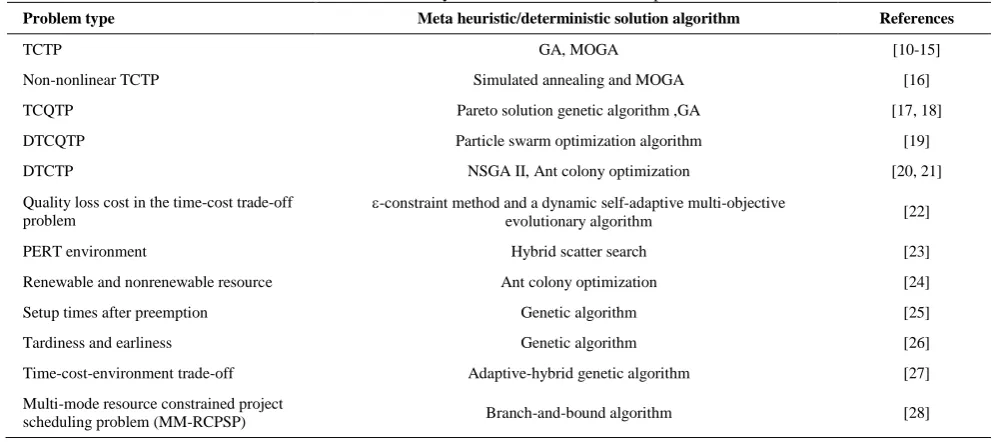
TABLE 1. A summary of the studies on the TCTP problem
Problem type Meta heuristic/deterministic solution algorithm References
TCTP GA, MOGA [10-15]
Non-nonlinear TCTP Simulated annealing and MOGA [16]
TCQTP Pareto solution genetic algorithm ,GA [17, 18]
DTCQTP Particle swarm optimization algorithm [19]
DTCTP NSGA II, Ant colony optimization [20, 21]
Quality loss cost in the time-cost trade-off problem
-constraint method and a dynamic self-adaptive multi-objective
evolutionary algorithm [22]
PERT environment Hybrid scatter search [23]
Renewable and nonrenewable resource Ant colony optimization [24]
Setup times after preemption Genetic algorithm [25]
Tardiness and earliness Genetic algorithm [26]
Time-cost-environment trade-off Adaptive-hybrid genetic algorithm [27]
Multi-mode resource constrained project
scheduling problem (MM-RCPSP) Branch-and-bound algorithm [28]
an uncertainty condition, which is resulted from three factors of an external environment, changes in business objectives and unsuitable methods designed for execution.
Uncertainty is not just the result of insufficient knowledge and low experience of the project team, but can mostly be related to the complexity and newness of the project. An external environment includes factors, such as commercial and political forces, changes in values and norms, rules related to technical and financial goals of the project, and changes in stockholders requirements.
Changes in the basic information for decision making during the time will result in project uncertainties, which put the project at risk. One of the most important challenges in project control is management of project risks. Today, risk management is an important part of project management, which results in an efficient improvement, cost saving and profit increase [29]. Every business has some risks and most of the problems of the project management are the results of the risks [30]. Today, the number and severity of risks has increased and this has motivated the stockholders to control the risks in order to protect their projects against the negative financial and legal outcomes [31].
One of the methods to solve such problems is to use the probability theory. In order to act in conditions of uncertainty, this theory can provide mathematical formulation of concepts, variables and systems that are unclear and ambiguous. It provides grounds for reasoning, inferring, controlling, and decision making. Despite the important role of uncertainty and risk in the
success of projects, a few studies have been carried out on mathematical modeling in project planning. In this study, another dimension is added to the cost-time-quality trade-off problem, which is called risk. On the other hand, this problem is an NP-hard one. It means that by increasing the problem size, the computational time will increase exponentially. Since this problem is a multi-objective optimization one, exact methods cannot be used to optimally solve large-sized problems. In most cases, meta-heuristic algorithms cannot be used alone. Thus, in this paper, the multi-objective model is solved by two different meta-heuristics as high-performance algorithms.
2. PROBLEM STATEMENT
to a shorter time is always costing. In contrast, reducing the completion time of a project has some revenues for stakeholders, including the flowing of involved capitals. Also, in new product development projects, especially in competition conditions between different producers, a faster presentation of a new product will possibly increase the market share of the company.
In most of time-cost trade-off models, the relationship between the reduction of the activity time and the growth of the activity cost is assumed as a linear function. In these models, the objective is to deliver the project product in the given due date with the minimum cost. There are so many alternative methods to solve these linear models [8, 32-34]. Although some other models are presented with convex and concave cost functions [35, 36], the discrete time-cost trade-off problem is more suitable for real applications. In contrast to the linear models, there is little research on a discrete time-cost trade-off problem (DTCTP). It may be because this model is very difficult to be solved [37]. There are at least two reasons for the problem discreteness. Firstly, resources and execution modes and the type of technology in real world projects are in form of discrete options, and secondly, it is easy to formulate every time-cost relationship in a discrete form in real projects.
In recent years, there have been requests from the project stakeholders for the cost and simultaneously time reduction and the increase of the project quality. This has led researchers to the development of models, which add the quality factor to the previous time-cost trade-off models. The quality of the whole project is influenced by the compression of the project net. So, the quality factor has added to the time-cost trade-off problem and has formed the discrete time-cost-quality trade-off problem (DTCQTP) [38, 39].
However, most of the today's projects are accomplish in a dynamic and complicated environment, in which uncertainty and risk are inherent feature of that environments. Most of the projects have not been successful in achieving the pre-determined goals because of the uncertainty and risk. These features have caused some problems, such as a lack of economic justification of the projects, reduction of the efficiency and dissatisfaction of key stockholders [40].
According to the PMBOK, risk is defined as an uncertain event, which will affect at least one of the project objectives if it is happened [1]. The goal of risk management is to increase the probability of the success of the project. It is achieved by systematic risk recognition and evaluation, presenting methods to avoid and reduce them using the opportunities [41]. According to the PMBOK, risk can decrease the quality and increase the time and cost of the project. Respect to the importance of the influence of the risk on the project performance, there is a serious need to develop methods
for the project planning and evaluating; which are correspondent to the project risks. Despite the importance of the risk identification, qualitative and quantitative analysis of the risks, no comprehensive mathematic model has been represented for the intervention of risks in planning, evaluating and controlling the projects in multi-mode cases so far. In this study, it has been attempted to evaluate the risk impacts on project goals; simultaneously to present a method for calculating their effects on project objectives including the quality, time and cost. This study also attempts to formulate a four-objective model, including the expected cost, quality, time and overall risk.
3. PRESENTED MODEL
The goal of solving the risk and expected time, cost, and quality problem is to choose a set of project activities for time compression, as the overall risk and expected time and cost are minimized and the expected project quality is maximized. In this problem, each project activity can be executed with specific executive methods. Each executive method has three features of E(t), E(c), and E(q), which represent the expected time, cost and quality, respectively. So far, no research has been carried out on combinational optimization problems. To eliminate the linear relationship between cost and time, also between time and quality, this research investigates the risk-based time-cost-quality trade-off problem in a discrete state (RDTCQTP)2. To
make the three-objective combinational optimization problem closer to the real situation, each executive method is assumed as uncertain. It means that in each executive method, the time, cost or quality (or all three factors) of each activity will be in the form of expected values (i.e., mean).
3. 1. Risk-based Project Performance Objectives
In this study, we examine time and cost overrun and quality reduction risks. The use of untrained human resources is a typical example of a case that ends up with more time, costs and less quality. Although these risks may not necessarily lead to project cancelation, they impair project’s economic performances. They are called ‘performance risks’[42].
Suppose that cost C is a stochastic value instead of a deterministic value, which depends on a probability density function pc(C) and does not fall below a certain minimum cost Cmin. We define metrics 𝑟∝for the cost
overrun risk of an activity with the expected value of cost E{C}.
𝐸{𝐶} =𝐶𝑚𝑖𝑛
1−𝑟∝ (1)
Additionally, suppose that time T is a stochastic value instead of a deterministic value. This time depends on a probability density function p (T) and does not fall below a certain minimum time Tmin. We define metrics
𝑟𝛾for the time overrun risk of an activity with the
expected value of cost E{T}. 𝐸{𝑇} =𝑇𝑚𝑖𝑛
1−𝑟𝛾 (2)
Furthermore, suppose that quality Q is a stochastic value instead of a deterministic value, which depends on a probability density function pq(Q) and does not
increase more than a certain maximum quality Qmax. We
define metrics 𝑟𝛽 for the quality reduction risk of an
activity with the expected value of quality E{Q}.
𝐸{𝑄} = 𝑄𝑚𝑎𝑥× (1 − 𝑟𝛽) (3)
3. 2. Quality Measurement of Project In this study, the method presented by Babu and Suresh [7] is used to evaluate the quality of the project. To evaluate the value of the quality of each activity in each qualitative feature (qijl), we can ask from technical
experts by asking this question: “how much the technical feature l related to the activity (link between i
and j) is considered if the activity is performed by k
executive mode?” the experts' reply to this question will be 𝑞𝑖𝑗𝑙𝑘. Obviously, the qualitative features of the
activities are different. If 𝑤́𝑖𝑗𝑙 is the qualitative weight
of each l feature in each activity, which is determined by experts, then the quality of each activity will be as follows:
𝑞𝑖𝑗𝑘= ∑𝐿𝑙=1𝑤́𝑖𝑗𝑙∗ 𝑞𝑖𝑗𝑙𝑘 , ∑𝐿𝑙=1𝑤́𝑖𝑗𝑙= 1 (4)
The value of the quality impact of each activity on the project quality can be calculated by the use of the technical experts' group decision-making. Then, the project quality can be calculated by:
𝑄 = ∑𝑖𝑗∈𝐸∑𝑘∈𝑀𝑖𝑗𝑤𝑖𝑗× 𝑞𝑖𝑗𝑘× 𝑦𝑖𝑗𝑘 (5)
3. 3. Problem Formulation A project is represented by a direct acyclic graph G=(V, E) consisting of m nodes and n arcs, in which V={1, 2, ..., m} is the set of nodes and E={(i, j), …, (l, m)} is the set of direct arcs. Arcs and nodes represent activities and events, respectively. Each project activity, called (i,
j)E, can be executed by a set of modes, Mij. Each
kMij needs an expected execution time of tijk, cost of
cijk and quality of qijk. Let k and r be two modes for
activity (i, j) and k<r ; then, it is assumed that tijk>tijr ,
cijk<cijr and qijk≠qijr. Although in the literature, it is
assumed that any activity time decreasing leads to activity quality decreasing. It is noteworthy that this is not always the case in real world projects. For instance, a new technology can be employed to reduce the
required time, while this reduction can be accompanied by an increase in the cost and quality.
The aim of this paper is to obtain the optimal combination (tijk, cijkand qijk) of each activity for
crashing the project network in the situation of existence of performance risk, including the risk of time and cost overrun and the risk of quality reduction, such that the risk-based cost and time of the project is minimized while the risk based project quality is maximized. Notations used for the problem formulation are as follows:
Parameters:
Mij Set of available execution modes for activities i
and j, where (i, j)E
Cijk Direct cost of activities i and j performed by
execution mode k
tijk Duration of activities i and j performed by
execution mode k
qijk Quality of activities i and j performed by
execution mode k
𝜔𝑖𝑗 Quality weight of activities i and j in the project,
∑𝑖𝑗∈𝐸𝜔𝑖𝑗 = 1
𝜔́𝑖𝑗𝑙 Weight of quality level L in activities i and j 𝑟∝𝑖𝑗𝑘 Probability of the cost overrun risk of the project
activity execution in execution mode k
𝑟𝛽𝑖𝑗𝑘 Probability of the quality reduction risk of the
project activity execution in execution mode k 𝑟𝛾𝑖𝑗𝑘 Probability of the time overruns risk of the
project activity execution in execution mode k 𝑟𝜃𝑖𝑗𝑘 Failure probability of the project through the
implementation of the executive mode k of activities i and j.Consequently, re-execution of the activity.
Decision Variables:
𝑦𝑖𝑗𝑘[10 otherwise if mode k is assigned to activities i and j
xi Earliest time of event i (i={1, 2, ..., m})
Objective Functions:
E (C) Total expected project cost
E (T) Total expected project duration
E (Q) Total expected project quality
OR Overall project risk
The problem of the RDTCQTP is formulated by:
Min 𝐸(𝐶) = ∑ ∑ (min(𝑐𝑖𝑗𝑘 )
1− 𝑟∝𝑖𝑗𝑘) × 𝑦𝑖𝑗𝑘
𝑘∈𝑀𝑖𝑗
𝑖𝑗∈𝐸 (6)
Min 𝐸(𝑇) = 𝑥𝑛− 𝑥1 (7)
Max 𝐸(𝑄) = ∑𝑖𝑗∈𝐸∑𝑙∈𝐿∑𝑘∈𝑀𝑖𝑗× 𝑤𝑖𝑗× (1 − 𝑟𝛽𝑖𝑗𝑘) × Max(𝑞𝑖𝑗𝑘) × 𝑦𝑖𝑗𝑘
𝑀𝑖𝑛 (𝑂𝑅) = ∏𝑖𝑗∈𝐸[1 − ∑𝑘∈𝑀𝑖𝑗(1 − 𝑟∝𝑖𝑗𝑘) ∗ (1 − 𝑟𝛽𝑖𝑗𝑘) ∗ (1 − 𝑟𝛾𝑖𝑗𝑘) ∗ (1 − 𝑟𝜃𝑖𝑗𝑘) ∗ 𝑦𝑖𝑗𝑘]
(9)
s.t.
𝑥𝑗− 𝑥𝑖≥ ∑ ( 𝑚𝑖𝑛(𝑡𝑖𝑗𝑘 )
1− 𝑟𝛾𝑖𝑗𝑘) × 𝑦𝑖𝑗𝑘
𝑘∈𝑀𝑖𝑗 ; 𝑖𝑗 ∈ 𝐸; 𝑖, 𝑗 ∈ 𝑉 (10)
∑𝑘∈𝑀𝑖𝑗𝑦𝑖𝑗𝑘= 1 ; 𝑖𝑗 ∈ 𝐸 (11)
𝑥𝑖≥ 0 ; 𝑖 ∈ 𝑉 (12)
𝑦𝑖𝑗𝑘∈ {0, 1} ; 𝑖, 𝑗 ∈ 𝐸 ; 𝑘 ∈ 𝑀𝑖𝑗 (13)
Equations (6) and (7) minimize the total project cost and duration. Equation (8) maximizes the total project quality. Equation (9) minimizes the overall project risk. Equation (10) preserves the precedence relations between project activities. In Equation (11), one and only one execution mode is assigned to each activity.
4. SOLUTION PROCEDURE
In the RDTCQTP, there are a number of execution modes to select for each activity. If the number of project activities is n and there are k execution modes for each activity to choose from, then there are kn
solutions, which results in a very large search space.Therefore, it is necessary to develop an efficient evolutionary algorithm.
4. 1. Non-dominated Sorting Genetic Algorithm (NSGA-II) Initialization of a random parent population 𝑃𝑂 sorted based on non-domination. First,
the offspring Q0 of size N will be created using the usual
binary tournament selection, recombination and mutation operators. Algorithm 1 describes the procedure for the t-th generation. First, we combine the parents and the offspring (𝑅𝑡= 𝑃𝑡∪ 𝑄𝑡), which has the size
2N. Then, we sort the population 𝑅𝑡 according to their
non-domination.
Elitism is ensured that the current and previous members are included in 𝑅𝑡. The new population (𝑃𝑡+1)
will be filled with the best fronts (first F1, then F2, etc.),
until the size of the next front (Fl) is bigger than the
number of open spots in 𝑃𝑡+1. To have exactly N
members in the new population and the diversity preservation (i.e., that a good spread of solutions is maintained in the obtained solution set), the front Fl will
be ordered based on the crowding-distance and the first
N − | Pt +1| (i.e., the number of open spots) solutions
will be added to end up with exactly N solutions in Pt +1.
Then, we start again to make an offspring (Qt +1) of Pt +1
and we repeat this algorithm until the stopping criterion is met [43].
Algorithm 1: NSGA-II (main-loop for the t-th generation).
Rt= Pt∪ Qt
F = fast- non-dominated-sort ( Rt)
Pt +1 = ∅and i = 1
while | Pt +1| + |Fi| ≤ N do
crowding-distance-assignment (Fi)
Pt +1 = Pt +1 ∪ Fi
i = i + 1 end while Sort (Fi≫ 𝑛)
Pt +1 = Pt +1 ∪ Fi[1 : (N −1 | Pt +1|)]
Qt +1 = make-new-pop ( Pt +1)
t = t + 1
4. 2. Memetic Algorithms (MA) A classical genetic algorithm acts well in finding the response regions, but spend a lot of time in obtaining the answer with the desired accuracy. This defect can be partially improved by utilizing existing knowledge of the problem or adding a local search phase to the evolutionary cycle [44].
Memetic algorithms during the implementation, due to the effective local improvement and correction made on the genes, provide a small step-by-step search capability, but they may miss the great search capacity, such as the convergence of the population to an optimal it should be avoided in dynamic environments. Therefore, this can be an interesting research idea in an efficient environment for examining the effectiveness of the algorithms that have been improved with a variety of appropriate methods. Therefore, local search (MEM) is related to the problem. So, how to find optimal operators and prevent us from using inappropriate local search methods is one of the most important issues. A consistent algorithm combines local initiative search with genetic algorithm to achieve better results in less time. In the following, we discuss the concepts and their differences with other algorithms and their application in dynamic environments.
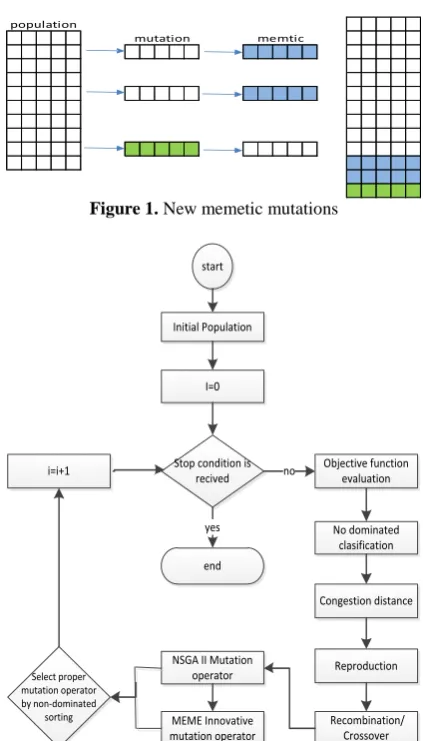
Figure 1. New memetic mutations
start
Initial Population
I=0
Stop condition is recived
Objective function evaluation
i=i+1 no
end yes
Recombination/ Crossover Reproduction No dominated
clasification
Congestion distance
NSGA II Mutation operator
MEME Innovative mutation operator Select proper
mutation operator by non-dominated
sorting
Figure 2. MEM-NSGAII algorithm [10]
5. ILLUSTRATIVE EXAMPLE
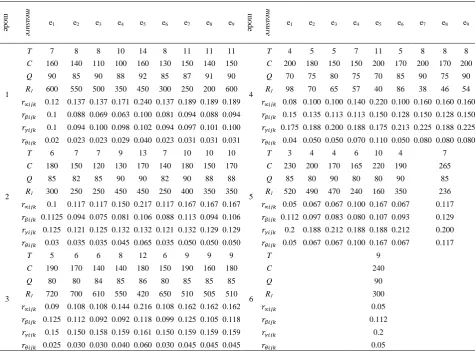
As an example, a project consisting of nine activities is presented in this section as depicted in Table 2. Different execution modes of each activity associated with its time, cost, quality and risk are presented in Table 5.
On the other hand, due to the nonlinearity of the objective function of the overall risk, it is possible to solve this nonlinear model with standard methods and available software that is impossible to achieve Pareto's solutions.
TABLE 2. Network matrix
First, the NSGA-II is coded in MATLAB software, and then improvements are made by improving the algorithm using the MEMTIC algorithm. In this section, the results of solving the designed model with the above-mentioned algorithms are discussed. Solving the formulated problem, a set of chromosomes that shows the combinational activities execution modes and its corresponding time, cost and quality are obtained as the output. Some parts of the results are shown in Tables 6 and 7. The project manager may then obtain executive solutions that best fit with project conditions. The values of Pareto solutions presented in these tables are obtained based on different execution modes with two meta-heuristic algorithms. For example, in Table 6 first row solution, execution modes of 5, 5, 5, 5, 6, 5, 2, 5 and 4 are respectively selected for the first to the ninth project activities. Based on this solution, the values of the expected time cost and quality and overall risk objective functions are respectively obtained as 28, 2032.579, 822.3523 and 0.000226.
6. EXPERIMENTAL EVALUATION
To validate the algorithm and the formulated model, the results of the MEM-NSGAII and NHGA [41] algorithms are compared under equal conditions. The results of this statistical comparison are presented in Tables 3 and 4.
The results of solving the three-objective model by using NHGA and MEM-NSGAII are compared. Description of the presented model results based on the central statistic features and dispersion is presented in Tables 3 and 4. The results of the ANOVA test show that the time and cost of the project plan in the NHGA is more than the MEM-NSGAII and its quality is less.
TABLE 3. NHGA and MEM-NSGAII description
method N Mean Std. Deviation
Time MEM-NSGAII 499 35.00 1.73
NHGA 499 37.4444 2.404
Cost MEM-NSGAII 499 1536.66 35
NHGA 499 2143.33 32.016
Quality MEM-NSGAII 499 815.860 .423
NHGA 499 812.176 1.876
population
TABLE 4. Results of the analysis of variance (ANOVA) test
F Sig. t Sig. (2-tailed) Mean Difference
Time Equal variances 2.248 0.153 -2.47 0.025 -2.44
Unequal variance -2.47 0.026 -2.44
Cost Equal variances .278 0.605 -38.4 0.000 -606.67
Unequal variances -38.4 0.000 -606.67
Quality Equal variances 0.883 .061 -.492 .0429 -.315
Unequal variances -.492 0.0435 -.3155
TABLE 5. Activities executions modes
TABLE 6. Part of the Pareto solution setof the given problem with the NSGA-II
Pareto solution Activities execution mode Objective
1 2 3 4 5 6 7 8 9 Expected time Expected cost Expected quality Overall risk
1 5 5 5 5 6 5 2 5 4 28 2032.579 822.3523 0.000226
2 1 1 1 1 1 2 1 1 2 45 1522.874 819.6351 5.44E-05
TABLE 7. Part of the Pareto solution setof the given problem with the MEM- NSGAII
Pareto solution Activities execution mode Objective
1 2 3 4 5 6 7 8 9 Expected time Expected cost Expected quality Overall risk
1 1 1 1 2 6 2 1 2 1 44 1585.614 820.115 5.18E-05
2 1 1 1 2 1 2 1 2 2 43 1562.634 819.9988 6.33E-05
mo
d
e
m
ea
su
re e1 e2 e3 e4 e5 e6 e7 e8 e9
mo
d
e
m
ea
su
re e1 e2 e3 e4 e5 e6 e7 e8 e9
1
T 7 8 8 10 14 8 11 11 11
4
T 4 5 5 7 11 5 8 8 8
C 160 140 110 100 160 130 150 140 150 C 200 180 150 150 200 170 200 170 200
Q 90 85 90 88 92 85 87 91 90 Q 70 75 80 75 70 85 90 75 90
1
R 600 550 500 350 450 300 250 200 600 R1 98 70 65 57 40 86 38 46 54
𝑟∝𝑖𝑗𝑘 0.12 0.137 0.137 0.171 0.240 0.137 0.189 0.189 0.189 𝑟∝𝑖𝑗𝑘 0.08 0.100 0.100 0.140 0.220 0.100 0.160 0.1600.160
𝑟𝛽𝑖𝑗𝑘 0.1 0.088 0.069 0.063 0.100 0.081 0.094 0.088 0.094 𝑟𝛽𝑖𝑗𝑘 0.15 0.135 0.113 0.113 0.150 0.128 0.150 0.1280.150
𝑟𝛾𝑖𝑗𝑘 0.1 0.094 0.100 0.098 0.102 0.094 0.097 0.101 0.100 𝑟𝛾𝑖𝑗𝑘 0.175 0.188 0.200 0.188 0.175 0.213 0.225 0.1880.225
𝑟𝜃𝑖𝑗𝑘 0.02 0.023 0.023 0.029 0.040 0.023 0.031 0.031 0.031 𝑟𝜃𝑖𝑗𝑘 0.04 0.050 0.050 0.070 0.110 0.050 0.080 0.0800.080
2
T 6 7 7 9 13 7 10 10 10
5
T 3 4 4 6 10 4 7
C 180 150 120 130 170 140 180 150 170 C 230 200 170 165 220 190 265
Q 85 82 85 90 90 82 90 88 88 Q 85 80 90 80 80 90 85
1
R 300 250 250 450 450 250 400 350 350 R1 520 490 470 240 160 350 236
𝑟∝𝑖𝑗𝑘 0.1 0.117 0.117 0.150 0.217 0.117 0.167 0.167 0.167 𝑟∝𝑖𝑗𝑘 0.05 0.067 0.067 0.100 0.167 0.067 0.117
𝑟𝛽𝑖𝑗𝑘 0.1125 0.094 0.075 0.081 0.106 0.088 0.113 0.094 0.106 𝑟𝛽𝑖𝑗𝑘 0.112 0.097 0.083 0.080 0.107 0.093 0.129
𝑟𝛾𝑖𝑗𝑘 0.125 0.121 0.125 0.132 0.132 0.121 0.132 0.129 0.129 𝑟𝛾𝑖𝑗𝑘 0.2 0.188 0.212 0.188 0.188 0.212 0.200
𝑟𝜃𝑖𝑗𝑘 0.03 0.035 0.035 0.045 0.065 0.035 0.050 0.050 0.050 𝑟𝜃𝑖𝑗𝑘 0.05 0.067 0.067 0.100 0.167 0.067 0.117
3
T 5 6 6 8 12 6 9 9 9
6
T 9
C 190 170 140 140 180 150 190 160 180 C 240
Q 80 80 84 85 86 80 85 85 85 Q 90
1
R 720 700 610 550 420 650 510 505 510 R1 300
𝑟∝𝑖𝑗𝑘 0.09 0.108 0.108 0.144 0.216 0.108 0.162 0.162 0.162 𝑟∝𝑖𝑗𝑘 0.05
𝑟𝛽𝑖𝑗𝑘 0.125 0.112 0.092 0.092 0.118 0.099 0.125 0.105 0.118 𝑟𝛽𝑖𝑗𝑘 0.112
𝑟𝛾𝑖𝑗𝑘 0.15 0.150 0.158 0.159 0.161 0.150 0.159 0.159 0.159 𝑟𝛾𝑖𝑗𝑘 0.2
In this paper, the NSGAII and MEM-NSGAII are coded and run in order to solve the four-objective time-cost-quality-risk trade-of problem and some of the results are presented in Tables 4 and 5.
In this section, the mean ideal distance (MID) measure is used to compare the results of the NSGA-II and MEM-NSGA. It is used for measuring the closeness between Pareto solution and an ideal point.
According to the objective functions, we consider (0, 0) as an ideal point. This metric is formulated as it is clear that a less value of the MID is of interest. In this equation, n denotes the number of non-dominated set and f1i and f2i denote the first and second objective value of the i-th non-dominated solution, respectively.
𝑀𝐼𝐷 =∑𝑛𝑖=1√𝑓1𝑖+𝑓2𝑖
𝑛 (14)
The ideal point for the model solution results using the NSGA-II and MEM-NSGA-II is shown in Tables 8 and 9, which is based on the answers of the first front (a set of 100 of Pareto solutions). It means that the minimum value is used for the objectives of time, cost, and risk and the maximum value is in the quality objective.
To calculate the MID index, the answer matrix is normalized with the Euclidean method, and then the closeness index to the ideal normalized answer for the NSGA-II is 0.007226.
The closeness index to the ideal normalized answer for the MEM-NSGAII is 0.006526703. Based on the average distance to the ideal solution considered as the accepted criterion for scholars in this field, the new improved MEM-NSGA-II algorithm has better results than the NSGA-II algorithm in the analyzed solutions.
TABLE 8. Ideal solution for the final model solving by the NSGA-II
TABLE 9. Ideal solution for the final model solving by the MEM-NSGAII
7. CONCLUSION
Over the past three decades, scheduling issues have been one of the most important issues for project managers. The literature review has shown that there is a deep gap in the discussion of risk issues in project
control issues. In this regard, in order to better match this issue with real world applications and fill the gap, this paper has addressed the issue of the risk, project costs, project execution time and quality improvement. The model presented in this paper has addressed real world projects. To be as realistic as possible, the problem was considered in an uncertain condition. In this condition, a risk-based discrete time-cost-quality trade-off problem (RDTCQTP) was also considered, in which each project activity could be executed by one of several modes. Associated with each execution mode of any activity, there are specific resources, execution methods, technology and risk. For each mode of an activity, there is a triple combination of the expected risk-based time, cost and quality (t, c, q). These risk probability numbers have represented the effect of performance risk on project objectives in such a way that the time and cost has increased and the quality has decreased.
To solve the given problem, a multi-objective evolutionary algorithm, called non-dominated sorting genetic algorithm (NSGA-II) was also used and developed. The high speed of the proposed algorithm and its quick convergence have made it desirable for large projects with a large number of activities. Furthermore, we have used the ANOVA test to compare the performance of the NSGA-II in the conditions of the lack and existence of project performance risks. The results have shown that in the condition of existence of the performance risks, project objectives including time and cost minimizing and quality maximizing have affected by uncertainties such that the time and cost of a project have increased and the quality has decreased. Considering critical risk factors, this model can be extended to more realistic cases. Also, after modeling the problem with four objectives, an applied scheduling problem with nine activities presented, solved and coded with the NSGA-II. In order to improve the results and the speed of the proposed algorithm in accessing the Pareto solutions, a new hybrid algorithm, called MEM-NSGA-II, is presented that gives better solutions than the NSGA-II at the same conditions.
8. REFERENCES
1. Guide, P., "A guide to the project management body of knowledge", in Project Management Institute. Vol. 3, (2004). 2. Perera, S., "Linear programming solution to network
compression", Journal of the Construction Division, Vol. 106, No. 3, (1980), 315-326.
3. Phillips Jr, S. and Dessouky, M.I., "Solving the project time/cost tradeoff problem using the minimal cut concept", Management
Science, Vol. 24, No. 4, (1977), 393-400.
4. Deckro, R., Hebert, J. and Verdini, W., "Non-linear multiple criteria time/cost tradeoff", Proceedings of the 1987 Annual
Western DSI, Palm Springs, CA, (1987), 134-137.
Minimum time
Minimum cost
Maximum quality
Minimum overall risk
28 1513.360 825.350 0.0000531
Minimum time
Minimum cost
Maximum quality
Minimum overall risk
5. Patterson, J.H. and Huber, W.D., "A horizon-varying, zero-one approach to project scheduling", Management Science, Vol. 20, No. 6, (1974), 990-998.
6. Wiest, J.D. and Levy, F.K., "Management guide to pert/cpm", Englewood Cliffs. Prentice-Hall, Inc, New Jersey, (1997).
7. Babu, A. and Suresh, N., "Project management with time, cost, and quality considerations", European Journal of Operational
Research, Vol. 88, No. 2, (1996), 320-327.
8. Tareghian, H.R. and Taheri, S.H., "On the discrete time, cost and quality trade-off problem", Applied Mathematics and
Computation, Vol. 181, No. 2, (2006), 1305-1312.
9. Tareghian, H.R. and Taheri, S.H., "A solution procedure for the discrete time, cost and quality tradeoff problem using electromagnetic scatter search", Applied Mathematics and
Computation, Vol. 190, No. 2, (2007), 1136-1145.
10. Li, H. and Love, P., "Using improved genetic algorithms to facilitate time-cost optimization", Journal of Construction
Engineering and Management, Vol. 123, No. 3, (1997),
233-237.
11. Azaron, A. and Tavakkoli-Moghaddam, R., "Multi-objective time–cost trade-off in dynamic pert networks using an interactive approach", European Journal of Operational
Research, Vol. 180, No. 3, (2007), 1186-1200.
12. Elazouni, A.M. and Metwally, F.G., "Expanding finance-based scheduling to devise overall-optimized project schedules",
Journal of Construction Engineering and Management, Vol.
133, No. 1, (2007), 86-90.
13. Pathak, B.K. and Srivastava, S., "Moga-based time-cost tradeoffs: Responsiveness for project uncertainties", in Evolutionary Computation, 2007. CEC 2007. IEEE Congress on, IEEE., (2007), 3085-3092.
14. Hooshyar, B., Tahmani, A. and Shenasa, M., "A genetic algorithm to time-cost trade off in project scheduling", in Evolutionary Computation, 2008. CEC 2008.(IEEE World Congress on Computational Intelligence). IEEE Congress on, IEEE., (2008), 3081-3086.
15. Mohammadi, G., "Using genetic algorithms to solve industrial time-cost trade-off problems", Indian Journal of Science and
Technology, Vol. 4, No. 10, (2011), 1273-1278.
16. B.K., P., Srivastava, S. and Srivastava, K., "Neural network embedded with multi-objective genetic algorithm to solve nonlinear time cost trade-off problem of project scheduling",
Journal of Scientific and Industrial Research, Vol. 67, (2008),
124-131.
17. Iranmanesh, H., Skandari, M. and Allahverdiloo, M., "Finding pareto optimal front for the multi-mode time, cost quality trade-off in project scheduling", World Academy of Science,
Engineering and Technology, Vol. 40, (2008), 346-350.
18. El Razek, R.H.A., Diab, A.M., Hafez, S.M. and Aziz, R.F., "Time-cost-quality trade-off software by using simplified genetic algorithm for typical-repetitive construction projects",
World Academy of Science, Engineering and Technology,
Vol. 37, (2010), 312-320.
19. Rahimi, M. and Iranmanesh, H., "Multi objective particle swarm optimization for a discrete time, cost and quality trade-off problem", World Applied Sciences Journal, Vol. 4, No. 2, (2008), 270-276.
20. Shahsavari-Pour, N., Modarres, M., Tavakoli-Moghadam, R. and Najafi, E., "Optimizing a multi-objectives time-cost-quality trade-off problem by a new hybrid genetic algorithm", World
Applied Science Journal, Vol. 10, No. 3, (2010), 355-363.
21. Mokhtari, H., Kazemzadeh, R.B. and Salmasnia, A., "Time-cost tradeoff analysis in project management: An ant system approach", IEEE Transactions on engineering management, Vol. 58, No. 1, (2011), 36-43.
22. Kim, J., Kang, C. and Hwang, I., "A practical approach to project scheduling: Considering the potential quality loss cost in the time–cost tradeoff problem", International Journal of
Project Management, Vol. 30, No. 2, (2012), 264-272.
23. Baradaran, S., Ghomi, S.F., Ranjbar, M. and Hashemin, S., "Multi-mode renewable resource-constrained allocation in pert networks", Applied Soft Computing, Vol. 12, No. 1, (2012), 82-90.
24. Li, H. and Zhang, H., "Ant colony optimization-based multi-mode scheduling under renewable and nonrenewable resource constraints", Automation in Construction, Vol. 35, (2013), 431-438.
25. Afshar-Nadjafi, B. and Majlesi, M., "Resource constrained project scheduling problem with setup times after preemptive processes", Computers & Chemical Engineering, Vol. 69, (2014), 16-25.
26. Bagherinejad, J. and Majd, Z.R., "Solving the mrcpsp/max with the objective of minimizing tardiness/earliness cost of activities with double genetic algorithms", The International Journal of
Advanced Manufacturing Technology, Vol. 70, No. 1-4,
(2014), 573-582.
27. Zheng, H., "Multi-mode discrete time-cost-environment trade-off problem of construction systems for large-scale hydroelectric projects", in Proceedings of the ninth international conference on management science and engineering management, Springer., (2015), 337-346.
28. Chakrabortty, R.K., Sarker, R.A. and Essam, D.L., "Multi-mode resource constrained project scheduling under resource disruptions", Computers & Chemical Engineering, Vol. 88, (2016), 13-29.
29. Zou, P.X., Zhang, G. and Wang, J., "Understanding the key risks in construction projects in china", International Journal of
Project Management, Vol. 25, No. 6, (2007), 601-614.
30. Subramanyan, H., Sawant, P.H. and Bhatt, V., "Construction project risk assessment: Development of model based on investigation of opinion of construction project experts from india", Journal of Construction Engineering and
Management, Vol. 138, No. 3, (2012), 409-421.
31. Fang, C. and Marle, F., "A simulation-based risk network model for decision support in project risk management", Decision
Support Systems, Vol. 52, No. 3, (2012), 635-644.
32. Fulkerson, D.R., "A network flow computation for project cost curves", Management Science, Vol. 7, No. 2, (1961), 167-178. 33. Siemens, N., "A simple cpm time-cost tradeoff algorithm",
Management Science, Vol. 17, No. 6, (1971), B-354-B-363.
34. Adel, S.M. and Elmaghraby, S.E., "Optimal linear approximation in project compression", IIE Transactions, Vol. 16, No. 4, (1984), 339-347.
35. Falk, J.E. and Horowitz, J.L., "Critical path problems with concave cost-time curves", Management Science, Vol. 19, No. 4-part-1, (1972), 446-455.
36. Kapur, K.C., "An algorithm for project cost-duration analysis problem with quadratic and convex cost functions", AIIE
Transactions, Vol. 5, No. 4, (1973), 314-322.
37. De, P., Dunne, E.J., Ghosh, J.B. and Wells, C.E., "The discrete time-cost tradeoff problem revisited", European Journal of
Operational Research, Vol. 81, No. 2, (1995), 225-238.
38. Pour, N.S., Modarres, M., Aryanejad, M.B. and Moghadam, R.T., "Calculating the project network critical path in uncertainty conditions", International Journal of Engineering
and Technology, Vol. 2, No. 2, (2010), 136-140.
39. Tavana, M., Abtahi, A.-R. and Khalili-Damghani, K., "A new multi-objective multi-mode model for solving preemptive time– cost–quality trade-off project scheduling problems", Expert
40. S.H., Z., E., R., Nazari, A. and Honarichbar, F., "Evaluating and selecting risk response strategies using multiple objective optimization model and fuzzy prioritizing approach in abadan power plant", Technology Research and Development Journal, Vol. 5, No. 4, (2012), 393-400.
41. Chapman, C. and Ward, S., "Project risk management: Processes, techniques, and insights", 2nd Ed., Chichester, John
Wiley & Sons (2003).
42. Sato, T. and Hirao, M., "Optimum budget allocation method for projects with critical risks", International Journal of Project
Management, Vol. 31, No. 1, (2013), 126-135.
43. van der Plas, C., Tervonen, T. and Dekker, I.R., “Evolutionary multi-objective optimization and preference modeling in green logistics”, Economie & Informatica, Retrieved from http://hdl.handle.net/2105/11492, (2012).
44. Neri, F., Cotta, C. and Moscato, P., "Handbook of memetic algorithms, Springer, Vol. 379, (2012).
A New Multi-objective Model for Multi-mode Project Planning with Risk
H. R. Mollaeia, R. Tavakkoli-Moghaddamb, A. Toloie-Eshlaghya
aDepartment of Industrial Management, Science and Research Branch, Islamic Azad University, Tehran, Iran bSchool of Industrial Engineering, College of Engineering, University of Tehran, Tehran, Iran
P A P E R I N F O
Paper history: Received 24October 2017
Received in revised form 02December 2017 Accepted 04Januray 2018
Keywords: Project Scheduling Risk based Project Planning
Discrete Time–Cost–Quality-risk Trade-off Evolutionary Algorithm
هديكچ
هعومجم باختنا ،هلئسم نیا زا فده تيلاعف زا يا
هدرشف يارب هژورپ ياه تدم ،راظتنا دروم هنیزه هکیروطب ،تسا يزاس
مامتا نامز
هنيمک هژورپ کسیر ،راظتنا دروم تيلاعف ره هلئسم نیا رد .دوش هنيشيب هژورپ راظتنا دروم لک تيفيک و
پ م هژور ي ياهشور اب دناوت
هصخشم راهچ اب ارجا شور ره .دوش ارجا صخشم يیارجا
E(t)
،
E(c)
،
E(q)
و
R
يم نايب ،نامز رگنايب بيترت هب هک ،دوش
يئارجا دم ره هب طوبرم يلک کسیر و راظتنا دروم تيفيک ،هنیزه فذح اب ،هلاقم نیا رد .تسا تيلاعف نآ
ر خ هطبا امز نيب يط ن
-نامز و هنیزه
-ک هنیزه هنزاوم هلئسم و تيفي
-ز نام -تيفيک -ح رد ار کسیر هتسسگ تلا
(DTCQRTP)
يسررب يلامتحا و
يم يعقاو يارب سپس ودنک ياه هصخشميیاتراهچ بيکرت ،هلئسم ندرک رت
(t, c, q, r)
ب يیارجا شور ره يارب ار ه
تروص
يم حرطم يعطقريغ ور ره رد تيلاعف ره )رايعم راهچ ره ای( کسیر ای تيفيک ای هنیزه ای نامز هکنیا ينعی .دنک
ب ،يیارجا ش ه
لدم زا سپ .دوب دهاوخ )يلامتحا نيگنايم( يراظتنا دادعا تروص ربراک هلئسم کی ،هفده راهچ هلئسم يزاس
ن اب يد ،تيلاعف ه ا هئار
تیروگلا اب و هدش م
NSGA-II
باوج هب يسرتسد تعرس شیازفا يارب .تسا هدش لح و يسیون دک ،اهباوج دوبهب و وتراپ ياه
يقيفلت متیروگلا
MEM-NSGA
باوج ناسکی طیارش رد هک تسا هدش هئارا يراکتبا تروصب ياه
یروگلا هب تبسن ار يرتهب مت
NSGA-II
.تسا هدومن هئارا