* Corresponding author: Beheshteh Jebelli, Email: [email protected]
O
O
RRIIGGIINNAALLA
A
RRTTIICCLLEEOptimized Choice for Pollution Control Systems in
Smelting Furnaces with Green Approach
PARVIZ JAFARI FESHARAKI1, ELHAM GHAZANCHAEI2, and BEHESHTEH JEBELLI3*
1
Crisis Management Department, Maleke Ashtar University, Tehran, Iran; 2Clinical Tuberculosis and Epidemiology Research Center, National Research Institute of Tuberculosis and Lung Diseases (NRITLD), Shahid Beheshti University of Medical Sciences, Tehran, Iran; 3Lung Transplantation Research Center, National Research Institute of
Tuberculosis and Lung Diseases (NRITLD), Shahid Beheshti University of Medical Sciences, Tehran, Iran.
Received January 17, 2014; Revised February 21, 2014; Accepted March 5, 2014
This paper is available on-line at http://ijoh.tums.ac.ir
ABSTRACT
Furnace division is one of the most polluted divisions ever known in the steel industry associated with several environmental pollutions. This study attempted to choose optimally, a pollution control system for dust emission from steel furnaces with the Green and environmentally friendly approach. Three electric smelting furnaces with 3, 6 and 12-ton output capacity were selected. The level of energy cost and consumption, capital and environmental damage, and indexes of environmental sustainability in bag houses and electrostatic precipitators based on computational methods and governing equations were studied. Findings showed that the total cost of bag houses in a steel electric furnace was lower than the total cost of electrostatic precipitators in the initial year and they were almost equal in the fourth year while the total cost of the former is higher than that of the latter after twenty years - the operational lifetime of dust collectors. It may be concluded that considering the environmental sustainability and industrial ecology, it would be reasonable and more economical to use bag houses for four years and electrostatic precipitators for longer periods.
Keywords:Industrial ecology, Pollutants, Steel industry
INTRODUCTION
The concept of industrial ecology was first suggested in Japan in 1990, emphasizing the design and construction process to reduce the environmental damage [ 1]. Considering the goals of industrial ecology in saving energy, capital, and material and reducing environmental damage, it seems essential to have an investigation on how to choose an appropriate dust collector system in steel industry (furnaces) with above goals involved. Energy consumption in any industry is more or less associated with environmental damage. Thus, promoting energy efficiency must be assigned a
very high priority in designing industrial ecosystems [ 2].
Compared to other industries, steel industry is counted as the world most energy-intensive industry. The declining trend of natural resources, fossil energy and gas reserves has made scientists and researchers in the field, to attempt to save energy in such industry [ 3]. When assessing the environmental impacts of steel plants, it was concluded that the most negative impact was assigned to air pollution (dust) resulted from the operation of electric smelting furnaces [ 4], to such extend that Majlesi town would have be buried under about thirty-centimeter of dust, if it was not for the dust collectors of Mobarakeh Steel Industrial Company [ 5]. With a look at hundreds of thousands of dust collectors installed throughout the world, the impact on global INTERNATIONAL JOURNAL OF OCCUPATIONAL HYGIENE
warming through their energy consumption would become evident [ 6].
Main industrial dust collectors used to trap dust from the steel furnaces, include bag houses and electrostatic precipitators [ 7]. In some steel industries such as Mobarakeh Steel Company and Khuzestan Steel Company, bag houses are used [ 8] and some others such as Esfahan Steel Company, are utilized by electrostatic precipitators. Electrostatic precipitators collect particles and dust suspended in the carrier gas flow by electrostatic forces [ 9]. Generating a voltage difference, these devices draw dust toward plates and filter it from the gas flow [ 10]. Industrial applications of electrostatic precipitators are mainly in industries such as power plants, steel industries, and cement and plaster industries [ 11]. Moreover, one negative property of electrostatic precipitators is ozone production [ 12- 14] and they have destructive impact on respiratory system of humans and plants [ 15- 16].
Bag houses operate by pulse jet method - one of the most widespread dust removal methods- to prevent dust discharge and emissions to atmosphere. During filtration, dust covers the outer surface of the filter fabric due to negative pressure generated by suction system. Sedimented on the outer surface of the filter, dust particles must be removed regularly and periodically which is conducted via pulses of compressed air entering into filters [ 17]. Electrostatic precipitators and bag houses are applicable in electric furnaces division of iron and steel industry [ 18]. Accordingly, this paper estimates the annual energy consumption as well as capital cost (given the discount rate) and environmental damage in bag houses and electrostatic precipitators. It worth mentioning that the more energy consumption the more environmental damage; e.g. nearly 0.9-2.7 cents environmental damage are incurred by gas plants for generating one KW/h of electricity [ 19].
MATERIALS AND METHODS
This project was conducted in six steps as follows: Regarding the fact that environmental sustainability is an index of sustainability by means of establishing a balance between the level of consumption and the carrying capacity of the region [ 20]. It requires studying both economic and environmental indicators that are almost opposite, using computational methods, to set up a sustainable and appropriate environmental schedule in dust collectors of a steel industry. That is, we estimate the level and cost of energy consumption, initial capital cost and cost from environmental damage in bag houses and electrostatic precipitators based on their operational lifetime (20 years) in 3, 6 and 12-ton capacity steel electric furnaces and when compared, the manner of selecting one would be identified. That is, to assign the capital cost, it requires estimating purchase, installation and operation costs for each dust collector, then calculating the depreciation expense based on their
operational lifetime and finally, computing the annual benefit cost of purchasing and installing devices using discount rate and bank interest so that the total capital cost of dust collectors can be obtained from sum of the total cost. Also, costing the energy in dust collectors, the level of energy consumption must be computed based on their power consumption systems such as ventilators, transformers and compressors, connected to dust collectors and then their annual energy consumption must be calculated using the actual value of electricity and the annual operation of dust collectors when furnaces are operating. Finally, we would compare the sum of total capital and energy costs and environmental damage incurred during the operational lifetime of dust collectors and optimally choose the collector.
Equations Governing the Annual Energy
Consumption Level and the Capital in Electrostatic Precipitators and Bag houses
To determine the level of annual energy consumption in a centrifuge ventilator connected to electrostatic precipitators and bag houses, equation 1 is applied [ 21].
( )( )( )
Q P θFP=0.000181 ∆ (1)
Where FP is the power output of the electric motor (KW/yr), θ is the annual working time (h/yr) and Q is the suction capacity (CFS) determined in various processes based on standards by the Committee of American Industrial Hygiene Association [ 22]. ΔP is the pressure drop of system in inches of water column where in electrostatic precipitators; it is usually lower than 0.5 inches of water column [ 7]. And the pressure drop rate in bag houses is typically 4-6 inches of water column. Thus, to estimate the approximate rate of energy, we consider the pressure drop as about 5 inches of water column. To calculate the annual energy consumption from transformers in electrostatic filters, equation 2 is applied:
θ A
OP=1.94×10⁻³ (2)
Where OP is the level of energy consumption (KW/h), A is the plate area in electrostatic precipitators (Sq. ft.) and θ is the of hours per year. To determine the plate area and calculate the annual energy consumption from the transformer and the impact system in electrostatic filters, equation 3 is applied [ 21]:
−
−
= Q
wA
e 1
η
(3)
of particles migration (m/s). To estimate the energy (electricity) consumption from the compressor, equation 4 is applied:
(4)
ω = actual power of the compressor (KW) η= compressor efficiency (0.5)
ϒ= ratio of the air specific heat (1.4) P1= initial pressure (KPa)
P2= final pressure (KPa)
Q1= volumetric flow rate of compressor (M 3
/s) The level of compressed air required to move the filters, is nearly 0.5% of the flow rate or the capacity of filter ventilator. Also, the final pressure from the compressor to move filters is about 792 KPa and the atmospheric initial pressure is 101.3 KPa. To calculate the volumetric flow of the compressor, equation 5 is applied:
(5)
Q1= volumetric flow rate of the compressor (M3) Q2= volumetric flow rate of the ventilator (M3/s) T1= ambient temperature (Kelvin)
T2= temperature input in bag house (Kelvin)
Determination of Capital and Energy Cost in Bag houses and Electrostatic Precipitators
The capital cost in a dust collection system is equal to total cost of initial purchase, installation, depreciation and annual benefit cost. The minimum purchase cost of one bag house is 1.25 dollar per CFS (cubic feet per minute) and its installation cost is estimated as 0.67 of its purchase cost, while the minimum purchase cost in electrostatic precipitators is equal to 1.5 dollar per CFS and its installation cost is estimated as 0.67 of its purchase cost [ 23]. To determine the annual depreciation expense in dust collectors, it is required to calculate the drop rate which is equal to difference between the highest bank interest and the average inflation rate and considering the device lifetime, compute the capital recovery factor according to equation 6 and finally multiply the factor by the initial capital cost according to equation 7 so the annual depreciation cost in the dust collector is obtained.
( )
( )
1 11 − +
+
= n n
i i i CRF
(6)
CRF
C
CRC
=
×
(7)
Where CRF is the capital recovery factor, I is the drop rate, n is the system lifetime, CRC is the depreciation expense and C is the capital cost. To obtain the annual interest cost of the capital, it is required to multiply the total cost of the initial capital by the drop rate according to equation 8,
TC i
CB= × (8)
Where CB is the annual interest cost of the capital, i is the drop rate and TC is the total cost of the initial capital. To calculate the energy cost, the cost of industrial power consumption, which has been 4 cents KW in average since targeting of subsidies in Islamic Republic of Iran, must be multiplied in the annual energy consumption pointed out in equations 1, 2 and 4.
Annual Energy Consumption in Electrostatic Precipitators and Bag houses Connected to 3, 6 and 12-Ton Capacity Steel Furnaces
To determine the rate of energy consumption in an Electro-Filter (Electronic Furnace Filter), it is required to calculate the rate of energy consumption in ventilator and transformer connected to the electrostatic precipitator. Taking into account the relevant standards of the Committee of American Industrial Hygiene Association to VS No. 105, the suction capacity for each ton of steel is equal to 2500 CFS; therefore, the suction rates for 3, 6 and 12-ton capacity steel furnaces are 7500, 15000 and 30000 CFS, respectively [ 22]. To calculate the rate of energy consumption in an electrostatic precipitator, it is necessary to estimate the rate of energy consumption in ventilator and transformer of the electrostatic precipitator. putting values of pressure drop level (0.5 inches of water column), particle migration speed in electrostatic precipitators (12.1 cm/s), 99% efficiency, 2920 hours annual operation (8 hours a day) and the range of electromotor in global market, in equations 3, 4 and 1, the annual energy consumption rates in electrostatic precipitators connected to 3, 6 and 12-ton steel furnaces come out as 10415, 20864 and 41729 KW/h, respectively. It is worth mentioning that choosing 8-hour daily operation of dust collectors is based on the phase of smelting process. Although, furnaces are constantly in operation, the smelting cycle including three phases of loading (scrap and ore mining), smelting and discharging processes, is available only in the phase of smelting process where there is a pollution and a need for utilization of dust collectors, and it takes nearly one third of the total time for the smelting cycle. To determine the rate of annual energy consumption in bag houses, it is required to add up the annual energy rate resulted from the electromotor of the ventilator and that form the compressed air compressor. The level of compressed air required for moving filters is about 0.5% of the flow rate or the filter ventilator capacity.
Also, the final pressure from the compressor required to move filters is about 792 kPa and the initial 005 . 0 2 1 2
1= × ×
pressure of the atmosphere is 100 kPa. Estimating the rate of annual energy consumption in bag houses and putting that in equations 4, 2 and 1, energy rates related to 3, 6 and 12-ton steel furnaces show 43800, 87600 and 175200 KW/h consumption, respectively.
Annual Energy Consumption Cost in Electrostatic and Bag houses Connected to 3, 6 and 12-Ton Capacity Steel Furnaces
Since the cost of industrial electricity consumption in Iran is 4 cents per KW/h, taking into account the annual energy consumption in bag houses and electrostatic precipitators connected to 3, 6 and 12-ton steel furnaces, the annual energy consumption costs in electrostatic precipitators connected to 3, 6 and 12 tone furnaces are 4166.6 dollars, 834.56 dollars and 1669.16 dollars, and in bag houses are 1752 dollars, 3504 dollars and 7008 dollars, respectively.
Capital Cost in Bag houses and Electrostatic Precipitators connected to 3, 6 and 12-Ton Capacity Steel Furnaces
Considering the minimum purchase cost in bag houses and electrostatic precipitators as approximately 1.25 dollar and 1.5 dollar CFS, respectively, and their installation cost as 0.67 of the purchase cost and taking the initial capital cost and dust collectors lifetime e.g. about 20 years [ 24], as well as the actual drop rate equal to 0.011 (the difference between the highest bank interest and the average inflation rate, which was 21.05% and 19.9%, respectively, in Iran in (2010) and the depreciation cost according to equations 6 and 7 into
consideration, and by putting the values of drop rate and total cost of initial capital in equation 8, we obtain the cost of total capital in bag houses as 16611.266 US $, 33222.5625 US $ and 66445.125 US $ and in electrostatic precipitators as 19933.537 US $, 39867.075 US $ and 79734.15 US $, respectively.
Annual Environmental Damage Cost from Energy Consumption in Bag houses and Electrostatic Precipitators Connected to 3, 6 and 12-Ton Capacity Steel Furnaces
Level of environmental damage from electricity consumption is approximately 0.9 to 2.7 cents per KW/h which is considered as 1.3 cent on average [ 19]. Therefore, taking the rate of annual energy consumption in bag houses and electrostatic precipitators connected to 3, 6 and 12-ton furnaces into account, the annual environmental damage cost in electrostatic precipitators for 3, 6 and 12-ton capacity furnaces are respectively 13.5395 dollars, 271.232 dollars and 542.477 dollars and in bag houses are respectively 569.4 dollars, 1138.8 dollars and 2277.6 dollars.
RESULTS
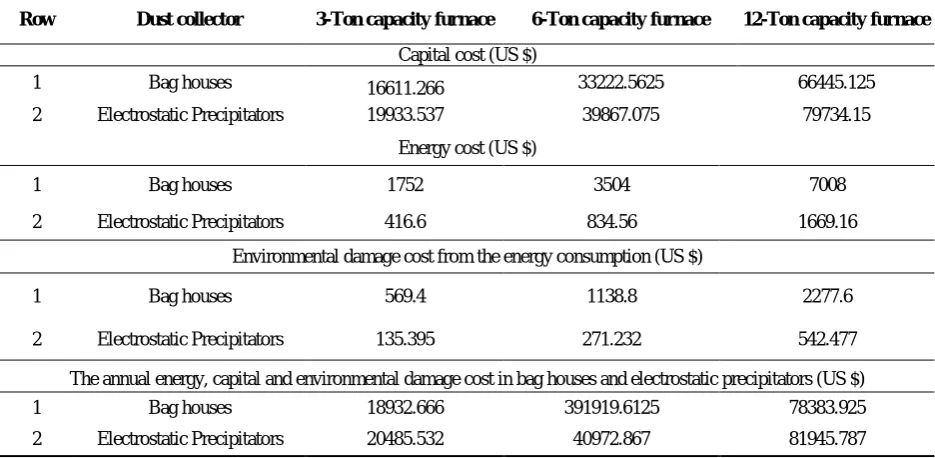
Results obtained from calculations of the annual total capital cost, including annual purchase, installation and operation, depreciation, and benefit cost in bag houses and electrostatic precipitators connected to 3, 6 and 12-ton capacity furnaces are shown in Table 1. It shows that the cost of electrostatic precipitators is 1.2 times the bag houses.
Table 1. The annual capital, energy, and environmental damage cost in bag houses and electrostatic precipitators (US $)
Row Dust collector 3-Ton capacity furnace 6-Ton capacity furnace 12-Ton capacity furnace
Capital cost (US $)
1 Bag houses 16611.266 33222.5625 66445.125
2 Electrostatic Precipitators 19933.537 39867.075 79734.15
Energy cost (US $)
1 Bag houses 1752 3504 7008
2 Electrostatic Precipitators 416.6 834.56 1669.16
Environmental damage cost from the energy consumption (US $)
1 Bag houses 569.4 1138.8 2277.6
2 Electrostatic Precipitators 135.395 271.232 542.477
The annual energy, capital and environmental damage cost in bag houses and electrostatic precipitators (US $)
1 Bag houses 18932.666 391919.6125 78383.925
Calculations findings about the annual energy cost and consumption in bag houses and electrostatic precipitators connected to 3, 6 and 12-ton furnaces are shown in Tables 1 and 2 revealing the annual energy cost and consumption in bag houses compared to that in electrostatic precipitators.
The annual environmental damage cost resulted from the energy consumption in bag houses and electrostatic precipitators are shown in Table 1 suggesting that the more energy consumption in these dust collectors, the more environmental damage. Besides, the annual energy, capital and environmental damage cost in bag houses and electrostatic precipitators are shown in Table 1 demonstrating that the total cost of energy, capital and environmental damage in bag houses connected to 3-ton capacity furnaces has little difference with that in electrostatic precipitators. While in 12-ton capacity furnaces, such ratio is increased.
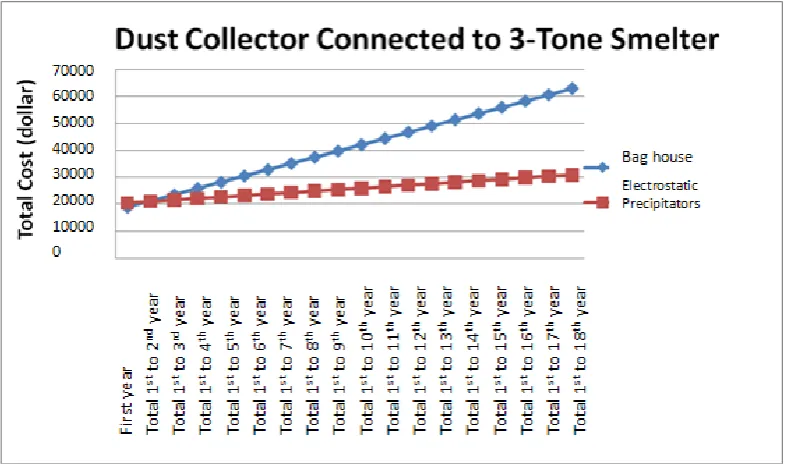
A comparison between the energy, capital and environmental damage cost in bag houses and that in
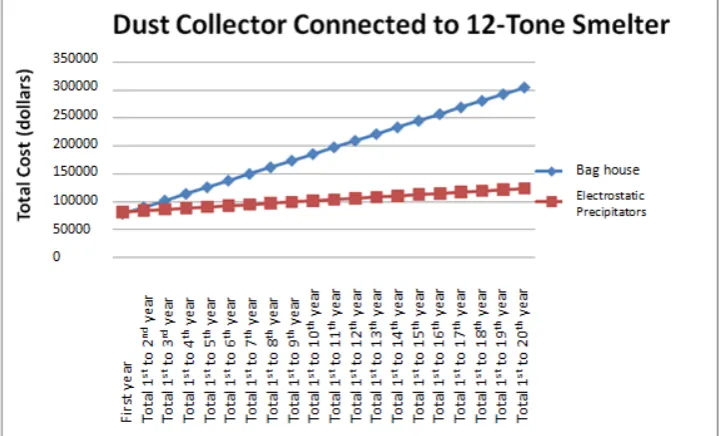
electrostatic precipitators connected to 3-ton furnaces, for an operation period of 20 years (filters’ lifetime), is illustrated in Fig.1 indicating that the energy and capital total cost in bag houses and electrostatic precipitators connected to 3-ton capacity furnaces will gradually increase thereafter. A comparison between the energy, capital and environmental damage cost in bag houses and electrostatic precipitators connected to 6-ton capacity furnaces is illustrated in Fig 2, indicating that the total cost in the two dust collectors will be almost equal after spending 2 years of operation. In Fig 3, the expense becomes approximately equal at the beginning of the first year.
DISCUSSION
Electrostatic precipitators and bag houses are compared in this article, in terms of energy consumption and cost, natural capital and environmental damage, and finally the best economic choice was determined.
Regarding studies undergone on national and international steel industries such as Ilva Taranto
Table 2. The annual rate of energy consumption in bag houses and electrostatic precipitators (KW/h)
Row Dust collector 3-Ton capacity furnace 6-Ton capacity furnace 12-Ton capacity furnace
1 Bag houses 43.800 87.600 175.200
2 Electrostatic Precipi-tators
10.415 20.864 41.729
international Italian steel company and Acheng and Anyang Steel companies based in China, as well as American Gary and Fairfield companies, it has been found that they mostly use bag houses. With respect to the goals this study has been aimed at, on environmental sustainability indicators such as energy, capital and natural resources, a correct selection of dust collectors shall happen based on the said parameters. In order to determine and provide a sustainable and adequate environmental planning for steel industry dust collectors, it is firstly required to define and determine environmental sustainability indicators and then, based on those indicators and results achieved from the work method, we would select type of dust collector system
complying with ecologic principals and based on the steel industry’s tonnage. One indicator of sustainability is environmental sustainability index, which is establishing a balance between the region’s consumption amount and scope capacity [ 20]. Another critical factor to achieve sustainability is energy. Energy is a vital factor to eliminate of poverty, improve welfare and to better life conditions. In many regions, energy consumption has led to environment deterioration which hampers achievement of sustainable development. About 1.7 billion people are deprived from electric power. Energy production, transmission and utilization leads to water, air and soil pollution, deforestation, and climate changes in long term. Environmental effects
Fig 2. Comparison between the energy and capital cost in bag houses and that in electrostatic precipitators connected to 6-ton capacity furnaces
caused by energy consumption lead to changes in workplaces, regions, districts, cities and the globe [ 25]. As population increases, it consequently increases dissemination of gases like carbon dioxide, carbon monoxide, sulfur dioxide and nitrogen dioxide (greenhouse gases). Dispersion of the said gases in the atmosphere leads to destruction of the environment as well as global warming, while energy consumption demand in 2020 will be 50 to 80 percent more than 1990 [ 26, 27]. For instance, carbon dioxide concentration is increasing: it has been around 270 ppm before industrialization, and has increased to 390 ppm today. These gases bear almost 35 percent of the impact on global warming due to human activities and a great part relates to energy consumption such as electric power consumption [ 28]. Carbon dioxide is one of the major air polluters in iron and steel industries. The rated amount of carbon dioxide in air is 300 ppm. It should be noted that the amount of carbon dioxide in the air has trespassed the critical limit, therefore its output and emission is strictly non-permissible. Since per each ton of steel production, three tons of carbon dioxide is emitted, therefore the less energy would be consumed to produce each ton of raw steel, the more sustainable development will be [ 29].
According to calculations findings, indexes of environmental sustainability and objectives of industrial ecology to reduce the consumption of energy and capital and consequently their environmental damage, grand total cost of bag houses in a steel electric furnace in the initial year is lower than the grand total cost of electrostatic precipitators. After twenty years of operational lifetime, the total cost of capital, energy and environmental damage in bag houses is more than twice the electrostatic precipitators. Moreover, greater tonnage of furnaces leads to higher cost. Therefore, the greater the tonnage of electric furnaces, the more economical the use of electrostatic precipitators, since reducing the electricity consumption leads to linear reduction of cumulative impacts of pollutants generated by power plants and environmental damage. However, if you want to operate a steel industry for a period of five years, the best dust collection system would be a bag house, because the total capital, energy and environmental damage cost in electrostatic precipitators is significantly different from that in bag houses in the fifth year. Also, electrostatic precipitators produce ozone and the effects of an electrostatic precipitator lead to production of troposphere ozone and cause hazardous side effects on human being, plants and the environment. Therefore, measuring the level of ozone affects the selection of electrostatic precipitators and bag houses significantly, when operated from the fifth year on.
Notes
1. Electrostatic precipitator (ESP) 2. Bag house
3. American Conferences Govermental Industrial Hygiene (ACGIH)
CONCLUSION
In regards to the significance of air pollution causing from energy consumption, it is necessary to attend energy consumption when choosing a dust collector, because the main factor of environmental damages is the high-energy consumption. It is obligate to choose our dust collector in relation with not only capital cost but also energy consumption and environmental damages.
In this research it is mentioned that capital, energy and environmental damages costs (due to energy consumption) on ESP (in melting furnace of 1, 3, 6 and 12 tons) is more less than bag filters, thus for choosing a dust collector in industry it is better to use ESP.
ACKNOWLEDGEMENTS
The authors declare that there is no conflict of interests. Tehran University supported financially the study. They provided scientific support.
REFERENCES
1. Ayres R, Ayres W. A Handbook of Industrial Ecology. Edward Elgar Publishing, Inc., USA, 2002.
2. Stanley E, Manahan. Industrial Ecology, Environmental Chemistry and Hazardous Waste. Cleaner Production Publisher: Taylor & Francis, Inc. 1999.
3. Ezazi A. Optimization Methods of Energy Consumption in Steel Industry of the Country, Steel Symposium Articles Collections (Paper Presented at the Steel Symposium Articles Collections, 2009, March 1st and 2nd, 83-832).
4. Harley P. Safety and Health in the Iron and Steel Industry. Geneva, International Labor Office, 2002; pp 236.
5. Makhdoom M. Living in Environment, Tehran University Publications. 1990.
6. Berwic G. New Technology Can Drastically Reduce Global Warming Canada.1990, Available from: http:// www.qamanage.com/Files/GlobalWarming.pdf.
7. Wayne T. Air Pollution Engineering Manual. 2nd ed. John Wiley and Sons Inc., 2000.
8. Jolazade N. Survey and Search of Energy Consumption in Steel, Steel Symposium Articles Collections (Paper Presented at the Steel Symposium Articles Collections). 2008.
9. Schmatloch V, Rauch S. Design and Characterization of an Electrostatic Precipitator for Small Heating Appliancs. J Electrostat 2005; 63(16): 85-100.
10. James R, Couper W. Chemical Process Equipment. 2nd ed. 2010; pp 691-716.
11. Cheremisinoff NP. Handbook of Air Pollution Prevention and Control. Elsevier Science, USA, 2002.
12. Hautanen J, Janka K, Koskinen J, Lehtimäki M, Kivistö T. Optimization of Filtration Efficiency and Ozone Production of the Electrostatic Precipitator. J Aerosol Sci 1986; 17: 622-626. 13. Liu LL, Guo J, Li J, Sheng L. The Effect of Wire Heating and
Configuration on Ozone Emission in a Negative Ion Generator. J Electrostat 2000; 48: 81-99.
14. Islamov R, Krishtafovich YA. A Peculiarity of Silver-base Wire Heating on Ozone Generation. J Electrostat 2011; Doi: 10-1016/J elstat 2011; 03-015.
16. Sillanpaa M, Geller MD, Phuleria H, Sioutas C. High Collection Efficiency Electrostatic Precipitator for in Vitro Cell Exposure to Concentrated Ambient Particulate Matter. J Aerosol Sci 2008; 39(4): 335-347.
17. Xavier Simon, Chazelet S, Thomas D, Bémer D, Régnier R. Experimental Study of Pulse-Jet Cleaning of Bag Houses Supported by Rigid Rings. Powder Technology 2007; 172(2): 67-81.
18. Doe, Industry Energy and Environment Profile of the U.S Iron and Steel. 2000.
19. Karbasi A. Environmental Management of Powerhouses. Iran Energy Efficiency Organization, Ministry of Energy, 2005. 20. Uwasu M, Yabar H. Assessment of Sustainable Development
Based on the Capital Approach. Ecol Indic 2011; 11(2): 348-352.
21. Mussatti D. EPA Air Pollution Control Cost Manual. 6th Ed. McGrow Hill. 2002.
22. ACGIH. Industrial Ventilation. Michigan. USA, 2002.
23. Baha S. How Can We Reduce the Energy Consumption of Pulse-Jet Dust Collectors in Order to Reap Economic, Ecological, and Social Benefits. Royal Roads University. 2005.
24. Bhasker C. Flow Simulation in Electro Static Precipitator (ESP) Ducts with Turning Vanes. Adv Eng Softw 2011; 42(7): 501-512.
25. Vera I, Langlois L. Energy Indicators for Sustainable Development. Energy 2007; 32: 875- 882.
26. Omer A. Energy, Environment and Sustainable Development. Renewable and Sustainable Energy Reviews 2008; 12: 2265- 2300.
27. Krupnick A, Burtlraw D. The Social Costs of Electricity Do the Numbers Add Up. Resources and Energy 1996; 18: 423-466.
28. Bloom AJ. Global Climate Change. Sinauer Associates Inc., USA. 2010.