Published online 2017 July 28 . Research Article
Decolorization of Reactive Red 198 by ultrasonic process in aqueous
solution
Behnam Barikbin
1*, Saeid Hadinasab
2, Mohammad Reza Nabavian
21
Social Determinants of Health Research Center, Birjand University of Medical Sciences, Birjand, IR Iran
2
Student Research Committee, Faculty of Health, Birjand University of Medical Sciences, Birjand, IR Iran
*Corresponding author: Behnam Barikbin, Social Determinants of Health Research Center, Associate Professor, Department of Environmental
Health Engineering, Faculty of Health, Birjand University of Medical Sciences, Birjand, IR Iran Tel: +985632381251, Fax: +985632440450, Email: B_ [email protected]
Received 2017 May 15; Revised 2017 July 10; Accepted 2017 July 19 Abstract
Background: Reactive dyes are extensively used in the textile industry due to their superior performance. However, the
effluence of the waste containing such dyes into water resources can pose hazardous effects on the environment because of their carcinogenic, mutagenic, allergenic and toxic nature. This study explored the efficiency of the ultrasonic process in removing Reactive Red 198 dye from aqueous solutions.
Methods: This research is a laboratory, experimental study carried out in the Environmental Health Engineering Research
Center of Birjand University of Medical Sciences. Two ultrasonic devices with a constant frequency and adjustable temperature and time were applied. The effects of various operating parameters and optimal conditions for removal such as initial concentration of dye (20-200 mg/L), contact time (1-90 mines), temperature (20-50 o
C), frequency (35,37 kHz) and pH (2-12) were investigated.
Results: The mean efficiency rate of removing Reactive Red 198 dye in optimal conditions (with primary dye
concentration of 20 mg/L, pH=3, retention time=50 min, temperature=50 o
C) at a frequency of 37 kHz obtained 84.82%. This result at the frequency of 35 kHz was 82.6%. The minimum removal at a frequency of 35 kHz with a concentration of 200 mg per liter at a pH of 12 and a retention time of 1 minute was 29.35 and at the frequency of 37 kHz, it was 39.12.
Conclusions: The results showed that the ultrasonic process has a high capacity to remove Reactive Red 198 dye from
aqueous solutions. Besides, this procedure can prove more efficient in case the effective operational factors are optimized.
Keywords: Reactive red 198 Dye; Ultrasound; Aqueous solutions
1. Introduction
Textile and dyeing industry is one of the largest consumers of water and, as the result, one of the most principal producers of wastewater. The wastewater from textile and dyeing factories contains large amounts of dyes and stabilizers. Over 50% of the consumed dyes enter the sewage system, which not only cause water discoloration but, due to toxicity and carcinogenicity of some components, they cannot be reused or released into the environment (1, 2). Colors are among the most dangerous groups of known chemical compositions in effluents of the mentioned industries, which have recently been shown to have adverse effects on the food chain and life of aquatics by creating environmental problems such as reduced light
penetration and the subsequent disruption in the process of photosynthesis in liquid water (3). Colors as such cause some problems on human health including allergies, dermatitis, skin irritation, cancer and genetic mutation and may affect the quality of drinking water and other uses (4).
Structurally, these colorful substances are placed in Azo, Anthraquinone and phthalocyanine groups, and functionally, they are divided into reactive, acid, direct, and dispersant categories (5). Reactive dyes are used as water-soluble and anionic dyes in dyeing, which have largely replaced DirectX and Azo colors (6). Ease of application, optimal stability during washing, and low power consumption are among the main factors that cause the wide application of this group of colors in dyeing (7). So far, different physical, chemical and biological methods
have been used for the treatment of this kind of wastewaters, among which one can refer to activated carbon adsorption, coagulation, chemical oxidation, reverse osmosis and filtration (8, 9).
However, absorption and coagulation just transfer impurities from the aqueous phase to the solid phase, and because of the environmental problems they need to be treated again. In addition, in these methods, decomposition of pollutants is not done (10). The common biological methods are not also able to decompose the contaminants, and most of surface adsorption occurs on the sludge (11).
Consequently, in recent years, advanced and
electrochemical oxidation methods for have been widely used to remove toxic (and hard-to-decompose) contaminants from drinking water and factories wastewater. Almost all advanced oxidation methods oxidize a wide range of pollutants quickly and non-selectively based on the production or use of active species such as hydroxyl radical (OH) (12).
There are various methods such as Fenton, ozonation, UV, electrochemical and photocatalytic methods for the production of hydroxyl radicals (13, 14). Given the limitations such as lack of affordability and almost low efficiency of the mentioned methods, other methods such as
advanced oxidation can be used (15). One of the advanced
oxidation methods is ultrasonic waves which can be used alone or in combination with other methods for the decomposition of organic substances due to easy set-up, comfortable operation, lack of by-products, no need to add chemicals, and lower startup costs in comparison to other methods (16). As an advanced oxidation process, ultrasound is capable of breaking down the organic compounds. When the aqueous solution undergoes ultrasonic process, a lot of pressure gradient is created in the liquid, causing expansion and contraction of the bubbles of micron size. This process leads to the formation of areas with high temperature and pressure within the fluid environment, which could cause pyrolysis of organic materials. In addition, in an aqueous medium, HO and HOO radicals are formed as a result of cavitation that decomposes the material inside or outside the bubble (17). Vincenzo Naddeo, Vincenzo Belgiornoa and colleagues demonstrated that ultrasonic waves are highly capable of eliminating NOM particles from the water environment (18). Moreover, studying ways to reduce the Azure B color by the process of advanced ultrasonic and Electro-Fenton, Zhanmei Zhang and Huaili Zheng (2012)
concluded that the reduction of the color depends on the kinetics of the existing components, pH, and the initial concentration of Fe where the reduction was achieved at pH between 2.6 to 3 (19). In addition, in a research by A. H. Mahvi A. Maleki in 2009 on the reduction of humic substances of water by using ultrasonic and ultraviolet waves, the preliminary results indicated the high power of ultraviolet in the degradation of humic substances. Also, the study showed that ultrasound alone cannot be an effective method in the removal of humic substances. In this experiment, the highest amount of degradation of humic substances increased after 90 minutes from 5.7 to 9.5 percent (20). In another study conducted in 2006 by S. Nasseri and F. Vaezi on determining the effect of ultrasonic waves on advanced treatment of wastewater, it was found that ultrasound can be used as an advanced oxidation method for the treatment of water and wastewater and the use of this method reduces mineral compounds during the cavitation process. In this experiment which was performed at the times of 10, 30, and 60 with the bandwidth of 35 and 130 kHz the results showed that ultrasonic causes a reduction of 25 to 30 percent of COD is less than 60 minutes (21).
In sum, Reactive Red 198 Dye that is used in textile industries is carcinogenic and causes environmental pollution. On the other hand, no adequate studies have been conducted so far in terms of removing this paint with ultrasonic waves. Thus, this study was performed with the aim of assessing the efficiency of ultrasonic process in the removal of the mentioned color in the optimum conditions in aqueous solutions.
2. Methods
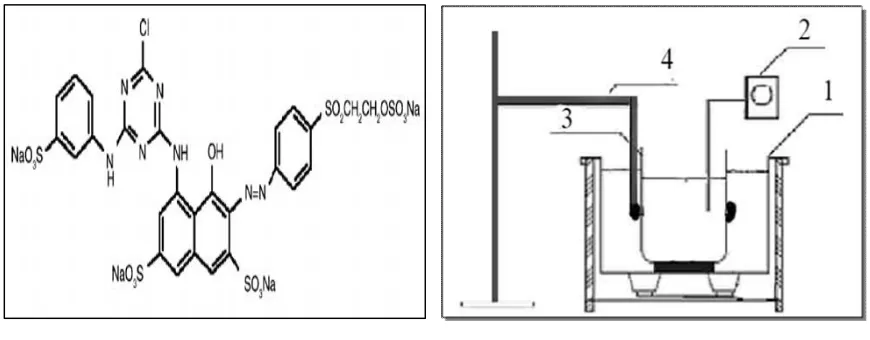
This project is an experimental study in the laboratory scale which was carried out in the laboratory of Department of Health and Research Center of Birjand University of Medical Sciences. This study is based on findings concerning the optimum conditions for the removal of Reactive Red 198 Dye, which uses the Reactive Red 198 Dye manufactured by Merck Factory in Germany, with the chemical formula of C27H18ClN7Na4O15S5 and the molecular
weight of 968.21. The mentioned dye was purchased and used from domestic importing companies.
The concentration of the desired substance in the samples was determined at the maximum wavelength of 518 nm (according to the articles and research in the field)
by using a spectrophotometer (model T80-PG Ltd) after determining the calibration curve and the linear regression curve. Also, pH was performed by using pH meter (MADC model) made in Germany and its regulation by using sulfuric acid and normal sodium hydroxide 1%. For the effect of sound waves on the discoloration process of Reactive Red 198 color, two ultrasonic water baths (made in Germany) with different capacities were used that could adjust the temperature and timer (with a specified frequency). Table 1 shows the characteristics of the ultrasonic devices used in the project.
In order to provide Reactive Red 198 Dye with different concentrations, first a solution of Reactive Red 198 color at a concentration of 1 gram per liter was prepared with distilled water. By diluting this solution, different solutions with required concentrations were prepared. Finally,
samples ready to reaction with the volume of 100 ml was put in the ultrasonic bath reactor exposed to ultrasonic waves so as to measure the efficiency of ultrasonic process. Figure 2. Specifications of the reactor
1. Ultrasonic bath; 2. pH meter; 3. Reaction container; 4. Clamp
After finding the level of concentration from among the concentrations of (20, 30, 50, 100, 150, 200), the effect of different amounts of pH (including 12, 10, 8, 7, 6, 4, 2) was assessed. Also, the impact of temperature (50, 40, 30, 20 degrees Celsius)( The temperature is regulated by the ultrasonic bath), frequency (35&37 kHz), and time points (1, 5, 10, 15, 30, 60, 90) were evaluated. The data were analyzed in the Excel software (version 2007).
Table 1. Characteristics of ultrasound devices used in the project
Power Consumption (W) Frequency
(kHz) Weight
(kg) container
size (mm) device volume
(liter) Manufacturer
Model Name of
device
240-320 37
2.8 300, 179, 214 2.75
Germany E 30H
ELMA
120-480 35
4 240, 140, 100 2
Germany DT 102H
BANDELIN
Figure 2: Specifications of the reactor
1. Ultrasonic bath; 2. pH meter; 3. Reaction container; 4. Clamp
Figure 1: Chemical structure of Reactive Red 198 Dye
3. Results
Effect of pH:
As shown in Diagram 1, the highest efficiency of the removal of Reactive Red 198 is in pH= 3 so that in the frequencies of 35 and 37 kHz, the concentration of Reactive Red 198 Dye was reduced 82.94 and 86.18 percent respectively. The lowest removal was related to pH=12 so that in this pH and at the frequencies of 35 and 37 kHz, the amounts of removal were 35.29 and 39.12% respectively.
Diagram 1: Effect of pH. (Initial concentration of the dye: 20ppm, solution volume: 100ml, time: 60min, temperature: 50°C)
Effect of the concentration:
According to the results of Diagram 2, the greatest amount of removal was 81.47% at a frequency of 35 kHz and a concentration of 20 milligrams per liter. It was 84.56% at a frequency of 37 kHz and a concentration of 20 milligrams per liter. The lowest amount of removal was 56.37% at the frequency of 35 kHz and concentration of
200 ppm, and 56.19% at the frequency of 37 kHz and concentration of 200 ppm.
Diagram 2: Effect of the concentration. (pH of solution=3, volume of solution=100 ml, time=60 min, temperature=50°C
Effect of contact time:
As Diagram 3 indicates, by increasing the contact time- while other conditions are fixed- the efficiency of removal increases so that the maximum amount of reduction was obtained to be 83.38% in a 60-minute time with a frequency of 37 kHz, and 81.91% at a frequency of 35 kHz. As is obvious, with the increase of contact time, the efficiency of the removal of Reactive Red 198 increases until the 60-minute time and after that the removal process becomes nearly constant and no significant increase is observed.
Diagram 3: Effect of contact time. (pH of solution=3, volume of
solution=100ml, concentration of solution=20ppm, temperature=50°C)
Effect of temperature
According to the results of Diagram 4, the greatest
amount of removal at the frequency of 37 kHz, 50 ° C
, and in concentration of 20 milligrams per liter was 84.82%, and at the frequency of 35 kHz, concentration of 20 mg per liter, and temperature of 50 ° C
, it was 82.6 percent. The lowest amount of reduction in the frequency of 35 kHz at a concentration of 20 ppm and a temperature of 50 ° C
obtained 62.65%, and at a frequency of 37 kHz, a concentration of 20 ppm, and a temperature of 50 ° C
, it was 70.29%.
Diagram 4. Effect of temperature. (pH of solution=3, volume of solution = 100ml, concentration of solution=20ppm, time=60 min)
4. Discussion
Effect of initial pH:
The results of recent studies have shown that in the reactions of the chemical oxidation of the compounds, especially when using ultrasonic waves, pH affects the efficiency of oxidation. When a solution is affected by ultrasonic waves, the water vapor in the bubbles caused by cavitation can take the form of H or OH, which is due to the pH of the environment (19). The results presented in Diagram 1 indicate that in acidic conditions, in comparison to the neutral pH and alkalinity conditions, the amount of the removal of Reactive Red 198 is higher mainly because at lower amounts of pH the dyeing substances usually exist in molecular shape, while in the alkaline amounts of pH, they have ionic form. Therefore, the diffusion of molecules at low amounts of pH is related to the interface of gas bubbles in which the concentration of hydroxyl radical is maximum, causing degradation of organic compounds. This result is consistent with the study by Zhanmei Zhang, Huaili Zheng (19) in which the optimal value of pH was between 2.6 to 3, and the most important reasons of the effect of the changes of the environment pH on the decomposition of organic compounds in advanced oxidation processes, have known to be the type and amount of the radicals produced in this process (19).
Effect of initial dye concentration:
In Diagram 2, the maximum amount of the removal at a frequency of 35 kHz and a concentration of 20 milligrams per liter was 81.47%, and at a frequency of 37 kHz and a concentration of 20 milligrams per liter, it was 84.56%. The results indicate reduced efficiency of the removal process by ultrasonic in high concentrations. Decreased rate of decomposition caused by increased concentrations can be explained due to greater competition for reaction with hydroxyl radicals in high concentrations. Moreover, when concentration increases in the liquid phase, the partial pressure of cavitation bubbles may increase and, as the result, the temperature of the solution reduces, which can have influence on the decomposition of some materials. Concentration can also be effective in the area of decomposition of materials (inside the bubble, interstitial area, and inside the solution) and, thus, the speed of decomposition of materials (22). In a study by Hua et al, with a 10 times increase in the concentration of CCl4, the constant rate of decomposition was not affected but the rate of Para-nitrophenol decomposition showed an inverse
correlation with the initial concentration. Drijvers et al also showed that the initial concentration has a significant effect on the kinetics of decomposition of organic materials in aqueous environment (23). In the study by Goel et al, in a comparison of the decomposition of volatile and non-volatile materials, the increase in initial concentration caused the decreased decomposition of both volatile and non-volatile materials (24). Manosaki et al used ultrasonic waves for removing sodium dodecyl benzene sulfonate. This test was carried out at the concentrations of 15, 30 and 100 mg per liter at a frequency of 20 and 80 kHz. The results showed that by decreasing the concentration of sodium dodecyl benzene sulfonate and increasing the frequency, the efficiency of removal increased (25).
Effect of contact time:
Based on the results of this study, as shown in Diagram 3, the percentage of decolorization of Reactive Red 198 by ultrasonic during the early stages rises quickly after a short reduction and takes an upward trend and at the time of 50 ° C achieves the maximum removal rate, which at a frequency of 37 kHz, 50 ° C, and concentration of 20 milligrams per liter obtained 84.82% and at the frequency of 35 kHz, concentration of 20 mg per liter and temperature of 50 °C, it was 82.6%. Generally, the rate of the removal of contaminants is quick at first. But gradually it reduces over time until it reaches balance. This is due to the fact that at the beginning and at the early stages of absorption, a large number of vacant surface sites are available for absorption but over time, the remaining vacant sites face difficulty in absorbing pollutants, which could be due to deterrent forces between the molecules adsorbed on the absorbing surface of the solid and the bulk of the liquid. Similar results have been reported by Gulnaz (23) and Akin (24). It is also consistent with the results of the research by A. H. Mahvi A. Maleki on the removal of humic acids from aqueous environments by ultrasonic (22).
Effect of temperature:
As Diagram 4 indicates, by increasing the temperature, the percentage of the removal of Reactive Red increases so that at the temperature of 50 degrees Celsius, it amounts its highest value (84.82 and 82.6 percent) at the frequencies of 35 and 37 kHz, and then the percentage of removal reaches equilibrium and no significant increase is observed. The reason why the efficiency of the removal of the color increases by increasing the temperature is that by increasing the temperature, the speed and efficiency of decolorization
increase because higher temperature causes increased rate of reaction and the production of oxidizing agents such as hydroxyl radicals increases and the efficiency and the reaction rate increases (19). Jiang Wang et al used the combined process of cavitation for removing the color of red diamonds ka BP-2. The results showed that increasing the temperature causes a significant difference in decolorization of the mentioned color (21). It is also consistent with the results of S. Nasseri and F. Vaezi who used ultrasonic in advanced treatment of wastewater (21).
5. Conclusion
The percentage of the removal of the color depends on the pH, the initial amount of the color, temperature, and contact time. Also, this process is capable of removing more than 80% of the reactive red 198 from aqueous solutions at a concentration of 20 mg per liter. In addition, the process of removing the Reactive Red 198 is inversely correlated with pH and initial concentration of the color and has a direct relationship with increasing the contact time and the frequency of the device.
6. Acknowledgements
The authors deem necessary to thank and appreciate the sponsorship and support of the Deputy of Research and Technology of Birjand University of Medical Sciences and also the cooperation of the experts working at chemistry laboratory of Birjand Department of Health.
References
1. Asgari G, Rahmani AR, Barjasteh Askari F, Godini K. Catalytic ozonation of enol using copper coated pumice and zeolite as catalysts . J Res Health Sci 2012; 12(2): 93-7. [Farsi]
2. Ghodsian M, Ayati B, Ganjidoust H. Determination of Optimum Amounts of Effective Parameters in Reactive Dyes Removal Using Photocatalytic Reactions by Immobilized TiO2 Nano Particles on Concrete Surface.” J Water Waste 2011; 3(1): 45-53. [Farsi]
3. McKay G, Hadi M, Samadi MT, Rahmani AR,Aminabad MS, Nazemi F. Adsorption of reactive dye from aqueous solutions by compost. Desalin water treat 2011; 28(3): 164-73.
4. Arslan, I., Balcioglu, I.A., and Bahnemann. Advanced chemical oxidation of reactive dyes in simulated dye house effluents by ferrioxalate-fenton/UV-A and TiO2/UV-A processes. D.W. 2000. J. of Dyes Pigments, 47, 207-218.
5. Anjaneyulu, Y., Chary, N.S., and Raj. Decolorization of industrial effluents-available methods and emerging technologies-a
review. D.S.S. 2005. J. of Rev. Environ. Sci. Biotechnol., 4, 245-273.
6. Lima, E.C., Royer, B., Vaghetti, J.C.P, Simon, N.M., Cunha, B.M., Pavan, F.A., et al. Application of Brazilian pine-fruit shell as a bio sorbent to removal of reactive red 194 textile dye from aqueous solution Kinetics and equilibrium study. 2008. J. of Hazard Mater., 155(3), 536-550.
7. Carneiro, P.A., Umbuzeiro, G.A., Oliveira, D.P., and Zanoni, M.V. Assessment of water contamination caused by a mutagenic textile effluent / dye house effluent bearing isperse dyes. 2010. J. of Hazard Mater, 174(1-3), 694-699.
8. Xu, X., Li, H., Wang, W., and Gu, J. Degradation of dyes in aqueous solutions by the Fenton process. 2004. J. of Chemosphere, 57, 595-600.
9. Gupta, V., Ali, I., and Vipin, K. Adsorption studies on the removal of Vertigo Blue 49 and Orange DNA13 from aqueous solutions using carbon slurry developed from a waste material. 2007. J. of Coll. Interf. Sci.,315, 87-96.
10. Shi, B., Li, G., Wang D., Feng, C., and Tang, H. Removal of direct dyes by coagulation: The performance of preformed polymeric aluminum species. . 2007. J. of Hazard Mater., 143, 567-574.
11. Jared, M., and Chen-Lu, Y .Electrochemical coagulation for textile effluent decolorization. . 2005. J. of Hazard Mater, B127, 40-47
12. Lee,Y.H., and Pavlostathis, S.G. Decolorization and toxicity of reactive anthraquinone textile dyes under methanogenic conditions 2004. J. of Water Res., 38,1838-1852.
13. Ramalho, P.A. Degradation of dyes with microorganisms studies with ascomycete yeasts [dissertation]. 2005. University of Minho, Portugal.
14. Jesionowski, T. Influence of aminosilane surface modification and dyes adsorption on zeta potential of spherical silica particles formed in emulsion system. 2003. J. of Colloids Surf A, 222, 87-94.
15. Peralta-Zamora, P., Kunz, A., De Moraes S.G., Pelegrini, R., Moleiro, P., and Reyes, J. Degradation of reactive dyes I. A comparative study of ozonation, enzymatic and photochemical processes. 2003. J. of Chemosphere, 4, 835-852.
16. Andrade, L.S., Ruotolo, L.A.M., Rocha-Filho, R., Bocchi, N., Biaggio, S.R, Iniesta, J., et al. On the performance of Fe and Fe, F doped Ti–Pt/PbO2 electrodes in the electrooxidation of the Blue Reactive 19 dye in simulated textile wastewater. 2001. J. of Chemosphere, 66, 2035-2043.
17. Koprivanac, N., and Kusic, H. Hazardous organic pollutants in colored wastewaters, Nova Science Publishers, Inc(2009). New York, USA.
18. Vincenzo N, Vincenzo B, Laura B. Control of fouling formation in membrane ultrafiltration by ultrasound irradiation. Environmental Technology. 2014: 36:10,1299-1307.
19. Zhanmei Z, Huaili Z . Optimization for decolorization of azo dye acid green 20 by ultrasound and H2O2 using response surface methodology. Journal of Hazardous Materials. 2012:Volume 172, Issues 2–3, 1388–1393.
20. Mahvi A.Maleki A.Reduction ofhumic substances in water by application of ultrasound waves and ultraviolet irradiation.iran.j.environ.health.sci.eng.,2009,vol,6,No.4,pp.233-240.
21. Nasseri S,Vaezi F.Determination of the ultrasonic effectiveness in
advanced wastewater
treatment.iran.j.environ.health.sci.eng.2006,vol.3,No.2.pp.109-116.
22. Mahvi A.Maleki A.Reduction ofhumic substances in water by application of ultrasound waves and ultraviolet irradiation.iran.j.environ.health.sci.eng.,2009,vol,6,No.4,pp.233-240.
23. Sadik, W.A.A., and Nashed, A.W. UV-induced decolorization of acid alizarine violet N by homogeneous advanced oxidation processes. 2008. J. of Chem. Eng., 137, 525-528.
24. Nasseri S,Vaezi F.Determination of the ultrasonic effectiveness in
advanced wastewater
treatment.iran.j.environ.health.sci.eng.2006,vol.3,No.2.pp.109-116.
25. Vincenzo N, Vincenzo B, Laura B. Control of fouling formation in membrane ultrafiltration by ultrasound irradiation. Environmental Technology. 2014: 36:10,1299-1307.