Journal of Computing and Security
Randomized SVD Based Probabilistic Caching Strategy in Named
Data Networks
Narges Mehran
a,∗
, Naser Movahhedinia
aaDepartment of Computer Architecture, Faculty of Computer Engineering, University of Isfahan, Isfahan, Iran.
A R T I C L E I N F O.
Article history:
Received:29 November 2016
Revised:22 September 2017
Accepted:06 November 2017
Published Online:01 April 2018
Keywords:
Named Data Network, Caching Strategy, Betweenness Centrality, Linear Weighted Moving Average, Randomized-SVD
A B S T R A C T
Named Data Networking (NDN), a data-centric enabled-cache architecture, as one of the candidates for the future Internet, has the potential to overcome many of the current Internet difficulties (e.g., security, mobility, multicasting). Influenced by using cache in intermediate equipment, NDN has gained attention as a prominent method of Internet content sharing. Managing the NDN caches and reducing the cache redundancy are the important goals in this paper. Our main contribution in this research is toward caching optimization in comparison with betweenness probabilistic in-network caching strategy. Therefore, with respect to combined impacts of long-term centrality-based metric and Linear Weighted Moving Average (LWMA) of short-term parameters such as user incoming pending requests and unique outgoing hit requests on caching management, a flexible probability caching strategy is proposed. Moreover, a simple Randomized-SVD approach is applied to combine averaged short-term and long-term metrics. The output of this data-fusion algorithm is used to allocate a proper probability to the caching strategy. Evaluation results display an increase in the hit ratios of NDN routers’ content-stores for the proposed method. In addition, the producer’s hit ratio and the Interest-Data Round Trip Time, compared to the betweenness scheme, is decreased.
c
2016 JComSec. All rights reserved.
1
Introduction
According to the Visual Networking Index (VNI) Global Mobile Data Forecast [1], monthly global mo-bile data traffic will be 49 Exabyte of which 78 percent will be video contents by 2021. To handle this increas-ing traffic volume of online contents, an emergincreas-ing paradigm has been developed for future Internet archi-tecture, called Information-Centric Network (ICN) [2] supporting in-network caching to efficiently transport named sub-objects (or chunks) to users.
∗ Corresponding author.
Email addresses:[email protected](N. Mehran),
[email protected](N. Movahhedinia)
ISSN: 2322-4460 c2016 JComSec. All rights reserved.
Content-Centric Networking project [3] (recently known as Named Data Networking (NDN) [4]) is one of ICN architectures proposed by PARC (Palo Alto Research Center, formerly Xerox PARC) in 2009. The goal of designing this architecture is to perform man-agement, routing and resource allocation according to the content ID, instead of the host ID.
CS
PIT
FIB
InterestData
lookup miss lookup hit
Downstream Upstream
discard Data
forward
forward
cache Data
new entry added to PIT add incoming
Interest to an old entry
drop or NACK
Figure 1. Interest and Data Processing in an NDN Router [3].
unique outgoing traffic distribution and users’ pending incoming requests, as well as a long-term one namely topology-related betweenness-centrality of the nodes. We modify the metrics used by NDN cache size allo-cation schemes proposed in [5–7], and the Adaptive Congestion Control Protocol in NDN (ACCPndn) pre-sented in [8], to obtain a more general model for a probabilistic caching decision applied to NDN routers. These parameters help to come across a node’s impor-tance with regard to its caching duty in NDN network. As the former two parameters may change frequently, they are smoothed out by Linear Weighted Moving Average scheme in a proper time interval. Next, the re-sults are combined with the betweenness values of the routers to encounter topological information. Eventu-ally, to denoise the gathered data and reduce the com-putational complexity of the algorithm, the important features are extracted by a Randomized-SVD method. In Section 2, we firstly describe the technology considered for future ICN architectures and the NDN routers and then focus on data-fusion algorithms as the basis of the proposed method. Section 3 reviews the related works presented specifically on NDN strategies for storage devices. In Section 4, our main contribution is discussed. Section 5 is devoted to evaluations of the proposed method. In Section 6, the paper is finally concluded.
2
Background
2.1 Information Centric Networking
Nowadays, Peer-to-Peer (P2P) and Content Distribu-tion Networks (CDNs) are two common broad content-centric Internet technologies. Content providers can purchase the resources from CDN operators owning a set of geographic replicated machines. This is a highly beneficial point for content providers as their content would be available on the worldwide Internet. Like-wise, in P2P networks, users contribute a share to the resources and receive content-centric services in
return. All of these activities are organized in over-lay over-layers; so that the core routers are not aware of requested contents [9].
The pioneer works proposing a redefinition of the Future Internet architecture have focused on mapping content names to locations by in-network caching em-ployment. ICN is a notable concept to organize an infrastructure with the help of which an enhanced sup-port will be provided for content distribution and mo-bility [10]. It focuses on finding and delivering named contents, instead of maintaining end-to-end commu-nications between hosts identified by IP addresses [11]. Among these, in this research, NDN architecture, thanks to CCNx [12] and NDN [13] projects with their simple, robust and effective communication models, has been selected.
2.2 NDN in a Nutshell
NDN proposes a communication standard based on the exchange of two types of packets: Interest and Data that carry Uniform Resource Identifier (URI)-like content names. A consumer requests a named content by broadcasting an Interest packet over its available network faces. The Interest is forwarded hop-by-hop until a producer provides the requested Data. As noticed in Figure 1, an NDN router has three data structures to cache and forward the Interest and Data packets: Content Store (CS), Pending Interest Table (PIT), and Forwarding Information Base (FIB).
CS, as the name implies, with defined placement and replacement policies, stores chunks of incoming Data messages for satisfying future possible Interests (requested by a user) in its storage device, simply named cache. PIT stores request not satisfied by CS and passed to next router. Finally, FIB forwards In-terest messages to the proper face of an NDN router. When the content’s location is broadcasted to all the NDN routers, it will be populated into FIBs. On the way that Data message is forwarding back to its desti-nation, if an entry in PIT is matched, the data chunk is immediately forwarded by to its destination [4].
2.3 Data-Fusion Algorithms
pro-cessing the input data, especially for large-scale renetwork parameters. The learning-based clustering al-gorithms, such as K-Means [14], need heavily to have some initial values to randomly group data points into clusters. As a result, the raw data sets collected from our implementations are not available before running the algorithm. For reducing the size of infor-mation and combining features with different quali-ties, Truncated-SVD is exploited; according to [15], Truncated-SVD has the ability to extract only the most important information from the data matrix by using just the first several components estimated from the original matrix of data set. Randomized-SVD im-plements a type of Truncated Singular Value Decom-position (Truncated-SVD) that only computes thek
largest singular values with a randomized algorithm, wherekis a user-specified parameter [16].
Randomized-SVD is similar to PCA [17], but differs in that it works on sample matricesX directly instead of their covariance matrices. When the column-wise (per-feature) means ofXis subtracted from the feature values, Randomized-SVD on the resulting matrix is equivalent to PCA [15].
Given an m×nmatrixX, a target number kof singular vectors, this procedure computes an approx-imate factorization UΣV∗, where U and V are or-thonormal matrices whose columns are eigenvectors of X.X∗ andX∗.X respectively, and Σ is nonnega-tive and diagonal matrix containing the eigenvalues of X.X∗ in the diagonal being sorted in descending order. As illustrated in [16], by considering the prob-lem of finding thekprincipal components of the SVD of anm×ninput matrix, randomized algorithms in-volveO(mnlog(k)) floating-point operations (flops) in distinction toO(mnk) for classical algorithms.
The six-step implementation of Randomized-SVD, briefly shown in the following pseudo code(Algorithm 1), can generate a structure from an unstructured input data matrix by using a sub-sampled random Fourier Transform (SRFT) and QR decomposition:
Algorithm 1Randomized-SVD’s Pseudo Code [18]
Goal: Given anm×ninput matrixX, compute an
approxi-mate rank-k SVD:X≈Uk.Σk.VkT
1: Draw ann×kGaussian random matrixΩ, 2: Form an m×k orthonormal matrix Q by using
(subsampled) FFT and QR factorization, 3: Form thek×nmatrixB=QT.X
4: Compute the SVD of the small matrix B: B = ˜
U .Σk.VkT,
5: Form the matrixUk=Q.U,˜ 6: CalculateXk=Uk.Σk.VkT.
3
Related Works
In [19], authors have presented a scheme called Au-tonomous System Collaboration Caching Strategy (ASCCS). In ASCCS scheme, CCN network is divided into several Autonomous Systems (AS) as OSPF does, then the control nodes are selected according to the be-tweenness and the cache replacement rate of the nodes. Each AS is centralized, and controlled by the control node. Then the selected control node is responsible for computing the popularity of different contents to define the suitable cache policy for them. Therefore, routers in the same AS collaborate with each other to improve the performance of the network caches.
In [20], the authors have been concerned with cache management operations and cache network modeling that have to be adjusted to fit in a completely decen-tralized environment. They have focused on the allo-cation of the available cache capacity along a request-response path; however, it is just for a hierarchical network topology. In other words, authors have sug-gested that if ICN routers are allocated the caching probability, associated with the path capacity, they achieve better network performance.
PopCache [21] allows an ICN router to store the content in accordance with the popularity characteris-tic of it. The closest router to the consumers store the content with the most popularity and the less popular contents are cached in other routers. In addition, the authors have taken into account the rule of distribu-tion of caching data packets along the path. They have indicated that in terms of Round-Trip Time (RTT), PopCache has a lower expected round-trip time than Ref. [20], especially when the Zipf exponent becomes larger.
In [22], authors have proposed a centrality-based caching algorithm by exploiting the concept of betweenness-centrality to improve the caching gain. The possibility of caching less in order to achieve higher performance gain has been investigated. They have also argued that the universal caching strategy is costly and sub-optimal.
balanced, and mostly cost-driven categories. A larger gain is achieved in balanced mode, since designing a better composition of hit ratio and cost fraction.
4
Problem Definition and Proposed
Scheme
4.1 Problem Definition
The problem inspected in this article is how to de-cide on a probabilistic placement strategy to improve NDN performance in terms of power consumption of wasteful caching while preserving the cache hits and low end-to-end delay. Therefore, we present a scheme focusing on the content store structure of an NDN router.
After collecting short-term dynamic parameters, and combining them with a long-term static parame-ter, the appropriate probabilistic caching strategy is derived. Indeed, each router is allowed to cache just based on this controllable probability. The important long-term centrality metric is betweenness; showing how many times, a router is on the shortest path be-tween Producer-Consumer pairs. As the data chunks would be routed for the requester based on the PIT table, more interfaces stored in a PIT may cause more data chunks expecting to be received. Moreover, more numbers of cache hits actually show more Interests satisfied by the cache. Altogether, the Unique Hit In-terests along with the users’ Pending InIn-terests in a router within an appropriate time interval, in con-junction with the betweenness-centrality of the router, are utilized to calculate the caching probability of an NDN router.
4.2 Metric Definition
If NDN is considered as a graph, the routers and the point-to-point links between routers represent the nodes and the links in the graph correspondingly. As the links are assumed symmetric and full duplex, the equivalent graph would be unidirectional. To find out how influential a node in a group is, a graph-related long-term parameter, betweenness-centrality (BC), precomputed offline, is used. This metric is an indicator of node centrality in the graph of a network. In order to find this type of centrality, the Equation (1) to Equation (3) are adopted [24].
The pair-wise dependencies of two nodes,sandt, on a special node,v, is calculated by Equation (1) [24]:
δ(s, t|v) = σ(s, t|v)
σ(s, t) (1)
whereσ(s, t) shows the number of different shortest paths from node s to t. In other words, the
pair-wise dependency shows the fraction of all the number of geodesics between the pair of nodes,σ(s, t), that include nodev,σ(s, t|v).
By aggregating these computations, we can have Equation (2) [24]:
δ(s|v) =X
t∈V
δ(s, t|v) (2)
Then, for all s, v ∈ V, we can compute the one-sided dependency ofson vertices, one edge farther away [24]:
δ(s|v) = X
w:
n (v,w)∈E and
dist(s,w)=dist(s,v)+1
o
σ(s, v)
σ(s, w).(1 +δ(s|w))
(3) The next phase is to collect the information includ-ing the number of stored pendinclud-ing interests and the number of unique data chunks being satisfied by the current node. These two metrics are sampled at the NDN routers. As the entries in PIT table are unique, the Hit Interests, satisfied by different data chunks in the current router, are also adopted as another dy-namic metric. In order to approximate and smooth the fluctuations of the obtained samples, a type of Weighted Moving Average (WMA) [25] procedure is applied because of its efficiency and simplicity. In this WMA model, named Linear WMA (LWMA) [26], the current and the several past samples are linearly weighted and added together. In other words, we can further predict the samples based on the behavior of their past. More specifically, the data set constitutes a time series for each router. By applying a time-series prediction method to the data set, activity of a sample at timetcan be forecasted. In this case, from then
total number of samples, justmnumber of them are chosen as a window for the prediction, wherem << n; in calculating ratio of the weights, the denominator is equal to the addition of all the weights and the numer-ator is selected from the window of LWMA weights.
Therefore, we declare Equations (4) and (5) to com-pute the weights in an m-size moving window for both the Pending Interest and Unique Hit Interest samples. In calculating the ratio of the weights, the denomina-tor is equal to the addition of all the weights and the numerator is selected from the window as follows:
P I W eight(w) =(m−(w−1))
m(m+ 1)/2 ;w∈[1, m] (4)
U niqHI W eight(w) = (m−(w−1))
the older the observation, the less the weight taken. Therefore, the smallest weight is allocated to the oldest sample, and it is continued until the largest weight is allocated to the newest sample in the window. The LWMA of PI and Unique HI samples are attained as Equations (6) and (7):
(N ew P I Sample∗P I W eight)[t] =
t
X
w=1
n
N ew P I Sample(w)×
P I W eight(t−(w−1))o;t∈[1, n] (6)
(N ew U niqHI Sample∗U niqHI W eight)[t] =
t
X
w=1
n
N ew U niqHI Sample(w)×
U niqHI W eight(t−(w−1))o;t∈[1, n] (7) where New PI Sample(t) is the time series of PIT snapshots andNew UniqHI Sample(t)is the time se-ries of unique CS hit events. The sampling frequency should be selected based on the behavior of fluctu-ations; therefore, ten samples per second (every 0.1 second) is an almost fair one.
In Section 4.3, we will describe how to use a Randomized-SVD method to allocate a probability to router’s cache, based on these time-variant variables and time-invariant one.
4.3 The Proposed Caching Strategy
Estimating the LWMA of unique outgoing Hit Inter-ests and users’ Pending InterInter-ests, the Randomized-SVD data fusion algorithm is applied to merge the dy-namic parameters with static betweenness-centrality one. This algorithm extricates the most important correlated information along with some orthogonal un-correlated factors;e.g., ifX is the observations from two features, then it is interpreted as a geometrical representation of the two original axes. In large-scale data sets, it can be seen as anm×nmatrix, where the valuemis the number of routers in the network, andnis the number of features collected from every router. Hence, this is the input to our Randomized-SVD algorithm, and the output is a vector withm
elements showing a value for a router. In our work, this value implies the importance of a router in NDN. The steps are briefly as follows:
At first, normalizing the data (Equation (8)),
x = x − mean
std dev (8)
Second, Randomized-SVD, applied to the training samplesX, produces a low-rank approximationXk,
as defined in Equation (9):
X ≈ Xk= Uk.Σk. VkT (9)
where matricesUkandVk, with orthonormal columns,
include the normalized eigenvectors ofXkT.Xk and
Xk.XkT respectively. The nonnegative diagonal
matrix Σk includes the same eigenvalues of matrix
Xk.XkT andXkT.Xk .
UkΣk is a transformed training set withkfeatures.
To also transform the original setX, we multiply it withVk (the normalized eigenvectors of a new
sub-space), as shown in Equation (10):
Xf used = X . Vk (10)
Having the raw data table processed by Randomized-SVD data-fusion algorithm, i.e., the elements of vector V in Equation (10), then vector Xf used is
obtained for each router. At the end, the elements of vectorXf usedare normalized to calculate the caching
probability of the router.
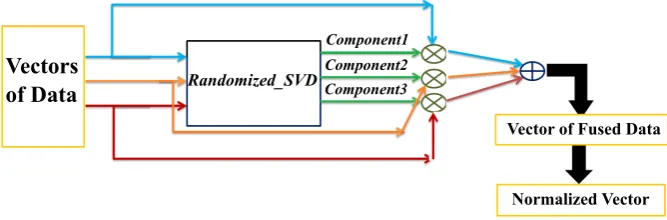
A flow diagram of the above data fusion process is depicted in Figure 2. The variables of NDN routeriare denoted by:X1[i],X2[i],X3[i], and the components of
first eigenvector are:Component1,Component2and Component3, as observed in Equation (11):
Component1 + Component2 + Component3 = 1 (11) Then, the fused data for the content router i is obtained by Equation (12):
Xf used[i] =
n
X1[i]Component1+
X2[i]Component2+
X3[i]Component3o
(12)
Using this value, the percentage of a cache or the probability is calculated. By that probability, a cache is allowed to store data chunks.
Vectors
of Data
Randomized_SVDComponent1
Component2 Component3
Vector of Fused Data
Normalized Vector
Figure 2. The Data Fusion Diagram of Proposed Method.
Algorithm 2Proposed Cache Size Allocation Algorithm
ProposedCachingStrategy (Topology of NDN Network)
1: Calculating betweenness-centrality of every node offline, 2: forevery NDN routerdo
3: Counting the number of PIs in PIT and the number of Unique HIs in current CS, 4: end for
5: Estimating the LWMA of counters in previous steps,
6: Apply the data-fusion Randomized-SVD algorithm on vectors of: (Betweenness, LWMA of PIs, LWMA of UniqHIs),
7: Using the components to calculate the fused data for every router,
8: After normalizing the fused-data vector, the importance of the NDN router is presented, 9: Computing the normalized caching probability, based on the NDN router’s importance.
By neglecting the additional cost of online runtime, the most complex parts of this algorithm are steps 1 and 3. The algorithm for Betweenness-centrality met-ric of every router runs inO(N M) time on unweighted networks [24], whereM is the number of links andN
is the number of routers in the NDN network. After gathering the information from step 2, the load of pro-cessing them in step 3 is aboutO(N ts), whereN is
the number of NDN core routers andtsis the number
of samples of PIs and Unique HIs. In step 4, by hav-ing just three features from an NDN router, it takes
O(kN) to compute the components.kis the number of feature. Other steps also takesO(N) to calculate the weights as an importance for every NDN cache. Therefore, the total time complexity of Algorithm 2 isO(N M+N ts+kN), which is a polynomial time
complexity. In other words, the complexity of this al-gorithm is dependent on network topology and the number of samples from all the NDN routers’ short-term metrics.
5
Evaluations
NDN, amongst ICN architectures, is a more complete promising Future Internet architecture, including a software development tool (CCNx [12]), and simula-tion softwares like ndnSIM [27] and ccnSim [28]. In addition, a new ICN simulator, Icarus [29], has been developed. Icarus offers researchers to evaluate their studies under other ICN architectures [30]. However,
to cope with our future needs, our focus is on an NDN based simulator that can be extended to other TCP/IP protocols beside the proposed method. As such, we evaluate our proposed method using the open source NS-3 [31] based simulator, ndnSIM-v2.1 released by the Internet Research Lab of UCLA.
P(Producer) C(Consumer) R(NDN Router)
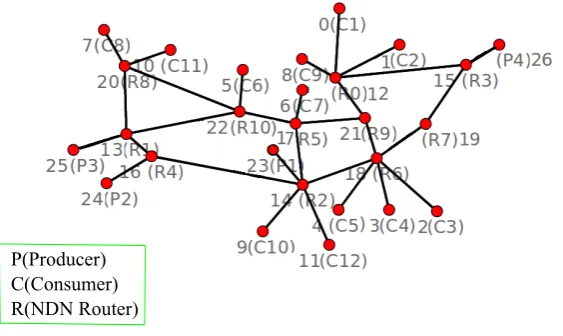
Figure 3. Topology of the Simulated Scenario With Abilene Core Routers.
As NDN attributes are inspired by the content-delivery and P2P networks, the Mandelbrot-Zipf dis-tribution is known to model the consumer behaviors:
p(i) =
1 (i+q)s P|F|
j=1 1 (j+q)s
, i∈[1,|F|] (13)
where p(i) is the probability of retrieving the ith content from the |F| contents in the network. The
q and s parameters are fixed for an ISP. s is the Mzipf shaping in the range of [0, 5].qis the plateau factor, controlling the plateau shape (flattened head) near the lowest ranked contents. Ifq= 0, then Mzipf degenerates into a Zipf distribution [37].
By applying this popularity distribution of files, it is observed that from 106 numbers of files in the catalog such as a large YouTube-like catalog, with
q = 5.0 and s = 0.5, 811270 files, which is above 90% of user Interests, are forwarded towards their consumers [38]. If shaping factor,s, is increased to 2.0, then the number of most popular files in the catalog is decreased to just six files.
The experiments are repeated ten times, and all of them are implemented in 300 seconds of simulation time. A consumer node issues 20 requests per sec-ond. The evaluations are conducted in two different cases: enabled-cache consumers and disabled-cache consumers; in the former case, simulations are per-formed with the assumption of activated caches in con-sumers, and in the latter one, the caches of consumers are deactivated to examine the situation of having under pressure NDN routers. Each case consists of three types of simulation scenarios with three vari-ous requested content sizes: 1MB, 10MB, and 100MB. These various scenarios are selected in order to take a general decision based on the proposed probability caching strategy. In the first and second scenarios,
ev-ery consumer is running a single application produced by just one producer with the content size of 1MB and 10MB respectively; however, in the third scenario, the consumer is interested in each of the producers’ 100MB-size contents.
In the first phase of Algorithm 2, the offline be-tweenness, online term HIs and online short-term PIs parameters are collected from NDN routers. Afterward LWMA of short-term parameters is cal-culated as accounted for in Section 2. Considering the numerical values of caching probabilities in Ta-bles 3 and 4, related to enabled and disabled-cache cases respectively, the first scenario is carried out to compare the performance of the proposed method ver-sus traditional betweenness probabilistic scheme [22]. As previously mentioned, ubiquitous caching strategy stores data chunks all over the path; however, it leads to a low network delay and is not an efficient use of router’s cache [33]. Since the proposed method selects the router due to the combination of the long-term and short-term metrics, the probabilistic scheme is selected for comparisons in terms of average hit ratio of CS, the number of unique cache hits, and the round trip time of Interest-Data delay.
Table 2 represented the betweenness-centrality of NDN routers of Figure 3. Firstly, in order to make decisions for probabilities, betweenness values are normalized. Secondly, probability 0.5 is considered for a node if the numerical value of the allocated caching probability is lower than 0.5, otherwise, probability 1.0 is selected.
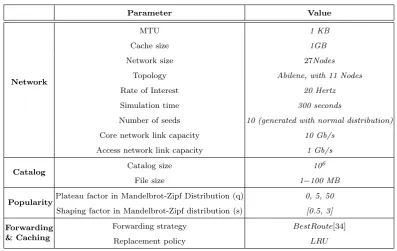
Table 1. System Parameters Used in the Experiments
Parameter Value
Network
MTU 1 KB
Cache size 1GB
Network size 27Nodes
Topology Abilene, with 11 Nodes
Rate of Interest 20 Hertz
Simulation time 300 seconds
Number of seeds 10 (generated with normal distribution)
Core network link capacity 10 Gb/s
Access network link capacity 1 Gb/s
Catalog Catalog size 10
6
File size 1−100 MB
PopularityPlateau factor in Mandelbrot-Zipf Distribution (q) 0, 5, 50 Shaping factor in Mandelbrot-Zipf distribution (s) [0.5, 3]
Forwarding & Caching
Forwarding strategy BestRoute[34]
Replacement policy LRU
Table 2. Betweenness Probabilistic Scheme for the Simulated Scenario.
Router ID
Parameter
Betweenness Centrality Caching Probabilities Final Caching Probabilities
NDN-Router 0 0.11 0.7 1
NDN-Router 1 0.05 0.2 0.5
NDN-Router 2 0.15 1 1
NDN-Router 3 0.04 0.2 0.5
NDN-Router 4 0.07 0.3 0.5
NDN-Router 5 0.14 0.9 1
NDN-Router 6 0.14 0.9 1
NDN-Router 7 0.03 0.2 0.5
NDN-Router 8 0.06 0.2 0.5
NDN-Router 9 0.13 0.8 1
NDN-Router 10 0.10 0.6 1
5.1 Enabled-Cache Consumer Case
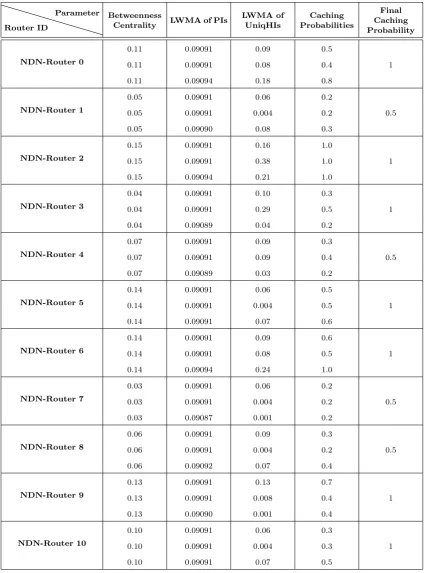
In enabled-cache consumer case, the normalized met-rics, and caching probabilities of the scenarios for the enabled-cache consumer case, computed by Algo-rithm 2, are shown in Table 3. In this table, there are three rows related to each NDN router showing the nu-merical values of the first, second and third scenarios respectively.
As remarked in Table 3, “LWMA of PIs” and “LWMA of Unique HIs” metrics gathered by the NDN-Router IDs 0, 2, 5, 6, 9 and 10 are as large as their betweenness values. It means that as these NDN
routers receive a large number of unique requests, they consequently collect a large number of incoming data chunks in their caches, by which more future Interests will be satisfied. Therefore, probability 1.0 is selected for these nodes. In NDN-Router ID 3, the numerous unique hits also ascribe a high probability of caching to this node. To maintain fairness, a probability equals to 0.5 is allocated to NDN-Router IDs 1, 4, 7, and 8, even though the output of several scenarios associated with these nodes display low numerical values.
Table 3. Normalized Parameters Gathered From the NDN Routers for the Enabled-Cache Consumer Scenarios.
Router ID
Parameter Betweenness
Centrality LWMA of PIs
LWMA of UniqHIs
Caching Probabilities
Final Caching Probability
NDN-Router 0
0.11 0.09091 0.09 0.5
0.11 0.09091 0.08 0.4 1
0.11 0.09094 0.18 0.8
NDN-Router 1
0.05 0.09091 0.06 0.2
0.05 0.09091 0.004 0.2 0.5
0.05 0.09090 0.08 0.3
NDN-Router 2
0.15 0.09091 0.16 1.0
0.15 0.09091 0.38 1.0 1
0.15 0.09094 0.21 1.0
NDN-Router 3
0.04 0.09091 0.10 0.3
0.04 0.09091 0.29 0.5 1
0.04 0.09089 0.04 0.2
NDN-Router 4
0.07 0.09091 0.09 0.3
0.07 0.09091 0.09 0.4 0.5
0.07 0.09089 0.03 0.2
NDN-Router 5
0.14 0.09091 0.06 0.5
0.14 0.09091 0.004 0.5 1
0.14 0.09091 0.07 0.6
NDN-Router 6
0.14 0.09091 0.09 0.6
0.14 0.09091 0.08 0.5 1
0.14 0.09094 0.24 1.0
NDN-Router 7
0.03 0.09091 0.06 0.2
0.03 0.09091 0.004 0.2 0.5
0.03 0.09087 0.001 0.2
NDN-Router 8
0.06 0.09091 0.09 0.3
0.06 0.09091 0.004 0.2 0.5
0.06 0.09092 0.07 0.4
NDN-Router 9
0.13 0.09091 0.13 0.7
0.13 0.09091 0.008 0.4 1
0.13 0.09090 0.001 0.4
NDN-Router 10
0.10 0.09091 0.06 0.3
0.10 0.09091 0.004 0.3 1
0.10 0.09091 0.07 0.5
applications, consumers are considered to be interested in all of the 100MB-size applications produced by the four producers. To simulate such a scenario, the shaping Zipf-Mandelbrot parameter is increased to
s= 3 (i.e., just a few files hold a higher popularity).
a value between [0,1] is derived. Scikit-learn, an open source library for Python, was exploited for this pur-pose [39]. Thereafter, probability 0.5 is considered for the product if the numerical value of that scenario is lower than 0.5, otherwise, probability 1.0 is selected. Then the three rounded values of an NDN router are combined to determine the final caching probability and a logical OR operation is performed to combine the scenarios (last column of Table 3). The caching probability of 1.0 (caching everything) is allocated to an NDN router if any of these three rounded values are 1.0. In this way, by reducing the probability of the data-chunk caching placement in the regular nodes to 50%, the results of Table 3 are obtained. In other words, the nodes are clustered into two groups: impor-tant and regular groups. The imporimpor-tant nodes have to cache every data chunk; however, the regular nodes just cache the received data chunks randomly with 50% probability.
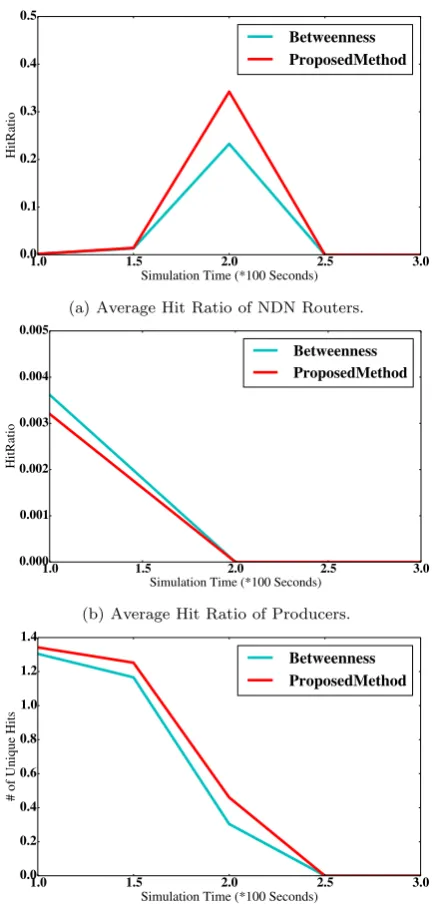
The performance comparisons between the pro-posed and betweenness methods are represented in Figure 4. Figure 4a exhibits that the proposed scheme outperforms betweenness scheme in terms of the NDN router’s hit ratio. As observed, by assigning a prob-abilistic storage strategy to every CS, based on the proposed scheme, the average routers’ hit ratio is increased to about 40%. It is consequently compre-hended that, just by increasing the caching probability of NDN-Router ID 3 to one, the number of in-network satisfied requests of the proposed method is increased. Actually, by measuring the LWMA of PIs and Unique HIs, the proposed method can reveal the importance of NDN-Router ID 3 compared to the betweenness measurements. As a desired effect, the numbers of hit events are enhanced about 90% compared with the betweenness method. As a miss occurrence in NDN router’s content store is normally due to the data not being stored in the cache, the unsatisfied request is forwarded to an upstream NDN router.
Therefore, at last one producer, in response to this unsatisfied Interest message, generates its requested content by the means of its CS module. As depicted in Figure 4b, the average hit ratio of producers’ con-tent stores in our scheme is 11.5% lower than the be-tweenness scheme. Accordingly, the management of in-network caching facilities in the proposed method helps to reduce the number of references to the pro-ducers’ content stores, in turn resulting in decreasing producers’ loads.
As portrayed in Figures 4a and 4b, until the middle of simulation runtime, whilst the NDN router’s hit rate is ascending, the producer’s hit ratio descends. Hence, the average hit rate of producers has a reverse relation with the average hit rate of NDN routers.
1.0 1.5 2.0 2.5 3.0
Simulation Time (*100 Seconds)
0.0 0.1 0.2 0.3 0.4 0.5
HitRatio
Betweenness
ProposedMethod
(a) Average Hit Ratio of NDN Routers.
1.0 1.5Simulation Time (*100 Seconds)2.0 2.5 3.0 0.000
0.001 0.002 0.003 0.004 0.005
HitRatio
Betweenness
ProposedMethod
(b) Average Hit Ratio of Producers.
1.0 1.5Simulation Time (*100 Seconds)2.0 2.5 3.0 0.0
0.2 0.4 0.6 0.8 1.0 1.2 1.4
# of Unique Hits
Betweenness
ProposedMethod
(c) Average Number of Unique hit Interests in NDN Routers.
Figure 4. Betweenness and Proposed Methods With Content Size=1MB by Enabling Caches in Consumers.
To measure the importance of the NDN routers, one of the selected metrics is the number of unique hit Interests. In Figure 4c, the proposed method improves the average number of unique hit Interests compared to the betweenness-based strategy, since the proposed caching strategy obliged NDN-Router ID 3 to exploit its cache to store the passing data chunks.
5.2 Disabled-cache Consumer case
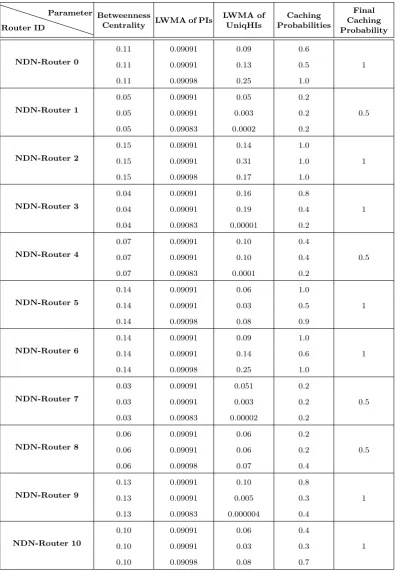
In the next simulations, it is shown that even by dis-abling the consumer’s cache, the supremacy of the pro-posed NDN layer’s caching scheme is still preserved. Therefore, in another set of simulations, we disabled the consumer’s content store in order to lessen the cost of consumer-side devices and examine if it is prob-able to utilize the routers’ caches in a more efficient manner. The scenarios are similar to the three ones running in the enabled-cache case, except that the consumer’s caches are deactivated. The normalized metrics and caching probabilities of these scenarios, computed by Algorithm 2, are shown in Table 4. Sim-ilar to the previous case, NDN-Router IDs 0, 2, 3 and 6 accommodate more unique data chunks in their CSs compared to other routers. Therefore, the allocated caching probabilities and the hit rates are correspond-ingly higher.
As it was expected, in this case similar to the enabled-cache case, the number of PIs in PIT tables has not been changed for 1MB and 10MB content-size scenarios. It shows that as the content-size is increased to 100 MB, the number of Interest messages for the data chunks is also increased.
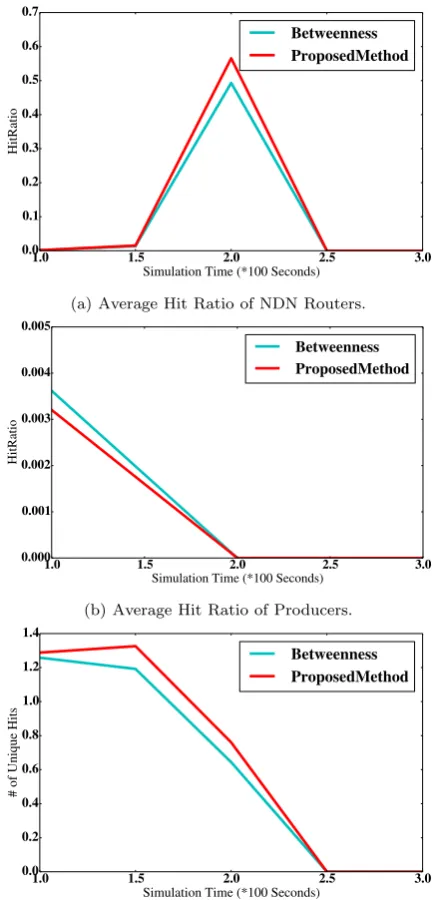
To compare the performance of the proposed method with the betweenness scheme, the first 1MB-content-size disabled-cache consumer’s scenario, by considering the numerical values of the caching prob-abilities in Tables 2 and 4, is simulated again. Since the consumer’s cache is disabled, the routers’ caches try to compensate the loss of the disabled caches. It is observed that in the disabled-cache scenario, the hit rate of NDN layer is increased. As illustrated in Figure 5a and Figure 5c, the caches in NDN routers are satisfying the requests whose data chunks do not exist in consumers’ caches. Furthermore, there is no need in referring to producer’s CS.
Figure 5a summarizes that the proposed method achieves better overall hit ratio in NDN routers’ caches compared to the betweenness scheme. In contrary to the enabled-cache scenario, the performance of the proposed scheme is nearly 15% more than the betweenness scheme.
As Figure 5b demonstrates, comparing to the be-tweenness method, the proposed scheme decreases pro-ducers’ hit ratio by approximately 11.5%. The main reason is that the high hit rate of an NDN router’s cache reduces the reference rate to the corresponding producer’s cache;i.e., higher hit rate in one leads to lower hit rate in another. Compared with Figure 4b, the hit rates of producers’ caches are approximately similar to the hit rates in enabled-cache case, show-ing that the NDN routers’ caches do not compel the
1.0 1.5 2.0 2.5 3.0
Simulation Time (*100 Seconds)
0.0 0.1 0.2 0.3 0.4 0.5 0.6 0.7
HitRatio
Betweenness
ProposedMethod
(a) Average Hit Ratio of NDN Routers.
1.0 1.5Simulation Time (*100 Seconds)2.0 2.5 3.0 0.000
0.001 0.002 0.003 0.004 0.005
HitRatio
Betweenness
ProposedMethod
(b) Average Hit Ratio of Producers.
1.0 1.5Simulation Time (*100 Seconds)2.0 2.5 3.0 0.0
0.2 0.4 0.6 0.8 1.0 1.2 1.4
# of Unique Hits
Betweenness
ProposedMethod
(c) Average Number of Unique hit Interests in NDN Routers.
Figure 5. Betweenness and Proposed Methods with Content Size=1MB by disabling Caches in Consumers.
producers to satisfy the Interests.
Table 4. Normalized Parameters Gathered From the NDN Routers for the Disabled-Cache Consumer Scenarios.
Router ID
Parameter Betweenness
Centrality LWMA of PIs
LWMA of UniqHIs
Caching Probabilities
Final Caching Probability
NDN-Router 0
0.11 0.09091 0.09 0.6
0.11 0.09091 0.13 0.5 1
0.11 0.09098 0.25 1.0
NDN-Router 1
0.05 0.09091 0.05 0.2
0.05 0.09091 0.003 0.2 0.5
0.05 0.09083 0.0002 0.2
NDN-Router 2
0.15 0.09091 0.14 1.0
0.15 0.09091 0.31 1.0 1
0.15 0.09098 0.17 1.0
NDN-Router 3
0.04 0.09091 0.16 0.8
0.04 0.09091 0.19 0.4 1
0.04 0.09083 0.00001 0.2
NDN-Router 4
0.07 0.09091 0.10 0.4
0.07 0.09091 0.10 0.4 0.5
0.07 0.09083 0.0001 0.2
NDN-Router 5
0.14 0.09091 0.06 1.0
0.14 0.09091 0.03 0.5 1
0.14 0.09098 0.08 0.9
NDN-Router 6
0.14 0.09091 0.09 1.0
0.14 0.09091 0.14 0.6 1
0.14 0.09098 0.25 1.0
NDN-Router 7
0.03 0.09091 0.051 0.2
0.03 0.09091 0.003 0.2 0.5
0.03 0.09083 0.00002 0.2
NDN-Router 8
0.06 0.09091 0.06 0.2
0.06 0.09091 0.06 0.2 0.5
0.06 0.09098 0.07 0.4
NDN-Router 9
0.13 0.09091 0.10 0.8
0.13 0.09091 0.005 0.3 1
0.13 0.09083 0.000004 0.4
NDN-Router 10
0.10 0.09091 0.06 0.4
0.10 0.09091 0.03 0.3 1
0.10 0.09098 0.08 0.7
method, enhances the reference rate to NDN routers’ caches.
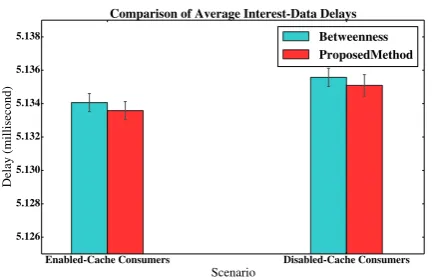
Figure 6 illustrates the RTT of the transmitted In-terest and its delivered Data. The average delay of the proposed scheme, in both cases of disabled- and
Enabled-Cache Consumers Disabled-Cache Consumers Scenario
5.126 5.128 5.130 5.132 5.134 5.136 5.138
Delay (millisecond)
Comparison of Average Interest-Data Delays Betweenness ProposedMethod
Figure 6. Average Round-Trip Time of Interest-Data Delay in Betweenness and Proposed Methods With Content Size=1MB by Enabling and Disabling Caches in Consumers.
ultimately proved worthwhile. In addition, it is illus-trated that, in the enabled-cache scenario, by employ-ing the caches in consumers, the RTT is less than the disabled-cache scenario. Therefore, by enabling con-sumers’ caches, the request-satisfaction time can be improved.
6
Conclusion
The router’s caching is one of the critical issues in NDN performance. In this article, the possibility of less in-network caching, by means of a new probabilistic caching strategy, is investigated. To assign a caching probability to each router in this network, a method is proposed based on both a long-term static metric (betweenness-centrality) and two short-term dynamic metrics (the number of Pending Interests and the number of unique satisfied/hit Interests) for an NDN router. After the short-term parameters are smoothed out by using LWMA, a data fusion technique based on Randomized-SVD is applied to extract the principal features of collected data set. Using these features, the caching probability of each router is obtained. Two typical scenarios based on Abilene core topology are implemented in NS-3 simulator to evaluate the performance of the proposed method.
The evaluation results could reveal that the pro-posed method does not just increase the average hit ratio of NDN routers, but it has also the advantage of exploiting information of graph-based centrality metric without considerable computation in nodes and message-passing between them. As assessed, in-network NDN routers have compensated the disabled caches of consumers. In addition, the caches of the overall NDN layer, in the enabled-cache consumer’s case, perform better than betweenness scheme by find-ing the important routers to store data chunks.
Furthermore, it is observed that by allocating a proper probability for storing the data chunks and
re-ducing the unnecessary caching in NDN routers, it is possible to decrease the energy consumption while pre-serving a relatively good performance. Future efforts for extending this study involve applying mobility in NDN for real-time applications.
Acknowledgements
The first author would like to thank Dr. Neda Moghim, for the insightful comments and discussion in her defense meeting at the University of Isfahan.
References
[1] Cisco Visual Networking Index: Global Mobile Data Traffic Forecast Update 2016-2021. Techni-cal report, Cisco Systems, Inc., Feb. 2017. [2] Pekka J¨appinen, Renata Guarneri, and
Luis M. Correia. An applications per-spective into the Future Internet. Jour-nal of Network and Computer Applications, 36(1):249 – 254, 2013. ISSN 1084-8045. doi:https://doi.org/10.1016/j.jnca.2012.08.009. [3] Van Jacobson, Diana K. Smetters, James D.
Thornton, Michael F. Plass, Nicholas H. Briggs, and Rebecca L. Braynard. Networking Named Content. InProceedings of the 5th International Conference on Emerging Networking Experiments and Technologies, CoNEXT ’09, pages 1–12, New York, NY, USA, 2009. ACM. ISBN 978-1-60558-636-6. doi:10.1145/1658939.1658941.
[4] Lixia Zhang, Alexander Afanasyev, Jeffrey Burke, Van Jacobson, kc claffy, Patrick Crowley, Chris-tos Papadopoulos, Lan Wang, and Beichuan Zhang. Named Data Networking. SIGCOMM Comput. Commun. Rev., 44(3):66–73, July 2014. ISSN 0146-4833. doi:10.1145/2656877.2656887. URL http://doi.acm.org/10.1145/2656877. 2656887.
[5] D. Rossi and G. Rossini. On sizing CCN content stores by exploiting topological infor-mation. In 2012 Proceedings IEEE INFO-COM Workshops, pages 280–285, March 2012. doi:10.1109/INFCOMW.2012.6193506.
ISSN 1869-1919. doi:10.1007/s11432-016-0501-5. [8] Amin Karami. ACCPndn: Adaptive Conges-tion Control Protocol in Named Data Network-ing by learnNetwork-ing capacities usNetwork-ing optimized Time-Lagged Feedforward Neural Network. Jour-nal of Network and Computer Applications, 56 (Supplement C):1 – 18, 2015. ISSN 1084-8045. doi:https://doi.org/10.1016/j.jnca.2015.05.017. [9] Andrea Passarella. A survey on content-centric
technologies for the current Internet: CDN and P2P solutions. Computer Communica-tions, 35(1):1 – 32, 2012. ISSN 0140-3664. doi:https://doi.org/10.1016/j.comcom.2011.10.005. [10] Ibrahim Abdullahi, Suki Arif, and Suhaidi
Hassan. Survey on caching approaches in Information Centric Networking. Journal of Network and Computer Applications, 56 (Supplement C):48 – 59, 2015. ISSN 1084-8045. doi:https://doi.org/10.1016/j.jnca.2015.06.011. [11] G. Xylomenos, C. N. Ververidis, V. A. Siris,
N. Fotiou, C. Tsilopoulos, X. Vasilakos, K. V. Katsaros, and G. C. Polyzos. A Survey of Information-Centric Networking Research.
IEEE Communications Surveys Tutorials, 16 (2):1024–1049, Second 2014. ISSN 1553-877X.
doi:10.1109/SURV.2013.070813.00063.
[12] PARC’s open-source implementation of content-centric networking, CCNx.http://blogs.parc. com/ccnx/. Accessed: November 2017.
[13] Named Data Networking (NDN) A Future In-ternet Architecture. http://named-data.net/. Accessed: November 2017.
[14] Michael Laszlo and Sumitra Mukherjee. A genetic algorithm that exchanges neighboring centers for k-means clustering. Pattern Recognition Let-ters, 28(16):2359 – 2366, 2007. ISSN 0167-8655. doi:https://doi.org/10.1016/j.patrec.2007.08.006. [15] Christopher D. Manning, Prabhakar Raghavan, and Hinrich Sch¨utze. Matrix decompositions & latent semantic indexing in Introduction to Infor-mation Retrieval, pages 220–235. Cambridge Uni-versity Press, New York, NY, USA, 2008. ISBN 0521865719, 9780521865715.
[16] N. Halko, P. G. Martinsson, and J. A. Tropp. Finding Structure with Randomness: Probabilis-tic Algorithms for Constructing Approximate Matrix Decompositions. SIAM Review, 53(2): 217–288, 2011. doi:10.1137/090771806.
[17] Herv´e Abdi and Lynne J. Williams. Principal component analysis. Wiley Interdisciplinary Re-views: Computational Statistics, 2(4):433–459, 2010. ISSN 1939-0068. doi:10.1002/wics.101. [18] Huamin Li, George C. Linderman, Arthur Szlam,
Kelly P. Stanton, Yuval Kluger, and Mark Tygert. Algorithm 971: An implementation of a random-ized algorithm for principal component analysis.
ACM Trans. Math. Softw., 43(3):28:1–28:14, Jan-uary 2017. ISSN 0098-3500. doi:10.1145/3004053. URLhttp://doi.acm.org/10.1145/3004053. [19] W. Kaili, W. Muqing, Z. Min, and C. Yanqing.
An autonomous system collaboration caching strategy based on content popularity in CCN. In 2016 IEEE 27th Annual International Sym-posium on Personal, Indoor, and Mobile Radio Communications (PIMRC), pages 1–6, Sept 2016. doi:10.1109/PIMRC.2016.7794940.
[20] Ioannis Psaras, Wei Koong Chai, and George Pavlou. Probabilistic In-network Caching for Information-centric Networks. In Pro-ceedings of the Second Edition of the ICN Workshop on Information-centric Network-ing, ICN ’12, pages 55–60, New York, NY, USA, 2012. ACM. ISBN 978-1-4503-1479-4. doi:10.1145/2342488.2342501.
[21] S. Tarnoi, K. Suksomboon, W. Kumwilaisak, and Y. Ji. Performance of probabilistic caching and cache replacement policies for Content-Centric Networks. In39th Annual IEEE Conference on Local Computer Networks, pages 99–106, Sept 2014. doi:10.1109/LCN.2014.6925761.
[22] Wei Koong Chai, Diliang He, Ioannis Psaras, and George Pavlou. Cache less for more in information-centric networks (extended version). Computer Communications, 36 (7):758 – 770, 2013. ISSN 0140-3664. doi:https://doi.org/10.1016/j.comcom.2013.01.007. [23] A. Araldo, D. Rossi, and F. Martignon.
Cost-Aware Caching: Caching More (Costly Items) for Less (ISPs Operational Expenditures). IEEE Transactions on Parallel and Distributed Systems,
27(5):1316–1330, May 2016. ISSN 1045-9219. doi:10.1109/TPDS.2015.2433296.
[24] Ulrik Brandes. On variants of shortest-path betweenness centrality and their generic computation. Social Networks, 30(2):136 – 145, 2008. ISSN 0378-8733. doi:https://doi.org/10.1016/j.socnet.2007.11.001. [25] R. Winter, J. H. Schiller, N. Nikaein, and C. Bon-net. CrossTalk: cross-layer decision support based on global knowledge. IEEE Communications Magazine, 44(1):93–99, Jan 2006. ISSN 0163-6804. doi:10.1109/MCOM.2006.1580938. [26] Y. Zhong, Y. Fan, K. Huang, W. Tan, and
J. Zhang. Time-Aware Service Recommendation for Mashup Creation. IEEE Transactions on Ser-vices Computing, 8(3):356–368, May 2015. ISSN 1939-1374. doi:10.1109/TSC.2014.2381496. [27] ndnSIM 2.0: A new version of the NDN simulator
[28] R. Chiocchetti, D. Rossi, and G. Rossini. cc-nSim: An highly scalable CCN simulator. In
2013 IEEE International Conference on Com-munications (ICC), pages 2309–2314, June 2013. doi:10.1109/ICC.2013.6654874.
[29] Lorenzo Saino, Ioannis Psaras, and George Pavlou. Icarus: A Caching Simulator for In-formation Centric Networking (ICN). In Pro-ceedings of the 7th International ICST Confer-ence on Simulation Tools and Techniques, SIMU-Tools ’14, pages 66–75, ICST, Brussels, Belgium, Belgium, 2014. ICST (Institute for Computer Sciences, Social-Informatics and Telecommuni-cations Engineering). ISBN 978-1-63190-007-5. doi:10.4108/icst.simutools.2014.254630.
[30] B. Ahlgren, C. Dannewitz, C. Imbrenda, D. Kutscher, and B. Ohlman. A survey of information-centric networking.IEEE Communi-cations Magazine, 50(7):26–36, July 2012. ISSN 0163-6804. doi:10.1109/MCOM.2012.6231276. [31] The Network Simulator-3 (ns-3). http://www.
nsnam.org/. Accessed: November 2017.
[32] Internet2 at Stanford. https://itservices. stanford.edu/service/network/internet2. Accessed: November 2017.
[33] Behrouz Shahgholi Ghahfarokhi, Neda Moghim, and Shayan Eftekhari. Reducing channel zapping time in live TV broadcasting over content centric networks. Multimedia Tools and Applications, 76(22):23239–23271, Nov 2017. ISSN 1573-7721. doi:10.1007/s11042-016-4037-3.
[34] Cheng Yi, Alexander Afanasyev, Ilya Moi-seenko, Lan Wang, Beichuan Zhang, and Lixia Zhang. A case for stateful forward-ing plane. Computer Communications, 36(7):779 – 791, 2013. ISSN 0140-3664. doi:https://doi.org/10.1016/j.comcom.2013.01.005. [35] Ioannis Psaras, Richard G. Clegg, Raul Landa,
Wei Koong Chai, and George Pavlou. Mod-elling and Evaluation of CCN-Caching Trees, pages 78–91. Springer Berlin Heidelberg, Berlin, Heidelberg, 2011. ISBN 978-3-642-20757-0. doi:10.1007/978-3-642-20757-0 7.
[36] O. Saleh and M. Hefeeda. Modeling and Caching of Peer-to-Peer Traffic. In Proceed-ings of the 2006 IEEE International Conference on Network Protocols, pages 249–258, Nov 2006. doi:10.1109/ICNP.2006.320218.
[37] Dario Rossi and Giuseppe Rossini. Caching performance of content centric networks un-der multi-path routing (and more). Technical report, Telecom ParisTech, 2011. https: //perso.telecom-paristech.fr/~drossi/ paper/rossi11ccn-techrep1.pdf.
[38] Michele Tortelli, Luigi Alfredo Grieco, and Gen-naro Boggia. Performance assessment of routing
strategies in Named Data Networking. In Pro-ceedings of GTTI 2013 Session on Telecommuni-cation Network, 2013.
[39] Fabian Pedregosa, Ga¨el Varoquaux, Alexandre Gramfort, Vincent Michel, Bertrand Thirion, Olivier Grisel, Mathieu Blondel, Peter Pretten-hofer, Ron Weiss, Vincent Dubourg, et al. Scikit-learn: Machine learning in Python. Journal of Machine Learning Research, 12(Oct):2825–2830, 2011.
Narges Mehranreceived her B.Sc. degree in Computer Hardware Engineering (2012), and her M.Sc. in Computer Architecture (2016) from University of Isfahan, Isfahan, Iran. The title of her M.Sc. dissertation was “A Non-uniform Cache Size Allocation Scheme for Routers in Named Data Networks”. Her cur-rent research interests include Future Internet Architectures with an emphasis on Caching, Underwater Networking, and Cryptographic Protocols on the Internet.
![Figure 1. Interest and Data Processing in an NDN Router [3].](https://thumb-us.123doks.com/thumbv2/123dok_us/38479.2004369/2.595.64.281.82.221/figure-data-processing-ndn-router.webp)