Economic evaluation of hatchery solid litter processing as poultry feedstuff
supplement in Iran
S. Mashayekhi
1*and A. Salahi
21Research Center of Agriculture and Natural Resources of Tehran Province, Tehran, Iran. 2Morghdaran Tehran Company (MTC), Tehran, Iran.
*Corresponding author, E-mail address: [email protected]
Abstract The purpose of this study was to evaluate the profitability of hatchery litter recycling into poultry feedstuff supplement. The data were collected in 2011 in 4 provinces, by direct inter-viewing of all hatcheries which used the hatchery litter drying machine. Net Present Value (NPV), Benefit-Cost Ratio (BCR), and Internal Rate of Return (IRR) methods were applied for this analysis. In the studied hatcheries, various methods were identified for hatchery litter handling, including mu-nicipal litter removal, drying, landfill disposal, and waste disposal well. The results indicated that only 39.1% of the hatcheries were recycling their litters; with 75% processing outside the hatchery. The average IRR of hatcheries’ litter recycling was equal to 8.2%. According to the results, 22.4% of the litter processing was fixed costs, and the remaining 77.6% consisted of variable costs. It is concluded that litter recycling activity using a litter drying machine it is not economical in the studied areas based on BCR, IRR and NPV evaluation measures.
Keywords: hatchery litter, recycling, profitability analysis, poultry diet
Received: 10 Sep. 2014, accepted: 9 May 2015, published online: 16 Jun. 2015
Introduction
The poultry industry is one of the most important agri-cultural sub-sectors in Iran. According to the Ministry of Agriculture of Iran, in 2009, there were 97 hatcheries in Iran, producing 181.5 million chicks (Ministry of Ag-riculture, 2010). On the average, 15.3 million tons of ag-ricultural waste is produced in Iran each year, which makes up more than 17.5-18% of all agricultural prod-ucts. The livestock industry produces approximately 12% of the agricultural wastes (Tutiaei and Solaimani, 2005). In developed countries, about 70% to 80% of this waste is processed, while less than 40% is processed in Iran (Tutiaei and Solaimani, 2005).
Hatchery litter disposal, an operation where most of the hatchery litter is sent to landfills or composting fa-cilities, costs the poultry industry millions of dollars each year in Australia (Glatz et al., 2011). Hatchery lit-ter recycling, a new technology, is a process in which hatchery litter is converted into useful materials. This has only been implemented within the last decade in Iran.
Hatchery litter consists of 35-37% dry matter (Al-Harthi et al., 2010). The major components of the hatch-ery solid waste include egg shells, infertile eggs, dead embryos, late hatchings and dead chickens (Glatz and
Miao,2009). InIran, the hatchery waste includes egg
shells after hatch, infertile eggs, cull and dead chicks, late hatchings and unhatched eggs (Koohi, 2013). The drying of hatchery litter using litter drying machines is currently the only method of hatchery waste recycling in Iran. In this method, the hatchery litter is pressed by passing through a roller, fed into the dryer tank where the temperature rises gradually until it reaches 150-170°C>After 4.5-5 hours, the hatchery litter is com-pletely dried, and then cooled. After grinding, the prod-uct is packed and sold to broiler/layer farms and fisher-ies.
Feed constitutes from 60% to 70% of total cost of poultry production in Iran (Mashayekhi and Hajizadeh Fallah, 2011). Therefore, an increase in the use of cheap feed resources is an important way to increase the prof-itability of the poultry industry. On this basis, processed hatchery litter can be an alternative feed ingredient.
Analysis of hatchery litter showed that it consists of 22.8% (Ilian and Salman, 1986) to 37.2% (Wisman, 1964) crude protein. Furthermore, hatchery litter is a significant source of calcium from 18% (Al-Harthi et al. 2010) to 22.6% (Ilian and Salman, 1986). Studies have shown that hatchery litter can be included into the diet at a rate of 3.6% (Zohari, 1975) to 14.1% for layers
12
5% (Wisman and Beane, 1965) for broilers. It could re-place 8-16% of soybean meal without negative effects on performance in layers (Vandepopuliere et al., 1977). From the investors’ point of view, the profitability of hatchery litter recycling is uncertain, and this can con-tribute to a lack of interest from investors. Therefore, this study was conducted for economic evaluation of hatchery litter recycling in four provinces of Iran.
Materials and methods
The study was conducted in Alborz, Tehran, Ghazvin and Mazandaran provinces. The 64 hatcheries in these provinces constitute 66% of all hatcheries in the country (Ministry of Agriculture, 2010). The questionnaire is the principal instrument for eliciting information from the target population in a benefit-cost analysis (Chandra, 2009), which is widely used for economic evaluations in the poultry, fishery, and livestock operations. A view of existing literature revealed many empirical re-searches in this industry, especially in recent years, to support the selection of the questionnaire as the research tool in present study (Adesiyan et al., 2007; Al-Sharafat and Al-Fawwaz, 2013; Kawsar et al., 2013; Olaoye and Oke, 2012; Omar, 2014; Singh et al., 2010; Vukina et al., 2014).
In this study, the data were collected through com-pletion of well-structured questionnaires by direct inter-viewing of all 25 chicken hatcheries in the studied area in 2011, in which the hatchery waste is processed using a litter drying machine. The questionnaire was pre-tested, and modified accordingly to omit the invalid questions from the questionnaire. The questionnaire consisted of a series of questions classified into three sections. The first section contained items covering so-cio-economic characteristics of respondents such as age, education, job experience, etc. The second section in-cluded the geographic, legal, and technical aspects of the studied hatcheries. The last section of the question-naire was focused on the various issues related to exist-ing costs and returns of hatchery litter recyclexist-ing for eco-nomic evaluation. The executive and scientific experts’ opinions were used for validity test of the questionnaire. Reliability refers to the accuracy and precision of a measurement instrument or scale. The coefficient alpha, developed by Cronbach (1951), is the most commonly used index for estimating the reliability of measurement instruments such as scales, multiple item tests, question-naires, or inventories (Raykov, 1997). Cronbach’s alpha coefficient is given specially by:
n
i i
n n
1 2 2
1 1
1
(1)
where, σ2 is the variance of the total scores and σ2i is the variance of the set of 0, 1 scores representing correct and incorrect answers on item i. The theoretical range of the coefficient is 0 to 1. Suggested guidelines for interpre-tation are <0.6 unacceptable, 0.6- 0.65 undesirable, 0.65- 0.70 minimally acceptable, 0.70- 0.80 respectable, 0.80- 0.90 very good, and >0.9 consider shortenings the scale by reducing the number of items (Dunn, 1989). In this study, Cronbach’s alpha coefficient was 0.85 indi-cating reliability of the questionnaire.
Benefit–cost analysis (BCA), sometimes called cost- benefit analysis (CBA), is a technique of analyzing pro-posed or previously enacted projects to determine whether their execution is in the public interest, or to choose between two or more mutually exclusive pro-jects (Zerbe and Bellas, 2006). In this study, BCA was applied for the economic evaluation of hatchery litter recycling.
In hatchery litter recycling by the drying method, costs include costs of oil, fuel, power, packing, tempo-rary staff, repair and maintenance, fire prevention, in-surance, transportation, rental value of the litter recy-cling unit, permanent staff, business insurance, depreci-ation, and miscellaneous costs. The initial costs of recy-cling hatchery litter by using litter drying machines in-clude land acquisition, construction of facilities, litter drying machine, and other equipment. On the other hand, benefits are the total value of processed waste in monetary terms, which are sold to the broiler farms as feed.
The timespan for hatchery litter recycling projects in Iran is considered 10 years and includes one year for start-up plus 9 years of economic life. The production of processed litter is assumed to be constant over the timespan. The investment realization (design, licensing, and construction) takes one year. The start-up phase will begin in the second year. At the end of the timespan, the operative life of the plants and other equipments is equal to the analysis period minus the construction time (Eu-ropean Commission, 2008). The most common indica-tors used in BCA are the Net Present Value (NPV), In-ternal Rate of Return (IRR) and Benefit-Cost Ratio (BCR) methods. It should be noted that in this study, all benefits and costs over the timespan refer to the private investors and the investment is financed by private funds. The NPV of a project is the sum of the present values of benefit minus the sum of the present values of cost (Zerbe and Bellas, 2006). It can be expressed as:
n
t
t t n
t
t
t PVB PVC
r C
r B NPV
0
0(1 ) (1 )
(2)
13 which cash flows are expected, Bt is the benefits in year
t, Ct is the costs in year t, r is the discount rate, PVB is the present value of benefits, and PVC is the present value of costs. An investment is acceptable if the NPV is positive.
A benefit-cost ratio (B/C ratio or BCR) is another important indicator in BCA. It is worked out as:
n
t
t t n
t
t t
r C
r B
BCR
0 0
) 1 (
) 1
( (3)
The definitions of Bt, Ct, n and r are the same as in ex-pression (2). If the calculated BCR in the project is greater than one, then the project can be considered worthwhile. The internal rate of return (IRR) for a cash flow is defined as the interest rate that equates the future worth at time n or present worth at time 0 of the cash flow to zero (Bediru and Omitaomu, 2007). The internal rate of return of a project is the interest rate that will generate an NPV of zero. The decision rule is that if the IRR for a project is greater than some target rate (oppor-tunity cost of capital), then the project is profitable (Zerbe and Bellas, 2006).
In this study, hatchery litter recycling was consid-ered a separate economic activity regardless of whether it is done inside or outside the hatchery. All of the costs incurred and income earned from hatchery litter recy-cling were undertaken on an annual basis. Also, all cash inflows and outflows were considered based on one kil-ogram of hatchery litter processed. Meanwhile, all costs incurred and incomes earned from hatchery litter recy-cling were converted from Iranian Rials (IRR) into USD
ata marketexchangerateof12,400IRR/USD2011 in
order to facilitate international comparison (CBI, 2011). The operating costs were further divided into fixed and variable components. Variable costs, were those which are directly associated with the level of production and sales. Fixed costs are the costs incurred irrespective of the level of operation of a project.
In this study, the fixed costs consisted of the costs of the rental value of the litter recycling unit, permanent staffs, business insurance, depreciation, and miscellane-ous costs. The rental value of land and buildings for lit-ter recycling units were considered in place of initial in-vestments for land and buildings even though they owned the litter processors. This was mainly due to the fact that the correct information about the purchase price of land and the construction costs of hatchery litter recycling units were not available.
The interest on both variable and fixed costs was considered as an important implicit cost in hatchery lit-ter recycling. An implicit cost is a cost that has occurred but it is not initially shown or reported as a separate cost. In other words, implicit costs are the costs that a busi-ness incurs without actually spending money. There-fore, in this study, the interest rate on variable and fixed costs is considered as an opportunity cost incurred by firm for using variable and fixed inputs. The interest on fixed costs was calculated by multiplying the rate of in-terest on savings deposits in government banks of Iran during the studied period (15.5% per annum) by the sum of variable costs. The interest on variable costs was cal-culated by multiplying the rate of interest on short-term deposits in government banks of Iran (7.8% per annum) by the sum of fixed costs. The straight-line and declin-ing balance methods were applied for calculation of de-
Table 1. Variable costs of hatchery’s litter processing in Iran
Item
Cost (USD/t on)
% of Total Variable Cost
% of Total Cost
Fuel Oil
Water charge Power Transportation Staff
Packing
Repair and maintenance Insurance
Cleaning and disinfecting Communication expenses Marketing expenses Miscellaneous charge Interest on variable cost Total Variable Cost
13.9 7.2 7.3 5.2 5.6 38.6
2.7 13.6 23.2 6.3 0.6 1.0 9.4 10.4 145
9.6 5.0 5.1 3.6 3.9 26.5
1.8 9.4 16.0
4.3 0.4 0.7 6.5 7.2 100
7.4 3.8 3.9 2.8 3.0 20.8
1.4 7.3 12.4
14
Table 2. Fixed costs of hatchery’s litter processing in Iran
Item Cost
(USD/ton)
% of Total Fixed Cost
% of Total Cost Rental value of hatchery
Watchman Business insurance Depreciation expenses Miscellaneous charge Interest on Fixed cost Total Fixed Cost
14.6 1.6 5.3 13.8
1.0 5.6 41.9
34.8 3.9 12.7 32.7 2.5 13.4
100
7.7 0.9 2.9 7.3 0.6 3.0 22.4
preciation of buildings and equipment, respectively. Meanwhile, land is assumed to have an unlimited useful life; therefore, land was not depreciated.
Results and Discussion
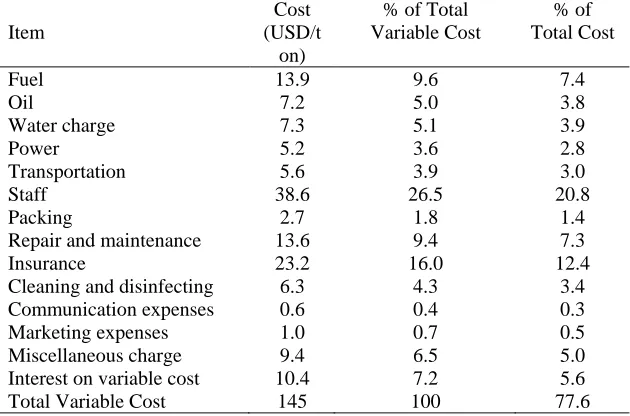
In order to evaluate the profitability of litter recycling in Iranian hatcheries, the Benefit-Cost analysis (BCA) was applied and the results are presented here. The respond-ents were hatchery managers. The characteristics of re-spondents showed that the mean, maximum, and mini-mum ages were 46, 66, and 33 years, respectively. The education status of respondents indicated that the major-ity of respondents (75%) had post-secondary education. The results also indicated that 62% of hatchery manag-ers had more than 15 years of experience in their jobs. Although most of the responders were highly educated, 52% of them had no propensity to accept a new litter recycling method. The variable cost structure of hatch-eries’ litter recycling operations is presented in Table 1. Among the variable costs, expenditure on staff (26.5%) was the most significant, followed by expenditure on in-surance (16%) and fuel (9.6%).
The staff cost forms a main portion of the total litter recycling costs. The calculated amount spent on staff was $38.6 USD per ton, accounting for more than a quarter of the total cost. High labor expenditure is due to the fact that hatchery litter processing is a labor inten-sive activity. Also, the health care of staff and the health control of hatchery litter recycling units are expensive as it requires constant disinfection. The marketing cost constitutes a low percentage of the total cost (0.5%) due to high demand for processed litter for poultry nutrition. The fixed costs of hatcheries’ litter recycling opera-tions are presented in Table 2. Tables 1 and 2 show that 77.6% of the total cost were variable costs; the rest were fixed costs. Also, the interest on variable and fixed costs accounted for 8.6% of total costs.
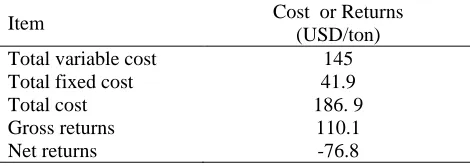
The gross returns for one ton of processed litter were $110.1 USD, which is much less than its total cost. As a result, it has led to negative net returns (Table 3).
The average Internal Rate of Return (IRR) of hatch-eries’ litter recycling was equal to 8.2% (Table 4), which
was much less than the interest rate on Savings deposits in government banks of Iran (15.5% per annum). Hence, the activity of litter recycling in hatcheries in Iran is not economically viable.
It can be concluded that this activity is not profitable taking into account all three criteria for economic eval-uation, namely BCR, NPV, and IRR. It is necessary to mention that positive and negative externalities should be accounted for cost-benefit analysis. Such externali-ties are not captured by the financial analysis, thus need to be estimated in the economic analysis (European Commission, 2008).
This study was done from the viewpoint of hatcher-ies, not the society. From the social viewpoint, hatchery litter recycling has environmental and health impacts, which were not considered in this study. It is mainly due to the lack of data and research constraints. Therefore, this study cannot conclusively assert this activity as dis-advantageous. If externalities and shadow prices were considered, hatchery litter recycling with negative fi-nancial NPV (FNPV) may show positive economic NPV (ENPV). Furthermore, the discount rate is also high in Iran, which directly influences the profitability of the investment projects.
Conclusions
The evaluation of hatchery litter recycling, like all eco-nomic activities, should be considered from technical, economic, financial, social, health, and environmental aspects. This study only attempted to highlight the eco-nomic aspects of this activity and based on this ap-praisal, hatchery litter recycling was not found to be
profitableinthestudiedprovinces.Thiswas due to the
Table 3. Total cost and returns of hatchery’s litter processing in Iran
Item Cost or Returns (USD/ton) Total variable cost 145 Total fixed cost 41.9
Total cost 186. 9
Gross returns 110.1
15 Table 4. Economic analysis of hatcheries’ litter processing in Iran
Particular Units Province Total
Average Tehran Alborz Ghazvin Mazandaran
Present value of benefits (A) USD/ton 112.2 109.7 100.1 124.2 110.1 Present value of costs (B) USD/ton 188.3 185.7 187.3 183.9 186.7 Net present value (A-B) USD/ton -76.3 -76.3 -87.3 -59.7 -75.6 Benefit cost ratio - 0.60 0.59 0.54 0.68 0.59 Internal rate of return % 8.2 8.2 7.4 8.9 8.2
high cost of labor, insurance, and fuel accounting for more than 40% of total cost. Unlike many economic ac-tivities in which profitability is the most important fac-tor, in hatchery litter recycling, health and environmen-tal considerations may be more important than eco-nomic aspects for the society.
This study showed that hatchery litter processing should be considered as a socially responsible alterna-tive to disposal methods, supported by the government to improve both human well-being and conservation of water and soil resources.
In further studies it may be proven that there are en-vironmental and health benefits resulting from the recy-cling of hatchery litter, and also utilization of this litter as a feed supplement in the poultry industry is benefi-cial. Based on the insights provided by this study, the authors suggest that the government should encourage and support this activity through sufficient financial in-centive policies.
References
Adesiyan, O.I., Adeleke, O.A., Adelalu, K.O., Salako, B.A., 2007. An analysis of cost and returns to broiler marketing in Ogbomoso north local government area of Oyo state, Ni-geria. Research Journal of Poultry Sciences 1, 26-30.
Al-Harthi, M.A., El-Deek, A.A., SalahEl-Din, M., Alabdeen, A.A, 2010. A Nutritional evaluation of hatchery by- product in the diets for laying hens. Egyptian Poultry Science 30, 339-351.
Al-Sharafat, A., Al-Fawwaz, T.M., 2013. Economic analysis of different broiler farm capacities: A case study of Jordan. International Journal of Business and Management 8, 41-47.
Bediru, A.B., Omitaomu, O.A., 2007. Computational Eco-nomic Analysis for Engineering and Industry. Taylor & Francis CRC Press, Boca Raton, Florida state, USA.
CBI, 2011. Foreign Exchange Rates data. Retrieved from Central Bank of Iran (In Persian). Available at: http:// www.cbi.ir [Accessed 6 Aug 2013].
Chandra, P., 2009. Projects Planning Analysis, Selection, Im-plementation & Review. 7th Ed., Tata McGraw-Hill
Pub-lishing Company Limited, New Delhi, India.
Cronbach, L.J., 1951. Coefficient alpha and the internal struc-ture of the tests. Psychometrika 16. 297-334.
Dufloth, J.H., Ciocca, M., De, L.S., Lebotute, E.M., 1987. Evaluation of the hatchery by-product meal as feedstuff for laying hens. Pesquisa Agropecuaria Brasileira 22, 859-866.
Dunn, G., 1989. Design and Analysis of Reliability Studies: The statistical Evaluation of Measurement Errors. Oxford University Press, USA.
European Commission, 2008. Guide to Cost- Benefit Analy-sis of Investment Projects. 5th ed., Directorate General
Re-gional Policy, Available at: http://ec.europa.eu/index [Ac-cessed 5 May 2012].
Glatz, P.C., Miao, Z., 2009. High value products from hatch-ery waste. Rural Research and Development Corporation Publication No 09/061, Australia.
Glatz, P.C., Miao, Z., Rodda, B., 2011. Handling and Treat-ment of Poultry Hatchery Waste: A Review. Sustainability 3, 216-237.
Ilian, M.A., Salman, A.J., 1986. Feeding processed hatchery wastes to poultry. Agricultural Wastes 15, 179-186.
Kawsar, M.H., Chowdhury, S.D., Raha, S.K., Hossain, M.M., 2013. An analysis of factors affecting the profitability of small-scale broiler farming in Bangladesh. World's Poultry Science Journal 69, 676-686.
Koohi, M.R., 2013. The effect of different levels of hatchery by-product on performance, carcass characteristics, tibia and some blood parameters in broilers. M.Sc. Thesis, Agri-cultural Sciences and Natural Resources University of Sari, Iran. (In Persian)
Mashayekhi, S., Hajizadeh Fallah, M., 2011. The study on the effective factors in chicken meat market in Iran: An appli-cation of vector autoregression model (In Persian). Eco-nomic Research Review 11, 131-154.
Ministry of Agriculture, 2010. Iran Agriculture Yearbook 2009 (In Persian). Department of Statistics and Information Technology, Government of Iran, Tehran.
16
Omar, M.A.E., 2014. Technical and economic efficiency for broiler farms in Egypt. Application of data Envelopment Analysis (DEA). Global Veterinaria 12, 588–593.
Raykov, T., 1997. Scale reliability, Cronbach’s coefficient al-pha, and violations of essential tau-equivalence with fixed congeneric components. Multivariate Behavioral Research 32, 329-353.
Shahriar, H.A., Adl, K.N., Doolgarisharat, J., Monirifar, H., 2008. Effects of dietary different levels of hatchery waste in broiler breeder. Journal of Animal and Veterinary Advances 7, 100-105.
Singh, V.P., Sharma, V.K., Sidhu, M.S., Kingra, H.S., 2010. Broiler production in Punjab: An economic analysis. Agri-cultural Economics Research Review 23, 315-324.
Tutiaei, A., Solaimani, A., 2005. Modification of consump-tion patterns on agricultural waste. Research Office on Ag-ricultural Structures (In Persian). Report No. 9. 981.
Vandepopuliere,J.M.,Voss,L.A.,Jones, H.B., 1977. Broiler
and egg type chick hatchery by-product meal evaluated as laying hen feedstuff. Poultry Science 56, 1140-1144.
Vukina, T., Anderson, K., Muth, M.K., 2014. Economic ef-fects of proposed changes in living conditions for laying hens under the national organic program. The Journal Ap-plied Poultry Research 23, 80-93.
Wisman, E.L., 1964. Processed hatchery by-product as an in-gredient in poultry rations. Poultry Science 43, 871-876.
Wisman, E.L., Beane, W.L., 1965. Utilization of hatchery by-product meal by the laying hen. Poultry Science 44, 1332-1333.
Zerbe, R.O., Bellas, A.S., 2006. A Primer for Benefit-Cost Analysis. Edward Elgar Publishing, Cheltenham,UK.
Zohari, M.R., 1975. The use of hatchery by-product meal in poultry diets (In Persian). Journal of Veterinary Faculty University of Tehran 31, 43-54.
Communicating editor: Mojtaba Zaghari
هجوج دماج تاعیاض یروآرف یداصتقا یبایزرا
ناونع هب یشک
ناریا رد رویط کاروخ لّمکم
س
.
یخیاشم
و
ا
.
یحلاص
:کینورتکلا تسپ ،لوئسم هدنسیون [email protected]
هدیکچ
تایزاب رووآدوس یبایزرا ،شهوژپ نیا فده هجدج تاعیاض
هآاآ .آدب ردیط کاردخ لّمکم نادنع هب یشک اه
هناخراک هّیلک زا ردضح هبحاصم قیرط زا هجدج اه
کشخ هاگتسآ اراآ هک یشک هجدج تاعیاض نک
رآ ،دنآدب یشک 4
لاس رآ ناتسا 0931
عمج شور .دش روو ( صلاخ لاح شزرا اه
NPV
هدیات بسن ،)
-( هنیزه
BCR
یهآزاب خرن و )
آ ( یلخا
IRR
هناخراک رآ .دووش هآرب راک هب لیلحت و هیزجت نیا ارب ) هجدج اه
شور ،هعلالم آردم یووشک یفلتخم اه
تاعیاض یریدم رج تاعیاض های و نیمز رآ تاعیاوض نتآ ،نآرک کوشخ ، راآرروش ه ّوسدت تاعیاوض عتآ لماوش
هجدج ارنت هک آدب نو رگنایب یاتن .دش ییاسانش یوشک 0
/ 93 ک زا دصرآ هناخرا
هجدج اه تایزاب ار آدخ تاعیاض ،یشک
،نازیم نیا زا و هآرک 57
هجدج زا زراخ رآ ، روورت زا دوووصرآ یم تردوووص یوووشک
یلخاآ یهآزاب خرن نیگنایم .آریذپ
هجدج تاعیاوض تایزاب لآاعم یوشک
2 / 8 ، یاتن ساسا رب .آدب دصرآ 4
/ 22 هنیزه هب طدبرم روورت هنیزه زا دصرآ اه
و باث 6 / 55 هنیزه هب قّلعتم ،ییبام دوصرآ هجیتن .آدب ریغتم اه
یم ریگ هآافتسا اب تاعیاوض تایزاب ّیلاعت هک آدوش زا
کووشخ هاگتووسآ یبایزرا اهرایعم ساووسا رب تاعیاووض نک
BCR
،
IRR
و
NPV
آاووصتقا ،هعلالم آردم قطانم رآ