Preventing nerve damage during total thyroidectomy or total
lobectomy surgeries
Received: 29/6/2015 Accepted: 1/11/2015
Abstract
* Department of Surgery, School of Medicine, SulaimaniUniversity, Sulaimani, Iraq. ** Surgical Unit, Shar Hospital, Sulaimani, Iraq.
*** Department of Community Health, Sulaimani PolytechnicUniversity, Sulaimani, Iraq.
Introduction
Thyroidectomy is an operation that involves surgical removal of all or part of the thyroid gland.1 It is among the most common operations, particularly in countries where iodine deficiency is a common condition.2-5
The preferred type of surgery in multinodular goiter has been controversial,
but today, total thyroidectomy is becoming
the main surgical option. Total thyroidectomy seems to be appropriate
when both thyroid lobes are involved and when the risk of recurrence is high.6 The essential objectives for thyroidectomy are; avoidance of injury to the recurrent laryngeal nerves, conservation of the parathyroid glands, accurate haemostasis and excellent cosmesis.7 The extent of resection, reoperation for completion,
patient volume per surgeon and the surgeon’s inexperience are risk factors for morbidity of thyroid surgery. Meticulous dissection is a key factor in minimizing the development of complications.8 The
main postoperative complications of thyroidectomy are hypoparathyroidism and recurrent laryngeal nerve injury.9 Injury to
the recurrent laryngeal nerves can result in a weakened voice (hoarseness) or loss of voice (aphonia) and cause problems in
10 The right recurrent
laryngeal nerve is more susceptible to damage during thyroid surgery because it is close to the bifurcation of the right inferior thyroid artery, variably passing in front of, behind, or between the branches.11 The nerve is permanently damaged in 0.3–3% of thyroid surgeries,
Background and objective: Thyroidectomy is an operation that involves surgical removal
of all or part of the thyroid gland. The main postoperative complications of thyroidectomy are hypoparathyroidism and recurrent laryngeal nerve injury. This study aimed to find out the main postoperative complications particularly nerve damage during total thyroidectomy or total lobectomy.
Methods: The medical records of patients who were diagnosed with thyroid disease and
underwent surgery between January 2nd, 2013 and December 30th, 2014 in Teaching,
Shar, Soma and Zhian hospitals in Sulaimaniyah were retrospectively reviewed.
Results: All patients who underwent total thyroidectomy or total lobectomy surgeries were
discharged within 24 hours of the operation. During the average follow-up of 24 months, no case of permanent recurrent laryngeal nerve injury was registered. Vocal cord paralysis was considered to be present, when there was absent or markedly reduced movement of the affected vocal cord.
Conclusions: Meticulous hemostasis and a delicate technique are required to prevent
nerve injury. We recommend dissection and division of all the vessels flush with the thyroid capsule at the anterior and peripheral aspect of the gland. Separate ligation of anterior and posterior branched of the superior thyroid artery will preserve the external branch of the superior laryngeal nerves.
Keywords: Thyroidectomy; Lobectomy; Nerve damage.
Methods
and transiently in 3–8% of surgeries, and is one of the leading causes of issues for surgeons.12 Injury to the external
branch of the superior laryngeal nerve leads to difficulty in singing and projection of the voice. The external branch of the superior laryngeal nerve lies close to the vascular pedicle of the superior poles of the thyroid lobe, which requires that the vessels be ligated with care to avoid injury to it.13 Therefore, this study
aimed to find out the main postoperative complications particularly nerve damage during total thyroidectomy or total lobec-tomy.
total thyroidectomy, unilateral (total) lobectomy, completion thyroidectomy (removal of contralateral lobe in patients
whom had previously undergone thyroid lobectomy alone), and revision
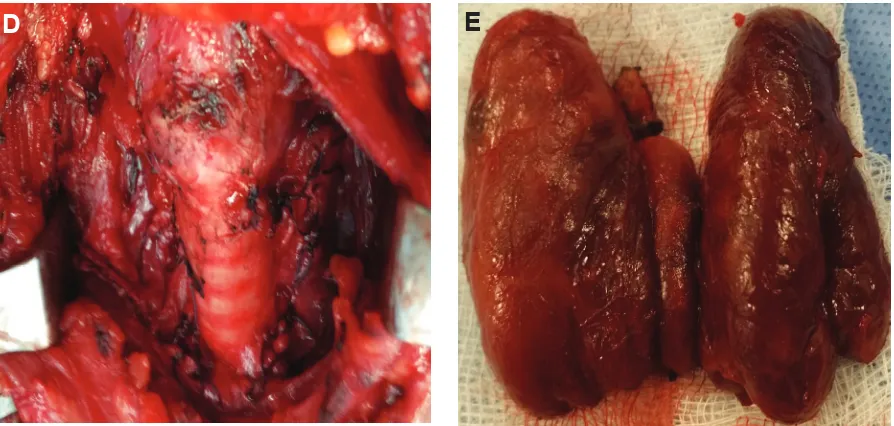
thyroidectomy (removal of remnant/ recurrent thyroid tissue in patients whom had previously undergone thyroid surgery on the ipsilateral side). All operations were performed by a senior surgeon (Figure 1 and Figure 2).
Procedure
A collar transverse incision approach to the thyroid gland was used, with extracapsular dissection. Intraoperative nerve monitoring was not employed. The branches of superior thyroid artery were ligated adjacent to the thyroid capsule. The external branch of the superior laryngeal nerve was protected by the early mobilization of the superior thyroid vessels and separation of both its anterior and posterior branches, ligatures placed for each one away from the nerve flush on the thyroid capsule of the superior pole. Regarding the inferior poles, we ligated the inferior thyroid artery and its branches near the thyroid capsule and the technique was of extracapsular dissection of the thyroid gland. Malignancy, central compartment neck dissection were also involved in our study. Patients with postoperative vocal cord paralysis were to be given appointments to repeat laryngoscopy. Any case of vocal cord paralysis persisting beyond 1 year was considered permanent. Data collection tools and methods
A structured interview questionnaire was used. The questionnaire included the following:
1: Socio-demographic data such as; age, gender, address, occupation and marital status were obtained
2: Data on the complications such voice change and neurological symptoms.
Study setting
The study was conducted at four hospitals in Sulaimaniyah city; Sulaimaniyah Teaching, Zhian, Shar and Soma hospitals. Study design
A retrospective study (review cases) was used for the implementation of the study. Target population
A single cohort of patients with thyroid diseases diagnosed within the past two years, between January 2nd, 2013 and
December 30th, 2014, were enrolled, in
order to study the results of total thyroidectomy or total lobectomy with regards to complications including nerve damage.
Study procedures
A
B
C
Figure 1: A, B and C total thyroidectomy.
Figure 2: D and E; post thyroidectomy.
Results
Main characteristics of participants
A series of 69 consecutive thyroid operations were performed on patients with a thyroid problem including thyroid malignancy with or without central neck dissection. We excluded only those who presented with voice changes due to recurrent laryngeal nerve palsy as a complication of previous thyroid surgery or invaded by the thyroid malignancy.
The study included 6 males (8.7%) and 63 females (91.3%) with a mean ± SD of age of 43.83 ± 11.42 years (range, 14 to 73 years). The distribution of patients according to demographic characteristics and return to work is given in Table 1. Post-operative complications
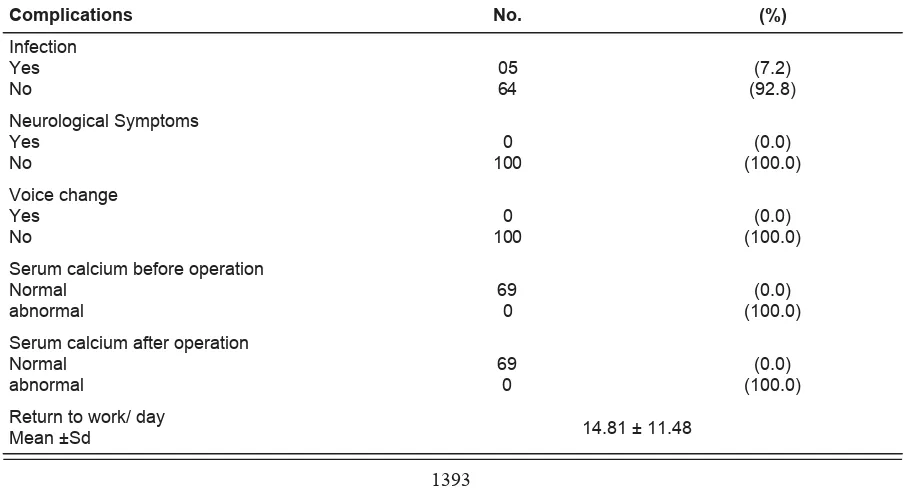
Minor complication such as infection was observed in 5 (7.2%) of the patients. The distribution of complications is shown in Table 2.
Characteristics No. (%)
Gender
Male Female
6 (8.7) 63 (91.3)
Address
Inside city
Outside city 33 (47.8) 36 (52.2)
Type of procedure
Total thyroidectomy Total lobectomy
38 (55.1) 31 (44.9)
Age
Mean ± SD (min. – max.) 43.83 ± 11.42 (14 – 73)
Duration of the disease/ months
Mean ± SD 20.45 ± 4.88
Table 1: Main characteristic of the participants.
The main characteristics of all patients, the table gives both the number and percentage of the patients, and the mean ± standard deviation of the age.
Table 2: Distribution of thyroidectomy patients according post-operative complications,
recurrence and patient’s satisfaction.
Complications No. (%)
Infection Yes
No 05 64 (92.8) (7.2)
Neurological Symptoms Yes
No
0 100
(0.0) (100.0) Voice change
Yes
No 100 0 (100.0) (0.0)
Serum calcium before operation Normal
abnormal
69 0
(0.0) (100.0) Serum calcium after operation
Normal
The patients were discharged at the same day of the operation. During the average follow-up of 24 months, no case of permanent recurrent laryngeal nerve injury was registered. Vocal cord paralysis was considered to be present when there was absent or markedly reduced movement of the affected vocal cord. The parathyroid glands were identified according to routine protocol, and the vascularity of the glands was evaluated at the end of the procedure. No glands required reimplanting. No incidence of clinical hypoparathyroidism has occurred, due to the technique of extracapsular dissection of the thyroid gland. All patients were asymptomatic and did not require calcium supplementation.
Discussion
In our study, we didn’t report single case of permanent vocal cord palsy and those of transient voice change during immediate postoperative period regained fully normal function within one year of follow up. The cause of temporary vocal cord palsy during post thyroid surgery is considered to be due to neuropraxic injury to the recurrent laryngeal nerve. This may be due to stretching, direct trauma during difficult dissection, thermal injury due to use of electrocautery, devascularization, or compressive injury due to postoperative hematoma. The RLN may also be more prone to stretching and/or direct trauma during revision surgery because of its being adherent to scar tissue.14 There is much debate in the literature regarding the role of elective central neck dissection in papillary thyroid carcinoma and whether central neck dissection with total thyroidectomy is associated with an increased risk of complications compared with total thyroi-dectomy alone. Some authors reported that central neck dissection was not associated with any increased risk of transient vocal cord palsy.14-20 The overwhelming majority
of patients with recurrent laryngeal nerve neuropraxia experience full recovery of function and resolution of symptoms within a period of months. Restitution of normal
vocal mobility has been reported to take as long as 2 years.21 Although most
designate vocal cord palsy persisting beyond 1 year as permanent.22-25 Some
cases of permanent vocal cord palsy post thyroidectomy, in which the surgeon documented that the recurrent laryngeal nerve had been preserved intra-operatively, may be due to unrecognized extralaryngeal recurrent laryngeal nerve branching and unrecognized injury to the anterior-most branch, which provides the major motor supply to the intrinsic laryngeal muscles.26 Thomusch et al.
reported 2 independent risk factors, a greater extent of resection and recurrent goiter, after investigating 7,266 benign goiter surgeries performed at 45 hospitals. The surgeon’s level of experience also affects the rate of postoperative RLN palsy after thyroid surgery.27- 29 In our study neither case of permanent recurrent neither laryngeal nor superior laryngeal nerve injuries were detected. This does not imply that peripheral ligation of the vessels is a fail-safe method, but complications can be minimized. In the best of hands and under the best of circumstances, nerve dysfunction or paralysis can occur. These risks are discussed with all patients in the informed consent, prior to the operation. Conclusions
Meticulous hemostasis and a delicate technique are required to prevent nerve injury. We recommend dissection and division of the all vessels flush with the thyroid capsule at the anterior and peripheral aspect of the gland. Separate ligation of anterior and posterior branch of superior thyroid artery will preserve external branch of superior laryngeal nerves.
Conflicts of interest
The authors report no conflicts of interest. References
2. Mishra A, Agarwal A, Agarwal G, Mishra SK. Total thyroidectomy for benign thyroid disorders in an endemic region. World J Surg 2001; 25(3):307-10. 3. Bron LP, O’Brien CJ. Total thyroidectomy for
clinically benign disease of the thyroid gland. Br J Surg 2004; 91(5):569-74.
4. Bellantone R, Celestino PL, Maurizio B, Mauro B, Carmela DC, Pierfrancesco A, et al. Total thyroidectomy for management of benign thyroid disease: review of 526 cases. World J Surg 2002; 26 (12): 1468-71.
5. Giles Y, Harika B, Tarik T, Serdar Tezelman. The advantage of total thyroidectomy to avoid reoperation for incidental thyroid cancer in multinodular goiter. Archives of Surgery 2004; 139 (2): 179-82.
6. Szubin L, Kacker A, Kakani R, Komisar A, Blaugrund S. The management of post-thyroidectomy hypocalcemia. Ear Nose Throat J 1996; 75:612-6.
7. Hydman J, Mattsson P. "Collateral reinnervation by the superior laryngeal nerve after recurrent laryngeal nerve injury." Muscle Nerve 2008; 38(4): 1280-9.
8. Pattou F, Frederic C, Sylvain F, Bruno C, Marc D, Jean-Louis W, et al. Hypocalcemia following thyroid surgery: incidence and prediction of outcome. World J Surg 1998; 22:718-24.
9. Zambudio AR, Rodríguez J, Riquelme J, Soria T, Canteras M, Parrilla P. Prospective study of
postoperative complications after total
thyroidectomy. Thyroid Research 2012; 5(15):4-5. 10. Moore KL, Arthur FD, Anne MR. Clinically
oriented anatomy. Lippincott Williams & Wilkins; 2013.
11. Bergenfelz A, Jansson S, Kristoffersson A, Mårtensson H, Reihnér E, Wallin G, et al. Complications to thyroid surgery. Results as reported in a database from a multicenter audit comprising 3,660 patients. Langenbeck Arch Surg 2008; 393:667-73.
12. Bhattacharyya N, Fried M. Assessment of the morbidity and complications of total thyroidectomy. Arch Otolaryngol Head Neck Surg
2002; 128:389-92.
13. Hayward N J, Simon G, Meei Y, William RJ, Jonathan S. "A Review Of Recurrent Laryngeal Nerve Injury In Thyroid surgery. ANZ Journal of Surgery 2013; 83(1–2):15-21.
14. Thomusch O, Machens A, Sekulla C, Ukkat J, Lippert H, Gastinger I, et al. Multivariate analysis of risk factors for postoperative complications in benign goiter surgery: prospective multicenter study in Germany. World J Surg 2000; 24 (11):1335-41.
15. Wingert DJ, Friesen SR, Iliopoulos JI, Pierce GE, Thomas JH, Hermreck AS. Post-thyroidectomy Hypocalcemia. Am J Surg 1986; 152:608-10.
17. Duh Q, Sancho J, Clark O. Parathyroid localization: clinical review. Acta Chir Scand 1987; 153:241-54.
18. Gardner E, Gray D, O'rahilly R. Anatomia. 4th ed.
Rio de Janeiro: Guanabara; 1978. PP. 668-704. 19. Chan WF, Lang BH, Lo CY. The role of
intraoperative neuromonitoring of recurrent laryngeal nerve during thyroidectomy: a comparative study on 1000 nerves at risk. Surgery 2006; 140(6):866-72.
20. White ML, Gauger PG, Doherty GM. Central Lymph Node Dissection In Differentiated Thyroid Cancer. World J Surg 2007; 31(5):895-904.
21. Zuniga S, Sanabria A. Prophylactic central neck dissection in stage N0 papillary thyroid carcinoma. Arch Otolaryngol Head Neck Surg 2009; 135(11):1087-91.
22. Osime U. Incidence of hypo-parathyroidism following thyroidectomy in a prospective study of 108 consecutive African patients. Cent Afr J Med 1992; 38:343-5.
23. Shindo M, Stern A. Total thyroidectomy with and without selective central compartment dissection: a comparison of complication rates. Arch Otolaryngol Head Neck Surg 2010; 136(6):584-7. 24. Henry JF, Gramatica L, Denizot A, Kvachenyuk
A, Puccini M, Defechereux T. Morbidity of prophylactic lymph node dissection in the central neck area in patients with papillary thyroid carcinoma. Langenbecks Arch Surg 1998; 383 (2):167-9.
25. Steurer M, Passler C, Denk DM, Schneider B, Niederle B, Bigenzahn W. Advantages of recurrent laryngeal nerve identification in thyroidectomy and parathyroidectomy and the importance of preoperative and postoperative laryngoscopic examination in more than 1000 nerves at risk. Laryngoscope 2002; 112(1): 124-33.
26. Rafferty MA, David PG, Lorne R, Sylvia LS, Tony P, Patrick G, et al. Completion thyroidectomy versus total thyroidectomy: is there a difference in complication rates? An analysis of 350 patients. J Am Coll Surg 2007; 205(4):602-7.
27. Snyder SK, Lairmore TC, Hendricks JC, Roberts JW. Elucidating mechanisms of recurrent laryngeal nerve injury during thyroidectomy and parathyroidectomy. J Am Coll Surg 2008; 206: 123-30.
28. Mishra A, Agarwal G, Agarwal A, Mishra SK. Safety and efficacy of total thyroidectomy in hands of endocrine surgery trainees. Am J Surg 1999; 178:377-80.