www.adv-radio-sci.net/6/325/2008/
© Author(s) 2008. This work is distributed under the Creative Commons Attribution 3.0 License.
Radio Science
Power optimization of digital baseband WCDMA receiver
components on algorithmic and architectural level
M. Sch¨amann1, M. B ¨ucker2, S. Hessel1, and U. Langmann1
1Institute of Integrated Systems, Ruhr-University Bochum, Germany 2Nokia Research Center, Bochum, Germany
Abstract. High data rates combined with high mobility rep-resent a challenge for the design of cellular devices. Ad-vanced algorithms are required which result in higher com-plexity, more chip area and increased power consumption. However, this contrasts to the limited power supply of mo-bile devices.
This presentation discusses the application of an HSDPA receiver which has been optimized regarding power con-sumption with the focus on the algorithmic and architectural level. On algorithmic level the Rake combiner, Prefilter-Rake equalizer and MMSE equalizer are compared regarding their BER performance. Both equalizer approaches provide a sig-nificant increase of performance for high data rates compared to the Rake combiner which is commonly used for lower data rates. For both equalizer approaches several adaptive algo-rithms are available which differ in complexity and conver-gence properties. To identify the algorithm which achieves the required performance with the lowest power consumption the algorithms have been investigated using SystemC mod-els regarding their performance and arithmetic complexity. Additionally, for the Prefilter Rake equalizer the power esti-mations of a modified Griffith (LMS) and a Levinson (RLS) algorithm have been compared with the tool ORINOCO® supplied by ChipVision. The accuracy of this tool has been verified with a scalable architecture of the UMTS channel estimation described both in SystemC and VHDL targeting a 130 nm CMOS standard cell library.
An architecture combining all three approaches combined with an adaptive control unit is presented. The control unit monitors the current condition of the propagation chan-nel and adjusts parameters for the receiver like filter size and oversampling ratio to minimize the power consumption while maintaining the required performance. The
optimiza-Correspondence to: M. Sch¨amann
tion strategies result in a reduction of the number of arith-metic operations up to 70% for single components which leads to an estimated power reduction of up to 40% while the BER performance is not affected.
This work utilizes SystemC and ORINOCO®for the first estimation of power consumption in an early step of the de-sign flow. Thereby algorithms can be compared in differ-ent operating modes including the effects of control units. Here an algorithm having higher peak complexity and power consumption but providing more flexibility showed less con-sumption for normal operating modes compared to the algo-rithm which is optimized for peak performance.
1 Introduction
The evolution of mobile systems provides the user with ever increasing data rates. But these rising data rates re-quire advanced algorithms which encode and decode the sig-nals. Therefore, an increased number of arithmetic opera-tions have to be carried out in the receiver. Figure 1 shows various predictions for the complexity of mobile receivers measured in million instructions per second (Rabaey, 2001; Hausner, 2001; Takano, 2002; Perkins, 2005). The predic-tions differ because of different assumppredic-tions, i.e. which com-ponents are included or not. However, the main trend shows that the complexity rises exponentially like the data rate.
10 10000
1000
100
2 2.5
2000 1992
GSM HSCSD
GPRS EDGE
3
2003
UMTS 3.5 OFDM ?4
2006 HSDPA
Million instructions
20??
per second
Fig. 1. Required complexity for different generations of mobile
systems (4: Rabaey, 2001;: Hausner, 2001;: Takano, 2002;
X: Perkins, 2005).
System level
Algorithmic level
Architectural level
Logic level
Layout level Transistor level
2 − 5x Power savings
20 − 50% 10 − 20x
Power analysis time Accuracy
seconds − minutes
minutes − hours
hours − days
imprecise
medium
precise
Fig. 2. Potential for power optimization on different levels
(Raghu-nathan, 1997).
The optimization of power consumption can be carried out on all levels of abstraction of the design. For example, the leakage of transistors can be minimized on the layout and transistor levels. On the logic level the power consumption can be reduced by clock gating or by switching components on and off on the architectural level.
However, the higher levels of abstraction provide a higher potential for power savings, e.g. by choosing and implement-ing algorithms of lower complexity and with less activity (Fig. 2). A higher abstraction level also has the side effect of a faster power estimation. But the accuracy of this estima-tion has to be observed carefully to ensure that the results of the estimation on a high level comply with the properties of the design at a lower level.
Therefore, the motivation of our work is to enhance the reception of high data rates according to the HSDPA specifi-cation even under bad propagation conditions with the mini-mum of energy consumed.
The report is organized as follows: at first, Sect. 2 gives a short overview of the system parameters, the properties of the propagation channel and possible approaches to the receiver design. Then Sect. 3 compares the performance, complexity, area and power consumption of different algorithms. Sec-tion 4 discusses the optimizaSec-tion of the receiver architecture
Pulse Shaping
RF Conversion
Propagation Channel CRC Attachment
Channel Coding
Modulation Mapping
Spreading
Scrambling User Data
BB Conversion CRC Detection
Channel Decoding
Modulation Demapping
Despreading
Channel Estimation Multipath
Combiner Descrambling Received Data
Pulse Shaped Matched Filter with Sample Ratio R
BER
raw BER BLER / throughput
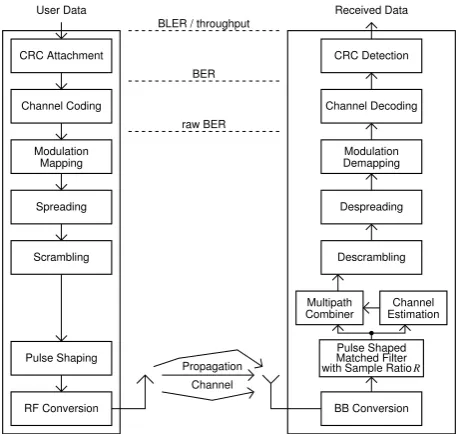
Fig. 3. Physical layer of the downlink of the investigated HSDPA
system (Left: Transmitter – Right: Receiver).
by an adaptive control unit. Results of the reduction of com-plexity and energy consumption lead to the conclusions of this report.
2 System model and propagation channel
Figure 3 shows the tasks which have to be carried out in the physical layer of the transmitter in the base station and the receiver in the mobile device of an High Speed Downlink Packet Access (HSDPA) system. The critical part for the transmission of high data rates is the fading multipath prop-agation between transmitter and receiver. Thus, mainly the receiver has to be enhanced by an improved multipath com-bination to restore the transmitted signal.
The figure of merit for the user is the achievable through-put of the transmission link which is related to the Frame Error Rate (FER) of transmitted blocks which were received correctly. However, the raw Bit Error Rate (BER) can act as a more precise indicator for the performance of the critical inner part. Simulations show that a raw BER smaller than 2% corresponds to a FER lower than 10 %. This FER al-lows to fulfill the requirements of the 3GPP standard for the throughput (3GPP TS 25.101, 2003).
the orthogonality of the transmitted signal (Hooli, 2002). These approaches improve the performance drastically, but only for the compromise of a higher complexity. A chip-level equalizer has the advantage of restoring the orthogonal-ity of the signal before decoding which simplifies the subse-quent tasks. However, the data equalization operates with the oversampled chip frequency of the pulse-shape matched filter (Fig. 3). Therefore, the activity of the equalizer is compar-atively high which results in increased power consumption. The optimization of this component plays a key role in min-imizing the overall power consumption and is discussed in detail below.
3 Optimizations on the algorithmic level
There are several algorithms which compute filter coeffi-cients to equalize the propagation channel in a Finite Impulse Response (FIR) filter. The algorithm which obtains the best performance is the Minimum Mean Square Error (MMSE) equalizer which is often given in literature as (Krauss, 2000):
wMMSE=(H0H+I σN2
σS2)
−1H0
δD (1)
In this equation H is the convolution matrix composed out of the channel impulse response estimated in the receiver. I is the identity matrix andσN2 andσS2 are the noise and sig-nal power, respectively. δD is the unit vector with a 1 at the
Dth postition. Depending on the signal to noise ratio the MMSE equalizer either performs like a zero-forcing equal-izer (σN2σS2):
wZF =(H0H)−1H0δD (2)
Or for a high noise level (σN2σS2) the Rake combiner is ap-proximated:
wRAKE= σS2
σN2H
0δ
D (3)
The MMSE equalizer can be transformed into a Prefilter Rake equalizer by separating the equalization into two tasks: at first, the Prefilter minimizes the cross correlation between the samples caused by multipath propagation. Then the sig-nal can be processed by a normal Rake combiner to maxi-mize the signal (Heikkilae, 2001).
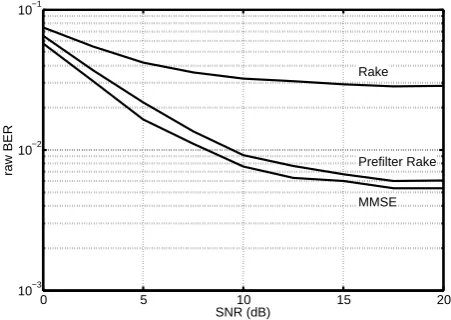
The concepts of the Rake combiner, the MMSE equal-izer and the Prefilter Rake equalequal-izer are compared regard-ing their raw BER performance for a vehicular propagation channel (VA30) and the HSDPA testcase H-Set 3 (3GPP TS 25.101, 2003) in Fig. 4 by a fixed-point SystemC simula-tion. The MMSE equalizer reaches the best results while the Rake combiner has a very high raw BER. The Prefilter Rake achieves also good raw BER results, but due to the separa-tion of the MMSE equasepara-tion, a small fracsepara-tion of the gain in performance is lost.
0 5 10 15 20
10−3 10−2 10−1
SNR (dB)
raw BER
MMSE Prefilter Rake Rake
Fig. 4. Comparison of performance of different algorithms for a
ve-hicular propagation channel (VA30) and HSDPA testcase H-Set 3.
There are multiple ways to solve the MMSE and Prefilter approaches. The method given in Eq. (1) by computing the pseudo inverse of H is usually the most complex version be-cause it requires several matrix computations. More reason-able versions in terms of complexity are adaptive algorithms, like Least Mean Square (LMS) (e.g. Widrow, 1985) or Re-cursive Least Square (RLS) (e.g. Moon, 1999) and their vari-ations.
Concerning the effort LMS algorithms have the advantage of a simple structure and of scaling linearly with the filter size while the RLS algorithms scale quadratically. Due to this advantage LMS algorithms are often preferred for im-plementations with a low complexity.
However, as simulations for the Prefilter Rake equalizer show, the computational complexity measured in multiplica-tions per slot is higher for the LMS algorithm when com-pared with the RLS algorithm (Fig. 5). This is caused by a different runtime behavior: for the convergence of filter coef-ficients the LMS algorithm has to adapt the coefcoef-ficients con-tinuously while the RLS algorithm can operate block-based with 2.5 updates per slot.
Further results have been obtained using the tool ORINOCO®supplied by ChipVision for the area and energy
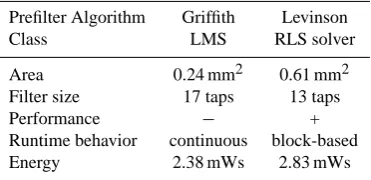
consumption of both Prefilter algorithms. The required area for the RLS algorithm is larger because more multiplications have to be performed simultaneously, but the energy con-sumption of both algorithms are comparable. An additional advantage of the RLS algorithm is that it yields better filter coefficients which enables the FIR filter to achieve a better performance with even less filter coefficients.
A summary of the different algorithms investigated with SystemC and ORINOCO®for the HSDPA receiver
1 2 4 8 0
0.5 1 1.5 2 2.5 3 3.5 4 4.5
5x 10
6
Oversampling Ratio
Number of Multiplications per Slot
MMSE (LMS)
Prefilter Rake (Levinson) Prefilter Rake (LMS)
Rake
Fig. 5. Complexity of different algorithms measured in
multiplica-tions per time unit.
Table 1. Results obtained with ORINOCO®for both Prefilter algo-rithms for a 130 nm standard cell library mapping.
Prefilter Algorithm Griffith Levinson
Class LMS RLS solver
Area 0.24 mm2 0.61 mm2
Filter size 17 taps 13 taps
Performance − +
Runtime behavior continuous block-based
Energy 2.38 mWs 2.83 mWs
propagation conditions. The best performance can be ob-tained with the MMSE equalizer, but only with the highest complexity, area and power consumption. A good trade-off is the Prefilter Rake equalizer which achieves a substantial increase in performance in comparison with the Rake com-biner with only a small increase of complexity and energy consumption. When comparing both algorithms for the Pre-filter Rake equalizer the Levinson algorithm (RLS) has the best trade-off of performance and energy consumption.
4 Optimizations on the architectural level
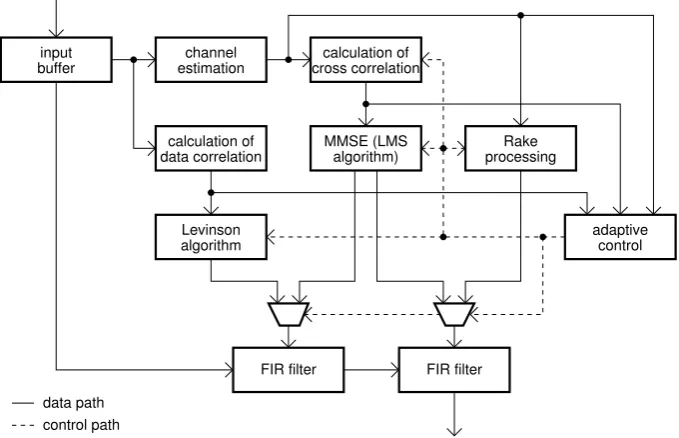
To create an architecture which is able to reach a high perfor-mance with a minimum of power consumption the MMSE equalizer (best performance), the Rake combiner (lowest complexity) and the Prefilter Rake equalizer using the Levin-son algorithm (best trade-off) have been combined in the pro-posed architecture in Fig. 6 together with an adaptive control unit. The control unit monitors the current state of the prop-agation channel and chooses the algorithm which achieves the necessary performance with the lowest complexity. For example, in vehicular environments the MMSE equalizer is used while in indoor or pedestrian environments the Rake
Table 2. Summarized comparison of approaches and algorithms
re-garding their BER performance for the vehicular propagation chan-nel VA30, their complexity (number of multiplications and addi-tions), area and estimated power consumption.
Approach MMSE Prefilter Prefilter Rake
Rake Rake Combiner
Algorithm LMS Levinson Griffith
Conjugate-(RLS) (LMS) complex
BER Very Good Medium Bad
good
Complexity High Medium Medium Low
Area Large Large Medium Small
Power High Medium Medium Low
combiner is activated which can maintain the performance with a lower complexity.
Apart from the receiver algorithm used for multipath com-bination, other parameters of the different algorithms can also be adjusted to reduce the required complexity further to the necessary extent:
– Oversampling ratio
The oversampling ratio determines the temporal resolu-tion of the multipath propagaresolu-tion which influences the performance of the multipath combination. But it also influences the data rate which has to be processed and consequently the complexity and power consumption of the receiver. Adjusting the oversampling ratio can there-fore be used to trade off performance and complexity (Sch¨amann, 2006).
– Convergence masking vector
By use of a convergence masking vector (Guo, 2005) the state of convergence for each filter coefficient can be monitored. If a coefficient becomes changeless, no further calculations are required for this coefficient. The coefficient is marked and in the following iterations this coefficient is skipped which reduces the number of mul-tiplications, additions and consequently the power con-sumption.
– Active filter size
Depending on the current delay spread of the multi-path propagation the FIR filter which is designed for the worst case scenario is not required to operate with its full range of filter coefficients. By switching off parts of the filter which are not necessary the complexity can be further reduced.
– Number of iterations
estimationchannel input
buffer cross correlationcalculation of
data correlationcalculation of MMSE (LMSalgorithm) processingRake
adaptive control Levinson
algorithm
FIR filter FIR filter
data path control path
Fig. 6. Architecture combining three algorithms and the proposed adaptive control unit to trade off performance with complexity and power
consumption.
conditions change faster which requires an update of fil-ter coefficients more often. But in the case of slow or no movement, the time between updates can be increased to minimize the activity of the receiver.
The results of the adjustment of parameters for the MMSE equalizer are shown in Table 3. Depending on the control mechanism used in the receiver the computational complex-ity can be reduced by up to 71.9% while the average BER for the VA30 propagation channel stays lower than 2%. The SystemC model of the MMSE equalizer including the con-trol unit was analyzed by ORINOCO®as well and reductions
of the energy consumption of up to 42% for subcomponents were observed.
5 Conclusions
The importance of estimating the power consumption on the algorithmic level early in the design process has been shown. The high potential for the reduction of power consumption was demonstrated by comparing the estimated area and en-ergy consumption using SystemC and ORINOCO®.
By monitoring the propagation conditions, selecting the algorithm adaptively and adjusting the receiver’s parameters the complexity and power consumption were reduced further. For the investigated application of an HSDPA receiver the number of required multiplications and additions could be reduced by up to 71.9% and the energy consumption could be reduced by up to 42% for subcomponents of the MMSE equalizer.
Table 3. Reduction of complexity measured in multiplications per
time unit by the adaptive control unit for the MMSE equalizer.
Method Reduction of BER
complexity performance
None 0% 1.1%
Convergence Masking vector up to 19.9% 1.1%
Adaptive filter size up to 66.0% 1.3%
Stop of adaptation on up to 30.7% 1.0%
error threshold
All three methods combined up to 71.9% 1.1%
Acknowledgement. This work has been funded by the German
Fed-eral Ministry of Education and Research (BMBF) within the re-search project LEMOS (grant no. 01M3155). Further information is available on the project website: http://lemos.offis.de
References
3rd Generation Parnetship Project (3GPP): TS 25.101 V6.0.0: UE Radio Transmission and Reception (FDD), Technical specifica-tion, 3rd Generation Partnership Project, Release 6, March 2003. Guo, Y., McCain, D., and Cavallaro, J. R.: Low Power VLSI Archi-tecture for Adaptive MAI Suppression in CDMA Using Multi-Stage Convergence Masking Vector, IEEE Vehicular Technology Conference, Dallas, Texas, USA, September 2005.
Heikkil¨a, M. J.: A Novel Blind Adaptive Algorithm for Channel Equalization in WCDMA Downlink, IEEE International Sym-posium on Personal, Indoor and Mobile Radio Communications, vol. 1, San Diego, CA, USA, p. 41–45, September 2001. Hooli, K., Juntti, M., Heikkil¨a, M. J., Komulainen, P.,
Latva-aho, M., and Lilleberg, J.: Chip-Level Channel Equalization in W-CDMA Downlink, EURASIP J. Appl. Signal Processing, 2002(8), 757–770, 2002.
Krauss, T. P., Zoltowski, M. D., and Leus, G.: Simple MMSE Equalizers for CDMA Downlink To Restore Chip Sequence: Comparison to Zero-Forcing and RAKE, IEEE International Conference on Acoustics, Speech and Signal Processing, vol. 5, Istanbul, Turkey, p. 2865–2868, June 2000.
Moon, T. K. and Stirling, W. C.: Mathematical Methods and Algo-rithms for Signal Processing, Prentice-Hall, Upper Saddle River, NJ, USA, August 1999.
Perkins, D.: Convergence Challenges & Solutions for Next Gen-eration Wireless Networking, Texas Wireless Symposium, USA, October 2005.
Rabaey, J. M.: Wireless Beyond the Third Generation - Facing the Energy Challenge, Intl. Symposium on Low Power Electronics and Design, Huntington Beach, CA, USA, August 2001. Raghunathan, A., Jha, N. K., and Dey, S.: High-Level Power
Anal-ysis and Optimization, Kluwer Academic Publishers, November 1997.
Sch¨amann, M., B¨ucker, M., Hessel, S., and Langmann, U.: Chan-nel Equalization in HSDPA Receivers: Trade-Off between Per-formance and Complexity with a Variable Oversampling, IEEE Vehicular Technology Conference, Melbourne, Australia, May 2006.
Takano, T., Gambe, H., and Katoh, T.: Fujitsu’s Challenges in Wire-less Communications, Fujitsu Scientific and Technology Journal, 38(2), 121–133, 2002.