© Author(s) 2014. CC Attribution 3.0 License.
Acoustic scattering of a complex-source beam by the edge of a plane
angular sector
H. Brüns and L. Klinkenbusch
Institute of Electrical and Information Engineering, Kiel University, Kaiserstr. 2, 24143 Kiel, Germany Correspondence to: H. Brüns ([email protected])
Received: 7 January 2014 – Revised: 6 May 2014 – Accepted: 27 May 2014 – Published: 10 November 2014
Abstract. The scattering and diffraction of a complex-source beam (CSB) by an acoustically soft or hard plane angular sector is treated by a rigorous spherical-multipole analysis in sphero-conal coordinates. By assigning a complex-valued radial source coordinate to the corresponding Green’s func-tion, the CSB is directed exactly towards the corner of the sector. Since the CSB can be interpreted as a localized plane wave, its interaction with the corner in the presence of the semi-infinite structure can be analyzed in detail. In opposite to the classical case of a non-localized incident plane wave, the resulting multipole series is strongly convergent and no summation techniques are necessary to obtain meaningful re-sults. The numerical results include a convergence analysis, total near fields as well as scattered far fields and prove the applicability of this new approach.
1 Introduction
Among the canonical problems in electromagnetic scatter-ing theory (see Bowman et al., 1987 for a comprehensive overview) those ones with semi-infinite structures turn out to be rather complicated to solve. Even though analytic results for the diffracted (total) fields are given for a large variety of such geometries (for example in the form of the related Green’s functions), it can be a considerably pretentious task to derive the scattered field, in particular if both the source point and the observation point are far away from the defi-nite end (e.g., the tip) of the semi-infidefi-nite structure. An ex-ample for the successful treatment of such a problem is the wedge and its special case, the half plane. The common way to tackle this problem is to transform the modal (multipole) expansion of the related Green’s function into a suitable con-tour integral in the complex plane and to evaluate the integral
asymptotically by means of a steepest-descend or stationary-phase method. This way, one can separate from the total field the incident, reflected and transmitted Geometrical-Optics (GO) terms and obtain a closed-form result for the field caused by the edge. Since the latter part serves as an exten-sion of the conventional GO field, this method is referred to as the Geometrical Theory of Diffraction (GTD, see Keller, 1959, 1962), while its generalization is the Uniform Theory of Diffraction (UTD, see Kouyoumjian and Pathak, 1974). In each case, the edge-related field part is described by the GTD (UTD) diffraction coefficient.
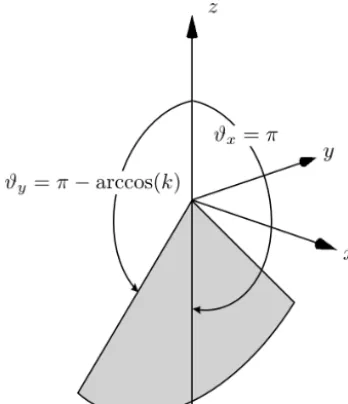
Figure 1. Plane angular sector described byϑ=πandk2=0.5.
part of the elementary solutions of the Helmholtz equation in sphero-conal coordinates. Using these new representations Blume et al. investigated the diffraction by an elliptic cone (including the sector) and found expressions for the related nose-on radar cross sections (RCS) (Blume et al., 1993).
With the eigenfunction expansion it may be relatively easy to rigorously evaluate the diffracted field if the source or the observation point (or both) are located not too far away from the sector’s tip, however the obtained series do not converge if both are in the far field. In that case special sequence trans-formations had to been used to come to the related limit-ing values. Blume et al. applied such techniques to calculate radar cross sections (RCS) and diffraction coefficients for the elliptic cone and for the sector (Blume and Klinkenbusch, 1999). However, the convergence properties were rather poor so that linear (Klinkenbusch, 2007) as well as non-linear transformation methods had to be employed.
Among the approximate methods, Hansen (1991) de-duced corner diffraction coefficients from numerically com-puted surface currents on a quarter plane, Hill (1990) calcu-lated UTD diffraction coefficients by an asymptotically valid evaluation of the Kirchhoff integral from edge-corrected Physical-Optics currents on a sector, and Maci et al. derived corresponding results by applying the Incremental Theory of Diffraction – ITD (Maci et al., 1994, 1998).
The present approach extends the multipole-based method which allows to derive an expression for the exact scattered far-field of the plane angular sector. The basic new idea is to illuminate just the corner of the sector by means of a complex-source beam (CSB). Such a CSB can be interpreted as a localized plane wave, and thus its interaction with the corner in the presence of the semi-infinite structure can be analyzed in detail. Particularly, the scattered field obtained for such an incident CSB is caused by the area around the
Figure 2. Eigenvalue curvesλ(ν)for all possible solutions of the differential Eq. (9) and discrete Dirichlet eigenvalues (×) satisfying the condition (11) atϑ0=180◦fork2=0.5 (quarterplane); func-tion type 1, see Eqs. (14) and (18).
corner only and thus perfectly suited for extending asymp-totic methods like the GTD or UTD. Finally, in advantage to the classical case of a full incident plane wave the illu-mination by a CSB yields a strongly convergent solution, so that the application of series transformation methods as men-tioned above is not necessary.
In Sect. 2 and 3 we briefly describe the system of sphero-conal coordinates and the solution of the Helmholtz equation in the presence of a plane angular sector, respectively. Sec-tion 4 deals with the diffracSec-tion of a complex-source beam by the sector, and in Sect. 5 the convergence properties of the method are described. Finally, Sect. 6 numerical results for the diffracted and scattered fields are presented.
2 Sphero-conal coordinates
Sphero-conal coordinatesr, ϑ, ϕ are related to Cartesian co-ordinates by
x=rsinϑcosϕ
y=rp1−k2cos2ϑsinϕ z=rcosϑ
q
1−k02sin2ϕ (1)
sϑ= 1
r
∂r ∂ϑ
=
s
k2sin2ϑ+k02cos2ϕ
1−k2cos2ϑ (2)
sϕ= 1
r
∂r ∂ϕ
=
s
k2sin2ϑ+k02cos2ϕ
1−k02sin2ϕ . (3)
The coordinate surfaceϑ=ϑ0represents a semi-infinite
el-liptic cone around the z axis (Blume and Klinkenbusch, 1999) which turns into a circular cone fork=1. Forϑ0=π
the elliptic cone becomes a plane angular sector lying in the
yzplane around the negativezaxis, see Fig. 1. The half outer opening angles of that sector are specified by
ϑx=π (4)
ϑy=π−arccos(k) . (5)
3 Solution of the Helmholtz equation in the presence of an acoustically soft or hard plane angular sector
Sphero-conal coordinates count to those eleven coordinates systems described by Eisenhart (1934) where for the three-dimensional Helmholtz equation
19(r, ϑ, ϕ)+κ29(r, ϑ, ϕ)=0 (6) the method of separation is completely successful. In Eq. (6), the wave numberκ is related to the wavelength 3byκ= 2π/3. The resulting elementary solution can be written as
9ν(r, ϑ, ϕ)=zν(κr)2ν(ϑ )8ν(ϕ) (7) with spherical Bessel functions being related by
zν(κr)=
r
π
2κrZν+1/2(κr) (8)
to ordinary Bessel functionsZof orderν+1/2. The periodic Lamé functions8ν(ϕ)and the non-periodic Lamé functions
2ν(ϑ )satisfy the differential equations
q
1−k02sin2ϕ d dϕ
q
1−k02sin2ϕd8ν
dϕ
+hλ−ν(ν+1)k02sin2ϕi8ν =0 (9)
p
1−k2cos2ϑ d dϑ
p
1−k2cos2ϑd2ν dϑ
+
h
ν(ν+1) (1−k2cos2ϑ )−λ
i
2ν=0. (10) Equations (9) and (10) are coupled by the two separation constantsνandλwhich also can be interpreted as eigenval-ues of a two-parametric eigenvalue problem. For the problem
0 0.2 0.4 0.6 0.8 1 1.2
-150 -100 -50 0 50 100 150
|Φ
|/|
Φmax
|
ϑ νmax = 30
νmax = 40
νmax = 50
→ϕ=180◦ ϕ=0◦←
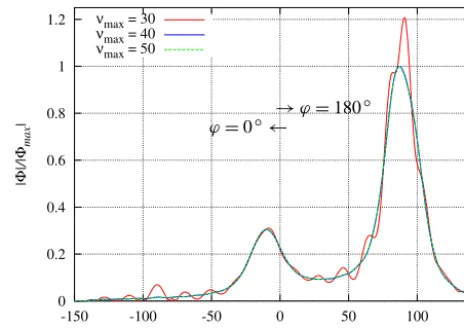
Figure 3. Radiation patterns of an acoustically soft sector (k2=
0.6) in thexzplane (ϕ=0◦andϕ=180◦) for different maximum numbers of eigenfunctions. The point source is located at the com-plex coordinatesrc=(0.001+10j )3,ϑc=90◦,ϕc=90◦, that is
rc=(0.001+10j )3yˆin Cartesian coordinates.
under consideration the periodic Lamé functions have to be 2πperiodic, and for any such solution the eigenvalues in the
(ν, λ)-plane lie on so-called eigenvalue curves, the courses of which depend only onk2(Blume and Klinkenbusch, 1999), see Fig. 2. To satisfy the boundary-value problem posed by the acoustically soft or hard plane-angular sector, the non-periodic Lamé functions have to satisfy either the Dirich-let (acoustically soft, indexs) or the Neumann (acoustically hard, indexh) boundary condition on the sector’s surface at
ϑ=π:
2νs(π )=0 (11)
d2νh dϑ
ϑ=π
=0. (12)
The corresponding (ντ, λ); τ ∈ {s, h} eigenvalue pairs are then discrete Dirichlet and Neumann eigenvalues on the eigenvalue curves as shown in Fig. 2. As in ordinary spherical coordinates, for solutions in the free space all eigenvaluesν
are all non-negative integers (ν=n=0,1,2,3, ...) on these eigenvalue curves.
The products of non-periodic and periodic Lamé functions are referred to as the Lamé products. They can be represented by a linear combination of four appropriately defined func-tion types
x z
0 9max
−9max 9s|ϑ=π=0 ∂9∂ϑh|ϑ=π=0
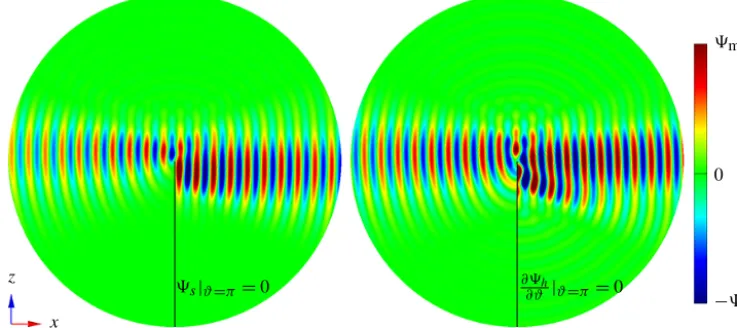
Figure 4. Real part of the total field in thexzplane near the edge (r <103) for an acoustically soft (left-hand side) and acoustically hard (right-hand side) sector. The point source has the complex locationrc=(0.001+10j )3,ϑc=90◦,ϕc=0◦, that isrc=(0.001+10j )3xˆ
in Cartesian coordinates.
The four types of periodic Lamé functions are described by each two alternatively valid Fourier series (Jansen, 1976)
8(ν1)(ϕ)=
∞
P
i=0
A2icos 2iϕ
p
1−k02sin2ϕP∞
i=0
C2icos 2iϕ
(14)
8(ν2)(ϕ)=
∞
P
i=0
A2i+1cos(2i+1)ϕ
p
1−k02sin2ϕP∞
i=0
C2i+1cos(2i+1)ϕ
(15)
8(ν3)(ϕ)=
∞
P
i=0
B2i+2sin(2i+2)ϕ
p
1−k02sin2ϕP∞
i=0
D2i+2sin(2i+2)ϕ
(16)
8(ν4)(ϕ)=
∞
P
i=0
B2i+1sin(2i+1)ϕ
p
1−k02sin2ϕP∞
i=0
D2i+1sin(2i+1)ϕ.
(17)
The non-periodic Lamé functions are expanded in terms of associated Legendre functions of the first kind (Jansen, 1976)
2(ν1)(ϑ )= ∞
X
i=0
A2iT (2i)Pν2i(cosϑ ) (18)
2(ν2)(ϑ )= ∞
X
i=0
A2i+1T (2i+1)Pν2i+1(cosϑ ) (19)
2(ν3)(ϑ )= √
1−k2cos2ϑ
sinϑ ∞
X
i=0
B2i+2(2i+2)T (2i+2)Pν2i+2(cosϑ ) (20)
2(ν4)(ϑ )= √
1−k2cos2ϑ
sinϑ ∞
X
i=0
B2i+1(2i+1)T (2i+1)Pν2i+1(cosϑ ) (21)
where the algebraic factorsT (i)are recursively defined as
T (i)= −(ν−1)(ν+i+1)T (i+2)
T (0)=T (1)=1. (22)
For the method of finding the coefficients we refer to Blume and Klinkenbusch (1999).
For integer eigenvaluesν=n=1,2,3, ...(free-space so-lutions) it has been shown (Jansen, 1976) that for each n
always one expansion per function type in Eqs. (14)–(17) becomes finite while the expansions (18)–(21) all are finite. Moreover, for each integral eigenvaluenthere exist 2n+1 eigenfunctions in total, distributed among the function types. In that case Lamé functions turn into Lamé polynomials de-noted by8(l)n,mand2(l)n,m, wheremstands for one of the 2n+1 linearly independent eigenfunctions pern.
Finally, the summation of all suitable elementary solutions (7) leads to the complete field representation in the domain outside of the acoustically soft or hard plane angular sector. Similar to the method described by Bowman et al. (1987), at a time factorej ωt for a unit point source located atr0 the solution can be written as a symmetric bilinear expansion according to
9τ(r)=j κ
X
ν
jντ(κr<)h
(2)
ντ (κr>)Yντ(ϑ, ϕ)Yντ(ϑ
0, ϕ0) (23)
y z
0 9max
−9max 9s|ϑ=π=0 ∂9∂ϑh|ϑ=π=0
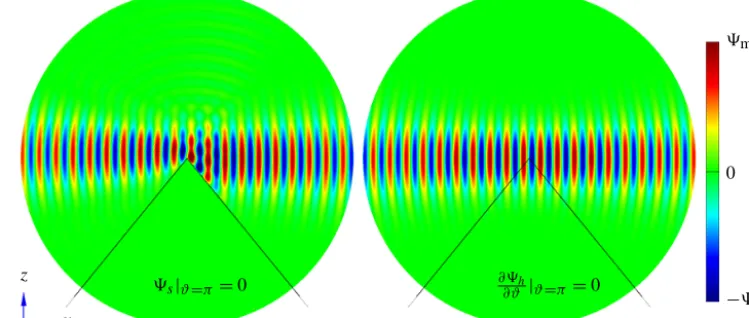
Figure 5. Real part of the total field in theyzplane near the edge (r <103) for an acoustically soft (left-hand side) and acoustically hard (right-hand side) sector. The point source has the complex locationrc=(0.001+10j )3,ϑc=90◦,ϕc=90◦, that isrc=(0.001+10j )3yˆ
in Cartesian coordinates.
4 Complex-source beam incident on an acoustically soft or hard plane angular sector
A complex-source beam (CSB) is a powerful tool to de-scribe focused beams analytically. As shown by (Katsav et al., 2012) and (Brüns and Klinkenbusch, 2013), the Green’s function of a point source at a complex-valued location can be used to approximately describe a Gaussian beam with an arbitrary beam direction. However, in contrast to a Gaussian beam, the CSB exactly satisfies the Helmholtz equation.
Let the complex valued locationrcof such a point source be defined by
rc=rr−jb. (24)
Then the vectorrrrepresents the location of the beam’s waist whileb/|b|specifies the direction of propagation.|b| corre-sponds to the Rayleigh length of the beam, that is, to the dis-tance between the waist and the area where the cross-section has doubled (Brüns and Klinkenbusch, 2013). Consequently, by choosing small rr and large b we obtain a nearly plane wave front at the origin (e.g., at the corner of the plane an-gular sector). In addition, that field has a transverse Gaussian profile thus the CSB represents a localized plane wave.
As shown by Katsav et al. (2012) a CSB pointing directly to the origin is defined by simply assigning a complex radial coordinate rc=rr+j bto the source. By means of a quite similar procedure we can easily prove that for sphero-conal coordinates as well: Consider that the waist of the CSB is located atrr, and that a vector pointing fromrr to the origin is given by b=(b, π−ϑr, π+ϑr). According to Eq. (24) and by using Eq. (1) we write in Cartesian coordinates:
rc=rr−jb
=
rrsinϑrcosϕr
rr
p
1−k2cos2(ϑ
r)sinϕr
rrcosϑr
p
1−k02sin2ϕ
r
−j
bsin(π−ϑr)cos(π+ϕr)
bp1−k2cos2(π−ϑ
r)sin(π+ϕr)
bcos(π−ϑr)
q
1−k02sin2(π+ϕr)
=
(rr+j b)sinϑrcosϕr
(rr+j b)
p
1−k2cos2ϑ
rsinϕr
(rr+j b)cosϑr
p
1−k02sin2ϕ
r
(25)
Consequently, by just assigning a complex valued source point in sphero-conal coordinatesrc=rr+j b, ϑc=ϑr, ϕc=
ϕr we obtain a CSB with a waist atrr and Rayleigh length
b directed exactly towards the corner of the plane angular sector.
Now we assign such a complex valued location in sphero-conal coordinatesr0=rc=rr+j ri, ϑc=ϑr, ϕc=ϕr to the point source in Eq. (23), and obtain the total field of an acous-tically soft or hard sector illuminated by a complex-source beam directed exactly towards its tip.
Finally it is noted that the incident CSB field (the field of the same CSB point source at rc as in Eq. (23) but in the absence of the sector) is expanded in terms of Lamé polyno-mials according to
9inc(r)=j κX
n,m
jn(κr<)h(n2)(κr>)Yn,m(ϑ, ϕ)Yn,m(ϑ0, ϕ0).
(26) The scattered field is then obtained by
x y z
0
|9max|
Figure 6. Radiation pattern of the scattered far field for an acousti-cally soft sector. The source has the complex locationrc=(0.001+
10j )3,ϑc=90◦,ϕc=0◦, that isrc=(0.001+10j )3xˆin
Carte-sian coordinates.
x y z
0
|9max|
Figure 7. Radiation pattern of the scattered far field for an acousti-cally soft sector. The source has the complex locationrc=(0.001+
10j )3,ϑc=90◦,ϕc=45◦, that isrc=(0.001+10j )3 (√1
2xˆ+ 1
√
2y)ˆ in Cartesian coordinates.
5 Convergence analysis
Basically, the convergence of the expansion (23) is deter-mined by the behaviour of the spherical Bessel functions for a fixed argument and large values of the order ν (see Abramowitz and Stegun, 1972, Eq. (9.3.1.) using the defi-nition (8). Note that in Eq. (23) the argument of the spher-ical Bessel function of the first kind is always smaller than the argument of the spherical Hankel function of the second kind, and hence for any limited and fixed arguments the prod-uct of both functions becomes arbitrarily small for any order larger than a certain fixed limit. Consequently, to achieve a given accuracy of the expansion (23) it is sufficient to con-sider all eigenvalue pairs(ν;λ)up to a certainν≤νmax.
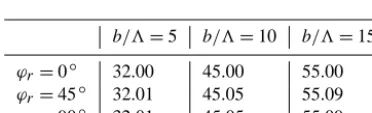
Ta-ble 1 shows the maximum value νmaxneeded for achieving
a relative error of the field expansion (23) for different val-ues of the angular position of the CSB waist (ϕr) and of the Rayleigh length (b). As expected the Rayleigh length influ-ences the maximum eigenvalueνmaxneeded to obtain a
cer-x y z
0
|9max|
Figure 8. Radiation pattern of the scattered far field for an acous-tically soft sector. The source has the complex location rc= (0.001+10j )3,ϑc=90◦,ϕc=90◦, that isrc=(0.001+10j )3yˆ
in Cartesian coordinates.
x y z
0
|9max|
Figure 9. Radiation pattern of the scattered far field for an acous-tically hard sector. The source has the complex location rc= (0.001+10j )3,ϑc=90◦,ϕc=0◦, that isrc=(0.001+10j )3xˆ
in Cartesian coordinates.
tain accuracy of Eq. (23) while the angle of incidenceϕrdoes not essentially affect the convergence properties.
To check the convergence of the spherical-multipole ex-pansion (23) with regard to the following numerical evalu-ation, Fig. 3 shows the radiation pattern of the scattered far field in thexzplane with a source located atrc=(0.001+ 10j )3, ϑc=90◦,ϕc=90◦. The outer half opening angle of the sector isϑy=140.77◦. The expansion of the field is obtained for different maximum numbers of eigenfunctions, i.e.,νmax= 30, 40 and 50. The results are normalized with
respect to the maximum of9τsc atνmax=50. As can be
ob-served, for a maximum number ofνmax=40 the multipole
0 0.2 0.4 0.6 0.8
-150 -100 -50 0 50 100 150
|
Φ
|/|
Φmax
|
ϑ [°]
x,z-plane (ϕ = 0°, 180°) y,z-plane (ϕ = 90°, 270°)
Figure 10. Radiation pattern of the scattered far field for an acous-tically soft sector in the xz and yz plane. The source has the complex locationrc=(0.001+10j )3,ϑc=90◦,ϕc=0◦, that is
rc=(0.001+10j )3xˆin Cartesian coordinates.
Table 1. Maximum eigenvalueνmaxnecessary to achieve a relative error<10−6in (23) for different Rayleigh lengthsriand angles of
incidenceϕ0.
b/3=5 b/3=10 b/3=15
ϕr=0◦ 32.00 45.00 55.00
ϕr=45◦ 32.01 45.05 55.09
ϕr=90◦ 32.01 45.05 55.09
6 Numerical evaluation
For the following results we set k2=0.6. According to Eq. (5) this yields a plane angular sector with a half outer opening angle of ϑy=140.77◦. Moreover, the complex lo-cation of the source is lying in the xy plane (ϑc=90◦) at
rc=(0.001+10j )3. The real partrr is relatively small to take advantage of the beam’s property of a nearly plane wave front nearby the waist.
6.1 Total fields
The results in Figs. 4 and 5 show the total field9τin the near-field range r <103in the xz plane (Fig. 4) and in theyz
plane (Fig. 5). For each of the figures the results on the left-hand side are for an acoustically soft sector while the results on the right-hand side are for an acoustically hard sector.
In Fig. 4 the source has the complex-valued locationrc=
(0.001+10j )3,ϑc=90◦,ϕc=0◦, that is, the beam is prop-agating towards the corner in a plane of incidence perpendic-ular to the sector. In both cases (soft and hard) we observe in-terferences of reflected and incident fields on the right-hand side of the sector.
In Fig. 5 the source is located at the complex coordinates
rc=(0.001+10j )3, ϑc=90◦, ϕ0=90◦, that is, the beam
0 0.2 0.4 0.6 0.8
-150 -100 -50 0 50 100 150
|
Φ
|/|
Φmax
|
ϑ [°]
x,z-plane (ϕ = 0°, 180°) y,z-plane (ϕ = 90°, 270°)
Figure 11. Radiation pattern of the scattered far field for an acous-tically soft sector in thexzandyzplane. The source has the com-plex location rc=(0.001+10j )3, ϑc=90◦, ϕc=90◦, that is
rc=(0.001+10j )3xˆin Cartesian coordinates.
propagates towards the corner in a plane of incidence parallel to the sector. For the acoustically soft sector (left-hand side) the beam is partly is reflected inzdirection. However, for the acoustically hard sector (right-hand side) the beam passes the sector completely unaffected.
6.2 Scattered far fields
The results for the scattered far fields (radiation patterns) are obtained by means of the large-argument approximation of the spherical Hankel functions of the second kind and by sub-tracting the incident field from the total field, see Eq. (27). Figures 6–8 show the radiation patterns of an acoustically soft sector for different angles of incidenceϕc.
Forϕc=0◦(Fig. 6) maxima of the scattered field can be observed in the direction of propagation as well as in the opposite direction which is due to reflection. The pattern is nearly symmetric to theyzas well as to thexzplane.
Forϕc=45◦(Fig. 7) we also see these two maxima men-tioned before with the reflected part being slightly larger.
Forϕc=90◦(Fig. 8) there appears a broad maximum in
ydirection.
Figure 9 shows a pattern for an acoustically hard sector for a point source located atϕc=0◦. In contrast to the result obtained for the acoustically soft sector (Fig. 6) the pattern is not symmetric to theyzplane.
Finally, Figs. 10 and 11 represent radiation patterns of the scattered far fields of an acoustically soft sector in thexzand
yzplane for different locations of the incident CSB waist.
7 Conclusions
scattering and diffraction of a localized plane wave by the corner of an acoustically soft or hard plane angular sector by means of a convergent and numerically stable analysis.
Future work will include solutions for the corresponding electromagnetic problems, the investigation of the CSB scat-tering and diffraction by more general elliptic cones, and the investigation and development of techniques to integrate the findings into asymptotic methods.
Acknowledgements. This work was supported by the Deutsche Forschungsgemeinschaft (KL815/10-1&2).
Edited by: U. van Rienen
Reviewed by: two anonymous referees
References
Abramowitz, M., and Stegun, I. A. (Eds.): Handbook of Mathemat-ical Functions with Formulas, Graphs, and MathematMathemat-ical Tables, New York, Dover Publications, p. 365, 1972.
Blume, S., Klinkenbusch, L., and Uschkerat, U.: The radar cross section of the semi-infinite elliptic cone, Wave Motion, 17, 365– 389, 1993.
Blume, S., and Klinkenbusch, L.: Spherical-multipole analysis in electromagnetics, in: Frontiers in Electromagnetics, edited by: Werner, D. H. and Mittra, R., New York, IEEE Press and Wiley, 553–608, 1999.
Bowman, J. J., Senior, T. B. A., and Uslenghi, P. L. E. (Eds.): Elec-tromagnetic and acoustic scattering by simple shapes (revised printing), New York, Hemisphere Pub. Corp., 129–179, 1987. Brüns, H. and Klinkenbusch, L.: Electromagnetic diffraction and
scattering of a complex-source beam by a semi-infinite circular cone, Adv. Radio Sci., 11, 31–36, doi:10.5194/ars-11-31-2013, 2013.
Eisenhart, L. P.: Separable systems of Stäckel, Ann. Math., 35, 284– 305, 1934.
Eisenhart, L.P.: Stäckel systems in conformal euclidean space, Ann. Math., 36, 57–70, 1935.
Hansen, T. B.: Corner diffraction coefficients for the quarter plane, IEEE T. Antenn. Propag., 39, 976–984, 1991.
Hill, C. H.: A UTD solution to the EM scattering by the vertex of a perfectly conducting plane angular sector, Ph.D. dissertation, The Ohio State University, Columbus (OH), 1990.
Jansen, J. K. M.: Simple-periodic and non-periodic Lamé functions and their application in the theory of conical waveguides, Ph.D. dissertation, Eindhoven University of Technology, Eindhoven, The Netherlands, 1976.
Katsav, M., Heyman, E., and Klinkenbusch, L.: Complex-source beam diffraction by an acoustically soft or hard circular cone, Proc. International Conference on Electromagnetics in Advanced Applications (ICEAA 2012), Cape Town, South Africa, 2–7 September, 135, 2012.
Keller, J. B.: The Geometrical Theory of Diffraction, Proc. of the Symp. on Microwave Optics, Eaton Electronics Labora-tory, McGill University, Montreal, Canada, June 1953, Vol. 1; Reprinted as “The Geometric Optics Theory of Diffraction”, The McGill Symp. on Microwave Optics, edited by: Karasik, B. S. and Zucker, F. J., AFCRC, Bedford, MA, 2, 207–210, 1959. Keller, J. B.: Geometrical theory of diffraction, J. Opt. Soc. Am.,
52, 116–130, 1962.
Klinkenbusch, L.: Electromagnetic scattering by semi-infinite cir-cular and elliptic cones, Radio Sci., 42, RS6S10, 2007.
Kouyoumjian, R. G. and Pathak, P. H.: A uniform geometrical the-ory of diffrcation for an edge in a perfectly conducting surface, Proc. IEEE, 62, 1448–1461, 1974.
Kraus, L.: Diffraction by a plane angular sector, Ph.D. dissertation, New York University, New York, 1955.
Maci, S., Tiberio, R., and Tocafondi, A.: Diffraction by a plane an-gular sector, J. Electromagnet. Wave, 8, 1247–1276, 1994. Maci, S., Albani, M., and Capolino, F.: ITD formulation for the
cur-rents on a plane angular sector, IEEE T. Antenn. Propag., 46, 1318–1327, 1998.
Moon, P. and Spencer, D. E.: Field theory handbook (2nd ed.), Berlin, Heidelberg, New York, Springer Verlag, 136–143, 1971. Radlow, J.: Diffraction by a quarter plane, Arch. Ration. Mech. An.,
8, 139–158, 1961.