RESEARCH
Screening for potential endocrine
disruptors in fish: evidence from structural alerts
and in vitro and in vivo toxicological assays
Monika Nendza
1*, Andrea Wenzel
2, Martin Müller
2, Geertje Lewin
3,5, Nelly Simetska
3, Frauke Stock
4and Jürgen Arning
4Abstract
Background: The European chemicals’ legislation REACH aims to protect man and the environment from substances of very high concern (SVHC). Chemicals like endocrine disruptors (EDs) may be subject to authorization. Identification of (potential) EDs with regard to the environment is limited because specific experimental assessments are not stand-ard requirements under REACH. Evidence is based on a combination of in vitro and in vivo experiments (if available), expert judgement, and structural analogy with known EDs.
Objectives: The objectives of this study are to review and refine structural alerts for the indication of potential estro-genic and androestro-genic endocrine activities based on in vitro studies; to analyze in vivo mammalian long-term repro-duction studies with regard to estrogen- and androgen-sensitive endpoints in order to identify potential indicators for endocrine activity with regard to the environment; to assess the consistency of potential estrogenic and androgenic endocrine activities based on in vitro assays and in vivo mammalian long-term reproduction studies and fish life-cycle tests; and to evaluate structural alerts, in vitro assays, and in vivo mammalian long-term reproduction studies for the indication of potential estrogenic and androgenic endocrine disruptors in fish.
Results: Screening for potential endocrine activities in fish via estrogenic and androgenic modes of action based on structural alerts provides similar information as in vitro receptor-mediated assays. Additional evidence can be obtained from in vivo mammalian long-term reproduction studies. Conclusive confirmation is possible with fish life-cycle tests. Application of structural alerts to the more than 33,000 discrete organic compounds of the EINECS inven-tory indicated 3585 chemicals (approx. 11%) as potential candidates for estrogenic and androgenic effects that should be further investigated. Endocrine activities of the remaining substances cannot be excluded; however, because the structural alerts perform much better for substances with (very) high estrogenic and androgenic activities, there is reasonable probability that the most hazardous candidates have been identified.
Conclusions: The combination of structural alerts, in vitro receptor-based assays, and in vivo mammalian studies may support the priority setting for further assessments of chemicals with potential environmental hazards due to estrogenic and androgenic activities.
Keywords: REACH, SVHC, Endocrine, Estrogen, Androgen, Structural analogy, QSAR, Priority setting, EINECS
© The Author(s) 2016. This article is distributed under the terms of the Creative Commons Attribution 4.0 International License
(http://creativecommons.org/licenses/by/4.0/), which permits unrestricted use, distribution, and reproduction in any medium,
provided you give appropriate credit to the original author(s) and the source, provide a link to the Creative Commons license, and indicate if changes were made.
Background
The European chemicals’ legislation REACH (EU 1907/2006) [1] aims to protect man and the environment
from substances of very high concern (SVHC). Chemi-cals with (very) persistent, (very) bioaccumulative, and toxic properties (PBT and vPvB compounds), substances that are carcinogenic, mutagenic, and toxic to reproduc-tion (CMR compounds), as well as chemicals of equiva-lent concern like endocrine disruptors (EDs), see Box 1, and sensitizers may be subject to authorization.
Open Access
*Correspondence: [email protected]
1 Analytical Laboratory, Bahnhofstr. 1, 24816 Luhnstedt, Germany
Box 1 Definition of endocrine disruptors
An Endocrine Disruptor is an “exogenous substance or mixture that alters function(s) of the endocrine systemandconsequentlycauses adverse health effectsin an intact organism, or its progeny, or (sub) populations,” according to the widely accepted WHO/IPCs definition. The REACH regulation does not use the term “Endocrine Disruptors” but refers to “substances—such as those having endocrine disrupting properties […]—for which there is scientific evidence of probable serious effects to human health or the environment which give rise to an equivalent level of concern” compared to CMR and PBT/vPvB substances (Art 57f ). However, the WHO/IPCS definition has been used for the identification of EDs as substances of very high concern and was confirmed to be the base for SVHC identification by the European Commission in its communication with regard to Endocrine Disruptors in June 2016 (http://ec.europa.eu/health/endocrine_disruptors/docs/ com_2016_350_en.pdf)
The Roadmap 2020, proposed by the European Com-mission in February 2013, asks all European Member States and the European Chemicals Agency (ECHA) to consider by 2020 which hazardous chemicals may be SVHC [2]. In this context, identification of potential EDs is restricted because specific experimental assessments are not standard requirements under REACH.
The OECD tiered conceptual framework for testing and assessment of EDs [3] involves OECD test guidelines and standardized test methods that can be used to evalu-ate chemicals for endocrine disruption. The guidance provides five levels of mammalian and non-mammalian toxicology using existing data and non-test information (level 1), in vitro (level 2) and in vivo (level 3) assays of selected endocrine mechanisms and pathways, in vivo assays providing data on adverse effects on endocrine rel-evant endpoints (level 4), and in vivo effects over more extensive parts of the life cycle of the organisms (level 5). Respective data are, however, available only for a limited number of chemicals.
Many currently known EDs operate via sexual endo-crine pathways, and estrogenic (E) and androgenic (A) EDs (EA-EDs), agonists and antagonists, are thus an important group of possible SVHC candidates under REACH. The screening for potential EDs with regard to the environment to identify SVHC candidates is currently based on a combination of observations from in vitro and/or in vivo experiments (if available), structural anal-ogy with known EDs, and expert judgement. The evalu-ation of informevalu-ation inherent to the chemical structures of the compounds is an appropriate starting point with-out the immediate need for animal experiments. Key to chemical structure-based approaches is the paradigm that similar chemical structures have similar properties and effects. However, chemical similarity is a complex and context-dependent phenomenon. Regarding estro-genic or androestro-genic activities, similar chemicals share one or several chemical patterns related to EA receptor interactions, the so-called structural alerts [4–19]. If a
structural alert for potential ligands of EA receptors, act-ing as agonists or antagonists, is present in a compound, there is evidence that it may be EA-ED and closer inspec-tion may be warranted.
The present study addresses screening for EA-EDs in fish based on evidence from structural alerts and in vitro and in vivo toxicological assays:
• review and refinement of structural alerts for the indication of potential estrogenic and androgenic endocrine activities based on in vitro studies;
• analysis of in vivo mammalian long-term reproduc-tion studies with regard to estrogen- and androgen-sensitive endpoints in order to identify potential indicators for endocrine activity with regard to the environment;
• consistency of potential estrogenic and androgenic endocrine activities based on in vitro assays and in vivo mammalian long-term reproduction studies and fish life-cycle tests; and
• evaluation of structural alerts, in vitro assays, and in vivo mammalian long-term reproduction studies for the indication of potential estrogenic and andro-genic endocrine disruptors in fish.
The results of this study have been used to develop a computerized screening tool for the German Environ-ment Agency (Umweltbundesamt, UBA) to identify potential EA-EDs with regard to the environment based on structural alerts related to binding to estrogen and androgen receptors. Other endocrine mechanisms, for example, interference with thyroid hormones or steroi-dogenesis, damage of the corticosteroid system or the immune system, or epigenetic effects, are not regarded in this study.
endocrine disruption, further regulatory action such as identification as SVHC and eventually restriction or the need for application for authorization might be triggered.
Results and discussion
Screening for potential endocrine disruptors in fish was approached based on evidence from structural alerts and in vitro and in vivo toxicological assays. First, struc-tural alerts for the indication of potential estrogenic and androgenic endocrine activities were reviewed and refined based on in vitro studies. Then, consistencies between in silico structural alerts, in vitro assays, and in vivo mammalian long-term reproduction studies and fish life-cycle tests were assessed. Finally, the model was applied to EINECS to search for potential candidates for estrogenic and androgenic effects with regard to the environment.
Review and refinement of structural alerts for the indication of potential estrogenic and androgenic endocrine activities based on in vitro studies In vitro data collection
Data from in vitro tests on estrogenic and androgenic effects (the so-called sexual endocrine effects) were retrieved from established databases [4, 21] and the lit-erature (see Additional file 1). The focus was on tests based on receptor binding and receptor activation in cell cultures measured via reporter gene activation or cell proliferation:
• Competitive ligand-binding assays measure the bind-ing affinity of a substance to an (isolated) receptor.
• Reporter gene assays measure activities of intact cells as a result of receptor-binding, for example mRNA, protein. The cells are transiently or permanently transfected with reporter gene systems.
• Cell proliferation assays measure cell proliferation triggered by receptor binding.
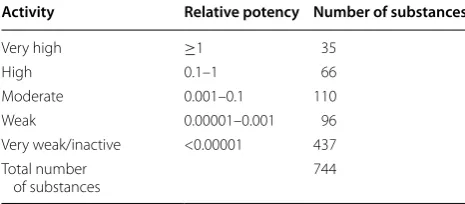
The collected dataset covers EA endocrine agonistic and antagonistic activities of 744 discrete chemicals. Sub-stances were categorized based on their in vitro potencies in individual tests, relative receptor-binding affinities, or effect concentrations relative to positive controls, ethi-nylestradiol (estrogenic) or testosterone (androgenic), respectively (Table 1). If several test results were available for the same compound, we used the highest reported in vitro potency. For a detailed description of the experi-mental data used to identify receptor-mediated EA endo-crine activities of substances, see the “Methods” section and Additional file 1.
Many chemicals are potential ligands of both, the estro-gen and androestro-gen receptors. Substantial similarity of EA
receptors regarding their binding sites can be assumed. Only a few chemical classes interact only with one of these receptor families, such as phthalates [5]. Because any kind of binding of xenobiotics to estrogen or andro-gen receptors is undesirable, we pooled the results from studies with both receptor types for the identification of relevant structural alerts. With the same reasoning, we did not differentiate between agonistic and antagonistic activities, since binding to the receptor is a prerequisite for both activities.
Analysis of available structural alerts
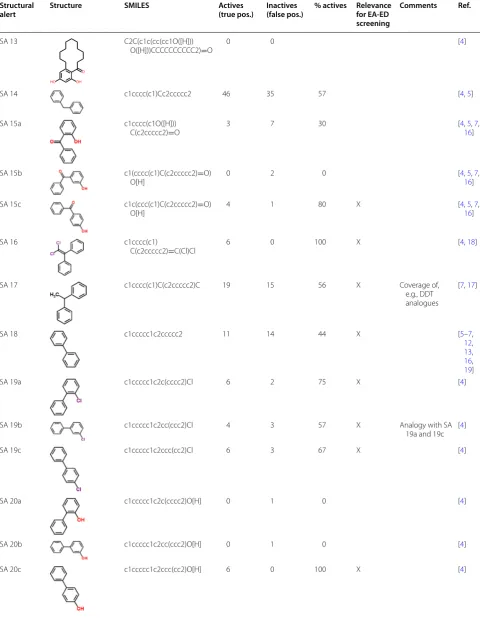
The collected dataset of estrogenic and androgenic activi-ties in vitro provided a comprehensive basis to analyze and define structural alerts that can be used to screen for potential EA-EDs (Table 2). First, we tested the applica-bility of structural alerts reported in the literature [1–17] like, for example, steroids, phytoestrogens, diphenyl-methanes, biphenyls, bisphenols, phthalates, and alkyl-phenols (for details, see Additional file 2). The existing structural alerts identified many potential EA-EDs, but also resulted in a considerable fraction of false negatives with active EA-EDs not detected. False negatives are par-ticularly critical because they could result in severe prob-lems if adequate precaution was then not taken.
Development of improved structural alerts
To improve the detection of potential EA-EDs, we iden-tified more structural alerts by systematic inspections of the chemical structures of substances with endo-crine activity, for example, brominated diphenyl ethers (BDEs) and hexabromocyclododecanes (HBCDDs) that are antagonists in EA receptor-binding assays [22]. Fur-thermore, we looked for possible refinements of estab-lished structural alerts. The phenolic ring structure is an essential element of many EA-EDs; however, without fur-ther specifications it is not an indicative structural alert. Table 1 Overview of relative in vitro EA endocrine poten-cies (agonistic and antagonistic) of test substances
Relative potency: substances were categorized based on their in vitro potencies in individual tests, relative receptor-binding affinities, or effect concentrations relative to positive controls, ethinylestradiol (estrogenic) or testosterone (androgenic), respectively
Activity Relative potency Number of substances
Very high ≥1 35
High 0.1–1 66
Moderate 0.001–0.1 110
Weak 0.00001–0.001 96
Very weak/inactive <0.00001 437 Total number
Established “phenol” alerts explicitly address, for exam-ple, DES, biphenylols, or parabens [4, 5, 7]. For additional improvements, we suggest p-alkyl substitution pattern to increase the detection of actives from less than 60% to more than 70% (see Table 2, SA 34 as compared to SA 26).
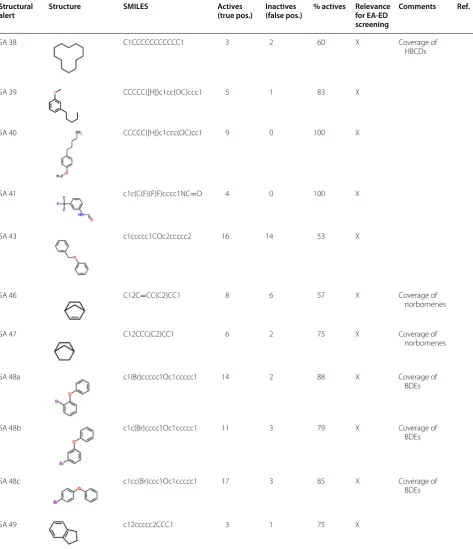
The performance of existing and new structural alerts was evaluated with the collected dataset of estrogenic and androgenic activities in vitro based on the number of substances with endocrine activity that contain the structural alert (“true positives”) relative to the number of substances without endocrine activity that contain the same structural alert (“false positives”). Table 2 lists the structural alerts together with their occurrences in either active or inactive substances. Generally, a struc-tural alert is considered a relevant EA-ED indicator (X in column “relevance for EA-ED screening”) if it could be found more often in active substances than in inac-tive substances. An empirical threshold of two-thirds was used to balance between too many “false positives” and too many “false negatives”. A few structural alerts with lower percentage of actives were included when either addressing very potent EA-EDs or covering large numbers of actives. Some structural alerts with high percentage of actives were not included because very similar structural alerts were available with even bet-ter performance (see Table 2, for example SA 6 as com-pared to SA 4 and 5). Some structural alerts could not be evaluated because they are not represented by the chemicals of the collected dataset of estrogenic and androgenic activities in vitro (see Table 2, for example SA 10, 13, 22, 31b, 36b).
The structural alerts (Table 2) classify 257 of 307 (84%) substances with endocrine activity in vitro as “true posi-tives”. The presence of a relevant structural alert thus clearly indicates potential EA receptor agonists and antagonists. These are priority pollutants to undergo further assessments of their potential for endocrine activities. At the same time, the structural alerts indicate 100 of 437 (23%) substances without endocrine activ-ity in vitro as false positives. False-positive predictions may lead to additional testing to show the absence of EA activities. Concern is related to false negatives [50 of 307 (16%)], chemicals with EA endocrine activities in vitro, but not recognized by structural alerts. Closer inspection of the 50 chemicals with false-negative predictions of EA-ED activities (for details, see Additional file 3) reveals 16 compounds with only (very) weak in vitro potencies according to the in vitro test results. With regard to pri-oritization of hazardous substances, these compounds may be considered less relevant. More significant are outliers with moderate (n = 26), high (n = 6), and very high (n = 2) in vitro potencies. Notably, among the eight
(very) highly potent compounds are six antiandrogens like linuron and cypermethrin. For example, linuron is a weak in vivo AR antagonist that causes antiandro-genic activity via enzymatic pathway inhibition [23] and thyreotoxicity [24]. Impairment of thyroidal function has profound effects on fetal development and postna-tal maturation and may mask EA-mediated effects. The 26 false-negative outliers of moderate in vitro potency are chemically diverse, including several pharmaceuticals and pesticides. The search for relevant structural alerts to detect these compounds was not successful. Another influential factor may be related to uncertainties of indi-vidual test results. Although the data were taken from peer-reviewed literature and quality-checked databases, “outliers” cannot be excluded.
It is important to note that the structural alerts are only indicators of the potential of chemical substances to be ligands of estrogen or androgen receptors. It is not possi-ble to conclude mode and strength of potential agonistic or antagonistic activities. Furthermore, chemicals acting by other endocrine pathways will not be recognized.
Analysis of in vivo mammalian long‑term reproduction studies with regard to estrogen‑ and androgen‑sensitive endpoints
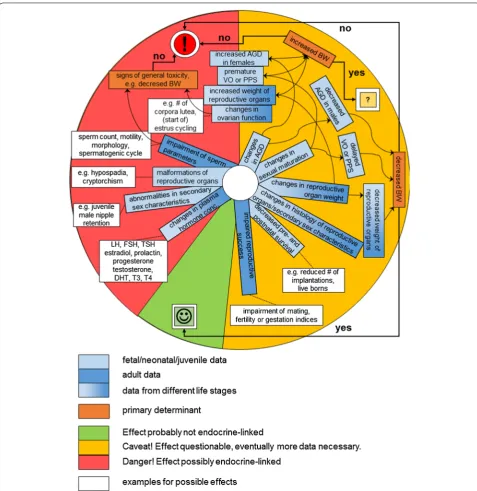
Long-term in vivo studies of the effects on reproduction and development of mammals may include effects on endocrine systems. Symptoms like estrus cycle irregulari-ties, reduced reproduction rate, or delayed sexual matu-ration may be due to systemic toxic effects, for example seen as decreased body weight, but also due to interfer-ences with the endocrine system [25]. Although causal links between the observed effects and endocrine dis-orders may be difficult to establish (Fig. 1), evaluation of existing information from repeated dose and multi-generation in vivo studies indicated several parameters related to potential endocrine disruption [26] and can thus be used to inform about potential endocrine disrup-tion with regard to the environment:
• malformation of reproductive organs, for example, agenesis/atrophic changes of testes, epididymis, and prostate;
• malformation and/or deviation of secondary sex characteristics, for example, hypospadia, male rodent nipple retention, and increased female anogenital distance;
• changes in serum hormone concentrations, for
example, luteinizing hormone (LH), follicle-stimulat-ing hormone (FSH), estrogen, and dihydrotestoster-one (DHT); and
Table 2 Performance of structural alerts for EA-EDs based on the number of substances with endocrine activity that con-tain the structural alert [Actives (true positives)] relative to the number of substances without endocrine activity that contain the same structural alert [Inactives (false positives)] (Table extracted from the project report [26])
Structural
alert Structure SMILES Actives (true pos.) Inactives (false pos.) % actives Relevance for EA‑ED screening
Comments Ref.
SA 01 C1CCC4C(C1)C2C(C3C(CC2)
CCC3)CC4 56 8 87 X [4, 7, 8]
SA 02 c1ccc3c(c1)C2C(CCCC2)
CC3 19 0 100 Covered by SA 01 [11]
SA 03 c1ccc2c(c1)C(C(C)CC2)C 21 0 100 X [40]
SA 04 c1cccc(c1)C=Cc2ccc(cc2)O 14 1 93 X [4]
SA 05 c1cccc(c1)CCc2ccc(cc2)O 17 2 89 X [4, 7]
SA 06 c1cccc(c1)CCc2ccccc2 18 8 69 More false
positives than SA 05
[5, 8]
SA 07 c1cccc(c1)C(=Cc2ccccc2)
c3ccccc3 8 0 100 X [4]
SA 08 C3(c1ccccc1)Oc2c(cccc2)
C(C=3)=O 8 7 53 [4]
SA 09 C3(c1ccccc1)Oc2c(cccc2)
C(C3)=O 5 4 56 [4]
SA 10 C3(c1ccccc1)C(c2c(cccc2)
OC3)=O 0 0 [4]
SA 11 C3(c1ccccc1)=Cc2c(cccc2)
OC3=O 1 0 100 X [4]
SA 12a
O
C(c1ccccc1)
CC(c2ccccc2)=O 7 4 64 [4]
SA 12b O=C(c(cccc1)c1)
Table 2 continued
Structural
alert Structure SMILES Actives (true pos.) Inactives (false pos.) % actives Relevance for EA‑ED screening
Comments Ref.
SA 13
HO OH
O
C2C(c1c(cc(cc1O([H]))
O([H]))CCCCCCCCCC2)=O 0 0 [4]
SA 14 c1cccc(c1)Cc2ccccc2 46 35 57 [4, 5]
SA 15a c1cccc(c1O([H]))
C(c2ccccc2)=O 3 7 30 [4, 165, ]7,
SA 15b c1(cccc(c1)C(c2ccccc2)=O)
O[H] 0 2 0 [4, 165, ]7,
SA 15c c1c(ccc(c1)C(c2ccccc2)=O)
O[H] 4 1 80 X [4, 165, ]7,
SA 16 c1cccc(c1)
C(c2ccccc2)=C(Cl)Cl 6 0 100 X [4, 18]
SA 17 c1cccc(c1)C(c2ccccc2)C 19 15 56 X Coverage of,
e.g., DDT analogues
[7, 17]
SA 18 c1ccccc1c2ccccc2 11 14 44 X [5–7,
12, 13, 16, 19]
SA 19a c1ccccc1c2c(cccc2)Cl 6 2 75 X [4]
SA 19b c1ccccc1c2cc(ccc2)Cl 4 3 57 X Analogy with SA
19a and 19c [4]
SA 19c c1ccccc1c2ccc(cc2)Cl 6 3 67 X [4]
SA 20a c1ccccc1c2c(cccc2)O[H] 0 1 0 [4]
SA 20b c1ccccc1c2cc(ccc2)O[H] 0 1 0 [4]
Table 2 continued
Structural
alert Structure SMILES Actives (true pos.) Inactives (false pos.) % actives Relevance for EA‑ED screening
Comments Ref.
SA 21 c1ccc2c(c1)Oc3c(O2)cccc3 1 0 100 X [12]
SA 22 c1ccc2c(c1)oc3c2cccc3 0 0 [12]
SA 23
O
O
O
O
c1ccc(c(c1)C(OC)=O)C(=O)
OC 7 6 54 X [5, 187, ]
SA 24 OH
O O
c1cc(ccc1C(OC)=O)O[H] 16 2 89 X [4, 5]
SA 25a OH
O c1c(c(ccc1)O([H]))OC 3 3 50 [4]
SA 25b OH
O
O(C)c1cc(ccc1)O[H] 15 17 47 [4]
SA 25c OH
O
O(C)c1ccc(cc1)O[H] 7 3 70 X [4]
SA 26 c1cc(ccc1)O[H] 131 98 57 Specified
phe-nols: see SA 04, SA 05, SA 15, SA 20, SA 25, SA 34
[5, 7– 11, 14– 16, 18, 40]
SA 27 C1(=O)CCCCC1 7 4 64 [40]
SA 28 c1cccc(c1)C(c2ccccc2)
c3ccccc3 1 5 17 [7]
SA 29 c1c(ccc(c1)S(c2ccc(cc2)
O([H]))(=O)=O)O[H] 0 1 0 [7]
SA 30a c1c(ccc(c1)Oc2c(cc(cc2)
Cl)Cl)Cl 2 0 100 X [18]
SA 30b c1c(ccc(c1)Oc2c(cc(cc2)Cl)
Cl)N(=O)=O 4 0 100 X [18]
SA 31a c1cccc(c1)CN2C(c3c(C2=O)
cccc3)=O 1 1 50 [7]
SA 31b c1c(ccc(c1)
CN2C(c3c(C2=O) cccc3)=O)N(=O)=O
Table 2 continued
Structural
alert Structure SMILES Actives (true pos.) Inactives (false pos.) % actives Relevance for EA‑ED screening
Comments Ref.
SA 31c c1c(ccc(c1)
CN2C(c3c(C2=O) cccc3)=O)O[H]
1 0 100 X [7]
SA 32a c1cccc(c1)OP(=O)(OC)OC 1 0 100 X [7]
SA 32b c1cccc(c1)OP(=S)(OC)OC 3 1 75 X [7]
SA 33 c1nc(N)nc(N)n1 0 6 0 [7]
SA 34a OH [H]Oc1ccc(C([H])C)cc1 39 15 72 X Specified from
SA 26
SA 34b OH [H]Oc1ccc(C(C)(C)C([H]))cc1 7 9 44 Specified from
SA 26
SA 34c OH [H]Oc1c([H])c([H])c(C([H])C)
c([H])c([H])1 23 5 82 X Specified from SA 26
SA 34d OH [H]Oc1c([H])c([H])c(C(C)(C)
C([H]))c([H])c([H])1 6 2 75 X Specified from SA 26
SA 35 c(c(c(c(c1)ccc2)c2)ccc3)
(c1)c3 13 8 62 X Coverage of certain active
polyaromatic compounds
SA 36a c1ccccc1CC=O 28 35 44 [7]
SA 36b
P S
c1ccccc1CP=S 0 0 [18]
SA 37 c1ccccc1N2C(=O)
As depicted in Fig. 1, deviation of only one param-eter is in most cases not sufficient to conclude an endocrine activity. First, it should be evaluated if a
secondary effect can be excluded, for example, due to changes in body weight. Second, it should be checked if further parameters are affected and the conclusion Table 2 continued
Structural
alert Structure SMILES Actives (true pos.) Inactives (false pos.) % actives Relevance for EA‑ED screening
Comments Ref.
SA 38 C1CCCCCCCCCCC1 3 2 60 X Coverage of
HBCDs
SA 39 O CCCCC([H])c1cc(OC)ccc1 5 1 83 X
SA 40 CCCCC([H])c1ccc(OC)cc1 9 0 100 X
SA 41 c1c(C(F)(F)F)cccc1NC=O 4 0 100 X
SA 43 c1ccccc1COc2ccccc2 16 14 53 X
SA 46 C12C=CC(C2)CC1 8 6 57 X Coverage of
norbornenes
SA 47 C12CCC(C2)CC1 6 2 75 X Coverage of
norbornenes
SA 48a c1(Br)ccccc1Oc1ccccc1 14 2 88 X Coverage of
BDEs
SA 48b c1c(Br)cccc1Oc1ccccc1 11 3 79 X Coverage of
BDEs
SA 48c c1cc(Br)ccc1Oc1ccccc1 17 3 85 X Coverage of
BDEs
SA 49 c12ccccc2CCC1 3 1 75 X
should be drawn based on a weight-of-evidence approach.
Reproductive toxicity data and subacute to chronic repeated dose toxicity studies were retrieved from the FedTex (http://cefic-lri.org/lri_toolbox/fedtex/) and the
RepDose (http://www.fraunhofer-repdose.de/)
data-bases. The FedTex and RepDose data were selected
from the available literature based on the level of detail regarding, for example, description of study design and details given for results. The data were double-checked by a second expert. Screening for chemicals with positive effect parameters related to potential endocrine disrup-tion resulted in a list of 240 organic compounds. These compounds are reproductive toxicants with a certain
likelihood of endocrine disruption. An indication of the EA-EDs among the 240 compounds was obtained from a comparison with results from receptor-based in vitro assays. We observed about half of them to interact with EA receptors, indicating true positives that are toxic for reproduction and likely to have endocrine activities in mammals. Such substances are also potential endocrine disruptors with regard to the environment and further assessment of effects in fish might be needed. The other half of the 240 compounds are inactive in receptor-based in vitro assays and probably not EA-EDs in mammals.
Consistency of potential estrogenic and androgenic endocrine activities based on in vitro assays and in vivo mammalian long‑term reproduction studies and fish life‑cycle tests
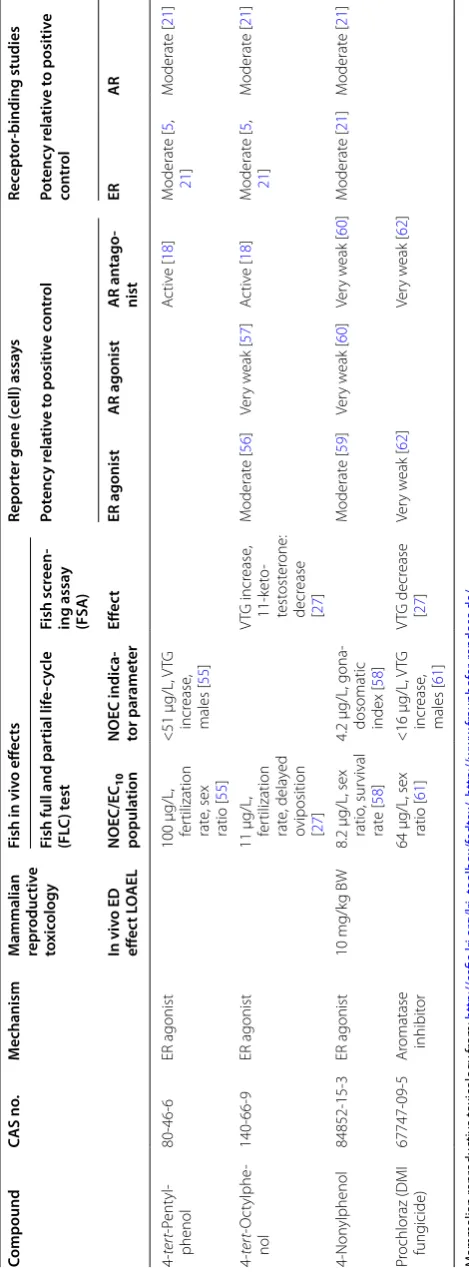
The predictive power of in vitro receptor binding and in vivo toxicity in mammals for endocrine activity in fish was assessed by comparing their outcome with results of reproduction and biomarker studies with fish, focusing on sexual endocrine endpoints, from an UBA report [27] and the literature cited therein (see Table 3). Population-relevant endpoints were addressed by full life-cycle and two-generation tests (FLC) focusing on the effect param-eters reproduction (fertilized eggs, fertility rate), sexual development, and generation time. Partial life-cycle tests also address population-relevant effects on sexual devel-opment and reproduction. Indicative biomarkers for endocrine effects were investigated in the short-term fish screening assay (FSA) including vitellogenin and steroid hormone levels in blood. Regarding fish in vivo data, in total 22 studies (fish full life-cycle, partial life-cycle, and fish screening assays) were available for 12 substances. The effects of these 12 substances on fish were compared to the effects on mammals and in in vitro tests (Table 3). Only for eight of them, also reproductive toxicity data for rodents were available. Receptor-based in vitro data could be retrieved for all the 12 substances. There is a remarkably good consistency of the data from fish and mammalian tests. The receptor-based in vitro activi-ties support comparable sexual endocrine pathways of toxic action in fish and mammals. Combined assess-ment of data obtained in in vitro assays and in vivo fish tests reveals information on the underlying mechanism of action of the tested substance in fish, for example, reduced fertilization rate due to inhibition of androgen receptor activity in males.
The substances identified as “endocrine active” in fish tests are reproductive toxicants in mammals and EA receptor ligands in in vitro assays (Table 3). There are no false-negative results; however, the relative poten-cies vary. For example, flutamide is a moderate AR ago-nist in in vivo fish FLC tests [27], very active in in vitro
reporter gene assays [28], and causes malformations in epididymis, seminal vesicles, prostate, Cowper’s glands, and penis in rodents [29]. It furthermore affects male secondary sexual characteristics in terms of feminization, impairs spermatogenesis, and alters pituitary hormone concentrations [30].
Evaluation of structural alerts, in vitro assays, and in vivo mammalian long‑term reproduction studies for the indication of potential estrogenic and androgenic endocrine disruptors in fish
Comparative analyses of the agreement of chemical and toxicological approaches to the identification of poten-tial EA-EDs in fish were based on receptor-based in vitro assays and in vivo mammalian long-term reproduction studies. The combined dataset includes 933 chemicals, with 693 having only in vitro data and 189 having only in vivo mammalian long-term reproduction data. For 51 substances, in vivo as well as in vitro data were avail-able. The minor overlap of the in vivo and in vitro data-sets with only 51 chemicals shows that for many in vivo reproductive toxicants in rodents, the corresponding in vitro results that could specify the relevant modes of action have not been published.
The results of pairwise comparisons of the in vivo mammalian long-term reproductive toxicities and in vitro classifications with structural alerts of potential EA-EDs were quantified in terms of accuracy (proportion of substances correctly classified), sensitivity (proportion of true positives correctly classified), and specificity (pro-portion of true negatives correctly classified); for details, see “Methods” section.
The structural alerts agree quite well (80% accuracy) with the in vitro classifications (Table 4). This was to be expected since the structural alerts were derived from in vitro data. 16.3% (50 of 307) of the active chemicals in vitro are false negatives not recognized by the struc-tural alerts. From the inactive chemicals in vitro, 22.9% (100 of 437) have the structural alerts and thus are false positives. Notably, performance of the structural alerts is better for chemicals with higher activity in vitro, and (very) high activities are classified more accurately than moderate to (very) weak activities.
Table 3 C omparison of in viv o long-t erm r epr oduc
tion studies with mammals and fish with r
esults fr om r ec ept or-based in vitr o assa ys Compound CAS no . M echanism M ammalian repr oduc tiv e to xic ology Fish in viv o eff ec ts Repor
ter gene (c
ell) assa ys Rec ept or ‑binding studies
Fish full and par
tial lif e‑ cy cle (FL C) t est Fish scr een ‑ ing assa y (FSA ) Pot enc y r ela tiv e t o positiv e c on tr ol Pot enc y r ela tiv e t o positiv e con tr ol In viv o ED eff ec t L O AEL NOEC/EC 10 popula tion NOEC indica ‑ tor par amet er Effe ct ER agonist AR agonist AR an tago ‑ nist ER AR 17-α Ethin yl-estradiol 57-63-6 ER agonist Pos .-contr ol in scr een -ing assa ys (OECD 440) 0.3
ng/L, fertilization rate, dela
yed
oviposition [41
] 1 ng/L, o vot es -tis [ 42 ] VT G incr ease [ 27 ] Ver y ac tiv e [ 43 ] No [ 28 ] Ver y ac tiv e [ 5 ] M oderat e [ 21 ] 17-β Estradiol 50-28-2 ER agonist 0.0025 mg/k g BW 2.9
ng/L, fertilization rate, juv
enile gr owth [ 44 ] 2.9 ng/L, V TG induc tion, males [ 44 ] Ver y ac tiv e [ 45 ] M oderat e [ 28 ] A ctiv e [ 18 ] Ver y ac tiv e [ 5 ] A ctiv e [ 21 ] Tamo xif en 10540-29-1 ER antagonist 0.00012 mg/ kg B W 1.6
µg/L, fertilization rate [
27 ] 1.6 µg/L, V TG decr ease , females [ 27 ] VT G decr ease [ 27 ] M oderat e [ 43 ] M oderat e [ 46 ] Ver y ac tiv e [ 21 ] A ctiv e [ 46 ] G enist ein 446-72-0
ER agonist, enz
yme inhibit or : ar omatase 1.25 mg/k g BW 1.3
µg/L, fertilization rate, dela
yed
oviposition [27
] M oderat e [ 47 ] Ver y ac tiv e [ 21 ] M oderat e [ 21 ] M eth yl-t est os -ter one 58-18-4 AR agonist 10
ng/L, sex ratio [
48 ] <0.4 ng/L, V TG decr ease , females [ 48 ] A ctiv e [ 49 ] A ctiv e [ 49 ] Ver y ac tiv e [ 21 ] 17β-Tr enbolone 10161-33-8 AR agonist 1.68 mg/k g BW 3
ng/L, sex ratio [
50 ] <1 ng/L, hist ol -ogy : egg debr is [ 50 ] VT
G and 11-k
et o-test ost er one: no eff ec t [ 27 ] A ctiv e[ 28 ] Ver y ac tiv e [ 21 ] Flutamide 13311-84-7 AR antagonist 2.5 mg/k g B W 189 µg/L, egg pr oduc tion [ 27 ] 435 µg/L, V TG decr ease , females , 11-k et o-test ost er one: incr ease [ 27 ] VT
G no eff
ec t, 11-k et o-test ost er one: incr ease [ 27 ] W eak [ 28 ] Ver y ac tiv e [ 28 ] M oderat e [ 21 ] Bisphenol A 80-05-7 ER agonist 0.0002 mg/k g BW 390 µg/L, f er ti-lization rat e, dela yed o vi -position [ 51 ] 160 µg/L, hat ching rat
e of F1
generation [52
Table 3 c on tinued Compound CAS no . M echanism M ammalian repr oduc tiv e to xic ology Fish in viv o eff ec ts Repor
ter gene (c
ell) assa ys Rec ept or ‑binding studies
Fish full and par
tial lif e‑ cy cle (FL C) t est Fish scr een ‑ ing assa y (FSA ) Pot enc y r ela tiv e t o positiv e c on tr ol Pot enc y r ela tiv e t o positiv e con tr ol In viv o ED eff ec t L O AEL NOEC/EC 10 popula tion NOEC indica ‑ tor par amet er Effe ct ER agonist AR agonist AR an tago ‑ nist ER AR 4-ter t -P ent yl -phenol 80-46-6 ER agonist 100 µg/L, fer tilization rat e, sex ratio [ 55 ] <51 µg/L, V TG incr ease , males [ 55 ] A ctiv e [ 18 ] M oderat e [ 5 , 21 ] M oderat e [ 21 ] 4-ter t -O ct ylphe -nol 140-66-9 ER agonist 11
µg/L, fertilization rate, dela
yed
oviposition [27
] VT G incr ease , 11-k et o-test ost er one: decr ease [ 27 ] M oderat e [ 56 ] Ver y w eak [ 57 ] A ctiv e [ 18 ] M oderat e [ 5 , 21 ] M oderat e [ 21 ] 4-Non ylphenol 84852-15-3 ER agonist 10 mg/k g B W 8.2
µg/L, sex ratio
, sur vival rat e [ 58 ] 4.2 µg/L, gona
-dosomatic index [
58 ] M oderat e [ 59 ] Ver y w eak [ 60 ] Ver y w eak [ 60 ] M oderat e [ 21 ] M oderat e [ 21 ] Pr
ochloraz (DMI fung
icide)
67747-09-5
Ar
omatase inhibit
or
64
µg/L, sex ratio [
61 ] <16 µg/L, V TG incr ease , males [ 61 ] VT G decr ease [ 27 ] Ver y w eak [ 62 ] Ver y w eak [ 62 ] M ammalian r epr oduc tiv e t oxic ology fr om: http://c efic -lr i.or g/lr i_t oolbo x/f edt ex/ , http://w w w .fr aunhof er -r epdose .de/ Rela tiv e pot
encies in r
ec ept or -based in vitr o assa ys: substanc es w er e ca tegor iz
ed based on their in vitr
o pot
encies in individual t
ests , r ela tiv e r ec ept or -binding affinities
, or eff
ec t c onc en tr ations r ela tiv e t o positiv e con tr ols , ethin ylestr adiol (estr
ogenic) or t
true positives). At the same time, inactivity in vitro is not a good indicator for the absence of reproductive toxicity in vivo. The reproductive toxicity of compounds with-out EA receptor-binding potential is likely due to other modes of action.
For an overview of the relationships between chemi-cal and toxicologichemi-cal approaches to the identification of potential EA-EDs, we calculated classification statistics of pairwise comparisons of in vivo mammalian long-term reproductive toxicities, receptor-based in vitro activities, and structural alerts of potential EA-EDs. Table 6 sum-marizes the overall agreement, sensitivities, and specifi-cities either for the full datasets (n = 744 or n = 240 for the receptor-based in vitro activities or the in vivo mam-malian long-term reproductive toxicities, respectively) or the subset of compounds with in vitro and in vivo data (n = 51). We observe similar results for the relationships between in vitro activities and structural alerts, regard-less of the size and composition of the datasets. The simi-lar information content of the in vitro activities and the structural alerts is furthermore the reason for the almost identical overall agreement, sensitivities, and specificities of activities in vivo with either structural alerts or in vitro activities, with regard to the same subset of compounds (n = 51). Again, we observe no false-negative results, but >50% false positives. The agreement is much less for the relationships between the entire dataset of activities
in vivo (n = 240) and structural alerts. This is due to the in vivo mammalian dataset representing multiple path-ways of reproductive toxicity, while the structural alerts are limited to EA receptor interactions.
The screening for potential EA-EDs based on struc-tural alerts relative to in vitro classifications and in vivo mammalian long-term reproductive toxicities is shown in Table 7. Regarding first the chemicals with mamma-lian long-term reproductive toxicity in vivo and recep-tor-based in vitro assays, we see positive results from the three approaches confirming each other for 19 chemicals (marked in red). Five substances with in vivo mammalian long-term reproductive toxicity are identified in vitro but not from their chemical structures (marked in orange). Structural alerts classify another three compounds with activity in vivo but not in vitro (marked in orange). For the remaining 21 mammalian long-term reproductive toxicants, neither in vitro assays nor structural alerts provide evidence of interferences with EA endocrine receptors and, thus, other toxic pathways are more likely causing the reproductive toxicity.
For 13 chemicals that are inactive in vivo, we observe no structural alerts and also the in vitro data suggest the absence of EA endocrine effects (marked in green).
Among the 744 chemicals in the combined dataset with in vitro data are 693 without information about in vivo mammalian long-term reproductive toxicity, 335 of them Table 4 Comparison of in vitro activities and structural alerts of potential EA-EDs (numbers of chemicals, n = 744)
Accuracy = 79.8% (overall agreement)
Sensitivity = 83.7% (→16.3% false-negative classifications)
Specificity = 77.1% (→22.9% false-positive classifications)
In vitro very high
activity In vitro high activity In vitro moderate activity In vitro weak activity In vitro very weak or no activity Σ
Structural alert = yes 33 60 84 80 100 357
Structural alert = no 2 6 26 16 337 387
Σ 35 66 110 96 437 744
Table 5 Comparison of in vivo mammalian long-term reproductive toxicities and in vitro activities of potential EA-EDs (numbers of chemicals, n = 51)
Accuracy = 52.9% (overall agreement)
Sensitivity = 100% (→no false-negative classifications)
Specificity = 50.0% (→50% false-positive classifications)
Mammalian long-term reproductive toxicants: in vivo active: causing specific endpoints indicative for endocrine activity, in vivo inactive: not causing specific outcomes in the available study/studies
In vitro very high
activity In vitro high activity In vitro moderate activity In vitro weak activity In vitro very weak or no activity Σ
In vivo active 6 6 11 1 24 48
In vivo inactive 0 0 0 0 3 3
with structural alerts and 358 without structural alerts. The evaluation of their in vitro activities in combination with structural alerts indicates 84 chemicals (marked in orange) with high probability of EA-EDs in fish and fur-ther assessments are recommended. Lower probability of EA-EDs may be associated with the chemicals with moderate to minor activity in vitro and/or the absence of structural alerts [marked in (pale) yellow]. The priority for further assessments is very low for the 313 substances with only very weak or no activity in vitro and without structural alerts (marked in pale green).
Application of structural alerts for the identification of potential EA‑EDs in EINECS
The structural alerts for the identification of potential EA-EDs (Table 2) have been applied to EINECS (Euro-pean inventory of existing commercial chemical sub-stances) to test the performance on large numbers of diverse substances and to prioritize potential candidates for endocrine activity due to interactions with estro-gen and androestro-gen receptors. EINECS includes approx. 100,000 substances that were deemed to be on the Euro-pean Community market between January 1, 1971 and September 18, 1981 [31]. Substances listed in EINECS
are “existing chemicals” and considered phase-in sub-stances under REACH.
For application to EINECS, the structural alerts
(Table 2) have been implemented in a computerized
screening tool (EDC-Scan).1 To support prediction
confi-dence of the structural alerts in EDC-Scan, their applica-bility domain (AD) was defined based on atom-centered fragments (ACFs) [32]. The collected dataset of estro-genic and androestro-genic activities in vitro (see Additional file 1) was used as the training set for the determination of the AD of the structural alerts. If a chemical is within the AD because it is similar to the substances used to set up the model, predictions are considered most trustwor-thy. If a compound is outside the AD, reliability of esti-mates is low because it may act in different ways.
More than 33,000 discrete organic EINECS compounds are within the ACF-defined AD of the structural alerts for potential EA-EDs. Among them, structural alerts indicate 3585 chemicals (ca. 11%) as candidates with
1 Within a follow-up project (UBA, FKZ 3714634120), the structural alerts
for EA-EDs as well as other endocrine effects are being included in Chem-Prop (http://www.ufz.de/ecochem/chemprop).
Table 6 Overall agreement, sensitivities, and specificities of in vivo mammalian long-term reproductive toxicities, in vitro activities, and structural alerts of potential EA-EDs
Dataset n = 744: all compounds with in vitro data, dataset n = 240: all compounds with in vivo data, dataset n = 51: all compounds with in vitro and in vivo data
n Overall agreement (%) Sensitivity (%) Specificity (%)
In vitro/structural alerts (all compounds with in vitro data) 744 79.8 83.7 77.1
In vitro/structural alerts (all compounds with in vitro and in vivo data) 51 84.3 79.2 88.9
In vivo/in vitro (all compounds with in vitro and in vivo data) 51 52.9 50.0 100
In vivo/structural alerts (all compounds with in vitro and in vivo data) 51 49.0 45.8 100
In vivo/structural alerts (all compounds with in vivo data) 240 20.0 15.4 100
Table 7 Screening for potential EA-EDs based on structural alerts relative to in vitro classifications and in vivo mammalian long-term reproductive toxicities (numbers of chemicals, n = 933)
in vitro
very high activity
in vitro
high activity
in vitro
moderate activity
in vitro
weak activity
in vitro
very weak or no activity
No information about in vitro
activity Σ
in vivoactive
Structural alert = yes 6 5 7 1 3 13 35
Structural alert = no 0 1 4 0 21 166 192
in vivoinactive
Structural alert = yes 0 0 0 0 0 0 0
Structural alert = no 0 0 0 0 3 10 13
No information about in vivoactivity
Structural alert = yes 27 55 77 79 97 0 335
Structural alert = no 2 5 22 16 313 0 358
potential endocrine activity. Their chemical structures are principally able to interact with estrogen and andro-gen receptors as either agonists or antagonists. Due to the possibility that these chemicals may interact with EA receptors, they should be subject to further investigations regarding their potential for endocrine effects in fish.
Structural alerts have been detected in another 413 organic chemicals that are outside the ACF-defined AD of the structural alerts for the identification of potential EA-EDs. According to good modeling practice, these pre-dictions are not valid because they are not supported by the activities of the compounds of the training set. Still, these 413 chemicals contain structural elements that may be able to interact with estrogen and androgen receptors. If no additional evidence for endocrine activity is availa-ble, such alerts would probably not be sufficient to trigger further regulatory action such as substance evaluation, although toxicological reasoning suggests that they are candidates for EA-ED activities.
Estrogenic and androgenic ED activities of the remain-ing substances cannot be excluded, but are less likely. Because the structural alerts perform much better for substances with (very) high estrogenic and androgenic activities (<10% false-negative classifications for strong binders) as compared to >15% false-negative classifica-tions for (very) weak binders, there is reasonable prob-ability that the candidates with potential endocrine activities based on structural alerts include the most haz-ardous EA-EDs.
Conclusions
In vivo, in vitro, and in silico methods for the identifi-cation of potential EA-EDs with regard to the environ-ment cover different adverse effects at the biomolecular and organism levels and indicate population-relevant effects. In vivo studies often summarize effects caused by multiple pathways of endocrine and other repro-ductive toxicities. In vitro assays may address specific modes of endocrine activities. Structural alerts repre-sent the in vitro assays from which they were derived. The combination of in vivo and in vitro information with structural alerts provides complementary informa-tion for evidence-based assessments of potential EDs. Information obtained at each level may support the pri-ority setting for further assessments of candidate chem-icals with potential environmental hazards. Evidence for endocrine activity increases if structural alerts, in vitro activities, as well as in vivo information provide positive results.
Application of structural alerts for the identification of potential EDs to the EINECS inventory indicated 3585 chemicals (ca. 11%) as potential candidates for endocrine
effects. Due to the possibility that these chemicals may interact with estrogen and androgen receptors, they should be subject to further investigations regarding their potential for endocrine activity with regard to the envi-ronment. Such substances are indicated during the mass screening performed by ECHA and manually screened by member states. They may become subject to regula-tory actions if the screening evidence is substantiated by additional information.
Methods
Experimental data from in vitro assays
Data were collected from publicly available databases and the open literature for in vitro tests on estrogenic and androgenic receptor binding and receptor activation in cell cultures. Activities were measured via reporter gene activation or cell proliferation, for example, competitive ligand-binding assays, reporter gene assays with mamma-lian cells with endogenous estrogen receptors transiently or permanently transfected with luciferase reporter gene systems, for example, CALUX [33, 34] and MVLN, MCF-7, or HeLa cells [33, 35–38], yeast-based receptor gene tests stably transfected with a β-galactosidase reporter gene [14], and MCF-7 cell proliferation assay (E-Screen) [39].
1. US Food and Drug Administration Endocrine Dis-ruptor Knowledge Base (FDA-EDKB): http://www. fda.gov/ScienceResearch/BioinformaticsTools/Endo-crineDisruptorKnowledgebase/default.htm.
The FDA-EDKB database contains data regard-ing bindregard-ing to androgen as well as estrogen recep-tors. The ligand-binding studies were conducted and validated at NCTR (National Center for Toxico-logical Research, Jefferson, USA). The test results are reported as percent relative binding affinity (RBA) of the test substance relative to the respective positive standards (17R-methyl-3H]methyltrienolone (R1881)
for AR and [3H]-17β-estradiol for ER).
Androgen receptor (recombinant receptor): log (RBA) is given for 146 of 202 substances, ranging between 2.3 and −3.6. The remaining 56 substances are classified as non-binding.
Estrogen receptor (isolated from rat uteri): log (RBA) is given for 131 of 232 substances, ranging between 2.6 and −4.5. The remaining 101 substances are clas-sified as non-binding.
2. National Center for Toxicological Research Estrogen Receptor Binding Database (DSSTOX-NCTRER): http://www.epa.gov/ncct/dsstox/sdf_nctrer.html. The DSSTOX-NCTRER database contains relative
sub-stances based on ligand-binding studies with estro-gen receptors (species: rat). Activities are classified in five “activity categories”. This dataset is identical with the estrogen receptor dataset of FDA-EDKB described above.
3. Data retrieved from primary literature:
Primary literature was evaluated for test results from diverse in vitro assays (Table 8); 1155 test results were collected for 744 substances (data tables with references are provided in Additional file 1).
Classification statistics
The results of pairwise comparisons of the in vivo, in vitro, and in silico classifications of potential EA-EDs were quantified in terms of accuracy (proportion of sub-stances correctly classified), sensitivity (proportion of true positives correctly classified), and specificity (pro-portion of true negatives correctly classified):
where TP: true positive, TN: true negative, FP: false positive, FN: false negative, and Tot: total number of compounds.
Accuracy= (TP+TN) Tot ×100
Sensitivity= TP
TP+FN×100
Specificity= TN
TN+FP×100
Authors’ contributions
MN evaluated structural alerts, calculated classification statistics, and drafted the manuscript. MM evaluated structural alerts and developed and programmed the EDC-Scan tool. AW collected and analyzed the in vitro data and evaluated in vivo fish toxicity studies. GL and NS contributed the in vivo mammalian reproductive toxicity data collection and assessment. FS and JA participated in the design and coordination of the study. All authors read and approved the final manuscript.
Author details
1 Analytical Laboratory, Bahnhofstr. 1, 24816 Luhnstedt, Germany. 2
Fraun-hofer Institute for Molecular Biology and Applied Ecology IME, Auf dem
Aberg 1, 57392 Schmallenberg, Germany. 3 Fraunhofer Institute for
Toxi-cology and Experimental Medicine ITEM, Nikolai-Fuchs-Str. 1, 30625
Han-nover, Germany. 4 German Environment Agency UBA, Wörlitzer Platz 1,
06844 Dessau-Roßlau, Germany. 5 Present Address: 30161 Hannover, Germany.
Acknowledgements
This project was done on behalf of the German Environment Agency (UBA) as part of the Environmental Research Plan—FKZ 206 67 448/05—and received federal funding.
The authors thank Elke Muth-Köhne, Matthias Teigeler, and Christoph Schäfers for critical discussions and valuable suggestions and two anony-mous reviewers for constructive comments, which helped us to improve the manuscript.
Competing interests
The authors declare that they have no competing interests.
Availability of data and materials
The data collected from publicly available databases and the open literature for in vitro tests on estrogenic and androgenic receptor-mediated activities
are available in Additional file 1. Structural alerts reported in the literature are
available in Additional file 2. The 50 chemicals with false-negative predictions
of EA-ED activities are listed in Additional file 3.
Received: 10 August 2016 Accepted: 24 October 2016
References
1. European Commission (2006) Regulation (EC) no 1907/2006 of the European parliament and of the council of 18 December 2006 concern-ing the registration, evaluation, authorisation and restriction of chemicals (REACH), establishing a European chemicals agency, amending directive 1999/45/EC and repealing council regulation (EEC) no 793/93 and com-mission regulation (EC) no 1488/94 as well as council directive 76/769/ EEC and commission directives 91/155/EEC, 93/67/EEC, 93/105/EC and 2000/21/EC. Brussels, Belgium
2. European Commission (2013) Roadmap for SVHCs identification and implementation of REACH risk management measures from now to 2020. http://register.consilium.europa.eu/doc/srv?l=EN&f=ST%205867%20 2013%20INIT. Accessed 3 Nov 2015
3. OECD (2012) Guidance document on standardised test guidelines for evaluating chemicals for endocrine disruption. OECD, Paris Additional files
Additional file 1. Estrogenic and androgenic endocrine activities in vitro. Additional file 2. Structural alerts.
Additional file 3. False negatives (not recognized by structural alerts).
Table 8 Numbers of in vitro data retrieved from primary literature
ER estrogen receptor, AR androgen receptor
In vitro assays Number of test results
Reporter gene assays
Androgen receptor activation, agonist 93 Androgen receptor activation, antagonist 395 Estrogen receptor activation, agonist ER alpha 202 Estrogen receptor activation, antagonist ER
alpha 86
Estrogen receptor activation, agonist ER beta 62 Estrogen receptor activation, antagonist ER
beta 7
Ligand-binding assays
Receptor-binding AR 36
Receptor-binding ER alpha 246
Receptor-binding ER beta 28
4. US EPA. Distributed structure-searchable toxicity (DSSTox) database. https://www.epa.gov/chemical-research/distributed-structure-searcha-ble-toxicity-dsstox-database. Accessed 21 Apr 2009
5. Blair RM, Fang H, Branham WS, Hass BS, Dial SL, Moland CL, Tong W, Shi L, Perkins R, Sheehan DM (2000) The estrogen receptor relative binding affinities of 188 natural and xenochemicals: structural diversity of ligands. Toxicol Sci 54:138–153
6. Bradbury SP, Mekenyan OG, Ankley GT (1996) Quantitative structure– activity relationships for polychlorinated hydroxybiphenyl estrogen receptor binding affinity: an assessment of conformer flexibility. Environ Toxicol Chem 15:1945–1954
7. Fang H, Tong W, Branham WS, Moland CL, Dial SL, Hong H, Xie Q, Perkins R, Owens W, Sheehan DM (2003) Study of 220 natural, synthetic, and environmental chemicals for binding to the androgen receptor. Chem Res Toxicol 16:1338–1358
8. Hong H, Tong W, Fang H, Shi L, Xie Q, Wu J, Perkins R, Walker JD, Branham W, Sheehan DM (2002) Prediction of estrogen receptor binding for 58,000 chemicals using an integrated system of a tree-based model with struc-tural alerts. Environ Health Perspect 110:29–36
9. Jordan VC, Mittal S, Gosden B, Koch R, Lieberman ME (1985) Structure– activity relationships of estrogens. Environ Health Perspect 61:97–110 10. Katzenellenbogen JA (1995) The structural pervasiveness of estrogenic
activity. Environ Health Perspect 103:99–101
11. Klopman G, Chakravarti SK (2003) Structure–activity relationship study of a diverse set of estrogen receptor ligands (I) using MultiCASE expert system. Chemosphere 51:445–459
12. Krishnan V, Safe S (1993) Polychlorinated biphenyls (PCBs),
dibenzo-p-dioxins (PCDDs), and dibenzofurans (PCDFs) as antiestrogens in MCF-7
human breast cancer cells: quantitative structure–activity relationships. Toxicol Appl Pharmacol 120:55–61
13. Navas JM, Alonso M, Casado S, Miranda C, Tarazona JV, Herradón B (2007) Structural features of ligands of the aryl hydrocarbon receptor: the case of the polybrominated biphenyl 209 (PBB-209). In: Poster presentation at SETAC Europe 17th annual meeting, Porto, Portugal
14. Routledge EJ, Sumpter JP (1997) Structural features of alkylphe-nolic chemicals associated with estrogenic activity. J Biol Chem 272:3280–3288
15. Schmieder P, Aptula AO, Routledge EJ, Sumpter JP, Mekenyan OG (2000) Estrogenicity of alkylphenolic compounds: a 3-D structure–activity evalu-ation of gene activevalu-ation. Environ Toxicol Chem 19:1727–1740
16. Schultz TW, Sinks GD, Cronin MTD (2002) Structure–activity relationships for gene activation oestrogenicity: evaluation of a diverse data set of aromatic chemicals. Environ Toxicol 17:14–23
17. Shi L, Tong W, Fang H, Tong W, Wu J, Perkins R, Blair RM, Branham WS, Dial SL, Moland CL, Sheehan DM (2001) QSAR models using a large diverse set of estrogens. J Chem Inf Comput Sci 41:186–195
18. Tamura H, Ishimoto Y, Fujikawa T, Aoyama H, Yoshikawa H, Akamatsu M (2006) Structural basis for androgen receptor agonists and antagonists: interaction of SPEED 98-listed chemicals and related compounds with the androgen receptor based on an in vitro reporter gene assay and 3 D-QSAR. Bioorg Med Chem 14:7160–7174
19. Waller CL, Minor DL, McKinney JD (1995) Using three-dimensional quan-titative structure–activity relationships to examine estrogen receptor binding affinities of polychlorinated hydroxybiphenyls. Environ Health Perspect 103:702–707
20. ECHA (2015) A common screening approach for REACH and CLP
processes.
http://echa.europa.eu/documents/10162/19126370/com-mon_screening_approach_en.pdf. Accessed 15 July 2016
21. FDA. Endocrine disruptor knowledge base.
http://www.fda.gov/Sci-enceResearch/BioinformaticsTools/EndocrineDisruptorKnowledgebase/ default.htm. Accessed 21 Apr 2009
22. Hamers T, Kamstra JH, Sonneveld E, Murk AJ, Kester MHA, Andersson PL, Legler J, Brouwer A (2006) In vitro profiling of the endocrine-disrupting potency of brominated flame retardants. Toxicol Sci 92:157–173 23. Webster TMU, Perry MH, Santos EM (2015) The herbicide linuron inhibits
cholesterol biosynthesis and induces cellular stress responses in brown trout. Environ Sci Technol 49:3110–3118
24. Schmutzler C, Ambrugger P, Huhne K, Grüters A, Köhrle J (2004) Endocrine disrupters inhibit human thyroid peroxidase activity. Exp Clin Endocrinol Diabetes 112:P119
25. Lewin G, Escher SE, van der Burg B, Simetska N, Mangelsdorf I (2015) Structural features of endocrine active chemicals—a comparison of in vivo and in vitro data. Reprod Toxicol 55:81–94
26. Müller M, Wenzel A, Nendza M, Lewin G (2009) Assessment and regula-tion of environmental hormones (sub-project 5): development of structure- and risk-based methods for the identification of chemicals with suspected endocrine disrupting activities for the prioritisation of chemicals as part of the authorisation procedure under REACH. Report: Forschungsprojekt im Auftrag des Umweltbundesamtes, FuE-Vorhaben FKZ 206 67 448/05. Dessau-Roßlau, Germany
27. Teigeler M, Knacker T, Schäfers C (2007) Charakterisierung endokrin ver-mittelter Wirkungen in Fischen: Relevante Parameter für die Entwicklung einer neuen OECD-Testmethode und die Anwendung in der gesetzlichen Umweltrisikobewertung. Report: Forschungsprojekt im Auftrag des Umweltbundesamtes, FuE-Vorhaben FKZ 206 67 470. Dessau-Roßlau, Germany
28. Bovee TFH, Helsdingen RJR, Hamers ARM, van Duursen MBM, Nielen MWF, Hoogenboom RLAP (2007) A new highly specific and robust yeast androgen bioassay for the detection of agonists and antagonists. Anal Bioanal Chem 389:1549–1558
29. McIntyre BS, Barlow NJ, Foster PM (2001) Androgen-mediated develop-ment in male rat offspring exposed to flutamide in utero: permanence and correlation of early postnatal changes in anogenital distance and nipple retention with malformations in androgen-dependent tissues. Toxicol Sci 62(2):236–249
30. Miyata K, Yabushita S, Sukata T, Sano M, Yoshino H, Nakanishi T, Okuno Y, Matsuo M (2002) Effects of perinatal exposure to flutamide on sex hormones and androgen-dependent organs in F1 male rats. J Toxicol Sci 27(1):19–33
31. European Commission (1990) EINECS (European inventory of existing commercial chemical substances). O.J. C 146A, (15.6.1990)
32. Kühne R, Ebert RU, Schüürmann G (2009) Chemical domain of QSAR models from atom-centered fragments. J Chem Inf Model 49:2660–2669 33. Bonefeld-Jorgensen EC, Long M, Hofmeister MV, Vinggaard AM (2007)
Endocrine-disrupting potential of bisphenol A, bisphenol A
dimeth-acrylate, 4-n-nonylphenol, and 4-n-octylphenol in vitro: new data and a
brief review. Environ Health Perspect 115:69–76
34. Legler J, van den Brink CE, Brouwer A, Murk AJ, van der Saag PT, Vethaak AD, van der Burg B (1999) Development of a stably transfected estrogen receptor-mediated luciferase reporter gene assay in the human t47d breast cancer cell line. Toxicol Sci 48:55–66
35. Bonefeld-Jorgensen EC, Grünfeld HT, Gjermandsen IM (2005) Effect of pesticides on estrogen receptor transactivation in vitro: a comparison of stable transfected MVLN and transient transfected MCF-7 cells. Mol Cell Endocrinol 244:20–30
36. Gutendorf B, Westendorf J (2001) Comparison of an array of in vitro assays for the assessment of the estrogenic potential of natural and synthetic estrogens, phytoestrogens and xenoestrogens. Toxicology 166:79–89
37. Jausons-Loffreda N, Balaguer P, Roux S, Fuentes M, Pons M, Nicolas JC, Gelmini S, Pazzagli M (1994) Chimeric receptors as a tool for luminescent measurement of biological activities of steroid hormones. J Biolumin Chemilumin 9:217–221
38. Pons M, Gagne D, Nicolas JC, Mehtali M (1990) A new cellular model of response to estrogens: a bioluminescent test to characterize (anti) estro-gen molecules. Biotechniques 9:450–459
39. Soto AM, Sonnenschein C, Chung KL, Fernandez MF, Olea N, Serrano FO (1995) The e-screen assay as a tool to identify estrogens: an update on estrogenic environmental pollutants. Environ Health Perspect 103:113–122
40. Klopman G, Chakravarti SK (2003) Screening of high production volume chemicals for estrogen receptor binding activity (II) by the MultiCASE expert system. Chemosphere 51:461–468
41. Schäfers C, Teigeler M, Wenzel A, Maack G, Fenske M, Segner H (2007) Concentration- and time-dependent effects of the synthetic estrogen, 17α-ethinylestradiol, on reproductive capabilities of the zebrafish, Danio rerio. J Toxicol Environ Health A 70:768–779
42. Länge R, Hutchinson TH, Croudace CP, Siegmund F, Schweinfurth H, Hampe P, Panter GH, Sumpter JP (2001) Effects of the synthetic estrogen
17α-ethinylestradiol on the life-cycle of the fathead minnow (Pimephales
43. Jungbauer A, Beck V (2002) Yeast reporter system for rapid determination of estrogenic activity. J Chromatogr B Analyt Technol Biomed Life Sci 777:167–178
44. Seki M, Yokota H, Maeda M, Kobayashi K (2005) Fish full life-cycle testing
for 17β-estradiol on medaka (Oryzias latipes). Environ Toxicol Chem
24:1259–1266
45. Schreurs RHMM, Sonneveld E, Jansen JHJ, Seinen W, van der Burg B (2005) Interaction of polycyclic musks and UV filters with the estrogen receptor (ER), androgen receptor (AR), and progesterone receptor (PR) in reporter gene bioassays. Toxicol Sci 83:264–272
46. Yamasaki K, Sawaki M, Noda S, Muroi T, Takakura S, Mitoma H, Sakamoto S, Nakai M, Yakabe Y (2004) Comparison of the Hershberger assay and androgen receptor binding assay of twelve chemicals. Toxicology 195:177–186
47. Hasenbrink G, Sievernich A, Wildt L, Ludwig J, Lichtenberg-Frate H (2006) Estrogenic effects of natural and synthetic compounds including
tibolone assessed in Saccharomyces cerevisiae expressing the human
estrogen alpha and beta receptors. FASEB J 20(9):1552–1554
48. Seki M, Yokota H, Matsubara H, Maeda M, Tadokoro H, Kobayashi K (2004) Fish full life-cycle testing for androgen methyltestosterone on medaka (Oryzias latipes). Environ Toxicol Chem 23:774–781
49. Ma R, Cotton B, Lichtensteiger W, Schlumpf M (2003) UV filters with antagonistic action at androgen receptors in the MDA-kb2 cell transcrip-tional-activation assay. Toxicol Sci 74:43–50
50. Böttcher M, Teigeler M, Schäfers C, Braunbeck T (2007) Effects of
endo-crine active substances on populations of the zebrafish (Danio rerio).
In: Poster presentation at SETAC Europe 17th annual meeting, Porto, Portugal
51. Segner H, Caroll K, Fenske M, Janssen CR, Maack G, Pascoe D, Schäfers C, Vandenbergh GF, Watts M, Wenzel A (2003) Identification of endocrine-disrupting effects in aquatic vertebrates and invertebrates: report from the European IDEA project. Ecotoxicol Environ Saf 54:302–314 52. Sohoni P, Tyler CR, Hurd K, Caunter J, Hetheridge M, Williams T, Woods
C, Evans M, Toy R, Gargas M, Sumpter JP (2001) Reproductive effects of
long-term exposure to bisphenol A in the fathead minnow (Pimephales
promelas). Environ Sci Technol 35:2917–2925
53. Nakazawa H, Yamaguchi A, Inoue K, Yamazaki T, Kato K, Yoshimura Y, Makino T (2002) In vitro assay of hydrolysis and chlorohydroxy derivatives of bisphenol A diglycidyl ether for estrogenic activity. Food Chem Toxicol 40:1827–1832
54. Satoh K, Ohyama K, Aoki N, Iida M, Nagai F (2004) Study on anti-andro-genic effects of bisphenol A diglycidyl ether (BADGE), bisphenol F diglyci-dyl ether (BFDGE) and their derivatives using cells stably transfected with human androgen receptor, AR-EcoScreen. Food Chem Toxicol 42:983–993
55. Seki M, Yokota H, Matsubara H, Maeda M, Tadokoro H, Kobayashi K (2003)
Fish full life-cycle testing for the weak estrogen 4-tert-pentylphenol on
medaka (Oryzias latipes). Environ Toxicol Chem 22:1487–1496
56. Matthews JB, Fertuck KC, Celius T, Huang YW, Fong CJ, Zacharewski TR (2002) Ability of structurally diverse natural products and synthetic chemicals to induce gene expression mediated by estrogen. J Steroid Biochem Mol Biol 82:181–194
57. Moffat GJ, Burns A, Van Miller J, Joiner R, Ashby J (2001) Glucuronidation of nonylphenol and octylphenol eliminates their ability to activate tran-scription via the estrogen receptor. Regul Toxicol Pharmacol 34:182–187 58. Yokota H, Seki M, Maeda M, Oshima Y, Tadokoro H, Honjo T, Kobayashi K
(2001) Life-cycle toxicity of 4-nonylphenol to medaka (Oryzias latipes).
Environ Toxicol Chem 20:2552–2560
59. Liu C, Du Y, Zhou B (2007) Evaluation of estrogenic activities and mechanism of action of perfluorinated chemicals determined by vitel-logenin induction in primary cultured tilapia hepatocytes. Aquat Toxicol 85:267–277
60. Hill EM, Smith MD (2006) Identification and steroid receptor activity of products formed from the bromination of technical nonylphenol. Chem-osphere 64:1761–1768
61. Kinnberg K, Holbech H, Petersen GI, Bjerregaard P (2007) Effects of the
fungicide prochloraz on the sexual development of zebrafish (Danio
rerio). Comp Biochem Physiol C Toxicol Pharmacol 145:165–170 62. Andersen HR, Vinggaard AM, Hoj Rasmussen T, Gjermandsen IM,
![Table 2 Performance of structural alerts for EA-EDs based on the number of substances with endocrine activity that con-tain the structural alert [Actives (true positives)] relative to the number of substances without endocrine activity that contain the same structural alert [Inactives (false positives)] (Table extracted from the project report [26])](https://thumb-us.123doks.com/thumbv2/123dok_us/9600471.1942428/5.595.54.539.125.697/performance-structural-substances-structural-substances-endocrine-structural-inactives.webp)