R E S E A R C H
Open Access
The use of long-term features for GMM- and
i-vector-based speaker diarization systems
Abraham Woubie Zewoudie
1*, Jordi Luque
2and Javier Hernando
1Abstract
Several factors contribute to the performance of speaker diarization systems. For instance, the appropriate selection of speech features is one of the key aspects that affect speaker diarization systems. The other factors include the techniques employed to perform both segmentation and clustering. While the static mel frequency cepstral coefficients are the most widely used features in speech-related tasks including speaker diarization, several studies have shown the benefits of augmenting regular speech features with the static ones.
In this work, we have proposed and assessed the use of voice-quality features (i.e., jitter, shimmer, and Glottal-to-Noise Excitation ratio) within the framework of speaker diarization. These acoustic attributes are employed together with the state-of-the-art short-term cepstral and long-term prosodic features. Additionally, the use of delta dynamic features is also explored separately both for segmentation and bottom-up clustering sub-tasks. The combination of the different feature sets is carried out at several levels. At the feature level, the long-term speech features are stacked in the same feature vector. At the score level, the short- and long-term speech features are independently modeled and fused at the score likelihood level.
Various feature combinations have been applied both for Gaussian mixture modeling and i-vector-based speaker diarization systems. The experiments have been carried out on Augmented Multi-party Interaction meeting corpus. The best result, in terms of diarization error rate, is reported by using i-vector-based cosine-distance clustering together with a signal parameterization consisting of a combination of static cepstral coefficients, delta, voice-quality, and prosodic features. The best result shows about 24% relative diarization error rate improvement compared to the baseline system which is based on Gaussian mixture modeling and short-term static cepstral coefficients.
Keywords:Cosine-distance, Fusion, GNE, i-Vector, Jitter, PLDA, Prosody, Segmentation, Clustering, Shimmer
1 Introduction
An audio recording normally consists of different speakers, music segments, noises, etc. Speaker diarization needs to first classify the speech and non-speech parts of the audio signal. Then, it marks the speaker changes in the detected speech. Finally, it clusters speech segments which belong to the same speaker [1].
One of the factors that affect the performance of speaker diarization systems is the extraction of relevant speaker features. Mel frequency cepstral coefficients (MFCCs) are the most widely used short-term speech fea-tures for speaker diarization [2]. Despite its broad employ-ment in speaker diarization, it is described in [3, 4] that
augmenting short-term speech characteristics with long-term ones improves the performance of speaker diariza-tion systems. These results manifest that the long-term features provide some complementary and discriminative information about different speakers not captured by the classical MFCCs.
One of the main contributions of this work is the use of jitter and shimmer voice-quality features both for GMM- and i-vector-based speaker diarization systems. Jitter and shimmer voice-quality measurements discern variations of fundamental frequency and amplitude, re-spectively. Studies show that these measurements can be used to detect voice pathologies [5], speaking styles, and emotions [6] and also identify age and gender [7]. For example, the authors in [8] report that fusing jitter and shimmer voice-quality measurements with the baseline cepstral features improves the performance of speaker
* Correspondence:[email protected]
1TALP Research Center, Department of Signal Theory and Communications, Universitat Politecnica de Catalunya, Barcelona, Spain
Full list of author information is available at the end of the article
recognition systems. It is also described in [6] that the use of jitter and shimmer measurements together with cepstral ones improves the classification accuracy of dif-ferent speaking styles. These measurements have also been successfully used in speaker diarization in our pre-vious works of [9,10].
In addition to speech features, other factors that affect the performance of speaker diarization systems are the statistical techniques employed to carry out speaker seg-mentation and speaker clustering. Speaker diarization approaches typically employ Gaussian mixture modeling (GMM)-based Bayesian information criterion (BIC) clus-tering technique to merge clusters.
Factor analysis techniques which are the state of the art in speaker recognition have recently been successfully ap-plied in speaker diarization experiments [11–17]. In these works, the speech clusters are first represented by i-vectors and the successive clustering stages are carried out using i-vector modeling techniques. The representation of the speech clusters by i-vectors enables to reduce the large-dimensional feature vector into a small-dimensional one while retaining most of the relevant information. For instance, it is reported in [18] that modeling speech seg-ments by i-vector and using cosine-distance clustering technique improves the performance of a diarization sys-tem compared to GMM-based BIC clustering technique. It is also shown in [19,20] that use of i-vector-based probabil-istic linear discriminant analysis (PLDA) clustering tech-nique provides better diarization error rate (DER) result compared to both GMM-based BIC and i-vector-based cosine-distance clustering techniques.
Note that the above mentioned works extract i-vectors exclusively from the short-term cepstral features for speaker clustering. In our work, we have proposed the extraction of i-vectors from the short-term cepstral and long-term speech features and the fusion of their cosine-distance and PLDA scores. These results have already been published in our previous works of [21,22]. Based on these studies, we have proposed the use of jitter and shimmer voice-quality features both for GMM- and i-vector-based speaker diarization systems. The voice-quality features are used together with other long-term features (i.e., pitch, intensity, formants, and Glottal-to-Noise Excitation ratio) and short-term ceps-tral features. The fusion of the voice-quality features with the other long-term and short-term cepstral fea-tures is carried out both at the feature and score levels.
The other contribution of this work is the use of delta dynamic features for speaker clustering both for GMM-and i-vector-based speaker diarization systems. The first time derivative of the instantaneous cepstral features (i.e., deltas) have been successfully used in speaker rec-ognition [23] and speech recognition [24]. However, they are not widely used in speaker diarization systems. For
example, it is reported in [25] that since the delta fea-tures deteriorate the diarization results, only the static MFCC features are used in speaker diarization. It is also
reported in [26] that delta features are not used in
speaker diarization systems.
Since delta features provide dynamic information to the static cepstral coefficients, we have also analyzed the impact of delta features both for GMM- and i-vector-based diarization systems. The delta features have been used only in speaker clustering because of their limited temporal resolution in segmentation. The delta features are used together with the static cepstral coefficients in speaker clustering.
In all of our previous works [9, 10, 21, 22], only the static MFCCs were used. The deltas were not used in these works. We have also analyzed the impact of using formants together with MFCC both for GMM- and i-vector-based speaker diarization systems. The test ex-periments have been carried out on 112 AMI shows. In our previous works, the test experiments were carried out on only 20 AMI shows [27].
The rest of this paper is organized as follows. The next section gives an overview of the proposed long-term speech features followed by the proposed speaker diarization sys-tems. Finally, Section4.2and Section6are presented.
2 Long-term speech features for speaker diarization
Mel frequency cepstral coefficients (MFCCs) are the most widely used short-term speech features in speaker diariza-tion [2]. While short-term features are extracted from a single speech frame, long-term features are extracted from portions of speech longer than one frame. Long-term fea-tures capture phonetic, prosodic, lexical, syntactic, seman-tic, and pragmatic information. Although short-term spectral features are the most widely used ones in different speech applications, the authors in [3, 4, 28] show that long-term features can be employed to reveal individual differences which cannot be captured by short-term spec-tral features.
Since long-term features add complimentary informa-tion to the classical MFCC features, fusion of short-term spectral features with long-term features has been ap-plied on speaker diarization experiments [3, 4, 29]. Fusion techniques also increase the reliability and ro-bustness of a system [30].
The proposed long-term speech features proposed in this work are described as follows:
2.1 Dynamic features
which are the time derivatives of the spectrum-based speech features are known as dynamic speech features. The delta dynamic features can complement the static information obtained by the MFCC.
Most of the state-of-the-art speaker diarization sys-tems use only the static MFCC for diarization [2]. The static MFCC features cannot accurately capture the tran-sitional characteristics of speech signal which contains speaker-specific information. The delta features can be used to extract more detailed speech features using the time derivation of static MFCC acoustic vectors. Hence, they provide dynamic information to the static MFCC
features [31]. The dynamic features are not also
ad-versely affected by convolution noise (i.e., channel effect) like the static MFCCs.
The MFCC feature vector describes only the power spectral envelope of a single frame. However, a speech signal has also information in the dynamics (i.e., what are the trajectories of the MFCC coeffi-cients over time). The delta features are computed as the time differences between a set of consecutive fea-ture vectors. They are usually appended to the static coefficients at the frame level. The extraction of the MFCC trajectories and appending them to the static MFCC features improve the performance of different speech applications. The delta features have been shown to improve the performance of speaker recog-nition [23], speech recognition [24], and speaker clas-sification [32] systems.
The delta features are computed by the weighted sum of feature vector differences between two consecutive static coefficients as follows:
dt¼
Pω
θ¼1θðCiþθ−Ci−θÞ
2Pωθ¼1θ2 ð1Þ
where dt is the delta coefficient at time t computed in
terms of the corresponding static coefficients fromCi−θ
toCi+θ. The delta window size is represented byω.
The delta dynamic features are used together with the static and other long-term ones. While the static MFCC and other long-term features are used both in segmenta-tion and clustering, the deltas are used only in speaker clustering.
2.2 Voice-quality features
Jitter and shimmer voice-quality measurements measure variations of the fundamental frequency and the ampli-tude of speaker’s voice, respectively. They have been ap-plied in several speaker-related tasks reporting successful results. For instance, it is reported in [8] that adding jitter and shimmer voice-quality features to the baseline spec-tral ones improves the performance of a speaker recogni-tion system. By using Praat [33], five different jitter and
six different shimmer measurement estimations can be ex-tracted. But we have extracted only absolute jitter, abso-lute shimmer, and shimmer apq3 as they are used in [8]. It is reported in [8] that absolute jitter (Fig. 1), absolute
shimmer (Fig.2), and shimmer apq3 measurements
pro-vide better results for speaker recognition compared to the other jitter and shimmer measurements.
Jitter (absolute): It is a cycle-to-cycle perturbation in the fundamental frequency of the voice, i.e., the average absolute difference between consecutive periods, expressed as:
litter absoluteð Þ ¼ 1
N−1 XN−1
i¼1
Ti−Tiþ1
j j ð2Þ
whereTi are the extracted pitch period lengths andNis
the number of extracted pitch periods.
Shimmer (absolute): It is the average absolute logarithm of the ratio between amplitudes of consecutive periods, expressed as:
Shimmer absoluteð Þ ¼ 1
N−1
XN−1
i¼1 20 log
Aiþ1
Ai
ð3Þ
where Ai are the extracted peak-to-peak amplitude data
andNis the number of extracted pitch periods.
Shimmer (apq3): It is the three-point Amplitude Perturbation Quotient, the average absolute difference between the amplitude of a period and the average of the amplitudes of its neighbors, divided by the average amplitude. It is expressed as:
apq3¼ 1
N−1
XN−2
i¼2 Ai−
Ai−1þAiþAiþ1 3
1
N−1
XN
i¼1Ai
ð4Þ
where Ai are the extracted peak-to-peak amplitude data
andNis the number of extracted pitch period.
2.3 Prosodic features
Prosody studies those aspects of speech that typically apply to a level above that of the individual phoneme.
It is expressed using intonation, rhythm, and stress which are perceived by listeners as changes in funda-mental frequency, sound duration, and loudness, re-spectively [34].
Encouraged by work of [4], we have extracted features related to the evolution in time of pitch, acoustic inten-sity, and the first four formant frequencies to validate their performance in this work.
Pitch
Pitch is the most important prosodic property of speech. It contains speaker-specific information. The de-fault pitch value and range of a speaker is influenced by the length and mass of the vocal folds in the larynx [35]. The pitch values of different speakers vary in relation to their age and gender. Pitch can be used as an important acoustic cue for tone, lexical stress, and intonation.
Acoustic intensity
It shows changes in loudness or energy of a speech signal. It is used to mark stress and express emotions. Therefore, changes in loudness can be used as a poten-tial speaker discriminant measure.
Formant frequencies
They are concentrations of acoustic energy around par-ticular frequencies at roughly 1000-Hz intervals. They occur only in voiced speech segments around frequencies that correspond to the speaker-specific resonances of the vocal tract. Therefore, they are suitable measures to help discriminate speakers.
2.4 Glottal-to-Noise features
In addition to jitter and shimmer acoustic parameters that are used to measure perturbations of speech signals, noise parameters can also be used to assess voice quality of a speaker [36]. Noise parameters can be used to assess the noise content of the signal and can be used in the evaluation of voice quality [36].
Glottal-to-Noise (GNE) is an acoustic measure that can be used to assess the amount of voice excitation by vocal-fold oscillations versus excitation by turbulent noise. It indicates whether a given voice signal originates from vibrations of the vocal folds or from turbulent noise generated in the vocal tract [37]. The main advan-tage of GNE is its computation is independent of varia-tions of fundamental frequency and amplitude [36, 38]. GNE is closely related to breathiness and is considered as a reliable measure for the relative noise level even in the presence of strong amplitude and frequency perturbations.
The process of extracting GNE (see Fig.3) is described in [37] as follows:
1. Down-sample the audio signal to 10 kHz. 2. Do inverse filtering of the speech signal. 3. Calculate the Hilbert envelopes of different
frequency bands with fixed bandwidth and different center frequencies.
Fig. 2Absolute shimmer measurement forN= 3 pitch periods
4. Consider every pair of envelopes for which the difference of their center frequencies is equal or greater than half the bandwidth: calculate the cross correlation function between such envelopes. 5. Pick the maximum of each correlation. 6. Pick the maximum from the maxima.
It is shown in the work of [36] that GNE parameter
has a significant potential to screen voices since it quan-tifies the amount of voice excitation and turbulent noise. It is also reported in [39] that GNE provides reliable measurements in terms of discrimination among normal and pathological voices compared to other classical long-term noise measurements, such as normalized noise energy and harmonics-to-noise ratio. It has also been used successfully to screen voice disorders in [39].
3 Proposed speaker diarization systems
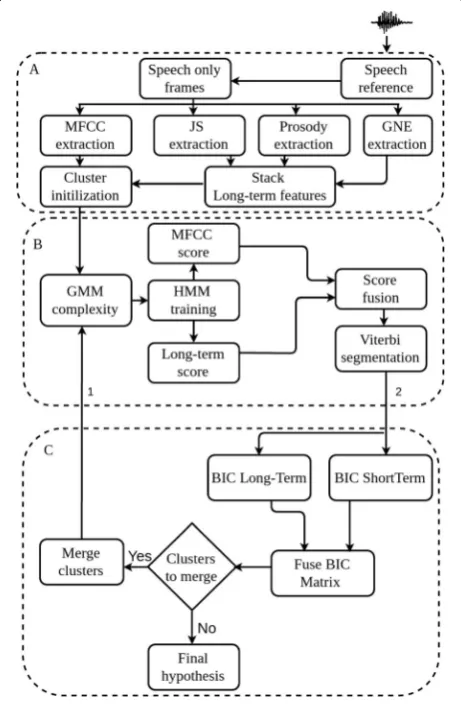
The baseline or reference speaker diarization system used in this work is depicted in Fig.4. Conceptually, the system
performs three tasks: the first task performing the feature extraction (Fig.4, block A), the second detecting speaker changes to segment the speech data (Fig.4, block B), and the third one grouping the segmented regions together into speaker-homogeneous clusters and displaying the sys-tem hypothesis (Fig.4, block C).
In the proposed speaker diarization systems, the short-term cepstral coefficients are augmented with long-term feature information. Firstly, the non-cepstral features (i.e., prosodic and GNE) are combined together at the feature level. Then, they are fused with MFCCs at the score level to assess the contribution of each set of feature representation. Depending on the proposed sys-tem, the fused score is interpolated either by using the likelihood produced by GMM models or by the corre-sponding i-vector scoring method.
3.1 Proposed GMM-based speaker diarization system
One of the main differences of the proposed GMM speaker diarization system is the inclusion of jitter and shimmer voice-quality information and its combination with formants, pitch, intensity, GNE, and MFCC characteristics.
In addition to the long-term information, the proposed HMM/GMM speaker diarization system is also aug-mented with the extraction of the delta dynamic fea-tures. In order to capture several speaker properties, two feature representations are explored. While the first one is the combination of static cepstral coefficients and delta features, the second speaker vector consists of the voice-quality, prosodic, and GNE information. It is worth to mention that both sets of feature representa-tions are employed both for speaker segmentation and clustering. However, delta features are only employed in the clustering task and discarded from the audio seg-mentation one.
After the computation of short- and long-term speech features, the audio signal is equally partitioned to gener-ate the initial number of clusters (see Fig. 4, block A). The initial number of clusters depends on meeting dur-ation, but it is constrained between 10 and 65. This is done to avoid the common issues of agglomerative hier-archical clustering (AHC) such as over-clustering and its high computational cost of pair-wise distance computa-tion. Independent HMM/GMM models are estimated for each feature set. The fusion of short- and long-term information in speaker segmentation is carried out at
the score level (see Fig. 4 block B). It is done by a
weighted interpolation of the two log-likelihoods result-ing from each GMM distribution, i.e., cepstral and long-term feature distributions.
Given a set of input feature vectors {x} and {y}, the log-likelihood score in the proposed segmentation is Fig. 4Proposed HMM-GMM speaker diarization system. The dotted
computed as a joint log-likelihood between feature dis-tributions as follows:
log Prx;yjθxi;θyi¼αlog Prxjθxi
þð1−αÞlog Pr yjθyi
ð5Þ
where log Prðx;yjθxi;θyiÞ is the logarithm of the fused emission probabilities for cluster i. While the model of cluster iusing cepstral feature vectors is represented by θx
i, the model for the same clusteriusing long-term fea-tures is denoted by θyi. The interpolation weight which controls the individual contribution of each feature set is α. The values ofαare tuned on development data set.
Once the audio data is segmented by the Viterbi algo-rithm, the homogeneous segments are grouped together based on Bayesian information criterion (BIC) distance among clusters (Fig.5block C).
Given two speech segments i and j, the BIC distance
computation is carried out as follows:
BIC ið Þ ¼;j β:BICxijþð1−βÞ:BICyij ð6Þ
where BICxij and BIC
y
ij are the BIC distances between
clusters i and j generated using short- and long-term
speech features. The BIC distances computed using the
short- and long-term feature sets are weighted byβand
(1−β), respectively, driving the contribution of each dis-tance to the final fused BIC disdis-tance.
3.2 Proposed i-vector-based speaker diarization system
The extraction of i-vectors from audio segments and its usage for speaker clustering are the key components of our proposed i-vector system. The extraction is inde-pendently performed from the short-term static cepstral coefficients and from the long-term speech features. Therefore, two sets of i-vectors are extracted for each
segmentation, representing different speaker traits.
While the first i-vector is extracted from short-term fea-tures, the second i-vector is computed from the long-term ones, i.e., the combination of voice-quality, pitch, intensity, formants, and GNE.
We have also investigated the use of delta features for speaker clustering. The delta features are combined to-gether with the static cepstral coefficients at the feature level, yielding a vector of size 40. Once the i-vectors are extracted from the audio segments, the fused distance between two segments is computed as interpolation of two i-vector distances. We have carried out both cosine and PLDA scoring techniques to explore the better one. It is worth to highlight that i-vectors are uniquely employed for speaker clustering task. In fact, it is the main difference of the proposed i-vector system com-pared to the previous HMM/GMM system. Note that the feature extraction and speaker segmentation mod-ules are the same both in the proposed GMM system (see previous section) and in the proposed i-vector sys-tem. Results reported in the literature [20] suggest that i-vector modeling is not well suited for the speaker seg-mentation task since it is difficult to reliably compute an estimate of i-vector from segments of short duration. The extraction of i-vectors from short duration has shown to degrade the performance of speaker recogni-tion systems [20]. Several works have paid attention to this issue during the last few years within the speaker
recognition community [40, 41]. We have carried out
some experiments to explore the impact of applying i-vectors on our segmentation module. Similar to results of speaker recognition in [40], the experimental results show that the use of i-vectors for speaker segmentation results in performance degradation in terms of diariza-tion error rate.
3.2.1 Cosine-distance scoring
In order to perform the agglomerative cluster procedure, the similarity measure among all pairs of i-vectors is needed to be computed leading to a symmetric matrix of distances. Then, at each iteration of the agglomerative clustering, the two closest clusters are merged, i.e., i-vector pairs with the highest cosine-distance score. After merging the two closest clusters, the Viterbi seg-mentation is carried out, and this process iterates by extracting a new set of i-vector from the newly hypothe-sized clustering. The similarity matrix between cluster pairs is also updated. The previous steps iterate until the speaker diarization system reaches the stopping criterion and provides the final segmentation.
The cosine-distances from both sets of i-vectors are linearly weighted and applied as a fused distance metric for speaker clustering. The fused cosine-distance score is computed as follows:
CDS¼β wiwj
wi
k k wj þð1−βÞ w0iw
0
j
w0i w
0
j
ð7Þ
where CDS stands for the fused distance score between clusters i and j. The corresponding i-vectors extracted from short-term cepstral coefficients and for clustersiand jare denoted bywiandwj, respectively. Similarly, the
vec-torsw0iandw
0
jrepresent the i-vectors extracted by model-ing long-term speech features for the same clustersi and j, respectively. Furthermore, two different weights are
assigned to both cosine-distances. While β weights the
cosine-distance of i-vectors extracted from short-term fea-tures, (1−β) weights the cosine-distance of i-vectors ex-tracted from the long-term features.
3.3 PLDA scoring
The main contribution of this section comprises the re-placement of the i-vector-based cosine-distance by an i-vector-based PLDA scoring within the speaker cluster-ing. Since PLDA is the state of the art in speaker verifica-tion [42] and speaker diarization systems [21], we are also motivated to use the i-vector-based PLDA clustering tech-nique in our proposed speaker diarization system.
Firstly, two sets of i-vectors are extracted from the short- and long-term speech features. Then, the PLDA scores of these two i-vectors are linearly weighted to ob-tain a fused distance score for further use on the speaker clustering task.
Finally, the fused PLDA score is computed as follows:
y:log p wi;wjjH1
p wið jH0Þp wjjH0
þð1−γÞ p w 0
i;w
0
jjH1
p wið jH0Þp wjjH0
ð8Þ
where wi and wj are the i-vectors extracted from the
short-term cepstral coefficients for cluster i and cluster j, respectively. Similarly, w0i and w
0
j represent the i-vectors extracted from long-term speech features for the same clusters i and j, respectively. Moreover, hypothesis H1
andH0assume that the two i-vectors belong to the same
and different speakers, respectively. Finally, the PLDA scores of i-vectors extracted from the short- and
long-term features are weighted by γ and (1−γ),
respectively.
Note that the long-term features in Eqs.7 and 8refer to two possibilities: voice quality with prosodic features and voice-quality with prosodic and GNE features.
4 Experimental setups and results
4.1 Databases and experimental setup
The experiments are developed and tested on AMI corpus, a multi-party and spontaneous speech set of recordings
[27]. The AMI is a meeting corpus consisting 100 h of
audio in 171 shows which use a range of signals synchro-nized to a common timeline. The shows were recorded using close-talking and far-field microphones. The meetings were recorded in English using three different rooms with different acoustic properties in IDIAP, Edinburgh, and TNO sites.
The development and test set are based on the far-field microphone array channels sampled at 16 kHz.
Development set: 10 shows are selected from IDIAP, Edinburgh, and TNO sites as a development set. These shows are used to tune the optimum parameters (i.e., optimum set of weight values for the short- and long-term speech features and optimum stopping threshold value). The total and average duration of the development set is 284 and 28.4 min, respectively.
Test set: In order to evaluate the performance of the proposed systems, the test experiments are carried out on 112 AMI shows selected from the IDIAP, Edinburgh, and TNO sites. The total and average duration of the test sets of the whole recording are 4075 min (about 69 h) and 36.38 min, respectively.
Manually annotated speech references are used to ex-tract the speech frames and discard the non-speech ones. The main reason for using the speech references, instead of speech activity detector (SAD), is that we are motivated to focus exclusively on speaker errors that occur to the diarization approach. But we have carried out a few set of experiments with SAD to compare the results of the systems with and without using SAD.
The short-term cepstral coefficients are computed within a 30-ms frame window at a 10-ms shift. The
di-mension of the cepstral coefficients is 20. The
voice-quality, prosodic, and GNE features are extracted over a 30-ms frame length and at a 10-ms shift using
Praat software [43]. Then, each of the voice-quality,
prosodic, and GNE features is estimated over a 500-ms window with a 10-ms shift. This is done to smooth out the feature estimation of the unvoiced frames. It is also done to synchronize them with the cepstral coefficients.
The UBM and the T matrix are trained using 100 AMI shows which have a duration of 60 h. Three universal back-ground models (UBMs) of 512 Gaussian components have been trained. While the first UBM is trained using only the static cepstral coefficients, the second UBM is trained using both the static cepstral coefficients and delta dynamic fea-tures. The third UBM is trained using long-term features (i.e., voice-quality, pitch, intensity, formants, and GNE).
respectively. The sizes of the total variability matrix are 100 and 50 for the short- and long-term speech features, respectively. The i-vector extraction is carried out using ALIZE open-source toolkit [44].
The PLDA of the short-term and long-term speech features is trained on 40 and 20 dimensional speaker spaces, respectively. The PLDA is trained on the same data used to train the UBM and T matrix. The i-vectors are length normalized before the PLDA training.
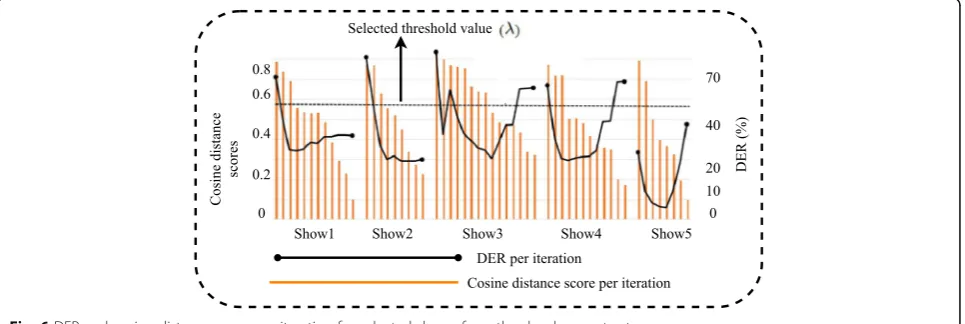
The selection of threshold value for stopping criterion for the proposed i-vector-based speaker diarization systems is
carried out as it is shown in Fig. 6. It is based on a
data-driven approach. The DER and corresponding cosine-distance/PLDA score values at each iteration are compared, andλ value that minimizes the DER is selected. Thus, the system stops merging when the highest cosine-distance/ PLDA score value among all pair of clusters is less than λ. As it is shown in Fig.6, the DER values decrease for some it-erations. However, its values start to increase after some number of iterations because of over-clustering.
Note that optimum parameters found through experi-mentation on the development set are directly applied on the test set.
The conventional performance metric employed for assessing speaker diarization systems is the diarization error rate (DER). DER represents the sum of false alarm speech, missed speech, and speaker error along time. Since speech references are used, the rate of false alarms and missed speech have zero values in the experimental results. Hence, DER values reported in the following sections correspond purely to speaker time confusion produced by the diariza-tion system. We have used a collar of 250 ms around every speaker segment to discard any inaccuracies in the refer-ence annotation.1
4.2 Experimental results
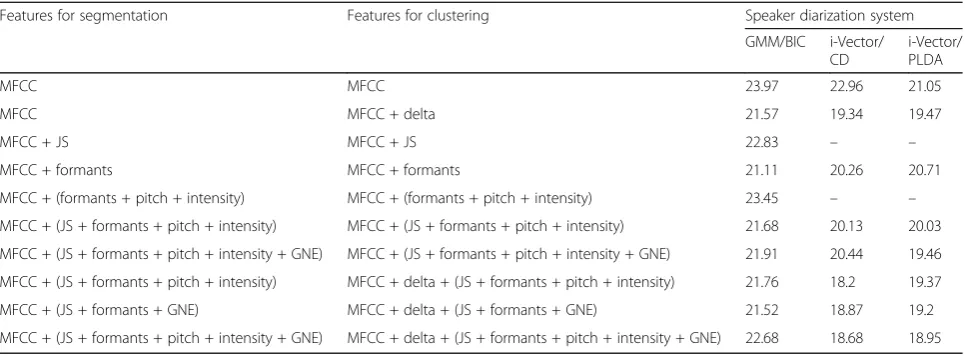
As it is shown in Table1, the baseline system of the test set has a DER of 23.97%. Note that the baseline system is
based on BIC clustering and static MFCC feature set both for segmentation and clustering. The table shows that the addition of long-term features (i.e., voice-quality, pitch, in-tensity, formants, GNE, and delta) to the static MFCC fea-tures improves the DER both for GMM- and i-vector-based speaker diarization systems.
For the GMM-based speaker diarization system, the table depicts that the fusion of the concatenated or indi-vidual long-term speech features with the cepstral coeffi-cients provides better DER compared to using only the later feature set. For example, the use of formants together
with MFCC provides a DER of 21.11%. This corresponds
to a 11.93% relative DER improvement compared to the
same system using static MFCC feature set. Similarly, the table shows that the fusion of voice-quality features to-gether with the cepstral coefficients provides a 4.76% rela-tive DER improvement compared to the system based only on cepstral coefficients.
Furthermore, the use of the concatenated long-term fea-tures (i.e., jitter, shimmer, pitch, intensity, and formants) together with the static cepstral coefficients improves the performance of both i-vector-based cosine-distance and PLDA clustering techniques. The table reports that the use of these concatenated long-term feature sets with the
MFCC ones provides a DER of 20.13% and 20.03% for
i-vector-based cosine-distance and PLDA clustering tech-niques, respectively. These represent a 12.33% and 8.75% relative DER improvement compared to the system based on GMM-based BIC clustering technique and using the same feature sets.
The table also shows that the use of delta dynamic fea-tures only in clustering improves the DER compared to using the static cepstral coefficients both in segmenta-tion and clustering. The DER improvements are both for GMM- and i-vector-based speaker diarization systems.
Hence, the use of delta dynamic features in
GMM-based BIC clustering reduces the DER to 21.57%.
This represents a 10.01% relative DER improvement
compared to the baseline system. Similarly, the use of delta dynamic features in clustering improves the DER both for i-vector-based cosine-distance and PLDA cluster-ing techniques. It provides a DER of 19.34% and 19.47%. These results correspond to a 15.77% and 11.3% relative DER improvement compared to the system using the same clustering technique and apply static cepstral coeffi-cients both for segmentation and clustering.
Note that the delta features are used only in speaker clustering. The motivation for using deltas only in cluster-ing is because they capture the transitional characteristics of the speech signal which contains speaker-specific infor-mation. Since they don’t have temporal resolution, they are not used in speaker segmentation. In our work, i-vectors are also applied only on the clustering stage. They are not applied in speaker segmentation since it is difficult to reliably estimate i-vectors from segments of short duration [21].
We have carried out some experiments on subset of AMI shows to explore the impact of applying deltas and i-vectors both in segmentation and clustering. The experi-mental results show that the use of delta and i-vectors in segmentation degrades the performance of speaker diari-zation system (i.e., the DER values are high).
Table 1 reveals that the best results are found when
i-vector-based cosine-distance clustering is used together with the short- and long-term speech features (i.e., MFCC,
delta, voice-quality, pitch, intensity, and formants). It pro-vides a DER of 18.2%. This provides a 24.07% relative DER improvement compared to the baseline system. It also
corresponds to a 9.59% relative DER improvement
com-pared to the system that uses the same clustering tech-nique and uses static MFCC, voice-quality, pitch, intensity, and formant feature sets. It also represents a
5.89% relative DER improvement compared to the system
that uses the same clustering technique and uses only the static and delta dynamic features.
We have also carried out experiments using speech ac-tivity detector (SAD) for the baseline (i.e., GMM-based speaker diarization system using only static MFCC fea-ture set) and the best performing system (i-vector-based cosine-distance system using MFCC, delta, jitter, shim-mer, pitch, intensity, and formants). Table 2 shows that the use of SAD on these experiments also exhibit the use of long-term features improves the performance of speaker diarization system both for the GMM- and i-vector-based speaker diarization systems. While the
DER of the baseline system using SAD is 48.91% (miss
speech = 19.7%, false alarm = 11.5%, and speaker error = 17.7%), the DER of the best performing system is 44.2% (miss speech = 19.7%, false alarm = 11.5%, and speaker error = 13%). The best performing system provides a
9.63% relative DER improvement compared to the
base-line system. If we compare only the speaker errors of the
Table 1DER of the test set using the proposed long-term speech features and proposed speaker diarization systems
Features for segmentation Features for clustering Speaker diarization system
GMM/BIC i-Vector/ CD
i-Vector/ PLDA
MFCC MFCC 23.97 22.96 21.05
MFCC MFCC + delta 21.57 19.34 19.47
MFCC + JS MFCC + JS 22.83 – –
MFCC + formants MFCC + formants 21.11 20.26 20.71
MFCC + (formants + pitch + intensity) MFCC + (formants + pitch + intensity) 23.45 – –
MFCC + (JS + formants + pitch + intensity) MFCC + (JS + formants + pitch + intensity) 21.68 20.13 20.03
MFCC + (JS + formants + pitch + intensity + GNE) MFCC + (JS + formants + pitch + intensity + GNE) 21.91 20.44 19.46
MFCC + (JS + formants + pitch + intensity) MFCC + delta + (JS + formants + pitch + intensity) 21.76 18.2 19.37
MFCC + (JS + formants + GNE) MFCC + delta + (JS + formants + GNE) 21.52 18.87 19.2
MFCC + (JS + formants + pitch + intensity + GNE) MFCC + delta + (JS + formants + pitch + intensity + GNE) 22.68 18.68 18.95
JSjitter and shimmer,CDcosine-distance
Table 2Speech activity detector (SAD) experiments for the baseline and the best performing system
Features Speaker diarization system
GMM/BIC i-Vector/CD
MFCC 48.91 –
two systems, the best performing system provides a
26.55% relative speaker error improvement compared to
the baseline system.
Since we have used a simple SAD based on energy thresholding and the AMI database corresponds to a complex scenario (i.e., there are reverberations, back-ground noises, echos), the percentage of miss speech is relatively high.
5 Discussion
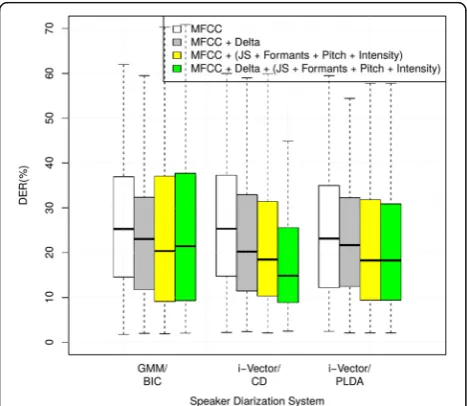
The box plots in Fig. 7 depict the DER distribution of
the different recordings for the test set. It shows the minimum, lower quartile, median, upper quartile, and maximum DER performed by the GMM and i-vector clustering techniques. The figure shows that the pro-posed i-vector-based clustering technique using short-and long-term features provides the minimum variance among all clustering techniques in terms of DER. As it is
also shown in Fig. 6, the DER values increase with the
number of iterations because of over-clustering.
Although the use of long-term features in GMM- and i-vector-based systems reduces the DER for most of the recordings, the DER values increase for few of them compared to the baseline system. One of the possible reasons is the threshold value used for the stopping cri-terion. In this work, we have proposed the same thresh-old value for all shows. It is also worth to investigate the impact of an automatic threshold value that varies per it-erations and recordings in the proposed systems.
Overall, our experimental results validate the useful-ness of the proposed methodology. The use of the i-vector-based clustering technique based on short- and
long-term speech features increases the robustness and reliability of speaker diarization systems.
6 Conclusions
This work has proposed the use of voice-quality features for GMM- and i-vector-based speaker diarization sys-tems. The proposed voice-quality features are used to-gether with the short-term cepstral and other long-term features (i.e., pitch, intensity, formants, and GNE).
The work has also analyzed the use of delta dynamic features for speaker clustering since they capture the tran-sitional characteristics of the speech signal which contains speaker-specific information. The delta dynamic features are not used in speaker segmentation because of their lim-ited temporal resolution in segmentation. But, they are used in speaker clustering since they capture the transi-tional characteristics of the speech signal which contains speaker-specific information. The delta features are used together with the short-term static cepstral coefficients and other long-term speech features (i.e., voice-quality, pitch, intensity, formants, and GNE) for GMM- and i-vector-based speaker clustering techniques.
The experimental results show that the use of voice-quality features together with the other long-term and short-term spectral features improves the performance of both GMM- and i-vector-based speaker diarization sys-tems. The experimental results also show that i-vector clus-tering techniques based on short- and long-term features provides better DER compared to the same clustering tech-nique using only short-term features. Moreover, the results show that i-vector-based cosine-distance and PLDA cluster-ing techniques provide a substantial relative DER improve-ment compared to GMM-based BIC clustering. Finally, the experimental results manifest that the use of delta dynamic features in clustering improves the DER both for GMM-and i-vector-based speaker diarization systems.
The results of our work manifest the usefulness of long-term speech features both for GMM- and i-vector-based speaker diarization systems.
7 Endnotes
1
The scoring tool is the NIST RT scoring used as ./md-eval-v21.pl -1 -nafc -c 0.25 -o -R reference.rttm-S hypothesis.rttm
Acknowledgements
This work has also received funding from the EU's Horizon 2020 research and innovation program under grant agreement No 645323. The text reflects only the author's view and the Commission is not responsible for any use that may be made of the information it contains.
Author’s contributions
All authors are responsible for proposing the algorithm and the manuscript. All authors have read and approved the final manuscript.
Competing interests
The authors declare that they have no competing interests.
Publisher’s Note
Springer Nature remains neutral with regard to jurisdictional claims in published maps and institutional affiliations.
Author details
1TALP Research Center, Department of Signal Theory and Communications, Universitat Politecnica de Catalunya, Barcelona, Spain.2Telefonica Research, Edificio Telefonica-Diagonal, Barcelona, Spain.
Received: 16 November 2017 Accepted: 10 September 2018
References
1. Meignier, S., Moraru, D., Fredouille, C., Bonastre, J.-F., & Besacier, L. (2006). Step-by-step and integrated approaches in broadcast news speaker diarization.Comput. Speech Lang., 20(2), 303–330.
2. Anguera, X., Bozonnet, S., Evans, N., Fredouille, C., Friedland, G., & Vinyals, O. (2011). Speaker diarization: a review of recent research.IEEE Trans. Audio Speech Lang. Process.
3. Friedland, G., Vinyals, O., Huang, Y., & Muller, C. (2009). Prosodic and other long-term features for speaker diarization.IEEE Trans. Audio Speech Lang. Process., 17(5), 985–993.
4. Zelenák, M., & Hernando, J. (2011). The detection of overlapping speech with prosodic features for speaker diarization. InINTERSPEECH(pp. 1041–1044). 5. Kreiman, J., & Gerratt, B. R. (2005). Perception of aperiodicity in pathological
voice.J Acoust Soc Am, 117(4).
6. Li, X., Tao, J., Johnson, M. T., Soltis, J., Savage, A., Leong, K. M., & Newman, J. D. (2007). Stress and emotion classification using jitter and shimmer features. In IEEE International Conference on Acoustics, Speech and Signal Processing. 7. Sadeghi N., A. Homayounpour, M.M.: Speaker age interval and sex
identification based on jitters, shimmers and mean MFCC using supervised and unsupervised discriminative classification methods. In: 8th International Conference on Signal Processing (2006).
8. Farru’s, M., Hernando, J., & Ejarque, P. (2007). Jitter and shimmer measurements for speaker recognition. InINTERSPEECH. 9. Woubie, A., Luque, J., & Hernando, J. (2014). Jitter and shimmer
measurements for speaker diarization. InVII Jornadas en Tecnolog´ıa del Habla and III Iberian SLTech Workshop(pp. 21–30).
10. Woubie, A., Luque, J., & Hernando, J. (2015). Using voice-quality
measurements with prosodic and spectral features for speaker diarization. In INTERSPEECH.
11. Kenny, P., Reynolds, D., & Castaldo, F. (2010). Diarization of telephone conversations using factor analysis. IEEE Journal of Selected Topics in Signal Processing, 4(6), 1059.
12. Franco-Pedroso, J., Lopez-Moreno, I., Toledano, D. T., & González-Rodríguez, J. (2010). ATVS-UAM system description for the audio segmentation and speaker diarization Albayzin 2010 evaluation. InFALA.
13. Shum, S., Dehak, N., Chuangsuwanich, E., Reynolds, D. A., & Glass, J. R. (2011). Exploiting intra-conversation variability for speaker diarization. InProceedings of Interspeech, Florence, Italy.
14. Shum, S., Dehak, N., & Glass, J. (2012). On the use of spectral and iterative methods for speaker diarization. InInterspeech.
15. Vaquero Avilés-Casco, C. (2011).Robust diarization for speaker characterization (diarización robusta para caracterización de locutores). University of Zaragoza, Zaragoza: PhD thesis.
16. Senoussaoui, M., Kenny, P., Dumouchel, P., & Stafylakis, T. (2013). Efficient iterative mean shift based cosine dissimilarity for multi-recording speaker clustering. InIEEE International Conference on Acoustics, Speech and Signal Processing (ICASSP).
17. Villalba, J., Ortega, A., Miguel, A., & Lleida, E. (2015). Variational Bayesian PLDA for speaker diarization in the MGB challenge. InAutomatic Speech Recognition and Understanding (ASRU), 2015 IEEE Workshop On(pp. 667–674) IEEE. 18. Silovsky, J., & Prazak, J. (2012). Speaker diarization of broadcast streams using
two-stage clustering based on i-vectors and cosine distance scoring. InIEEE International Conference on Acoustics, Speech and Signal Processing (ICASSP). 19. Prazak, J., & Silovsky, J. (2011). Speaker diarization using PLDA-based speaker
clustering. In6th IEEE International Conference on Intelligent Data Acquisition and Advanced Computing Systems (IDAACS), vol. 1.
20. Sell, G., & Garcia-Romero, D. (2014). Speaker diarization with PLDA i-vector scoring and unsupervised calibration. InProceedings of SLT.
21. Woubie, A., Luque, J., & Hernando, J. (2016). Short- and long-term speech features for hybrid HMM-i-vector based speaker diarization system. InOdyssey 2016-The Speaker and Language Recognition WorkshopPaper Accepted. 22. Woubie, A., Luque, J., & Hernando, J. (2016). Improving i-vector and PLDA based
speaker clustering with long-term features. InINTERSPEECH(pp. 372–376). 23. Furui, S. (1981). Cepstral analysis technique for automatic speaker
verification.IEEE Trans. Acoust. Speech Signal Process., 29(2), 254–272. 24. Kumar, K., Kim, C., & Stern, R. M. (2011). Delta-spectral cepstral coefficients
for robust speech recognition. InAcoustics, Speech and Signal Processing (ICASSP), 2011 IEEE International Conference On(pp. 4784–4787) IEEE. 25. Luque, J. (2012).Speaker diarization and tracking in multiple-sensor
environments. Barcelona: PhD thesis, Universitat Polit’ecnica de Catalunya. 26. Yella, S. H. (2015).Speaker diarization of spontaneous meeting room
conversations. Switzerland: PhD thesis, EPFL, Lausanne.
27. The Augmented Multi-party Interaction Project, AMI Meeting Corpus (2011). Website,http://corpus.amiproject.org.
28. Farrús, M., Garde, A., Ejarque, P., Luque, J., Hernando, J. (2006). On the fusion of prosody, voice spectrum and face features for multimodal person verification. In9th International Conference on Spoken Language Processing, ICSLP, pp. 2106–2109.
29. Pardo, J.M., Anguera, X., Wooters, C.: Speaker diarization for multiple-distant-microphone meetings using several sources of information. in IEEE Transactions on Computers (2007).
30. Wang, X.-G., & Shen, H. C. (1999). Multiple hypothesis testing fusion method for multisensor systems. InIEEE International Conference on Intelligent Robots and Systems, vol. 2.
31. Memon, S., Lech, M., & Maddage, N. (2009). Speaker verification based on different vector quantization techniques with Gaussian mixture models. In Third International Conference on Network and System Security(pp. 403–408). 32. Nguyen, P.T.: Automatic speaker classification based on voice characteristics.
University of Canberra, ??? (2010).
33. Boersma, P., Weenink, D.: Praat: doing phonetics by computer (2009). 34. Adami, A. G. (2007). Modeling prosodic differences for speaker recognition.
Speech Comm., 49(4), 277–291.
35. Dellwo, V., Huckvale, M., & Ashby, M. (2007). How is individuality expressed in voice? An introduction to speech production and description for speaker classification. In Speaker Classification I (pp. 1-20). Springer, Berlin, Heidelberg.
36. Sáenz Lechón N., Osma Ruiz V., Fraile Muṅoz R., Godino Llorente J.I., Gómez Vilda P.: Screening voice disorders with the glottal to noise excitation ratio (2009). 37. Michaelis, D., Gramss, T., & Strube, H. W. (1997). Glottal-to-noise excitation
ratio–a new measure for describing pathological voices.Acta Acustica united with Acustica, 83(4), 700–706.
38. Michaelis, D., Frohlich, M., & Strube, H. W. (1998). Selection and combination of acoustic features for the description of pathologic voices.J Acoust Soc Am, 103(3), 1628–1639.
39. Godino-Llorente, J. I., Osma-Ruiz, V., Sáenz-Lechón, N., Gómez-Vilda, P., Blanco-Velasco, M., & Cruz-Roldán, F. (J Voice, 2010). The effectiveness of the glottal to noise excitation ratio for the screening of voice disorders., 24(1), 47–56. 40. Kanagasundaram, A., Vogt, R., Dean, D. B., Sridharan, S., & Mason, M. W.
(2011). i-vector based speaker recognition on short utterances. In Proceedings of the 12th Annual Conference of the International Speech Communication Association, pp. 2341–2344International Speech Communication Association (ISCA).
41. Poddar, A., Sahidullah, M., & Saha, G. (2015). Performance comparison of speaker recognition systems in presence of duration variability. InIndia Conference (INDICON), 2015 Annual IEEE(pp. 1–6) IEEE.
42. Kenny, P. (2010). Bayesian speaker verification with heavy-tailed priors. In Odyssey, p. 14.
43. Boersma, P., Weenink, D.: Praat: doing phonetics by computer, Version 5.3. 69.http://www.praat.org/