R E S E A R C H
Open Access
Influence of substrate on electricity generation of
Shewanella loihica
PV-4 in microbial fuel cells
Wenguo Wu
1,2*, Fei Yang
3, Xing Liu
2and Linling Bai
2Abstract
Background:The substrate, serving as carbon and energy source, is one of the major factors affecting the
performance of microbial fuel cells (MFCs). We utilized BIOLOG system to rapidly screen substrates for electricigens, and further evaluated influence of these substrates on electricity generation ofShewanella loihicaPV-4 in MFCs. Results:Three of most favorable substrates (lactate acid, formic acid and cyclodextrin) with OD590/750of 0.952,
0.880 and 0.849 as well as three of most unfavorable substrates (galactose, arabinose and glucose) with OD590/750of
0.248, 0.137 and 0.119 were selected by BIOLOG system under aerobic conditions. The chronoamperometry results showed that MFCs fed with these substrates exhibited different current behaviors. Cyclic voltammograms results showed that arabinose, galactose and glucose promoted electron transfer from outer membranec-Cyts of cells to the electrode surface. Lactic acid, formic acid and cyclodextrin produced lower quantity of electric charge of 10.13 C, 9.83 C and 10.10 C, the corresponding OD600value was 0.180, 0.286 and 0.152 in BES; while galactose, arabinose
and glucose generated higher quantity of electric charge of 12.34 C, 13.42 C and 17.45 C, and increased OD600
values were 0.338, 0.558 and 0.409 in BES. SEMs results showed that plenty of plump and stretched cells as well as appendages were observed when lactic acid, formic acid, and cyclodextrin were utilized as substrates, while sparse cells in short shape were obtained when galactose, arabinose and glucose were used as substrates.
Conclusions:These results suggest that substrate not only has important role in electrochemical performances of MFCs but also in biological properties of electricigens. Lactic acid, formic acid, and cyclodextrin beneficial for cell growth under aerobic conditions are unfavourable for planktonic cell growth and current generation under anaerobic conditions, while consumptions of galactose, arabinose and glucose adverse to cell growth under aerobic conditions are favourable for planktonic cell growth and current generation under anaerobic conditions due to the increase of cell numbers with more outer membranec-Cyts transferring electrons between the electrode surface and cells.
Background
Microbial fuel cells (MFCs), harvesting electricity from renewable biomass, have attracted great interest in the area of wastewater treatment, bioremediation, biosensors and so on [1-4]. The microbial fuel cell consists of an anode, which accepts electrons released from the micro-bial metabolism and passes electrons to a cathode, where they are accepted by molecular oxygen. The knowledge that bacteria can generate electric current was first re-ported by Potter [5]. However, the low power density is
still one of the main limiting factors restricting the prac-tical application of MFC [6,7]. To overcome this problem, many researchers devote research to the optimization of MFC construction and operation condition [8,9], screen-ing of active electricigens [10], as well as the modification of electrode with nanostructures [11-14]. The substrate serving as carbon and energy source is also considered as a major factor which affects the performance of MFC [15]. However, most of these studies are focused on the limited sorts of single substrate or complex substrates in MFCs with pure culture or activated sludge, respectively.
Shewanella loihica PV-4, a dissimilatory metal redu-cing bacterium isolated from the Loihi Seamount in Hawaii, has received attention because it generates higher current density than other Shewanella strains [16]. In * Correspondence:[email protected]
1
College of Chemical Engineering, Huaqiao University, 361021 Xiamen, P. R. China
2
State Key Laboratory of Bioelectronics, Biological science and medical engineering department, Southeast University, 210096 Nanjing, P. R. China Full list of author information is available at the end of the article
contrast to mostShewanella species, S. loihicaPV-4 was able to utilize fumarate, galactose, glucose, citrate, lactate, malate, maltose, N-acetylglucosamine, succinate and ala-nine as substrates but unable to utilize acetate, propionate or Tween 40 [17]. Although the effect of lactate [16] and a mix of volatile fatty acids [18] as substrates on the perform-ance of MFCs have been evaluated, there is rare report about influence of other single substrates on electricity gen-eration performance and cell growth as well as the inter-action between them.
BIOLOG system, taking advantage of microbe’s ability to use particular carbon sources to produce a unique “fingerprint”of 95 single carbon sources in a MicroPlate, is widely used for the assessment of bacterial functional diversity in environmental samples [18-20]. The ability of a microbe to use a particular carbon source produces respiration, which reduces a tetrazolium redox dye and causes a color change in that well. The end result is a pattern of colored wells that is characteristic for that or-ganism. Herein, we utilize BIOLOG system to rapidly screen favorable and unfavorable substrates for the growth ofS. loihicaPV-4, and further evaluate influence of these substrates on electricity generation ofS. loihica
PV-4 in MFCs.
Results and discussion Substrate screening results
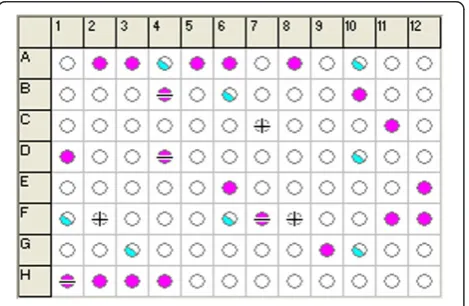
The substrate metabolism process ofS. loihicaPV-4 was indicated by a tetrazolium redox dye in GN2 MicroPlate. The specific pattern of color change on the plate pro-vided an identifiable metabolic fringerprint. As shown in Figure 1, some wells exhibited noticeable purple color in comparison with the control well (A1) with water as substrate after 25 h of aerobic culture. Most of negative wells showed no obvious color, it was indicated that the substrates in them are favorable for cellular growth and
respiration. In addition, some wells exhibited half cyan color, it was suggested that the substrates in them are unfavorable. Combined with these OD590/750 results, we
chose three of the most favorable and unfavorable sub-strates to study substrate influence on electricity gener-ation of S. loihica PV-4 in MFCs. They were D, L-lactic acid (E6, OD590/750= 0.952), formic acid (D4, OD590/750=
0.880),α-cyclodextrin (A2, OD590/750= 0.849), D-galactose
(B4, OD590/750= 0.248), L-arabinose (A10, OD590/750=
0.137) andα-D-glucose (B6, OD590/750= 0.119).
Chronoamperometry
The electricity generation results of S. loihica PV-4 in bioelectrochemical system (BES) at a poised potential of 0.2 V for 25 h with lactic acid, formic acid, cyclodextrin, galactose, arabinose and glucose as substrates were shown in Figure 2. With the addition of cells, an oxida-tive current was generated on ITO electrode, whereas no redox response was observed on the electrode with-out the addition of cells (data not shown). The oxidative current is ascribed to the electrical connection from outer membranec-Cyts of cells to the electrode [21-24]. As shown in Figure 2, the BES fed with different sub-strates in the presence of cells exhibited different current behaviors. When formate acid and cyclodextrin were used as substrates, an oxidative current of 0.19μA cm−2 and 0.46 μA cm−2 was generated, and gradually grew with a broad current peak of 0.71 μA cm−2 and 0.57 μA cm−2 until ~11.4 h and ~3.2 h, then decreased slowly to a final current of 0.21μA cm−2and 0.23μA cm−2 respectively. When lactic acid, galactose, arabinose and glucose were used as substrates, an immediate current peak of 1.76 μA cm−2, 1.49μA cm−2, 1.58 μA cm−2 and 1.69μA cm−2was generated and gradually decreased or in-creased to a final current of 0.30μA cm−2, 0.56μA cm−2,
Figure 1Profiling ofS. loihicaPV-4 cultures in GN2 MicroPlate using MicroLog software after 25 h of culture.Purple color: positive, no color: negative, plus and minus: mismatches.
Figure 2Substrate effect on the electricity generation of
0.50 μA cm−2 and 0.79 μA cm−2 respectively. Similar chronoamperometry results were observed in the single-chamber, three-electrode electrochemical system with ITO as working electrode and S. loihica PV-4 as electricigens [22,25]. However, current was greatly enhanced on graph-ite (5 μA cm−2) [25], nanograss array boron-doped dia-mond (1.2μA cm−2) [13], and ITO coated with polyaniline nanowire network electrodes (45 μA cm−2) [26] due to high surface roughness and nanostructured surface. It was reported that an important aspect of achieving high power density was having a low internal resistance [27]. The total internal resistance consists of anodic, membrane, cathodic, and electrolyte resistance [28]. Among these, anodic resist-ance is the main limiting factor in internal resistresist-ance in this single-chamber, three-electrode electrochemical sys-tem where the cathode is platinum wire. The low current generated on ITO electrode was ascribed to increase of an-odic resistance from small population of bacteria attached to the plane electrode surface [27]. However, ITO is widely used for spectroelectrochemical characterization of puri-fied redox proteins and whole microbial cells due to its ex-cellent optoelectronics properties [22,25]. Herein, it was chosen for the study of substrate effect on biological and electrochemical properties ofS. loihicaPV-4.
Cylic voltammetry
The effect of substrates on electron transfer between
S. loihica PV-4 cells and ITO electrode was evaluated by cyclic voltammograms (CVs), after polarizing the electrode for 25 h. As shown in Figure 3, there were no obvious redox waves on ITO electrode in the absence of substrate. After the addition of substrate, pairs of well-defined redox waves were observed on the electrode. The current gener-ation was ascribed to the oxidgener-ation of organic compounds
coupled to reduction of electron acceptors by cells. For for-mic acid, cyclodextrin and lactic acid, CVs showed sharp reductive peaks at−0.298 V,−0.318 V,−0.332 V, and broad oxidative peaks at −0.060 V,−0.082 V,−0.094 V. For ara-binose, galactose and glucose, quasi-reversible CVs with reductive peaks at−0.336 V,−0.338 V,−0.378 V and oxida-tive peaks at−0.124 V,−0.168 V,−0.124 V were exhibited on the electrode. These CVs results confirm an outer membrane c-Cyts-mediated electron transfer to the elec-trode surface [13,22]. The cells inoculated in the presence of arabinose, galactose and glucose exhibited higher redox peak currents as compared to those using formic acid, cy-clodextrin and lactic acid as substrates. It was indicated that arabinose, galactose and glucose promoted electron transfer from outer membranec-Cyts of cells to the elec-trode surface and cells fed with these substrates had super-ior electrochemical performances. These CVs results were in accordance with the chronoamperometry results.
Quantity of electric charge and cell growth
To further explore the substrate effect on electricity gen-eration, the total quantity of electric charge (Q) was cal-culated by integrating each I-T curve with respect to
time. The formula was Q¼ Z t
0 Idt
[29,30]. The
inter-relationship between total electric charge and planktonic cell growth under anaerobic conditions with lactic acid, formic acid, cyclodextrin, galactose, arabinose and glucose as substrates in BES after 25 h was shown in Figure 4. When lactic acid, formic acid and cyclodextrin were used as substrates, the quantity of electric charge of MFC in 25 h was 10.13 C, 9.83 C and 10.10 C respectively; the cor-responding OD600 value representing planktonic cell
growth was 0.180, 0.286 and 0.152. In comparison, when
Figure 3CVs ofS. loihicaPV- 4 obtained on ITO electrode in the absence (blank control) and presence of substrates. Scan rate: 0.01 mV s−1.
galactose, arabinose and glucose were used as substrates, increased quantity of electric charge of 12.34 C, 13.42 C and 17.45 C, and increased OD600 values of 0.338, 0.558
and 0.409 were observed. It was suggested that lactic acid, formic acid and cyclodextrin beneficial for cell growth of
S. loihicaPV-4 under aerobic conditions were unfavorable for electricity generation and planktonic cell growth under anaerobic conditions, while galactose, arabinose and glucose adverse for cell growth under aerobic conditions were favorable for electricity generation and planktonic cell growth under anaerobic conditions. These results were in accordance with the above CVs results that BES fed with galactose, arabinose and glucose had superior electrochemical performances. This was ascribed to the increase of cell numbers with more outer membrane
c-Cyts transferring electrons between the electrode sur-face and cells.
SEM results
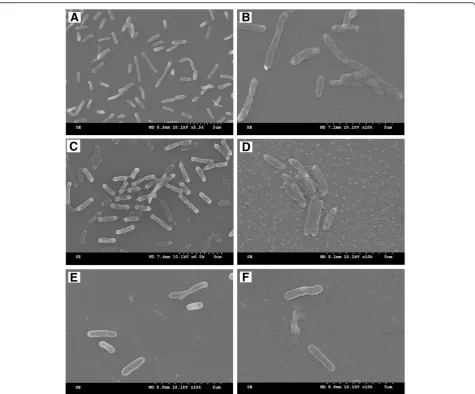
SEM images ofS. loihicaPV-4 cells on ITO electrode in MFCs after 25 h of current generation with lactic acid, formic acid, cyclodextrin, galactose, arabinose and glu-cose as substrates were shown in Figure 5. When lactic acid, formic acid and cyclodextrin were used as sub-strates, a significant amount of cells in plump and long rod shape were observed on ITO electrodes. Especially when formic acid was utilized as substrate, the length of cells nearly arrived at ~5 μm (Figure 5B). Interestingly, when cyclodextrin was used as substrate, there were ob-vious appendages connecting cells between each other to form a bacterial network. Similar phenomenon was observed when Pelotomaculum thermopropionicum was grown in monocultures on fumarate and in cocultures with
Methanothermobacter thernoautotropicus on propionate [31]. These experimental results proved thatS. loihica
4 could also produce pilus-like appendages in response to different substrates fed into MFCs. It was reported that microbial nanowires performed under unnatural condi-tions [32]. The OD600 value results mentioned above had
shown that cyclodextrin was the most unfavourable sub-strate for planktonic cell growth under anaerobic condi-tion. This unsuitable culture condition could have an important role in the formation of appendages. However, further researches such as the formation mechanism and electrical properties of these appendages are still neces-sary. When galactose, arabinose and glucose were used as substrates, the cells attached on the electrodes were very sparse and in shorter shape, indicating that the catalytic activity of each individual cell was high. In contrast, bacterial biofilm in uniform morphology was observed on the anode surface of a mixed culture MFC, operated with a high strength wastewater [33]. It was suggested that cellular morphologies together with biological and electro-chemical activities of electricigens were significantly af-fected by substrates.
Conclusions
Lactic acid, formic acid, cyclodextrin, galactose, arabinose and glucose serving as electron donors forS. loihicaPV-4 in MFCs were selected by BIOLOG system. Lactic acid, formic acid and cyclodextrin beneficial for cell growth under aerobic conditions were unfavourable for planktonic cell growth under anaerobic conditions and produced lower quantity of electric charge, while galactose, arabinose and glucose adverse to cell growth were favourable for planktonic cell growth under anaerobic conditions and generated higher quantity of electric charge. The electron donor played an important role not only in electrochemical performances of cells but also in cellular morphologies, es-pecially the formation of appendages. Further researches including underlying formation mechanism and electrical properties of appendages are still necessary.
Methods Bacteria culture
Shewanella loihica PV-4 strain (ATCC BAA-1088) was aerobically cultured in 10 mL of Marine Broth (20 g L−1) at 30°C for 24 h. After centrifugation, the Marine Broth was replaced with 10 mL of defined media (DM) [21] at 30°C for 48 h with different substrates. The suspension was centrifuged for 10 min and the resultant cell suspen-sion was washed with DM three times prior to being used for electrochemical experiments. As substrates, lac-tate acid, formic acid, cyclodextrin, galactose, arabinose and glucose (10 mM) were used respectively.
Screening of substrates by BIOLOG system
S. loihicaPV-4 was inoculated and aerobically cultured in Marine Agar (20 g L−1) at 30°C for 16–24 h. A uniform
suspension within the specified turbidity range was pre-pared by dipping the swab picking up cells into the inocu-lating fluid. Inoculate cells (150 μl per well) into GN2 MicroPlate (Biolog Catalog #1011), incubate aerobically at 30°C for 25 h and then read by BIOLOG MicroLog System (Release 4.2, Biolog Inc., USA) with two appropri-ate filters (590 and 750 nm).
Electrochemical measurements
A single-chamber, three-electrode system was used for the electrochemical measurements, where ITO electrode was used as the working electrode on the bottom of the cell [21], a platinum wire as the counter, and an Ag/ AgCl (saturated KCl) electrode as the reference. The re-actor filled with 4 mL DM containing 10 mM different substrates mentioned above was deaerated by purging with N2gas (30 min) and subsequently injected with
bac-terial culture (OD6002.0) as described above at a constant
poised potential of 0.2 V using a CHI 660D potentiostat (CH Instruments, Chenhua Co. Shanghai, China) at 25°C, pH 7.8. After these electrochemical measurements, the final optical density (OD600) of the bacterial culture in the
reactor after 25 h was measured using a spectrophotom-eter (Mapada, China). All these experimental tests were repeated for one time.
SEM observation
S. loihica PV-4 attached on the electrodes were imaged using an SEM (HITACHI, S-300 N). Samples were fixed in 2.5% glutaraldehyde for 2 h, rinsed three times in phosphate buffer (pH 7.0, 50 mM), dehydrated by alco-holic series (60, 70, 80, 90, 95, and 100%), and then air-dried.
Competing interests
The authors declare that they have no competing interests.
Authors’contributions
WW carried out the electrochemical measurements, participated in the screening of substrates by BIOLOG system and drafted the manuscript. FY carried out the screening of substrates by BIOLOG system. XL participated in the electrochemical measurements and SEM observation. LB participated in its design and coordination and helped to draft the manuscript. All authors read and approved the final manuscript.
Acknowledgements
This work was supported by National Natural Science Foundation of China (NSFC 81301290), Quanzhou Science and Technology Plan Project (2013Z24) and Research Foundation for High-level Talents of Huaqiao University (12BS207).
Author details
1College of Chemical Engineering, Huaqiao University, 361021 Xiamen, P. R.
China.2State Key Laboratory of Bioelectronics, Biological science and medical engineering department, Southeast University, 210096 Nanjing, P. R. China.
3
Key Laboratory of Environmental Medicine Engineering, Ministry of Education, School of Public Health, Southeast University, 210009 Nanjing, P. R. China.
References
1. Lovley DR:Bug juice: harvesting electricity with microorganisms.Nat Rev Microbiol2006,4:497–508.
2. Wang ZW, Mei XJ, Ma JX, Wu ZC:Recent advances in microbial fuel cells integrated with sludge treatment.Chem Eng Technol2012,35:1733–1743. 3. Wang X, Gao N, Zhou Q:Concentration responses of toxicity sensor with
Shewanella oneidensisMR-1 growing in bioelectrochemical systems.
Biosens Bioelectron2013,43:264–267.
4. Pant D, Singh A, Van Bogaert G, Olsen SI, Nigam PS, Diels L, Vanbroekhoven K:Bioelectrochemical systems (BES) for sustainable energy production and product recovery from organic wastes and industrial wastewaters.
Rsc Advances2012,2:1248–1263.
5. Potter MC:Electrical effects accompanying the decomposition of organic compounds.Proc R Soc Lond B Biol Sci1911,84:260–276.
6. Logan BE:Exoelectrogenic bacteria that power microbial fuel cells.
Nat Rev Microbiol2009,7:375–381.
7. Zhou M, Chi M, Luo J, He H, Jin T:An overview of electrode materials in microbial fuel cells.J Power Sources2011,196:4427–4435.
8. Kim BH, Chang IS, Gadd GM:Challenges in microbial fuel cell development and operation.Appl Microbiol Biotechnol2007,76:485–494. 9. Osman MH, Shah AA, Walsh FC:Recent progress and continuing
challenges in bio-fuel cells. Part II: microbial.Biosens Bioelectron2010,
26:953–963.
10. Hou HJ, Li L, Cho Y, de Figueiredo P, Han A:Microfabricated microbial fuel cell arrays reveal electrochemically active microbes.PLoS One2009,
4:e6570.
11. Peng L, You SJ, Wang JY:Carbon nanotubes as electrode modifier promoting direct electron transfer fromShewanella oneidensis.Biosens Bioelectron2010,25:1248–1251.
12. Wu WG, Xie RG, Bai LL, Tang ZM, Gu ZZ:Direct electrochemistry of Shewanella loihicaPV-4 on gold nanoparticles-modified boron-doped diamond electrodes fabricated by layer-by-layer technique.J Nanosci Nanotechnol2012,12:3903–3908.
13. Wu WG, Bai LL, Liu X, Tang ZM, Gu ZZ:Nanograss array boron-doped diamond electrode for enhanced electron transfer fromShewanella loihicaPV-4.Electrochem Commun2011,13:872–874.
14. Fan YZ, Xu ST, Schaller R, Jiao J, Chaplen F, Liu H:Nanoparticle decorated anodes for enhanced current generation in microbial electrochemical cells.Biosens Bioelectron2011,26:1908–1912.
15. Pant D, Van Bogaert G, Diels L, Vanbroekhoven K:A review of the substrates used in microbial fuel cells (MFCs) for sustainable energy production.Bioresour Technol2010,101:1533–1543.
16. Newton GJ, Mori S, Nakamura R, Hashimoto K, Watanabe K:Analyses of current-generating mechanisms ofShewanella loihicaPV-4 and Shewanella oneidensisMR-1 in microbial fuel cells.Appl Environ Microbiol 2009,75:7674–7681.
17. Gao HC, Obraztova A, Stewart N, Popa R, Fredrickson JK, Tiedje JM, Nealson KH, Zhou JZ:Shewanella loihicasp nov., isolated from iron-rich microbial mats in the Pacific Ocean.Int J Syst Evol Microbiol2006,56:1911–1916. 18. Pant D, Arslan D, Van Bogaert G, Gallego YA, De Wever H, Diels L,
Vanbroekhoven K:Integrated conversion of food waste diluted with sewage into volatile fatty acids through fermentation and electricity through a fuel cell.Environ Technol2013,34:1935–1945.
19. Preston-Mafham J, Boddy L, Randerson PF:Analysis of microbial community functional diversity using sole-carbon-source utilisation profiles - a critique.FEMS Microbiol Ecol2002,42:1–14.
20. Singh MP:Application of Biolog FF MicroPlate for substrate utilization and metabolite profiling of closely related fungi.J Microbiol Methods 2009,77:102–108.
21. Smalla K, Wachtendorf U, Heuer H, Liu WT, Forney L:Analysis of BIOLOG GN substrate utilization patterns by microbial communities.Appl Environ Microbiol1998,64:1220–1225.
22. Nakamura R, Kai F, Okamoto A, Newton GJ, Hashimoto K:Self-constructed electrically conductive bacterial networks.Angew Chem Int Ed2009,
48:508–511.
23. Okamoto A, Nakamura R, Ishii K, Hashimoto K:In vivo electrochemistry of c-type cytochrome-mediated electron-transfer with chemical marking.
ChemBioChem2009,10:2329–2332.
24. Kim BH, Kim HJ, Hyun MS, Park DH:Direct electrode reaction of Fe(III)-reducing bacterium,Shewanella putrefaciens.J Microbiol Biotechnology 1999,9:127–131.
25. Anand J, Jack OC, Richard W, Satheesh K, Enrico M:Extracellular electron transfer mechanism inShewanella loihicaPV- 4 biofilms formed at indium tin oxide and graphite electrodes.Int J Electrochem Sc2013,
8:1778–179.
26. Zhao Y, Watanabe K, Nakamura R, Mori S, Liu H, Ishii K, Hashimoto K:
Three-Dimensional Conductive Nanowire Networks for Maximizing Anode Performance in Microbial Fuel Cells.Chem-Eur J2010,
16:4982–4985.
27. EIMekawy A, Hegab HM, Dominguez-Benetton X, Pant D:Internal resistance of microfluidic microbial fuel cell: Challenges and potential opportunities.
Bioresour Technol2013,142:672–682.
28. Torres CI, Marcus AK, Lee HS, Parameswaran P, Krajmalnik-Brown R, Rittmann BE:A kinetic perspective on extracellular electron transfer by anode-respiring bacteria.FEMS Microbiol Rev2010,34:3–17. 29. Bretschger O, Cheung ACM, Mansfeld F, Nealson KH:Comparative
microbial fuel cell evaluations of Shewanella spp.Electroanalysis2010,
22:883–894.
30. Ji JY, Jia YJ, Wu WG, Bai LL, Ge LQ, Gu ZZ:A layer-by-layer self-assembled Fe2O3nanorod-based composite multilayer film on ITO anode in microbial fuel cell.Colloids Surf A: Physicochemical and Engineering Aspects 2011,390:56–61.
31. Gorby YA, Yanina S, McLean JS, Rosso KM, Moyles D, Dohnalkova A, Beveridge TJ, Chang IS, Kim BH, Kim KS, Culley DE, Reed SB, Romine MF, Saffarini DA, Hill EA, Shi L, Elias DA, Kennedy DW, Pinchuk G, Watanabe K, Ishii S, Logan B, Nealson KH, Fredrickson JK:Electrically conductive bacterial nanowires produced byShewanella oneidensisstrain MR-1 and other microorganisms.Proc Natl Acad Sci U S A2006,103:11358–11363. 32. Malvankar NS, Vargas M, Nevin KP, Franks AE, Leang C, Kim B-C, Inoue K, Mester T, Covalla SF, Johnson JP, Rotello VM, Tuominen MT, Lovley DR:
Tunable metallic-like conductivity in microbial nanowire networks.
Nat Nanotechnol2011,6:573–579.
33. Sevda S, Dominguez-Benetton X, Vanbroekhoven K, De Wever H, Sreekrishnan TR, Pant D:High strength wastewater treatment accompanied by power generation using air cathode microbial fuel cell.Appl Energy2013,105:194–206.
doi:10.1186/1475-2859-13-69
Cite this article as:Wuet al.:Influence of substrate on electricity generation ofShewanella loihicaPV-4 in microbial fuel cells.Microbial Cell Factories201413:69.
Submit your next manuscript to BioMed Central and take full advantage of:
• Convenient online submission
• Thorough peer review
• No space constraints or color figure charges
• Immediate publication on acceptance
• Inclusion in PubMed, CAS, Scopus and Google Scholar
• Research which is freely available for redistribution