Strategic Planning
Notes 2013
Table of Contents
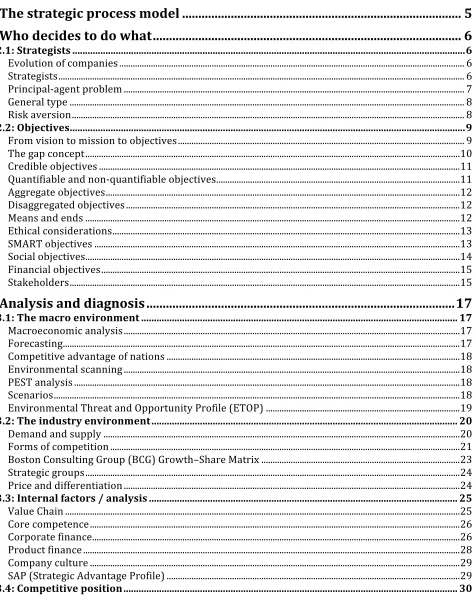
1: The strategic process model ... 5
2: Who decides to do what... 6
2.1: Strategists ...6
Evolution of companies ... 6
Strategists... 6
Principal-‐agent problem ... 7
General type ... 8
Risk aversion... 8
2.2: Objectives...9
From vision to mission to objectives... 9
The gap concept...10
Credible objectives ...11
Quantifiable and non-‐quantifiable objectives...11
Aggregate objectives...12
Disaggregated objectives...12
Means and ends ...12
Ethical considerations...13
SMART objectives ...13
Social objectives...14
Financial objectives...15
Stakeholders...15
3: Analysis and diagnosis...17
3.1: The macro environment ... 17
Macroeconomic analysis...17
Forecasting...17
Competitive advantage of nations ...18
Environmental scanning ...18
PEST analysis ...18
Scenarios...18
Environmental Threat and Opportunity Profile (ETOP) ...19
3.2: The industry environment... 20
Demand and supply ...20
Forms of competition ...21
Boston Consulting Group (BCG) Growth–Share Matrix ...23
Strategic groups...24
Price and differentiation ...24
3.3: Internal factors / analysis ... 25
Value Chain ...25
Core competence...26
Corporate finance...26
Product finance ...28
Company culture ...29
Porter’s “5 Forces Model”...30
Product Life Cycle (PLC) ...31
4: Choice...32
4.1: Generic strategy alternatives... 32
Corporate level...32
Business level...33
Decision Maker Generic Strategies...35
4.2: Strategy variations... 36
Related and unrelated diversification...36
Vertical Integration ...37
Acquisitions ...37
Alliances and Joint Ventures ...39
International Expansion...39
From generics to variations...40
Pricing ...40
4.3: Strategy choice ... 42
Shareholder wealth ...42
Performance gaps ...43
Corporate management...43
SBU management ...44
Risk and uncertainty analysis...44
Managerial Perceptions...44
SWOT analysis...47
From SWOT to generics...47
Accounting techniques...47
5: Implementation...49
5.1: Resources and structure... 49
Organisational structure...49
Managerial style...51
Critical success factors...52
5.2: Resource allocation ... 53
Management of change...53
Opportunity cost...54
Marginal analysis ...55
Budgets...55
5.3: Evaluation and control ... 57
6: Feedback...60
Communication channels ... 60
Ability to adapt... 61
Learning organisation... 61
A: Acronyms...62
B: The augmented process model ...63
Who decides to do what ... 63
Objectives ...63
Strategists...63
Choice ... 66
Generic strategy alternatives...66
Strategy variations ...66
Strategy choice ...66
Implementation ... 67
Resource and structure ...67
Resource allocation ...67
Evaluation and control...67
Feedback... 68
C: Quick cheat sheet ...69
BCG Growth–Share Matrix ... 69
Strategies... 69
Hierarchy ...69
Environmental analysis... 69
SLEPTD ...69
PEST...69
SWOT...69
Porter’s five forces...69
Robert Miles / Charles Snow...70
Product life cycle ...70
Market strategies... 70
D: Selected Student Answers matrix ...71
1: The strategic process model
2: Who decides to do what
2.1: Strategists
Topics as defined in the augmented process model:
-‐ Principal-agent problem
-‐ General type
o Prospector
o Analyser
o Defender
o Reactor
-‐ Risk aversion
-‐ Team composition
-‐ Group dynamics
Bold items are discussed in more detail below.
Evolution of companies
The typical company is continuously evolving, and the roles undertaken by
decision makers are to some extent dependent on the stage of the company’s evolution, which can be classified in three stages:
1. The small single-‐product company
2. The integrated company
3. The large diversified company
Only a very small minority of companies actually ‘evolve’ in the sense that they end up as large diversified companies.
Strategists
The implication of the life cycle approach to company evolution is that strat-
egists with different characteristics are required for companies at different stages. This leads to problems in ensuring that the right type of person is in charge. For example, there are many instances of entrepreneurial strategists who develop a company but are unsuited to running a conglomerate in a stable
The four (five) main steps of the process model serve to identify several roles as follows:
-‐ Strategist, entrepreneur and goal setter
-‐ Analyser and competitor
-‐ Strategy decision maker
-‐ Implementer and controller
-‐ (Communicator)
Strategic planning can be regarded as a multidimensional role which is under-
taken by many individuals working at different levels. For example, there are corporate level strategists, typically the Board of Directors and the CEO; below these are the SBU strategists, who comprise executives, planning departments and consultants. In some cases the pinnacle of the strategic planning process is occupied by the General Manager who sits at the top of the decision making process. Thus control of the strategic planning process can rest in the hands of different people. This does not mean that the process itself cannot be identified and analysed, but it does suggest that companies should give some thought to how the function is undertaken in their organisations. If no one is very sure about who is carrying out the strategic planning function, it could well be that the
process itself could be greatly improved.
Principal-‐agent problem
The problem which permeates management at all levels is the need to strike a
bargain with subordinates which ensures that the manager’s objectives are met without the need for constant monitoring of activity.
The personal objectives of an individual manager may include maximisation of wealth, ambition, desire for a quiet life, desire to avoid confrontation, and so on.
There is no guarantee that the manager will place the company’s objectives
high in this personal set of priorities.
General type
The Prospector is primarily concerned with the identification of new market
opportunities so issues relating to internal organisation take second place.
The Analyser is characterised by sophisticated internal information systems and
detailed investigation of options, but this is unlikely to be followed up by the type of action undertaken by the Prospector.
The Defender is concerned with maintaining the current market position without
exhibiting a great deal of initiative in developing new market opportunities.
The Reactor simply deals with circumstances as they arise.
Risk aversion
A particular manager may feel that even though the probability of losing 100% is only one in ten, this is still an unacceptable risk because it would result in the
company going bankrupt. This is known as risk aversion, and results in the
manager preferring an investment with a lower expected value which did not contain the risk of bankruptcy in the probability distribution.
The expected value approach can conceal the fact that risks are not symmetrical, and therefore it would be folly to base decisions on the expected values alone no
matter what the ‘law of large numbers’ states, because the company may end up
2.2: Objectives
Topics as defined in the augmented process model:
-‐ Business definition
-‐ Mission
-‐ Shareholder wealth
-‐ Gap analysis
-‐ Means and ends
-‐ Ethics
-‐ Profit maximisation
-‐ Growth vector
-‐ Stakeholder map
-‐ Credible, quantifiable, disaggregated, economic, financial
Bold items are discussed in more detail below.
From vision to mission to objectives
Vision
One of the primary roles of the CEO is to develop a long-‐term view of what the company is about and the markets within which it should be operating. This is
sometimes referred to as the vision because it is not expressed in detailed terms
and is perhaps no more than a broad thrust within which the company will be directed.
Mission
It is necessary to translate this vision into a tangible set of directions which can
be used by employees to direct their efforts in a manner which is consistent throughout the organisation. There are a number of steps which are necessary to achieve this:
-‐ Develop the mission statement
-‐ Disaggregate the mission
-‐ Derive objectives
Mission statement
The mission statement needs to have several characteristics including the following.
-‐ Serve as a definition of the business the organisation is in
-‐ Be clearly understood by employees
-‐ Provide a focus for activities
Setting objectives
Once the general vision of the company has been established, and the mission identified, it is necessary to determine what has to be achieved for the mission to be successful.
While the mission can be expressed in general terms, it is necessary to state the
objectives at least partly in terms of measurable performance targets. In the absence of identifiable targets the mission can have little operational significance and will probably be acknowledged but largely ignored by managers at all levels.
Objective setting introduces accountability into the pursuit of the company vision, so it is not productive to use vague terms such as ‘increase market share’ or ‘increase the return on assets employed’.
It is also essential to ensure that objectives are consistent.
The gap concept
The gap concept is concerned with the difference between expected and
desired future states. There are two steps in identifying a performance gap:
1. Decide what the desired future state is at a specified time in the future.
2. Analyse the state the company is likely to be in at that time if no changes to
strategy are made.
The difference between the expected and the desired state is the perform- ance gap.
Once the gap has been identified, three questions can be tackled:
-‐ Does the gap arise because of external or internal factors?
-‐ Does the company have potential resources to close the gap?
-‐ Can a strategy be developed which will close the gap?
A revealing outcome of gap analysis is that while it may appear that the difference
between the current and the desired state is not large, there may well be a
substantial difference between expected and desired states.
Credible objectives
There is no point to setting objectives, even where these are derived from the
company mission, which employees think cannot be achieved and hence do not
serve as a guide for resource allocation.
The setting of realistic objectives is a dynamic process which is constantly under review. It would be naive to characterise objectives as immutable goals set by
isolated policy makers, and the process model emphasises the feedback which
makes it possible to adjust objectives in the light of experience.
Quantifiable and non-‐quantifiable objectives
Company objectives can be expressed in terms of a single variable, such as a target rate of return on investment. However, few companies claim to focus on only one objective, and companies typically express objectives in terms of a number of components or characteristics.
quality’ product, as defined by the development engineers, and a dominant market share.
Aggregate objectives
The corporate objective as derived from the mission statement is an aggregate
concept in the sense that it applies to overall company performance, size, target markets, financial structure and so on. The specification of corporate aggregate objectives has profound implications for the structure of the company and the operations of SBUs.
Aggregate objectives are sometimes indistinguishable from mission statements and may be expressed in vague terms such as ‘being in the transport business’ or ‘being innovative and quality orientated’; this is possibly because it is difficult to visualise a single objective which applies to a range of products and SBUs.
One important reason for adopting a quantitative view of aggregate objectives is
that it can be used as a measure of the effectiveness of corporate executives.
Disaggregated objectives
The process of converting corporate or aggregate objectives to a series of
objectives for managers at lower levels raises many difficulties. This is because it
is necessary to interpret the aggregate objective in terms which are realistic,
consistent and achievable, and make sense to managers at each level in the company.
A prerequisite is to identify the individual objectives which must be achieved in
pursuit of the aggregate objectives.
For example, there is little point in telling a sales force manager that the corporate objective is to achieve 15 per cent rate of return on investment. Instead, the manager needs to be told what level of sales is consistent with the objective of a 15 per cent rate of return. In the absence of explicit guidance, the sales force manager may attempt to maximise the sales of all products in
response to the general objective, while the optimum corporate strategy may be to maintain market share at the current level and take-‐over a key competitor.
Means and ends
An issue which is closely related to the process of disaggregating objectives is the
The distinction between means and ends is not always clear cut when applied to many real life situations, and this can lead to confusion as to the nature of
objectives.
For example, the objective of a company may be to achieve a 15 per cent rate of return on investment. The extent to which this is best achieved by a happy and stable workforce, or by being associated with high-‐quality products, depends on subjective judgements concerning the contribution of each to the profit objective; because of the importance a company lays on a happy and stable workforce, many managers, and their subordinates, may gain the impression that this is an objective of the company. Strictly speaking, it is a means to an end.
Ethical considerations
Moral behaviour is difficult to define for companies and for managers. The
manager may find it counter-‐productive to take a stand ‘for the sake of principle’ when that principle is based on a series of dubious premises.
Some companies impose a code of ethics on their employees, such as never
accepting bribes. This is somewhat difficult to enforce in countries where bribery is socially acceptable, and is not seen as immoral behaviour.
It may simply be the case that such companies are using moral values as a means towards the end of promoting an image of honesty, integrity and dependability which will enhance their competitive potential.
SMART objectives
A useful acronym that captures many of the dimensions of objectives discussed
above is SMART which stands for objectives that are:
-‐ Specific
-‐ Measurable
-‐ Achievable
-‐ Relevant
-‐ Time-‐bound
and ends, given that it is typically easier to be specific about the means than the ends.
Measurable
Some objectives are by their nature non-‐quantifiable, such as ‘to have a happy and stable workforce’. But just because they are not strictly measurable does not mean they should be left out of the equation.
Achievable
Different things can appear achievable and credible to different people. It is often possible to identify after the event that the objective was not achievable but this may not be apparent when the decision is being made.
Relevant
It is clearly important that objectives are aligned with the resource capabilities of the company – or the other way round.
Time-bound
While it may appear to add definition to the objectives to relate them to a time scale it has to be recognised that it is impossible to predict the future with any degree of certainty.
Social objectives
The notion that companies have a wider responsibility to the community gained momentum after 2000 and has gained the formal title of Corporate Social
Responsibility (CSR). Many companies claim to take CSR into account in their decision making and Annual Reports often contain a section on CSR.
Financial objectives
The application of financial concepts makes it possible to quantify the profit maximisation objective. In economics, the profit maximisation objective is expressed in terms of comparative statics, i.e. it is assumed that all future cash flows can be collapsed to a present value so that projects which are undertaken at the present with different cash flows in the future can be compared.
Financial concepts that can help define financial objectives are:
-‐ NPV
-‐ Cost of capital
-‐ Return on investment (ROI)
-‐ Shareholder wealth
Stakeholders
A variety of individuals and groups have an interest in the organisation and some influence on the way it is managed; those individuals and groups are categorised as the stakeholders.
The notion of stakeholder extends well beyond the shareholders, or owners of the company, to include:
-‐ Shareholders
-‐ Managers
-‐ Employees
-‐ Suppliers
-‐ Customers
-‐ Creditors
-‐ Local community
-‐ Government
Stakeholder influence
While it can be argued that in principle some stakeholders should have little interest in the company, the existence of legislative, institutional and historical factors can imbue stakeholders with a significant degree of influence; for
Stakeholder map
Stakeholder influence and priority can have a significant impact on how an
organisation operates and on its potential for change. The constraints imposed by stakeholder influence are not always recognised and one of the reasons why things often do not turn out as expected is that the interests of stakeholders have not been taken into account. One approach is to map the potential importance of stakeholders according to their influence and priority as shown below:
3: Analysis and diagnosis
3.1: The macro environment
Topics as defined in the augmented process model:
-‐ Macroeconomic analysis
o Unemployment
o Inflation
o Interest rates
o Exchange rates
-‐ Forecasting
-‐ Competitive advantage of nations
-‐ Environmental scanning
-‐ PEST analysis
-‐ Scenarios
-‐ ETOP
Bold items are discussed in more detail below.
Macroeconomic analysis
-‐ Unemployment
-‐ Inflation
-‐ Interest rates
-‐ Exchange rates
Forecasting
No one can look into the future with any degree of certainty. This amounts to
trying to ascertain what is likely to happen. Even vague predictions can be
valuable.
While it might not be possible to forecast the amount of change in a key value
needed for a strategic decision, it might be possible to get a reasonable feeling for
Competitive advantage of nations
National market factors which relate to the source of competitive advantage:
-‐ domestic factor conditions
-‐ related and supporting industries
-‐ demand conditions
-‐ strategy, structure and rivalry
Environmental scanning
Environmental scanning is the process of keeping in touch with changes in the environment and is an important component of the feedback part of the strategic process.
But in practice it is an extremely difficult activity to undertake; for example, what are the characteristics of the person to be given responsibility for environmental scanning? What specific direction can be given regarding what to look for? Many CEOs would be unconvinced of the productivity of such a role.
PEST analysis
The checklist of
-‐ Political
-‐ Economic
-‐ Social
-‐ Technological
factors provides a useful framework for assessing these influences. At one level the PEST analysis is nothing more than four lists, and as such is of little value. But
the identification of a range of relevant factors, and an analysis of the relation-
ships among them, can provide important insights into the company’s prospects.
Scenarios
Once some projections of possible futures have been made they can be used as
the basis of scenarios. A scenario is not a forecast, but it is an attempt to
investigate the implications of possible futures for the company.
A scenario is actually a narrative about a particular way in which the future might
take shape. It is therefore a story about what could happen if particular
Environmental Threat and Opportunity Profile (ETOP)
The so-‐called ETOP profile is a method of systemising how changes in the economic environment might relate to the company’s strategy:
1. Use the PEST approach as a checklist
2. Apply macroeconomic ideas to economy wide influences
3. Consider international factors both in terms of exchange rates and inter-‐
national competitive influences
4. Use the environmental scanning approach to think beyond the immediate
situation
5. Put together some scenarios to help put factors into context
3.2: The industry environment
Topics as defined in the augmented process model:
-‐ Demand and supply
o Price determination
o Price elasticity
-‐ Forms of competition
o Perfect/imperfect competition
o Oligopoly
o Monopoly
-‐ Segmentation
-‐ Differentiation
o Perceived price/differentiation matrix
-‐ Quality
-‐ Strategic groups
Bold items are discussed in more detail below.
Demand and supply
The market price is determined when supply and demand “meet”.
If supply and demand change price might fluctuate:
Forms of competition
Perfect competition
In a perfectly competitive market
-‐ The product is homogeneous
-‐ There are no barriers to entry
-‐ No economies of scale
-‐ Universal availability of information on prices and quantities
-‐ Large number of sellers and buyers
The result is that no firm can charge more than the market price and the demand curve is horizontal.
Monopoly
The industry is comprised of only one producer whose demand curve is the
industry demand curve for the product. This demand curve slopes from left to right because the company is not a price taker, i.e. it can sell more by lowering the price.
Oligopoly
In an oligopoly relatively few competitors have split the market between them.
Often a price-leader emerges whose actions (either increasing the price due to
increased costs or decreasing the price in an attempt to gain market share) are quickly mimicked by the competitors.
Barriers to entry
Structural barriers are outside the control of the firm while strategic barriers
depend on actions undertaken by the firm that deter entry. Structural barriers
include:
-‐ Size of the market
-‐ Capital requirements
-‐ Sunk costs
-‐ Control by legislation or tacit agreement
-‐ Economies of scale
-‐ Experience effect
Strategic barriers arise from competitive actions undertaken by the company, and include:
-‐ Reputation
-‐ Pricing
-‐ Access to distribution channels
It is doubtful if strategic barriers to entry can be effective in the absence of structural barriers.
Contestable markets
A market in which entry costs are not sunk, therefore exit is costless, is known as perfectly contestable. The ability to exit without having made any capital
commitment guarantees freedom of entry, and the fear of hit-‐and-‐run raids forces incumbents to set prices lower than they would have done otherwise.
In a contestable market it is likely that the monopolist is already efficient because
of potential competitive forces.
Boston Consulting Group (BCG) Growth–Share Matrix
Four quadrants:
Relative market share
Market growth High Low
High Stars Question marks
Low Cash cows Dogs
Dogs
A product which has a low market share in a stable market, and which is not making profits currently, stands little chance of making profits in the future.
Question marks
The product in this sector is called a Question Mark because it may become either a Dog or a Star as the market matures. If market share can be increased before the growth in the market stops it will become a star; if not it will become a dog.
Cash cows
This product achieves economies of scale, is further up the experience curve than competitors and, since demand has stabilised resources can be aligned closely with demand. It is now possible to apply JIT and reduce marketing expenditure.
Strategic groups
(Also applies to 2.4: Competitive position)
It may not be immediately obvious where in an industry competitive forces actually arise; there may be many firms in an industry but not all of them may be direct competitors.
One approach is to identify strategic groups, which are sets of firms in an
industry which are similar to one another and different from firms outside the group on one or more key dimensions of their characteristics and strategy.
Price and differentiation
The two most important determinants of a product’s success are likely to be the
perception of its price compared to similar products, and the degree to which
consumers perceive the product as a different offering. A product can be
approximately located in the price/differentiation matrix:
3.3: Internal factors / analysis
Topics as defined in the augmented process model:
-‐ Value chain
-‐ Shareholder value analysis
-‐ Core Competence
-‐ Experience curve
-‐ Economies of scale
-‐ Innovation
-‐ Economies of scope
-‐ Synergy
-‐ Joint production
-‐ Opportunity cost
-‐ Marginal analysis
-‐ Ratios
-‐ Gearing
-‐ Cash flow
-‐ Culture
o Power
o Role
o Task
o Personal
-‐ SAP
Bold items are discussed in more detail below.
Value Chain
A company can be visualised as a chain of value producing activities which
starts with inputs at one end and sales at the other.
The primary activities in the value chain are:
-‐ In-‐bound logistics
-‐ Operations
-‐ Out-‐bound logistics
-‐ Marketing and sales
The primary activities cannot operate on their own but need support in a variety of ways. The support activities are:
-‐ Procurement
The process by which resources are acquired -‐ Technology development
The technology associated with each of the value activities, including learning by doing, product design and process development
-‐ Human resources
The whole business of managing the workforce -‐ Management systems
Including quality control, finance and operational planning
Core competence
Core competencies are difficult to define and are by their nature unique to the situation, otherwise they would have been copied already:
-‐ Difficult to identify
-‐ Difficult to imitate
-‐ Do not reside within SBUs
Relatively rare
Corporate finance
To analyse the financial situation of the corporation one needs to look at the financial indicators and ratios that apply to the corporation as a whole. Later those indicators can be compared with the corresponding values from individual products.
Some values can be taken directly from the financial statements of the company that is being analysed. However often the interesting indicators and ratios need to be determined from the various numbers in the Accounts statement, Balance sheet and Cash flow statements.
Financial indicators and ratios
There are a lot of financial indicators and ratios that are potentially interesting in evaluating a company’s fortune. Which ones are applicable depends on the
-‐ Return on owner’s equity (ROE) -‐ Return on total assets (ROTA)
Both ROE and ROTA need to be positive of course. They also need to exceed the company’s cost of capital (see below). If not the shareholders would be better off investing elsewhere!
Both values are calculated by taking the net cash flow (see below) and divid-‐ ing them by either the owner’s equity or the total assets of the company.
-‐ Cost of capital
How much the company has to pay for it’s capital. Usually calculated by di-‐ viding interest payments by the amount of long-‐term debt.
-‐ Gearing
High gearing makes it difficult to borrow more money. Gearing is calculated as the percentage of the long-‐term debt compared to owner’s equity (Long-‐ term debt / equity).
-‐ Net cash flow
After subtracting all costs the resulting net cash flow should be positive. One-‐time effects from sales (or investments) might distort the net cash flow number and should be taken into account appropriately.
-‐ Cash reserve
A good cash reserve allows the company to sustain losses or low profits for a while.
-‐ Corporate overhead
Company overhead and corporate centre costs need to be looked at relative to the profit numbers. Do overhead and corporate centre cost too much?
-‐ Hiring and redundancy costs
High hiring and redundancy costs indicate problems with the HR processes and a high turnover rate of the workforce. HR is a part of the value chain, indicating that problems exist in the value chain.
-‐ Marketing
Product finance
As with the company as a whole there are a lot of financial indicators and ratios that are potentially interesting in evaluating the performance of an individual
product.
Products performing well compared to the company as a whole are obviously positive for the company while products whose indicators/ratios are below the company average need to be looked at in more detail.
Financial indicators and ratios
Some frequently used indicators are: -‐ Contribution margin
The contribution margin for the product must be evaluated with the PLC and BCG positions of the product in mind. Contribution of a ‘Cash cow’ needs to be high while the attempt to capture market share in a growth market for a ‘Star’ will reduce the contribution margin without indicating a problem exists with the product.
-‐ Inventory
Inventory levels (and production capacity) must be in line with PLC and BCG positions.
-‐ Gross profit
Gross profits for product lines need to be analysed with a sensitivity analy-‐ sis. Multiple factors might be involved in gross profit estimates and rela-‐ tively small changes in multiple parameters at the same time might change the gross profit number considerably!
-‐ Market share
The market share of a product can indicate in which phase of the PLC it is. Marketing and costs for development must match the position of the pro-‐ duct in the BCG matrix.
-‐ Attrition rate
Company culture
The culture of a company can influence the strategies that are possible. Possible cultures and their possible implications for the selection and execution of
strategies:
Culture Achieve competitive advantage Cope with strategic change
Power Lacks analysis Unpredictable
Role Slow Resistant
Task Flexible Change is norm
Personal Lack focus Unpredictable
SAP (Strategic Advantage Profile)
Similar to the Environmental Threat and Opportunity Profile (ETOP), which looks at the macro-‐environment, the Strategic Advantage Profile (SAP)can be used for the internal characteristics of the company. By constructing a profile which summarises where competitive strengths or weaknesses are likely to lie, an attempt can then be made to rank the strengths and weaknesses to generate a balanced view of the company and its potential.
The SAP could look at the various departments and list the strengths and weaknesses of those departments, for example:
Internal area Competitive strength (+) or weakness (-)
Research + Recently invented a temperature control
-‐ Team has narrow vision
Development + Reduced lead time by 10%
-‐ Costs are usually overrun by 20%
Production + Working at full capacity
-‐ High labour turnover rate
Marketing + Computerised customer databank
-‐ Lack of technically qualified salespeople
Finance + Share price is buoyant
-‐ Lack of liquidity
3.4: Competitive position
Topics as defined in the augmented process model:
-‐ Porter’s Five Forces
-‐ PLC
-‐ Market share
Bold items are discussed in more detail below.
Porter’s “5 Forces Model”
Five interactive competitive forces collectively determine an industry’s long-‐
term attractiveness:
-‐ Present competitors
-‐ Potential competitors (threat of new entrants)
-‐ Bargaining power of suppliers
-‐ Bargaining power of buyers
-‐ Threat of substitute products
Product Life Cycle (PLC)
-‐ Introduction
-‐ Growth
-‐ (Shake-‐out)
-‐ Maturity
-‐ Decline
4: Choice
4.1: Generic strategy alternatives
Topics as defined in the augmented process model:
-‐ Corporate and business strategy
-‐ Stability, expansion, retrenchment
-‐ Combination
-‐ Cost leadership
-‐ Differentiation
-‐ Focus
-‐ Segmentation
Bold items are discussed in more detail below.
Generic strategies are associated with broad classifications of strategy. The
business generic strategy options are usually represented differently at
corporate and business levels.
These generic strategies are the basis on which the company attempts to build its competitive advantage; without a clear idea of the generic strategy that it is
pursuing, a company is likely to end up with no identifiable strategy with the result that it will lack direction.
SWOT analysis comes in as a guide to the selection of the generic strategy and
the most appropriate strategy variation.
Corporate level
At the corporate level the generic options are related to the scope of the company and the directions it will pursue, for example the development of new products or the acquisition of companies to increase the product portfolio.
-‐ Stability
-‐ Expansion
-‐ Retrenchment
-‐ Combination
Stability
The initial inclination is to regard this as being ‘no change’; however, the fact that managers do not perceive objectives in terms of increasing markets, introducing new products or acquiring new businesses, does not mean that the company is in a steady state.
Expansion
An expansion strategy can be pursued due to various reasons. An increase
product portfolio might be seen as a helping the company. Existing competencies are found to be useful in previously unexplored areas, etc.
Retrenchment
Under this heading come the notions downsizing, delayering and restructuring.
These initiatives are undertaken in the quest for a more efficient organisation
either in terms of shedding businesses which are not seen as part of the com-‐ pany’s core competence or in terms of enhancing labour productivity.
This is the strategy which many managers often do not want to be associated with, because it implies that mistakes have been made in the past. This is why many companies find it necessary to appoint a new CEO when retrenchment is necessary.
Combination
When a multiple SBU company is pursuing different generic strategies in relation to individual SBUs, and it is impossible to characterise the generic strategy for the company as a whole as stability, expansion or retrenchment.
The company can also pursue a different generic policy sequentially, so that the current generic policy can only be interpreted in the context of the dynamic overall strategy.
Business level
-‐ Cost leadership
-‐ Differentiation
-‐ Focus
-‐ Stuck in the middle
Cost leadership
The objective is to achieve a situation where unit costs are significantly lower
than those of other companies in the industry.
The company must attempt to achieve the market share which has the potential
to generate the cost advantages desired. This market share must be achievable!
The company must also be continually concerned with efficient resource
allocation, and be at the forefront of technological developments which have the potential to reduce costs.
Differentiation
The effect of differentiation is to increase profits by segmenting the market and
enabling different prices to be charged in different segments.
The strategic process involves searching for and adding some characteristic such as superior quality or service associated with the product; it may not be a real effect, but may be an image consciously created by the company.
Focus
The previous generic strategies involved different ways of meeting competition and achieving an advantage: in the first case this was by lower cost and in the second by altering product characteristics.
The focus strategy is different in that it typically involves the identification of
market niches where it is possible to avoid confrontation with competitors.
Within the niche the company can focus on cost or differentiation.
Stuck in the middle
A company which does not specialise is likely to be continuously adjusting its competitive focus in response to changes in the market, with the result that it is ‘stuck in the middle’.
Such an undefined strategy is likely to be associated with relatively poor performance, because the marketing effort of such a company is likely to be confused: at any one time it may not be clear whether marketing managers are attempting to achieve market share, differentiate the product in the eyes of the consumer, or find unexploited opportunities.
Decision Maker Generic Strategies
Based on Miles/Snow typology of strategies:
The Prospector is primarily concerned with the identification of new market
opportunities so issues relating to internal organisation take second place.
The Analyser is characterised by sophisticated internal information systems and
detailed investigation of options, but this is unlikely to be followed up by the type of action undertaken by the Prospector.
The Defender is concerned with maintaining the current market position without
exhibiting a great deal of initiative in developing new market opportunities.
The Reactor simply deals with circumstances as they arise.
4.2: Strategy variations
Topics as defined in the augmented process model:
-‐ Diversification
o Related
o Unrelated
-‐ Vertical integration
-‐ Mergers and acquisitions
-‐ Joint ventures and alliances
-‐ Pricing
o Leadership
o Limit
o Predatory
Bold items are discussed in more detail below.
Within the context of a given generic strategy some broad classifications can serve to reduce the options which have to be evaluated. The decision to pursue one of these variations immediately reduces the strategic options. It is at this
point that SWOT analysis is brought to bear – the alignment of strengths and
opportunities helps to identify the appropriate strategic variation.
Related and unrelated diversification
At first sight there appear to be many compelling arguments in favour of staying in the business that you know most about; for example, marketing and selling techniques are known, production processes are similar and many administrative and distributive overheads can be shared among similar products, and the nature of the competition is well known (or it should be).
There are four main incentives to diversify:
-‐ To minimise risk
Minimizes management risk but not shareholder risk!
-‐ To capture economies of scope
The pursuit of economies of scope might as easily lead to value destruc-‐ tion rather than value creation
-‐ To add value through the parenting function and
-‐ To benefit from synergy
The factors which are likely to contribute to long run returns are:
-‐ The potential to reap economies of scope across SBUs that can share the
same strategic asset
-‐ The potential to use an existing core competence in the new SBU
-‐ The potential to utilise an existing core competence to create a new stra-‐
tegic asset in a new business faster
-‐ The potential to expand the company’s pool of core competencies as it
learns new skills
Vertical Integration
Vertical integration involves movement into other parts of the production chain. This can be a backward integration (towards raw materials) or a forward
integration (towards final products).
The crucial question which must always be borne in mind is whether, taking everything into consideration, the company would add value by controlling other parts of the productive chain.
Acquisitions
Instead of undertaking internal action through the mobilisation of the company’s own resources to achieve objectives, the company can undertake external action
by taking over or merging with another company.
Many studies have demonstrated that the majority of acquisitions produce very little value for the acquiring company. Reasons for acquisitions are listed below:
Recognising Unrealised Value
Some chief executives have a skill in identifying companies which have not fully
exploited their value opportunities. The activities of such a company may be unrelated to the current business of the potential acquirer, whose competence is
in adding value independent of the type of business. It is instructive to try to
identify the areas in which the company’s performance might be inad- equate, because unless these can be identified it is difficult to understand the rationale for acquisition.
Buying market share
Instead of investing in new plants and trying to obtain market share from
competitors by using marketing measure (and potentially creating a price-‐war) a take-‐over makes it possible to avoid the costs of the competitive thrust required to achieve the increase in market share. Also the labour force in the acquisition will be relatively high on the experience curve.
Reducing competitive pressure
Buying a competitor can be used to reduce the competitive pressure on a company. However the possible reaction from possible new entrants and also governments can make the positive effects smaller than anticipated.
Synergy
There may be potential gains from sharing resources and making better use of capacity. Capitalising on synergy is difficult and the history of acquisitions which attempted to take advantage of synergy has not been encouraging.
Balancing the portfolio
Rather than introduce a new product into the portfolio from scratch, the company may be on the lookout for a Star or Question Mark which fits with its existing portfolio and has the potential to be developed into a Cash Cow.
Core competencies
The acquisition may have the potential to fit with the strategic direction of the
company in the sense that it complements the set of difficult-‐to-‐replicate skills and attributes on which the company’s competitive advantage is based, while being consistent with the company’s dominant management logic.
It may also be seen as fitting with the company’s strategic architecture in terms of the linkages in the value chain. These characteristics of the acquisition may lead to a long-‐term addition to competitive advantage and hence to value added.
There is no obvious way of identifying the potential contribution to core
Strategic fit
This appears to be a formidable list of reasons that can be marshalled in favour of
an acquisition. The trouble is that each factor is subject to interpretation and
different conclusions can be drawn for a given acquisition target.
Alliances and Joint Ventures
Alliances and joint ventures take many forms including licensing agreements, franchise agreements, relational contracting, relational management, consortia, virtual corporations, virtual functions and joint ventures.
It is known that the success rate of mergers and take-‐overs has been low; it is therefore important to determine whether or not this form of cooperative action
leads to better results. Research has found no significant long-term effects of
joint venture activity on profitability in any industrial sector. One reason for this
is probably the prisoner's dilemma: no contract can cover all eventualities and
one side always has an incentive to cheat in some way.
International Expansion
There is no difference in principle in moving into a foreign market compared with opening up new domestic markets. The same considerations of strategic
opportunities and threats and competitive advantage must be taken into account.
But it has to be recognised that competitive conditions may be significantly
different in another country.
The fact that a company has a competitive advantage in one location does not mean that it can be readily transferred abroad. Competitive advantage can be
country specific or company specific and this determines whether it is appropriate to export to a foreign market or shift production there.
Besides the problem of transferring advantages, there are several variables which complicate operations on the international scene:
-‐ Volatile exchange rates
-‐ Relative factor costs vary by country
-‐ Productivity varies widely among countries
-‐ Governments often protect home production
From generics to variations
At the corporate level the generic strategy chosen requires the implementation of a variation. The process is illustrated below:
A strategic variation which is to contribute to long run competitive advantage must satisfy a number of criteria including the following:
-‐ Consistency with objectives
An option may appear to be attractive, but it may not fit with the com-‐ pany's stated objectives.
-‐ Suitability in terms of company resources
SWOT analysis is of crucial