Periodic Relationships
Among the Elements
General Periodic Trends
General Periodic Trends
to know:
to know:
• Atomic size (atomic radius)Atomic size (atomic radius)
• Ionic size (ionic radius)*Ionic size (ionic radius)*
• Ionization energyIonization energy
• Electron Affinity*Electron Affinity*
• ElectronegativityElectronegativity
• Metallic CharacterMetallic Character
Half of the distance between nuclei in covalently bonded
diatomic molecule
"covalent atomic radii"
Determination of Atomic Radius:
1. Atomic Radius
Periodic Trends in Atomic Radius
Radius inc down a group
Addition of principal quantum levels (larger “n”) and increase in shielding
Reason?
Radius dec across a period
Reason?
Effective Nuclear Charge?
Zeff = Z – S
Z = atomic number (number of protons)
S = screening constant (# of core electrons)
Core electrons are those not in the valence shell. They help to shield the nucleus from the other electrons in the cloud.
Nuclear Charge for Na?
Zeff = 11 – 10 = +1
Table of
Table of
Atomic
Atomic
Radii
2. Ionic Radii
2. Ionic Radii
Cations
Positively charged ions
Ionic Radii
Ionic Radii
Anions
Negatively charged ions
Cation is always smaller than atom from which it is formed.
Anion is always larger than atom from which it is formed.
Table of Table of Ion Sizes Ion Sizes
*Ionic Radii follows same trend as
Atomic radii – if only comparing ions
(cations and anions separately)
*If comparing atoms and ions,
Examples:
1. Arrange Na, Be and Mg in order of increasing atomic radius.
Be < Mg < Na
2. Arrange K+, Cl-, Ca2+ and S2- in order of
increasing ionic radius.
Ca2+ < K+ < Cl- < S
2-3. Arrange Mg2+, Ca2+ and Ca in order of
increasing radius.
Isoelectronic Series
Isoelectronic: ions all containing the same numbers of electrons.
Increasing Nuclear Charge
O2- F- Na+ Mg2+ Al3+ 1.26 Å 1.19 Å 1.16 Å 0.86 Å 0.68 Å
AP Practice Question
The elements in which of the following have most nearly the same atomic radius?
A.Be, B, C, N
B.Ne, Ar, Kr, Xe C.Mg, Ca, Sr, Ba D.C, P, Se, I
AP Practice Question
Which of the following best helps to account for the fact that the F- ion is smaller than the
O2- ion?
A.F- has a larger nuclear mass than O2- has.
B.F- has a larger nuclear charge than
O2- has.
C.F- has more electrons than O2- has.
Increases for successive electrons taken from
the same atom
3.
Ionization Energy
- the energy required to remove an electron from agaseous atom
Ionization of Mg
Ionization of Mg
Mg + 738 kJ Mg+ + e-
Mg+ + 1451 kJ Mg2+ e-
AP Practice Question
The ionization energies for element X are listed in the table above. On the basis of the data,
element X is most likely to be A. Na
Tends to increase across a period
Electrons in the same quantum level do not shield as effectively as electrons in inner levels, thus nuclear charge increases
Irregularities at half filled and filled
sublevels due to extra repulsion of
electrons paired in orbitals, making them easier to remove
Tends to decrease down a group
Outer electrons are farther from the
Nucleus, less energy to remove, electron shielding, Coulomb’s Law
IE is endothermic (heat E
needed to remove e-)
Can be written as an equation:
Example for atom of sodium: 1s22s22p63s1
Na(g) Na+(g) + e- ΔH = 496 kJ mol-1 Na+(g) Na2+(g) + e- ΔH = 4562 kJ mol-1
*Why is the 2nd IE (I
2)so much higher? Core electrons being removed
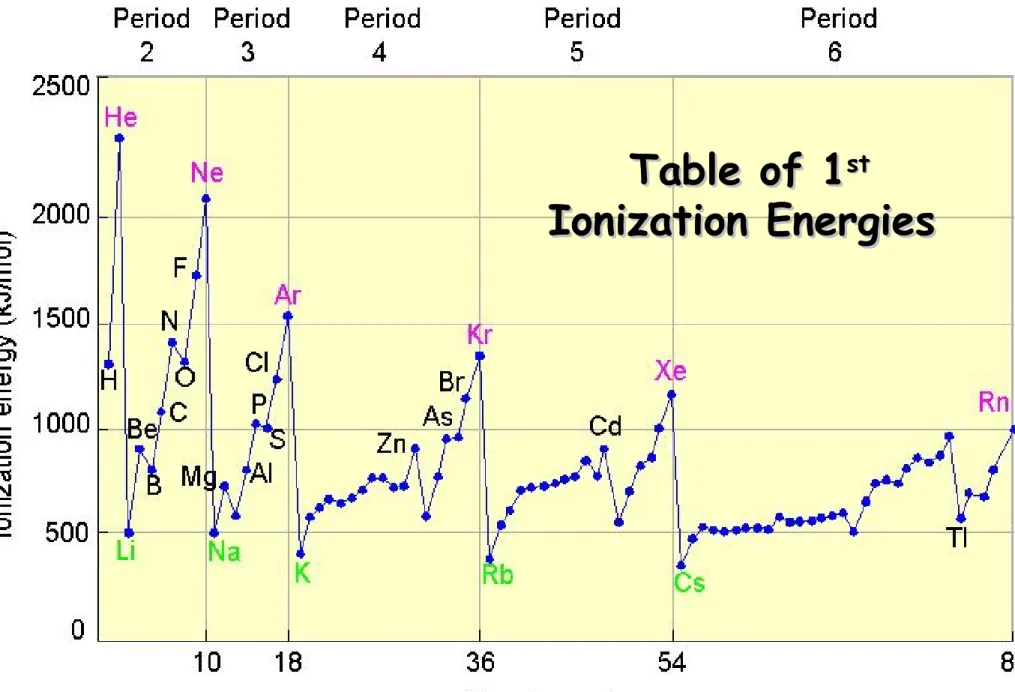
Table of 1
Table of 1stst
Ionization Energies
Can you spot the discontinuities?
AP Practice Questions
Which of the following represents an electron configuration that corresponds to the valence electrons of an element for which there is an especially large jump between the second and third ionization energies? (Note: n represents a
principal quantum number equal to or greater than 2.)
A.ns2
B.ns2np1
C.ns2np2
AP Practice Question
For element X represented above, which of the following is the most likely explanation for the large difference
between the second and third ionization energies? A.The effective nuclear charge decreases with
successive ionizations.
B.The shielding of outer electrons increases with successive ionizations.
C.The electron removed during the third ionization is, on average, much closer to the nucleus than the first two electrons removed were.
AP Practice Question
Which of the following correctly identifies which has the higher first-ionization energy, Cl or Ar, and supplies the best justification?
A.Cl, because of its higher electronegativity B.Cl, because of its higher electron affinity
C.Ar, because of its completely filled valence shell
Affinity tends to increase across a period Affinity tends to decrease as you go down
in a group.
Electrons farther from the nucleus experience less nuclear attraction *Some irregularities due to repulsive forces in the relatively small p orbitals
4. Electron Affinity
4. Electron Affinity
- the - the energy changeenergy change associated with theassociated with the additionaddition of an of an electronelectron
*Opposite meaning than IE, but same trend.
*Opposite meaning than IE, but same trend.
Electron Affinity is Exothermic
(E is released by attracting e-)
Cl(g) + e- Cl-(g) ΔH = -349 kJ mol-1
*Ionization E and Electron affinity are opposites
•IE measures the ease to lose e- to become
cation (+)
•Affinity measures the ease to gain e- to
become anion (-)
Trends in Electron Affinity
There are again,
however, two discontinuities in this trend.
Trends in Electron Affinity
• The first occurs
between Groups IA and IIA.
– The added electron must go in a p orbital, not an s orbital.
Trends in Electron Affinity
• The second
discontinuity occurs between Groups IVA and VA.
– Group VA has no empty orbitals.
AP Practice Question
Which of the following best helps to explain why the electron affinity of Br has a greater magnitude than that of I?
A.Br has a lower electronegativity than I does. B. Br has a lower ionization energy than I does. C. An added electron would go into a new shell in Br but not in I.
5. Electronegativity
5. Electronegativity
Is a measure of the
Is a measure of the
ability of an atom in
ability of an atom in
a molecule to attract
a molecule to attract
electrons to itself.
electrons to itself.
Concept proposed by
Concept proposed by
Linus Pauling
Linus Pauling
1901-1994
1901-1994
Concept proposed by Concept proposed by
Linus Pauling Linus Pauling
Trend in Electronegativity?
Trend in Electronegativity?
Electronegativities tend to increase
across a period WHY???
stronger nuclear charge and more
attraction of the electrons to the nucleus
Electronegativities tend to decrease
down a group or remain the same WHY???
Periodic Table of Electronegativities Highest
Electronegativity
Decreases as elements get
FURTHER
AP Practice Question
Which of the following best helps explain why the electronegativity of Cl is less than that of F?
A.The mass of the Cl atom is greater than the mass of the F atom. B.The Cl nucleus contains more protons than the F nucleus
contains.
C.When Cl and F form bonds with other atoms, the Cl bonding electrons are more shielded from the positive Cl nucleus than the F bonding electrons are shielded from the positive F nucleus. D.Because Cl is larger than F, the repulsions among electrons in the valence shell of Cl are less than the repulsions among
Trends Review
Which period 3 element could be
represented by the ionization energy data collected below? Provide an explanation.
Ionization Energy (kJ/mol)
1st 738
2nd 1451
Rank the Following:
Rank the following ions in order of
increasing ionic radius and explain your answer.
Isoelectronic Series
Isoelectronic: ions all containing the same numbers of electrons.
Increasing Nuclear Charge
O2- F- Na+ Mg2+ Al3+ 1.26 Å 1.19 Å 1.16 Å 0.86 Å 0.68 Å
Properties of Metal, Nonmetals,
and Metalloids
“Special” Groups
• Group 1: Alkali metals
• Group 2: Alkaline earth metals
• Group 3-12: Transitional elements
• Group 17: Halogens
• Group 18: Noble gases
• Elements 58-71: Lanthanides
Metals
• Located on the left-hand side of the stairs • Good conductors of electricity and heat • Easily lose electrons to form cations
• Malleable • Ductile
• Luster
Nonmetals
• Located on the right-hand side of the stairs • Poor conductors of electricity and heat
• Tend to gain electrons to form anions • Brittle
Metalloids
• Located in purple below (make up the stairs)
Metals vs Nonmetals
• Metals tend to form cations.
6. Metallic and 7. Nonmetallic
Character
Metallic character: Decrease across the PT and increases down PT
Summary of Periodic Trends
You Should also know
generalities
• Mass increases (for the most part) from L to R and Top to Bottom
• PT organized by increasing atomic number • HONCl BrIF elements (diatomic gases)
• Monatomic gases (Noble gases)
• Nuclear Charge, E- shielding, PEL, Coulomb’s Law
AP Practice Questions
Which of the following correctly compares periodic properties of two elements and provides an accurate explanation for that difference?
A.The first ionization energy of Al is greater than that of B because Al has a larger nuclear charge than B does.
B.The first ionization energy of F is greater than that of O because O has a higher electronegativity than F has.
C.The atomic radius of Ca is larger than that of Mg because the valence electrons in Mg experience more shielding than the
valence electrons in Ca do.
Trends with Valence Electrons
• Valence electrons: electrons in the highest outer most principle
energy level of an atom • Across a period the
valence electrons increase by 1
• Down a group the
valence electrons stay the same. Why?
Bohr Model for
Remember this?
*Elements in the same
group end with the same # of electrons in each
sublevel
Importance of Valence e-?
• Properties of elements and
compounds/molecules dictated by the
number of valence electrons.
• Similar properties of all elements in groups, similar formulas for
compounds/mole cules in those
Goal number of Valence
Electrons?
• Which group of elements is stable?
• How many VE to all elements have in this group?
Trends with Ions?
• Atoms will gain or lose as many electrons needed to have 8 valence electrons
• Lose electrons: positive ions, metals
• Gain electrons: negative ions, nonmetals
*Because of ions, formulas for compounds should be similar with elements in the
Modern Application
• Solar panels
*n-type: adding an atom w/ one more e- than Si (n = negative charge carrying) *p-type: adding an atom w/
one less e- than Si (p = positive charge carrying) *Junctions between the two
AP Practice Question
Which of the following ions has the same number of electrons as Br - ?
-AP Practice Question
All the chlorides of the alkaline earth metals have similar
empirical formulas, as shown in the table above. Which of the following best helps to explain this observation?
A.Cl2(g) reacts with metal atoms to form strong, covalent double bonds.
B.Cl has a much greater electronegativity than any of the alkaline earth metals.
C.The two valence electrons of alkaline earth metal atoms are relatively easy to remove.
AP Practice Question
RbCl has a high boiling point. Which of the following
compounds is also likely to have a high boiling point, and why?
A.NO, because its elements are in the same period of the periodic table.
B.ClF, because its elements are in the same group of the periodic table.
C.Cl2O, because its elements have similar
AP Practice Question
If Na reacts with chlorine to form NaCl, which of the following elements reacts with Na to form an ionic compound in a one-to-one ratio, and why?
A.K, because it is in the same group as Na.
B.Mg, because its mass is similar to that of Na. C.Ar, because its mass is similar to that of Cl.