Vectors
Chapter 3
3-1
Vectors and Their Components
3.01
Add vectors by drawing
them in head-to-tail
arrangements, applying the
commutative and associative
laws.
3.02
Subtract a vector from a
second one.
3.03
Calculate the components
of a vector on a given
coordinate system, showing
them in a drawing.
3.04
Given the components of
a vector, draw the vector and
determine its magnitude and
orientation.
3.05
Convert angle measures
between degrees and
radians.
Learning Objectives
A Vector is something that has two and only two
defining characteristics.
Magnitude
: the meaning of magnitude is 'size' or
'quantity‘
Properties of Vectors
1
-Two vectors,
A
and
B
are equal if they have the same
magnitude and direction, regardless of whether they
have the same initial points
2
-A vector having the same
magnitude as
A
but in the opposite
direction to
A
is denoted by
–A
3-1
Vectors and Their Components
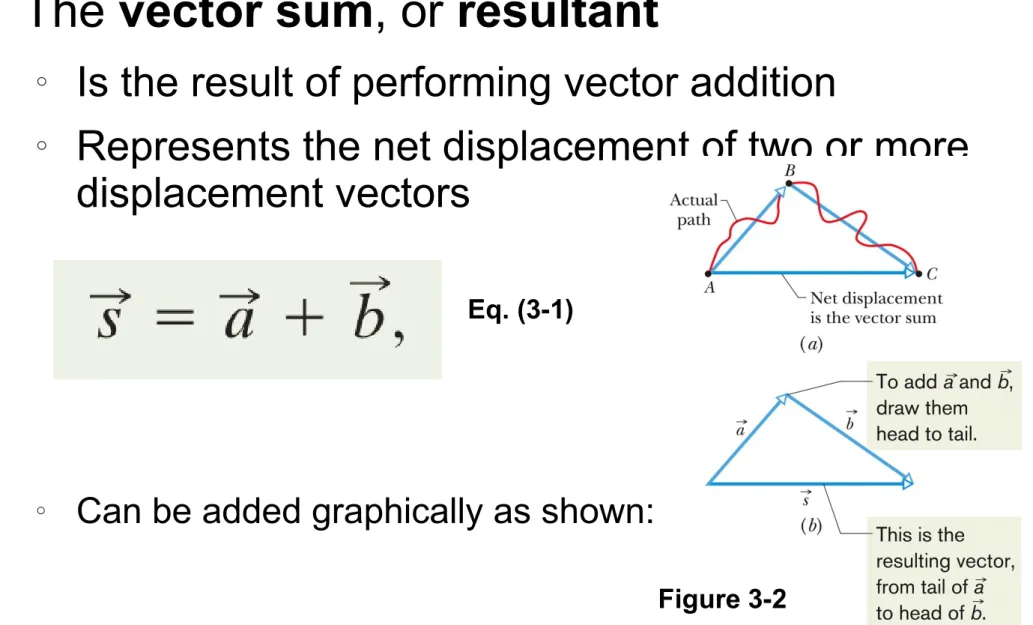
The
vector sum
, or
resultant
o
Is the result of performing vector addition
o
Represents the net displacement of two or more
displacement vectors
o
Can be added graphically as shown:
Figure 3-2
Eq. (3-1)
3-1
Vectors and Their Components
Vector addition is
commutative
oWe can add vectors in any order
Eq. (3-2)
Figure (3-3)
3-1
Vectors and Their Components
Vector addition is
associative
o
We can group vector addition however we like
Eq. (3-3)
Figure (3-4)
3-1
Vectors and Their Components
These rules hold for all vectors, whether they
represent displacement, velocity, etc.
Only vectors of the same kind can be added
o
(
distance
) + (
distance
) makes sense
o(
distance
) + (
velocity
) does not
Answer:
(a) 3 m + 4 m = 7 m (b) 4 m - 3 m = 1 m
3-1
Vectors and Their Components
A negative sign reverses vector
direction
We use this to define vector
subtraction
Eq. (3-4)
Figure (3-5)
Figure (3-6)
Graphically
Panel 1
a vector is represented by an arrow, defining the direction, and
the length of the arrow defines the vector's magnitude. This is
shown in Panel 1. . If we denote one end of the arrow by the
origin O and the tip of the arrow by Q. Then the vector may
be represented algebraically by OQ.
OQ = -QO
.
Cartesian coordinate system
in the
plane
, two perpendicular
3-1
Vectors and Their Components
Angles may be measured in degrees or radians
Recall that a full circle is 360
˚
, or 2
π
rad
Know the three basic trigonometric functions
Figure (3-11)
The polar coordinates
x = r cos Ɵ
And
y = r sin Ɵ
( 1.3 )
tan
θ
=
y/x
Components in two dimensions can be found by:
Where
θ
is the angle the vector makes with the positive
x
axis, and
a
is the vector
length
The length and angle can also be found if the components are known
Therefore, components fully define a vector
Eq. (3-5)
What is the
magnitude
and direction of the following
vector?
The direction of the vector is 55° North of East,
and the vector's magnitude is 2.3.
Example
Express the vectors coordinates below as ordered
pairs in simplest radical form.
Answer
y coordinate = 2 ×sin(30°) = 1
x coordinate = 2 ×cos(30°)
Example 2
Express the vectors coordinates below as ordered pairs in
simplest radical form.
Example
© 2014 John Wiley & Sons, Inc. All rights reserved.
Find the direction of the following vector
Example
© 2014 John Wiley & Sons, Inc. All rights reserved.
The unit vector
Vectors can be related to the basic coordinate systems
which we use by the introduction of what we call "unit
vectors."
The multiplication of two vectors
,
First, the scalar or dot product of two vectors
The scalar product of two
vectors,
A
and
B
denoted by
A·B
, is defined as the product
of the magnitudes of the vectors
times the cosine of the angle
between them,.
Note that the result of a dot product is a scalar, not a vector.
The rules for scalar products are given in the following list,
© 2014 John Wiley & Sons, Inc. All rights reserved.
© 2014 John Wiley & Sons, Inc. All rights reserved.
© 2014 John Wiley & Sons, Inc. All rights reserved.
© 2014 John Wiley & Sons, Inc. All rights reserved.
Solve the following Problems:
© 2014 John Wiley & Sons, Inc. All rights reserved.
Vector has a magnitude of 88 km/h and is directed at 25
relative
to the
x
axis. Which of the following choices indicates the
horizontal and vertical components of vector ?
r
x
r
y
© 2014 John Wiley & Sons, Inc. All rights reserved.
which one of the following statements concerning unit
vectors is true
?
a) The magnitude of a unit vector is always equal to 1
.
b) A unit vector always points in the direction of motion
.
c) The magnitude of a unit vector sometimes equals zero
.
d) A unit vector depends on the units of measurement used
and is a method for tracking the units throughout a
calculation
.
© 2014 John Wiley & Sons, Inc. All rights reserved.
• Sort these quantities into scaler and vectors:
Speed- velocity- acceleration- force- power- volume- displacement-
pressure- mass-weight