Chapter 19
Network Layer:
19-1 IPv4 ADDRESSES
An IPv4 address is a 32-bit address that uniquely and universally defines the connection of a device (for example, a computer or a router) to the Internet.
Address Space Notations
Classful Addressing Classless Addressing
Network Address Translation (NAT)
An IPv4 address is 32 bits long.
The IPv4 addresses are unique
and universal.
The address space of IPv4 is
2
32or 4,294,967,296.
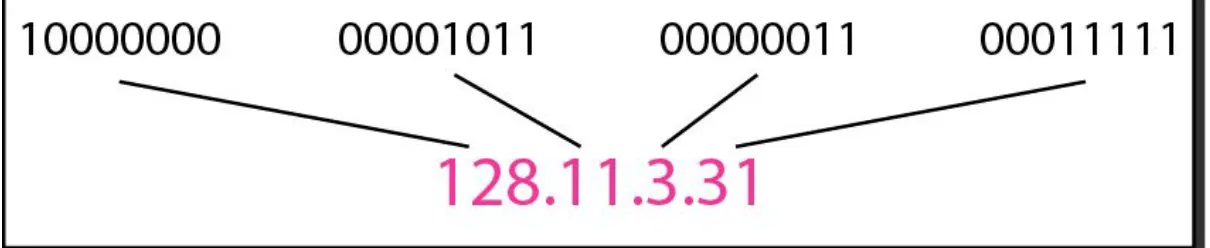
Change the following IPv4 addresses from binary notation to dotted-decimal notation.
Example 19.1
Solution
Change the following IPv4 addresses from dotted-decimal notation to binary notation.
Example 19.2
Solution
Find the error, if any, in the following IPv4 addresses.
Example 19.3
Solution
a. There must be no leading zero (045).
b. There can be no more than four numbers.
c. Each number needs to be less than or equal to 255.
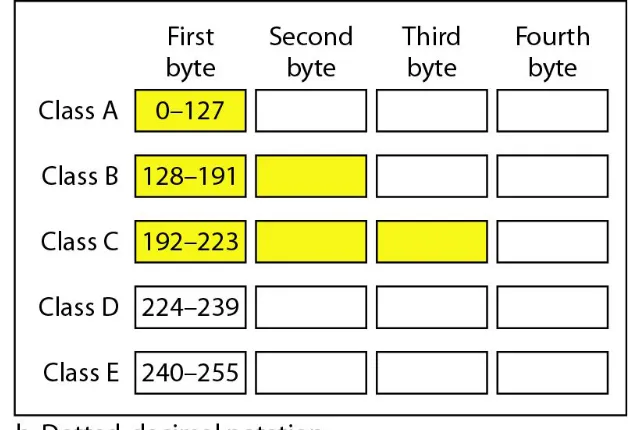
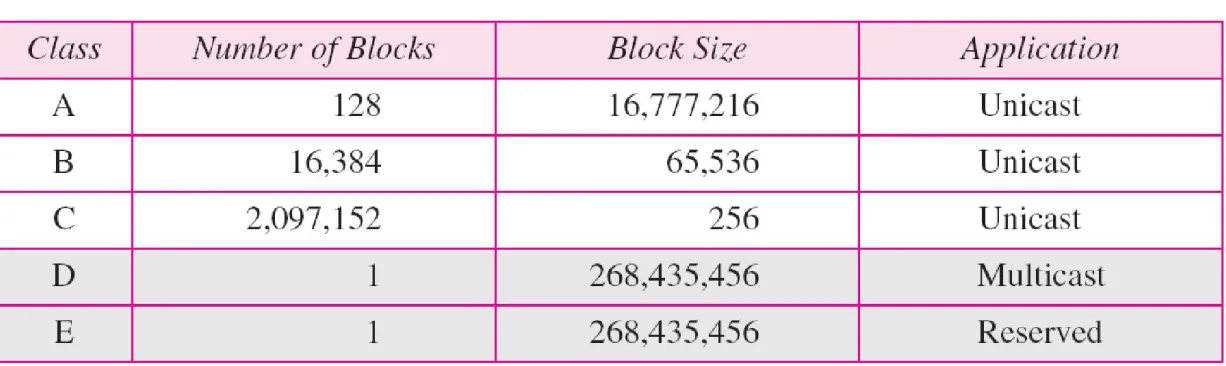
In classful addressing, the address
space is divided into five classes:
A, B, C, D, and E.
Find the class of each address.
a. 00000001 00001011 00001011 11101111
b. 11000001 10000011 00011011 11111111
c. 14.23.120.8
d. 252.5.15.111
Example 19.4
Solution
a. The first bit is 0. This is a class A address.
b. The first 2 bits are 1; the third bit is 0. This is a class C address.
c. The first byte is 14; the class is A.
In classful addressing, a large part of the
available addresses were wasted.
Classful addressing, which is almost
obsolete, is replaced with classless
addressing.
Classless Addressing
■ Classless Addressing: Classless addressing system is also known
as CIDR(Classless Inter-Domain Routing).Classless addressing is a way to allocate and specify the Internet addresses used in
inter-domain routing more flexibly than with the original system of Internet Protocol (IP) address classes. What happened in classful addressing is that if any company needs more than 254 host
machines but far fewer than the 65,533 host addresses then the only option for the company is to take the class B address. Now suppose company needs only 1000 IP addresses for its host
computers then in this (65533-1000=64533) IP addresses get
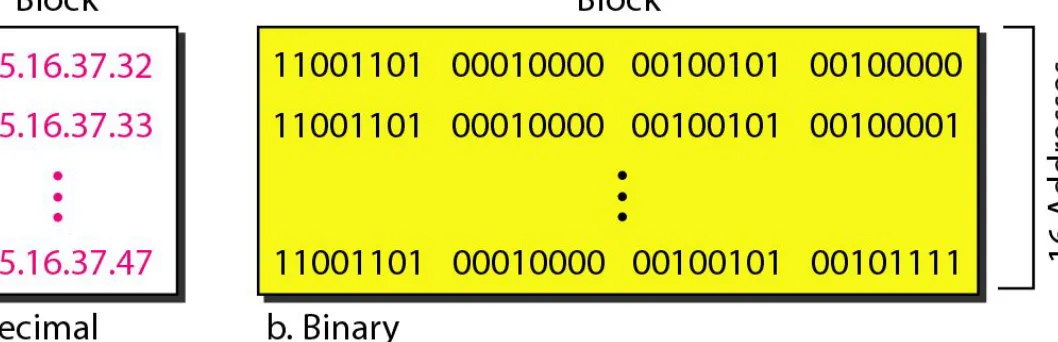
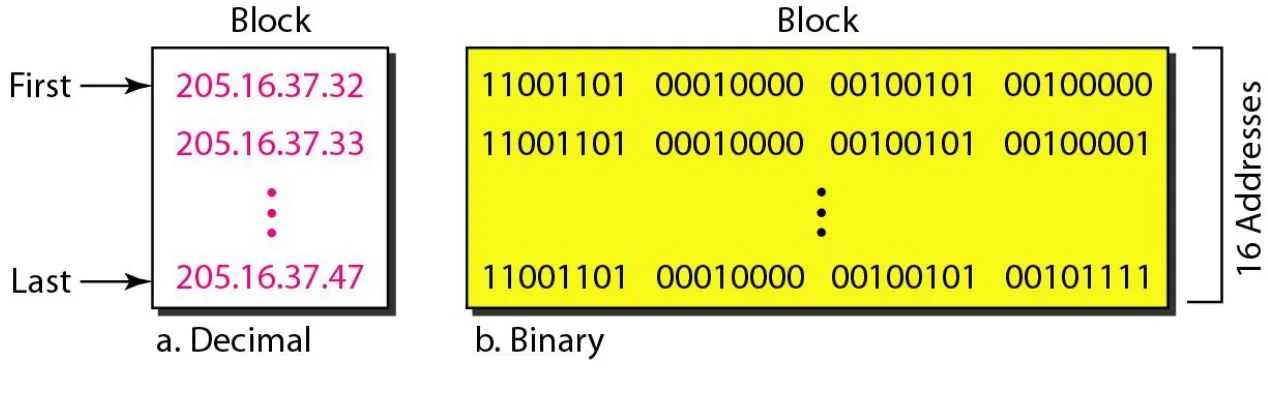
Figure 19.3 shows a block of addresses, in both binary and dotted-decimal notation, granted to a small business that needs 16 addresses.
We can see that the restrictions are applied to this block. The addresses are contiguous. The number of addresses is a power of 2 (16 = 24), and the first address is divisible by 16. The first address, when converted to a decimal number, is 3,440,387,360, which when divided by 16 results in 215,024,210.
In IPv4 addressing, a block of
addresses can be defined as
x.y.z.t /n
in which x.y.z.t defines one of the
addresses and the /n defines the mask.
The first address in the block can be
found by setting the rightmost
32 − n bits to 0s.
A block of addresses is granted to a small organization. We know that one of the addresses is 205.16.37.39/28. What is the first address in the block?
Solution
The binary representation of the given address is
11001101 00010000 00100101 00100111
If we set 32−28 rightmost bits to 0, we get
11001101 00010000 00100101 00100000
or
205.16.37.32.
The last address in the block can be
found by setting the rightmost
32 − n bits to 1s.
Find the last address for the block in Example 19.6.
Solution
The binary representation of the given address is
11001101 00010000 00100101 00100111
If we set 32 − 28 rightmost bits to 1, we get
11001101 00010000 00100101 00101111
or
205.16.37.47
The number of addresses in the block
can be found by using the formula
2
32−n.
Find the number of addresses in Example 19.6.
Example 19.8
Solution
The first address in a block is
normally not assigned to any device;
it is used as the network address that
represents the organization
to the rest of the world.
Each address in the block can be
considered as a two-level
hierarchical structure:
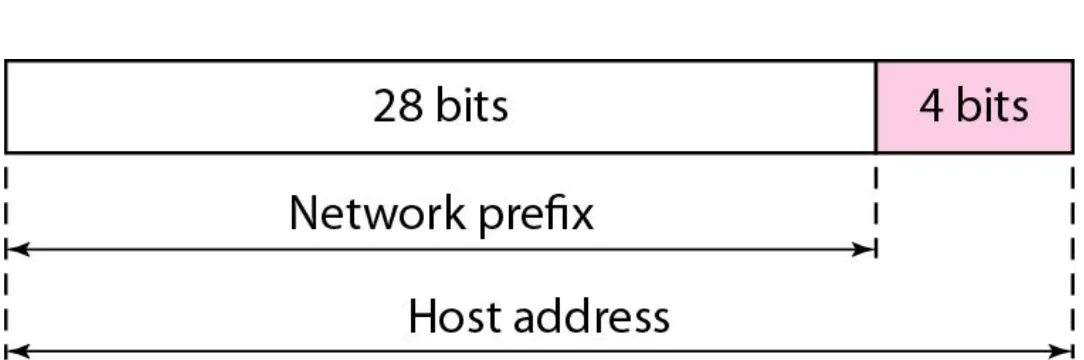
the leftmost n bits (prefix) define
the network;
the rightmost 32 − n bits define
the host.
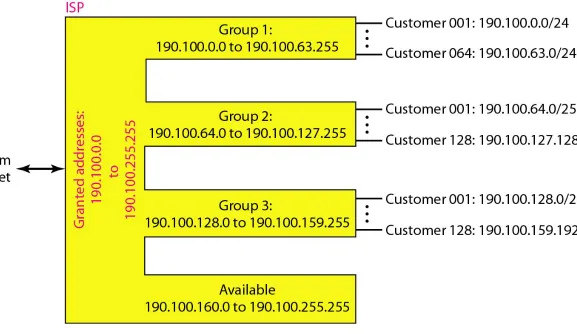
An ISP is granted a block of addresses starting with 190.100.0.0/16 (65,536 addresses). The ISP needs to distribute these addresses to three groups of customers as follows:
a. The first group has 64 customers; each needs 256 addresses.
b. The second group has 128 customers; each needs 128 addresses.
c. The third group has 128 customers; each needs 64 addresses.
Design the subblocks and find out how many addresses are still available after these allocations.
Solution
Figure 19.9 shows the situation.
Example 19.10 (continued)
Group 1
Example 19.10 (continued)
Group 2
Example 19.10 (continued)
Group 3
For this group, each customer needs 64 addresses. This means that 6 (log264) bits are needed to each host. The prefix length is then 32 − 6 = 26. The addresses are
Network Address Translation (NAT)
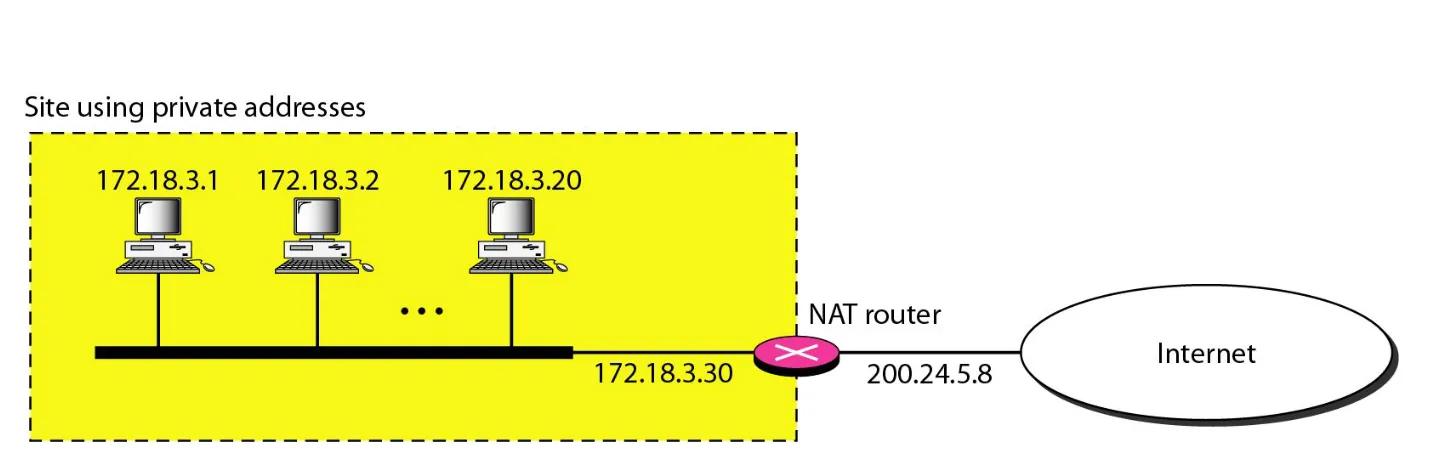
■ network address translation (NAT). NAT enables a user
NAT
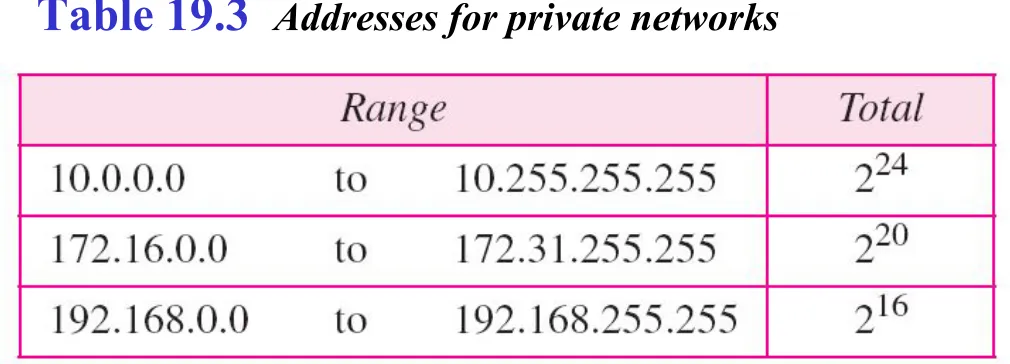
■ As Figure 19.10 shows, the private network uses private
Address Translation
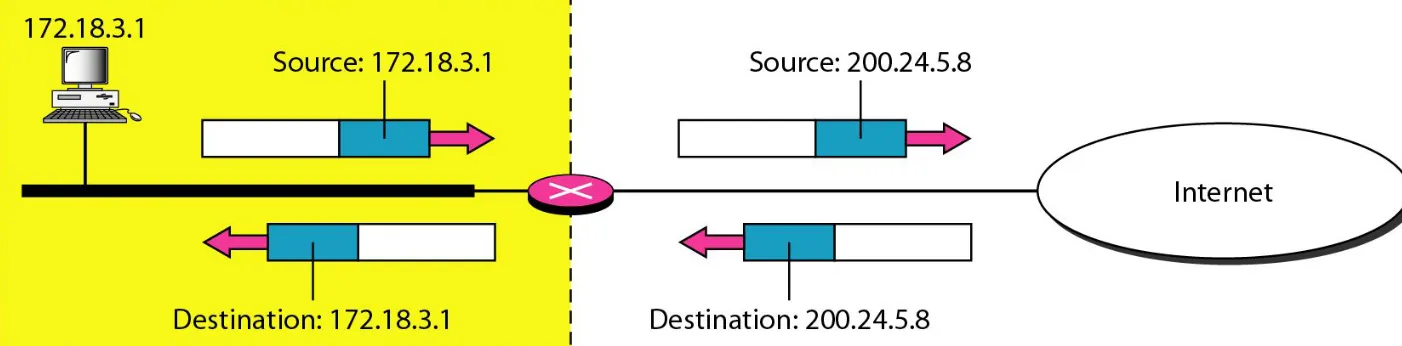
■ All the outgoing packets go through the NAT router,
which replaces the source address in the packet with the global NAT address. All incoming packets also pass
through the NAT router, which replaces the destination address in the packet (the NAT router global address)
Translation Table
■ The reader may have noticed that translating the source
addresses for outgoing packets is straightforward. But how does the NAT router know the destination address for a packet coming from the Internet? There may be
tens or hundreds of private IP addresses, each belonging to one specific host. The problem is solved if the NAT
Using One IP Address
■ In its simplest form, a translation table has only two
columns: the private' address and the external address (destination address of the packet). When the router translates the source address of the outgoing packet, it also makes note of the destination address-where the packet is going. When the response comes back from the destination, the router uses the source address of the packet (as the external address) to find the private address of the packet. Figure 19.12 shows the idea. Note that the addresses that are changed (translated) are
19-2 IPv6 ADDRESSES
Despite all short-term solutions, address depletion is still a long-term problem for the Internet. This and other problems in the IP protocol itself have been the motivation for IPv6.
Structure
Address Space
An IPv6 address is 128 bits long.
Expand the address 0:15::1:12:1213 to its original.
Example 19.11
Solution
We first need to align the left side of the double colon to the left of the original pattern and the right side of the double colon to the right of the original pattern to find how many 0s we need to replace the double colon.