Functions: Domain,
Range, Operations
At the end of this lecture, a student must be able to:
1 Illustrate the difference of relations from functions
2 Determine the domain, codomain, and range of a function
3 Interpret the notationf(x)
4 Find the (natural) domain of a function f when given
expressionf(x)
Relations
Recall: X×Y ={(x, y)|x∈X and y ∈Y}
Definition
A relationis a non-empty set of ordered pairs.
Relations
Recall: X×Y ={(x, y)|x∈X and y ∈Y}
Definition
A relationis a non-empty set of ordered pairs.
Example: Let X ={x1, x2, x3, x4}, Y ={y1, y2, y3, y4},
R ={(x2, y1),(x2, y2),(x3, y3)}
X
x1
x2
x4
x3
R
Y y1
y2
y4
y3
R is a relation from X toY since R ⊆X×Y, and R6=∅.
Example: Let X ={x1, x2, x3, x4}, Y ={y1, y2, y3, y4},
R ={(x2, y1),(x2, y2),(x3, y3)}
X
x1
x2
x4
x3
R
Y y1
y2
y4
y3
R is a relation from X toY since R ⊆X×Y, and R6=∅.
Applications of Functions
- describing a quantity in terms of another,
Bus fare depends on distance traveled
Cost of production is a function of the quantity on raw material used
Applications of Functions
- describing a quantity in terms of another, Bus fare depends on distance traveled
Cost of production is a function of the quantity on raw material used
Functions
Definition
A function from X toY, denoted f :X −→Y, is a relation from X to Y such that for every x∈X, there is a unique y ∈Y such that (x, y)∈f.
Example: Do we have a function?
1. X ={x1, x2, x3, x4}, Y ={y1, y2, y3, y4}
X
x1
x2
x4
x3
f Y
y1
y2
y4
y3
f =
Example: Do we have a function?
1. X ={x1, x2, x3, x4}, Y ={y1, y2, y3, y4}
X
x1
x2
x4
x3
f Y
y1
y2
y4
y3
2. A={1,2,3,4,5}, B =N g={(x, y)∈A×B |y= 2x}
={(1,2),(2,4),(3,6),(4,8),(5,10)}
3.
X
x1
x2
x4
x3
R Y
y1
y2
y4
y3
R =
{(x2, y1),(x2, y2),(x3, y3)}
R is not a function
2. A={1,2,3,4,5}, B =N
g={(x, y)∈A×B |y= 2x} ={(1,2),
(2,4),(3,6),(4,8),(5,10)}
3.
X
x1
x2
x4
x3
R Y
y1
y2
y4
y3
R =
{(x2, y1),(x2, y2),(x3, y3)}
R is not a function
2. A={1,2,3,4,5}, B =N
g={(x, y)∈A×B |y= 2x} ={(1,2),(2,4),
(3,6),(4,8),(5,10)}
3.
X
x1
x2
x4
x3
R Y
y1
y2
y4
y3
R =
{(x2, y1),(x2, y2),(x3, y3)}
R is not a function
2. A={1,2,3,4,5}, B =N
g={(x, y)∈A×B |y= 2x} ={(1,2),(2,4),(3,6),(4,8),(5,10)}
3.
X
x1
x2
x4
x3
R Y
y1
y2
y4
y3
R =
{(x2, y1),(x2, y2),(x3, y3)}
R is not a function
2. A={1,2,3,4,5}, B =N
g={(x, y)∈A×B |y= 2x} ={(1,2),(2,4),(3,6),(4,8),(5,10)}
3.
X
x1
x2
x4
x3
R Y
y1
y2
y4
y3
R =
{(x2, y1),(x2, y2),(x3, y3)}
R is not a function
2. A={1,2,3,4,5}, B =N
g={(x, y)∈A×B |y= 2x} ={(1,2),(2,4),(3,6),(4,8),(5,10)}
3.
X
x1
x2
x4
x3
R Y
y1
y2
y4
y3
R =
{(x2, y1),(x2, y2),(x3, y3)}
R is not a function
2. A={1,2,3,4,5}, B =N
g={(x, y)∈A×B |y= 2x} ={(1,2),(2,4),(3,6),(4,8),(5,10)}
3.
X
x1
x2
x4
x3
R Y
y1
y2
y4
y3
R =
{(x2, y1),(x2, y2),(x3, y3)}
R is not a function
Determine whether or not the following represent functions.
1. f ={(0,1),(2,3),(4,3)} Yes.
2. g ={(0,1),(2,3),(2,4)}No.
3. h={(x, y)∈R×R|x2+y2 = 1}No, because (0,1)∈h and (0,−1)∈h.
4. p={(x, y)∈R×R|y−x2 = 2} Yes, because for each x in
Determine whether or not the following represent functions.
1. f ={(0,1),(2,3),(4,3)}
Yes.
2. g ={(0,1),(2,3),(2,4)}No.
3. h={(x, y)∈R×R|x2+y2 = 1}No, because (0,1)∈h and (0,−1)∈h.
4. p={(x, y)∈R×R|y−x2 = 2} Yes, because for each x in
Determine whether or not the following represent functions.
1. f ={(0,1),(2,3),(4,3)} Yes.
2. g ={(0,1),(2,3),(2,4)}No.
3. h={(x, y)∈R×R|x2+y2 = 1}No, because (0,1)∈h and (0,−1)∈h.
4. p={(x, y)∈R×R|y−x2 = 2} Yes, because for each x in
Determine whether or not the following represent functions.
1. f ={(0,1),(2,3),(4,3)} Yes.
2. g ={(0,1),(2,3),(2,4)}
No.
3. h={(x, y)∈R×R|x2+y2 = 1}No, because (0,1)∈h and (0,−1)∈h.
4. p={(x, y)∈R×R|y−x2 = 2} Yes, because for each x in
Determine whether or not the following represent functions.
1. f ={(0,1),(2,3),(4,3)} Yes.
2. g ={(0,1),(2,3),(2,4)}No.
3. h={(x, y)∈R×R|x2+y2 = 1}No, because (0,1)∈h and (0,−1)∈h.
4. p={(x, y)∈R×R|y−x2 = 2} Yes, because for each x in
Determine whether or not the following represent functions.
1. f ={(0,1),(2,3),(4,3)} Yes.
2. g ={(0,1),(2,3),(2,4)}No.
3. h={(x, y)∈R×R|x2+y2 = 1}
No, because (0,1)∈h and (0,−1)∈h.
4. p={(x, y)∈R×R|y−x2 = 2} Yes, because for each x in
Determine whether or not the following represent functions.
1. f ={(0,1),(2,3),(4,3)} Yes.
2. g ={(0,1),(2,3),(2,4)}No.
3. h={(x, y)∈R×R|x2+y2 = 1} No, because (0,1)∈h and (0,−1)∈h.
4. p={(x, y)∈R×R|y−x2 = 2} Yes, because for each x in
Determine whether or not the following represent functions.
1. f ={(0,1),(2,3),(4,3)} Yes.
2. g ={(0,1),(2,3),(2,4)}No.
3. h={(x, y)∈R×R|x2+y2 = 1} No, because (0,1)∈h and (0,−1)∈h.
4. p={(x, y)∈R×R|y−x2 = 2}
Determine whether or not the following represent functions.
1. f ={(0,1),(2,3),(4,3)} Yes.
2. g ={(0,1),(2,3),(2,4)}No.
3. h={(x, y)∈R×R|x2+y2 = 1} No, because (0,1)∈h and (0,−1)∈h.
4. p={(x, y)∈R×R|y−x2 = 2} Yes, because for each xin
R, there corresponds only one y,
Determine whether or not the following represent functions.
1. f ={(0,1),(2,3),(4,3)} Yes.
2. g ={(0,1),(2,3),(2,4)}No.
3. h={(x, y)∈R×R|x2+y2 = 1} No, because (0,1)∈h and (0,−1)∈h.
4. p={(x, y)∈R×R|y−x2 = 2} Yes, because for each xin
R, there corresponds only one y, y=x2+ 2,
Determine whether or not the following represent functions.
1. f ={(0,1),(2,3),(4,3)} Yes.
2. g ={(0,1),(2,3),(2,4)}No.
3. h={(x, y)∈R×R|x2+y2 = 1} No, because (0,1)∈h and (0,−1)∈h.
4. p={(x, y)∈R×R|y−x2 = 2} Yes, because for each xin
We can also think of a function as a machine which processes an input and gives exactly one output for each input.
In a way, the value of an output y depends on an input value x. Thus,x is called theindependent variable and y is called the
We can also think of a function as a machine which processes an input and gives exactly one output for each input.
In a way, the value of an output y depends on an input value x.
Thus,x is called theindependent variable and y is called the
We can also think of a function as a machine which processes an input and gives exactly one output for each input.
In a way, the value of an output y depends on an input value x. Thus,x is called theindependent variable and y is called the
Whenever (x, y)∈f, we write
y=f(x).
X
x1
x2
x4
x3
f Y
y1
y2
y4
y3
X ={x1, x2, x3, x4},
Y ={y1, y2, y3, y4}
f(x1) =y1,
f(x2) =y2,
f(x3) =y2,
f(x4) = y1
Whenever (x, y)∈f, we write y=f(x).
X
x1
x2
x4
x3
f Y
y1
y2
y4
y3
X ={x1, x2, x3, x4},
Y ={y1, y2, y3, y4}
f(x1) =y1,
f(x2) =y2,
f(x3) =y2,
f(x4) = y1
Whenever (x, y)∈f, we write y=f(x).
X
x1
x2
x4
x3
f Y
y1
y2
y4
y3
X ={x1, x2, x3, x4},
Y ={y1, y2, y3, y4}
f(x1) =y1,
f(x2) =y2,
f(x3) =y2,
f(x4) = y1
Whenever (x, y)∈f, we write y=f(x).
X
x1
x2
x4
x3
f Y
y1
y2
y4
y3
X ={x1, x2, x3, x4},
Y ={y1, y2, y3, y4}
f(x1) =
y1,
f(x2) =y2,
f(x3) =y2,
f(x4) = y1
Whenever (x, y)∈f, we write y=f(x).
X
x1
x2
x4
x3
f Y
y1
y2
y4
y3
X ={x1, x2, x3, x4},
Y ={y1, y2, y3, y4}
f(x1) =y1,
f(x2) =y2,
f(x3) =y2,
f(x4) = y1
Whenever (x, y)∈f, we write y=f(x).
X
x1
x2
x4
x3
f Y
y1
y2
y4
y3
X ={x1, x2, x3, x4},
Y ={y1, y2, y3, y4}
f(x1) =y1,
f(x2) =
y2,
f(x3) =y2,
f(x4) = y1
Whenever (x, y)∈f, we write y=f(x).
X
x1
x2
x4
x3
f Y
y1
y2
y4
y3
X ={x1, x2, x3, x4},
Y ={y1, y2, y3, y4}
f(x1) =y1,
f(x2) =y2,
f(x3) =y2,
f(x4) = y1
Whenever (x, y)∈f, we write y=f(x).
X
x1
x2
x4
x3
f Y
y1
y2
y4
y3
X ={x1, x2, x3, x4},
Y ={y1, y2, y3, y4}
f(x1) =y1,
f(x2) =y2,
f(x3) =y2,
f(x4) = y1
Whenever (x, y)∈f, we write y=f(x).
X
x1
x2
x4
x3
f Y
y1
y2
y4
y3
X ={x1, x2, x3, x4},
Y ={y1, y2, y3, y4}
f(x1) =y1,
f(x2) =y2,
f(x3) =y2,
f(x4) = y1
Letf be a function from X toY.
1 X: domain of f, denoted domf. 2 Y: codomain of f, denoted codomf.
3 range of f, denoted ranf: set of all y∈Y to which some
x∈X is associated. That is,
ranf ={y∈Y |y=f(x) for some x∈X}.
X
x1
x2
x4
x3
f Y
y1
y2
y4
y3
f :X −→Y
domf ={x1, x2, x3, x4},
codomf ={y1, y2, y3, y4},
Letf be a function from X toY.
1 X: domain of f, denoted domf.
2 Y: codomain of f, denoted codomf.
3 range of f, denoted ranf: set of all y∈Y to which some
x∈X is associated. That is,
ranf ={y∈Y |y=f(x) for some x∈X}.
X
x1
x2
x4
x3
f Y
y1
y2
y4
y3
f :X −→Y
domf ={x1, x2, x3, x4},
codomf ={y1, y2, y3, y4},
Letf be a function from X toY.
1 X: domain of f, denoted domf. 2 Y: codomain of f, denoted codomf.
3 range of f, denoted ranf: set of all y∈Y to which some
x∈X is associated. That is,
ranf ={y∈Y |y=f(x) for some x∈X}.
X
x1
x2
x4
x3
f Y
y1
y2
y4
y3
f :X −→Y
domf ={x1, x2, x3, x4},
codomf ={y1, y2, y3, y4},
Letf be a function from X toY.
1 X: domain of f, denoted domf. 2 Y: codomain of f, denoted codomf.
3 rangeof f, denoted ranf: set of all y∈Y to which some
x∈X is associated.
That is,
ranf ={y∈Y |y=f(x) for some x∈X}.
X
x1
x2
x4
x3
f Y
y1
y2
y4
y3
f :X −→Y
domf ={x1, x2, x3, x4},
codomf ={y1, y2, y3, y4},
Letf be a function from X toY.
1 X: domain of f, denoted domf. 2 Y: codomain of f, denoted codomf.
3 rangeof f, denoted ranf: set of all y∈Y to which some
x∈X is associated. That is,
ranf ={y∈Y |y=f(x) for some x∈X}.
X
x1
x2
x4
x3
f Y
y1
y2
y4
y3
f :X −→Y
domf ={x1, x2, x3, x4},
codomf ={y1, y2, y3, y4},
Letf be a function from X toY.
1 X: domain of f, denoted domf. 2 Y: codomain of f, denoted codomf.
3 rangeof f, denoted ranf: set of all y∈Y to which some
x∈X is associated. That is,
ranf ={y∈Y |y=f(x) for some x∈X}.
X
x1
x2
x4
x3
f Y
y1
y2
y4
y3
f :X −→Y
domf ={x1, x2, x3, x4},
codomf ={y1, y2, y3, y4},
Letf be a function from X toY.
1 X: domain of f, denoted domf. 2 Y: codomain of f, denoted codomf.
3 rangeof f, denoted ranf: set of all y∈Y to which some
x∈X is associated. That is,
ranf ={y∈Y |y=f(x) for some x∈X}.
X
x1
x2
x4
x3
f Y
y1
y2
y4
y3
f :X −→Y domf =
{x1, x2, x3, x4},
codomf ={y1, y2, y3, y4},
Letf be a function from X toY.
1 X: domain of f, denoted domf. 2 Y: codomain of f, denoted codomf.
3 rangeof f, denoted ranf: set of all y∈Y to which some
x∈X is associated. That is,
ranf ={y∈Y |y=f(x) for some x∈X}.
X
x1
x2
x4
x3
f Y
y1
y2
y4
y3
f :X −→Y
domf ={x1, x2, x3, x4},
codomf ={y1, y2, y3, y4},
Letf be a function from X toY.
1 X: domain of f, denoted domf. 2 Y: codomain of f, denoted codomf.
3 rangeof f, denoted ranf: set of all y∈Y to which some
x∈X is associated. That is,
ranf ={y∈Y |y=f(x) for some x∈X}.
X
x1
x2
x4
x3
f Y
y1
y2
y4
y3
f :X −→Y
domf ={x1, x2, x3, x4},
codomf =
{y1, y2, y3, y4},
Letf be a function from X toY.
1 X: domain of f, denoted domf. 2 Y: codomain of f, denoted codomf.
3 rangeof f, denoted ranf: set of all y∈Y to which some
x∈X is associated. That is,
ranf ={y∈Y |y=f(x) for some x∈X}.
X
x1
x2
x4
x3
f Y
y1
y2
y4
y3
f :X −→Y
domf ={x1, x2, x3, x4},
codomf ={y1, y2, y3, y4},
Letf be a function from X toY.
1 X: domain of f, denoted domf. 2 Y: codomain of f, denoted codomf.
3 rangeof f, denoted ranf: set of all y∈Y to which some
x∈X is associated. That is,
ranf ={y∈Y |y=f(x) for some x∈X}.
X
x1
x2
x4
x3
f Y
y1
y2
y4
y3
f :X −→Y
domf ={x1, x2, x3, x4},
codomf ={y1, y2, y3, y4},
ranf =
Letf be a function from X toY.
1 X: domain of f, denoted domf. 2 Y: codomain of f, denoted codomf.
3 rangeof f, denoted ranf: set of all y∈Y to which some
x∈X is associated. That is,
ranf ={y∈Y |y=f(x) for some x∈X}.
X
x1
x2
x4
x3
f Y
y1
y2
y4
y3
f :X −→Y
domf ={x1, x2, x3, x4},
codomf ={y1, y2, y3, y4},
Example: Let A={1,2,3,4,5}, B =Nand g :A −→B, such that for eachx∈A, g(x) = 2x
g(1) = 2, g(2) = 4, g(3) = 6, g(4) = 8, g(5) = 10
domg =A, codomg =B,
rang ={2,4,6,8,10}
Example: Let A={1,2,3,4,5}, B =Nand g :A −→B, such that for eachx∈A, g(x) = 2x g(1)
= 2, g(2) = 4, g(3) = 6, g(4) = 8, g(5) = 10
domg =A, codomg =B,
rang ={2,4,6,8,10}
Example: Let A={1,2,3,4,5}, B =Nand g :A −→B, such that for eachx∈A, g(x) = 2x g(1) = 2,
g(2) = 4, g(3) = 6, g(4) = 8, g(5) = 10
domg =A, codomg =B,
rang ={2,4,6,8,10}
Example: Let A={1,2,3,4,5}, B =Nand g :A −→B, such that for eachx∈A, g(x) = 2x g(1) = 2,
g(2) = 4,
g(3) = 6, g(4) = 8, g(5) = 10
domg =A, codomg =B,
rang ={2,4,6,8,10}
Example: Let A={1,2,3,4,5}, B =Nand g :A −→B, such that for eachx∈A, g(x) = 2x g(1) = 2,
g(2) = 4, g(3) = 6, g(4) = 8, g(5) = 10
domg =A, codomg =B,
rang ={2,4,6,8,10}
Example: Let A={1,2,3,4,5}, B =Nand g :A −→B, such that for eachx∈A, g(x) = 2x g(1) = 2,
g(2) = 4, g(3) = 6, g(4) = 8, g(5) = 10
domg =A, codomg =B,
rang ={2,4,6,8,10}
Example: Let A={1,2,3,4,5}, B =Nand g :A −→B, such that for eachx∈A, g(x) = 2x g(1) = 2,
g(2) = 4, g(3) = 6, g(4) = 8, g(5) = 10
domg =A, codomg =B,
rang ={2,4,6,8,10}
Example: Let A={1,2,3,4,5}, B =Nand g :A −→B, such that for eachx∈A, g(x) = 2x g(1) = 2,
g(2) = 4, g(3) = 6, g(4) = 8, g(5) = 10
domg =A, codomg =B,
rang ={2,4,6,8,10}
When given f(x) = an expression involving the variable x, this gives us a rule to obtain the images of elements of the domain.
Example:
If the functionf squares a real number, thenf(x) =x2.
When given f(x) = an expression involving the variable x, this gives us a rule to obtain the images of elements of the domain.
Example:
If the functionf squares a real number,
then f(x) =x2.
When given f(x) = an expression involving the variable x, this gives us a rule to obtain the images of elements of the domain.
Example:
If the functionf squares a real number, thenf(x) =x2.
When given f(x) = an expression involving the variable x, this gives us a rule to obtain the images of elements of the domain.
Example:
If the functionf squares a real number, thenf(x) =x2.
Ifg(x) adds 1 to a positive number,
When given f(x) = an expression involving the variable x, this gives us a rule to obtain the images of elements of the domain.
Example:
If the functionf squares a real number, thenf(x) =x2.
Letf(x) = x2−3x+ 2.
1 f(2) = (2)2−3(2) + 2 =0
2 f(−3) = (−3)2−3(−3) + 2 =20
3 f(c) +f(1) = (c2−3c+ 2) + (12−3(1) + 2) =c2−3c+ 2 4 f(c+1) = (c+1)2−3(c+1)+2 =c2+2c+1−3c−3+2 =c2−c 5
f(x+h)−f(x)
h =
[(x+h)2−3(x+h) + 2]−(x2−3x+ 2) h
= x
2+ 2xh+h2−3x−3h+ 2−x2+ 3x−2
h
= 2xh−3h+h
2
h
Letf(x) = x2−3x+ 2.
1 f(2)
= (2)2−3(2) + 2 =0
2 f(−3) = (−3)2−3(−3) + 2 =20
3 f(c) +f(1) = (c2−3c+ 2) + (12−3(1) + 2) =c2−3c+ 2 4 f(c+1) = (c+1)2−3(c+1)+2 =c2+2c+1−3c−3+2 =c2−c 5
f(x+h)−f(x)
h =
[(x+h)2−3(x+h) + 2]−(x2−3x+ 2) h
= x
2+ 2xh+h2−3x−3h+ 2−x2+ 3x−2
h
= 2xh−3h+h
2
h
Letf(x) = x2−3x+ 2.
1 f(2) = (2)2−3(2) + 2
=0
2 f(−3) = (−3)2−3(−3) + 2 =20
3 f(c) +f(1) = (c2−3c+ 2) + (12−3(1) + 2) =c2−3c+ 2 4 f(c+1) = (c+1)2−3(c+1)+2 =c2+2c+1−3c−3+2 =c2−c 5
f(x+h)−f(x)
h =
[(x+h)2−3(x+h) + 2]−(x2−3x+ 2) h
= x
2+ 2xh+h2−3x−3h+ 2−x2+ 3x−2
h
= 2xh−3h+h
2
h
Letf(x) = x2−3x+ 2.
1 f(2) = (2)2−3(2) + 2 =0
2 f(−3) = (−3)2−3(−3) + 2 =20
3 f(c) +f(1) = (c2−3c+ 2) + (12−3(1) + 2) =c2−3c+ 2 4 f(c+1) = (c+1)2−3(c+1)+2 =c2+2c+1−3c−3+2 =c2−c 5
f(x+h)−f(x)
h =
[(x+h)2−3(x+h) + 2]−(x2−3x+ 2) h
= x
2+ 2xh+h2−3x−3h+ 2−x2+ 3x−2
h
= 2xh−3h+h
2
h
Letf(x) = x2−3x+ 2.
1 f(2) = (2)2−3(2) + 2 =0 2 f(−3)
= (−3)2−3(−3) + 2 =20
3 f(c) +f(1) = (c2−3c+ 2) + (12−3(1) + 2) =c2−3c+ 2 4 f(c+1) = (c+1)2−3(c+1)+2 =c2+2c+1−3c−3+2 =c2−c 5
f(x+h)−f(x)
h =
[(x+h)2−3(x+h) + 2]−(x2−3x+ 2) h
= x
2+ 2xh+h2−3x−3h+ 2−x2+ 3x−2
h
= 2xh−3h+h
2
h
Letf(x) = x2−3x+ 2.
1 f(2) = (2)2−3(2) + 2 =0 2 f(−3) = (−3)2−3(−3) + 2
=20
3 f(c) +f(1) = (c2−3c+ 2) + (12−3(1) + 2) =c2−3c+ 2 4 f(c+1) = (c+1)2−3(c+1)+2 =c2+2c+1−3c−3+2 =c2−c 5
f(x+h)−f(x)
h =
[(x+h)2−3(x+h) + 2]−(x2−3x+ 2) h
= x
2+ 2xh+h2−3x−3h+ 2−x2+ 3x−2
h
= 2xh−3h+h
2
h
Letf(x) = x2−3x+ 2.
1 f(2) = (2)2−3(2) + 2 =0
2 f(−3) = (−3)2−3(−3) + 2 =20
3 f(c) +f(1) = (c2−3c+ 2) + (12−3(1) + 2) =c2−3c+ 2 4 f(c+1) = (c+1)2−3(c+1)+2 =c2+2c+1−3c−3+2 =c2−c 5
f(x+h)−f(x)
h =
[(x+h)2−3(x+h) + 2]−(x2−3x+ 2) h
= x
2+ 2xh+h2−3x−3h+ 2−x2+ 3x−2
h
= 2xh−3h+h
2
h
Letf(x) = x2−3x+ 2.
1 f(2) = (2)2−3(2) + 2 =0
2 f(−3) = (−3)2−3(−3) + 2 =20 3 f(c) +f(1)
= (c2−3c+ 2) + (12−3(1) + 2) =c2−3c+ 2
4 f(c+1) = (c+1)2−3(c+1)+2 =c2+2c+1−3c−3+2 =c2−c 5
f(x+h)−f(x)
h =
[(x+h)2−3(x+h) + 2]−(x2−3x+ 2) h
= x
2+ 2xh+h2−3x−3h+ 2−x2+ 3x−2
h
= 2xh−3h+h
2
h
Letf(x) = x2−3x+ 2.
1 f(2) = (2)2−3(2) + 2 =0
2 f(−3) = (−3)2−3(−3) + 2 =20 3 f(c) +f(1) = (c2−3c+ 2)
+ (12−3(1) + 2) =c2−3c+ 2
4 f(c+1) = (c+1)2−3(c+1)+2 =c2+2c+1−3c−3+2 =c2−c 5
f(x+h)−f(x)
h =
[(x+h)2−3(x+h) + 2]−(x2−3x+ 2) h
= x
2+ 2xh+h2−3x−3h+ 2−x2+ 3x−2
h
= 2xh−3h+h
2
h
Letf(x) = x2−3x+ 2.
1 f(2) = (2)2−3(2) + 2 =0
2 f(−3) = (−3)2−3(−3) + 2 =20
3 f(c) +f(1) = (c2−3c+ 2) + (12−3(1) + 2)
=c2−3c+ 2
4 f(c+1) = (c+1)2−3(c+1)+2 =c2+2c+1−3c−3+2 =c2−c 5
f(x+h)−f(x)
h =
[(x+h)2−3(x+h) + 2]−(x2−3x+ 2) h
= x
2+ 2xh+h2−3x−3h+ 2−x2+ 3x−2
h
= 2xh−3h+h
2
h
Letf(x) = x2−3x+ 2.
1 f(2) = (2)2−3(2) + 2 =0
2 f(−3) = (−3)2−3(−3) + 2 =20
3 f(c) +f(1) = (c2−3c+ 2) + (12−3(1) + 2) =c2
−3c+ 2
4 f(c+1) = (c+1)2−3(c+1)+2 =c2+2c+1−3c−3+2 =c2−c 5
f(x+h)−f(x)
h =
[(x+h)2−3(x+h) + 2]−(x2−3x+ 2) h
= x
2+ 2xh+h2−3x−3h+ 2−x2+ 3x−2
h
= 2xh−3h+h
2
h
Letf(x) = x2−3x+ 2.
1 f(2) = (2)2−3(2) + 2 =0
2 f(−3) = (−3)2−3(−3) + 2 =20
3 f(c) +f(1) = (c2−3c+ 2) + (12−3(1) + 2) =c2−3c
+ 2
4 f(c+1) = (c+1)2−3(c+1)+2 =c2+2c+1−3c−3+2 =c2−c 5
f(x+h)−f(x)
h =
[(x+h)2−3(x+h) + 2]−(x2−3x+ 2) h
= x
2+ 2xh+h2−3x−3h+ 2−x2+ 3x−2
h
= 2xh−3h+h
2
h
Letf(x) = x2−3x+ 2.
1 f(2) = (2)2−3(2) + 2 =0
2 f(−3) = (−3)2−3(−3) + 2 =20
3 f(c) +f(1) = (c2−3c+ 2) + (12−3(1) + 2) =c2−3c+ 2
4 f(c+1) = (c+1)2−3(c+1)+2 =c2+2c+1−3c−3+2 =c2−c 5
f(x+h)−f(x)
h =
[(x+h)2−3(x+h) + 2]−(x2−3x+ 2) h
= x
2+ 2xh+h2−3x−3h+ 2−x2+ 3x−2
h
= 2xh−3h+h
2
h
Letf(x) = x2−3x+ 2.
1 f(2) = (2)2−3(2) + 2 =0
2 f(−3) = (−3)2−3(−3) + 2 =20
3 f(c) +f(1) = (c2−3c+ 2) + (12−3(1) + 2) =c2−3c+ 2 4 f(c+1)
= (c+1)2−3(c+1)+2 =c2+2c+1−3c−3+2 =c2−c
5
f(x+h)−f(x)
h =
[(x+h)2−3(x+h) + 2]−(x2−3x+ 2) h
= x
2+ 2xh+h2−3x−3h+ 2−x2+ 3x−2
h
= 2xh−3h+h
2
h
Letf(x) = x2−3x+ 2.
1 f(2) = (2)2−3(2) + 2 =0
2 f(−3) = (−3)2−3(−3) + 2 =20
3 f(c) +f(1) = (c2−3c+ 2) + (12−3(1) + 2) =c2−3c+ 2 4 f(c+1) = (c+1)2−3(c+1)+2
=c2+2c+1−3c−3+2 =c2−c
5
f(x+h)−f(x)
h =
[(x+h)2−3(x+h) + 2]−(x2−3x+ 2) h
= x
2+ 2xh+h2−3x−3h+ 2−x2+ 3x−2
h
= 2xh−3h+h
2
h
Letf(x) = x2−3x+ 2.
1 f(2) = (2)2−3(2) + 2 =0
2 f(−3) = (−3)2−3(−3) + 2 =20
3 f(c) +f(1) = (c2−3c+ 2) + (12−3(1) + 2) =c2−3c+ 2 4 f(c+1) = (c+1)2−3(c+1)+2 =c2+2c+1
−3c−3+2 =c2−c
5
f(x+h)−f(x)
h =
[(x+h)2−3(x+h) + 2]−(x2−3x+ 2) h
= x
2+ 2xh+h2−3x−3h+ 2−x2+ 3x−2
h
= 2xh−3h+h
2
h
Letf(x) = x2−3x+ 2.
1 f(2) = (2)2−3(2) + 2 =0
2 f(−3) = (−3)2−3(−3) + 2 =20
3 f(c) +f(1) = (c2−3c+ 2) + (12−3(1) + 2) =c2−3c+ 2 4 f(c+1) = (c+1)2−3(c+1)+2 =c2+2c+1−3c−3
+2 = c2−c
5
f(x+h)−f(x)
h =
[(x+h)2−3(x+h) + 2]−(x2−3x+ 2) h
= x
2+ 2xh+h2−3x−3h+ 2−x2+ 3x−2
h
= 2xh−3h+h
2
h
Letf(x) = x2−3x+ 2.
1 f(2) = (2)2−3(2) + 2 =0
2 f(−3) = (−3)2−3(−3) + 2 =20
3 f(c) +f(1) = (c2−3c+ 2) + (12−3(1) + 2) =c2−3c+ 2 4 f(c+1) = (c+1)2−3(c+1)+2 =c2+2c+1−3c−3+2
=c2−c
5
f(x+h)−f(x)
h =
[(x+h)2−3(x+h) + 2]−(x2−3x+ 2) h
= x
2+ 2xh+h2−3x−3h+ 2−x2+ 3x−2
h
= 2xh−3h+h
2
h
Letf(x) = x2−3x+ 2.
1 f(2) = (2)2−3(2) + 2 =0
2 f(−3) = (−3)2−3(−3) + 2 =20
3 f(c) +f(1) = (c2−3c+ 2) + (12−3(1) + 2) =c2−3c+ 2 4 f(c+1) = (c+1)2−3(c+1)+2 =c2+2c+1−3c−3+2 =c2−c
5
f(x+h)−f(x)
h =
[(x+h)2−3(x+h) + 2]−(x2−3x+ 2) h
= x
2+ 2xh+h2−3x−3h+ 2−x2+ 3x−2
h
= 2xh−3h+h
2
h
Letf(x) = x2−3x+ 2.
1 f(2) = (2)2−3(2) + 2 =0
2 f(−3) = (−3)2−3(−3) + 2 =20
3 f(c) +f(1) = (c2−3c+ 2) + (12−3(1) + 2) =c2−3c+ 2 4 f(c+1) = (c+1)2−3(c+1)+2 =c2+2c+1−3c−3+2 =c2−c 5
f(x+h)−f(x) h
= [(x+h)
2−3(x+h) + 2]−(x2−3x+ 2)
h
= x
2+ 2xh+h2−3x−3h+ 2−x2+ 3x−2
h
= 2xh−3h+h
2
h
Letf(x) = x2−3x+ 2.
1 f(2) = (2)2−3(2) + 2 =0
2 f(−3) = (−3)2−3(−3) + 2 =20
3 f(c) +f(1) = (c2−3c+ 2) + (12−3(1) + 2) =c2−3c+ 2 4 f(c+1) = (c+1)2−3(c+1)+2 =c2+2c+1−3c−3+2 =c2−c 5
f(x+h)−f(x)
h =
[(x+h)2−3(x+h) + 2]
−(x2−3x+ 2) h
= x
2+ 2xh+h2−3x−3h+ 2−x2+ 3x−2
h
= 2xh−3h+h
2
h
Letf(x) = x2−3x+ 2.
1 f(2) = (2)2−3(2) + 2 =0
2 f(−3) = (−3)2−3(−3) + 2 =20
3 f(c) +f(1) = (c2−3c+ 2) + (12−3(1) + 2) =c2−3c+ 2 4 f(c+1) = (c+1)2−3(c+1)+2 =c2+2c+1−3c−3+2 =c2−c 5
f(x+h)−f(x)
h =
[(x+h)2−3(x+h) + 2]−(x2−3x+ 2)
h
= x
2+ 2xh+h2−3x−3h+ 2−x2+ 3x−2
h
= 2xh−3h+h
2
h
Letf(x) = x2−3x+ 2.
1 f(2) = (2)2−3(2) + 2 =0
2 f(−3) = (−3)2−3(−3) + 2 =20
3 f(c) +f(1) = (c2−3c+ 2) + (12−3(1) + 2) =c2−3c+ 2 4 f(c+1) = (c+1)2−3(c+1)+2 =c2+2c+1−3c−3+2 =c2−c 5
f(x+h)−f(x)
h =
[(x+h)2−3(x+h) + 2]−(x2−3x+ 2) h
= x
2+ 2xh+h2−3x−3h+ 2−x2+ 3x−2
h
= 2xh−3h+h
2
h
Letf(x) = x2−3x+ 2.
1 f(2) = (2)2−3(2) + 2 =0
2 f(−3) = (−3)2−3(−3) + 2 =20
3 f(c) +f(1) = (c2−3c+ 2) + (12−3(1) + 2) =c2−3c+ 2 4 f(c+1) = (c+1)2−3(c+1)+2 =c2+2c+1−3c−3+2 =c2−c 5
f(x+h)−f(x)
h =
[(x+h)2−3(x+h) + 2]−(x2−3x+ 2) h
= x
2+ 2xh+h2
−3x−3h+ 2−x2+ 3x−2
h
= 2xh−3h+h
2
h
Letf(x) = x2−3x+ 2.
1 f(2) = (2)2−3(2) + 2 =0
2 f(−3) = (−3)2−3(−3) + 2 =20
3 f(c) +f(1) = (c2−3c+ 2) + (12−3(1) + 2) =c2−3c+ 2 4 f(c+1) = (c+1)2−3(c+1)+2 =c2+2c+1−3c−3+2 =c2−c 5
f(x+h)−f(x)
h =
[(x+h)2−3(x+h) + 2]−(x2−3x+ 2) h
= x
2+ 2xh+h2−3x−3h
+ 2−x2+ 3x−2
h
= 2xh−3h+h
2
h
Letf(x) = x2−3x+ 2.
1 f(2) = (2)2−3(2) + 2 =0
2 f(−3) = (−3)2−3(−3) + 2 =20
3 f(c) +f(1) = (c2−3c+ 2) + (12−3(1) + 2) =c2−3c+ 2 4 f(c+1) = (c+1)2−3(c+1)+2 =c2+2c+1−3c−3+2 =c2−c 5
f(x+h)−f(x)
h =
[(x+h)2−3(x+h) + 2]−(x2−3x+ 2) h
= x
2+ 2xh+h2−3x−3h+ 2
−x2+ 3x−2
h
= 2xh−3h+h
2
h
Letf(x) = x2−3x+ 2.
1 f(2) = (2)2−3(2) + 2 =0
2 f(−3) = (−3)2−3(−3) + 2 =20
3 f(c) +f(1) = (c2−3c+ 2) + (12−3(1) + 2) =c2−3c+ 2 4 f(c+1) = (c+1)2−3(c+1)+2 =c2+2c+1−3c−3+2 =c2−c 5
f(x+h)−f(x)
h =
[(x+h)2−3(x+h) + 2]−(x2−3x+ 2) h
= x
2+ 2xh+h2−3x−3h+ 2−x2+ 3x−2
h
= 2xh−3h+h
2
h
Letf(x) = x2−3x+ 2.
1 f(2) = (2)2−3(2) + 2 =0
2 f(−3) = (−3)2−3(−3) + 2 =20
3 f(c) +f(1) = (c2−3c+ 2) + (12−3(1) + 2) =c2−3c+ 2 4 f(c+1) = (c+1)2−3(c+1)+2 =c2+2c+1−3c−3+2 =c2−c 5
f(x+h)−f(x)
h =
[(x+h)2−3(x+h) + 2]−(x2−3x+ 2) h
= x
2+ 2xh+h2−3x−3h+ 2−x2+ 3x−2
h
= 2xh−3h+h
2
h
Letf(x) = x2−3x+ 2.
1 f(2) = (2)2−3(2) + 2 =0
2 f(−3) = (−3)2−3(−3) + 2 =20
3 f(c) +f(1) = (c2−3c+ 2) + (12−3(1) + 2) =c2−3c+ 2 4 f(c+1) = (c+1)2−3(c+1)+2 =c2+2c+1−3c−3+2 =c2−c 5
f(x+h)−f(x)
h =
[(x+h)2−3(x+h) + 2]−(x2−3x+ 2) h
= x
2+ 2xh+h2−3x−3h+ 2−x2+ 3x−2
h
= 2xh−3h+h
2
h
Letf(x) = x2−3x+ 2.
1 f(2) = (2)2−3(2) + 2 =0
2 f(−3) = (−3)2−3(−3) + 2 =20
3 f(c) +f(1) = (c2−3c+ 2) + (12−3(1) + 2) =c2−3c+ 2 4 f(c+1) = (c+1)2−3(c+1)+2 =c2+2c+1−3c−3+2 =c2−c 5
f(x+h)−f(x)
h =
[(x+h)2−3(x+h) + 2]−(x2−3x+ 2) h
= x
2+ 2xh+h2−3x−3h+ 2−x2+ 3x−2
h
= 2xh−3h+h
2
h
= h(2x−3 +h) h
Letf(x) = x2−3x+ 2.
1 f(2) = (2)2−3(2) + 2 =0
2 f(−3) = (−3)2−3(−3) + 2 =20
3 f(c) +f(1) = (c2−3c+ 2) + (12−3(1) + 2) =c2−3c+ 2 4 f(c+1) = (c+1)2−3(c+1)+2 =c2+2c+1−3c−3+2 =c2−c 5
f(x+h)−f(x)
h =
[(x+h)2−3(x+h) + 2]−(x2−3x+ 2) h
= x
2+ 2xh+h2−3x−3h+ 2−x2+ 3x−2
h
= 2xh−3h+h
2
h
Example: Let f(x) = x2,domf =R and
g(x) = x2,domg = [0,+∞). As functions, isf equal to g?
Solution:
Note thatf(−1) = 1 but g is undefined at −1.
Negative real numbers can’t be inputs tog while f can have any real number as input.
As sets of ordered pairs of real numbers,f contains the ordered pair (−1,1) but g does not.
Thus,f and g are not equal.
Example: Let f(x) = x2,domf =R and
g(x) = x2,domg = [0,+∞). As functions, isf equal to g?
Solution:
Note thatf(−1)
= 1 butg is undefined at −1.
Negative real numbers can’t be inputs tog while f can have any real number as input.
As sets of ordered pairs of real numbers,f contains the ordered pair (−1,1) but g does not.
Thus,f and g are not equal.
Example: Let f(x) = x2,domf =R and
g(x) = x2,domg = [0,+∞). As functions, isf equal to g?
Solution:
Note thatf(−1) = 1
but g is undefined at −1.
Negative real numbers can’t be inputs tog while f can have any real number as input.
As sets of ordered pairs of real numbers,f contains the ordered pair (−1,1) but g does not.
Thus,f and g are not equal.
Example: Let f(x) = x2,domf =R and
g(x) = x2,domg = [0,+∞). As functions, isf equal to g?
Solution:
Note thatf(−1) = 1 but g is undefined at −1.
Negative real numbers can’t be inputs tog while f can have any real number as input.
As sets of ordered pairs of real numbers,f contains the ordered pair (−1,1) but g does not.
Thus,f and g are not equal.
Example: Let f(x) = x2,domf =R and
g(x) = x2,domg = [0,+∞). As functions, isf equal to g?
Solution:
Note thatf(−1) = 1 but g is undefined at −1.
Negative real numbers can’t be inputs tog while f can have any real number as input.
As sets of ordered pairs of real numbers,f contains the ordered pair (−1,1) but g does not.
Thus,f and g are not equal.
Example: Let f(x) = x2,domf =R and
g(x) = x2,domg = [0,+∞). As functions, isf equal to g?
Solution:
Note thatf(−1) = 1 but g is undefined at −1.
Negative real numbers can’t be inputs tog while f can have any real number as input.
As sets of ordered pairs of real numbers,f contains the ordered pair (−1,1) but g does not.
Thus,f and g are not equal.
Example: Let f(x) = x2,domf =R and
g(x) = x2,domg = [0,+∞). As functions, isf equal to g?
Solution:
Note thatf(−1) = 1 but g is undefined at −1.
Negative real numbers can’t be inputs tog while f can have any real number as input.
As sets of ordered pairs of real numbers,f contains the ordered pair (−1,1) but g does not.
Thus,f and g are not equal.
Example: Let f(x) = x2,domf =R and
g(x) = x2,domg = [0,+∞). As functions, isf equal to g?
Solution:
Note thatf(−1) = 1 but g is undefined at −1.
Negative real numbers can’t be inputs tog while f can have any real number as input.
As sets of ordered pairs of real numbers,f contains the ordered pair (−1,1) but g does not.
Thus,f and g are not equal.
Finding the (Natural) Domain of a Function
1 We considerreal-valued functions, meaning functions whose
codomain is R.
2 If the domain of a function f is not specified, we take it to be
the set of real numbersx such that f(x)∈R.
1 Denominators should not be zero
Finding the (Natural) Domain of a Function
1 We considerreal-valued functions, meaning functions whose
codomain is R.
2 If the domain of a function f is not specified, we take it to be
the set of real numbersx such that f(x)∈R.
1 Denominators should not be zero
Example:
Consider f ={(x, y)∈R×R|y = 2x+ 1}. What is domf?
This will be written simply asf(x) = 2x+ 1.
For anyx∈R, 2x+ 1 is also a real number. Therefore,
Example:
Consider f ={(x, y)∈R×R|y = 2x+ 1}. What is domf?
This will be written simply asf(x) = 2x+ 1.
For anyx∈R, 2x+ 1 is also a real number. Therefore,
Example:
Consider f ={(x, y)∈R×R|y = 2x+ 1}. What is domf?
This will be written simply asf(x) = 2x+ 1.
For anyx∈R,
2x+ 1 is also a real number. Therefore,
Example:
Consider f ={(x, y)∈R×R|y = 2x+ 1}. What is domf?
This will be written simply asf(x) = 2x+ 1.
For anyx∈R, 2x+ 1 is also a real number.
Therefore,
Example:
Consider f ={(x, y)∈R×R|y = 2x+ 1}. What is domf?
This will be written simply asf(x) = 2x+ 1.
For anyx∈R, 2x+ 1 is also a real number. Therefore,
Example: Find the domain of f(x) = 2x x2−5x.
Solution:
The denominator can’t be zero: x2−5x = 0
x(x−5) = 0 x= 0,5
Example: Find the domain of f(x) = 2x x2−5x.
Solution: The denominator can’t be zero: x2−5x = 0
x(x−5) = 0 x= 0,5
Example: Find the domain of f(x) = 2x x2−5x.
Solution: The denominator can’t be zero: x2−5x = 0
x(x−5) = 0
x= 0,5
Example: Find the domain of f(x) = 2x x2−5x.
Solution: The denominator can’t be zero: x2−5x = 0
x(x−5) = 0 x= 0,5
Example: Find the domain of f(x) = 2x x2−5x.
Solution: The denominator can’t be zero: x2−5x = 0
x(x−5) = 0 x= 0,5
Therefore,domf =R\ {0,5}.
Example: Find the domain of f(x) = 2x x2−5x.
Solution: The denominator can’t be zero: x2−5x = 0
x(x−5) = 0 x= 0,5
Example: Find the domain of f(x) =√x2 −4x+ 3.
Solution: The radicand must be nonegative:
x2−4x+ 3 ≥ 0
(x−1)(x−3) ≥ 0 critical points : 1, 3
Table of Signs:
(−∞,1] [1,3) (3,+∞) x−1
− + +
x−3 − − +
(x−1)(x−3) + − +
Example: Find the domain of f(x) =√x2 −4x+ 3.
Solution: The radicand must be nonegative:
x2−4x+ 3 ≥ 0 (x−1)(x−3) ≥ 0
critical points : 1, 3
Table of Signs:
(−∞,1] [1,3) (3,+∞) x−1
− + +
x−3 − − +
(x−1)(x−3) + − +
Example: Find the domain of f(x) =√x2 −4x+ 3.
Solution: The radicand must be nonegative:
x2−4x+ 3 ≥ 0 (x−1)(x−3) ≥ 0
critical points : 1, 3
Table of Signs:
(−∞,1] [1,3) (3,+∞) x−1
− + +
x−3 − − +
(x−1)(x−3) + − +
Example: Find the domain of f(x) =√x2 −4x+ 3.
Solution: The radicand must be nonegative:
x2−4x+ 3 ≥ 0 (x−1)(x−3) ≥ 0
critical points : 1, 3
Table of Signs:
(−∞,1] [1,3) (3,+∞) x−1
− + +
x−3 − − +
(x−1)(x−3) + − +
Example: Find the domain of f(x) =√x2 −4x+ 3.
Solution: The radicand must be nonegative:
x2−4x+ 3 ≥ 0 (x−1)(x−3) ≥ 0
critical points : 1, 3
Table of Signs:
(−∞,1] [1,3) (3,+∞) x−1
− + +
x−3
− − +
(x−1)(x−3)
+ − +
Example: Find the domain of f(x) =√x2 −4x+ 3.
Solution: The radicand must be nonegative:
x2−4x+ 3 ≥ 0 (x−1)(x−3) ≥ 0
critical points : 1, 3
Table of Signs:
(−∞,1] [1,3) (3,+∞)
x−1 −
+ +
x−3
− − +
(x−1)(x−3)
+ − +
Example: Find the domain of f(x) =√x2 −4x+ 3.
Solution: The radicand must be nonegative:
x2−4x+ 3 ≥ 0 (x−1)(x−3) ≥ 0
critical points : 1, 3
Table of Signs:
(−∞,1] [1,3) (3,+∞)
x−1 − +
+
x−3
− − +
(x−1)(x−3)
+ − +
Example: Find the domain of f(x) =√x2 −4x+ 3.
Solution: The radicand must be nonegative:
x2−4x+ 3 ≥ 0 (x−1)(x−3) ≥ 0
critical points : 1, 3
Table of Signs:
(−∞,1] [1,3) (3,+∞)
x−1 − + +
x−3
− − +
(x−1)(x−3)
+ − +
Example: Find the domain of f(x) =√x2 −4x+ 3.
Solution: The radicand must be nonegative:
x2−4x+ 3 ≥ 0 (x−1)(x−3) ≥ 0
critical points : 1, 3
Table of Signs:
(−∞,1] [1,3) (3,+∞)
x−1 − + +
x−3 −
− +
(x−1)(x−3)
+ − +
Example: Find the domain of f(x) =√x2 −4x+ 3.
Solution: The radicand must be nonegative:
x2−4x+ 3 ≥ 0 (x−1)(x−3) ≥ 0
critical points : 1, 3
Table of Signs:
(−∞,1] [1,3) (3,+∞)
x−1 − + +
x−3 − −
+
(x−1)(x−3)
+ − +
Example: Find the domain of f(x) =√x2 −4x+ 3.
Solution: The radicand must be nonegative:
x2−4x+ 3 ≥ 0 (x−1)(x−3) ≥ 0
critical points : 1, 3
Table of Signs:
(−∞,1] [1,3) (3,+∞)
x−1 − + +
x−3 − − +
(x−1)(x−3)
+ − +
Example: Find the domain of f(x) =√x2 −4x+ 3.
Solution: The radicand must be nonegative:
x2−4x+ 3 ≥ 0 (x−1)(x−3) ≥ 0
critical points : 1, 3
Table of Signs:
(−∞,1] [1,3) (3,+∞)
x−1 − + +
x−3 − − +
(x−1)(x−3) +
− +
Example: Find the domain of f(x) =√x2 −4x+ 3.
Solution: The radicand must be nonegative:
x2−4x+ 3 ≥ 0 (x−1)(x−3) ≥ 0
critical points : 1, 3
Table of Signs:
(−∞,1] [1,3) (3,+∞)
x−1 − + +
x−3 − − +
(x−1)(x−3) + −
+
Example: Find the domain of f(x) =√x2 −4x+ 3.
Solution: The radicand must be nonegative:
x2−4x+ 3 ≥ 0 (x−1)(x−3) ≥ 0
critical points : 1, 3
Table of Signs:
(−∞,1] [1,3) (3,+∞)
x−1 − + +
x−3 − − +
(x−1)(x−3) + − +
Example: Find the domain of f(x) =√x2 −4x+ 3.
Solution: The radicand must be nonegative:
x2−4x+ 3 ≥ 0 (x−1)(x−3) ≥ 0
critical points : 1, 3
Table of Signs:
(−∞,1] [1,3) (3,+∞)
x−1 − + +
x−3 − − +
(x−1)(x−3) + − +
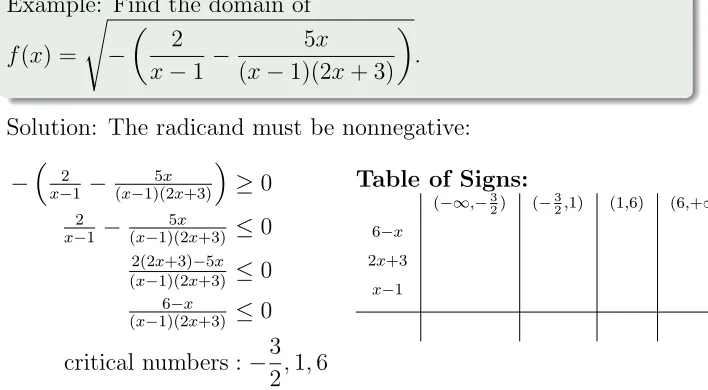
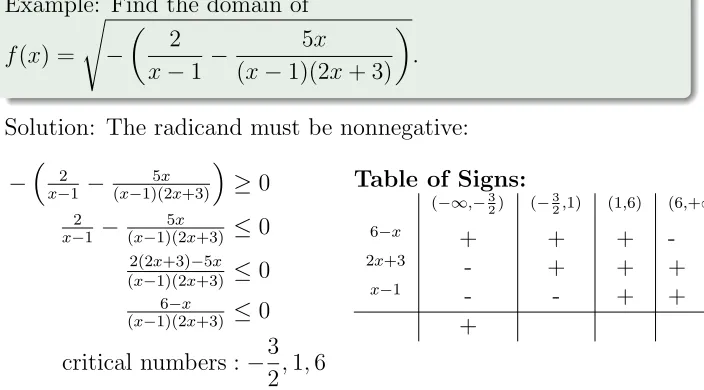
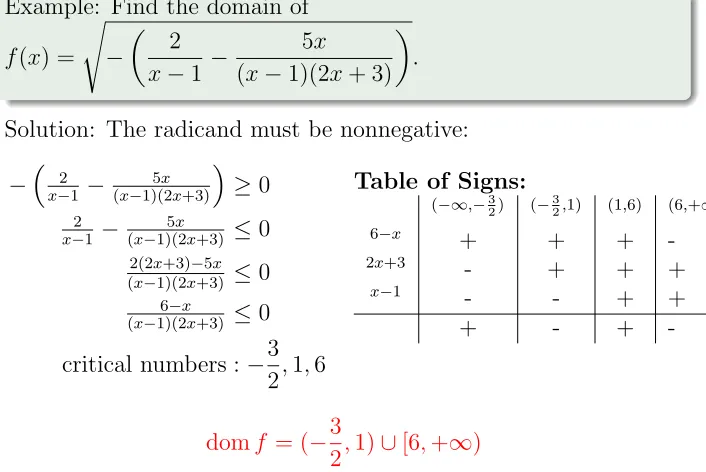
Example: Find the domain of f(x) = s − 2 x−1 −
5x (x−1)(2x+ 3)
.
Solution: The radicand must be nonnegative:
− 2
x−1 − 5x
(x−1)(2x+3)
≥0
2
x−1 − 5x
(x−1)(2x+3) ≤0 2(2x+3)−5x
(x−1)(2x+3) ≤0 6−x
(x−1)(2x+3) ≤0
critical numbers :−3 2,1,6
Table of Signs:
(−∞,−3 2) (−
3
2,1) (1,6) (6,+∞)
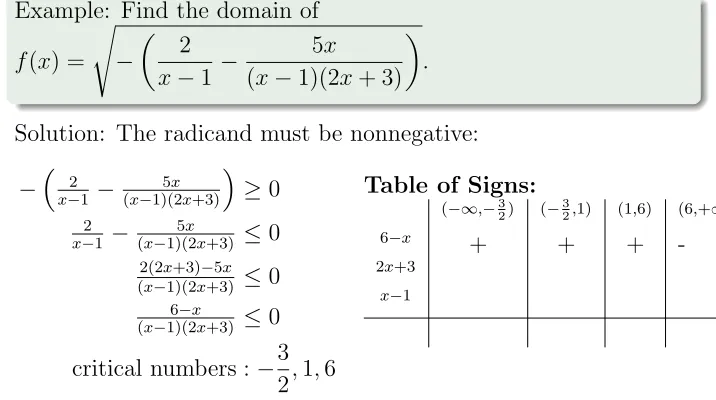
6−x
+ + +
-2x+3
- + + +
x−1
- - + +
+ - +
-domf = (−3
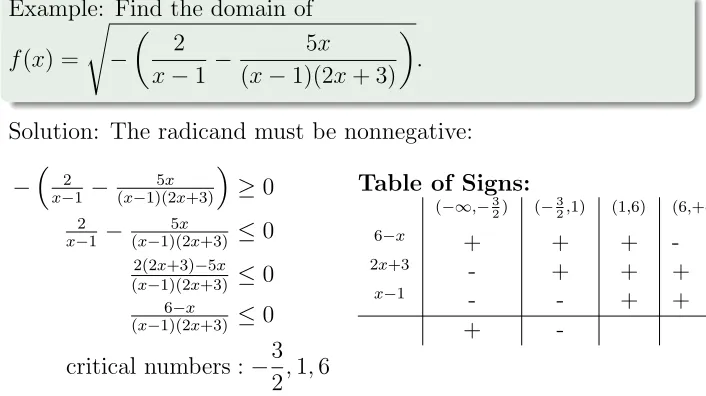
Example: Find the domain of f(x) = s − 2 x−1 −
5x (x−1)(2x+ 3)
.
Solution: The radicand must be nonnegative:
− 2
x−1 − 5x
(x−1)(2x+3)
≥0
2
x−1 − 5x
(x−1)(2x+3) ≤0
2(2x+3)−5x
(x−1)(2x+3) ≤0 6−x
(x−1)(2x+3) ≤0
critical numbers :−3 2,1,6
Table of Signs:
(−∞,−3 2) (−
3
2,1) (1,6) (6,+∞)
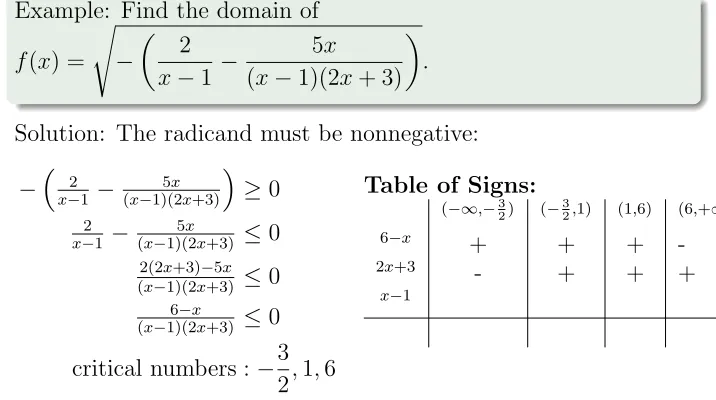
6−x
+ + +
-2x+3
- + + +
x−1
- - + +
+ - +
-domf = (−3
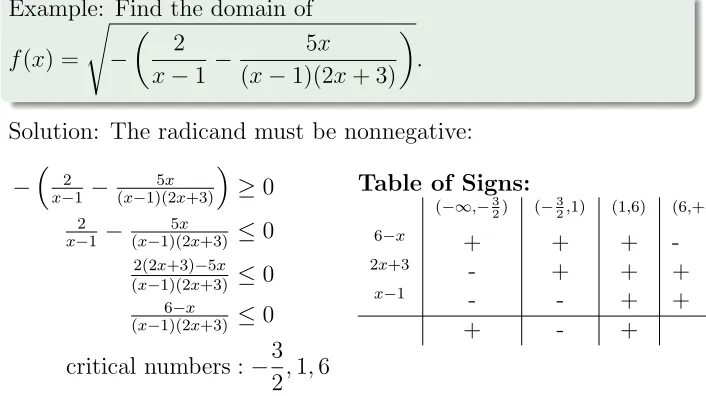
Example: Find the domain of f(x) = s − 2 x−1 −
5x (x−1)(2x+ 3)
.
Solution: The radicand must be nonnegative:
− 2
x−1 − 5x
(x−1)(2x+3)
≥0
2
x−1 − 5x
(x−1)(2x+3) ≤0 2(2x+3)−5x
(x−1)(2x+3) ≤0
6−x
(x−1)(2x+3) ≤0
critical numbers :−3 2,1,6
Table of Signs:
(−∞,−3 2) (−
3
2,1) (1,6) (6,+∞)
6−x
+ + +
-2x+3
- + + +
x−1
- - + +
+ - +
-domf = (−3
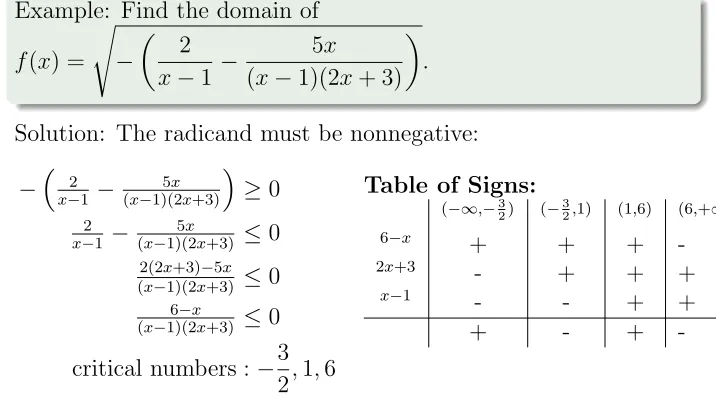
Example: Find the domain of f(x) = s − 2 x−1 −
5x (x−1)(2x+ 3)
.
Solution: The radicand must be nonnegative:
− 2
x−1 − 5x
(x−1)(2x+3)
≥0
2
x−1 − 5x
(x−1)(2x+3) ≤0 2(2x+3)−5x
(x−1)(2x+3) ≤0 6−x
(x−1)(2x+3) ≤0
critical numbers :−3 2,1,6
Table of Signs:
(−∞,−3 2) (−
3
2,1) (1,6) (6,+∞)
6−x
+ + +
-2x+3
- + + +
x−1
- - + +
+ - +
-domf = (−3
Example: Find the domain of f(x) = s − 2 x−1 −
5x (x−1)(2x+ 3)
.
Solution: The radicand must be nonnegative:
− 2
x−1 − 5x
(x−1)(2x+3)
≥0
2
x−1 − 5x
(x−1)(2x+3) ≤0 2(2x+3)−5x
(x−1)(2x+3) ≤0 6−x
(x−1)(2x+3) ≤0
critical numbers :−3 2,1,6
Table of Signs:
(−∞,−3 2) (−
3
2,1) (1,6) (6,+∞)
6−x
+ + +
-2x+3
- + + +
x−1
- - + +
+ - +
-domf = (−3
Example: Find the domain of f(x) = s − 2 x−1 −
5x (x−1)(2x+ 3)
.
Solution: The radicand must be nonnegative:
− 2
x−1 − 5x
(x−1)(2x+3)
≥0
2
x−1 − 5x
(x−1)(2x+3) ≤0 2(2x+3)−5x
(x−1)(2x+3) ≤0 6−x
(x−1)(2x+3) ≤0
critical numbers :−3 2,1,6
Table of Signs:
(−∞,−3 2) (−
3
2,1) (1,6) (6,+∞)
6−x
+ + +
-2x+3
- + + +
x−1
- - + +
+ - +
-domf = (−3
Example: Find the domain of f(x) = s − 2 x−1 −
5x (x−1)(2x+ 3)
.
Solution: The radicand must be nonnegative:
− 2
x−1 − 5x
(x−1)(2x+3)
≥0
2
x−1 − 5x
(x−1)(2x+3) ≤0 2(2x+3)−5x
(x−1)(2x+3) ≤0 6−x
(x−1)(2x+3) ≤0
critical numbers :−3 2,1,6
Table of Signs:
(−∞,−3 2) (−
3
2,1) (1,6) (6,+∞)
6−x + + +
-2x+3
- + + +
x−1
- - + +
+ - +
-domf = (−3
Example: Find the domain of f(x) = s − 2 x−1 −
5x (x−1)(2x+ 3)
.
Solution: The radicand must be nonnegative:
− 2
x−1 − 5x
(x−1)(2x+3)
≥0
2
x−1 − 5x
(x−1)(2x+3) ≤0 2(2x+3)−5x
(x−1)(2x+3) ≤0 6−x
(x−1)(2x+3) ≤0
critical numbers :−3 2,1,6
Table of Signs:
(−∞,−3 2) (−
3
2,1) (1,6) (6,+∞)
6−x + + +
-2x+3 - + + +
x−1
- - + +
+ - +
-domf = (−3
Example: Find the domain of f(x) = s − 2 x−1 −
5x (x−1)(2x+ 3)
.
Solution: The radicand must be nonnegative:
− 2
x−1 − 5x
(x−1)(2x+3)
≥0
2
x−1 − 5x
(x−1)(2x+3) ≤0 2(2x+3)−5x
(x−1)(2x+3) ≤0 6−x
(x−1)(2x+3) ≤0
critical numbers :−3 2,1,6
Table of Signs:
(−∞,−3 2) (−
3
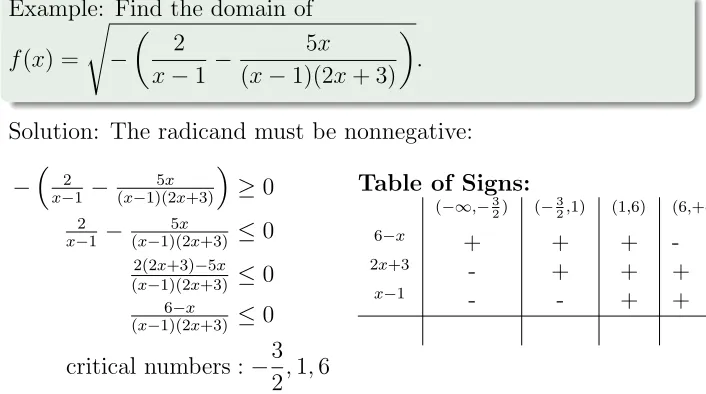
2,1) (1,6) (6,+∞)
6−x + + +
-2x+3 - + + +
x−1 - - + +
+ - +
-domf = (−3
Example: Find the domain of f(x) = s − 2 x−1 −
5x (x−1)(2x+ 3)
.
Solution: The radicand must be nonnegative:
− 2
x−1 − 5x
(x−1)(2x+3)
≥0
2
x−1 − 5x
(x−1)(2x+3) ≤0 2(2x+3)−5x
(x−1)(2x+3) ≤0 6−x
(x−1)(2x+3) ≤0
critical numbers :−3 2,1,6
Table of Signs:
(−∞,−3 2) (−
3
2,1) (1,6) (6,+∞)
6−x + + +
-2x+3 - + + +
x−1 - - + +
+
- +
-domf = (−3
Example: Find the domain of f(x) = s − 2 x−1 −
5x (x−1)(2x+ 3)
.
Solution: The radicand must be nonnegative:
− 2
x−1 − 5x
(x−1)(2x+3)
≥0
2
x−1 − 5x
(x−1)(2x+3) ≤0 2(2x+3)−5x
(x−1)(2x+3) ≤0 6−x
(x−1)(2x+3) ≤0
critical numbers :−3 2,1,6
Table of Signs:
(−∞,−3 2) (−
3
2,1) (1,6) (6,+∞)
6−x + + +
-2x+3 - + + +
x−1 - - + +
+
-+
-domf = (−3
Example: Find the domain of f(x) = s − 2 x−1 −
5x (x−1)(2x+ 3)
.
Solution: The radicand must be nonnegative:
− 2
x−1 − 5x
(x−1)(2x+3)
≥0
2
x−1 − 5x
(x−1)(2x+3) ≤0 2(2x+3)−5x
(x−1)(2x+3) ≤0 6−x
(x−1)(2x+3) ≤0
critical numbers :−3 2,1,6
Table of Signs:
(−∞,−3 2) (−
3
2,1) (1,6) (6,+∞)
6−x + + +
-2x+3 - + + +
x−1 - - + +
+ - +
-domf = (−3
Example: Find the domain of f(x) = s − 2 x−1 −
5x (x−1)(2x+ 3)
.
Solution: The radicand must be nonnegative:
− 2
x−1 − 5x
(x−1)(2x+3)
≥0
2
x−1 − 5x
(x−1)(2x+3) ≤0 2(2x+3)−5x
(x−1)(2x+3) ≤0 6−x
(x−1)(2x+3) ≤0
critical numbers :−3 2,1,6
Table of Signs:
(−∞,−3 2) (−
3
2,1) (1,6) (6,+∞)
6−x + + +
-2x+3 - + + +
x−1 - - + +
+ - +
-domf = (−3
Example: Find the domain of f(x) = s − 2 x−1 −
5x (x−1)(2x+ 3)
.
Solution: The radicand must be nonnegative:
− 2
x−1 − 5x
(x−1)(2x+3)
≥0
2
x−1 − 5x
(x−1)(2x+3) ≤0 2(2x+3)−5x
(x−1)(2x+3) ≤0 6−x
(x−1)(2x+3) ≤0
critical numbers :−3 2,1,6
Table of Signs:
(−∞,−3 2) (−
3
2,1) (1,6) (6,+∞)
6−x + + +
-2x+3 - + + +
x−1 - - + +
+ - +
-domf = (−3
Example: Find the domain of f(x) = √
x+ 6 x2−5x−4.
Solution:
The radicand must be nonnegative, and the denominator must not be zero.
x+ 6 ≥0 and R\ {solutions to x2−5x−4 = 0} x ≥ −6 and R\ {x= 5±
√
25−4(1)(−4)
2(1) }
[−6,∞) ∩ R\ {5−√41
2 ,
5+√41
2 }
domf = [−6,∞)\ {5−√41 2 ,
Example: Find the domain of f(x) = √
x+ 6 x2−5x−4.
Solution:
The radicand must be nonnegative, and the denominator must not be zero.
x+ 6 ≥0 and R\ {solutions to x2−5x−4 = 0}
x ≥ −6 and R\ {x= 5± √
25−4(1)(−4)
2(1) }
[−6,∞) ∩ R\ {5−√41
2 ,
5+√41
2 }
domf = [−6,∞)\ {5−√41 2 ,
Example: Find the domain of f(x) = √
x+ 6 x2−5x−4.
Solution:
The radicand must be nonnegative, and the denominator must not be zero.
x+ 6 ≥0 and R\ {solutions to x2−5x−4 = 0} x ≥ −6 and R\ {x= 5±
√
25−4(1)(−4)
2(1) }
[−6,∞) ∩ R\ {5−√41
2 ,
5+√41
2 }
domf = [−6,∞)\ {5−√41 2 ,
Example: Find the domain of f(x) = √
x+ 6 x2−5x−4.
Solution:
The radicand must be nonnegative, and the denominator must not be zero.
x+ 6 ≥0 and R\ {solutions to x2−5x−4 = 0} x ≥ −6 and R\ {x= 5±
√
25−4(1)(−4)
2(1) }
[−6,∞) ∩ R\ {5−√41
2 ,
5+√41
2 }
domf = [−6,∞)\ {5−√41 2 ,
Example: Find the domain of f(x) = √
x+ 6 x2−5x−4.
Solution:
The radicand must be nonnegative, and the denominator must not be zero.
x+ 6 ≥0 and R\ {solutions to x2−5x−4 = 0} x ≥ −6 and R\ {x= 5±
√
25−4(1)(−4)
2(1) }
[−6,∞) ∩ R\ {5−√41
2 ,
5+√41
2 }
domf = [−6,∞)\ {5−√41 2 ,