Math. Finance Lett. 2019, 2019:3 https://doi.org/10.28919/mfl/4104 ISSN: 2051-2929
FORECASTING SESAME PRICE USING KALMAN FILTER ALGORITHM
TESFAHUN BERHANE1,∗, MOLALIGN ADAM1, NURILIGN SHIBABAW1, AEMIRO SHIBABAW1, ABERA A. MUHAMED2
1Department of mathematics, Bahir Dar University, Bahir Dar, P.O.Box 3018, Ethiopia
2Department of mathematics, Kotebe Metropolitan University, Addis Ababa, P.O.Box 31248, Ethiopia
Copyright c2019 the authors. This is an open access article distributed under the Creative Commons Attribution License, which permits
unrestricted use, distribution, and reproduction in any medium, provided the original work is properly cited.
Abstract. This study aims at forecasting the white Humera Gondar sesame class 4 (WHGS4) price in Ethiopia.
We used the daily closed price data of Ethiopian sesame recorded in the period 2 January 2012 to 30 March 2018
obtained from Ethiopia commodity exchange (ECX) to analyse the price of sesame. We applied the Kalman
filter-ing algorithm on a sfilter-ingle linear state space model to estimate and forecast an optimal value of sesame price. We
used root mean square error (RMSE) to evaluate the performance of the algorithm for estimating and forecasting
the sesame price . Based on the linear state space model and the Kalman filtering algorithm, the root mean square
error (RMSE) is 0.000001877 , which is small enough, and it indicates that the algorithm performs well. Keywords:WHGS4 sesame price; forecasting; state space model; Kalman filtering algorithm.
2010 AMS Subject Classification:62P05, 97M30.
1.
INTRODUCTIONSesame is one of the oldest oilseed crops and is cultivated in tropical and subtropical regions
of Asia, Africa and South America [10]. Ethiopia is among the top five world’s producers of
sesame seed [4]. In Ethiopia, the production of sesame is both by small and large scale farmers;
∗Corresponding author
E-mail address: [email protected]
Received April 24, 2019
and it is an important crop and export commodity. The total area, production and
productiv-ity during 2013 were 0.299 million hectare, 0.220 million tonnes and 0.735 tone per hectare,
respectively; and the total area and production were increased by 61.23 % and 17.91 %,
re-spectively [2]. Ethiopia has a large number of different sesame varieties, including the Humera,
Gonder and Wellega varieties, which well known in the international market. The major sesame
growing areas are found in the locations of Humera, Metema, Benshungul Gumuz and Wellega
[5]. Sesame is the second largest export crop in Ethiopia next to coffee, and accounts for over
90% of the value of oil seeds exports[4]. And it is the third largest exporter of sesame seed after
India and Sudan[1]. Ethiopia has been significantly increasing its supply to world markets from
1998 to 2005/06. Its annual total exported quantity increased from 50,000 to 150,000 tonnes,
which is a threefold rise in eight years time[3]. The main importers of Ethiopian sesame are
China, Israel, Turkey, Japan and other European countries [7]. It contributes the highest
mar-ket values from the oilseeds exports. Thus, Sesame plays a major role for the development of
Ethiopian economy.
Sesame production varies from year to year due to weather conditions, diseases, traditional
production system, low productivity varieties and others. These have great impact on sesame
market. And it is unstable and characterized by wide fluctuations in price. This price fluctuation
has great effect on farmers’ livelihood and it makes difficult for them to predict their income
for the coming season. Therefore, it is of great significance to develop a model to forecast
the sesame price to reduce the risks associated with White Humera Gondar Sesame Grade four
(WHGS4) price fluctuations.
There are previous studies related to price forecasting problems. For instance, ARIMA and
GARCH models are applied to model and forecast the volatility of the price of Ethiopian
sesame. These models are employed to analyze the price fluctuation of monthly recorded
sesame data which is obtained from National bank of Ethiopia and Central statistical agency
[6]. Kalman filtering algorithm is suitable in the study of multi variable systems, time varying
systems and random processes. Kalman filtering algorithm is used to forecast highly fluctuated
and time varying stock market price [9]. More over, this algorithm was also applied to forecast
As per the knowledge of the authors, there is no mathematical model that has been developed
for estimating and forecasting sesame price in Ethiopia. Therefore, in this paper we use a linear
model in state space form which we estimate using Kalman filter. The paper is organized as
follows: section 2 analysis of sesame price, in section 3 we describe the Kalman filter, section
4 result and discussion and section 5 conclusion.
2.
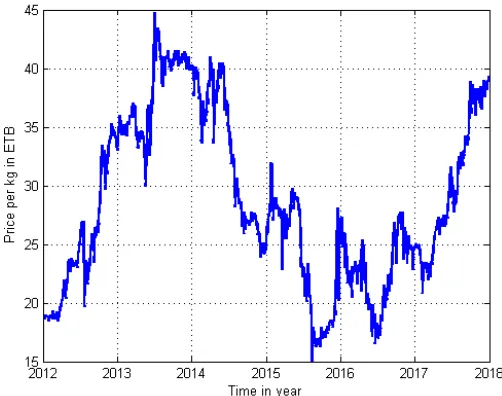
ANALYSIS OF WHGS4SESAME PRICE DATAThe daily closed price of Ethiopian sesame from January 2, 2012 to March 30, 2018 recorded
by Ethiopia commodity exchange (ECX) market is considered to study sesame prices
move-ments see figure 1
FIGURE 1. The WHGS4 price from 2012 to 2018
Figure 1 shows that the sesame price gradually increases since the beginning of 2012 and
reached a peak price of( attain maximum price ) 41.50 ETB(Ethiopian Birr) at the middle of
2013 and then after the price decreases step by step and fall down to a minimum price of 15.00
ETB at the end of 2015. Again from the beginning of 2016 to the middle of 2017 there were
ups and downs in the price of sesame. Finally, the sesame price shows an increasing pattern
since the end of 2018. In general the sesame price plot shows that the price does not have any
3.
THEKALMAN FILTERThe Kalman filter is a recursive algorithm that is used to find an optimal estimation of the state
of a time-varying system and non-stationary random processes which is indirectly observed
through noisy measurements. Kalman filtering theory set out to extend Wiener filters to
non-stationary processes. The formulation is not very much more complicated than for Wiener
theory. It is recursive so that new measurements can be processed as they arrive. The Kalman
filter algorithm has two step process:prediction and update steps. In the prediction step, the
Kalman filter calculates estimates of the current state variables and the error covariance to obtain
a prior information for updating step. In updating step, the Kalman filter tries to incorporate the
next new measurement in to the prior estimate to obtain an improved posterior estimate. For
the Kalman filter, the stochastic process must be represented in a state space formulation. This
representation consists of a transition equation to describe the evolution of the state variables
over time and a measurement equation to relate the state variables to the observable data.
Consider the dynamic system
(1) xk=Axk−1+qk−1
(2) yk=Hxk+rk
whereA is the state transition matrix, H is the measurement matrix, qk−1 is the model noise,
xk is the state vector, yk is the measurement vector, rk is the measurement noise, qk−1 and
rk are the independent white noises with zero mean, and their variance matrices areQ andR
respectively. Here, our aim is to study a single time series sesame price data, this means that
the state transition matrixAis one, and it indicates that the sesame price at timekis the same
as the price at timek−1 plus the random shock. Also, the measurement matrix H is one. Then
equation 1 and 2 can be expressed as
(3) xk=xk−1+qk−1
The system 3-4 represents the state space model of sesame price. The aim of estimation of
the state is to get the optimal price estimator value from observed price, by taking the first
observed value as initial expectation of state variable and the variance of the first difference
of the observed data as initial covariance P0. The shock term qk−1 is random white noise, so its expectation is zero and variance isQ . Here, the initial value of state variable is zero, the
expectation of state variable is 19.30, and the covariance is 0.62464. The measurement equation
is aimed to relate the state variables to the observable data and the termrk is a white noise that
is its mean zero and covarianceR=0.01.
The prediction equation of sesame price is given by
E[xk/k−1] =E[(xk−1+qk)/k−1] =E[xk1/k−1] +E[qk−1/k−1]
m−k =E[xk−1/k−1]
m−k =mk−1
(5)
WhereE is expectation, m−k is predicted mean. Forecast error, which is the difference between
observed value and the forecast value is:
(6) Vk=yk−m−k
This difference,vk is usually called innovation and it plays a vital role in the Kalman filtering
algorithm specially to extract all useful information as far as possible. And, its variance is given
by
(7) Sk=Pk−+R
The covariance of prediction-estimation, Sk is measurement prediction covariance, Pk− is
pre-dicted covariance. The covariance of prediction-estimation error is given as
The Kalman gain matrix equation that minimizes the covariance of the filtering prediction error
is
(9) Kk=Pk−S−k1
The sesame price equation of Kalman filtering estimation is:
(10) mk=m−k +KkVk
The covariance equation of Kalman filtering estimation is:
(11) Pk=Pk−−KkPk−Kkt
For the state equations 3 and 4, the Kalman filter prediction and update steps are given as
Prediction step:
m−k =mk−1 Pk−=Pk−1+Q
(12)
Update step:
Vk=yk−m−k
Sk=Pk−+R
Kk=Pk−S−k1 mk=m−k +KkVk
Pk=Pk−−KkSkKkt
(13)
4.
RESULT AND DISCUSSIONIn this study, we use daily recorded sesame price from 2 January 2012 to 30 March 2018 from
the Ethiopian Commodity Exchange. The results show that one-step forecasting of sesame price
using Kalman filtering algorithm is efficient. Sesame price is analyzed based on the price itself.
Figure 2 shows that Kalman filtering algorithm performs well to estimate the sesame price.
According to the linear state space model and the Kalman filtering algorithm, the root mean
FIGURE 2. Observed value and estimated value by Kalman filtering
performs well. Based on the linear state space model and Kalman filtering algorithm, we are
able to forecast the WHGS4 sesame price on 30 March 2018. Accordingly, the forecasted value
of sesame price on the specified date is 39.29 ETB per kg and the actual sesame price on the
same date is 39.30 ETB per kg. As a result, the forecasting error is too small. In general, the
above result indicates that the algorithm is effective in forecasting one-step sesame price.
5.
CONCLUSIONWe used the Kalman filter Algorithm to analyze the WHGS4 sesame price. Through
contin-uous prediction and updating, the algorithm estimates the sesame price with a minimum error.
Moreover, we forecast the sesame price for 30 March 2018 and the forecasted value of sesame
price on the specified date is 39.29 ETB per kg and the actual sesame price on the same date
is 39.30 ETB per kg, which is a very good estimate. In general, the Kalman filtering algorithm
is applied in the field of estimating and forecasting sesame price and can be widely used for
prediction of other commodity prices.
ACKNOWLEDGMENT
We greatly appreciate Big Data Engineering and IT Solutions PLC (www.bigdataeits.com)
Conflict of Interests
The authors declare that there is no conflict of interests.
REFERENCES
[1] D. Alemu, G.W. Meijerink, Sesame Traders and the Ethiopia Commodity Exchange: An Overview with
Focus on Transaction Costs and Risks, Addis Ababa, VC4PPD Report no. 8 (2010).
[2] Central Statistical Agency, Agricultural Sample Survey 2012/2013 (2005 E.C.), Report on Area and
Produc-tion of Crops (Private Peasant Holdings, Meher Season), Statistical Bulletin, Addis Ababa 1(2013).
[3] Central Statistical Agency, Agricultural Sample Survey 2006-07, Addis Ababa, 1(2007).
[4] FAO Statistical Database,Trade. Rome: Food and Agriculture Organization (2012). http://faostat.fao.org.
[5] W.T. Kuma, A. MasAparisi, B. Lanos, Rome., Analysis of price incentie Organization of the United Nations
(2015), 1-40.
[6] M. Sebsib, G. Emmanuel, Modeling and Forecasting the Volatility of the Export Price of Sesame in Ethiopia,
J. Econ. Sustain. Dev. 9 (19) (2018), 7-9.
[7] D. Soresa, Baseline survey of sesame trade arrangements, costs and risks in Ethiopia draft report for Sesame
Value Chain for Pro-Poor Development Projects, Addis Ababa, Wageningen UR., Mark Speer (2009).
[8] B. Tesfahun, S. Nurilign, S. Aemiro, A. Molalign, A. Abera, Forecasting the Ethiopian Coffee Price Using
Kalman Filtering Algorithm, J. Resources Ecol. 9(3) (2018), 302-305.
[9] X. Yan, G. Zhang, Application of Kalman Filter in the Prediction of Stock Price. 5th International Symposium
on Knowledge Acquisition and Modeling (KAM 2015). Atlantis Press (2015), 197-198.
[10] H. Zhang, H. Miao, L. Wang, L. Qu, H. Liu, Q. Wang, M.Yue, Genome sequencing of the important oilseed