in the population sciences published by the Max Planck Institute for Demographic Research Konrad-Zuse Str. 1, D-18057 Rostock · GERMANY www.demographic-research.org
DEMOGRAPHIC RESEARCH
VOLUME 19, ARTICLE 27, PAGES 1059-1104
PUBLISHED 01 JULY 2008
http://www.demographic-research.org/Volumes/Vol19/27/ DOI: 10.4054/DemRes.2008.19.27
Research Article
Spain:
Short on children and short on family policies
Margarita Delgado
Gerardo Meil
Francisco Zamora López
This publication is part of Special Collection 7: Childbearing Trends and Policies in Europe (http://www.demographic-research.org/special/7/)
© 2008 Delgado, Meil & Zamora López.
1 Introduction 1060
2 Fertility trends 1060
3 Proximate determinants of fertility 1074
4 Contraception 1080
5 Induced abortion 1083
6 Societal conditions impacting on family formation 1086
7 Family policies supporting childbearing 1093
8 Prospects and conclusions 1096
9 Acknowledgments 1100
Spain:
Short on children and short on family policies
Margarita Delgado 1
Gerardo Meil 2
Francisco Zamora López 3
Abstract
Spain’s total fertility rate has more than halved since 1975, when it was 2.8, to the present 1.3 (the lowest rate on record, 1.2, was reached in 1995). At the same time, the mean age at first childbirth has grown continually, seriously hindering any sustained recovery of fertility. Cohort fertility, in turn, has declined uninterruptedly since the 1941 cohort, and according to all estimates, this will drop to 1.6 for women born in the 1960s. A downturn in nuptiality, which has not been offset by a rise in consensual unions, along with the prevalence of contraceptives and abortion, have contributed substantially to falling fertility. Underlying this decrease is the profound cultural, social, and economic change that has raised the perceived costs of leaving the parental home and having children. The lack of any explicit family policy or transfers to compensate for such costs has reinforced that perception.
1 Spanish Council for Scientific Research. E-mail: [email protected] 2
Universidad Autónoma de Madrid
1. Introduction
Spain, with a population of 44.11 million on 1 January 2005, has the typical characteristics of a western low-fertility country: long life expectancy (77.2 for men and 83.8 for women in 2004), low fertility (1.3 children per woman in 2004) and a sizeable foreign population (3.73 million in 2005, or 8.5% of the total). And yet, these figures do not reflect what truly characterizes the Spanish population: the swift and profound changes taking place in the last 50 years that have made the country a model of relatively recent and speedy demographic transformation. In terms of the above indicators, life expectancy at birth for males has risen by 17.4 years (from 59.8 years in 1950) and for females by 19.5 years (from 64.3 years in 1950). The period fertility rate plummeted from 2.5 children per woman in 1950 to 1.2 in 1995, and the token presence – 59,483, just 0.2% of the population – of foreigners in 1953 (the first year for which data on foreigners residing in Spain are available) has soared in the interim to nearly 63 times the 1953 number. Consequently, one of the most representative characteristics of recent Spanish demographics has been the conversion from a country of emigration to one of immigration, and from a net outflow of 1.2 million people in the 1950s and 1960s to the net inflow of 1.7 million in the 1990s4. This rapid change in the various demographic indicators is a reflection on the modernization undergone by Spanish society in the last few decades and may help to understand its sometimes contradictory behavior.
2. Fertility trends
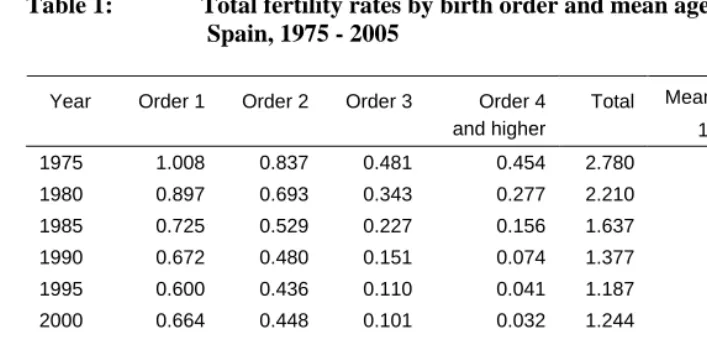
Fertility rates tumbled to record lows in the last few decades of the 20th century in some developed countries. In Spain, the lowest rates were reached in the 1990s, when total fertility rate values dipped below 1.2 between 1995 and 1998. A steady downward trend – with certain minor fluctuations – had been observed since the last half of the 1970s, when the rate was 2.78 (Table 1).
4 In Spain, ‘foreigner’ is understood to mean a person’s nationality, not his/her place of birth. When foreign
Table 1: Total fertility rates by birth order and mean age at childbearing, Spain, 1975 - 2005
Mean age at childbearing
Year Order 1 Order 2 Order 3 Order 4
and higher
Total
1st birth All births
1975 1.008 0.837 0.481 0.454 2.780 25.3 28.8
1980 0.897 0.693 0.343 0.277 2.210 25.1 28.2
1985 0.725 0.529 0.227 0.156 1.637 25.8 28.5
1990 0.672 0.480 0.151 0.074 1.377 26.8 28.9
1995 0.600 0.436 0.110 0.041 1.187 28.4 29.8
2000 0.664 0.448 0.101 0.032 1.244 29.0 30.7
2002 0.694 0.446 0.100 0.031 1.272 29.2 30.8
2003 0.704 0.448 0.099 0.030 1.282 29.2 30.8
2004 0.717 0.452 0.099 0.030 1.298 29.3 30.9
2005 0.736 0.459 0.098 0.031 1.323 29.3 30.8
* Since 2002 rates are calculated on population from Padron Municipal de Habitantes.
Source: Instituto Nacional de Estadística.
Spanish fertility patterns, like the tendencies recorded earlier in other Western European countries, exhibit characteristics typical of the Second Demographic Transition. The tardy onset in Spain of trends previously recorded in neighboring European countries is nothing new; however, since the secular decline that began in the late 19th century elsewhere, this first became apparent in 1920-1930 in Spain (Leasure 1963; Livi-Bacci 1968; Coale and Watkins 1986; Hicks and Martínez Aguado 1987).
The contribution of the highest orders to fertility is closely related to the age at first birth, for postponing that event reduces the possibility of higher-order births (Delgado et al. 2006). Since the 1970s and early 1980s, the mean age at first birth has risen in Spain by four years (25.3 in 1975 to 29.3 in 2004) and by 2.1 years for age at childbearing (28.8 in 1975 to 30.9 in 2004). Yet, postponement of the childbearing calendar occurred most swiftly in the 1990s, with age at first childbirth increasing by 2.2 years in that decade alone. Moreover, this has been a consistent trend, with mothers’ age at first birth rising even in the years when fertility rates – for first-order births almost exclusively – turned slightly upward. Furthermore, the gap between the average age at first childbirth and age at childbearing has been steadily closing; an indication that the period devoted to reproduction has narrowed.
Figure 1: Age-specific fertility rates by order in Spain, 1975-2004.
a) Order 1, rates of the second kind (incidence rates)
0 20 40 60 80 100 120
15 20 25 30 35 40 45
A ge A ge-s pec ifi c f e rt ili ty r a te s ( ‰ ) 1975 1990 2004
b) all orders
0 50 100 150 200 250
15 20 25 30 35 40 45
A ge A g e -s p e c ific f e rt ilit y r a te s ( ‰ ) 1975 1990 2004
The slight upturn in fertility rates since 1999 is due, in strictly demographic terms, to two effects: the small increase in the first-order rate among Spanish women and the contribution of foreign women. The contribution of foreign women is more conspicuous in absolute than in relative terms, accounting for 3.3% of newborns in 1996, but only 1.4% of that year’s fertility, while in 2004 the figures were 13.8% and 3.5%, respectively. The increase since 1996 – first year for which data differentiated by nationality are available – is considerable, but less in terms of the fertility rate than of number of births, as a result of larger foreign population inflows. Another relevant observation is that foreign women’s fertility are high soon after their arrival and fall with the duration of their stay in Spain, eventually converging to native population patterns. Moreover, it would hardly be reasonable to expect foreign women to contribute to a rise in fertility of any consequence, for they would either have to sustain unrealistic rates or their flows would have to reach volumes that neither Spanish society nor its labor-market could assimilate (Delgado and Zamora López 2004 and 2006). In other words, although the foreign population is helping to raise population numbers and even out the volume of births in Spain, which has recently become an immigration host, its contribution to fertility is very modest.
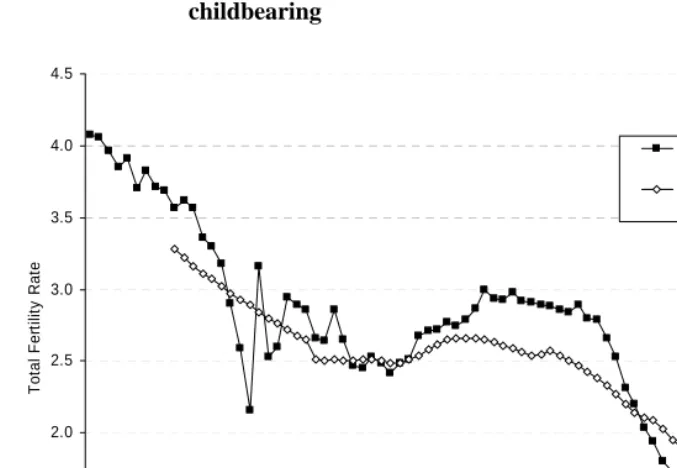
When childbearing is postponed, period total fertility rates have relatively low values (Bongaarts and Feeney 1998). To the extent that TCFRs are available, these provide a picture of long-term fertility trends unaffected by changes in the timing of births. For this reason, data should be analyzed longitudinally to determine whether and to what extent generations will be replaced.
Fertility trends among Spanish cohorts born in the 20th century fall into three stages. The first covers the generations born from 1901 to 1916, with a steep and steady decline in the fertility rate, from 3.3 to 2.5 children per woman. The second stage includes the generations born between 1917 and 1940, with a fluctuating pattern: relative stability, hovering at around 2.5 for the 1916-1926 cohorts, was followed by a rise that peaked at 2.7 for the 1931-1933 cohorts. Such growth was due practically solely to increased nuptiality, since marital fertility had been dropping steadily, with some very slight fluctuation in certain years (Fernández Cordón 1986). The third stage began with the cohorts born after 1940, whose fertility exhibited a visible and persistent decline.
Figure 2: Period and cohort total fertility rates, lagged by the mean age at childbearing
1.0 1.5 2.0 2.5 3.0 3.5 4.0 4.5
1922 1932 1942 1952 1962 1972 1982 1992 2002
T
o
ta
l F
e
rt
ilit
y
R
a
te
Period Fertility Rate
Cohort Fertility Rate (lagged)
Source: Data from Fernández Cordón (1986), Frejka and Sardon (2004) and Delgado et al. (2006).
Fertility decreased systematically among the cohorts subsequent to 1941, from 2.6 for women born in that year to 1.6 for those born in 1965, the last cohort considered: i.e., a decline of one birth in 24 cohorts. Based on their age at childbearing, the 1941-55 cohorts had their children in the 1970s and early 1980s, but their lower fertility was greatly attenuated and therefore not reflected in the period rates because age at motherhood had not yet begun to climb and in fact had dipped slightly. Consequently, the shift to earlier motherhood, as recorded in Spain in the 1970s, had inflated the period rates with respect to cohort rates (Delgado 2003). At this time, however, the opposite is true: the rates for the cohorts presently of childbearing age are expected to reach values higher than the 1.2 period rate (Bongaarts 2001, Frejka and Sardon 2004).
for the cohorts born from 1960 onward only. Such a relatively recent point of departure does not provide for full coverage of any of the respective cohorts' reproductive lives.
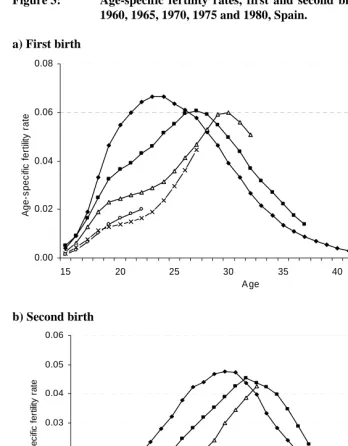
Although with truncated data, Figure 3 shows the full dimension of the process of delayed maternity recorded for the successive cohorts. The first-order fertility curves show that, with the sole exception of 1980, the rates for women up to the age of 26 are higher in the 1960 cohort than in any subsequent group. After that age, although fertility is higher in each cohort than in the one preceding it, such heightened intensity is attained at increasingly later ages. As a result, the recovery of postponed fertility becomes increasingly elusive, for even the desire for a first pregnancy runs a greater risk of non-consummation due to age-related sterility.
Second-order fertility declines systematically up to the age of 31 in all cohorts subsequent to 1960, whereas after that age, intensity is greater in the 1965 than in the 1960 cohort, and the tendency observed for the 1970 cohort suggests a similar outcome.
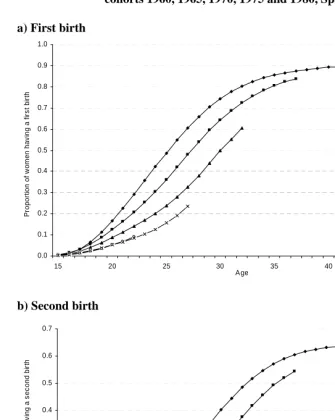
However, as Figures 4a and 4b show, the cumulative progression rate to first birth declines for all cohorts after 1960, regardless of the age considered. This evidence supports the hypothesis that the delay in first childbirth is not fully offset by higher intensities at later ages. Hence, according to cumulative fertility data, 85.6% of the women born in 1960 had been mothers by age 35, while the figure for the 1965 cohort dips to 80.5%. The figures for the age of 32, in turn – chosen instead of age 35 to be able to draw on data for three successive cohorts – show that 80.3% of the women in the 1960 cohort were mothers. By contrast, only 72.4% and 60.4%, respectively, of those born in 1965 and 1970 had children by that age: i.e., there is a 20-point difference between the first and last cohorts. For second births, the cumulative progression rate depicts a similar situation. By the age of 32, nearly half (48.5%) of the women born in 1960 had been mothers for the second time, while for the 1965 and 1970 cohorts the figures drop to 37.4% and 27.2%, respectively.
Figure 3: Age-specific fertility rates, first and second births, birth cohorts 1960, 1965, 1970, 1975 and 1980, Spain.
a) First birth
0.00 0.02 0.04 0.06 0.08
15 20 25 30 35 40 45
A ge A g e -s p e c ific f e rt ilit y r a te 1960 1965 1970 1975 1980
b) Second birth
0 0.01 0.02 0.03 0.04 0.05 0.06
15 20 25 30 35 40 45
Figure 4: Cumulative progression rate to first and second births, birth cohorts 1960, 1965, 1970, 1975 and 1980, Spain.
a) First birth
0.0 0.1 0.2 0.3 0.4 0.5 0.6 0.7 0.8 0.9 1.0
15 20 25 30 35 40 45
A ge P rop or tio n of w o m e n hav in g a f ir s t b ir th 1960 1965 1970 1975 1980
b) Second birth
0 0.1 0.2 0.3 0.4 0.5 0.6 0.7
15 20 25 30 35 40 45
A ge P rop or tio n o f w o men hav in g a s e c ond bi rt h 1960 1965 1970 1975 1980
The sharpest decline between the percentages for the 1960 and the 1965 cohorts is observed at relatively early ages. Nonetheless, the narrowing of the gap later in life, to only 5 points by the age of 35, is an indication that postponed childbearing was subsequently offset, but only in part. In the case of the second child, however, recovery is less complete, with nearly an eight-point difference in the proportion of women with two children.
The first childbirth differences observed between the 1970 and the reference cohorts for women in their 20s are even more sizeable (28 points at the age of 27). Although these differences tend to taper later in life, there is still a 20-point gap at the age of 32. This deficit would appear to be very difficult, if not impossible, to surmount to regain not the 1960, but even the 1965 values. It may be deduced from the shape of the curve that to attain the same levels as the 1965 cohort, first fertility would have to rise suddenly and very steeply. More specifically, a gain of one third of the total fertility accumulated between the ages of 15 and 32 would have to be forthcoming in just three years. The differences for second-order childbirth with respect to the reference cohort are smaller in the early ages, but by the age of 32 are very similar to the first-order differences.
These data suggest that, due to the delay in the age at first childbirth, the most recent cohorts will not be able to make up for the deficit recorded at younger ages. As a result, they will have a lower cohort fertility rate than the 1960 cohort.
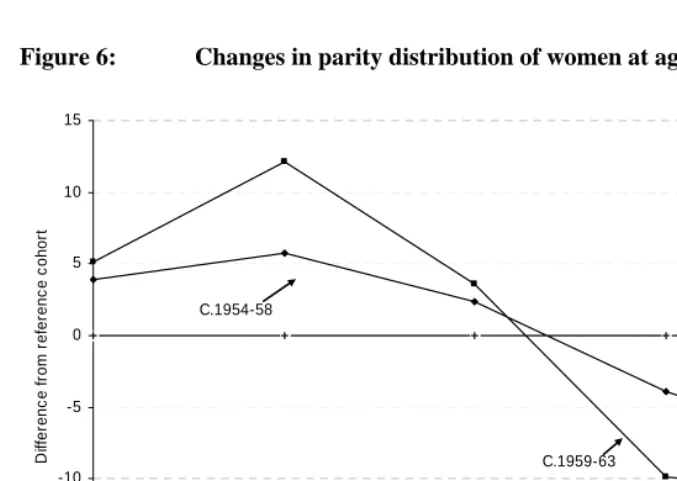
Retrospective data from the 1999 Fertility Survey provide insight into parities higher than two for Spanish cohorts. As Figure 6 shows, childlessness among women in their latter reproductive years, i.e., 35-year-olds, is nearly four points higher in the 1954-1958 and 5.1 points higher in the 1959-1963 cohorts than in the reference group (1949-1953). In both groups, increases are recorded in the proportion of women with single children (5.8 and 12.1), while the proportion with two children is very similar to the reference cohort figure and a steep decline is observed for women having three or four.
Figure 5: Cumulative absolute change in first and second births progression rate by age, bith cohorts 1960, 1965, 1970, 1975 and 1980, Spain
(benchmark cohort 1960).
a) First birth
-0.4 -0.3 -0.2 -0.1 0.0
15 20 25 30 35 40 45
Age C u mul a ti v e a b s o lu te c hange 1960 1965 1970 1975 1980
b) Second birth
Age -0.25 -0.20 -0.15 -0.10 -0.05 0.00
15 20 25 30 35 40 45
C u m u la ti v e a b s o lu te c h a n g e 1960 1965 1970 1975 1980
Figure 6: Changes in parity distribution of women at age 35, Spain, 1999
Cohort 1949-53 (ref erence)
C.1954-58
C.1959-63
-15 -10 -5 0 5 10 15
0 1 2 3 4+
Children
D
iff
e
ren
c
e
fr
o
m
r
e
fe
re
n
c
e c
o
ho
rt
Source: Instituto Nacional de Estadística, Encuesta de Fecundidad 1999.
Table 2: Timing of motherhood, measured by the proportion of women
with children at specific ages by educational attainment,
Spain, 1999
25 30 35 (N)
Birth cohort
Age in
1999 ELEM. SEC. HIGH ELEM. SEC. HIGH ELEM. SEC. HIGH sample
1949-53 45-49 70.3 54.4 44.4 90.4 84.5 72.1 93.9 89.9 84.3 1,027
1954-58 40-44 71.9 57.7 34.2 87.2 82.4 62.5 91.7 90.4 72.0 1,231
1959-63 35-39 65.9 38.4 15.6 87.3 65.8 49.5 92.2 82.5 75.7 1,365
1964-68 30-34 53.3 29.7 8.3 81.3 61.8 37.7 1,407
1969-73 25-29 40.6 14.0 1.8 1,147
ELEM = Elementary SEC = Secondary HIGH = University
In Spain, the preference has been for children to be born within marital union. As the 1999 Fertility Survey shows, around 90% of first children were born to married parents, a figure that rises to 96% for second and subsequent children (Zamora López 2006). This behavior is changing to some extent, and although the figures still differ substantially from the data for some European countries – in Scandinavia, for instance – the percentage of extramarital children in Spain rose from 2% in 1975 to 25% in 2004. This may be the outcome of relatively recent legislation – equal status for children born in and out of wedlock was not established until the 1978 Constitution was ratified – and social change, with a growing acceptance of consensual unions and therefore acceptance of the children born to these couples. Moreover, the evolution of births out of wedlock reflects not only new behavioral patterns, but also the impact of the composition of the population by nationality. Although a clear upward swing was recorded in the late 1980s and mid-1990s, the proportion fluctuated very little during this period: between 9% and 11%. It was not until the latter half of the 1990s – concurring with the intensification of immigration flows – that the percentage began to rise at a faster pace. One revealing fact in this regard is that in 2004 the proportion of children born to unwed Spanish mothers was 22%, to unmarried foreign women as a whole 42%, and to Columbian and Ecuadorian women, around 65%. Consequently, the growing weight of South American women in the foreign community is largely responsible for the rise in births out of wedlock, because in these cultures cohabitation or ‘paperless partnerships’ are traditional patterns of behavior reaching back into history (Quilodrán 1999) rather than an outcome of changing values.
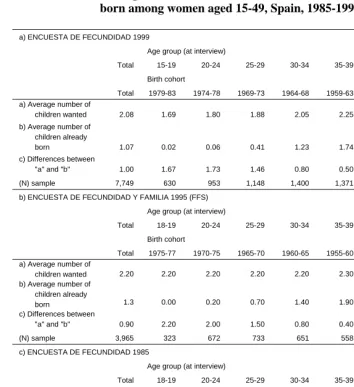
A comparison of the intended family size of two children, which Spanish women say they would like to have, according to the data from the latest (1999) Fertility Survey, to the number of children they actually do have according to the same survey, vary with age (Table 3). For women between the ages of 40 and 44 and 45 and 49, the difference is estimated to be 0.40 and 0.26 children, respectively.
Table 3: Average number of children wanted and children already born among women aged 15-49, Spain, 1985-1999
a) ENCUESTA DE FECUNDIDAD 1999
Age group (at interview)
Total 15-19 20-24 25-29 30-34 35-39 40-44 45-49
Birth cohort
Total 1979-83 1974-78 1969-73 1964-68 1959-63 1954-58 1949-53
a) Average number of
children wanted 2.08 1.69 1.80 1.88 2.05 2.25 2.40 2.62
b) Average number of children already
born 1.07 0.02 0.06 0.41 1.23 1.74 2.00 2.36
c) Differences between
"a" and "b" 1.00 1.67 1.73 1.46 0.80 0.50 0.40 0.26
(N) sample 7,749 630 953 1,148 1,400 1,371 1,229 1,018
b) ENCUESTA DE FECUNDIDAD Y FAMILIA 1995 (FFS)
Age group (at interview)
Total 18-19 20-24 25-29 30-34 35-39 40-44 45-49
Birth cohort
Total 1975-77 1970-75 1965-70 1960-65 1955-60 1950-55 1945-50
a) Average number of
children wanted 2.20 2.20 2.20 2.20 2.20 2.30 2.60 2.50
b) Average number of children already
born 1.3 0.00 0.20 0.70 1.40 1.90 2.10 2.20
c) Differences between
"a" and "b" 0.90 2.20 2.00 1.50 0.80 0.40 0.50 0.30
(N) sample 3,965 323 672 733 651 558 594 433
c) ENCUESTA DE FECUNDIDAD 1985
Age group (at interview)
Total 18-19 20-24 25-29 30-34 35-39 40-44 45-49
Birth cohort
Total 1965-67 1960-65 1945-50 1950-55 1945-50 1940-45 1935-40
a) Average number of
children wanted 2.62 2.52 2.47 2.45 2.56 2.73 2.80 2.93
b) Average number of children already
born 1.56 0.08 0.33 1.10 1.85 2.24 2.56 2.75
c) Differences between
"a" and "b" 1.06 2.44 2.14 1.35 0.71 0.49 0.24 0.18
(N) sample 8,782 664 1,739 1,415 1,306 1,323 1,198 1,137
For Encuesta de Fecundidad 1999 the reference date is 1 January 1999
Source: For 1999: Instituto Nacional de Estadística, Encuesta de Fecundidad 1999.
Further to the results of the 1999 survey, the discrepancy between the number of children wanted, and the actual number had is largely attributed by respondents to ‘insufficient economic resources’. Around one-third of the women over 35 who had at least one child had fewer than they wanted and one of the reasons most frequently cited to explain this difference was the paucity of financial resources; and the lower the educational level, the more frequent was this explanation (Delgado 2006). The stress and difficulties entailed in raising children are other considerations that ranked high among the reasons cited.
3. Proximate determinants of fertility
Marriage patterns, cohabitation, divorce, separation
According to the latest data available, in 2004 there were 216,149 couples who married in Spain, i.e., 55,200 fewer than the 271,347 recorded at the 20th century peak reached in 1975. In this same period, the total female first marriage rate dropped from 1.05 to 0.56, but several stages can be distinguished: an initial steep decline between 1975 and 1982 preceded periods marked by fluctuations, although defining an overall downward trend (Figure 7). What these data actually reveal is a change from a model – in effect since the 1960s – characterized by high intensity (with values of close to or higher than 1), which collapsed after the second half of the 1970s, giving way to another model whose distinguishing feature was low intensity. From a more general standpoint, the steep decline observed in the number of marriages at the end of the 1970s was followed, beginning in 1996, by a slight upturn in number but not in the total female first marriage rate, which in fact declined after 2000.
Figure 7: Number of marriages with and without foreign spouses and total female first marriage rate, Spain, 1975-2004
150,000 175,000 200,000 225,000 250,000 275,000 300,000
1975 1980 1985 1990 1995 2000
Y ear N u m ber of m a rr iages 0.0 0.2 0.4 0.6 0.8 1.0 1.2 T o ta l f e m a le fi rs t m a rr ia g e r a te Total marriages
Marriages w ith no f oreign spouse
Total f emale f irst marriage rate
Source: Instituto Nacional de Estadística.
Figure 8: Mean age at marriage by sex, Spain, 1990-2004
25 26 27 28 29 30 31 32 33 34 35
1990 1992 1994 1996 1998 2000 2002 2004
Y ear
Ag
e
Total marriages-Men
Total marriages-Women First marriages-Men First marriages-Women
Source: Instituto Nacional de Estadística. www.ine.es/inebase2
Figure 9: Cumulative proportion of women entering first marriage by age and birth cohort, Spain, 1999
0 10 20 30 40 50 60 70 80 90 100
11 16 21 26 31 36 41 46
Age
Pe
rc
e
n
t
C.1979-83
C.1974-78 C.1969-73
C.1964-68 C.1959-63
C.1954-58 C.1949-53
Source: Instituto Nacional de Estadística, Encuesta de Fecundidad 1999.
As with fertility, marriage patterns are observed to differ with women’s educational level: by the age of 30, 93.9% of the women in the cohort 1949-1953 with an elementary school background, 89.1% with secondary school training, and 80.5% with a higher education had married. The figures for cohorts born 15 years later (1964-1968) were 85.4%, 74.3% and 60.6%, respectively. Here again, the differences within the cohort as well as the inter-generational changes were more drastic in women with higher educational levels.
influence of nuptiality. Even more relevant is the pattern observed in 1991-1996, when the decline in the proportion of married women would have caused a 23% drop, which was not reflected in the actual figures because an increase in marital fertility countered the impact of that decline (Delgado 2000). More recent data show that the trend persists, for the close to 6% increase in fertility from 1996 to 2001 would have been in the order of 15%, had it not been for the slump in the proportion of married women of fertile age. Indeed, while marital and non-marital fertility continued to climb in the early 1990s, this did not suffice to fully offset the decline in nuptiality.
The parallel between mean age at first marriage and age at first childbirth (29.2 and 29.3, respectively, in 2004) patterns is fairly significant, particularly in a population in which the majority feels that childbearing should ideally take place within a marital relationship, despite the increase in the proportion of children born to unmarried mothers, as discussed above. In the context of a population marrying at older ages, this increase in the proportion of extramarital children may be explained by a number of factors:
• The scant difference between the mean ages at first marriage and first motherhood is suggestive of ‘premarital births’, i.e., children conceived and born out of wedlock but that in all likelihood induced subsequent marriage in many couples who may not have taken that step otherwise.
• Since foreign women’s contribution to extramarital births (23.30% in 2004) is higher than their contribution to births in general (13.78%), this proportion is growing.
• The small proportion of unmarried couples in Spain (between 3% and6% in 2001, according to Eurostat and the Spanish National Statistics Institute, respectively) is not consistent with what might be expected in light of such a high proportion of extramarital births. This would confirm the hypothesis that such women marry soon after the birth of their children, refuting any hypothetical rejection of marriage as an institution, at least among couples who decide to be parents.
number of consensual unions (Baizán et al. 2003). Nonetheless, while still relatively small, the number of consensual unions is characterized by moderate growth both in absolute terms and by its weight in the total. Finally, while cohabitation may serve the purpose of either trial marriage or an alternative to marriage in second unions, its incidence is small due to the scant number of second unions recorded in Spain (Meil 2003).
Legislation governing divorce, in turn, was enacted fairly recently in Spain (1981). The number of divorces grew nearly 2.8-fold between 1985 (just under 18,300) and 2004, when close to 51,000 were recorded. Nonetheless, the total divorce rate only rose from 0.08 to 0.10 divorces per marriage in the same period, although it did climb somewhat higher in certain years (0.15 in 1995). These figures do not include separations, which are more numerous than divorces and also grew 3.3-fold between 1985 (25,046) and 2004 (82,400). In this regard, the 1981 Divorce Act stipulated prior separation for a certain period of time – one year for legal separations and two for de facto separations – as a requisite to divorce (Alberdi 1999). Simply summing the number of separations and divorces would therefore yield inaccurate results, for some cases would logically be counted twice. As this requisite was removed in the new act passed in 2005, couples may now obtain a divorce with no need for prior separation, which, when legal, involves a court hearing. Under the former arrangements, couples were obliged to duplicate legal procedures.
Since the statistics on the dissolution of marriage have unfortunately been very rudimentary in Spain, a detailed analysis of the phenomenon is no easy task. That notwithstanding, the average duration of marriage prior to divorce was observed to decline from 15.4 years in 1985 to 14.4 in 2001, inching back up to 14.7 in 2003. The lower figures recorded from the 1980s to 2001 are not necessarily due to greater vulnerability of unions, yet rather due to the fact that the enactment of the law (1981) had still been very recent in 1985, and to the concomitant accumulation of de facto separations from several years prior to that which could not be formalized as divorce until the law was enacted. Similarly, with the elimination of the mandatory ‘cooling-off’ period between separation and divorce in the 2005 act, the duration of marriage among newly divorced couples may be expected to decrease by at least one or two years, i.e., the mandatory legal or de facto separation period, respectively, required under the former legislation.
of a shift away from religious practice within the broader process of gradual secularization of Spanish society. In this regard, a more precise indicator of such a shift away from religion would be the increase between 1990 and 2004 (from 14.3% to 28.2%, respectively) in the proportion of civil first marriages, for this is indicative of a deliberate choice on the part of the spouses. Divorced Catholics, on the contrary, have no other choice open to them, inasmuch as they are unable to remarry in the church. Nonetheless, in light of the predominance of religious weddings in first marriages (over 70%), religious indifference in this regard may be seen to be fairly moderate.
4. Contraception
While the first fertility transition took place before modern contraceptives were available and was based on more rudimentary and less effective practices (Santow 1995; Van de Walle and Muhsam 1995; Van de Walle 2000), these methods, primarily oral contraceptives, played a crucial role in the second transition. Act 45/78, which decriminalized contraceptives in Spain with the amendment of articles 343 bis and 416 of the Penal Code, entered into effect in 1978. This does not mean that prior to that date Spanish women did not use contraceptives, for such provisions were only leniently enforced and contraceptive methods could be obtained legally if prescribed for therapeutic purposes. Contraceptives were also often purchased abroad for personal or third party use. Nonetheless, such methods of sidestepping the law or attenuating its effects were only accessible to people with greater financial and educational resources and beyond the reach of a large portion of the population. Hence, the change in Spanish women’s contraceptive patterns has been gradual and the transformation, primarily with respect to the effectiveness of the methods used, has come relatively recently – in the 1980s and 1990s. The proportion of women using contraception in general grew during that period, with the use of effective methods exhibiting the steepest rise.
Table 4: Contraceptive status: Women aged 15-49 in a union (marriage or
consensual union), Spain 1985-1999
a) ENCUESTA DE FECUNDIDAD 1999
Age group (at interview)
Total 15-19 20-24 25-29 30-34 35-39 40-44 45-49
Birth cohort
Total 1979-83 1974-78 1969-73 1964-68 1959-63 1954-58 1949-53
Contraceptive
prevalence 71.6 59.1 71.8 71.2 78.4 75.1 74.7 56.5
Sterilization 19.2 1.2 0.6 3.7 13.4 22.5 30.2 22.6
Reversible methods 52.4 57.9 71.2 67.5 65.1 52.7 44.6 33.9
Modern methods (1) 46.8 41.8 66.0 63.5 60.3 48.2 38.5 25.9
Traditional methods
(2) 5.6 16.1 5.2 4.0 4.8 4.5 6.1 8.0
Using no contraceptive
method 21.7 37.0 19.3 17.0 14.2 19.9 20.2 36.8
(N) sample 7,749 630 953 1,148 1,400 1,371 1,229 1,018
b) ENCUESTA DE FECUNDIDAD Y FAMILIA 1995 (FFS)
Age group (at interview)
Total 18-19 20-24 25-29 30-34 35-39 40-44 45-49
Birth cohort
Total 1975-77 1970-75 1965-70 1960-65 1955-60 1950-55 1945-50
Contraceptive
prevalence 81.1 85.7 76.0 77.4 83.8 85.7 84.7 71.9
Sterilization 20.2 0 1.2 4.6 14.8 28.6 31.6 27.7
Reversible methods 60.9 85.7 74.8 72.8 69.0 57.1 53.1 44.2
Modern methods (1) 47.3 64.1 67.3 66.4 60.4 43.6 34.7 19.8
Traditional methods
(2) 13.6 21.6 7.5 6.4 8.5 13.6 18.3 24.4
Using no contraceptive
method 8.0 7.1 11.5 8.7 7.2 6.0 4.8 13.4
Table 4: continued
c) ENCUESTA DE FECUNDIDAD 1985
Age group (at interview)
Total 18-19 20-24 25-29 30-34 35-39 40-44 45-49
Birth cohort
Total 1965-67 1960-65 1945-50 1950-55 1945-50 1940-45 1935-40
Contraceptive
prevalence 59.8 44.8 64.5 65.2 69.1 64.5 56.1 37.5
Sterilization 4.5 0.0 0.0 1.6 5.4 7.4 7.2 4.5
Reversible
methods 55.2 44.8 64.5 63.5 63.7 57.2 48.9 33.0
Modern methods
(1) 33.7 30.3 49.8 49.1 43.1 31.5 20.4 8.9
Traditional
methods (2) 21.5 14.5 14.7 14.5 20.6 25.7 28.5 24.1
Using no contraceptive
method 29.9 41.8 23.0 26.3 25.3 30.7 36.4 36.3
(N) sample 8,782 664 1,739 1,415 1,306 1,323 1,198 1,137
For Encuesta de Fecundidad 1999 the reference date is 1 January 1999 (1) Pill, IUD, injection, diaphragm, condom.
(2) Periodic abstinence, withdrawal, other methods.
Source: For 1999: Instituto Nacional de Estadística, Encuesta de Fecundidad 1999.
For 1995: Delgado y Castro Martín (1998). For 1985: Instituto Nacional de Estadística (1987)
induced abortion recorded during the same period in which the use of traditional methods declined.
Viewing the figures by age groups in greater detail shows that between 1985 and 1995, the use of contraception rose in all groups due to the increase in sterilization, primarily in groups of women aged 35 and over, but also due to the more widespread use of effective reversible methods, although this was offset by the decline in the use of traditional methods. The only exceptions to this pattern were found among teenagers, whose use of traditional methods likewise rose, and to a minor degree, women between the ages of 45 and 49.
While there was a clear overall drop in the use of contraception between 1995 and 1999, it varied in detail from one group to another. In women over 30, for instance, while the percentage of users of modern methods rose, the prevalence rate fell. This can be attributed to the reduction in both sterilization – understandable in light of the rising mean age at first childbirth – and the percentage of women using traditional methods. In women under 30, the use of all manner of contraceptives declined, with a particularly sharp drop among women under 20. The ratio between the use of modern methods and total contraception shows that effectiveness fell in this group. It should be noted, however, that whereas in the 1999 survey, the under 20 ages that were covered ranged from 15- to 19-year-olds, in the earlier surveys only 18- and 19-year-olds were included. In any event, reduced contraceptive protection, particularly effective protection among ages under 30, is mirrored in the abortion figures.
It may be concluded from an analysis of contraceptive patterns among Spanish women that the transition from traditional to modern contraceptive methods has taken place very recently in Spain. Large percentages of women born in the mid-20th century used traditional methods such as ‘coitus interruptus’, whose effectiveness is questionable. Modern methods, primarily condoms, only began to be used by a majority when the generations born after the mid-1960s reached a sexually active age. These cohorts were responsible for consolidating the contraceptive transition in Spain, and the substitution of modern contraceptives for traditional methods whose effectiveness is uncertain.
5. Induced abortion
mental health is in jeopardy; b) when the pregnancy is the result of a previously reported rape; and c) the foetus is diagnosed to have severe physical or mental defects. In cases ‘b’ and ‘c’, the abortion must be performed within the first 12 or 22 weeks of gestation, respectively. The law sets no limit for case ‘a’.
Since decriminalization, the number of induced abortions in Spain has grown steadily. According to Ministry of Health and Consumer Affairs data, it rose from 37,000 in 1990 to nearly 85,000 in 2004, with an even steeper increase in the age groups under 25, particularly bearing in mind the declining population of that age in the interim (Delgado and Barrios 2007). The chief reason adduced for the procedure was concern for the mother’s physical or mental health, which accounted for over 90% of the cases, and for over 99% in women under 25. This provision, in fact, affords considerable leeway.
The number of abortions continued to rise both when fertility fell and when it turned slightly upward and, while the age at first childbirth followed a clearly upward trend, the mean age at first abortion declined steeply (Figure 10), from 28.5 in 1990 to 26.1 in 2004.
Figure 10: Mean age at childbearing and at abortion, Spain, 1990-2004
26 27 28 29 30 31 32
1990 1991 1992 1993 1994 1995 1996 1997 1998 1999 2000 2001 2002 2003 2004
Year
A
ge
all births firs t birth all abortions firs t abortion
One prominent finding is that the rate of recurrence grew in all age groups. In 2001, 25% of all women aborting voluntarily had a second or higher-order abortion, up from 20% in 1991. The figure has continued to climb, according to the latest data (27.8% in 2004). This trend is more acute in certain age groups, such as women aged 30-39, where the recurrence rate rose from 25% in 1990 to 34% in 2004. Around 11% of all teenage abortions, in turn, are second time interruptions.
The figures on induced abortion acquire significance only if contrasted with the figures on births, either as a proportion of the latter or expressing the number of induced abortions as a percentage of the total number of pregnancies. Table 5 gives these figures by age groups in three different years: 1991, at the beginning of the period when exhaustive data on induced abortion first became available; 1995, when the proportion of pregnancies ending in abortion had not yet begun to decline in any age group; and 2004, the last year for which data are available.
Table 5: Abortion ratio*, Spain, 1991-2004
AGE GROUP 1991 1995 2000 2004
15-19 22.2 35.9 44.1 47.8
20-24 12.9 21.9 30.0 32.9
25-29 5.4 7.7 10.5 14.5
30-34 6.0 6.3 6.3 7.6
35-39 13.0 12.5 9.9 10.2
40-44 25.2 29.3 23.2 21.4
45-49 35.6 48.1 38.3 33.1
TOTAL 15-49 9.0 11.6 13.2 15.3
Total Induced Abortion Rate 0.14 0.16 0.21 0.27
TOTAL ABORTIONS** 41,910 49,578 63,756 84,985
*Proportion of abortions (six months before) on pregnancies **Calendar year
Source: Instituto Nacional de Estadística, Ministerio de Sanidad y Consumo.
brought the proportion of interrupted pregnancies among teenagers to 47.8% and among women from 20 to 24 to 32.9% in 2004. Only the figure for women from 45 to 49 came close to those percentages. But one of the most prominent traits of the period analyzed is the uninterrupted rise in the total induced abortion rate, which was very moderate between 1991 and 1995 and steeper thereafter.
Perhaps the chief inference to be drawn is that the tendency of the youngest and oldest women to resort to abortion when faced with an unwanted pregnancy is an indication of a considerable paucity of contraceptive resources in these age groups. Among the younger women, this may be regarded as a consequence of shortcomings in sex education, for these subjects are not included in school curricula. Not only information, but education is needed, consisting of instilling in young adults the awareness of the risk of pregnancy inherent in sexual intercourse without appropriate contraceptive protection.
Here again, attention must be drawn to the impact of the foreign population. While exhaustive information on induced abortion by nationality is not always available, where it is, foreign women are found to be contributing substantially to the increase in the abortion numbers: in the region of Madrid, of the total induced abortions performed in 2004, foreign women comprised 52%. The percentage was even higher in the 20-34 age groups, reaching 58% in some cases (López-Gay and Izarra Pérez 2005). These data can obviously not be extrapolated to Spain as a whole, because, among other reasons, the foreign population is not as large in other communities as it is in Madrid. And yet, figures from other regions are indicative of a similar pattern, i.e., that foreign women in Spain are contributing much more in relative terms to the number of abortions than to the number of births.
6. Societal conditions impacting on family formation
of having children even higher. The increasing dualization of the labor-market has made the careers of the youngest generations and women more unstable, particularly in the years when families are formed, while aspirations for higher levels of material well-being have made two incomes necessary to guarantee the wherewithal to acquire socially desirable levels of consumer goods. Both processes, together with the difficulty in reaching a balance between work and family life, again in a context of family planning, have also contributed to raising the perceived cost of having children. The lack of any explicit family policy and transfers to offset such costs has reinforced that perception. A more detailed discussion of this issue follows.
a) Cultural change and the social perception of the costs of parenthood
Like other developed countries in the period covered by this analysis, Spain has seen profound change in the values and norms that shape individual life projects. As Second Demographic Transition theorists (Lesthaeghe 1983; Van de Kàa 1987) and Ulrich Beck’s (1992) Individualization Theory sustains, the last quarter century – which in Spain, moreover, concurred with the transition from dictatorship to democracy – has witnessed a profound change in the social control exerted on individuals, giving rise to greater freedom in the design of individual life projects. Family projects and lifestyles, in particular, have been privatized while inherited models of family organization have ceased to be binding; the forms that family life eventually adopts have thus come to depend on the negotiation conducted by the parties concerned.
This process is often believed to be less widely extended in southern European countries, such as Spain, than in northern European and English-speaking countries (McDonald 2002). The fact that certain indicators of family change – cohabitation, divorce or female employment – do not reach levels comparable to the ones prevailing in other countries does not, however, imply that the scope of cultural change has been smaller, as this paper will contend. Although cultural change embraces many dimensions, for reasons of space, this discussion will be restricted to change relating to religious practice, gender role models, the various dimensions of parenthood, and the perception of the conditions requisite to forming a family.
number of indicators may be cited in this regard, but one of the most obvious is church attendance, which has consistently declined. According to the ISSP’s survey on religion (1998), a mere 30% of the population regularly attended religious services (at least several times a month) in that year, while the figure for young adults – (18 to 29 years old) – was only 13%. Subsequent trends do not appear to be indicative of any substantial rise in religious practice, reflecting the ebbing influence of religion in society as a whole; and family life in particular. The approval of homosexual marriage in 2005, including adoption rights, with little social conflict outside of a few critical demonstrations, certified that loss of influence. In a context of low fertility, however, this should not be construed to mean that women claiming to be Catholic do not have higher fertility than non-Catholics (Adsera 2004).
Table 6: Attitudes towards mother’s paid work: Responses to the question: “Do you think that women should work outside the home full-time, part time or not at all under the following circumstances?”
Respondents aged 18-60
SWEDEN
Full- time Part-time Stay home
After marrying and before there are children 96 4 0
When there is a child under school age 17 68 15
After the youngest child starts school 39 60 2
After the children leave home 93 7 0
SPAIN
After marrying and before there are children 80 16 4
When there is a child under school age 21 48 31
After the youngest child starts school 42 47 11
After the children leave home 78 14 8
UNITED KINGDOM
After marrying and before there are children 93 5 1
When there is a child under school age 5 43 52
After the youngest child starts school 20 75 5
After the children leave home 79 20 1
Source: International Social Survey Programme, Family and Changing Gender Roles III, 2002 in Zentral Archiv der Empirischen
Forschung, Universität Köln, ZA Study 3880
There is a general perception among parents that it is harder to raise children today than it was in the past (Meil 2006a).
Such stricter prerequisites for parenthood stem from the expansion of consumer society and the cultural change on which it rests, but they are also the outcome of a profound transformation in intergenerational relations within today’s families. The new circumstances have enabled youngsters to postpone leaving home and forming unions, with the concomitant decline in fertility (Kohler et al. 2002, Delgado et al., 2006). The greater freedom enjoyed by young adults in their parents’ homes as a result of the disappearance of the authoritarian and the emergence of the ‘negotiating’ family, has meant that young adults no longer equate living with their parents with dependence. In addition to children’s attainment of autonomy at younger and younger ages, families’ improved income has afforded youngsters greater spending power. Indeed, children are given a weekly or monthly allowance and, when working, are no longer expected (or required) to add their wages to the family income. The resulting rise in the cost of leaving the parental home without substantially forfeiting comfort levels has led to the postponement to older and older ages of marital or consensual partnering (Baizán et al. 2002). The most relevant of these costs, in Spain, include access to home ownership prior to cohabitation or marriage and, very closely related to this issue, job security (López 2005). Purchase of a home has come to be perceived as a requisite to emancipation for the vast majority of young adults, since paying rent is viewed as a waste of money. The spectacular rise in housing prices in the last ten years – when market prices have climbed 2.5-fold – has reinforced this perception and rendered home ownership the more desirable and even more difficult. In this context, reference should be made both to the rise in the perceived costs of parenthood and the extension of risk-averse behavior, reinforced by labor-market dualization.
b) Socio-structural factors
Figure 11: Unemployment rates for males (m) and females (f) by age groups, Spain, 1987-2006
0 10 20 30 40 50 60
1987 1988 1989 1991 1992 1993 1994 1996 1997 1998 1999 2001 2002 2003 2004 2006
Year
P
e
rc
ent
m 20-24
f 20-24
m 25-29
f 25-29
m 30-34
f 30-34
Source: Instituto Nacional de Estadística.
throughout the entire period of family formation, when mortgages have to be paid and decisions on fertility need to be made.
Figure 12: Percentage of employed people with unstable labor conditions by
age, Spain, 1987-2004
0 10 20 30 40 50 60 70 80
1987QII 1989QII 1991QII 1993QII 1995QII 1997QII 1999QII 2001QII 2003QII Year
Pe
rc
e
n
t
20-24 25-29 30-39
Source: Instituto Nacional de Estadística, Encuesta de Población Activa, serie homogeneizada (Labour Force Survey) in www.ine.es
involvement in child-rearing and domestic chores has also increased considerably (Alberdi 2003; García Díez 2004; Meil 2006b). According to time use surveys (Meil 2006b), in 23% of dual-earner households the division of housework between the spouses (excepting childcare) is roughly egalitarian; and according to women’s responses in opinion surveys, that figure may be as high as 36% (Meil 2006a). Nonetheless, this has not translated into any perceptible increase in fertility.
The absence of any explicit family policy and the very low tax benefits for families have reinforced the perception of the high cost of parenthood. The changes forthcoming in the last ten years have constituted more of a political gesture than genuine measures, as discussed below, and have not therefore substantially modified the general perception that having a child in Spain is costly, in terms of direct as well as indirect and opportunity costs.
7. Family policies supporting childbearing
Family policy played a prominent political and social role during the Franco dictatorship (1936-1975) (Meil 1994). Family policy translated, on the one hand, into very restrictive legal provisions to reinforce traditional family relationships and, on the other hand, a relatively generous policy of income transfers designed to keep women at home, caring for their families, as well as to raise birth rates (del Campo 1995; Meil and Iglesias de Ussel 2001). In parallel, a pension policy providing for nearly universal coverage was developed, although the tiny sums involved forced the elderly to rely on their own savings or intergenerational solidarity. With the transition to democracy, against the backdrop of the profound change taking place in social structures – not only in gender roles, but also in lifestyles and the model for economic growth– social policy priorities were radically redesigned. Providing decent and sufficient pensions and thereby ensuring financial independence for each generation became a priority objective, together with the development – in light of the rapid rise in unemployment rates – of social protection for the unemployed, particularly for workers with dependants. The pursuit of this objective left a very narrow margin for the development of other social welfare policies, particularly family policies, which, moreover, were deeply discredited, for they were associated with social protection for the traditional family. As a result of this process, social protection for the family plunged to insignificant levels (Meil 1994; Iglesias de Ussel 1998; Picontó-Novales 1997; Meil and Iglesias de Ussel 2001; López and Valiño 2004).
were and continue to be very small, so as not to increase public spending. Significantly, they have only been inflation-adjusted once since they were instituted, and therefore their purchasing power and the protection they afford have systematically declined. While in the last 20 years the percentage of public spending earmarked for family benefits doubled from 0.3% to 0.6% of the GDP, it is still much lower than the European (EU-25) average, which was 2.1% in 2003 and rising (Eurostat 2006). There has never actually been political determination or organized social demand that has been able to exert enough pressure to establish a system of income redistribution that would compensate families for part of the costs of raising children, either through direct Social Security benefits or income tax relief. Such costs have been privatized under the implicit assumption that they are an issue that should be dealt with by families themselves. There appears to be a general consensus in this respect, even though population surveys show (depending on the wording of the questions) that a majority favors financial benefits for families. The tax treatment of dependants illustrates this quite clearly: in 2000, an average salary provided an after-tax disposable income, net of family transfers, of 85% for singles and 95% for a person with two children and a spouse with no paid work (Meil and Iglesias de Ussel 2001). Despite the fact that in the context of the plunge in fertility, the major political and social actors have begun to express the need for an active family policy and certain measures have been taken in this regard (birth, multiple birth or large family allowances). A review of the national budget reveals that the costs of having children or caring for dependant family members continue to be defrayed nearly exclusively by families (Meil 2004a). Yet, as a recent opinion poll shows (Centro de Investigaciones Sociológicas 2004), what Spanish public opinion and social as well as political actors associate with family support policies are housing policies and measures (easier access to ownership) as well as labor-market (less temporary employment) and old-age (more public support for the elderly) policies and measures to promote the balance between family and working lives. Policies addressing such demands have been developed in recent years or are being designed (Meil 2006b), although in this context only the last item mentioned is briefly discussed below.
late, both to foster greater father involvement in the family domain and to encourage employers to establish working conditions more clearly geared to facilitating the balance between work and family life.
The general characteristics and evolution of the measures of leaves can be summarized as follows:
• Successive enlargement of maternity leave to 16 weeks (1989), expanded to 18 weeks in the event of babies with disabilities (2007). In 1995, maternity was included as a specific Social Security contingency, distinguished from the temporary inability to work, with a 100% compensation salary and more flexible conditions (to cover adopted and foster children as well). A maternity allowance for self-employed workers was introduced in 2006, and entitlement conditions for young mothers were further lowered in 2007.
• Introduction of fathers’ right to also take up to four weeks of maternity leave (1989) and beginning in 2007 a specific 13-day paternity leave (15 in the event of multiple births and four weeks for all after 2013), in addition to the two days legislated since 1980.
• Successive expansion of parental-leave to up to three years (1980), to include not only biological children, but adopted and foster children as well (1989). Beginning in 1999, workers have also been entitled to a one-year leave (two years after 2007) to care for family members up to the second degree of kinship who for reasons of age or illness are unable to manage on their own and who have no paid employment. Although no allowance is paid to compensate for the forfeiture of their salaries, employees are allowed to compute their social security tax as paid during the first year of parental-leave.
• Enhancement of return to work guarantees in the event of parental-leave with the establishment in 1989 of the right to reserve a job for the first year of leave and, in 1995, the employment relationship for up to three years; prohibition of dismissal for maternity after 1999.
• Beginning in 1999, the costs of leaves were lowered for employers, who were exempted from social security tax for employment contracts (under temporary arrangements) to replace workers on leave to care for minors, and since 2002, for workers on leave to care for relatives up to the second degree of kinship.
reduction in salary. Since 1999, such cutbacks have also been possible in order to care for family members up to the second degree of kinship who are unable to take care of themselves due to age or illness.
• The introduction in 2003 of an allowance of up to 1,200 euros yearly for children under the age of three is only granted to mothers who work and pay social security tax, but not to those who are on leave or have no paid work.
This leave policy has been supplemented by the provision, included in the 1990 education reform, that lowered the school age to three years, even though the reasons behind this measure have less to do with a policy to further balanced work and family life than with education policy per se. The outcome has been the universal schooling of children between the ages of three and six in all-day schools, most of them with midday meal services: the enrolment rate of three-year-olds grew from 57% to 97% between 1994 and 2005, and has now reached 100% for four-year-olds. Such schooling was cost-free in public schools only until 2003 (65% of all places are in public schools), but in charter schools as well after that year. Care for children under age three, however, takes place primarily in informal contexts (family or baby-sitters), for the schooling rate for these ages in 2005 was only 13.5% (Ministerio de Educación y Ciencia 2005), with the vast majority in private institutions.
The policy for balancing work and family life in Spain has consisted, therefore, in providing time to assume family responsibilities while also attempting to guarantee the employment relationship. This has been done essentially through legislation and by providing incentives for employers, while the costs of child-rearing have been shouldered nearly exclusively by families. The idea that having and rearing children is beneficial for society and that such costs must be partially offset has not come to form a part of the conceits addressed on the political arena; it should consequently come as no surprise that the population at large perceives that there is no financial aid for raising children, which has become a very expensive endeavor.
8. Prospects and conclusions
The consequences of the present Spanish fertility levels, while varied in nature – demographic, economic, political and so on – are not specific to Spain, but shared with other countries with similar levels. One of the most prominent results relates to population aging.
the population (0-19) declined from 35.8% in 1950 to 20.5% in 2001, the weight of the most elderly (65 and over) grew from 7.2% to 17.0%. In absolute numbers, however, the drop in the former (-1.63 million) was much smaller than the rise (+4.94 million) in the latter. It is interesting to note that in the same period, the potential working population (20-64) grew both in relative (from 56.9% to 62.4%) and absolute (+9.56 million) terms. This would mitigate, at least for the period in question, the adverse consequences of the growing numbers of old aged people. Moreover, there has been a decline in the proportion of youngsters and children in the total dependent population supported by the working population.
Table 7: Age structure of the Spanish population 1950, 2001, 2060
POPULATION
Year Total 0-19 20-64 65+ 80+
1950 27.976,755 10.026,544 15.926,706 2.023,505 272,617
2001 40.847,371 8.397,421 25.485,683 6.964,267 1.584,780
2060 52.511,518 9.297,946 27.533,694 15.679,878 6.891,590
DISTRIBUTION (%)
Year Total 0-19 20-64 65+ 80+
1950 100.0 35.8 56.9 7.2 1.0
2001 100.0 20.5 62.4 17.0 3.9
2060 100.0 17.7 52.4 29.9 13.1
Source: Instituto Nacional de Estadística in www.ine.es/inebase/cgi and own elaboration
Projections formulated by the Instituto Nacional de Estadística (2006b) confirm the aging of the Spanish population irrespective of the variant used. Not only will persons over age 65 account for nearly 30% of the population in 2060, but their actual numbers will grow to 16 million by that year, up by 8.72 million since 2001. Moreover, in the same time frame the increase in the number of people aged over 80 (+5.31 million) will exceed the growth of the young and potential working population together (+0.90 and +2.05 million, respectively). As a result, the over 80s will come to 7 million or 13.1% of the total population by 2060. Such explosive growth in the number of very old people will certainly have a forceful impact on Spanish society.
working population, may in fact grow faster than the dependent segment of young and old citizens. This quasi-conviction is based on the increasing participation of women in the labor market and increased employment rates associated with the arrival of immigrants, developments observed in recent years that will in all likelihood continue to be seen in the years to come. An increase in the female working population might well go hand-in-hand with certain perverse effects, for in the absence of measures to balance work and family life, greater female participation in the labor-market might have an adverse effect on fertility. Add to this – in the not so distant future – a postponement in the retirement age; a measure that is receiving increasingly greater political and media coverage and that a substantial portion of the population is beginning to view as inevitable.
While aging is the most important consequence of the demographic trends observed to date and foreseeable through horizon year 2060, another repercussion may be the imbalance of the marriage market, closely linked to the base of the pyramid; this effect may nonetheless be countered, in Spain, by a growing foreign population, favoring the number of mixed marriages and births in which at least one of the parents is Spanish. It is believed that such a development would enhance and accelerate the integration of the foreign population in Spain.
Another factor of a somewhat different nature might be the rise in the financial – and perhaps also the psychological – value of children in a framework of increasingly scarce births. At the same time, the reduction in the number or the total absence of children, along with the potential prolongation of a couple’s life expectancy may lead to more fragile relationships, although these effects have not yet been perceived.
Lastly, one aspect directly related to the postponement of childbearing and subsequent reconsideration is the already visible increase in the use of assisted reproduction techniques. Since such treatments are not presently covered by the public health system, the couples concerned are burdened not only with the emotional, but also the considerable financial costs involved.
• Spain’s fertility rate is determined by the drastic reduction in higher than second-order children, which, in turn, is primarily the result of the late age at first motherhood.
• The postponement of first motherhood is associated with the late age at first marriage/cohabitation, which is somewhat higher in marriage than in consensual unions.
• Late marriage/cohabitation is conditioned by young adults’ perception of their ability to achieve financial independence. In this regard, the structural factors afflicting the Spanish labor-market are decisive: in the 1990s the unemployment rates among people under 30, particularly women, were conspicuously higher than the EU-15 average. Unemployment rates fell in the early years of this century, although in exchange for a rise in precarious employment and high temporary employment rates. Here again, young workers in general and women in particular were most acutely affected.
• The price of housing climbed spectacularly throughout the 1990s and although the pace has slowed somewhat in the past year, the tendency is still upward. The situation is so serious that the economic authorities have been sounding alarms about the high levels of family indebtedness.
People can hardly be blamed for wanting to have a job and a place to live before forming a family; and especially before having children. When uncertainties of this nature arise, the decision is to postpone the decision, which may lead to never making it. It is here that public policy should take the initiative if fertility dynamics are to be reversed in Spain.
Therefore, one of the most important ways to attain any significant recovery of fertility rates is to lower the age at first childbirth. Public policies favoring a reversal in the trend to delay the age at first birth (support for young adults to purchase or rent housing, measures to facilitate access to a first job, lowering job insecurity and so on) or of support for motherhood (longer maternity leave for both parents, the institution of child care centers, aid for single mothers, measures geared to balancing women’s professional and family life, and so on) have either not been explicitly established in Spain or are insufficiently generous, despite certain very recent initiatives. There is, therefore, no indication that any clear turnabout is in the offing. One solution put forward on occasion, to the effect that fertility should increase with foreign immigration, must be ruled out, for it entails assuming wholly implausible fertility rates among foreign women.
cutback in the number of years devoted to education. This strategy may indisputably be effective, but it would be insufficient in Spain. In this country, the presence of other unfavorable circumstances as described above – labor- market structure, housing and so on – also tend to delay the initiation of adult life. Rather, a whole series of coordinated measures are required to lower the age at first childbirth if a clear and sustained upturn in fertility is to be feasible.
But what Spanish society needs most is enhanced awareness of the nature of reproduction as an element of social balance in which all its members – public authorities, employers, individuals – are implicated and whose cost should not be borne exclusively by families, and certainly not solely by women who decide to be mothers.
9. Acknowledgments
References
Adsera, A. (2004). "Marital fertility and religion: recent changes in Spain." Discussion Papers Series, IZA DP, 1399. http://ftp.iza.org/dp1399.pdf.
Alberdi, I. (1999). La nueva familia española. Madrid: Taurus.
Alberdi, I. (2003). "El trabajo remunerado de las mujeres y su impacto en la vida familiar."
Arbor, 694: 195-238.
Baizán, P., Aassve, A., Billari, F. C. (2003). "Cohabitation, marriage, and first birth: The interrelationship of family formation events in Spain." European Journal of Population,
19, 2: 147-169.
Baizán, P., Michielin, F., Billari, F. C. (2002). "Political economy and life course patterns: The heterogeneity of occupational, family, and household trajectories of young Spaniards."
Demographic Research, 6, 8:191-240. www.demographic-research.org. Beck, U. (1992). Risk Society: Toward a New Modernity. London: Sage.
Bongaarts, J. (2001). "The end of the fertility transition in the developed world." Serie Working Papers, 152, New York: Population Council.
Bongaarts, J., Feeney, G. (1998). "On the quantum and tempo of fertility." Population and Development Review, 24, 2: 271-291.
Busch, F., Scholz, W.D., editors. (2006). Familienvorstellungen zwischen Fortschrittlichkeit und Beharrung. Würzburg: Ergon Verlag.
Campo, S. del. (1995). "La Política familiar en el franquismo" and "La Política familiar en la democracia." Familias: Sociología y Política. Madrid: Ediciones Universidad Complutense.
Centro de Investigaciones Sociológicas. (2004). Opiniones y actitudes sobre la familia. Estudio 2598. www.cis.es.
Chesnais, J.C. (1996). "Fertility, family and social policy in contemporary Western Europe."
Population and Development Review, 22, 4: 729-739.
Coale, A. J., Watkins, S. C., editors. (1986). The decline of fertility in Europe. Princeton: Princeton University Press.
Delgado, M. (2000). "Los componentes de la fecundidad: su impacto en la reducción del promedio de hijos por mujer en España." Economistas, 86: 23-34.
Delgado, M. (2003). "La fecundidad en España a fines del siglo XX." Sistema, 175-176: 51-66. Delgado, M. (2006). Reproducción. En: M. Delgado, coordinadora. Familia y reproducción en
España a partir de la Encuesta de Fecundidad de 1999. Madrid: Centro de Investigaciones Sociológicas. Serie Opiniones y Actitudes, 53: 71-112.
Delgado, M., Barrios, L. (2007). Determinantes sociales de la interrupción del embarazo en España. Madrid: Centro de Investigaciones Sociológicas.
Delgado, M., Castro Martín, T. (1998). Encuesta de Fecundidad y Familia 1995 (FFS). Madrid: Centro de Investigaciones Sociológicas. Serie Opiniones y Actitudes, 20.
Delgado, M., Zamora López, F. (2004). "Españolas y extranjeras: su aportación a la fecundidad en España." Economistas, 99: 88-97.