in the population sciences published by the Max Planck Institute for Demographic Research Konrad-Zuse Str. 1, D-18057 Rostock · GERMANY www.demographic-research.org
DEMOGRAPHIC RESEARCH
VOLUME 17, ARTICLE 17, PAGES 497-540
PUBLISHED 11 DECEMBER 2007
http://www.demographic-research.org/Volumes/Vol17/17/ DOI: 10.4054/DemRes.2007.17.17
Research Article
Economic integration in a
West-African urban labour market:
Does migration matter?
The case of Ouagadougou, Burkina Faso
Younoussi Zourkaléini
Victor Piché
© 2007 Zourkaléini & Piché
This open-access work is published under the terms of the Creative Commons Attribution NonCommercial License 2.0 Germany, which permits use, reproduction & distribution in any medium for non-commercial purposes, provided the original author(s) and source are given credit.
1 Introduction 498 2 Theoretical and methodological considerations 499
3 Burkina Faso’s migration system 504
4 Data and methodology 505
4.1 Data 505
4.2 Methodology 506
5 Techniques of analysis 508
6 Explanatory variables 510
7 Results 514
7.1 Migration and employment: a cross-sectional approach 514 7.2 Access to a first job: a longitudinal approach 522
8 Conclusions and discussion 530
9 Acknowledgement 532
Economic integration in a West-African urban labour market:
Does migration matter? The case of Ouagadougou, Burkina Faso
Younoussi Zourkaléini1 Victor Piché2
Abstract
This study explores the relationship between migration and employment in Ouagadougou. Using both a cross-sectional and a longitudinal approach, we compare the economic integration of migrants to that of non-migrants. Contrary to most studies based on urban samples, the data used here come from a national survey. It is thus possible to reintegrate into the analysis the migration episodes to Ouagadougou of those respondents elsewhere in Burkina Faso. Results indicate that, contrary to the dominant hypothesis, with the introduction of time-dependent variables, migrants are not more disadvantaged than non-migrants in the labour market, whether we consider the situation at the time of the survey or at their time of arrival in the city hunting for their first paid job.
1. Introduction
Research on urbanization focuses particularly on the relationship between migration and employment. On the one hand, theories of rural-urban migration all highlight the predominance of economic factors in the decisions to migrate, be it at the origin (push factors) or at the destination (pull factors) (Massey et al, 1998). On the other hand, upon their arrival in town, integration into the job market becomes the migrants’ central preoccupation, the result of which determines the success or failure of the migration itself (Antoine and Piché, 1998). Theories of migrants’ economic integration do not lack ambiguity as migration theories (Williamson, 1988; Piché, 2006). Indeed, the literature on the relationship between migration and work suggests two conflicting hypotheses concerning the economic performance of migrants compared to non-migrants. The first insists on the migrants’ difficulties in accessing urban jobs and their weak potential for economic integration; as a result, they join the ranks of the unemployed and the marginalized (e.g. Adepoju, 1988; Todaro, 1997). The second hypothesis suggests, to the contrary, that migrants have easier access to urban jobs; this hypothesis is confirmed by a series of longitudinal (retrospective) surveys carried out in several West-African cities (Piché and Gingras, 1998 and Bocquier and LeGrand, 1998 for Dakar and Bamako). Several recent studies have made the point that male and female migrants rapidly develop adaptation capacities in urban areas, especially by getting involved in small, informal businesses (Kouamé, 1991; Portes and Shauffer, 1993). The present job crisis in urban areas and the recent increase in return migration to rural areas (Beauchemin, 2001; Potts, 2000), raises the question as to whether rural emigration strategies remain viable.
Since the data used here come from a national sample, as opposed to an urban sample, it is possible to reintegrate into the analysis the migration episodes to Ouagadougou those responders elsewhere in Burkina Faso3. This is the first major difference between the present analysis and similar ones conducted in the past. To measure the overall (net) effect of the migration experience, we retain a certain number of other factors recognized as important in the study of economic integration (Goldlust and Richmond, 1974; Piché, 2006). Among theses factors, we look at cohort effects, which in a sense approximate the impact of the changing labour market, and we include human capital variables (education, previous experience, marital status, age), gender (sex), social background (father’s and mother’s economic activity), and ethnic origin (father’s ethnic group). The main results show that first the dominant migration-employment model do not apply to women and, second that, contrary to the dominant hypotheses, men migrants are not more disadvantaged than non-migrants in the labour market, whether we consider the situation at the time of the survey or at their time of arrival in the city in search for their first paid job.
2. Theoretical and methodological considerations
Theoretical approaches to the study of internal migration in Developing Countries have their origin in the general theories of migration first developed to study migration in Developed Countries, but have been extensively modified and expanded to take into account structural differences in the markets and differences in the social organization at the household and community level (White and Lindstrom, 2005).
According to Neoclassical economic theory, migration occurs as a response to regional differences in income opportunities generated by imbalance in the spatial distribution of the factors of production. However, Todaro (1969) and Harris and Todaro (1970) changed the neoclassical focus on nominal wage rates to expected wage rates, where expected wages factored in the probability of eventually finding a job in the modern sector (White and Lindstrom, 2005).Nevertheless, urban economies have changed greatly since the formulation of the highly influential models of Todaro (1969) and Harris and Todaro (1970). The assumption that rural migrants are motivated mainly by the prospect of formal sector employment places more emphasis on this one segment of the urban labour market is warranted,see Montgomery and al, (2003) for a review.
Studies on urban economic activity and employment in Developing Countries identify a formal and informal economic sector in which work organization and characteristics differ in terms of adherence to regulations, skill requirements, wage and
3 Admittedly, we always ignore the experience of people who lived in Ouagadougou and living abroad at the
benefits, opportunities for advancement, and job stability (Montgomery and al, 2003; White and Lindstrom, 2005).The informal sector is a crucial source of employment for migrants and non-migrants in cities of developing Countries. The absorption of migrants by the informal sector represents the important contrast to migration in Developed Countries, where the informal sector has historically been smaller (White and Lindstrom, 2005). These differences in economic structures have important implications for migration and the processes by which migrants become integrated into sectors of destination areas.
Much of the literature represents migration in terms of individual decisions involving comparisons of real wages or earnings. However, in recent years, this literature has substantially broadened, and it now accommodates a variety of assumptions about the relevant set of decision makers and the economic outcomes they may consider (Montgomery et al. 2003). In developing countries, households are “closer” and more integrated than those in developed countries are, with household members being more interrelated with stronger emotional ties. Than, households as income pooling units provide many benefits to individuals, including insurance against risk of failed health, unemployment, and in the case of migration, failure to find work in an urban location. Hence, decisions about labour allocation are made within the context of family and satisfying current income needs and reducing economic vulnerability and risk are more important to household than income maximization (White and Lindstrom, 2005).
Migration has been recognized as a social process in which the migrant’s actions are embedded in a web of familial, friendship, neighbourhood and labour market. This may form part of the social capital upon which an individual may rely while developing a migration strategy. Nevertheless, where people migrate to, and how long they stay depend on the original motivations for migration, which are not restricted to income maximization, as well as the people to whom they are socially tied (White and Lindstrom, 2005).
sectors of the economy. This implies that migration will occur even in the absence of nominal or expected wage differentials (White and Lindstrom, 2005).
Than, the strategy, which aims at taking advantage of economic opportunities within a spatial context (Portes, 1978; Dureaux, 1987), can adopt two different forms: a survival strategy and a strategy of social mobility (Findley, 1987; Adepoju, 1988). The first case involves very poor households who send their members to look for jobs while expecting financial transfers. These migrants also constitute for these households a form of investment and a means to diversify incomes against exclusive dependency on local subsistence activities. In the second case, those households, which are not confronted with survival problems, rely on migration for an upward social mobility of some of their members through access to more profitable and stable jobs. Thus, given theses important expectations, the question of links between migration and employment becomes central in assessing the result of migration. Furthermore, paid employment highly concentrated in urban areas, a key question is to what extent and in which context do migrants integrate the urban labour market.
The main question at the core of this research is: How fast and how successfully do migrants assimilate the economic activities of their new environment? Alternatively, put otherwise, how do the economic performances of migrants compare to those of local (non-migrant) population? The answers to these questions are echoed in two research traditions that have developed in a parallel fashion: one related to the case of international immigration to developed countries, and the other focused on rural-urban migration in developing countries (Lucas, 2003).
In the case of immigration, most studies have referred to the conceptual framework of the study of integration factors as initially suggested by Goldlust and Richmond 1974 and revisited by Piché, 2006. Several micro-individual factors are identified as influencing the integration process: age, duration of residence, time of arrival, languages spoken, education, sex, and immigration status (admission category and/or type of migration). Research on the individual integration factors in developed countries predominantly bases on cross-sectional data, usually coming from censuses, and, more rarely, from sample surveys. This approach compares immigrants to local populations in several economic dimensions. For instance, income differentials between these two groups show that immigrants are, upon arrival at a disadvantage compared to locals. With time, immigrants’ incomes tend to increase during their process of adjustment to the new environment, allowing them to use most their skills and qualifications. American and Canadian studies have shown that immigrants, except for recent cohorts, rather quickly attained locals’ average incomes (Chiswick, 1986; Lalonde and Topel, 1992; Bloom, Grenier and Gunderson, 1995; Hum and Simpson, 2002).
various groups of immigrants. In the United States, there is an important socio-economic stratification of immigrant groups according to their extraction region: European immigrants are at the top of the hierarchy while non-Europeans, particularly Latin Americans (Poston, 1994), recent immigrants from developing countries (Lalond and Topel, 1991 and 1992) and, more specifically Mexicans (Chiswick, 1978) are at the bottom of the ladder. We see the same phenomenon in Canada (Bloom, Grenier and Gunderson, 1995). In Europe, the use of ethnic categories in official statistics such as censuses poses more problems than in North America or in England, and this is particularly true in the case of France (Rallu, Piché and Simon, 2004). In the latter case, it is only through recent longitudinal surveys that the existence of ethnic stratification has been documented (Tribalat, 1996).
The study of the differential integration process were recently enriched considerably by the availability of longitudinal surveys that confirm that individual characteristics related to human capital such as schooling, age, previous experience, language and sex, constitute strong determinants of integration into the job market. The results also show that after considering all of these factors, national extraction still plays a significant role in economic integration, an indication that some discrimination may be at work (Piché, Renaud, and Gingras, 2002; Richard, 2000; Dayan, Echardour and Glaude, 1997).
In the case of developing countries, interest in economic integration issues emerged very late, as early as the 1980s in Africa (Antoine and Coulibaly, 1979). For a long time, two preoccupations dominated migration theories in Africa: the circulatory nature of migration and rural exodus. The first case refers to the model of the “target worker” (Gulliver, 1955; Cordell, Gregory and Piché, 1996): in this scenario, the migrant leaves his/her village to get a specific amount of money from the city and after achieving this goal he/she returns to the village. The question of integration is thus overshadowed by the migrants’ plans to return home. It seems however, that, now, although rural-urban migrants continue to return to the village for ceremonies and festivities, or for brief and occasional stays, they tend to rarely move back (Assogba, 1992).
saturated urban job market and assumes that migrants are more disadvantaged compared to other urban groups (“locals”) who are said to have greater access than migrants to urban resources, particularly education and family and social networks (Piché and Guingras, 1998: 49). Thus, rural out-migration contributes to massive urban unemployment, to marginalization of a growing proportion of the urban migrant population (possibly linked also to higher urban crime and violence), and to low wages because of abundant labour ready to take below-market remuneration. This is more a model of non-integration than integration and characterizes much of the neo-classical theories of hyper-urbanization (e.g. Bairoch, 1973 for Latin America and Adepoju 1988 for Africa) as well as of Marxist theories that portray the migrant masses as excluded from the modern, urban economy (Amin, 1974; Gregory and Piché, 1978).
It is noteworthy that, although the hypotheses underlying most integration models imply a dynamic approach to integration and as such require longitudinal data to be validly tested (Lucas, 2003), it is only recently that such longitudinal data have become available. Several such empirical studies, for example on the speed of getting an urban job show, contrary to these models, very short episodes of joblessness for urban migrants (Yap, 1977; Banerjee, 1991) and in many instances, the chances of access to employment are greater for migrants than for urban natives of the city, after control for human capital and social network variables (Sinclair, 1978; Oberai and Singh, 1984; Fuller, 1981; Si Anh and al., 1996; Guest, 1996). In China, Wang (1990) found a positive correlation (correlation becomes stronger over time) between migratory behaviour and individual income in the urban population such that migrants’ income is higher than non-migrants are.
The impact of migration is bi-directional. Not only does migration offer employment opportunities for the migrants themselves but rural-urban migration can also have positive effects on the economic conditions of rural populations and thus on the economic performance of the country as a whole (Liu, 1991; Oucho, 1996; Guest, 1996). Migrants contribute directly and indirectly to rural development in many ways. For instance, Skeldon (1997) concludes that migration alleviates poverty in Thailand. Urban migrants achieve economic and material wealth and, through their attachment to voluntary tribal associations, assist local community development (Twumasi-ankrah, 1995). Thus, out-migration enables migrants to improve earnings and acquire new knowledge/skills, which they may remit and transfer, respectively, to rural areas (Oucho, 1996: 109). In the case of Burkina Faso, a number of entrepreneurs consist of return migrants who acquired their skills in Cote d’Ivoire (Konseiga, 2005).
studies in Bamako (Mali) and Dakar (Senegal) show that economic sector (formal/informal) and occupation status (self-employed/salaried) do not differ significantly between migrants and non-migrants (Piché, Mariko and Gingras, 1995; Bocquier and LeGrand, 1998). However, results seem to vary from one country to another. For instance, results in Yaoundé (Cameroon) seem to indicate that migrants from rural areas and from other urban zones get their first employment later than locals do (Kishimba, 2002). Furthermore, in a comparative study of seven countries in Western Africa, Traoré (1997) shows that migratory status has a positive effect in five countries (measured here by the probability of being unemployed at the time of survey): Côte d'Ivoire, Guinea, Mali, Mauritania and Senegal. Nevertheless, in two other countries, Burkina Faso and Niger, the effect of migratory status is not significant (Traoré, 1997: 257).
3. Burkina Faso’s migration system
Burkina Faso is well known for the importance of migration and is well endowed in migration studies (Cordell, Gregory and Piché, 1996). Although international migration is particularly important (23 percent of all migration in 1974-75 and 27% in the period 1995-2000), internal migration, and particularly rural-migration remains significant (nearly 40% of all internal movements). Political interest in internal migration has always focused on rural exodus, which was perceived as negative. Hence, many rural development projects during both the colonial and since independence times (1960) have tried to tackle rural out-migration. The high population density of certain areas, in particular within the Mossi Plateau, was another political preoccupation. Projects aiming at population transfer from densely populated to under populated areas have been implemented thus (Ouédraogo, 1986; Ouattara, 1998). Zones of intense colonization have grown over a ten-year period by 79.4 %, which represents an annual average rate of 6.0 % (Ouédraogo, 1986). In addition, the construction of infrastructures (roads, schools, health centres, boreholes, etc.) within the implementation of several development plans enabled the gradual settling of migrant families along roads and near residential developments.
many studies report high unemployment rates (Lachaud, 1994; INSD, 2003) and an important development of the informal sector (Calvès and Schoumaker, 2004). Thus, the issue of migrants’ economic integration with respect to unemployment and informal activities in Ouagadougou remains paramount.
4. Data and methodology
4.1 Data
This study was conducted using data from a national survey, conducted in 2000 in Burkina Faso. Overall, this survey included 8,644 migratory biographies collected in 3,517 households (Poirier et al, 2001)4. Within the selected households, biographies for all people aged between 25 and 64 are recorded. For those 14 to 24 aged, given the demographic importance of this group, only one out of two biographies are collected. The analyses presented here based on weighted data.
Ouagadougou sample comprises 2,838 biographies from 1,184 households. This study is not limited to biographies registered in Ouagadougou but also includes all those that lived in Ouagadougou for at least three months at a point in time but were residing elsewhere at the time of the survey. Table 1 shows the proportion of the survey population that previously lived in Ouagadougou (25%) against those who resided there at the time of the survey (75%). We deem important to include this quarter of the population in the comparison of locals to migrants.
Table 1: Residence status at the time of survey, Ouagadougou, 2000
Residence Status
Male Female Total
Percentage* Nf Percentage* Nf Percentage* Nf
Resident 77.4 910 74.1 947 75.6 1857
Non resident 22.6 100 25.9 90 24.47 190
Total 100 1010 100 1037 100 2047
* Percentages are calculated on weighed numbers not shown here
4 This survey was collaboratively conducted by the College of Population Sciences (ISSP) of the University
The survey collected biographical information covering five types of histories: family, residence (including migration), employment, marital and reproductive. Here we use data from the first four modules. Firstly, employment history includes periods of both economic activity as well as inactivity. Thus, episodes of study, unemployment, sickness and retirement are specified. Housework is also included as an economic activity. An individual’s active life is summarized as a succession of activity and/or inactivity periods, and all episodes lasting at least three months are reported. Moreover, given that women’s employment is generally underestimated, a particular attention was given to measuring women’s employment. Secondly, information about residential mobility complements that of economic activities since it is then possible to associate precisely employment and residence. Finally, information on family and marital histories provides the indicators needed for assessing the key independent variables, notably those concerning social class, ethnic group, and martial status of the parents.
As in all retrospective survey data, the data used here have limitations. The biography technique actually requires the precise chronological registering of all the happenings during the life of an individual. This type of survey essentially taps on the memory of the respondents and memory lapses can be important. However, the use of an “age-event” procedure, which has proven very useful in this type of biographical survey, helps to minimize recall biases (Antoine and Piché, 1998).
4.2 Methodology
Research in migrants’ economic integration in the African urban areas suffers from three important limitations. Firstly, most studies do not use a conceptual framework allowing a comparison of migrants and non-migrants based on a set of key control variables as suggested by immigration studies in developed countries. Our first objective is thus to compare the economic performance of migrants and locals following the multivariate model initially developed by Goldlust and Richmond (1974) and revised by Piché (2006). This model identifies key variables, including migratory status, that intervene as factors of economic integration. The effect of migration on employment can only be determined after considered important factors such as length of residence, education, and previous experience (human capital), sex (gender), cohort (a variable indirectly measuring the context of labour market), marital status, social and ethnic origins.
coming from (i) relatives and/or friends who live in the city or (ii) from the more or less frequent visits made by the migrants themselves (informational selectivity); (2) only the best educated and most qualified people choose to migrate (this is the classic human capital-related selectivity); (3) respondent migrants in the city are those who have succeeded their economic integration, the others in the face of difficulty having chosen to return to their village or try their chances elsewhere; the opposite can also be true, namely that it is the best qualified that experience out migration (sample selectivity). Migratory selectivity linked to human capital can be bypassed by including human capital variables in the comparison. However, informational and sample selectivity cannot be taken into account with exclusive urban samples. Thus, our second objective aims to take advantage of the fact that the survey we use covers the entire country, which allows us to include all the people who stayed in Ouagadougou during the course of their life even if they were not present in Ouagadougou at the time of the survey.
Finally, the third limitation is technical: longitudinal analyses conducted up to now have used the semi-parametric Cox (1972) model, which specifies that the total population at risk must start from the same point in time. For locals, it suffices to set the age limit on which the individual starts looking for work. This age can vary from one society to another; for Africa, the authors most often set this starting point between 12 and 15 years of age. For migrants, access to urban employment begins when they arrive in the city; therefore, it coincides with their age on arrival. The pre-employment waiting time (before the transition to work or to truncation linked to the survey date) is thus measured by the difference between the age at the time of the event and age on arrival. Since access to work is subject to age, this procedure biases comparisons between locals and migrants, the latter “entering” into the population at risk at various ages. To avoid this problem, and this is our third objective, we use an age-specific method, which estimates risks by age groups.
integration. Of course, this implies that employers hire the best candidates irrespective of any migratory status.
5. Techniques of analysis
The analytical methods used in this study are specific to the cross-sectional and longitudinal definitions of the dependent variables retained for analysis. With respect to the cross-sectional approach, the comparison of migrants and locals follows classical methods of logistic regression which aim to estimate the net effects of variables associated with being employed (or not) at the time of the survey. Work is measured by paid work; work in the formal sector, and self-employed (independent) work. The longitudinal approach consists of predicting access to the first job using the same explanatory factors listed in the conceptual framework. In this case, access to first paid job is defined first globally, then divided into two exclusive categories: formal and self-employed. Technically speaking, the occurrence of a non-studied event is considered as a truncation.
Paid employment is defined as the main occupation that lasted at least three months. Thus, episodes of study, retirement, unemployment and household domestic work are excluded just as are training activities and non-remunerated family work. Formal work is defined as being the main occupation lasting at least three months and where the employee receives a regular monthly wage. Self-employment is defined as the main occupation lasting at least three months by which a person works for him/herself in an individual business. The latter can employ (or not) one to several salaried workers or benefit from the work of family members or non-remunerated apprentices. Insufficient number of cases does not allow us to distinguish between the self-employed, the employer, employer meaning someone who is self-employed (works for him/herself), and who has employees.
Hence, at each age, those have not been censored either definitively through getting a job or temporary through emigration are added on new immigrants of this age.
In summary, those who never migrated after the age of twelve are still at risk of getting a first job from age twelve until the age of getting a job or until truncation (end of survey or age limit for the analysis). Male and female migrants are included in the study starting at the age of their arrival in Ouagadougou until the time they get a first job and migrate again or are censored. Those very few respondents who migrated multiple times before getting their first job in Ouagadougou will have lapses in their observation time. In other words, periods lived outside Ouagadougou are not considered in the analysis; only those periods lived in the city are considered since these make the time of exposure to Ouagadougou labour market.
As some migrants, return home and others move to alternative destinations, Guest (1996) argue that studies that rely only on comparisons between migrants and non-migrants (as the reference group) at destination do not fully reveal the effects of migration in the destination areas. In an analysis of migration adjustment in Bangkok, Yang (1994) shows that the excluding repeat migrants, who may have returned home or elsewhere, creates a small but observable bias when comparing migrants and non-migrants. The bias seems to be in the direction of improving the outcomes of non-migrants. To avoid such migrants’ selectivity bias, the analysis presented here includes all individuals having been to Ouagadougou even though they are residing elsewhere in Burkina Faso at the time of the survey.
Lastly, some migrants may decide to move to the city, knowing that a job is awaiting them (informational selectivity) or because they are being transferred. As Bocquier and Legrand (1998) noted, in such a situation that it is not migration that influences their chance of getting a job but the opposite. The result would be to overestimate the economic performance of migrants. To avoid such biases, those migrants that have obtained a job upon arrival in Ouagadougou are excluded from the analysis. Such cases concern 789 migrants for who date of arrival and date of first job are identical.
We perform maximum likelihood estimation of parametric regression survival-time models (Gamme, Log-normal, Gompertz, Weibull, Exponential and log-logistic) than we use Deviance residuals to evaluate each of them. After all, a log-logistic5 parametric model is used to evaluate the time taken to get a first job, whether remunerated, formal or self-employed job. Let “t” be the length of exposure at a given age. The logarithm of survival time, Log (t), is defined as a linear function of
5 This choice results in the use of Akaide’s Information Criteria (AIC) (1974) by contrasting models that seem
explanatory variables and takes the following form: Log (tj) = Xjβ + zj. In this equation,
Xj represents the vector of the explanatory variable, β the vector of regression coefficients, and zj the error term; we assume the density function has a logistic form.
Two individuals with the same exposure time at different ages can have different probabilities of finding a job. We have thus divided observation time, in other words age, into several groups to determine the effect in each group. Each model contains this dependant variable, fixed variables, and time-varying variables. This last type of variables allows for the fact that a respondent can have one or several forms of the variable during his/her lifetime. Since individuals who undergo these changes are in several modules of the database, standard errors of the regression coefficients have been adjusted by using Huber-White standard errors (Hox, 2002). Coefficients presented in Table 8 are thus ‘time ratios’ and indicate the speed with which an individual accesses employment. The quicker the access, the more the ratio will be less than one.
6. Explanatory variables
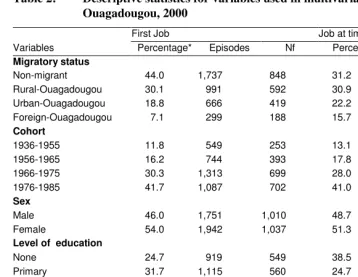
Table 2: Descriptive statistics for variables used in multivariate analyses , Ouagadougou, 2000
First Job Job at time of survey (2000) Variables Percentage* Episodes Nf Percentage* Nf
Migratory status
Non-migrant 44.0 1,737 848 31.2 798
Rural-Ouagadougou 30.1 991 592 30.9 921
Urban-Ouagadougou 18.8 666 419 22.2 632
Foreign-Ouagadougou 7.1 299 188 15.7 485
Cohort
1936-1955 11.8 549 253 13.1 448
1956-1965 16.2 744 393 17.8 608
1966-1975 30.3 1,313 699 28.0 956
1976-1985 41.7 1,087 702 41.0 824
Sex
Male 46.0 1,751 1,010 48.7 1,413
Female 54.0 1,942 1,037 51.3 1,423
Level of education attained
None 24.7 919 549 38.5 1,168
Primary 31.7 1,115 560 24.7 692
Secondary 37.7 1,386 784 31.8 821
Tertiary 6.0 273 154 4.9 155
Father’s last activity
Independent 67.0 2,432 1,372 71.3 2,068
Salaried 32.5 1,232 657 28.1 748
Table 2: (continued)
First Job Job at time of survey (2000) Variables Percentage* Episodes Nf Percentage* Nf
Mother’s last activity
Independent 60.5 2,233 1,233 62.3 1,789
Salaried 5.1 187 109 4.5 111
Family helper 18.8 617 350 17.8 515
Other 15.7 656 355 15.4 421
Marital status
Single 69.7 2,451 1,296 41.9 978
Married 29.0 1,192 711 53.2 1,693
Div/wid//sep 1.31 50 40 4.9 165
Ethnic group
Mossi 72.1 2,744 1,502 74.8 2,145
Peul 2.3 91 45 2.0 60
Senoufo 5.1 186 112 4.4 113
Gourounsi 7.8 182 104 5.2 139
Bissa 3.3 133 73 3.7 106
Other 9.4 357 211 9.9 273
Prior Episode of Activity
Study 41.9 1,572 711
Apprenticeship 12.7 475 354
Unemployment 5.1 169 118
Household helper/at home 40.3 1,477 864 Age on arrival
Before 12 58.7 2,195 1,076 31.2 798
13-15 14.0 469 226 8.8 200
16-18 13.7 468 305 9.6 239
19-21 7.9 311 210 10.2 263
22-24 3.0 136 102 8.7 262
25-27 1.6 63 46 7.4 249
28-30 0.6 35 27 6.1 206
31-34 0.5 16 15 7.3 252
35 & + - - - 10.6 367
Total 100 3,693 2,047 100 2,836
* Percentages are calculated on weighed numbers not shown here.
extraction (rural, urban and alien). To analyze access to first job, migratory status is a variable that can change over time; for example, a person can migrate several times to Ouagadougou during the study period before getting his/her first job in the city.
To control for changes in the labour market we use cohort as a proxy. Given sample size, we consider four groups of cohorts: 1936-1955, 1956-1965, 1966-1975, and 1976-1985. While the first cohort is relatively longer than the others are, it is poorly represented in the sample. Migrants’ length of residence is calculated from the age on arrival. This variable is time dependent because a person can take several trips during his/her life. For example, a local resident of Ouagadougou who emigrates at age 13 and then returns to Ouagadougou will have two arrival ages – the first at thirteen and a second upon return to Ouagadougou. For non-migrants, “age on arrival” takes the lower bound (twelve years) of the age group 12-35 retained in the present study. Thus, length of residence is calculated as the difference between age on arrival (or 12 years old for non-migrants) and age at getting first job (or age at time of survey for those who did not find a job). For those migrants that experienced many moves in and out of Ouagadougou before getting first job or the date of the survey, length of residence is the sum of all the periods in Ouagadougou.
To measure the impact of education on access to a first remunerated job, we use the last level of education completed before getting the first job or at the time of truncation. People who never went to school are compared to people who attended elementary school, secondary school (general or technical) or higher education levels. We note that very few individuals completed the most advanced level.
For previous experience, we consider the effect of spending time on studies, training, unemployment, and inactivity on the chances of getting a remunerated job. This variable varies with time; therefore, an individual can experience several of these periods of activity and inactivity during his/her life. For example, an individual can first have a period of inactivity, then training, unemployment and finally a first job.
Marital status takes three forms: single, married and divorced. This variable changes over time. Before getting a first job, a person can change status from single to married and then divorce before another marriage. Another time-varying variable is age on arrival: while it is set at 12 years for non-migrants, this variable can take many values for those several times migrants in and out of Ouagadougou.
the parents’ last economic activity: for both fathers and mothers, “self-employed” is the most common category.
7. Results
7.1 Migration and employment: a cross-sectional approach
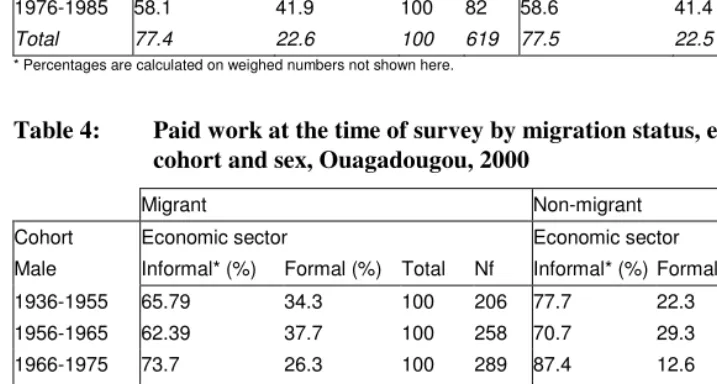
Employment status at the time of the survey is the first indicator of migrants and non-migrants’ performance in the job market. In examining work status (Table 3) we find that men non-migrants are more self-employed compared to men migrant, regardless of cohort. For women however migratory status does not distinguish them given that: nearly all of them are in the self-employed category.
Looking at data on economic sectors (Table 4) yields similar results: male non-migrants tend to be more concentrated in the informal sector compared to men migrants, whereas for women migratory status does not play a role, the majority of women, both migrant and non-migrant, are in the informal sector. It already appears that young men (cohorts 1966-75 and 1976-85) are less numerous in the formal sector than older men, but the multivariate analysis will allow us drawing a conclusion.
Table 3: Paid work at the time of survey by migration status, activity status, cohort and sex, Ouagadougou, 2000
Migrant Non migrant
Variables Activity status Activity status
Cohort Independent*(%) Salaried (%) Total Nf Independent* (%) Salaried* (%) Total Nf
Male
1936-1955 55.3 44.7 100 206 72.8 27.2 100 16 1956-1965 48.8 51.2 100 258 61.3 38.7 100 37 1966-1975 49.1 50.9 100 289 53.2 46.8 100 75 1976-1985 47.7 52.3 100 57 73.1 26.9 100 39
Total 50.3 49.6 100 810 63.1 36.8 100 167
Female
1936-1955 90.4 9.59 100 133 100 0 100 22 1956-1965 78.9 21.1 100 177 81.2 18.8 100 55 1966-1975 79.8 20.2 100 227 91.0 8.9 100 96 1976-1985 58.1 41.9 100 82 58.6 41.4 100 66
Total 77.4 22.6 100 619 77.5 22.5 100 239
* Percentages are calculated on weighed numbers not shown here.
Table 4: Paid work at the time of survey by migration status, economic sector, cohort and sex, Ouagadougou, 2000
Migrant Non-migrant
Cohort Economic sector Economic sector
Male Informal* (%) Formal (%) Total Nf Informal* (%) Formal*(%) Total Nf 1936-1955 65.79 34.3 100 206 77.7 22.3 100 16 1956-1965 62.39 37.7 100 258 70.7 29.3 100 37 1966-1975 73.7 26.3 100 289 87.4 12.6 100 75 1976-1985 92.6 7.4 100 57 97.1 2.9 100 39
Total 70.4 29.6 100 810 86.7 13.3 100 167
Female
1936-1955 91.6 8.4 100 133 100 0 100 22 1956-1965 84.0 16.0 100 177 92.2 7.8 100 55 1966-1975 86.8 13.2 100 227 93.2 6.8 100 96 1976-1985 97.2 2.8 100 82 96.0 4.0 100 66
Total 89.1 10.9 100 619 94.6 5.4 100 239
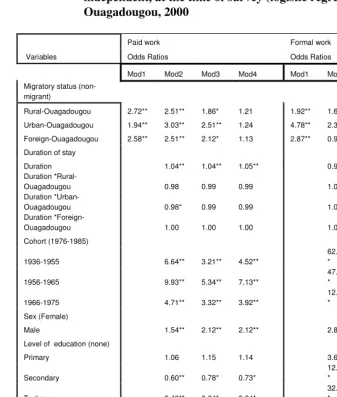
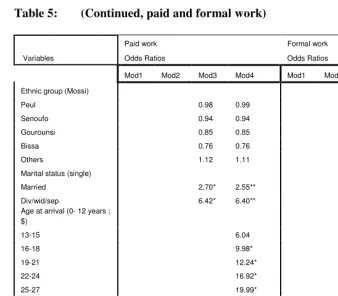
The first model in Table 5 simply shows the crude effect of migratory status on the chances (odds ratio) of having a remunerated job at the time of the survey. The model confirms the descriptive analyses presented above, namely that migrants have a greater chance than non-migrants do of having a remunerated job at the time of the survey, regardless of the sector and status, except for urban migrants to Ouagadougou who seem to have similar chances of being self-employed.
In the second model, after controlling for length of stay, education, sex and cohort, the effect of migratory status is no longer significant for formal work. But Migratory status continues to favour access to first employment remunerated and self employed. One can think that the nature of these results depends on a strong correlation, which would exist between length of stay and cohort. The association between length of stay and cohort exceeds hardly 50 %; all variables involved in the linear relationship have variance- inflation factor (VIF) less than 10; both variable reach statistical significance (paid work and independent work) despite being correlated. Hence, there is no clear indications that something is wrong to say there is a huge problem with multicollinearity. Even when multicollinearity is present, note that estimates of the importance of other variables in the equation (variables that are not collinear with others) are not affected.
Let us return to the interpretation of our results. While access to formal jobs is not related to length of residence, access to self-employment increases with length of residence. This suggests that access to the formal sector depends more on individual profiles whereas awaiting period seems to entail resort to self-employment.
The results for education seem to indicate on the one hand that education decreases the chance of having a remunerated or self-employed job. On the other hand, education considerably increases the chances of entering the formal sector. This result would suggest that educated people prefer to wait for a job commensurate with their aspirations and competence rather than accept any job. Thus access to self-employment is reserved to the less educated.
It is clear that the younger cohort (1976-85) has a lesser chance of having a job at the time of the study and this is particularly true in the formal sector. However, the difference between cohorts remained stable for self-employment while it reduced for jobs in the formal sector. This certainly reflects the effect of the crisis on the urban job market that struck the young urban cohorts.
As predicted, women have significantly less chances of being employed. However, the chances of men having a self-employed job shrink significantly. This is in line with observations that self-employment is predominantly feminine.
Education continues to be conducive of access to first employment, in particular for formal sector jobs and the differences between cohorts remain.
Marital status seems to be positively associated with access to first job but social and ethnic origin have little influence on access to a first remunerated job. Contrary to the hypotheses on ethnicity, ethnic origin does not have a significant effect on the probability of being employed, regardless of the type or job (except for the Senoufo group who seems to have a lesser chance of being self-employed). It is tempting to conclude that Ouagadougou’s job market is not stratified on an ethnic basis as it is for most cities in the developed countries.
Social background, measured here by the type of last economic activity carried out by the respondent’s father and mother, gives interesting results. On the one hand, the father’s last activity does not seem to have a significant effect on the probability of being employed. On the other hand, when the mother’s last activity is in the domestic sphere (e.g. family assistance); the respondents’ chances of having a remunerated or self-employed job are reduced. However, the mother’s last activity does not play a role in formal jobs. In short, it could be that the children of these women will also work in the domestic sphere.
In model 4 (Table 5), after controlling for ages on arrivals (12 years for all non migrants and age on arrival for migrants), the effect of migratory status is no longer significant. Therefore, the result holds also true for the two other types of work: remunerated and self employed. Thus, it is not migratory status per se that affects the chances of being employed but rather the characteristics associated with time, gender, cohort, marital status and age on arrival. Thus, the characteristics that increase the chances of having a job are a longer stay, belonging to an older cohort, being a man and being married or divorced. However, age on arrival seems to be the most significant.
Table 5: Odds ratios for factors associated with paid work, formal or independent, at the time of survey (logistic regression), Ouagadougou, 2000
Paid work Formal work
Variables Odds Ratios Odds Ratios
Mod1 Mod2 Mod3 Mod4 Mod1 Mod2 Mod3 Mod4 Migratory status
(non-migrant)
Rural-Ouagadougou 2.72** 2.51** 1.86* 1.21 1.92** 1.61 1.26 0.84 Urban-Ouagadougou 1.94** 3.03** 2.51** 1.24 4.78** 2.39 2.12 1.32 Foreign-Ouagadougou 2.58** 2.51** 2.12* 1.13 2.87** 0.90 0.90 0.64
Duration of stay
Duration 1.04** 1.04** 1.05** 0.99 0.99 1.01 Duration
*Rural-Ouagadougou 0.98 0.99 0.99 1.00 1.00 1.00 Duration
*Urban-Ouagadougou 0.98* 0.99 0.99 1.00 0.99 1.00 Duration
*Foreign-Ouagadougou 1.00 1.00 1.00 1.00 1.00 1.00
Cohort (1976-1985)
1936-1955 6.64** 3.21** 4.52**
62.83* * 35.76* * 25.24* *
1956-1965 9.93** 5.34** 7.13**
47.31* * 26.24* * 22.75* *
1966-1975 4.71** 3.32** 3.92**
12.22*
* 8.72** 8.60**
Sex (Female)
Male 1.54** 2.12** 2.12** 2.82** 3.21** 3.16**
Level of education (none)
Primary 1.06 1.15 1.14 3.67** 3.73** 3.81**
Secondary 0.60** 0.78* 0.73*
12.03* * 12.34* * 12.70* *
Tertiary 0.48** 0.64* 0.64*
32.52* * 38.32* * 41.03* * Last activity of father
(Independent)
Salaried 1.07 1.06 1.17 1.22
Others 4.75* 5.10* 2.05 2.04
Last activity of mother
(Independent)
Salaried 0.63 0.62* 0.78 0.74
Family helper 0.80 0.80* 0.89 0.89
Table 5: (Continued, paid and formal work)
Paid work Formal work
Variables Odds Ratios Odds Ratios
Mod1 Mod2 Mod3 Mod4 Mod1 Mod2 Mod3 Mod4
Ethnic group (Mossi)
Peul 0.98 0.99 1.14 1.08
Senoufo 0.94 0.94 1.14 1.08
Gourounsi 0.85 0.85 1.29 1.43
Bissa 0.76 0.76 0.90 0.87
Others 1.12 1.11 0.92 0.96
Marital status (single)
Married 2.70* 2.55** 2.54** 2.45** Div/wid/sep 6.42* 6.40** 1.32 1.40 Age at arrival (0- 12 years ;
$)
13-15 6.04 1.41
16-18 9.98* 2.32*
19-21 12.24* 3.71**
22-24 16.92*
25-27 19.99*
28-30 24.93**
31-33 41.22**
34-36 39.80**
37 &+ 39.71**
Paid/formal/independent 1,835 1,835 1,835 1,835 349 349 349 349 Pseudo R-square 0.0347 0.2063 0.2280 0.2326 0.0470 0.3157 0.3277 0.3326
Table 5: (Continued, independent work)
Independent work
Variables Odds Ratios
Mod1 Mod2 Mod3 Mod4 Migratory status (non-migrant) Rural-Ouagadougou 1.99** 1.82* 1.51 0.64 Urban-Ouagadougou 0.94 1.67 1.54 0.73 Foreign-Ouagadougou 1.72** 2.98** 2.54* 1.08
Duration of stay
Duration 1.05** 1.04** 1.05** Duration *Rural-Ouagadougou 0.99 1.00 1.00 Duration *Urban-Ouagadougou 0.98 0.99 0.99 Duration *Foreign-Ouagadougou 0.98 0.99 0.98
Cohort (1976-1985)
1936-1955 2.87** 1.84** 3.30** 1956-1965 3.60** 2.32** 3.61** 1966-1975 3.50** 2.71** 3.50**
Sex (Female)
Male 0.59** 0.71** 0.70**
Level of education (none) Primary 0.68** 0.78* 0.74** Secondary 0.27** 0.28** 0.29** Tertiary 0.04** 0.06** 0.06** Last activity of father (Independent)
Salaried 0.91 0.90
Others 2.78 2.94
Last activity of mother (Independent)
Salaried 0.70 0.71
Family helper 0.65** 0.64**
Table 5: (Continued, independent work)
Independent work
Variables Odds Ratios
Mod1 Mod2 Mod3 Mod4
Ethnic group (Mossi)
Peul 1.14 1.13
Senoufo 0.51** 0.51**
Gourounsi 0.78 0.86
Bissa 0.87 0.90
Others 1.06 1.10
Marital status (single)
Married 1.95** 1.87**
Div/wid/sep 3.54** 3.26** Age at arrival (0- 12 years ; $)
13-15 1.51
16-18 2.31
19-21 3.56
22-24 2.86
25-27 3.48
28-30 3.58
31-33 4.51
34-36 2.78
37 &+ 2.80
Paid/formal/independent 1,189 1,189 1,189 1,189 Pseudo R-square 0.0194 0.1955 0.2147 0.2203
7.2 Access to a first job: a longitudinal approach
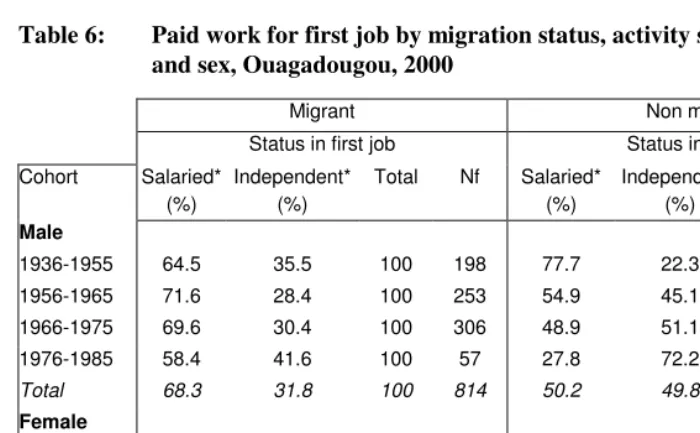
As was the case for the descriptive analysis of employment at the time of the survey, we start by looking into the share of respondents employed in a first job by work status (Table 6) and job sector (Table 7). Firstly, it must be noted that, contrary to non-migrants, for a large section of migrants (between 30 and 45%) this is not their first lifetime job. Nevertheless, what is of interest to us here is their performance once they face Ouagadougou job market. We note that men migrants are more often in a first salaried and formal job compared to non-migrants, and this holds true for all cohorts. However women do not differ by migratory status. These results corroborate the findings with respect to the situation at the time of the survey. For women, their strong presence in self-employed and informal jobs conveys an image of great homogeneity in the job market.
As was the case with the cross-sectional results, it is possible that the advantage that migrants seem to have in Ouagadougou job market is only an “apparent” effect that is perhaps mediated by other factors. The analysis of the net effect of migratory status is presented in Table 8: model 1 (crude effect of migratory status) confirms the results of the descriptive analyses presented above, namely that migrants get a remunerated job more quickly whether formal or self-employed (the only exception being migrants of urban extraction who do not differ from non-migrants). However, the underlying integration dynamics in a first job differs from the dynamics prevailing at the time of the survey in as much as the introduction of education, cohort and sex does not change the results: migrants continue to get remunerated, formal and self-employed jobs more rapidly than non-migrants (model 2) do. The same is true in model 3 when including variables for social and ethnic origin, marital situation, and previous experience. It is only after including, age on arrival that the differences between migratory statuses vanish. Here too, we did not find High multicollinearity after the inspection of the correlation matrix and the variance-inflation factors.
However, when looking at types of jobs (sector and status), we see that the non-educated tend to have jobs in small businesses and that the non-educated get the formal sector jobs.
Table 6: Paid work for first job by migration status, activity status, cohort and sex, Ouagadougou, 2000
Migrant Non migrant
Status in first job Status in first job Cohort Salaried*
(%)
Independent* (%)
Total Nf Salaried* (%)
Independent* (%)
Total Nf
Male
1936-1955 64.5 35.5 100 198 77.7 22.3 100 40 1956-1965 71.6 28.4 100 253 54.9 45.1 100 51 1966-1975 69.6 30.4 100 306 48.9 51.1 100 94 1976-1985 58.4 41.6 100 57 27.8 72.2 100 36
Total 68.3 31.8 100 814 50.2 49.8 100 221
Female
1936-1955 17.2 82.8 100 124 14.5 85.5 100 39 1956-1965 21.5 78.5 100 188 21.8 78.2 100 67 1966-1975 22.0 78.0 100 240 16.8 83.2 100 108 1976-1985 40.3 59.7 100 97 42.8 57.2 100 50
Table 7: Paid work for first job by migration status, economic sector, cohort and sex, Ouagadougou, 2000
Migrant Non migrant
Economic sector Economic sector Cohort Informal*
(%)
Formal*
(%) Total Nf
Informal* (%)
Formal*
(%) Total Nf Male
1936-1955 67.9 32.1 100 198 55.9 44.1 100 40 1956-1965 70.0 30.0 100 253 67.2 32.8 100 51 1966-1975 75.8 24.2 100 306 87.0 13.o 100 94 1976-1985 82.2 17.8 100 57 96.7 3.3 100 36
Total 73.0 27.0 100 814 79.7 20.3 100 221
Female
1936-1955 83.7 16.3 100 124 89.2 10.8 100 39 1956-1965 83.1 16.9 100 188 92.2 7.8 100 67 1966-1975 92.8 7.2 100 240 91.6 8.4 100 108 1976-1985 99.1 0.9 100 97 97.4 2.6 100 50
Total 89.9 1017 100 656 92.7 7.3 100 264
Model 3 (Table 8) introduces social and ethnic origin variables and shows that these variables have little influence on access to a first remunerated job. Social background is not significant when measuring by father’s activity but is significant when measured by mother’s activity. The chances of access to a first remunerated job reduce significantly when the mother is a wage earner (versus being self-employed). Finally, ethnic origin seems to play a role: while as a whole, only the Bissa ethnic group seems to be disadvantaged compared to the Mossi (majority) ethnic group, when disaggregating the analysis by economic sectors, the Fulani and Senoufo have a more rapid access to formal employment. It is difficult to suggest an interpretation for these “ethnic” effects since there are no previous studies on the subject. Finally, the fact that the mother was in independent work also plays a significant role in accelerating the respondents’ access to independent work. These findings support the household image of the informal, independent sector whereby when children are brought into the sector they tend to remain in there.
work. This result is confounding in as much as it is possible that we are in the presence of anticipatory behaviour: the anticipation of marriage speeding up job hunting. However, the fact that the effect is significant only for the self-employed leads us to suggest that the death of the partner or divorce accelerates employment in the informal sector through sheer economic necessity.
Furthermore, previous work experience before arriving in Ouagadougou could also explain the advantages of migrants over non-migrants. The experience of a prior period of study, apprenticeship or unemployment delays access to paid work or to formal sector jobs. This suggests that apprenticeship could be a means of acquiring the skills needed for a formal sector job or for starting self-employment through family and friendship networks. As for the unemployed, they would usually come from the formal sector and therefore evaluate positively their chances of finding another formal job. In one word, those who believe they have a fair chance of finding formal employment, because of their dynamism, their qualifications or their family support during job hunting time, will be more inclined to remain jobless rather than accept menial employment in the informal sector.
It is equally notable that the effect of sex and education also disappears in this model, respectively for self-employed and paid job. The difference between men and women in access to independent employment is no longer significant after controlling for marital status (model not presented). The entry of mothers (married or singled) women in activity could therefore explain gender differences in the access to independent employment noted in the analysis of model three. Education appears as a factor accelerating the access to formal employment while delaying access to independent employment. Acting in the two opposite directions according to sector of activity or employment status, aggregated results would tend to suggest that education has no effect on access to paid employment. Disaggregated results suggest on the contrary that the most educated will accept independent employment only after on a long period of job hunting in the formal labour market.
Introducing age on arrival (12 years for all non-migrants and age on arrival for migrants) in the last model of Table 8 does not alter the effects of cohort, marital status, ethnicity and social background. However, the net effect of migratory status on getting a job disappears, with only one exception for the self-employed to what we will come back later.
explained by age selectivity: non-migrants in this model start belonging to the “population at risk” at age 12 while migrants do so upon arriving in Ouagadougou, often times at ages more akin to employment. Indeed, migrants that arrive after 25 years of age find employment more quickly than non-migrants do while those who arrive before this age find employment less rapidly than non-migrants do. Perhaps migrants that come to Ouagadougou before 25 are less inclined to search for paid employment given that their reasons for migrating can be either family or education, thus postponing job hunting until completion of their studies or they deem that they should become independent from family support.
The unique position of migrants of urban extraction can be explained by the fact that they probably feel more confident in securing employment in the formal sector in the capital city than remaining in the informal sector of their city of extraction. Thus, resort to independent employment takes place only as a final solution.
Table 8: Time ratios for factors associated with access to first paid job, formal or independent (parametric log-logistic regression), Ouagadougou, 2000
First paid job First formal job
Independent Variables Mod1 Mod2 Mod3 Mod4 Mod1 Mod2 Mod3 Mod4 Time ratio Time ratio
Migratory status (non-migrant)
Rural-Ouagadougou 0.52** 0.57** 0.59** 0.98 0.45** 0.52** 0.57** 0.90 Urban- Ouagadougou 0.57** 0.55** 0.55** 1.01 0.38** 0.42** 0.47** 0.91 Foreign- Ouagadougou 0.51** 0.53** 0.54** 1.03 0.40** 0.38** 0.40** 0.96
Cohort (1976-1985)
1936-1955 0.61** 0.61** 0.79** 0.19** 0.18** 0.31** 1956-1965 0.59** 0.59** 0.77** 0.26** 0.27** 0.40** 1966-1975 0.69** 0.69** 0.80** 0.43** 0.44** 0.53**
Sex(Female)
Male 0.90* 0.90* 0.93** 0.61** 0.75** 0.86*
Level of education (none)
Primary 1.08 1.06 1.03 0.57** 0.62** 0.71** Secondary 1.24** 1.01 1.03 0.30** 0.27** 0.43** Tertiary 1.28* 0.96 1.04 0.33** 0.27** 0.43**
Father’s activity (Independent)
Salaried 1.08 0.98 1.19 1.11
Other 0.81 0.84* 0.75 0.72
Mother’s activity (Independent)
Salaried 1.27** 1.11 1.18 0.96
Table 8: (continued, first paid job, first formal job)
First paid job First formal job
Independent Variables Mod1 Mod2 Mod3 Mod4 Mod1 Mod2 Mod3 Mod4 Time ratio Time ratio
Other 1.06 1.02 1.04 1.06
Ethnic group (Mossi)
Peul 0.99 1.04 0.71* 0.74*
Senoufo 0.86 0.96 0.73* 0.84*
Gourgandine 1.14 1.02 0.92 0.88
Bissa 1.23* 1.21* 0.93 0.95
Other 0.94 0.99 0.94 1.04
Marital status (single)
Married 0.90 0.98 1.03 1.07
Div/wid/sep 0.94 0.86 1.02 1.06
Previous experience (Studies)
Apprentice 0.70** 0.90** 0.58** 0.75** Unemployment 0.65** 0.83** 0.49** 0.70** Family helper/At home 0.85* 0.93 1.30 1.20
Age on arrival(0- 12)
13-15 4.99** 5.30**
16-18 3.27** 3.86**
19-21 2.04** 2.35**
22-24 1.40** 1.57**
25-27 0.41** 0.57**
28-30 0.47** 0.22**
31-34 0.17** 0.10**
Age (12_14)
15-17 0.86 0.86 0.95 1.32** 0.80 0.83 0.92 1.19 18-20 1.01 1.01 1.03 1.88** 0.49 0.57 0.64 1.18 21-23 1.17 1.22 1.21* 2.68** 0.57 0.75 0.84 1.84* 24-26 1.30 1.51** 1.61** 3.85** 0.52 0.75 0.85 2.43** 27-29 1.16 1.35 1.32 5.67** 0.55 0.88 1.00 3.51** 30-32 2.22** 2.70** 2.72** 8.10** 1.13 1.41 1.47 5.18** 33-35 2.64** 3.50** 3.63** 12.27** 2.32 2.35 2.61 16.88** First paid/formal/independent 1201 1201 1201 1201 270 270 270 270 Wald chi2(n) 309.93 462.39 583.50 1867.11 126.62 204.56 241.90 575.77 /ln_gam -0.99** -1.01** -1.01** -1.58** -0.79** -0.87** -0.90** -1.35** Gamme 0.37 0.36 0.36 0.21 0.45 0.42 0.41 0.26
Table 8: (continued, first independent job)
First Independent job
Independent Variables Mod1 Mod2 Mod3 Mod4 Time ratio
Migratory status (non-migrant)
Rural-Ouagadougou 0.61** 0.63** 0.64** 1.02 Urban- Ouagadougou 0.88 0.79** 0.76** 1.15* Foreign- Ouagadougou 0.71** 0.71** 0.69** 1.11
Cohort (1976-1985)
1936-1955 0.73** 0.74** 0.90* 1956-1965 0.71** 0.76** 0.85** 1966-1975 0.75** 0.78** 0.85**
Sex(Female)
Male 1.20** 1.05 0.99
Level of education (none)
Primary 1.16* 1.10 1.06
Secondary 1.73** 1.76** 1.23** Tertiary 4.23** 3.05** 2.28**
Father’s activity (Independent)
Salaried 1.08 1.00
Other 0.79 0.82
Mother’s activity (Independent)
Salaried 1.53** 1.31*
Family helper 1.14 1.04
Other 1.06 1.03
Ethnic group (Mossi)
Peul 1.12 1.09
Senoufo 0.95 1.04
Gourgandine 1.17 1.01
Bissa 1.18 1.07
Table 8: (continued, first independent job)
First Independent job
Independent Variables Mod1 Mod2 Mod3 Mod4 Time ratio
Marital status (single)
Married 0.75** 0.85**
Div/wid/sep 0.84 0.79*
Previous experience (Studies)
Apprentice 0.73** 0.89*
Unemployment 0.96 1.01
Family helper/At home 0.84* 0.91
Age on arrival(0- 12)
13-15 3.56**
16-18 2.47**
19-21 1.59**
22-24 1.09
25-27 0.31**
28-30 0.49**
31-34 0.14**
Age (12_14)
15-17 0.95 0.94 1.01 1.47**
18-20 1.24 1.18 1.21 2.12**
21-23 1.59** 1.50* 1.46* 3.04** 24-26 1.66** 1.75* 1.84** 4.21**
27-29 1.38 1.42 1.41 6.00**
30-32 2.41** 2.84** 2.94** 8.35** 33-35 2.41** 3.40** 3.42** 10.95** First paid/formal/independent 649 649 649 649 Wald chi2(n) 256.85 392.13 451.73 1235.69 /ln_gam -0.96** -0.98** -0.97** -1.49**
Gamme 0.38 0.38 0.38 0.22
8. Conclusions and discussion
The results presented here show that the relationships between migration and work are complex and multidimensional. Generally, the classical approach dominated by the availability of cross-sectional data sources compare migrants and non-migrants’ economic performance. However, there is little work of this type in developing countries mainly due to the absence of such data in censuses. Concerning studies in Africa, the dominant hypotheses have postulated that economic integration was more difficult for migrants than for non-migrants. The most commonly held position is that migrants join the ranks of the unemployed and jobless. This means then that migrants least often hold remunerated jobs, formal sector jobs and waged jobs. However, the cross-sectional results presented here about Ouagadougou demonstrate the opposite: in the job market migrants seem to hold the upper hand due essentially to factors related to demographic and human capital characteristics. After controlling for these factors, there are no significant differences between migrants and non-migrants.
One can argue, in line with the literature on immigrants’ economic integration and, particularly in Africa, following Todaro’s model that it is upon arrival that migrants differ from locals. This then implies that upon their arrival, the majority of migrants would have non-remunerated activities or work in the informal sector and have a self-employed status, and this much more so than non-migrants have. However, as was demonstrated with the situation at the time of the survey, analyses conducted here on the access to first job show the contrary even after including human capital variables into the explanatory model. It is only after having added age on arrival that the differences between migrants and non-migrants become blurred. Thus, it is not migration per se that influences access to employment but rather age on arrival, qualifications and the pressure of domestic responsibilities which press on migrants into employment.
Beyond the link between migration and work, the central focus of our analyses, three other results deserve attention. Firstly, the economic migration model appears to be of little relevance for women. Regardless of their migratory status, women are always at a disadvantage in the market of remunerated jobs; women heavily concentrate in the informal sector as self employed (essentially in small business). Moreover, the fact that this is a sphere where family work is important could explain the effect of mother’s self-employment on the chances of more rapid access to a first remunerated job as independent. These results confirm the necessity of gender-specific migration theories (Chant and Radcliffe, 1992) because it is clear that the predominant migratory models do not apply to the case of urban African women.