IPA
International Journal of Psychology Vol. 9, No. 2, Summer & Fall 2015
PP. 125-147
Iranian Psychological Association
Religious Well-Being, Existential Well-Being,
Positive Religious Coping and Family Protective
Factors (Family Adaptation):
A Causal Model
Majid Ghaffari, PhD
Department of Psychology University of Mazandaran
The present study tested a conceptual model of the relationships among religious well-being, existential well-being, positive religious coping, and family protective factors. A sample of three hundred and eighty nine voluntary and unpaid Muslim participants (230 females, 159 males), aged between 21 and 47 years old (31.18 ± 4.28 years), were selected through multi-stage cluster sampling in Isfahan, Iran. All participants were asked to complete the Spiritual Well-Being Scale (SWBS; Paloutzian & Ellison, 1982), the Brief Religious Coping Scale (RCOPE; Pargament, Smith, Koenig, & Perez, 1998), and the Inventory of Family Protective Factors (IFPF; Gardner, Huber, Steiner, Vasquez & Savage, 2008). Using structural equation modeling, the results supported the mediating effects for existential well-being and positive religious coping among religious well-being and family protective factors. The analytic model explained 40% of the distribution of family protective factors. These findings suggest that the positive impact of religious well-being is correlated with family protective factors.
Keywords: religious well-being, existential well-being, positive religious coping, family protective factors
McCubbin, Thompson, & Thompson, 1995; McCubbin & Patterson, 1981) initially developed and researched what has become knownas The Resiliency Model of Family Stress, Adjustment, and Adaptation, which has directed the attention of helping professionals toward critical elements of family functioning from a resilience perspective. The Family Adaptation Model (Drummond, Kysela, McDonald, & Query, 2002; McDonald, Kysela, Drummond, Martin, & Wiles, 1997) directly emanates from this work; however, unlike the McCubbin and colleagues’ model, there is only one simple iterative process of family adaptation rather than two processes that represent protective processes and vulnerability processes separately (Gardner, Huber, Steiner, Vazquez, & Savage, 2008). Given the potential complexity of family assessment and intervention, this singular, ongoing process eliminates the tendency to dichotomize family strengths and deficits and promotes a systemic orientationthat highlights reciprocity as well as parsimony and practical utility (Drummond, Kysela, McDonald, & Query, 2002).
adaptation process (Gardner et al., 2008). The descriptor “protective” in this context implies family members who experience higher levels of protective factors (and lower levels of stressors) in their family milieu and are less affected. Thus, they are more likely to move toward adaptation when interacting with demands or stressors they encounter (i.e., protected), thereby predicting greater likelihood of “good adaptation” (Masten & Reed, 2005). Supports for the factors that are included in the IFPF are present in separate bodies of literature that represent each of them.
referred to as rewarding experiences that provide a sense of meaning and control over one’s life (Papalia, Olds, & Feldman, 2001). Compensating experiences represent a manner of problem solving which is a cognitive enterprise with a behavioral component: “actions that help” (Lazarus & Folkman, 1984, p. 141). Clarifying issues and redefining a situation is a critical component of family coping (McCubbin, Sussman, & Patterson, 1983). Masten (2001) posited the influence of family mastery resources as compensatory. Conger and Conger (2002) likewise asserted a family’s sense of mastery to be a compensating psychological resource and a way to reduce emotional distress.
As discussed by Stinnett (1979) and Schumm (1985), spiritual/religious aspects of lifestyle are important elements in strong families. Research finding suggests that the positive impact of religious and spiritual variables is often correlated with positive outcomes in individuals and families (Varner, 2009). Stinnett and DeFrain (1985) noted that strong families have spiritual lifestyle and these families said that they had an awareness of God or a higher power that gave them a sense of purpose and gave their family support and strength and reported that this awareness helped them to be more forgiving, more patient with each other, and to be more positive and supportive. Wheeler (2008) reported a positive effect of religious/spiritual aspects of one’s life on family strength through enhancing person’s feeling of worth.
be a comprehensive conceptualization of spirituality. The first dimension is associated with one’s relationship with a higher power within a particular system of religious beliefs (religious well-being), and the second dimension is one’s sense of meaning and purpose in life (existential well-being) (Varner, 2009). Within this definition, meaning and purpose in life are not dependent on a specific religious framework (Varner, 2009). In order to measure spiritual well-being, Paloutzian and Ellison (1982) developed the Spiritual Well-Being Scale (SWBS). The scale itself consists of two scales, the Religious Well-Being (RWB) scale and the Existential Well-Being (EWB) scale. The results of 350 studies have shown that people with spiritual well-being have healthier lifestyle, are more hopeful, enjoy more mental stability, and are more satisfied with their life (Shahidi & Hamdie, 2002). Ghaffari (2013) reported that spiritual well-being has a positive and significant effect on family protective factors in young married couples.
On the other hand, in research studies that manipulated participants’ sense of personal control, greater belief in a God who has control over events was reported by those whose sense of personal control was undermined (Kay, Gaucher, McGregor, & Nash, 2010), suggesting that religion serves a compensatory control function. In addition to providing individuals with meaning in life and comfort through a relationship with a higher power, spiritual and religious beliefs often provide a framework for coping with difficult circumstances. In times of stress, a person’s religious orientation dictates the beliefs and practices that are translated into coping skills (Varner, 2009).
coping indicates a less secure relationship with God, an ominous view of the world and a religious struggle for meaning in life (Pargament, Smith, Koenig, & Perez, 1998). For example, factor analysis suggested that strategies for positive religious coping include redefining the stressful situation as an opportunity for spiritual growth and that negative religious coping may be demonstrated through redefining the situation as the work of the Devil or as punishment from God (Pargament, Koenig, & Perez, 2000). Positive religious coping has been found to be significantly tied to increased levels of stress-related growth and positive religious outcomes. Conversely, negative religious coping is related to depression (pargament et al., 1998). Therefore, positive religious coping can be a valuable resource in times of stress (Varner, 2009).
In times of stress, a person’s religious orientation dictates the beliefs and practices that are translated into coping skills, and therefore, positive religious coping include redefining the stressful situation as an opportunity for spiritual growth which can be a valuable resource in times of stress (Varner, 2009).
Baumeister (1991) noted that many religions provide the possibility of believing that God may have higher purposes that humans cannot understand. In such cases, one may remain convinced that events that seem highly aversive may, in fact, be serving desirable ends, even if one is unable to guess what these ends might be. Thus, religious explanations permit religious individuals to trust that every event, regardless of its overt appearance and painfulness, is part of God’s plan (Park, 2010).
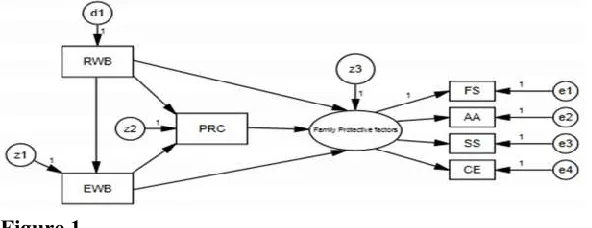
stress (Park, 2010), this research hypothesized that positive religious coping would mediate the relationships between (a) religious well-being and (b) existential well-being with the dependent variable of family protective factors (Figure 1).
Figure 1
Conceptual Model of the Relationships among Religious Well-Being, Existential Well-Being, Positive Religious Coping, and Family Protective Factors
Note: RWB= Religious Well-Being, EWB= Existential Well-Being, PRC=
Positive Religious Coping, FS = Fewer Stressors, AA= Appraisal Adaptation,
SS =Social Support, CE= Compensating Experiences
Method
Statistical Population, Sample, and Procedure
zone was selected, randomly. Only the participants who completed the instruments were included in the analysis. Also, in a bid to meet the multivariate normality, outlying values were omitted. The final number of participants, therefore, reached three hundred and eighty nine participants (230 females, 159 males), aged between 21 and 47 years old (31.18 ± 4.28 years). The rules of privacy of the subjects’ answers were confirmed in the questionnaire instruction. All participants were volunteers, anonymous and unpaid. Before the administration of the instruments, the participants received a brief introduction about the nature of the research, ethical requirements for confidentiality and voluntary participation. In order not to be influenced by their spouse, the participants were asked to fill out the scales alone.
Instruments
SWBS= .87; RWBS=.84; EWBS =.84). The internal consistency coefficients (Cronbach’s α) of the subscales, namely religious well-being and existential well-being, in this study were found to be .82, and .81 respectively.
Brief RCOPE (Pargament et al., 1998). A 14-item Brief RCOPE was used to assess positive and negative religious coping: seven items measure positive religious coping which are associated with a loving and supportive view of God, and other seven items measure negative religious coping associated with a punishing and rejecting view of God (Varner, 2009). The Brief RCOPE items are rated on a four-point Likert scale from 0 (nor at all) to 3 (a great deal).The psychometric properties of the BRCOPE were confirmed in various researches (Varner, 2009). In this study, the concurrent validity of the Persian translation of the BRCOPE was obtained by correlating the score of this measure with the Daily Spiritual Experience Scale (Underwood, 2006) (BRCOPE: r=.38; PRC: r=.55, p<.01; NRC=.07, p>.05). Using the data collected in this study, the reliability coefficients (Cronbach’s α; BRCOPE=.88; PRC=.87; NRC=.83), and results from confirmatory factor analysis (CMIN/DF=2.63; GFI=.89; AGFI=.85; CFI=.90; RMSEA=.06) were satisfactory. The positive subscale score was used in this study.
The internal consistency coefficients (Cronbach’s α) of the IFPF and its subscales, namely fewer stressors, adaptive appraisal, social support and compensating experiences, in this study were found to be .60, .81, .88, and .89 respectively.
Results
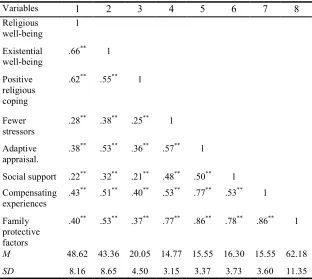
The hypothesized relationships between variables were tested using structural equation modeling (SEM) in AMOS 20.00. The Hoelter’s Index confirmed the adequacy of the sample size (Hoelter’s Index=283, p=.01, Ghasemi, 2010). The variables did not exhibit problematic univariate skew (i.e., absolute values of the skewness index were<3.00., Kline, 2011), nor did the variables exhibit problematic univariate Kurtosis (i.e., absolute values of the kurtosis index were<10.00., Kline, 2011). The critical ratio of .95 for Mardia’s Coefficient (1.09) proved the multivariate normality (Ghasemi, 2010). The model therefore tested using Maximum Likelihood (ML) estimation in AMOS.20. Table 1 contains descriptive statistics and the bivariate correlations for the variables used in the analysis.
Table 1
Descriptive Statistics and the Correlation Matrix of the Model Variables
Variables 1 2 3 4 5 6 7 8
Religious well-being
1
Existential well-being
.66** 1
Positive religious coping
.62** .55** 1
Fewer stressors
.28** .38** .25** 1
Adaptive appraisal.
.38** .53** .36** .57** 1
Social support .22** .32** .21** .48** .50** 1
Compensating experiences
.43** .51** .40** .53** .77** .53** 1
Family protective factors
.40** .53** .37** .77** .86** .78** .86** 1
M 48.62 43.36 20.05 14.77 15.55 16.30 15.55 62.18
SD 8.16 8.65 4.50 3.15 3.37 3.73 3.60 11.35
Note: N = 389, ** p< .001
chi-square should be less than 2 or 3 (Ulman, 2001). Table 3 shows the fit indices of the conceptual model.
Table 3
Goodness of Fit Summaries for the Conceptual Model
χ2 DF CMIN/DF P GFI AGFI CFI NFI RMSEA
15.78 12 1.31 .20 .99 .97 .99 .97 .04
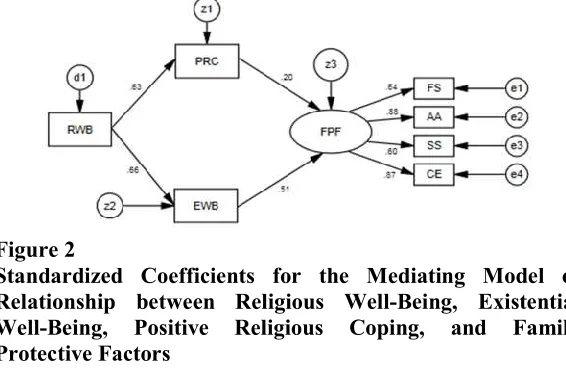
As shown in table 3, the SEM analyses on the conceptual model of the structural relationships among the model variables resulted in satisfactory indices (RMSEA<.05, GFI>.90, AGFI>.90, CFI>.90, and TLI> .90). That is, the results showed the well-fitness of the conceptualized model for the structural relationships among religious well-being, existential well-being, positive religious coping and family protective factors. Figure 2 shows the standardized direct effect coefficients (standardized regression weights) for the relationships among model variables (p<.001).
Figure 2
Standardized Coefficients for the Mediating Model of Relationship between Religious Well-Being, Existential Well-Being, Positive Religious Coping, and Family Protective Factors
Note: RWB = Religious Well-Being, EWB = Existential Well-Being, PRC =
All the standardized direct effect coefficients (Figure 2) were positive and satisfactory (p< .001) but the direct effects of religious well-being on family protective factors (β=.05, p=.91), and existential well-being on positive religious coping (β= .07, p= .18) were not statistically significant. Therefore, the mediating role for positive religious coping between existential well-being and family protective factors was not supported. The results revealed a significant standardized indirect effect (β=.46, p=.001) between religious well-being and family protective factors, with existential well-being and positive religious coping as mediators. Figure 2 shows that on the family protective factors, the direct effect of existential well-being (β= .51, p<.001), is much stronger than the direct effect of positive religious coping (β= .20, p<.001).
The results showed that, religious well-being predicts 43% of the variance of the existential well-being, and 40% of the variance of the positive religious coping, and the conceptual model explained 40% of the distribution of the family protective factors (40% of fewer stressors; 78% of adaptive appraisal; 34% of social support; 76% of compensating experiences) through indirect effect of religious well-being, and direct effects of existential well-being and positive religious coping.
Discussion
religious well-being leads to development of a high level of existential well-being and positive religious coping. Also existential well-being and positive religious coping lead to increase family protective factors. On the other words, religious well-being leads to development of family protective factors through the development of existential well-being and positive religious coping. Results therefore mostly supported the hypotheses of existential well-being and positive religious coping as mediators of religious well-being and family protective factors. According to the findings, on the family protective factors, the direct effect of existential well-being is stronger than the direct effect of positive religious coping.
previous studies have shown that spiritual/religious aspects of lifestyle are important elements in strong families and in such families there are more patience, mutual and social support, forgiveness, justice, and resilience (Ghaffari, 2013; Stinnett & DeFrain, 1985; Varner, 2009; Wheeler, 2008). Thus, according to the proposed model, it can be concluded that the positive impact of religious well-being is correlated with family protective factors or in fact, family adaptation. Based on the findings, the mediating role for positive religious coping between existential well-being and family protective factors was not supported. Therefore, it seems existential well-being has not significant direct effect on positive religious coping.
The cross-sectional nature of this investigation and also the statistical population are limitations of the present study. Some researchers have recently framed religiousness as culture (e.g., Cohen, 2009). This perspective opens many doors to research examining meaning systems as cultural elements. Park (2010) noted that, the need to examine global and situational meaning and the roles of religion in diverse populations across the world is obvious. Of course, more research is needed with different measures (e. g. different measures based on different conceptualizing of spirituality and religiosity) and with different population (e.g. people in stressful conditions, different socio-economic levels, religions, cultures and sub-cultures) to provide a comprehensive theoretical explanation for the interrelationships among spiritual/religious variables and family adaptation.
References
Amerikaner, M., Monks, G., Wolfe, R., &Thomas, S. (1994). Family interaction and psychological health. Journal of Counseling & Development, 72, 614-620.
Baumeister, R. F. (1991). Meaning of Life. New York: Guilford. Beavers, W. R., & Hampson, R. B. (1990). Successful Families.
New York: Norton.
Browne, M. W., & Cudeck, R. (1989). Single sample cross-validation indices for covariance structures. Multivariate Behavioral Research, 24, 445-455.
Byrne, B. M. (1994). Structural equation modeling with EQS and EQS/Windows. Thousand Oaks, CA: Sage Publications.
Calicchia, J.A., & Graham, L.B. (2006). Assessing the relationship between spirituality, life stressors, and social resources: Buffers of stress in graduate students. North American Journal of Psychology, 8(2), 307-320.
Chase-Lansdale, P. L., Wakschalage, L. S., & Brooks-Gunn, J. (1995). A psychological perspective on the development of caring in children and youth: the role of the family. Journal of Adolescences,18, 515-556.
Cohen, A. B. (2009). Many Forms of Culture.American Psychologist, 64, 194-204.
Conger, R. D., & Conger, K. J. (2002). Resilience in Midwestern families: selected findings from the first decade of prospective, longitudinal study. Journal of Marriage and Family,64, 361-373.
Cronbach, L. J. (1970). Essentials of Psychological testing. New York: Harper and Raw International. Davis, T.L., Kerr, B.A., & Kurpius, S.E.R. (2003). Meaning,
Diener, E., Sandvik, E., & Pavot, W. (1991). Happiness is the frequency, not the intensity, of positive versus negative affect. In F. Strack (Ed.), Subjective well-being: An interdisciplinary perspective (pp. 119- I 39). Oxford, UK: Pergamon.
Drummond, J., Kysela, G. M., McDonald, L., & Query, B. (2002). The family adaptation model: examination of dimensions and relations. Canadian Journal of Nursing Research,34, 29-46.
Folkman, S. (2008). The case for positive emotions in the stress process. Anxiety, Stress, & Coping, 21(1),3-14.
Frederickson, B. L. (2001). The role of positive emotions in positive psychology. American Psychologist, 56, 218-226. Gardner, D. L., Huber, C. H., Steiner, R., Vazquez, L. A., &
Savage, T. A. (2008). The development and validation of the inventory of family protective factors: a brief assessment for family counseling. The Family Journal,16 (2), 107-117.
Ghaffari, M. (2013). The effects of spiritual well-being, marital justice, and family protective factors on family strength. PhD Dissertation, University of Isfahan, Isfahan: Iran. Ghaffari, M., Fatehizadeh, M., Ahmadi, A., Ghasemi, V., &
Baghban, I. (2013). Predictors of Family strength: An integrated spiritual/religious-resilient perspective to understanding the healthy/strong family. Iranian Journal of Psychiatry and Behavioral Sciences, 7(2), 57-67.
Ghasemi V. (2010). Structural equation modeling in social researches using Amos Graphics. Tehran: Jameeshenasan. Holahan, C. J., & Moos, R. H. (1991). Life stressors, personal
LISREL application. Tehran: SAMT.
Hu, L. T., & Bentler, P. M. (1995). Evaluating Model Fit. In R. H. Hoyle (Ed.), Structural equation modeling: Concepts, issues, and applications (pp. 76-99). Thousand Oaks, CA: Sage.
Kamya, H.A. (2000). Hardiness and spiritual well-being among social work students: Implications for social work education. Journal of Social Work Education, 36(2), 231-239.
Kay, A., Gaucher, D., McGreoger, I., & Nash, K. (2010). Religious belief as compensatory control. Personality and Social Psychology Review, 14, 37-48.
Kline, R. B. (2011). Principles and practice of structural equation modeling (3rd ed.). New York: Guilford Press. Lazarus, R. S., & Folkman, S. (1984). Stress, Appraisal, and
Coping. New York: Springer.
Luthar, S. S. (1991). Vulnerability and resilience: A study of high-risk adolescents. Child Development, 62, 600-616. Marian, M. R., & Huber, C. H. (2011). Mexican American
elderly: self- reported anxiety and the mediating influence of family protective factors. The Family Journal,19 (1), 63-72.
Masten, A. S. (2001). Ordinary magic resilience processes in development. American Psychologist, 56, 227-238.
Masten, A. S., & Reed, M. J. (2005). Resilience in development. In C. R. Synder,& S. J. Lopez (Eds.), Handbook of positive psychology (pp. 74-88). New York: Oxford University Press.
research and practice (pp. 294-3 12). Madison: University of Wisconsin.
McCubbin, H. I., McCubbin, M. A., Thompson, A. I., & Thompson, E. A. (1995). Resiliency in ethnic families: A conceptual model for predicting family adjustment and adaptation. In H. I. McCubbin, E. A. Thompson, A. I. Thompson, & J. E. Fromer (Eds.), Resiliency in families (pp. 329-351). Thousand Oaks, CA: Sage.
McCubbin, H. I., & Patterson, J. M. (1981). Systematic assessment of family stress, resources, and coping: Tools for research, education, and clinical intervention. St. Paul, NM: Department of Family Science.
McCubbin, H. I., Sussman, M. B., & Patterson, J. M. (1983). Social stress and the family advances and developments in family stress theory and research. New York, NY: Hawthorne Press.
McDonald, L., Kysela, G., Drummond, J., Martin, C., & Wiles, W. (1997). Assessment of the clinical utility of a family adaptation model. Journal of Family Studies, 3, 47-65. Moberg, D. O., & Brusek, P. M. (1978). Spiritual well-being: A
neglected subject in quality of life research. Social Indicator Research, 5, 303-323.
Nadi, M., & Sajjadian, A. (2012). The analytical relations between spiritual concept with spiritual well-being, mental happiness, satisfaction with life, psychological flourishing, hope for future and purposefulness in the university students. The Journal of Toloo-E-Behdasht, 10 (3): 54-68. Otto, H. A. (1962). What is a strong family? Marriage and
Family Living, 10, 77-80.
major depression. Cognitive Therapy and Research, 21, 409-420.
Paloutzian, R.F., & Ellison, C.W. (1982). Loneliness, spiritual well-being and quality of life. In L.A. Peplau & O. Perlman (Eds.), Loneliness: A sourcebook of current theory, research and therapy (pp. 224-237). New York: Wiley Interscience.
Papalia, D. E., Olds, S. W., & Feldman, R. D. (2001). Human development (8thEd). Boston, MA: McGraw Hill.
Pargament. K. I., Koenig, H. G., & Perez, L. M. (2000). The many methods of religious coping: Development and initial validation of the RCOPE. Journal of Clinical Psychology, 56 (4), 513-543.
Pargament, K. I., Smith, B.W., Koenig, H. G., & Perez, L. (1998). Patterns of positive and negative religious coping with major life stressors. Journal for the Scientific Study of Religion, 37, 710-724.
Park, C. L. (2010). Making sense of the meaning literature: An integrative review of meaning making and its effects on adjustment to stressful life events. Psychological Bulletin, 136, 257-301.
Schumm, W. R. (1985). Beyond relationship characteristics of strong families: Constructing a model of family strengths. Family Perspectives, 19, 1-9.
Shahidi, Sh., & Hamdie, M. (2002). Principles and Basis of Mental Health. Tehran: SAMT.
Steiger, J. H. (1990). Structural model evaluation and modification: An interval estimation approach. Multivariate Behavioural Research, 25, 173-180.
Stinnett, N. (1979). Strengthening families. Family Perspective, 13, 3-9.
Boston, MA: Little, Brown & Company.
Stinnett, N., Sanders, G., Defrain, J., & Parkhurst, A. (1982). A nationwide study of families who perceived themselves as strong. Family Perspective, 16, 15-22.
Tiet, Q. Q., Bird, H. R., Davies, M., Hoven, C., Cohen, P., Jensen, P. S., et al. (1998). Adverse life events and resilience. Journal of the American Academy of Child and Adolescent Psychiatry,37, 1191-1200.
Ullman, J. B. (2001). Structural equation modeling. In B. G. Tabachnick & L. S. Fidell (2001). Using Multivariate Statistics (4th ed; pp 653- 771). Needham Heights, MA: Allyn & Bacon.
Underwood, L. G. (2006). Ordinary spiritual experience: qualitative research, interpretive guidelines, and population distribution for Daily Spiritual Experience Scale. Archive for the Psychology of Religion, 28 (1), 181-218.
Varner, (2009). Effects of spiritual well-being, religious coping, and hardiness on parenting behaviors in low socioeconomic status families. PhD Dissertation, University of Southern Mississippi: US.
Weber, L., & Cummings, A. L. (2003). Relationships among spirituality, social support, and childhood maltreatment in university students. Counseling and Values, 47, 82-95. Werner, E. E. (1993). Risk and resilience in individuals with
learning disabilities: Lessons learned from the Kauai longitudinal study. Learning Disabilities Research & Practice, 8, 28-34.
Wheeler, T. (2008). Investigating the interrelationships among various measures of family strengths. PhD Dissertation, Kansas State University, Manhattan: Kansas.
supernatural agency in American and Hindu ways of responding to uncertainty. In J. Greenberg, S. L. Koole, & T. Pyszczynski (Eds.), Handbook of experimental existential psychology (pp. 215-230). New York: Guilford.