Language Proficiency Among Iranian EFL Learners
Aliakbar Jafarpour Boroujeni¹, Ali Roohani², & Mohammad Sharifi²¹Corresponding author, Shahrekord University, [email protected] ²Shahrekord University, [email protected]; [email protected]
Received: 28/02/2014 Accepted: 05/07/2014
Abstract
The purpose of this study was twofold. Firstly, it attempted to investigate whether language learning strategies (LLSs) can predict foreign language (FL) proficiency. Secondly, it examined what kind of LLSs Iranian learners of English use more frequently in FL institutes. To do so, 112 intermediate Iranian EFL learners participated in the study. Oxford’s Strategy Inventory for Language Learning (1990; SILL) was used to collect the data on the participants’ strategy use. Additionally, the participants’ scores on an achievement test were used as a measure of their language proficiency. Data were subjected to descriptive and inferential statistics. Results showed that FL proficiency is predictable through LLSs. Metacognitive strategies with the largest beta coefficient (0.302) made the strongest contribution to predicting FL proficiency. Furthermore, results indicated that the participants were medium strategy users (M = 3.17) and used metacognitive strategies significantly more (M = 3.80) than other categories.
Keywords: Language Learning Strategy Use; Prediction of FL Proficiency; Learning Styles
1. Introduction
to inform learners of these strategies and their features whether or not students are aware of them. The significance of LLSs in language learning is due to two reasons. Firstly, they help learners use language more effectively. Secondly, the use of these strategies increases learners’ autonomy in learning. LLSs have been the focus of many studies in recent years (e.g., Baker & Boonkit, 2004; Brown, 2007; Hong-Nam & Leavell, 2006; Khamkhien, 2010). There are some factors influencing learning strategy choice, such as motivation (Oxford & Nyikos, 1989), nationality (Griffiths & Parr, 2000), and psychological traits (Ehrman & Oxford, 1989).
In order to have an appropriate and successful instruction, EFL teachers are required to identify their students’ preferences for foreign language (FL) learning. Learners may employ LLSs subconsciously, meaning that they themselves are not aware of the type of strategies they use. However, learners can bring them into conscious awareness (Chamot, 2005). Teachers can identify learners’ strategies by means of questionnaires, cheklists, and language diaries, as well as help learners use them efficiently. In addition, teachers can incorporate LLSs into their instruction and help learners use the strategies which are consistent with particular FL skills.
FL learners can employ learning strategies more effectively if they are made conscious of LLSs (Khamkhien, 2010; O’Malley & Chamot, 1990). It can be inferred that an appropriate and frequent use of learning strategies will cause better achievement in a FL (Zare, 2010). Therefore, teachers are expected to provide students some chances to make use of LLSs. Both teachers and students need to enhance their awareness of LLSs which lead to success in FL instruction and learning. When students become aware of appropriate LLSs, they can be more autonomous in performing FL tasks.
1. Do Iranian EFL learners’ language learning strategies predict English proficiency?
2. What category of language learning strategies do Iranian EFL learners use more frequently in FL institutes?
2. Literature Review 2.1 Factors Affecting LLSs
Recent research has shown that there are many factors influencing strategy choice. Factors such as awareness and level of instruction might influence learners’ preferences for strategies. Except for the previously mentioned ones, there are other factors which might have a significant role in using LLSs. Some major factors are described in the following:
2.1.1 Learning styles
Learning styles are considered as crucial factors affecting LLSs. Language learners always employ learning strategies which reflect their learning styles (Oxford & Nyikos, 1989). This matter signifies the importance of learning styles in influencing LLSs.
The effect of learning styles on LLSs was one of the goals of the study by Pei-Shi (2012). The researcher investigated the relationship between learning styles and strategy use among learners with different language proficiency levels. The participants were 71 non-English majors in New Taipei City. They were divided into two high and low proficiency levels in line with an English proficiency test. Two questionnaires including learning strategy and learning style were used. The conclusion was that there was a significant difference between learning styles and LLSs, but this difference was pertinent to only one type of learning strategy.
2.1.2 Personality types and traits
Psychological or personality type has four dimensions including extroversion vs. introversion, sensing vs. intuition, thinking vs. feeling, and judgment vs. perception (Pittenger, 1993). Ehrman and Oxford (1989) investigated the impact of personality type on using strategies. In that study, 79 language learners, teachers, and supervisors were surveyed in an intensive training setting. Personality type was measured by Myers-Briggs Type Indicator (MBTI). This study revealed that those with an extrovert personality type were more likely to use affective strategies, whereas the introverts used strategies for communicating meaning more frequently than extroverts. Moreover, intuitive type people compared with sensing type people used more strategies for searching, and communicating meaning and used the language for authentic communication and managing emotions.
In another study, Fazeli (2012) investigated the relationship between the use of metacognitive English LLSs among EFL learners based on personality traits, and the role of personality traits in the prediction of the use of such strategies. Two hundred and thirteen Iranian female university students whose major was English in Iran participated in this research. The results showed that there was a significant relationship among four traits of personality and the use of metacognitive LLSs. However, the predictability of metacognitive LLSs was not supported by the findings of this study.
2.1.3 Motivation
The effect of motivation on using language strategies was investigated by Oxford and Nyikos (1989). In this study, the researchers surveyed 1,200 students studying five different languages in a foreign service institute. The study concluded that motivation is the most influential variable affecting strategy choice. The researchers claim that “not only does high motivation lead to significant use of LLSs, but high strategy use probably leads to high motivation as well” (p. 296). This matter shows that there can be a mutual relationship between motivation and LLSs.
In another study (Sadighi & Zarafshan, 2006), 126 participants including freshmen and seniors whose majors were English translation and English teaching were surveyed. The results indicated that integratively motivated students employed more strategies than instrumentally oriented ones. In addition, Sato, Nakagawa, and Yamana (2008) concluded that teachers who provide learning strategies and employ different instructional materials can motivate and encourage their learners.
2.2 Research on LLSs and FL Proficiency
good language learners (e.g., Bialystok, 1981; Oxford & Ehrman, 1995; Rubin, 1975). Furthermore, they could find that the quality of strategy use is relevant to the successful completion of language tasks and activities and also language achievement and proficiency (e.g., Ian & Oxford, 2003; O’Malley, Chamot, Stewner-Manzanares, Kupper, & Russo, 1985; Park, 1997).
However, some researchers examined FL proficiency (e.g., Fewell, 2010; Green & Oxford, 1995; Park, 1997; Radwan, 2011) as another factor that affected the use of learning strategies. Examining the relationship between LLSs and FL proficiency in EFL contexts seems much more important than ESL contexts because EFL learners have little exposure to the L2. Therefore, it is worth reporting the studies conducted so as to evaluate EFL learners’ LLSs in such contexts.
Radwan (2011) investigated the use of LLSs by 128 students majoring in English in Oman. In that study, proficiency was measured by the student’s grade point average (GPA) in English courses, study duration in the English Department, and the students’ perceived self-rating. The questionnaire was distributed to classes that represent different study durations including freshmen, sophomores, juniors, and seniors. The researcher used the students’ GPAs because there was no standardized English test available in the university to be administered to all the participants. The students’ GPAs were divided into two groups B-and-above, and C-and-below. In terms of self-rating, students were asked to rate their English (speaking, listening, reading, and writing skills) as excellent, good, fair, and poor. Regarding proficiency, the researcher grouped the learners into two groups including proficient students averaging B and above and less proficient students averaging C and below. The ANOVA results showed that in terms of overall strategy use, students used metacognitive strategies significantly more than any other category of strategies. Memory strategies ranked last on the students’ preference scale. In addition, the ANOVA results showed that more proficient students used more cognitive, metacognitive, and affective strategies than less proficient students. For study duration, the results showed a curvilinear relationship between strategy use and study duration. Freshmen used more strategies followed by juniors, seniors, and sophomores, respectively. Analysis of the relationship between strategy use and rating revealed a contrast between learners who are self-efficacious and those who are not. At last, a backward stepwise logistic regression analysis was performed on the students’ data. The analysis showed that the use of cognitive strategies was the only predictor that distinguished students with high GPAs and those with low GPAs.
test, and a brief background questionnaire. The sample group consisted of a first-year Japanese college students enrolled in an English course at a university in Okinawa, Japan. The group consisted of 29 English majors and 27 business majors.
The results of the SILL questionnaire were compared between two academic groups—English and Business majors—and subsets of learners within each of these groups were sorted regarding their scores on an English proficiency test. The study found that LLS utilization decreased as English proficiency increased. The SILL results of the top 25% of English proficient learners had an average score of 2.9, whereas the bottom 25% had an average score of 3.5. In each separate category, the SILL score of the bottom group was higher than the top group. A comparison of the SILL results of the Business majors in the top and bottom 25%, sorted according to an English proficiency test, indicates almost the same results on the SILL. The top group had an average score of 2.1, whereas the bottom group had an average score of 2.0. Moreover, an examination of individual categories revealed that learners in the bottom proficiency group utilized a higher degree of compensation and social learning strategies.
3. Method 3.1 Participants
The participants included 112 Iranian EFL learners from several branches of a FL institute in Isfahan, Iran. They attended their English classes three times a week. The reason for selecting the participants from language institutes was that EFL teachers might have more time and opportunities to incorporate LLSs into their instruction. An intermediate level of instruction was selected for the study because at this level students might be familiar with the strategies and use them subconsciously more frequently than elementary learners. Levels below intermediate are so low that learners might use LLSs less frequently or even might not use them at all. It seems reasonable that learners at the intermediate level use LLSs more subconsciously compared with higher levels. Therefore, teachers can make the learners aware of the strategies explicitly and help them use LLSs consciously and more effectively at higher levels.
3.2 Instrument
In this study, the main material was Oxford’s (1990) SILL used for collecting the data on the strategy use of the participants. SILL is one of the most useful inventories of learning strategy assessment tool which is currently available. This test has been used in many recent studies (e.g., El-Dip, 2004; Gan, Humpreys & Hamp-Lyons, 2004; Ian & Oxford, 2003; Lafford, 2004; Oxford, Cho, Leung, & Kim, 2004; Wharton, 2000). There was a reporting scale of SILL which could be used to inform instructors and students of the groups of strategies they use in learning English. According to Oxford (1990), the groups included high usage (3.5- 5.0), medium usage (2.5-3.4), and low usage (1.0-2.4). There were two versions of SILL: one for native speakers of English including 80 items, and another one for EFL/ESL learners including 50 items. Each item was a statement saying “I do…” (e.g., “I review English lessons often”) and learners responded on a 5-point Likert scale ranging from 1 (never) to 5 (always). The version of the SILL used in this study was the 50-item instrument which classified the strategies into two types: direct and indirect. Direct strategies were those which involve the target language such as reviewing and practicing. Indirect strategies were those used for planning, cooperating, and seeking opportunities. This questionnaire was translated into Persian in order to help the participants better understand the items. Cronbach’s alpha coefficient for the reliability of the translated SILL was calculated, and it was found to be 0.84, suggesting very good internal consistency reliability for the scale with this sample. Pallant (2007) states, “values above 0.7 are considered acceptable; however, values above 0.8 are preferable” (p. 98).
self-ratings questionnaire (Radwan, 2011), and language achievement tests (O’Mara & Lett, 1990; Philips, 1991). In this study, a language achievement test was used to determine the participants’ proficiency. The achievement test had 90 items, and the maximum score the participants could achieve was 100. Therefore, after the participants took the achievement tests, the scores of the tests were collected as proficiency scores to carry out the investigations of the study.
To ensure the content validity of the test, the comments of two experts were sought. Each expert confirmed the appropriateness of the test regarding the content and the objective of measuring the participants’ language proficiency in listening, structure, vocabulary, and reading comprehension. To estimate the reliability of the achievement test, the internal consistency of the test was computed based on KR-21 reliability formula. Raatz and Klein-Braley (1995) maintain that the formula measures internal consistency in an acceptable way. The reliability index of the test was found to be 0.82 which is considered as a high positive reliability. Table 1 presents the obtained results:
Table 1. Reliability of the Achievement Test Test Type Number of
Items
Mean Standard Deviation
KR-21
Achievement
test 90 83.88 5.54 0.82
3.3 Procedure
scores were used as the measure of FL proficiency. This process helped the researchers to determine which inventory belonged to which student and analyze their responses to the surveys and their achievement result.
4. Results
The first research question dealt with the prediction of FL proficiency through LLSs. A multiple regression analysis was performed on the students’ data to find out which category of strategies was the best predictor of FL proficiency as measured by the scores of final exams. The six categories of strategies were specified as the predictor variables along with the students’ scores as the criterion (i.e., dependent) variable.
Table 2 is termed Model Summary. In this table, the R value shows the correlation between the independent variables including the six strategies and the dependent, or criterion, variable which is FL proficiency. Moreover, R Square shows how much of the variance in the dependent variable is explained by the model which includes the six categories of strategies. In this case, the R value is 0.293, meaning that the correlation between the independent variables (six strategies) and the dependent variable (FL proficiency) is 0.293. The R Square value is 0.086. Expressed as a percentage (multiply by 100), this means that the model (six strategies) explains 8.6 percent of the variance in FL proficiency. Table 2 indicates the results:
Table 2. Model Summary
Model R R Square Adjusted R
Square
Std. Error of the Estimate
1 .293a .086 .034 6.6337
a. Predictors: (Constant), Social, Affective, Compensation, Metacognitive, Memory, Cognitive
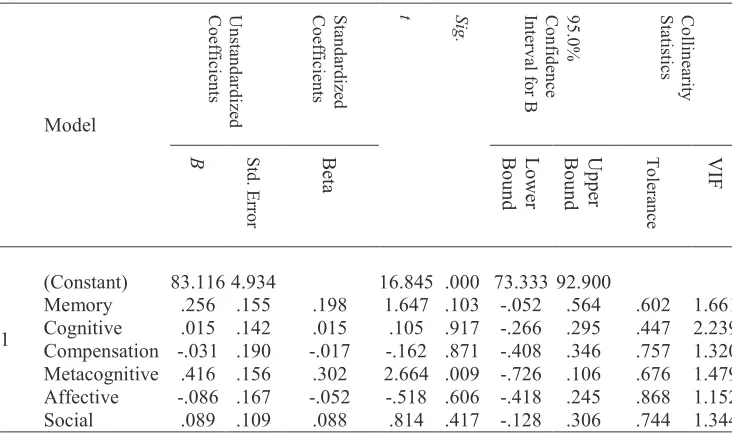
Table 3 shows that all Tolerance and VIF values are not less than 0.10 and above 10, respectively. The purpose was to compare the contribution of each independent variable. To compare the different variables, it was important to look at the standardized coefficients. Standardized means that these values for each of the different variables have been converted to the same scale so that one can compare them (Pallant, 2007). Therefore, the beta values should be examined. In this case, the largest beta coefficient is 0.302, which is for metacognitive strategies. This means that this variable makes the strongest unique contribution to predicting the dependent variable, which is FL proficiency. Furthermore, the column labeled Sig (significance) shows that the variable metacognitive strategies make a statistically significant contribution to the model (p = 0.009). The second category strategies which had a large beta value was memory with the beta value of 0.198, but its prediction was not significant (α = 0.05, p = 0.103). However, the only type of strategy with meaningful contribution was the metacognitive one. Table 3 presents the results:
Table 3. Coefficients
Model U n st an d ard iz ed Co effi ci en ts S ta n d ard iz ed Co effi ci en ts
t S
ig . 9 5 .0 % Co n fi d en ce In te rv al fo r B Co lli n ea ri ty S ta tis tic s B S td . E rr o r B et a L o w er B o u n d U p p er B o u n d T o le ra n ce V IF 1
(Constant) 83.116 4.934 16.845 .000 73.333 92.900
Memory .256 .155 .198 1.647 .103 -.052 .564 .602 1.661 Cognitive .015 .142 .015 .105 .917 -.266 .295 .447 2.239 Compensation -.031 .190 -.017 -.162 .871 -.408 .346 .757 1.320 Metacognitive .416 .156 .302 2.664 .009 -.726 .106 .676 1.479 Affective -.086 .167 -.052 -.518 .606 -.418 .245 .868 1.152 Social .089 .109 .088 .814 .417 -.128 .306 .744 1.344
the medium usage range (M = 2.5 and 3.4). These were cognitive strategies (M = 3.15), followed by social strategies (M = 3.08), compensation strategies (M = 3.03), and memory strategies (M = 2.96), respectively, and finally the least preferred strategy is the affective strategy (M = 2.77). Moreover, the total mean score of SILL indicates that the participants were medium strategy users (M = 3.17):
Table 4. Descriptive Statistics for Various Strategies
Strategies Mean
Std. Deviation
Std. Error
95% Confidence Interval for Mean
Min. Max.
Lower Bound Upper Bound Memory Cognitive Compensation Metacognitive Affective Social Total 2.96 3.15 3.03 3.80 2.77 3.08 3.17 1.373 1.296 1.345 1.283 1.470 1.428 1.388 .043 .033 .052 .040 .057 .055 .019 2.88 3.09 2.92 3.72 2.66 2.98 3.13 3.05 3.22 3.13 3.87 2.88 3.19 3.20 1 1 1 1 1 1 1 5 5 5 5 5 5 5
In order to see whether the differences in the use of strategies by all the participants were significant, a one-way ANOVA was conducted. The results of the ANOVA revealed statistically significant differences (F = 61.901, p = .000) in the overall use of strategies by the participants. Table 5 depicts the results of the one-way-ANOVA for the use of strategies.
Table 5. One-Way ANOVA for the Overall Use of Strategies by All the Participants
Sum of Squares df Mean Square F Sig. Between groups 565.496 5 113.099 61.901 .000 Within groups 10220.714 5594 1.827
Total 10786.210 5599
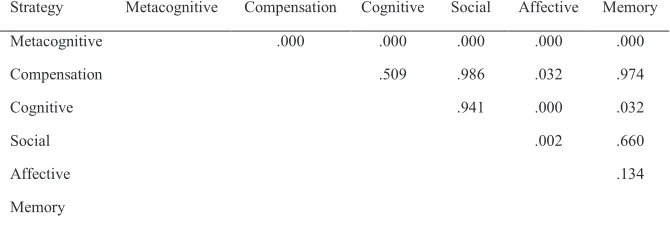
Table 6. Scheffe Results for Multiple Comparisons Among All the Strategies
Strategy Metacognitive Compensation Cognitive Social Affective Memory
Metacognitive .000 .000 .000 .000 .000
Compensation .509 .986 .032 .974
Cognitive .941 .000 .032
Social .002 .660
Affective .134
Memory
5. Discussion and Conclusion
This study revealed two important findings. First, it showed that among the LLSs, only metacognitive strategies were significantly predictive of FL proficiency. Second, the results of overall strategy use indicated that the Iranian EFL learners favored metacognitive strategies over others.
The regression model presented in this study revealed that metacognitive strategies are significantly correlated with language proficiency which was measured by means of an achievement test. Among the 50 strategies of SILL, nine strategies are considered as metacognitive. Examples of metacognitive strategies include items like “I pay attention when someone is speaking English” and “I think about my progress in learning English.” Metacognitive strategies help students monitor and evaluate their learning. Oxford (1990) pointed out that metacognitive strategies help learners coordinate and maximize their learning processes by monitoring, planning, organizing, and seeking opportunities to use the language. These strategies are critical for success in learning English. It is also worth including metacognitive strategies as the main part of any explicit instruction.
The results of total strategy use showed that participants in this study were medium strategy users (M = 3.17). This finding is in line with the study conducted by Zare (2010) in Iran. In his study, 148 undergraduate EFL learners were reported to be medium strategy users (M = 3.35). In addition, Soleimani (2008) also found that 97 English major university students were medium strategy users (M = 3.36). It seems that Iranian EFL learners at both intermediate level in language institutes and university level are medium strategy users though both groups are different from each other in terms of their majors and levels of instruction. Moreover, this finding is consistent with the results of the studies done on other Asian learners such as the Chinese and Korean (e.g., Hong, 2006; Lee, 2003).
other categories. This finding is supported by the results of previous research studies on both EFL and ESL language learners (Griffiths, 2003; Hong-Nam & Leavell, 2006; Magogwe & Oliver, 2007; Oxford, 1990; Soleimani, 2008; Zare, 2010).
The findings of this study showed that the participants employed metacognitive strategies more than other strategies. It seems that Iranian EFL learners are concerned about their grades in learning English. It is because they often monitor and evaluate their learning. In other words, they may be motivated to learn the L2. They make attempts to learn the language so as to achieve a good grade (Zare, 2010). Affective and memory strategies were the least used strategies by the participants. Although affective strategies ranked the least favored strategies they were of medium usage (M = 2.77). The low usage of such strategies is perhaps due to the fact that Iranian EFL learners are usually conservative with their feelings. They are afraid of both losing their face before their classmates and teacher and being negatively assessed by their teacher (Zare, 2010). Soleimani (2008) maintains that the Iranian educational system, to some extent, makes cognitive change in the learners at the expense of affective learning at universities. The result of the low usage of affective strategies reported in this study might suggest that the educational system of language institutes in Iran is similar to that of the universities in this case. The findings of this study indicating the low usage of memory strategies contradict the belief that the Asian learners tend to use strategies depending on memorization (O’Malley & Chamot, 1990; Politzer & McGroarty, 1985).
The current study demonstrated that Iranian EFL learners at FL institutes were aware of the significance of LLSs for the development of their proficiency in English. The results indicated that metacognitive strategies make a major contribution to predicting FL proficiency at intermediate level. In addition, it was found that Iranian EFL learners are medium strategy users at this level. They employed LLSs with a medium to high frequency with metacognitive strategies ranking the highest among other strategies. Metacognitive strategies which help students monitor, organize and plan their learning were favored by all students over other strategies. Soleimani (2008) and Zare (2010) obtained similar result from studies on English major university students.
language learners. Anderson (2002) believes that “developing metacognitive awareness may also lead to the development of stronger cognitive skills” (p. 1). Although there is no evidence indicating that a high usage of metacognitive strategies would lead to more usage of cognitive strategies which the finding of this study seemed to support, the overall use of strategies showed that the participants preferred cognitive strategies after metacognitive strategies which were ranked high in use.
The findings of this study might bear some implications for FL pedagogy in four ways. First, an important implication of this study is the need to provide all students with more opportunities to use LLSs more frequently because the overall strategy use by the participants under study falls in the high and medium ranges. Second, this study reported that metacognitive strategies can predict FL proficiency and is correlated with it. Thus, it seems reasonable to include these strategies as the core of any strategy-based instruction and explicit instruction EFL contexts. Third, more proficient learners (i.e., the high group) seemed to use more strategies than other learners, but this finding was not supported by the results because the difference between proficiency groups in the use of LLSs was not significant. When teachers try to familiarize learners, especially less proficient students, with appropriate LLSs, this might help them to be more independent and develop confidence which in turn would enhance their language abilities. Finally, the findings indicated that the males and females significantly differed from each other in the use of affective strategies. The males used fewer affective strategies, showing reluctance in sharing their feelings. Thus, this finding should be stressed, and males should be encouraged to express their emotions more. They should be encouraged by teachers to participate in group activities which help them decrease their anxiety and enhance their self-confidence. Teachers themselves should be aware of all LLSs and factors affecting them and prepare their lessons accordingly.
not understand the strategy descriptions in the questionnaire items” (p. 15). However, for this study, SILL was translated into Persian so as to help the participants understand the strategy descriptions. It is suggested that further studies use multiple data collection procedures such as interviews by combining the usage of the SILL questionnaire. This would be an effective way of gaining more insights into the strategy use, particularly if the participants are to be selected from language institutes because researchers might have more time to apply such procedures.
References
Anderson, N. J. (2002). Using telescopes, microscopes, and kaleidoscopes to put metacognition into perspective. TESOL Matters, 12(4), 1-4.
Baker, W., & Boonkit, K. (2004). Learning strategies in reading and writing: EAP contexts. RELC Journal, 35(3), 299-328.
Bialystok, E. (1981). The role of conscious strategies in second language proficiency. Modern Language Journal, 65, 24-35.
Brown, D. H. (2000). Principles of language learning and teaching (4th ed.). NY: Longman.
Brown, D. H. (2007). Principles of language learning and teaching (5th ed.). Pearson: Longman.
Chamot, A. (2004). Issues in language learning strategy research and teaching. Electronic Journal of Foreign Language Teaching, 1(1), 14-26.
Chamot, A. (2005). The cognitive academic language learning approach (CALLA): An update. In P. Richard-Amato & M. Snow (Eds.), Academic success for English language learners: Strategies for K-12 mainstream teachers (pp. 87-101). White Plains, NY: Longman.
Chen, S. (1990). A study of communication strategies in interlanguage production by Chinese EFL learners. Language Learning, 40, 155-187.
Ehrman, M. E., & Oxford, R. L. (1989). Effects of sex differences, career choice, and psychological type on adult language learning strategies. The Modern Language Journal, 73, 1-13.
El-Dip, M. A. (2004). Language learning strategies in Kuwait: Links to gender, language level, and culture in a hybrid context. Foreign Language Annals, 37(1), 85-95.
Fewell, N. (2010). Language learning strategies and English language proficiency: An investigation of Japanese EFL university students. TESOL Journal, 2, 159-174.
Gan, Z., Humpreys, G., & Hamp-Lyons, L. (2004). Understanding successful and unsuccessful EFL students in Chinese universities. The Modern Language Journal, 88(4), 229-244.
Green, J. M., & Oxford, R. L. (1995). A closer look at learning strategies, L2 proficiency and Gender. TESOL Quarterly, 29(2), 261-297.
Griffiths, C. (2003). Language learning strategy use and proficiency: The relationship between patterns of reported language learning strategy (LLS) use by speakers of other languages (SOL) and proficiency with implications for the teaching/learning situation. Unpublished doctoral dissertation, University of Auckland, New Zealand.
Griffiths, C., & Parr, J. M. (2000). Language learning strategies, nationality, and proficiency. Independence, 28, 7-10.
Hong, K. (2006). Beliefs about language learning and language learning strategy use in an EFL context: A comparison study of monolingual Korean and bilingual Korean-Chinese university students. Unpublished doctoral dissertation, University of North Texas, United States.
Hong-Nam, K., & Leavell, A. G. (2006). Language learning strategy use of ESL students in an intensive English learning context. System, 34, 399-415.
Ian, R., & Oxford, R. L. (2003). Language learning strategy profiles of elementary school students in Taiwan. International Review of Applied Linguistics in Language Teaching, 41(4), 331-372.
Khamkhien, A. (2010). Factors affecting language learning strategy reported usage by Thai and Vietnamese EFL learners. Electronic Journal of foreign Language teaching, 7(1), 66-85.
Lafford, B. (2004). The effect of the context of learning on the use of communication strategies by learners of Spanish as second language learners. Studies in Second Language, 26(1), 201-225.
Lee, K. O. (2003). The relationship of school year, sex, and proficiency on the use of learning strategies in learning English. Asian EFL Journal Quarterly, 5(4), 1-36.
Nisbet, D., Tindall, E., & Arroyo, A. (2005). Language learning strategies and English proficiency of Chinese university students. Foreign Language Annals, 38(1), 100-107.
Nikoopour, J., & Farsani, M. A. (2010). On the relationship between language learning strategies and personality types among Iranian EFL learners. Journal of English Studies, 1(1), 81-101.
Nosratinia, M. (2011). The effect of personality type, learning styles, and strategies on Iranian M.A. EFL learners. Paper presented at the Conference of Teaching and Learning, Tehran, Iran.
Nyikos, M., & Oxford, R. (1993). A factor analytic study of language-learning strategy use: Interpretations from information-processing theory and social psychology. The Modern Language Journal, 77, 11-22.
O’Malley, J. M., & Chamot, A. U. (1990). Learning strategies in second language acquisition. Cambridge: Cambridge University Press.
O’Malley, J. M., Chamot, A. U., Stewner-Manzanares, G. Kupper, L. J., & Russo, R. P. (1985). Learning strategies used by beginning and intermediate ESL students. Language Learning, 35(1), 21-46.
O’Mara, F., & Lett, J. (1990). Foreign language learning and retention: Interim results of the language skill change report. Advanced technology, Inc.: Reston, VA.
Oxford, R. L. (1990). Language learning strategies: What every teacher should know. New York: Newbury House.
Oxford, R. L., & Nyikos, M. (1989). Variables affecting choice of language learning strategies by university students. The Modern Language Journal, 73(3), 291-300.
Oxford, R. L., Cho, Y., Leung, S., & Kim, H. (2004). Effect of the presence and difficulty of task on strategy use: An exploratory study. International Review of Applied Linguistics in Language Teaching, 42(1), 1-47.
Oxford, R.L., & Ehrman, M.E., (1995). Adults' language learning strategies in an intensive foreign language program in the United States. System, 23, 359-386.
Pallant, J. (2007). SPSS: Survival manual (3rd ed.). Berkshire, England: Open University Press (McGraw Hill).
Park, G. (1997). Language learning strategies and English proficiency in Korean university students. Foreign Language Annals, 30(2), 211-221.
Pei-Shi, W. (2012). The effect of learning styles on learning strategy use by EFL learners. Journal of Social Sciences, 8(2), 230-234.
Phillips, V. (1991). A look at learners strategy use and ESL proficiency. CATESOL Journal,
3, 57-67.
Pittenger, D. J. (1993). Measuring the MBTI and coming up short. Journal of Career
Planning & Placement, 54(1), 48-52.
Politzer, R., & McGroarty, M. (1985). An exploratory study of learning behaviors and their relationship to gains in linguistic and communicative competence. TESOLQuarterly, 19, 103-123.
Raatz, E., & Klein-Braley, C. (1995). Introduction to language testing and C-tests. In Coleman (Ed.), University language testing and the C-test. Retrieved January 26, 2008
from the World Wide Web: http://www.uniduisburg.de/FB3/
angling/forschung/howtodo.html
Radwan, A. A. (2011). Effects of L2 proficiency and gender on choice of language learning strategies by university students majoring in English. Asian EFL Journals, 13(1), 114-153.
Rossi-Le, L. (1989). Perceptual learning style differences and their relationship to language learning strategies in adult students of English as a second language. Unpublished doctoral dissertation, Drake University, Des Moines, IA.
Rubin, J. (1975). What the ‘good language learner’ can teach us. TESOL Quarterly, 9, 41-51.
Sadighi, F., & Zarafshan, M. (2006). Effects of attitude and motivation on the use of language learning strategies by Iranian EFL university students. Journal of Social Sciences and Humanities, 23(1), 71-80.
Sato, T., Nakagawa, T., & Yamana, T. (2008). The basic research of college-level English
learners: What motivates them and how do they learn? Bulletin of Tsukuba
International University, 14, 43-59.
Soleimani, M. M. (2008). Strategy teaching and its impact on reading comprehension in an EFL setting. Iranian EFL Journal, 2(2), 22-35.
Wharton, G. (2000). Language learning strategy use of bilingual foreign language learners in Singapore. Language Learning, 50(2), 203-243.
Zare, P. (2010). An investigation into language learning strategy use and gender among
Iranian undergraduate language learners. World Applied Sciences Journal, 11(10),