٭Corresponding Author, Email: [email protected]
Vol. 46 - No. 2 - Fall 2014 11
Adaptive Neural Network Method for Consensus
Tracking of High-Order Mimo Nonlinear Multi-Agent
Systems
B. Karimi
1*and H. Ghiti Sarand
11- Department of Electrical Engineering, Malek Ashtar University of Technology, Shahin Shar, Iran
ABSTRACT
This paper is concerned with the consensus tracking problem of high order MIMO nonlinear multi-agent
systems. The agents must follow a leader node in presence of unknown dynamics and uncertain external
disturbances. The communication network topology of agents is assumed to be a fixed undirected graph. A
distributed adaptive control method is proposed to solve the consensus problem utilizing relative information
of neighbors of each agent and characteristics of the communication topology. A radial basis function neural
network is used to represent the controller’s structure. The proposed method includes a robust term with
adaptive gain to counter the approximation error of the designed neural network as well as the effect of
external disturbances. The stability of the overall system is guaranteed through Lyapunov stability analysis.
Simulations are performed for two examples: a benchmark nonlinear systems and multiple of autonomous
surface vehicles (ASVs). The simulation results verify the merits of the proposed method against uncertainty
and disturbances.
KEYWORDS
12
Vol. 46 - No. 2 - Fall 2014 1.INTRODUCTIONCoordination and consensus of multi-agent systems which is inspired from natural phenomena, e.g. birds flocking, have received considerable attention in the past decay. Sensor networks, unmanned air vehicles (UAVs), autonomous under water vehicles (AUVs) and robotic teams are a few examples of multi-agent systems application areas.
Consensus of networked agents with linear dynamics is broadly developed for various points of view [1-8]. However, in practice, dynamics of most physical systems are nonlinear and distributed control of such systems is more complicated. In [9], leaderless consensus problem was studied for coordination of multi-agent systems with first order nonlinear dynamics under directed graph. The leader following problem of first order nonlinear systems with undirected graph was studied in [10]. In [11] distributed consensus protocol with a guaranteed H∞ performance was presented for a Lipchitz nonlinear network of agents subject to external disturbances. Second-order consensus of nonlinear multi-agent systems was investigated in [12] for directed graph and in [13] extended to the leader following problem under fixed undirected and directed communication topology. In [14] a master–slave type of chaos synchronization of Lur’e systems with time-delay has been investigated. Then, the authors addressed sampled-data exponential synchronization method for complex dynamical networks such that dynamics of each node includes time-varying coupling delay and variable sampling [15]. Some authors addressed synchronization of networked systems with dynamics described by Euler-Lagrange equations [16-17].
All the above mentioned studies discussed nonlinear multi-agent systems with known dynamics. However, this assumption is not sufficient for many practical systems which have unknown nonlinear dynamics. Neural networks (NNs) and Fuzzy models have been considered as general tools for approximating nonlinear functions [18-23]. Therefore, developing consensus problem for such systems is necessary. Recently, distributed control of unknown multi-agent systems using NNs has received much research interest. In [24] decentralized robust adaptive control of unknown multi-agent systems was proposed for undirected graph. Then, leader following problem of these systems was investigated in [25]. In [26] synchronization of unknown single input-single output (SISO) nonlinear networked systems was studied. In [24-26], degree of dynamics of agents was first-order and unknown nonlinearities were approximated by NNs. Cooperation of high order nonlinear SISO multi-agent
systems with unknown dynamics were studied in [27-29]. In [29] NN adaptive protocol for undirected connected graph considered and [27-28] employed same method for consensus tracking under directed graph. In [30], distributed consensus control based on terminal sliding mode was proposed for second-order unknown nonlinear multi-agent system under undirected graph. In [31] distributed consensus control of SISO second-order unknown nonlinear multi-agent system was considered to follow a leader under a directed graph. Consensus based on NN adaptive control under undirected graphs was designed in [32].
According to the literature, most existing researches on the consensus of multi-agent systems consider the agents with first-order [24-26] or second-order [30-31] unknown dynamics. Also, some few of them deals with MIMO agents [24-25, 30, 32]. Only SISO multi-agent systems with high order dynamics have been considered [27-29].
According to the best of the authors’ knowledge, there is no work in cooperation of high order MIMO nonlinear multi-agent systems with unknown dynamics. Also, control of MIMO systems becomes a more challenging problem due to coupling between inputs and outputs. This paper deals with consensus tracking problem of high order MIMO nonlinear multi-agent systems with unknown dynamics under undirected connected graph and in presence of uncertain external disturbances. The main contributions of this paper can be summarized as follows: (1) The considered class for agent dynamics leads to take into account cooperation of more general class of nonlinear systems in addition to first and second order ones. (2) Gain matrix of each agent is assumed to be function of states while in the most of the aforementioned methods, input gain (matrix gain) is assumed to be unity [24]-[31]. (3) Generally, dynamics of agents are assumed to be non-identical. (4) A distributed robust term with adaptive gain is designed to counter the approximation error of the designed NN as well as the effect of external disturbances. A radial basis function neural network (RBFNN) is used to estimate unknown nonlinearities. By using Lyapunov stability analysis, stability of the closed-loop system is achieved and it is shown that all signals are uniformly ultimately bounded.
Vol. 46 - No. 2 - Fall 2014
13
analysis guarantees the performance and stability of the designed distributed adaptive controllers based on NN approximation methods for networked systems. Simulation results are given in section 6. Finally, section 7 concludes the paper.
2.GRAPH THEORY
Let G=(V,E,A) be an undirected graph of order n, where V={v1, ..., vN} is the nonempty set of nodes,
E V Vis the set of edges, and A=[aij] is weighted
adjacency matrix. The node indices belong to a finite set I={1,...,n}. eij={vi, vj} is an edge of G and for an
undirected graph once ei jE then ejiE. The adjacency matrix is defined as aii =0 andaijaji0, where aij0 if
and only if ei jE. The set of neighbors of node vi is denoted by Ni={vjE: ( ,vi vj)E}. In-degree matrix is
defined as D=diag(di) with
i ij
j
i Na
d
(i.e. ith row sum of A) [26]. An undirected graph is connected if there is a path between every pair of nodes. The Laplacian matrix of a graph is defined as L = D – A. The all row sums of the Laplacian matrix are equal to zero. Then, for the Laplacian matrix L=[lij], we have lii= di and lij=- aij, i j[26].For an undirected graph, L is symmetric positive
semi-definite, i.e.
L
L
T.
3.PROBLEM STATEMENT
Dynamics of the ith agent is defined as
( )n ( ) ( ) ( ), 1,...,
i i i i i i i t i N
x f x g x u w
(1)
where
(
1,...,
)
T m
i
x
ix
im
x
, ( ) ( )1 (
n n
i xi x
( )
,...,
n)
T mim
x
,,
mi i
u w
are states, inputs and disturbances of the agent, respectively, and1 ( 1)
( 1) 1 1
(
,...,
n,...,
,...,
nm)
T n ix
ix
ix
imx
im
x
. 1 m i i n n
isthe state vector available for the measurement [33] and N
is number of agents.
( )
m i i
f x
is an unknown continuous vector function and the gain matrix( )
m m i i
g x
is known and nonsingular.Assumptions 1. Uncertain disturbance, wi, is assumed to
be deterministic and bounded above by constants wMi.e.
i wMi
w , i=1,...,N. Knowing the boundness value of
disturbance, wMi, is not necessary and its value will be estimated by adaptive rules in order to compensate for the effect of disturbance on the proposed controller.
The tracking error for the ith agent is defined as
0, 1,...,
i i i N
e x x
(2)
where
x
0
m is state of leader/reference trajectory that should be followed by agents (followers). The relative state error for the ith follower agent is defined as0 1
( ) ( )
N
xi ij i j i i
j
a b
e x x x x
(3)
withbi 0 defined as pinning gain [24] and bi 0 for at least one i. Then, bi0 implies that there exists an edge from the leader to the ith agent in G. The follower agents for which bi0 are called pinned or controlled agents [28, 34]. Applying equation (2) in equation (3) yields
1 1
( )
N N
xi ij i j i i ij j i i
j j
a b l b
e e e e e e
(4)
The overall system’s relative state error becomes
x
E Me
(5)
where
e
( ,...,
e
1Te
TN) ,
TE
x
(
e
xT1,...,
e
TxN)
T and M (L B )Im.
denotes Kronecker product.Lemma 1 [30]: If G is connected, then the matrix LB
associated with G is symmetric and positive definite, where B = diag{bi}, i=1,...,N.
Now, we define filtered error of the ith agent as
1
(
)
ni i xi
d
dt
s
e
(6)
where the coefficients are chosen such that the polynomial
1 2
1
...
2 1n n
in i i
s
s
s
is Hurwitz. Filtered error forthe networked system is expressed as follows
1
( )n
x
d
S λ E
dt
(7)
whereS(s1T,...,sTN)T Nm, ( )n1 ((d 1)n1 dt d λ dt 1 ,..., (d N)n ) Tm
dt
1 and
(1,...,1)
T mm
1
.Differentiating (7) and applying Lemma 1 leads to
( ) 0
( n)
S M f Gu w v x
(8)
where
(
1,...,
)
T T T NmN
u
u
u
, w(
1,...,
)
T T T Nm
N
w
w
,1
( ,...,
T NT T)
Nm
f
f
f
,diag
( ,...,
1 N)
Nm Nm
G
g
g
and
( 1) ( 2)
1 2 ... 1
n n
n n
14
Vol. 46 - No. 2 - Fall 2014where
(
1,...,
)
,
Nm Nm i
diag
i
NiI
m
α
i1,...,n1are diagonal matrices of coefficients of the binomial expansion of the corresponding filtered error in (7),
0 0 N
x x 1 and
1
N
(1,...,1)
T
N.4.CONTROLLER DESIGN
The control objective here is to find some appropriate controllers such that for any initial conditions, the solutions of the controlled network (1) synchronize to the state of the leader in the sense that
( ) ( )
0
lim ij j 0, 1,..., , 1,...,
t x x i N j n
(10)
It is assumed that in (1) both the nonlinearities f xi( )
and the disturbances wi( )t are unknown. Therefore, the consensus protocols must be robust to unknown dynamics and uncertain disturbances. In control engineering, NNs are usually employed as the function approximator to emulate the unknown function [18-22]. The RBFNN has been shown to have universal approximation ability to approximate any smooth function on a compact set. Also, due to their “linear-in-the-weight” property, RBFNN is a good candidate for this purpose. Assume that the unknown nonlinearities in (1) are locally smooth and thus can be
approximated on a compact set i by
( ) T ( )
i i ii i i
f x W x ε
(11)
where weight matrix p mi
i
W
, pi denotes the numberof neurons,
(.)
pii
is the activation function andm i
ε
is the bounded approximation error. Ideal weight matrix Wi is unknown. Subsequently, for real applications its approximationWˆi is utilized. Estimationof (11) is defined as
ˆ( ) ˆ T ( )
i i i
i if x W x
(12)
Based on (11) and (12), the overall graph nonlinearities and their estimation are written as
( ) T ( )
f x W Φ x ε
(13)
ˆ( ) ˆT ( )
f x W Φ x
(14)
with ˆ (ˆ1T, ...,ˆT T) Nm N
f f f ,
diag
{
i}
p Nm
W
W
,1
(
T, ...,
NT T)
p
Φ
1
,
N
i i
p p
, Wˆ diag{Wˆi}p mN
and
ε
( ,...,
ε
1Tε
TN)
T
Nm. Local control lawfor every agent is given by
1
( )[
ˆ
( )
]
i i i i i i
i si
u
g
x
f x
v
s
u
(15)
where constant
0
,u
si
m is robust term such thatˆ (( ) )
si
isign dibi iu s . Robust term is used to counter
approximation error and external disturbances. According
to (6), vi,i1,...,N equals to
( 1)
( 1)
...
1n
i
n i i
i i
v
e
e
(16)
Then taking into account (8) and (13-15), the global control input of the follower agents is
1
ˆ
( )[
( )
s]
u G
x
f x
v
S u
(17)
where 1
( )
diag
{
i1( )}
G
x
g
x
,(
1,...,
)
T T T Nm
N
x
x
x
and
u
s
(
u
Ts1,...
u
TsN)
T
Nmis the overall robustifyingterm to counteract uncertainties. Substituting (17) in the filtered error dynamics, (8), yields to
( ) 0
(
T
s n)
S
M W Φ
S u
w ε x
(18)
where WW W ˆ is the parameter estimation error.
Remark 1. Due to the appearance of the vector function ˆ( )
f x in the controller (15), it has to be approximated by
general approximators such as NNs. Otherwise, some
assumptions on the vector function ˆ( )f x is needed, e.g., being bounded. Hence, using NNs provides possibility of considering more general class of nonlinear systems.
Remark 2. Considering definition of robustifying term for each agent, the overall robust term becomes
ˆ(
(((
)
)) )
Ts
sign D B
I
mu
S
(19)
with
ˆdiag{
ˆiIm}as its gain which is tuned adaptively. The ideal gain,
, will be determined duringLyapunov analysis and sign function will be applied to every element of ((DB)Im))S.
Remark 3.
(.)and
(.) denote minimum and maximumsingular values of a matrix and .F denotes Frobenius
norm of a given matrix. tr{.} represents trace of a matrix.
Remark 4 [19]. Robust term of the distributed control law (15), contains the discontinuous function sign(.). A
continuous saturation function sat(S MT / ) with real
Vol. 46 - No. 2 - Fall 2014
15
5.STABILITY ANALYSIS
First, in this subsection, it is shown how to tune NN weights and gain of robust term in a distributed manner. The following standard assumptions are required.
Assumptions 2. Approximation error vector,
ε
i, is bounded by constants
Mi, i.e. ε
Mi, i=1,...,N.Assumptions 3. State of leader agent/reference trajectory and its time-derivatives up to order n are given and
bounded. Especially,
x
0( )n is bound as ( )0 M
n X
x .
Assumptions 4.Unknown ideal NN weight matrix and
NN activation functions are bounded by M
F W
W and
,
M
Φ respectively.
The following adaptive rules are proposed to update
the parametersWˆi, i=1,...,N and
ˆ.ˆ T( ) ˆ
ikw i i
dibi kw
iW s W
(20)
ˆi ks iT(di bi) ksˆi
s
(21)
where kw0, ks 0and
0
are real constants.Theorem 1. Consider non-linear multi-agent systems (1) with adaptive protocol (15), adaptive laws (20)-(21) and assumptions 1-3. If the interaction graph G is connected, then all agents synchronize to reference trajectory and all the signals of the closed loop system are uniformly ultimately bounded.
Proof: Consider the following Lyapunov function
1 2
V V V
(22)
with
1
1 2
T
V S S
(23)
2 2 1 { } 2 2 N T i i w s tr V k k
W W
(24)
where kw0, ks 0 and gain error is
i
iˆi. The ideal gain,
i, will be determined during this analysis. First, the time derivative ofV
1 along the error dynamics (18) is calculated( )
1 ( 0 )
T T T n
s
V S SS M W ΦS u w ε x
( ) 0 2 ( ) 0 ( ) ( ) (( ) ) (( ) )( ) ( ) ( ) ( )( )
T T T n
s
T
m s
T
m
T T n T
m s
T m
D B I D B I
A I A I
S MS S M W Φ u w ε x
M S S u
S w ε
S M W Φ x S u
S w ε
(25)
Use assumption 1 and definition NMiwMi
Mito rewrite (25) as2 ( )
1 ( ) ( 0 )
(( ) ) ( )
(( ) ) ( )
T T n
T
m s M
T T
m M m s
V
D B I A N
D B I N A I
M S S M W Φ x
S u S
S S u
(26)
Let
i NMi. Choosing
[
N
M21
...
N
MN2]
1/ 2andreplacing (19), (24) and (26) into (22) yields
2 2 1 ( ) 0 ( ) (( ) ) ˆ (( ) ) (( ( ) ) ) (( ) ) { } ( ) ( ) ( ) T T m T Nm m T m m N
T i i
i
w s
T T T n
m
V D B I
I D B I sign
D B I D B I
tr
A
k k
A A I
M S S W Φ
S
S S
W W S
S S W Φ S Mx
(27)
2 1 ( ) ( ) ( ) { ( (( ) )} ( ( ) ) ( ) ( ) T T m w NT T T
i
i i
i s
M
i i m
V A
tr D B I
k
d b A I
k X A
M S M S S
W
W ΦS
s S W Φ
S
(28)
Inequality (28) is obtained from equality
(( ) )( ( (( ) ))) (( )
T T T T
m m
DB I sign DB I DB
S S S
)
mI
,
ˆi
i iand property of the trace operator{ } ,
T tr T m
x y yx x y . According to the definitions
of the NN weight estimation error and the gain error, their
16
Vol. 46 - No. 2 - Fall 2014 2 2 ˆ ( ) { } ( )( ) (2 ( ) ( ) )
T M M V A X tr A A
M S W W
S W
S M S
2 2 2 2 2
(
)
{
(
)}
( )
( )
(2 ( )
(
)
)
(
)
( )
( )
(2 ( )
(
)
)
T M M F F M M Mtr
A
A
A
W
A
A
A
X
X
M S
W W W
S W
S
M
S
M S
W
W
S
S W
M
S
(29)
where
( ,...,
ˆ
1ˆ
) .
T N
By defining variables
1 2 1 2 3[
],
( )
2
2
0
,
2
0
1
2
F Ma
a
a
a
a
W
y
S
W
M
Q
q
(30)
where a1 M
( )A ,a2
( )A and a32 ( ) A( )XM
M .One obtains
T
V y Qyqy
(31)
Therefore
V
0
, ifQis positive definite and( ) q
y
Q
(32)
Eq. (32) implies the overall system is ultimately bounded and according to section 4.8 in [31], it can be easily shown that all signals are uniformly ultimately
bounded, i.e., xi( )j x( )oj b,i j, and
t
t
0t
f,
0
f
t
t
where b>0 is the ultimate bound and it isindependent of time t00. In order the matrix Qbeing positive definite, its principal minors must be positive. Hence, the following inequalities are obtained with respect those conditions
2 2 1
2 1
0, ( )
4 ( ) a a M
(33)
This completes the proof.
6.SIMULATION AND RESULTS
In order to verify the effectiveness of the proposed method, simulations are carried out for two different cases.
Case (1): We apply the proposed distributed NN adaptive control protocol to the undirected connected graph structure in Figure 1 with 4 agents with non-identical dynamics and a leader node connected to agent 1. The edge weights and the pinning gain in (4) were taken equal to 1.
The agent i dynamics are given by [30]
1 1 2
2 2 1
2
4 sin( ) sin( )
1
4 2 2
( ) ,
10
cos( )
4 cos( )
2 2
i i i
i i i
i i i
i
h x it
x f
h x it
x I x w g
(34)
where
(
1,
1,
2,
2)
T i
x x
i ix
ix
ix
. h1i, h2i and the initial statesof the follower agents are given in [30]. As seen from (34), the disturbance is periodic and bounded. Thus, Assumptions 1 is satisfied. The Laplacian and adjacency matrices L and B are defined by
2 1 1 0
1 2 0 1
, (1, 0, 0, 0)
1 0 1 0
0 1 0 1
L B diag
(35)
Square waves are selected as desired consensus trajectory x0. The following parameters are used in the simulation: Control gain22, gains of updating laws kw=0.25, ks=0.04,
1
, filtering error coefficients12,
i i
. One layer radial basis neural network withbasis functions 2
exp( / )
i i i i
x c
(i=1,..,4) including the centers ci evenly spaced in
2, 2
2, 2
2, 2
2, 2
and the spreads
i 2.4were employed to estimate unknown nonlinearity fi with number of neurons at each node pi=16. The initial values
Vol. 46 - No. 2 - Fall 2014
17
neighborhood of zero. In other words, all the closed-loop signals are uniformly ultimately bounded.
Compared to [30], synchronization speed of the agents to the desired signal based on the method proposed in this paper is much faster than that of the adaptive method proposed in [30].
Fig. 1.Connected graph of 4 agents and leader
Fig. 2.Desired signal tracking by the states of the agents
Fig. 3.Top: first inputs and Bottom: second inputs of the agents during consensus tracking
Fig. 4.Convergence of weights of neural networks
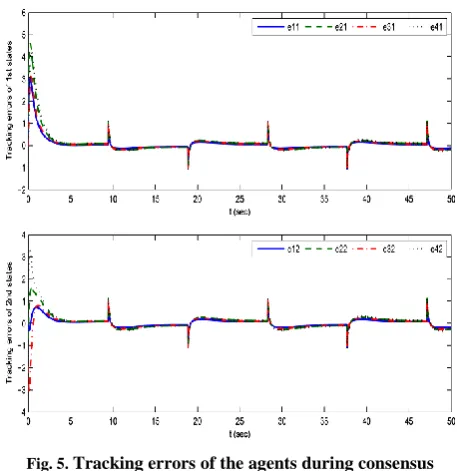
Fig. 5.Tracking errors of the agents during consensus tracking
Case (2): In this example a group of three nonlinear ASVs governed by the 3 degrees-of-freedom (3DOF) model is considered. Due to large number of DOFs of ASVs, these robots belong to highly nonlinear systems. The ith ASV dynamics are represented by following equations [37]
( )
i ii i
η R ν
(36)
( , )
i i i i i i di
M ν h η ν τ τ
(37)
where
cos( ) sin( ) 0
( ) sin( ) cos( ) 0
0 0 1
i i
i i i i
R and
(500,1000, 700),
18
Vol. 46 - No. 2 - Fall 2014( , )
1 25 1000 0
500 10 200 0
0 0 0.5 1500
i i i
i i
i i i
i
u r
r v
r
h η ν
ν
(38)
3
[ , ,
]
T i
x y
i i
i
η
is the position vector in the earth-fixed reference frame andν
i
[ , , ]
u v r
i i i T
3 is velocityvector in the body-fixed reference frame.
M
i
M
Ti
3and
R
i
R
i( )
i
3 denote the inertia matrix and therotation matrix from the body-fixed to the earth-fixed
reference frame, respectively.
τ
i
[
ui,
vi,
ri]
T
3 and 3[
,
,
]
T di
udi vdi rdi
τ
represent the control input and the disturbances of the environment, respectively. By replacing (36) and its derivative into (37) yields following equation which is in form of the Equation (1)( , ) ( , )
i i i i i i i i i
η f η η g η η τ w
(39)
where i
(.)
i i1 i( , )
i i i i1 i
f
R M h η ν
R R η
, gi(.) i i1
R M
, 1i i i di
w
R M τ
. Laplacian and the adjacency matrices of the considered undirected connected graph are defined by2 1 1
1 1 0 , (1, 0, 0)
1 0 1
L B diag
(40)
The initial conditions of agents areη1(0)[4,5,/ 6]T ,η2(0) [ 4,5, / 6] T,
2(0)[0,-4
η ,- / 6]
Tand νi 0
for i=1,2,3. The consensus desired trajectory is defined as
t
[ ,
,
]
[0.2 ,3cos(
), arctan(
)]
20
T d T
d d d d
d
y
x y
t
x
η
(41)
where t denotes time. The external disturbances include wind, wave and current are chosen as in which the wind is assumed to be constant and the wave and the current are assumed to be the sine wave with a fixed frequency at one time [36]. So, the external disturbances can be chosen as:
[18+ 18sin(t)+ 14.4sin(5t),
-7.2+ 18sin(t- )+ 14.4sin(15t), 6
-7.2sin(t+ )-36sin(t)]
3
di
T
τ
(42)
As mentioned in assumption 1, from the controller point of view, the disturbance of (42) is bounded and uncertain and the robust term of the proposed controller counteracts its effect. Similar to [30], the proposed control protocol (15) is compared to the linear control protocol
1
( )[
]
i i i i i
u
g
x
v
s
(43)
The following parameters are used in the simulation: Control gain, gains of updating laws kw=0.01, ks=0.04,
2
and filtering error coefficients
i 1, i. The centers of the applied RBF networks, ci, i=1,2,3, evenly spaced in
1,1
1,1
1,1
/ 6,
/ 6
with spreads0.34 i
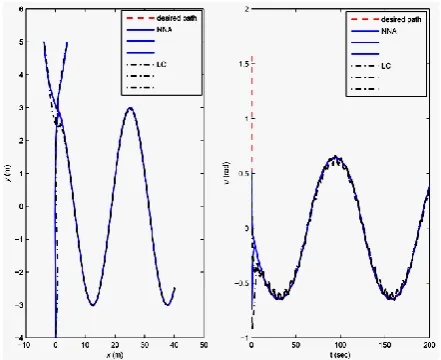
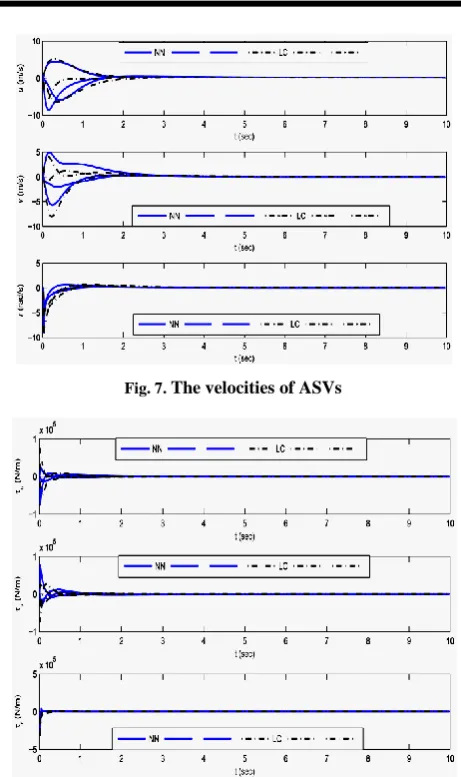
and number of neurons at each node pi=16were utilized. The initial values of RBF weights and robust term of the controller (19) were set to zero. Figure6 to Figure10 illustrate the results of simulation for the grouped ASVs. The results for the proposed method (15) and the linear controller (43) are shown by solid line “-” and dotted line“...”, respectively. In the figures, NNA and LC stand for NN adaptive controller and linear control. The movements of ASVs in the plane and their heading tracking curve are shown in Figure 6. Figure 7to Figure 9 show the velocities, the applied control forces and tracking errors during consensus process of ASVs, respectively. In order to see the transients and the speed of convergence clearly, in Figure 7 to Figure 9, the results were illustrated for 10 seconds. It is seen from Figure 6 that the ASVs realized the coordinated tracking task. But the significant fluctuations in the motion of the ASVs using the linear controller (43) compared to the new control protocol (15) implies robustness of the proposed method against environment disturbances. According to Figure 7, the velocities of these agents achieve consensus as a whole. In order to investigate the performance of the proposed controller compared to the linear counterpart, an absolute relative error metric (AEM) defined as
2
AEM e is employed. The absolute relative error criterion is shown in Figure10. As seen from Figure6 and Figure10, the proposed controller can provide faster convergence and higher consensus tracking performance than the linear counterpart.
The simulation results show that the proposed method is robust against estimation errors and environment disturbances.
Vol. 46 - No. 2 - Fall 2014
19
Fig. 7.The velocities of ASVsFig. 8.Control inputs of ASVs during consensus tracking
Fig. 9.Tracking errors of ASVs during consensus process
Fig. 10.absolute relative error 7.CONCLUSIONS
In this paper, consensus tracking problem for high order MIMO multi-agent systems with nonlinear dynamics have been studied. The proposed protocol was distributed NN robust adaptive method under undirected connected topologies. The proposed control method was constructed based on filtered error which obtained using relative state error. To estimate unknown nonlinearities of the controller, RBFNNs were employed and approximation error and effect of uncertain disturbances was compensated for by additional robust term in the controller. Update laws of unknown parameters of neural networks were determined from Lyapunov stability analysis. Lyapunov stability analysis was applied to guarantee overall system stability and convergence of unknown parameters. Simulation results presented to confirm the validity of the proposed controllers.
8.REFERENCES
[1] W. Ren, R. Beard and E. Atkins, “Information consensus in multivehicle cooperative control,” IEEE Control Systems Mag., vol. 27, pp. 71-82, March 2007.
[2] R. Olfati-Saber, J. Fax, and R. Murray, “Consensus and cooperation in networked multi-agent systems,” Proc. IEEE 95, pp 215-233, 2007.
[3] W. Ren and R. Beard, Distributed consensus in multi-vehicle cooperative control: Theory and applications, Springer-Verlag, London, 2008.
[4] W. Ren, R. Beard and E. Atkins, “A survey of consensus problems in multi-agent coordination,” Proc. American Control Conf., pp. 1859-1864, 2005.
20
Vol. 46 - No. 2 - Fall 2014IEEE Int. Conf. Networking, Sensing and Control, Ft. Lauderdale, FL, pp 457-462. 2006.
[6] Z. Li, Z. Duan, G. Chen and L. Huang, “Consensus of multiagent systems and synchronization of complex networks: A unified viewpoint,” IEEE Trans. Circuits and Systems, vol. 57, pp. 213-224, April 2010.
[7] Z. Li, Z. Duan and G. Chen, “Dynamic consensus of linear multi-agent systems,” IET Control Theory Appl., vol. 5, pp. 19-28, January 2011.
[8] D. Meng, Y. Jia and J. Du, “Robust iterative learning protocols for finite time consensus of multi-agent systems with interval uncertain topologies,” Int. J. Syst. Sci., vol. 46, pp. 857-871, May.
[9] W. Yu, G. Chen and M. Cao, “Consensus in directed networks of agents with nonlinear dynamics”, IEEE Trans. Automaic Control, vol. 56, pp. 1436-1441, June 2011.
[10] G. Wen, A. Rahmani and Y. Yu, “Consensus tracking for multi-agent systems with nonlinear dynamics under fixed communication topologies,” Proc. World Congress on Engineering and Computer Science, San Francisco, USA, 2011.
[11] Z. Li, X. Liu, M. Fu and L. Xi, “Global H∞
consensus of multi-agent systems with Lipschitz nonlinear dynamics”, IET Control Theory Appl., vol. 6, pp. 2041-2048, September 2012.
[12] W. Yu, G. Chen, M. Cao and J. Kurths, “Second-order consensus for multiagent systems with directed topologies and nonlinear dynamics,” IEEE Trans. Syst. Man Cybern. Part B, vol. 40, pp. 881-891, June 2010.
[13] G. Wen, Z. Peng, A. Rahmani, and Y. Yu, “Distributed leader-following consensus for second-order multi-agent systems with nonlinear inherent dynamics,” Int. J. Syst. Sci., vol. 45, pp. 1892-1901, January 2014.
[14] Z. G. Wu, P. Shi, H. Su and J. Chu, “Sampled-data synchronization of chaotic Lur’e systems with time delays,” IEEE Trans. Neural Netw., vol. 24, pp. 410-421, March 2013.
[15] Z.G. Wu, P. Shi, H. Su and J. Chu, “Sampled-data exponential synchronization of complex dynamical networks with time-varying coupling delay,” IEEE Trans. Neural Netw., vol. 24, pp. 1177- 1187, August2013.
[16] E. Nuño, R. Ortega, L. Basañez and D. Hill, “Synchronization of networks of nonidentical Euler-Lagrange systems with uncertain parameters and communication delays,” IEEE Trans. Autom. Control, vol. 56, pp. 935-941, April 2011.
[17] W. Ren, “Distributed leaderless consensus algorithms for networked Euler–Lagrange systems,”
Int. J. Control, vol. 82, pp. 2137-2149, November 2009.
[18] B. Karimi and M.B. Menhaj, “Non-affine nonlinear adaptive control of decentralized large-scale systems using neural networks,” Inf. Sci., vol. 180, pp. 3335-3347, September 2010.
[19] B. Karimi, M.B. Menhaj, M. Karimi-Ghartemani and I. Saboori, “Decentralized adaptive control of large-scale affine and nonaffine nonlinear systems” IEEE Trans. Instrum. Meas., vol. 58, pp. 2239-2247, August 2007.
[20] G.P. Liu, V. Kadirkamanathan and S.A. Billings, “Variable neural networks for adaptive control of nonlinear systems,” IEEE Trans. Syst. Man Cybern. Part C, vol. 29, pp. 34-43, February 1999.
[21] C.Y. Lee and J.J. Lee, “Adaptive control for uncertain nonlinear systems based on multiple neural networks,” IEEE Trans. Syst. Man Cybern. Part B, vol. 34, pp. 325-333, February 1999.
[22] I. Kar, and L. Behera, “Direct adaptive neural control for affine nonlinear systems,” Appl. Soft Comput., vol. 9, pp. 756–764, March 2009.
[23] L.X. Wang and J.M. Mendel, “Fuzzy basis function, universal approximation, and orthogonal least-squares learning,” IEEE Trans. Neural Netw., vol. 3, pp. 807-814, September 1992.
[24] Z. Hou, L. Cheng and M. Tan, “Decentralized robust adaptive control for the multiagent system consensus problem using neural networks,” IEEE Trans. Syst. Man Cybern. Part B, vol. 39, pp. 636-647, June 2009.
[25] L. Cheng, Z. Hou, M. Tan, Y. Lin and Zhang, W. “Neural-network-based adaptive leader-following control for multiagent systems with uncertainties,” IEEE Trans. Neural Netw., vol. 21, pp. 1351-1358, August 2010.
[26] A. Das and F.L. Lewis, “Distributed adaptive control for synchronization of unknown nonlinear networked systems,” Automatica, vol. 46, pp. 2014-2021, August 2010.
[27] H. Zhang and F.L. Lewis, “Adaptive cooperative tracking control of higher-order nonlinear systems with unknown dynamics,” Automatica, vol. 48, pp. 1432-1439, December 2012.
[28] R. Cui, B., Ren and S.S. Ge, “Synchronized tracking control of multi-agent system with high-order dynamics,” IET Control Theory Appl., vol. 6, pp. 603-614, July 2012.
Vol. 46 - No. 2 - Fall 2014
21
[30] A.M. Zou, K.D. Kumar and Z.G. Hou, “Distributed consensus control for multi-agent systems using terminal sliding mode and Chebyshev neural networks,” Int. J. Robust Nonlinear, vol. 23, pp. 334-357, February 2013.
[31] A. Das and F.L. Lewis, “Cooperative adaptive control for synchronization of second-order systems with unknown nonlinearities,” Int. J. Robust Nonlinear Control, vol. 21, pp. 1509-1524, September 2011.
[32] G.X. Wen, C.L.P. Chen, Y.J. Liu and Z. Liu, “Neural-network-based adaptive leader-following consensus control for second-order non-linear multi-agent systems,” IET Control Theory Appl., vol. 9, pp. 1927–1934, August.
[33] H. Xu, and P.A. Ioannou, “Robust adaptive control for a class of MIMO nonlinear systems with guaranteed error bounds,” IEEE Trans. Automat. Control, vol. 48, pp. 728-742, May 2003.
[34] W. Yu, G. Chen and J. Lu, “On pinning synchronization of complex dynamical networks,” Automatica, vol. 45, pp. 429-435, February 2009.
[35] H. Khalil, Nonlinear Systems, 3rd ed., Prentice-Hall, Englewood Cliffs, NJ 2002.
[36] M. Fu, J. Jiao and S. Yin, “Robust coordinated formation for multiple surface vessels based on backstepping sliding mode control,” J Abstr. App. Anal., vol. 2013,July 2013.