Open Access
Research
Open source model for generating RR intervals in atrial fibrillation
and beyond
Jie Lian*
1, Gari D Clifford
2, Dirk Müssig
1and Volker Lang
1Address: 1Micro Systems Engineering, Inc., 6024 SW Jean Rd., Lake Oswego, OR 97035, USA and 2Harvard-MIT Division of Health Sciences & Technology, 77 Massachusetts Avenue, Cambridge, MA 02139, USA
Email: Jie Lian* - [email protected]; Gari D Clifford - [email protected]; Dirk Müssig - [email protected]; Volker Lang - [email protected]
* Corresponding author
Abstract
Background: Realistic modeling of cardiac inter-beat (RR) intervals is highly desirable for basic research in cardiac electrophysiology, clinical management of heart diseases, and developing signal processing tools for ECG analysis.
Methods: We present an open source computer model that is capable to generate realistic time series of RR intervals in both physiologic and pathologic conditions. Detailed model structure and the software implementation are described.
Results: Examples are provided on how to use this model to generate RR intervals in atrial fibrillation with ventricular pacing, normal sinus rhythm with heart rate variability, and typical atrial flutter with atrioventricular block. The extensibility of the model is also discussed.
Conclusion: The present computer model provides a unified platform wherein various types of ventricular rhythm can be simulated. The availability of this open source model promises to support and stimulate future studies.
Background
The variation of cardiac beat (PP, RR or NN) inter-vals results from both rhythmic activity of the heart elec-trical source and the dynamic properties of the cardiac conduction pathway, both of which are under autonomic control. In normal sinus rhythm, the RR intervals are known to fluctuate at various time scales, a phenomenon known as heart rate variability, which has been exten-sively investigated to probe the autonomic nervous activ-ity [1]. On the other hand, the abnormal cardiac rhythm, for example during atrial fibrillation (AF), has been thought to mainly result from disturbance in autonomic modulations of the electrophysiological properties of the atria and the atrioventricular (AV) node [2]. Hence,
anal-ysis of RR intervals may offer valuable insights into the mechanisms of arrhythmia genesis, maintenance, and ter-mination.
From the therapeutic perspective, characterization of the RR intervals can guide the development of novel strategies for cardiac rhythm management. For instance, many antiarrhythmic drugs are known to affect ventricular rhythm by modifying various electrical properties of the heart, including the automaticity, the conduction velocity, and the refractory period [3]. In another example, spe-cially designed pacing protocols could be used for preven-tion, terminapreven-tion, or rate regularization of AF through implantation of artificial pacemakers [4].
Published: 2 March 2007
BioMedical Engineering OnLine 2007, 6:9 doi:10.1186/1475-925X-6-9
Received: 14 November 2006 Accepted: 2 March 2007
This article is available from: http://www.biomedical-engineering-online.com/content/6/1/9 © 2007 Lian et al; licensee BioMed Central Ltd.
Consequently, time series analysis of RR intervals has been a research thrust in the field of biomedical engineer-ing. Numerous techniques based on RR interval analysis have been developed in the past decades to assess the autonomic control of the cardiovascular system, to assist clinical diagnosis of cardiac disorders, to facilitate arrhyth-mia predication and risk stratification, and so on [5]. However, quantitative comparison of different analytic methods has been hindered by the heterogeneity of vari-ous data sources and the inherent noise and uncontrolla-bility of real world recordings. Therefore, realistic modeling of RR intervals is highly desired to provide a unified platform wherein various algorithms can be eval-uated.
Despite the apparent scientific merits and clinical signifi-cance, there is a stark paucity of computer models to gen-erate realistic time series of RR intervals. Although several RR interval generators had been created in response to the PhysioNet/Computers in Cardiology Challenge 2002 [6], all these models are limited to synthesizing sinus rhythm with simulated heart rate variability, yet not applicable to abnormal rhythms.
Recently, a novel computer model, known as AF-VP, was developed by the authors to elucidate the effects of
ven-tricular pacing (VP) on the venven-tricular rhythm in AF [7]. The kernel component of the model is the AV junction (AVJ), which is treated as a lumped structure with defined electrical properties mimicking those of individual AV nodal cells. As illustrated in Figure 1, the action potential of the AV nodal cells has five phases. The cell is depolar-ized (Phase 0) when its membrane potential crosses the depolarization threshold. Then the cell repolarizes (Phases 1–3) and returns to the resting potential (Phase 4). The refractory period, when no new action potential can be initiated, begins with Phase 0 and extends into Phase 3. The AV nodal cells can depolarize spontaneously due to gradual increase of the membrane potential in Phase 4. Such automaticity is usually suppressed by the higher firing rate of the sinus node in atrium, but may manifest in abnormal conditions, such as during sinus node dysfunction or the AV junctional tachycardia.
It has been demonstrated that this AF-VP model could account for most known experimental observations in AF [7]. Of particular note is the plasticity of the model, that is, this model can be easily extended beyond AF, to simu-late various types of RR intervals in both normal physio-logic and pathophysio-logic conditions. In order to facilitate the use and further improvement of the AF-VP model, its soft-ware (written in ANSI/ISO C [see Additional file 1]) has
Illustration of the action potential of the AV nodal cells Figure 1
been made freely available on PhysioNet [8], an on-line forum for the dissemination and exchange of recorded and simulated biomedical signals and archives of open source software [9].
In this paper, we describe the software architecture of the AF-VP model. Examples are given on how to use this model to synthesize RR intervals for different rhythms, and the extensibility of the model is discussed.
Methods
Model structure
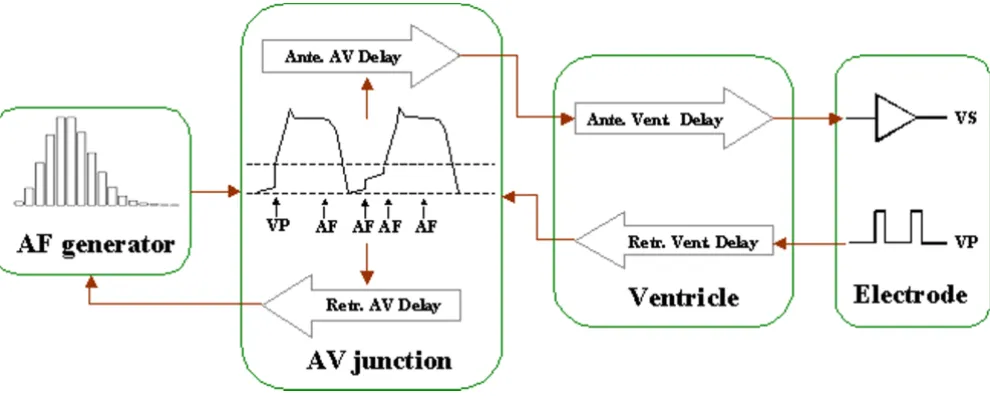
Figure 2 illustrates how the AF-VP model is composed of four inter-connected components: the AF generator, the AV junction (AVJ), the ventricle, and the electrode used to record the electrical activity [7].
The AF generator outputs random AF impulses bombard-ing the AVJ. However, retrograde conducted waves escap-ing the AVJ can collide with an imminent AF impulse or reset the timing cycle of the AF generator.
The AVJ fires when its membrane potential (Vm) reaches
the depolarization threshold (VT). The activation of AVJ starts a refractory period, when the AVJ is refractory to any stimulation. At the end of refractory period, Vm returns to the resting potential (VR) and starts to rise in a linear man-ner. Each time an AF impulse hits the AVJ during Phase 4, Vm is increased by a discrete amount ΔV [10,11]. However, if the AVJ is invaded by a VP-induced retrograde wave dur-ing Phase 4, Vm is brought to VT directly.
The firing of the AVJ generates an activation wave that starts an antegrade or retrograde AV delay (AVD),
depend-ing on the direction of activation. If the AVJ is retrograde activated while an antegrade wave has not finished its AVD or vice versa, a collision occurs, annihilating the acti-vation waves in both directions. Both refractory period and conduction delay of the AVJ are dependent upon its recovery time, which is defined as the interval between the end of last AVJ refractory period and the current AVJ acti-vation time. In addition, the electrotonic modulation of the AVJ refractory period by blocked impulses is also incorporated in the model [7].
After finishing the antegrade AVD, an activation wave is generated in the ventricle and starts the antegrade ven-tricular conduction. The delivery of VP also generates a retrograde activation wave in the ventricle toward the AVJ. When both antegrade and retrograde waves are present in the ventricle, a ventricular fusion beat manifests, causing the extinction of both waves.
The electrode for recording this activity is assumed to be implanted in the ventricle and connected to a pacing device operating in demand mode. If an activation wave propagates to the electrode after an antegrade ventricular conduction delay, a ventricular sense (VS) occurs that inhibits the scheduled VP, whereas the timeout of the pac-ing interval triggers the VP.
Software implementation
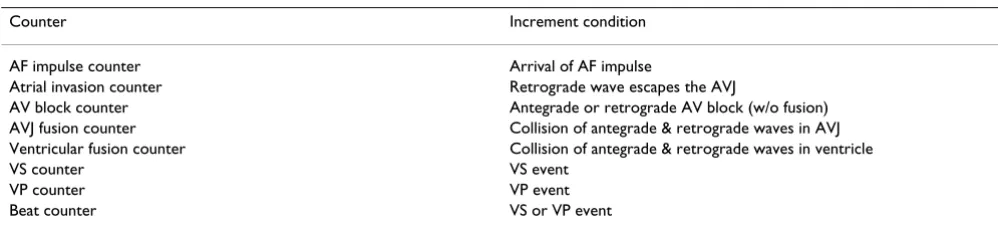
Figure 3 shows the top-level flowchart of the simulation model. The software loads the model parameters from an external configuration file (see Appendix A for an exam-ple), and then initializes variables that include various timers and counters as being summarized in Tables 1, 2, respectively. The simulation runs at the programmed
sam-Schematic drawing of the AF-VP model Figure 2
pling frequency (with a default of 1000 Hz). At each sam-pling time, the model adjusts the timers and updates Vm (in a linearly increasing manner) if the AVJ is in Phase 4, and then handles possible event(s) as detailed below. The simulation continues until the desired number of cardiac beats (RR intervals) is generated or the simulation time runs out, when the model logs statistics and exits.
The event handling routine is described in Figure 4. Sequentially, the model checks its timers to detect the fol-lowing events and calls for respective services if any:
- ventricular fusion (VtrFusion),
- AF bombardment of AVJ (AnteHitAvj),
- retrograde invasion of AVJ (RetrHitAvj),
- ventricular sense (VtrSense),
- ventricular pace (VtrPace),
- antegrade AVD timeout (AnteEscAvj), and
- retrograde AVD timeout (RetrEscAvj).
The model then checks the status of the AVJ. If the AVJ is in Phase 4 and Vm ≥ VT, then services are called for AVJ activation (ActivateAvj) and the initiation of the refractory period (StartAvjRef). On the other hand, if the AVJ is in
refractory period, then no action is taken until its timeout, when a service is called to start the Phase 4 (StartAvjPh4).
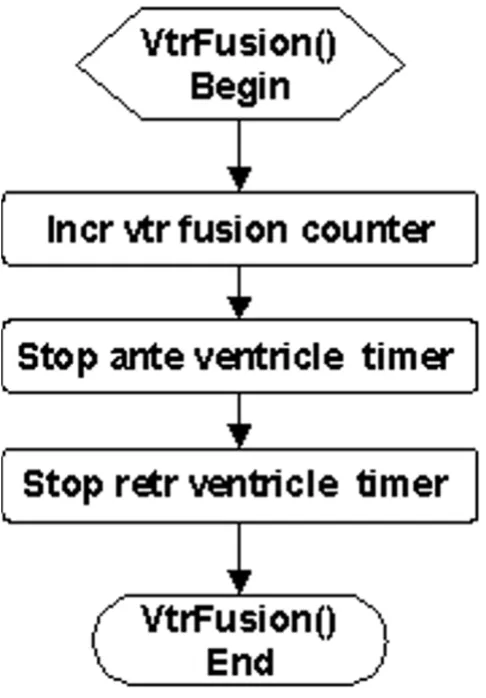
Ventricular fusion is detected when two opposite traveling waves in the ventricle meet, based on the ratios of active ventricle timers to the fixed ventricular conduction delays in both directions. The VtrFusion service (Figure 5) increases the ventricular fusion counter, and then stops both antegrade and retrograde ventricle timers.
The AVJ is bombarded by an AF impulse at the end of an AF interval. The AnteHitAvj service (Figure 6) increments the AF counter, resets the AF generator and obtains the next AF interval. If the AVJ is in Phase 4, then Vm has a step increase of ΔV. Antegrade AVJ activation is flagged if Vm ≥ VT. On the other hand, if the AF impulse hits the AVJ dur-ing refractory period, then the AVJ refractory period is extended, simulating the electrotonic modulation effect of the concealed conduction. If there is a retrograde wave in the AVJ and the AF impulse has supra-threshold strength, then the retrograde AVJ timer is disabled (pre-vent retrograde conduction to atrium) and the AVJ fusion counter is incremented. Otherwise, an antegrade AV block is registered.
The AVJ is invaded by a VP-induced retrograde wave when its timer completes the retrograde ventricular conduction delay. The RetrHitAvj service (Figure 7) first stops the ret-rograde ventricular timer. If the AVJ is in Phase 4 and Vm < VT, then Vm is brought to VT directly and the retrograde AVJ activation is flagged. If the AVJ is in Phase 4 but Vm ≥ Table 1: List of timers used in the AF-VP model
Timer Start condition Stop condition
AF interval timer Arrival of AF impulse End of AF interval RR interval timer Any VS or VP event Next VS or VP event AVJ refractory timer AVJ activation End of AVJ refractory period VP clock timer Any VS or VP event End of VP interval
Antegrade AVJ timer Antegrade AVJ activation End of antegrade AVD Retrograde AVJ timer Retrograde AVJ activation End of retrograde AVD Antegrade ventricle timer End of antegrade AVD VS event or ventricle fusion
Retrograde ventricle timer Delivery of VP Retrograde invasion of AVJ or ventricle fusion
Table 2: List of counters used in the AF-VP model
Counter Increment condition
AF impulse counter Arrival of AF impulse
Atrial invasion counter Retrograde wave escapes the AVJ
AV block counter Antegrade or retrograde AV block (w/o fusion) AVJ fusion counter Collision of antegrade & retrograde waves in AVJ Ventricular fusion counter Collision of antegrade & retrograde waves in ventricle
VS counter VS event
VP counter VP event
VT, then it implies a rare condition that the AVJ is simulta-neously activated from both directions. On the other hand, if the AVJ is in refractory period, then the AVJ
refrac-tory period is extended (electrotonic modulation effect). If there is an active antegrade wave in the AVJ, then the antegrade AVJ timer is disabled (prevent antegrade con-Top-level flowchart of the AF-VP model
Figure 3
duction to ventricle) and the AVJ fusion counter is incre-mented. Otherwise, a retrograde AV block is registered.
A ventricular sense is registered when an antegrade ventri-cle timer completes the antegrade ventricular conduction delay. The VtrSense service (Figure 8) takes a series of steps to flag the VS event, increment the beat counter and the VS counter, record the RR interval, obtain the next VP inter-val, reset the VP clock (i.e., inhibit VP), and stop the ante-grade ventricle timer.
A ventricular pace is registered when the VP clock exceeds the VP interval. In parallel to the VS event, the VtrPace
service (Figure 9) flags the VP event, increments the beat counter and the VP counter, records the RR interval, obtains the next VP interval, resets the VP clock, and starts a retrograde ventricle timer for retrograde conduction if the ventricle is non-refractory (sufficient delay since last excitation).
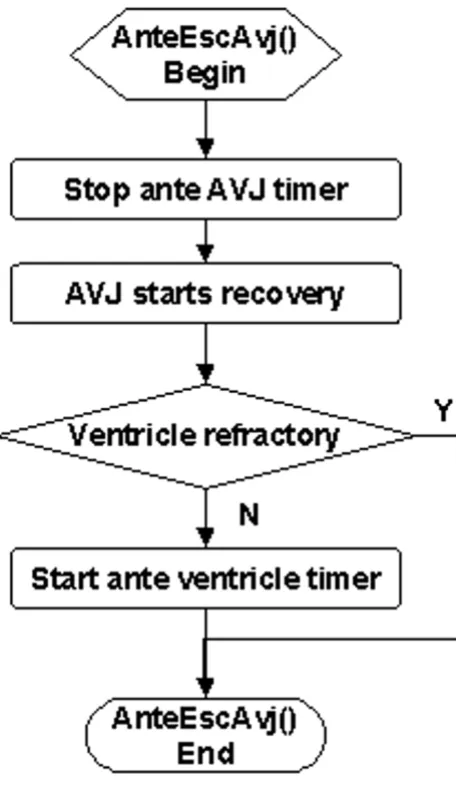
An antegrade wave escapes the AVJ after finishing the antegrade AVD. The AnteEscAvj service (Figure 10) stops the antegrade AVJ timer, enables the AVJ for recovery, and starts an antegrade ventricle timer for antegrade conduc-tion if the ventricle is non-refractory (sufficient delay since last excitation).
Likewise, a retrograde wave escapes the AVJ after complet-ing the retrograde AVD. The RetrEscAvj service (Figure 11) increments the atrial invasion counter, stops the retro-grade AVJ timer, and enables AVJ recovery. If there is an impending AF impulse, then an atrial collision is expected and there is no impact on next AF arrival time. Otherwise, the AF generator is reset and the next AF interval is updated.
The AVJ is activated when Vm ≥ VT. The ActivateAvj service (Figure 12) calculates the AVD based on the measured AVJ recovery time. If the AVJ is antegrade excited, then an ante-Flowchart of the AF-VP model event handling routine
Figure 4
grade AVJ timer is started if there is no retrograde wave in the AVJ (expected normal condition); otherwise, the retro-grade AVJ timer is stopped and the AVJ fusion counter is incremented (not applicable if the AVJ refractory period ≥ retrograde AVD). If the AVJ is retrograde activated, then a retrograde AVJ timer starts if there is no antegrade wave in the AVJ (expected normal condition), otherwise, the ante-grade AVJ timer is disabled and the AVJ fusion counter is incremented (not applicable if the AVJ refractory period ≥ antegrade AVD). If the AVJ is simultaneously activated from both directions, an AVJ fusion is registered and no activation wave is generated.
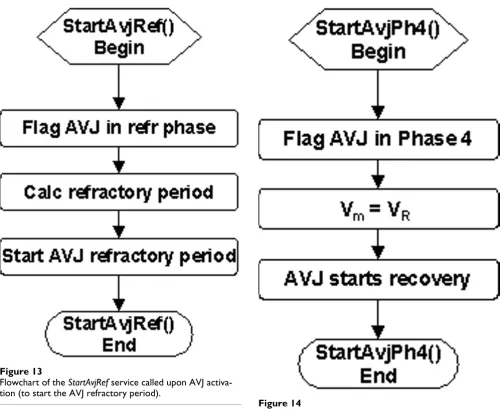
The activation of AVJ also starts the AVJ refractory period. The StartAvjRef service (Figure 13) simply flags the AVJ refractory phase, calculates the refractory period based on the measured AVJ recovery time, and then starts the AVJ refractory timer.
The AVJ enters Phase 4 when the AVJ refractory timer reaches the end of the AVJ refractory period. The
StartAvjPh4 service (Figure 14) then flags the AVJ in Phase 4, resets (Vm = VR), and enables the AVJ to recover.
Of particular note is the fact that the above model frame-work allows different processes to generate the AF inter-vals, different protocols to generate the VP interinter-vals, and different formulas to calculate the conduction time and refractory period (including the electrotonic modulation effect of the concealed conduction) of the AVJ.
Results
In a typical application, Figure 15 shows the model-gener-ated RR intervals in the presence of AF and VP. Five differ-ent sequences of 500 RR intervals were generated by varying the ventricular pacing cycle length (PCL). The arrival of AF impulses was modeled by a truncated Pois-son process with a mean rate of 5/s [7]. Each AF impulse increments the Vm by 15 mV, and the AVJ spontaneous
Phase 4 depolarization rate is 30 mV/s. The ventricular response of intrinsic AF (PCL = 10 s) is characterized by short and irregular RR intervals. Progressively shortening the PCL (850 ms, 750 ms, 680 ms, 600 ms) results in increased percentage of VP (respectively 30%, 60%, 80%, 95%) and increased stabilization of the ventricular rate. In agreement with previous findings [12], VP not only elim-inates long ventricular pauses, but also suppresses short intrinsic RR intervals in AF.
Figure 16 illustrates a train of simulated 500 beat intervals (PP vs. RR intervals) in normal sinus rhythm. In this example, the random AF generator was replaced with a sinus rhythm generator according to a process described in [13]. Each of the atrial impulse (P wave) has supra-threshold strength, i.e., can bring Vm directly to VT. The mean ± standard deviation (SD) of the atrial rate was set to 60 ± 1 bpm. The time series of PP intervals also has pre-defined heart rate variability that is characterized by a low frequency (LF) band centered at 0.1 Hz and a high fre-quency (HF) band centered at 0.25 Hz, and with LF/HF ratio of 0.5. Although the RR intervals generally match the corresponding PP intervals, slight difference between the two time series is apparent, which can be attributed to the rate-dependent variation of the AV conduction time.
In another example, Figure 17 shows five runs of model-generated 500 beat RR intervals in the presence of typical atrial flutter and Mobitz type II AV block. In this case, the arrival of atrial impulses was simulated as a Gaussian process, and each atrial impulse has supra-threshold strength. From the first to the fifth sequence, the mean PP interval was decreased from 500 ms to 100 ms (with a step-size of 100 ms), all with a standard deviation (SD) of 10 ms. The AVJ refractory period, which is dependent on Flowchart of the VtrFusion service called upon ventricular
fusion Figure 5
recovery time, was limited to a range between 250 ms and 500 ms. At a slower atrial rates (PP intervals of 400 ms and 500 ms), each atrial impulse is followed by a ventricular sense (known as 1:1 AV conduction). At higher atrial rates (PP intervals of 200 ms and 300 ms), every other atrial impulse is conducted to the ventricle (known as 2:1 AV conduction). For even higher atrial rates (a PP interval of 100 ms), 3:1 AV conduction occurs.
Details on how to generate above examples using the present AF-VP model are given in Appendix B.
Discussion
The present AF-VP model described above can be easily extended to generate various types of ventricular rhythms by modifying the parameters specified in the model con-figuration file (see Appendices A, B).
From the system modeling perspective, the AVJ can be considered as a relay unit that connects its output (ante-grade and retro(ante-grade activation waves) to the ventricle and atrium, which are respectively driven by two electrical sources, ventricular pacing and atrial impulse. Therefore, although the present model was described in the frame-work of atrial fibrillation and ventricular pacing, its usage is not limited to AF and VP only. Further applications of the model may include, but are not limited to:
- The AF generator can be modified to generate other ran-dom or deterministic processes, to simulate other types of atrial rhythms, including sinus rhythm with heart rate var-iability and atrial ectopic beats, paroxysmal or persistent atrial tachycardia, and programmed atrial pacing proto-cols [14].
- The AVJ properties (conduction timer and refractory period) can be modified to simulate various degrees of AV Flowchart of the AnteHitAvj service called upon antegrade AF bombardment of the AVJ
Figure 6
block including the second-degree Mobitz type I AV block (Wenckebach phenomena) [14] and the Mobitz type II block (Figure 17), or the uni-directional AV block. Alter-natively, AV junctional tachycardia can be simulated by increasing the spontaneous Phase 4 activity of the AVJ [11].
- Various VP schemes can be tested by programming dynamic (instead of fixed) PCL. For example, different VP protocols can be implemented by continuously adjusting the PCL based on measured RR intervals, for the purpose of ventricular rate stabilization (VRS) in AF [15,16]. Two such algorithms, adaptive-VRS [16] and dynamic over-drive pacing [17], were included in the software as built-in functions for users' reference. In another example, the ventricular conduction time can be adjusted to simulate ventricle apical pacing or His bundle pacing, and quanti-tatively compare their VRS effects [18]. Moreover, the VP can be replaced by spontaneous ventricular activation to
simulate the ventricular ectopic beats or episodes of ven-tricular tachycardia.
- The simulation output of the present model actually includes three closely coupled time series: PP intervals, RR intervals, and PR intervals (AV delays). By simulating var-ious cardiac rhythms with different model parameter set-tings, these generated time series can be used to build a standard test platform for quantitative evaluation or com-parison of different signal processing techniques, for example, the assessment of heart rate variability, the quantification of rhythm complexity, the classification of ECG rhythm types, and so on.
Conclusion
We present the structure and implementation of a novel computer model, which is capable for synthesizing realis-tic time series of RR intervals under physiologic and path-ologic conditions. The availability of this open source model promises to aid and stimulate future research in Flowchart of the RetrHitAvj service called upon VP-induced retrograde wave invasion of the AVJ
Figure 7
Flowchart of the VtrPace service called upon ventricular pace Figure 9
Flowchart of the VtrPace service called upon ventricular pace. Flowchart of the VtrSense service called upon ventricular
sense Figure 8
basic and applied cardiac electrophysiology involving RR interval analysis. Code to run this model, written in C, is available from PhysioNet [8].
Competing interests
The author(s) declare that they have no competing inter-ests.
Authors' contributions
JL conceived, designed and implemented the computer model, and drafted the manuscript. DM and VL super-vised the project, contributed to the discussion and inter-pretation of the results, and participated in manuscript revisions. GDC helped format the code and write the
manuscript for open source release. All authors read and approved the final manuscript.
Appendix A
The software reads the AF-VP model parameters from an external configuration file (default filename: config.txt), Flowchart of the AnteEscAvj service called upon antegrade
wave completing AV delay and escaping the AVJ Figure 10
Flowchart of the AnteEscAvj service called upon antegrade wave completing AV delay and escaping the AVJ.
Flowchart of the RetrEscAvj service called upon retrograde wave completing AV delay and escaping the AVJ
Figure 11
which can be modified by any text editor. Each model parameter is defined in a text line in the format of:
parameter name = parameter value
Any empty line is ignored. Besides, a line starting with '%', and the text following double slash '//' are considered as comments.
The model parameters are grouped into five parts, corre-sponding to the simulation environment and the four model components: the AF generator, the AVJ, the ventri-cle, and the right ventricular (RV) electrode (see [7] for detailed descriptions of the model parameters).
A sample configuration file, with suggested default model parameters and some comments, is listed below.
% [Simulation environment]
fnRR = outrr1.txt // output RR interval filename
fnAA = outaa1.txt // output AA interval filename
fnAV = outav1.txt // output AVJ status filename
fnLOG = outlog1.txt // output event log filename
MAX_RR = 500 // max RR cycles to run for one simulation
MAX_TIME(s) = 1000.0 // max time to run for one simu-lation
Ts(s) = 0.001 // sampling interval (1000 Hz)
RR0(s) = 1.000 // initial RR interval
% [Atrium model]
AA_MODEL = 0 // AA interval generator method
lambda(1/s) = 5 // mean rate of AF bombardment on AV junction
Flowchart of the ActivateAvj service called upon AVJ activation Figure 12
AAstd(s) = 0.0 // standard deviation of AA interval
dVmean(mV) = 15 // mean potential increment (dV) by AF bombardment
dVstd(mV) = 0 // standard deviation of dV
AtrDly(ms) = 0.03 // atrial conduction delay from AF source to AVJ
S1S2(s) = 0.2 // S1S2 interval of atrial pacing protocol (used in [12])
S2S3(s) = 0.5 // S2S3 interval of atrial pacing protocol (used in [12])
% AA model: 0-exponential, 1-inv poisson (n/a), 2-uniform, 3-Gaussion, % 4-S1S2 pacing, 5-S1S2/S2S3 pacing, 6-fixed
% [AVJ model]
Vt(mV) = -40 // AVJ depolarization threshold potential
Vr(mV) = -90 // AVJ resting potential
dVdt(mV/s) = 33 // phase 4 depolarization rate
MinAVDa(s) = 0.070 // minimum anterograde AV con-duction delay
MinAVDr(s) = 0.070 // minimum retrograde AV conduc-tion delay
alpha(s) = 0.130 // max extension of the AV conduction time
Flowchart of the StartAvjRef service called upon AVJ activa-tion (to start the AVJ refractory period)
Figure 13
Flowchart of the StartAvjRef service called upon AVJ activa-tion (to start the AVJ refractory period).
Flowchart of the StartAvjPh4 service called upon completion of the AVJ refractory period (to start the AVJ Phase 4) Figure 14
tau_c(s) = 0.100 // time constant for AV conduction curve
MinRef(s) = 0.050 // minimum AVJ refractory period
beta(s) = 0.250 // max extension of the AVJ refractory period
tau_r(s) = 0.500 // time constant for AVJ recovery curve
Ref_std(s) = 0.000 // standard deviation of AVJ refractory period
delta = 10 // electrotonic modulation control (strength)
theta = 10 // electrotonic modulation control (time)
% [Ventricle model]
AntDly(s) = 0.050 // antegrade conduction delay from AVJ to RV electrode
RetDly(s) = 0.150 // retrograde conduction delay from RV electrode to AVJ
ref(s) = 0.100 // ventricular refractory period
% [RV electrode model]
VP_MODEL = 0 // ventricular pacing method
BI(s) = 0.80 // standby ventricular pacing basic interval
% VP_MODEL: 0-VVI, 1-adaptive VRS, 2-wittkampf, >2(default): VVI
Example of simulated RR intervals in the presence of AF and VP Figure 15
Example of simulated PP and RR intervals in sinus rhythm with heart rate variability Figure 16
Example of simulated PP and RR intervals in sinus rhythm with heart rate variability.
Example of simulated RR intervals in the presence of atrial flutter and AV block Figure 17
Appendix B
Various patterns of RR intervals can be generated using the present AF-VP model by modifying the configuration file described in Appendix A.
For example, Figure 15 (AF rhythm and VP) is produced by simply replacing the default values of the following two parameters as:
dVdt(mV/s) = 30
BI(s) = 10 // also 0.85, 0.75, 0.68, 0.60
Similarly, Figure 17 (atrial flutter rhythm) is generated by changing the default values of the following parameters to:
AA_MODEL = 3
lambda(1/s) = 2 // also 2.5, 3.333, 5, 10
AAstd(s) = 0.01
dVmean(mV) = 50
dVdt(mV/s) = 50
MinRef(s) = 0.250
BI(s) = 10
As laid out in Figs 3, 4, 5, 6, 7, 8, 9, 10, 11, 12, 13, 14, the software architecture of the model is constructed in a modular manner, to facilitate code change for achieving a particular aim. For example, in Figure 16 (sinus rhythm with normal heart rate variability), the PP intervals were generated using another open source model described in [13], instead of using any built-in AF interval generators (AA_MODEL). To achieve this, only two minor modifica-tions are needed: (1) the PP intervals are imported from an external file (generated by the other model) during the 'Model Initialization' step (Figure 3); (2) the imported PP intervals are indexed to 'obtain the next AF interval' (Fig-ures 6, 11), regardless of the parameter AA_MODEL set-ting.
Additional material
Acknowledgements
The authors are grateful to Dr. S. E. Greenhut for helpful discussions on the AF model, and to George. B. Moody for independent testing of the compu-ter model.
References
1. Malik M, Camm AJ: Heart Rate Variability. Armonk, NY: Futura; 1995.
2. Toivonen L, Kadish A, Kou W, Morady F: Determinants of the ventricular rate during atrial fibrillation. J Am Coll Cardiol 1990,
16:1194-1200.
3. Fogoros : Antiarrhythmic drugs: A practical guide. Malden: Blackwell Science; 1997.
4. Lau CP: Pacing for atrial fibrillation. Heart 2003, 89:106-112. 5. Clifford GD, Azuaje F, McSharry PE, (Eds): Advanced methods and
tools for ECG analysis. Boston: Artech House Publishing; 2006. 6. Moody GB: RR interval time series modeling: the PhysioNet/
Computers in Cardiology Challenge 2002. Comp Cardiol 2002,
29:125-128.
7. Lian J, Müssig D, Lang V: Computer modeling of ventricular rhythm during atrial fibrillation and ventricular pacing. IEEE Trans Biomed Eng 2006, 53:1512-1520.
8. AFVP – A Realistic Ventricular Rhythm Model During AF And VP [http://physionet.org/physiotools/afvp/]
9. Goldberger AL, Amaral LAN, Glass L, Hausdorff JM, Ivanov PCh, Mark RG, Mietus JE, Moody GB, Peng CK, Stanley HE: PhysioBank, PhysioToolkit, and PhysioNet: components of a new research resource for complex physiologic signals. Circulation 2000, 101:e215-e220.
10. Zipes DP, Mendez C, Moe GK: Evidence for summation and voltage dependency in rabbit atrioventricular nodal fibers.
Circ Res 1973, 32:170-177.
11. Cohen RJ, Berger RD, Dushane TE: A quantitative model for the ventricular response during atrial fibrillation. IEEE Trans Biomed Eng 1983, 30:769-781.
12. Wittkampf FH, de Jongste MJ, Lie HI, Meijler FL: Effect of right ven-tricular pacing on venven-tricular rhythm during atrial fibrilla-tion. J Am Coll Cardiol 1988, 11:539-545.
13. McSharry PE, Clifford GD, Tarassenko L, Smith L: A dynamical model for generating synthetic electrocardiogram signals.
IEEE Trans Biomed Eng 2003, 50:289-294.
14. Lian J, Müssig D, Lang V: Validation of a novel atrial fibrillation model through simulated atrial pacing protocols. Proceedings of the 28th Annual International Conference of the IEEE Engineering in Medicine and Biology Society: 30 August – 3 September 2006; New York City 2006:4024-4027.
15. Lian J, Müssig D, Lang V: Quantitative comparison of ventricular rate smoothing algorithms for atrial fibrillation [abstract].
Heart Rhythm 2006, 3(Suppl 1):S150-S151.
16. Lian J, Müssig D, Lang V: Adaptive ventricular rate smoothing during atrial fibrillation: a pilot comparison study. Proceedings of the 27th Annual International Conference of the IEEE Engineering in Medicine and Biology Society: 1–4 September 2005; Shanghai 2005:3881-3884.
17. Wittkampf FH, De Jongste MJ: Rate stabilization by right ven-tricular pacing in patients with atrial fibrillation. Pacing Clin Electrophysiol 1985, 9(Pt 2):1147-1153.
18. Lian J, Müssig D, Lang V: On the role of ventricular conduction time in rate stabilization for atrial fibrillation. Europace in press.
Additional File 1
Open-source of the AF-VP model. This file contains the complete archive of the AF-VP model source code.
Click here for file