R E S E A R C H
Open Access
New approximation methods for solving
elliptic boundary value problems via
Picard-Mann iterative processes with mixed
errors
Teng-fei Li
1,2and Heng-you Lan
1**Correspondence:
1College of Mathematics and
Statistics, Sichuan University of Science & Engineering, Zigong, Sichuan 643000, P.R. China Full list of author information is available at the end of the article
Abstract
In this paper, we introduce and study a class of new Picard-Mann iterative methods with mixed errors for common fixed points of two different nonexpansive and contraction operators. We also give convergence and stability analysis of the new Picard-Mann iterative approximation and propose numerical examples to show that the new Picard-Mann iteration converges more effectively than the Picard iterative process, Mann iterative process, Picard-Mann iterative process due to Khan and other related iterative processes. Furthermore, as an application, we explore iterative approximation of solutions for an elliptic boundary value problem in Hilbert spaces by using the new Picard-Mann iterative methods with mixed errors for contraction operators.
MSC: 47H10; 54H25; 47H09
Keywords: new Picard-Mann approximation; common fixed point; nonexpansion and contraction; elliptic boundary value problem; convergence and stability
1 Introduction
In order to find a weak solution of the following elliptic boundary value problem (so-called Dirichlet problem):
⎧ ⎨ ⎩
–u=f(x,u), x∈,
u(x) = 0, x∈∂, (1.1)
where⊂Rnis a bounded domain,f :×R→Ris a Carathéodory function, Ayadi et al. [1] proved a new global minimization theorem in Hilbert spaces by using the notion of a nonexpansive potential operator. As we all know, multidimensional dynamical sys-tems are frequently formulated by partial differential equations, which generally depend on space and time, i.e., parabolic or evolutionary type equations, and are treated with em-phasis on various real-world applications in (thermo)mechanics of solids and fluids, elec-trical devices, engineering, chemistry, biology, etc. (see [2, 3]). But under some suitable conditions, the time-dependent form of partial differential equations can be rewritten as a
time-independent form (see [4, Example 4, p. 161]), and some special cases of the Dirichlet problem (1.1) represent elliptic variational forms of second order physician, physicist and anatomist equation (see [2, 5]). Thus, the nonlinear elliptic problem (1.1) has been stud-ied via fixed point index theory, critical point theory, Morse theory, variational inequality theory and so on. See, for example, [4, 5] and the references therein. The boundary value problem is widely used in physics. In 1997, Marin [6] established necessary and sufficient conditions for the existence and uniqueness of the weak solution to the mixed bound-ary value problem in the domain of dipolar bodies with voids. Later, Marin and Vlase [7] showed that the existence of internal state variables has no effect on the uniqueness of the solution associated with the mixed initial boundary value problem in thermoelasticity of microstretch bodies (see [7, Theorems 1-3, p. 248]), the proof of the uniqueness of the solution and some useful estimations are also contained.
In particular, many problems in physics and other applications cannot be formulated as equations but have some more complicated structure, and usually the so-called comple-mentarity problem, which is equivalent to a variational inequality. Further, the applicabil-ity of variational inequalapplicabil-ity theory, which was initially developed to cope with equilibrium problems (e.g., the Signorini problem, which was first posed by Antonio Signorini in 1959), has been extended to involve problems in economics, finance, electrodynamics, mechan-ics, engineering science, optimization and game theory. Hence, the variational method is very important in optimal control theory, and such generalization is often needed in optimal-control theory of elliptic problems. In fact, optimal control problems in control theory are searching for a kind of control mode which can transform the initial state of the control object to the terminal state and make sure that the objective function can reach the maximum or minimum. For more details on variational inequalities in the context of their optimal control, one can refer to [2–5] and the references therein, and the following examples.
Example 1.1([8]) Consider the following optimal boundary control problem of elliptic equation constraints:
minJ(u), (1.2)
where state variabley(u)∈V=H1(), state space, and control variableu∈U=L2(∂), control space, satisfy
⎧ ⎪ ⎪ ⎪ ⎨ ⎪ ⎪ ⎪ ⎩
–y=f, x∈, ∂y
∂−→n =u+g, x∈N,
y=yd, x∈D,
(1.3)
where ⊂R2 is a bounded convex region with smooth boundary∂,N andD are
respectively Neumann boundary and Dirichlet boundary,∂=N∪D,N∩D=∅,−→n
is the unit normal vector of∂,f,gandydare given functions.
Define the objective function in (1.2) by
J(u) =1 2
γy(x) –y0(x)2dx+
N
wherey0(x) is a given target state variable,γ,α> 0 are two constants, which play a role of balance to the state variableyand the control variableu. By optimal control theory [9] and the definition of directional derivative for functional, now we know that solving the optimal problem (1.2) on a convex setUis equivalent to finding the control variableu∈U such that the following variational inequality holds:
J(u),v–u=
N
(αu+p)(v–u)ds≥0, ∀v∈U, (1.5)
wherepis the dual state variable ofyand satisfies the following state equation:
⎧ ⎪ ⎪ ⎪ ⎨ ⎪ ⎪ ⎪ ⎩
–p=γ(y–y0), x∈, ∂p
∂−→n = 0, x∈N,
p= 0, x∈D,
(1.6)
which is the dual problem of (1.3). Inequality (1.5) is called optimality condition for the optimal control problems (1.2) and (1.3), which is equivalent to the equation system com-posed of (1.3), (1.5) and (1.6).
Based on the above analysis of dualization and optimality condition for the optimal con-trol problems (1.2) and (1.3), Liu and Sun [8] introduced and studied an iterative non-overlapping domain decomposition method for (1.3)-(1.6) and proved convergence of the sequence generated by the iterative method. Furthermore, by using an iterative algorithm due to the penalized gradient projection method, adaptive finite element method, edge stabilization Galerkin method, variational iteration method, etc., such kind of problems as (1.2) or (1.3) were considered by many authors and researchers. See, for example, [9–16] and the references therein. Especially noteworthy, Zhou and Li [17] pointed out ‘though much achievement has been achieved, application of the variational iteration method to Cauchy problems has not yet been dealt with’.
On the other hand, in order to compare to Picard, Mann and Ishikawa iterations for ap-proximating fixed points and to solve equation systems, Khan [18] introduced and studied a Picard-Mann hybrid iterative process and showed that the Picard-Mann hybrid itera-tive process converges faster than all of Picard, Mann and Ishikawa iteraitera-tive processes for contractions. Following on the works of Khan [18], by using an up-to-date method for ap-proximating common fixed points of countable families of nonlinear operators, Deng [19] introduced a modified Picard-Mann hybrid iterative algorithm for a sequence of nonex-pansive mappings and established strong convergence and weak convergence of the itera-tive sequence generated by the modified hybrid iteraitera-tive algorithm in a convex Banach space. Okeke and Abbas [20] introduced and studied Picard-Krasnoselskii hybrid iter-ations, which converge faster than Picard, and gave an application to delay differential equations Mann, Krasnoselskii and Ishikawa iterative processes for contractive nonlin-ear operators. However, one can know that the Picard-Krasnoselskii hybrid iteration is a special case of the Picard-Mann hybrid iterative process due to Khan [18], it is because αn∈(0, 1) of (1.4) in [18] includesλ∈(0, 1) in (1.7) of [20] (see [20, Example 2.2, p. 25]).
establish the error estimates between the approximate solutions and the exact solutions for partial differential equations is not reported in the literature.
Moreover, Roussel [22] pointed out that equilibria are not always stable. Since stable and unstable equilibria play quite different roles in the dynamics of a system, it is use-ful to be able to classify equilibrium points based on their stability. Thus, there are many scholars and researchers who have discussed stability of the iterative sequence generated by the algorithm for solving the investigated problems. See, for example, [23–27] and the references therein. Especially, stimulated by the work of Bosede and Rhoades [28], Akewe and Okeke [27] obtained stability results for the Picard-Mann hybrid iterative scheme due to Khan [18] for a general class of contractive-like operators introduced by Bosede and Rhoades [28]. However, how does one obtain stability analysis when the Picard-Mann hy-brid iterative scheme due to Khan [18] is generalized for two different nonexpansive and contraction operators and one involves errors or mixed errors? This is a significant and challenging research work.
Motivated and inspired by the above works, we aim in this paper to introduce and study a class of new Picard-Mann iterative methods with mixed errors for common fixed points of two different nonexpansive and contraction operators. Then convergence and stability analysis of the new Picard-Mann iterative approximation are given. Finally, two numerical examples to verify effectiveness of the new Picard-Mann iteration are presented, and a new iterative approximation of solutions for an elliptic boundary value problem in Hilbert spaces is investigated by using the new Picard-Mann iterative methods with mixed errors for nonexpansive operators, which are different from the method proposed in [1].
2 New Picard-Mann approximation methods
In this section, we shall introduce and study a class of new Picard-Mann iterative methods with mixed errors for common fixed points of two different nonexpansive and contraction operators and prove convergence and stability of the new Picard-Mann iterative approxi-mation.
We need the following definitions and lemmas for our main results.
Definition 2.1 LetXbe a normed space andK⊂Xbe a nonempty subset. Then an op-eratorT:K→Kis said to be
(i) nonexpansive if
Tu–Tv ≤ u–v, ∀u,v∈K; (2.1)
(ii) contraction if there exists a constantk∈[0, 1)such that
Tu–Tv ≤ku–v, ∀u,v∈K. (2.2)
Remark 2.1 The constantkin Definition 2.1(ii) is called the Lipschitz constant ofT. Con-tractive operators are sometimes called Lipschitzian operators. If the above condition is instead satisfied fork≤1, then the operatorTis said to be nonexpansive.
Definition 2.2 LetSbe a selfmap of the normed spaceX,x0∈X, and letxn+1=h(S,xn)
{x∈X:Sx=x} =∅and{xn}converges to a fixed pointx∗ofS. Let{wn} ⊂Xand letεn=
wn+1–h(S,wn). Iflimn= 0 implies thatwn→x∗, then the iteration procedure defined
byxn+1=h(S,xn) is said to beS-stable or stable with respect toS.
Lemma 2.1([29]) Let X be a normed space and C be a nonempty closed convex bounded subset of X.Then each nonexpansive operator T:C→C has a fixed point in C.
Lemma 2.2([30]) Let{an},{bn},{cn}be three nonnegative real sequences satisfying
an+1≤(1 –tn)an+tnbn+cn, (2.3)
where tn∈[0, 1],
∞
n=0tn=∞,limn→∞bn= 0,
∞
n=0cn<∞.Then an→0 (n→ ∞).
Now, we establish a class of new Picard-Mann iterations with mixed errors for common fixed points of two different nonlinear operators (in short, (PMMD)) as follows.
Algorithm 2.1 Step 1. Choosex0in a normed spaceX. Step 2. Let
⎧ ⎨ ⎩
xn+1=T1yn+hn,
yn= (1 –αn)xn+αnT2xn+αndn+en,
(2.4)
whereT1,T2:X→Xare two nonlinear operators, andhn,dn,en∈Xare errors to take into
account a possible inexact computation of the operator points.
Step 3. Choose sequences{αn},{hn},{dn}and{en}such that forn≥0,{αn} ⊂[0, 1] and
{hn},{dn},{en}are three sequences inXsatisfying the following conditionsP:
(i) dn=dn+dn;
(ii) limn→∞dn= 0; (iii) ∞n=0hn<∞,
∞
n=0dn<∞,
∞
n=0en<∞.
Step 4. Ifxn+1,yn,αn,hn,dnandensatisfy (2.4) to sufficient accuracy, go to Step 5;
oth-erwise, setn:=n+ 1 and return to Step 2.
Step 5. Let{wn}be any sequence inXand define{εn}by
⎧ ⎨ ⎩
εn=wn+1– (T1ξn+hn),
ξn= (1 –αn)wn+αnT2wn+αndn+en.
(2.5)
Step 6. Ifεn,wn+1,ξn,αn,hn,dnandensatisfy (2.5) to sufficient accuracy, stop; otherwise,
setn:=n+ 1 and return to Step 3.
Remark 2.2 For special choices of the operatorsT1andT2, the spaceX, and the errorshn,
dnandenin (2.4), one can obtain a large number of Picard iterative process, Mann iterative
process, Picard-Mann iterative process due to Khan [18] and other related iterations. Now we list some special cases of iteration (2.4) as follows.
Special Case IIfhn=dn=en= 0, the iterative process (2.4) becomes the following
x0∈X,
⎧ ⎨ ⎩
xn+1=T1yn,
yn= (1 –αn)xn+αnT2xn.
(2.6)
Special Case IIWhenT1=T2=T, for any givenx0∈X, iteration (2.4) reduces to the sequence{xn}defined by
⎧ ⎨ ⎩
xn+1=Tyn+hn,
yn= (1 –αn)xn+αnTxn+αndn+en.
(2.7)
We note that the iterative processes (PMD) and the Picard-Mann iteration with mixed errors (2.7) (in short, (PMM)) are new and not studied in the literature.
Special Case IIIIfT1=T2=T, then (2.6) reduces to
⎧ ⎨ ⎩
xn+1=Tyn,
yn= (1 –αn)xn+αnTxn,
(2.8)
which was the Picard-Mann iterative process (in short, (PM)) studied by Khan [18] whenαn∈(0, 1). We note that (PM) can be obtained from (2.7) ifhn=dn=en= 0for
alln≥0. Further, the iterative process (2.8) reduces to the Picard-Krasnoselskii hybrid iterations studied by Okeke and Abbas [20] whenαn=λ∈(0, 1). As Khan [18] pointed
out, the iteration (2.8) is independent of all Picard and Mann iterative processes if {αn} ⊂(0, 1). But one can easily see that the iterative process (2.8) will reduce to Picard
and a special case of Ishikawa iterative process whenαn= 0andαn= 1, respectively.
Special Case IV WhenT1=I, the identity operator, for any givenx0∈X, the iteration (PMD) defined by (2.6) can be written as
xn+1= (1 –αn)xn+αnT2xn, (2.9)
which is the Mann iterative process (in short, (MI)) forαn∈[0, 1].
Based on Lemma 2.1 and the existence of fixed point for a contraction operator, in the sequel, we will prove convergence and stability of the new Picard-Mann iterative processes with mixed errors generated by Algorithm 2.1.
Theorem 2.1 Let X be a normed space and C⊂X be a nonempty closed convex bounded subset.Let T1:C→C be nonexpansive and T2:C→C be a contraction operator with constantθ∈[0, 1).Suppose that F(T1∩T2) :={x∈C:Tix=x,i= 1, 2} =∅and
∞
n=0αn=
∞.Then
(i) the iterative sequence{xn}generated by(PMMD)in Algorithm2.1converges to
x∗∈F(T1∩T2)with convergence rate
ϑ= 1 –α(1 –ˆ θ) < 1, (2.10)
(ii) if,in addition,for any sequence{zn} ⊂X,there existsα> 0such thatαn≥αfor all
n≥0,then
lim
n→∞wn=x
∗ if and only if lim
n→∞εn= 0, (2.11)
whereεnis defined by(2.5).
Proof It follows from (2.4) that
xn+1–x∗
≤yn–x∗+hn
≤(1 –αn)xn–x∗+αnT2xn–x∗
+αndn+dn+en+hn
≤(1 –αn)xn–x∗+αnθxn–x∗
+αndn+dn+en+hn
=ϑnxn–x∗+ (1 –θ)αn·
1 1 –θd
n
+dn+en+hn
, (2.12)
whereϑn= 1 – (1 –θ)αn. Since
∞
n=0αn=∞, by Lemma 2.2 and (2.12), now we know that
xn–x∗ →0 (n→ ∞). Thus, the sequence{xn}converges tox∗forϑn.
Further, by (2.12), we have
lim sup
n→∞
ϑn= 1 –α(1 –ˆ θ), (2.13)
whereαˆ=lim supn→∞αn.
Next, we prove the conclusion (ii). Since 0 <α≤αn, it follows from the proof of
inequal-ity (2.12) and (2.5) that
T1ξn+hn–x∗
≤1 – (1 –θ)αnwn–x∗+αndn+dn+en+hn
, (2.14)
and
wn+1–x∗
≤T1ξn+hn–x∗+εn
≤1 – (1 –θ)αnwn–x∗+αndn+εn
+dn+en+hn
≤1 – (1 –θ)αnwn–x∗+ (1 –θ)αn·
1 1 –θ
dn+εn α
+dn+en+hn
Let limn→∞εn = 0. Then, by
∞
n=0αn = ∞, Lemma 2.2 and (2.15), we know that
limn→∞wn=x∗.
Conversely, iflimn→∞wn=x∗, then it follows from (2.14) andαn≤1 that, for alln≥0,
εn=wn+1– (T1ξn+hn)
≤wn+1–x∗+T1ξn+hn–x∗
≤wn+1–x∗+
1 – (1 –θ)αnwn–x∗
+αndn+dn+en+hn
≤wn+1–x∗+wn–x∗+dn+dn+en+hn
, (2.16)
this implies thatεn→0 asn→ ∞. This completes the proof.
Remark 2.3 (i) Since the errors in Algorithm 2.1 exist objectively when the inexact calcu-lation of operator points is considered, the iterative process (2.4) (i.e., (PMMD)) is more truthful than the Picard iteration, Mann iteration, Picard-Mann iteration due to Khan [18] and so on. One can easily observe in the next numerical simulations visually.
(ii) We note that the stability analysis in Theorem 2.1 is little discussed in the literature. Akewe and Okeke [27] gave the stability theorems for the Picard-Mann hybrid iterative scheme for a general class of contractive-like operators. However, comparing with the stability analysis in [27], we use a different method to analyze the stability and also extend the application of stability for iterations.
(iii) According to inequality (2.12), one can obtain
xn+1–x∗ ≤ϑnxn–x∗+
dn+en+hn
≤ϑnϑn–1xn–1–x∗+ϑn
dn–1+en–1+hn–1
+dn+en+hn
≤ · · ·
≤
n
i=1
ϑix1–x∗+ n–1
k=1
n
i=k+1 ϑi
dk+ek+hk
+dn+en+hn
, (2.17)
whereni=1ϑi=ϑ1·ϑ2· · · · ·ϑnandϑiis the same as in (2.12) for alli= 1, 2, . . . ,n. As a
matter of fact,nk–1=1ni=k+1ϑi(dk+ek+hk) + (dn+en+hn) =o(dn+en+
hn). Hence, these errors in (2.4) can help to adjust the iteration results to improve the
algorithms by using this infinitesimal of a higher order sequence.
From Theorem 2.1 and Remark 2.1, we have the following result.
Theorem 2.2 Let C⊂X be a nonempty closed convex bounded subset of a normed space X,and let T:C→C be a contraction operator with constantθ∈[0, 1).If{αn} ⊂[0, 1]and
∞
(i) the iterative sequence{xn}generated by(2.7) (that is, (PMM))converges to
p∈F(T) :={x∈C:Tx=x}with convergence rateϑ= 1 –α(1 –ˆ θ) < 1,where
ˆ
α=lim supn→∞αn∈(0, 1];
(ii) if,in addition,for any sequence{zn} ⊂X,there existsα> 0such thatαn≥αfor all
n≥0,then
lim
n→∞zn=p ⇐⇒ nlim→∞n= 0, (2.18)
wherenis defined by
⎧ ⎨ ⎩
n=zn+1– (Tsn+hn),
sn= (1 –αn)zn+αnTzn+αndn+en.
(2.19)
3 Numerical simulations and an application
In order to verify our main results presented in the above section, in this section, we give some numerical simulations and consider approximation of the elliptic boundary value problem (1.1) by using the new Picard-Mann iterative methods with mixed errors for con-tractive operators.
3.1 Numerical examples
We first give the following examples and their numerical simulations to show verification of Theorem 2.1 and Remark 2.3(iii) and to display effectiveness of the new Picard-Mann iterative methods with mixed errors.
Example 3.1 LetX=R, 1 <k≤4986,C= [–1,52+12
135
k–1],T1x= 1
πsin(πx) + 8 andT2x=
√
x2– 5x+ 40 for allx∈C, andh
n= –4075n,αn=1n,dn=n12 +n13 anden= –n147 forn≥1. It is easy to see thatT1is nonexpansive andT2is a contraction operator with constant √1
k.
In fact, for allx,y∈C, we have
T1x–T1y= 1
πsin(πx) –sin(πy) ≤ 1
ππx–πy=x–y (3.1)
and
T2x–T2y=
(x– 2.5)2– (y– 2.5)2
(x– 2.5)2+ 33.75 +(y– 2.5)2+ 33.75
=(x–y)[(x– 2.5) + (y– 2.5)] x– 2.5+y– 2.5
· x– 2.5+y– 2.5
(x– 2.5)2+ 33.75 +(y– 2.5)2+ 33.75
≤√1
kx–y. (3.2)
{xn}generated by (PMMD) can be rewritten as follows:
(PMMD)
⎧ ⎨ ⎩
xn+1=π1sin(πy) + 8 – 5 407n, yn= (1 –n1)xn+1n
x2
n– 5xn+ 40 +1n(n12 +n13) –14n7. Moreover, the corresponding two special cases are listed as well.
(PMD)
⎧ ⎨ ⎩
xn+1=π1sin(πy) + 8, yn= (1 –1n)xn+n1
x2
n– 5xn+ 40,
(MI) xn+1=
1 –1 n
xn+
1 n
x2
n– 5xn+ 40.
By Theorem 2.1, now we know that {xn} generated by (PMMD) converges tox∗= 8.
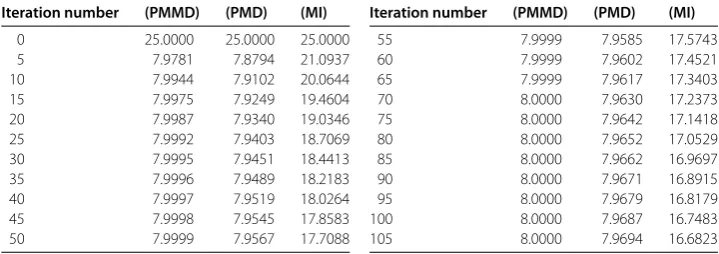
Further, in order to show the availability of the New Picard-Mann iterative methods with mixed errors, by using software Matlab 7.0, the numerical simulation results for the se-quences{xn}generated by (PMMD), (PMD) and (MI) are given with 70, more than 200
and more than 200 iterations in Figure 1 and Table 1, respectively.
Remark 3.1 If these mixed errors can be used properly, the property of (2.4) will be better than the other algorithms. From Figure 1 and Table 1, it is easy to see that the iterative process (PMMD) is effective and the sequence{xn}generated by (PMMD) converges much
faster.
Figure 1 Iterative solutions of (PMMD), (PMD) and (MI).
Table 1 A comparison of the iterative processes (PMMD), (PMD) and (MI)
Iteration number (PMMD) (PMD) (MI)
0 25.0000 25.0000 25.0000
5 7.9781 7.8794 21.0937
10 7.9944 7.9102 20.0644
15 7.9975 7.9249 19.4604
20 7.9987 7.9340 19.0346
25 7.9992 7.9403 18.7069
30 7.9995 7.9451 18.4413
35 7.9996 7.9489 18.2183
40 7.9997 7.9519 18.0264
45 7.9998 7.9545 17.8583
50 7.9999 7.9567 17.7088
Iteration number (PMMD) (PMD) (MI)
55 7.9999 7.9585 17.5743
60 7.9999 7.9602 17.4521
65 7.9999 7.9617 17.3403
70 8.0000 7.9630 17.2373
75 8.0000 7.9642 17.1418
80 8.0000 7.9652 17.0529
85 8.0000 7.9662 16.9697
90 8.0000 7.9671 16.8915
95 8.0000 7.9679 16.8179
100 8.0000 7.9687 16.7483
Next, we verify Theorem 2.2 by the following numerical example.
Example 3.2 LetX=R, constant 1 <l≤4925,C= [–1, 4 + 2
6
l–1],Tx= √
x2– 8x+ 40 for allx∈C, andhn=101n,αn=21n,dn=n1+n12 anden= –n165 forn≥1. Then, for allx,y∈C, we have
Tx–Ty= (x– 4)
2– (y– 4)2
(x– 4)2+ 24 +(y– 4)2+ 24
=(x–y)[(x– 4) + (y– 4)] x– 4+y– 4
· x– 4+y– 4
(x– 4)2+ 24 +(y– 4)2+ 24
≤√1
lx–y, (3.3)
and soT is a contraction operator. Thus, we obtain the following iterative processes as two special cases of (PMMD):
(PMM)
⎧ ⎪ ⎪ ⎨ ⎪ ⎪ ⎩
xn+1=
y2
n– 8yn+ 40 +101n, yn= (1 –21n)xn+21n
x2
n– 8xn+ 40
+21n(n1+n12) –n165,
(PM)
⎧ ⎨ ⎩
xn+1=
y2
n– 8yn+ 40,
yn= (1 –21n)xn+21n
x2
n– 8xn+ 40.
It follows from Theorem 2.2 thatxngenerated by (PMM) converges top= 5, which is
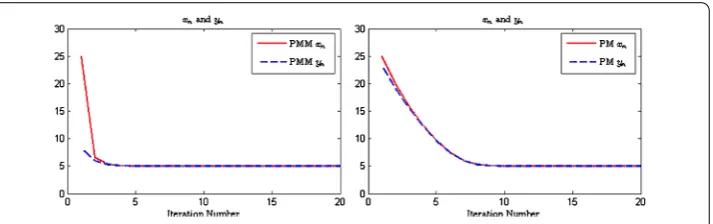
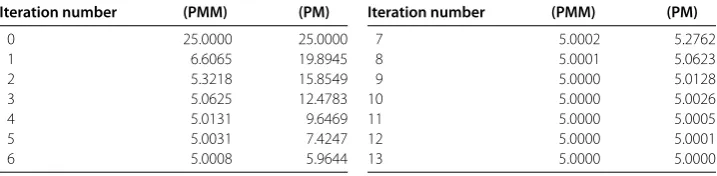
the unique fixed point ofT. Similarly, in order to compare (PMM) to (PM), the numerical simulations are displayed with 9 and 13 iterations in Figure 2 and Table 2, respectively. One can clearly see that the acceleration efficiency is 44.44%.
Remark 3.2 Figure 2 and Table 2 show that the iterative process (PMM) is effective and the sequence{xn}generated by (PMM) converges faster than that produced by (PM).
3.2 An application to the elliptic boundary value problem
In 2013, by using the notion of a nonexpansive potential operator, Ayadi et al. [1] proved a new global minimization theorem in Hilbert spaces to find a weak solution of the following
Table 2 A comparison of the iterative processes (PMM) and (PM)
Iteration number (PMM) (PM)
0 25.0000 25.0000
1 6.6065 19.8945
2 5.3218 15.8549
3 5.0625 12.4783
4 5.0131 9.6469
5 5.0031 7.4247
6 5.0008 5.9644
Iteration number (PMM) (PM)
7 5.0002 5.2762
8 5.0001 5.0623
9 5.0000 5.0128
10 5.0000 5.0026
11 5.0000 5.0005
12 5.0000 5.0001
13 5.0000 5.0000
elliptic boundary value problem:
⎧ ⎨ ⎩
–u=f(x,u), x∈,
u(x) = 0, x∈∂, (3.4)
where⊂Rnis a bounded domain in ann-dimensional real space.f,f:×R→Rare Carathéodory functions, herefis the derivative off with respect to its second variable.
One can know that a weak solution of (3.4) is a solution of the following variational problem:
⎧ ⎨ ⎩
∇u· ∇v dx–
f(x,u)·v dx= 0, ∀v∈H 1 0(), u(x)∈H1
0().
(3.5)
Letφ:H1
0()→Rbe a nonlinear operator such that
φ(u) = 1 2u
2–
F(x,u)dx, F(x,u) =
u
0
f(x,ζ)dζ. (3.6)
From Theorem 2.2, we have the following existence results of solutions for problem (3.4).
Theorem 3.1 LetRnbe an n-dimensional real space and⊂Rnbe a nonempty bounded
domain.Define T:C→C by T=I–φ,whereφis determined by(3.6),C= [ν,ω] ={u∈ H1
0() :ν(x)≤u(x)≤ω(x),∀x∈},hereν,ω∈H01()are a subsolution and a supersolu-tion of problem(3.5),respectively.If F(T) :={u∈C:Tu=u} =∅and∞n=0αn=∞,then
(i) the iterative sequence{un}generated by(2.7)converges to a weak solutionu∗∈F(T)
of problem(3.4)with convergence rateϑ= 1 –α(1 –ˆ θ) < 1,where
ˆ
α=lim supn→∞αn∈(0, 1]andθ=supu∈C(I–φ)u;
(ii) if,in addition,there existsα> 0such thatαn≥αfor alln≥0,then
lim
n→∞zn=u
∗ ⇐⇒ lim
n→∞n= 0, (3.7)
wherenis defined by(2.19)and{zn}is any sequence.
Remark 3.3 In the proof of Theorem 3.1, we employ the new Picard-Mann iterative ap-proximation with mixed errors for contraction operators, which differs from the method proposed in Ayadi et al. [1] for showing that problem (3.4) has a weak solution.
4 Concluding remarks
In this paper, we introduced a class of new Picard-Mann iterative methods with mixed errors for two different nonlinear operators as follows:
⎧ ⎨ ⎩
xn+1=T1yn+hn,
yn= (1 –αn)xn+αnT2xn+αndn+en,
(4.1)
whereT1,T2:X→Xare respectively nonexpansive and contraction operators,αn∈[0, 1]
andhn,dn,en∈Xare errors to take into account a possible inexact computation of the
operator points. Iteration (4.1) includes the Picard-Mann iterative process due to Khan [18], Picard iterative process, Mann iterative process and other related iterative processes as special cases.
Then we gave convergence and stability analysis of the new Picard-Mann iterative ap-proximation and proposed two numerical examples to show that the new Picard-Mann iteration converges more effectively than the Picard iterative process, Mann iterative pro-cess, Picard-Mann iterative process due to Khan and other related iterative processes. Fur-thermore, as an application of the new Picard-Mann iterative methods with mixed errors for contractive operators, which are different from the method proposed in [1], we explore iterative approximation of solutions for the following elliptic boundary value problem:
⎧ ⎨ ⎩
–u=f(x,u), x∈,
u(x) = 0, x∈∂, (4.2)
where⊂Rnis a bounded domain,f :×R→Ris a Carathéodory function.
However, can our results be obtained whenTis only nonexpansive in Theorem 2.2 orT2 is also nonexpansive in Theorem 2.1? These are stillopen questionsthat are worth further studying.
Acknowledgements
We would like to thank the editors and referees for their valuable comments and suggestions to improve our paper.
Funding
This work was supported by the Scientific Research Project of Sichuan University of Science & Engineering (2017RCL54), the Innovation Fund of Postgraduate, Sichuan University of Science & Engineering (y2016041).
Abbreviations
(PMMD), new Picard-Mann iterations with mixed errors for two different nonlinear operators; (PMD), Picard-Mann iteration for two different operators; (PMM), Picard-Mann iteration with mixed errors; (PM), Picard-Mann iterative process; (MI), Mann iterative process.
Availability of data and materials Not applicable.
Ethics approval and consent to participate Not applicable.
Competing interests
Consent for publication Not applicable.
Authors’ contributions
T-FL carried out the proof of the theorems and gave some numerical simulations to show the main results. H-YL conceived of the study and participated in its design and coordination. All authors read and approved the final manuscript.
Authors’ information
Further, Mr. T-FL is studying for an MA degree. His research interests focus on the theory and algorithm of nonlinear system optimization and control. H-YL is a professor in Sichuan University of Science & Engineering. He received his doctoral degree from Sichuan University in 2013. His research interests focus on the structure theory and algorithm of operational research and optimization, nonlinear analysis and applications.
Author details
1College of Mathematics and Statistics, Sichuan University of Science & Engineering, Zigong, Sichuan 643000, P.R. China. 2Institute of Nonlinear Physical Science, Sichuan University of Science & Engineering, Zigong, Sichuan 643000, P.R. China.
Publisher’s Note
Springer Nature remains neutral with regard to jurisdictional claims in published maps and institutional affiliations.
Received: 8 August 2017 Accepted: 29 November 2017
References
1. Ayadi, S, Moussaoui, T, O’Regan, D: Existence of solutions for an elliptic boundary value problem via a global minimization theorem on Hilbert spaces. Differ. Equ. Appl.8(3), 385-391 (2016)
2. Roubíˇcek, T: Nonlinear Partial Differential Equations with Applications, 2nd edn. International Series of Numerical Mathematics, vol. 153. Springer, Basel (2013)
3. Barbu, V: Analysis and Control of Nonlinear Infinite-Dimensional Systems. Mathematics in Science and Engineering, vol. 190. Academic Press, Boston (1993)
4. Lan, HY: Variational inequality theory for elliptic inequality systems with Laplacian type operators and related population models: an overview and recent advances. Int. J. Nonlinear Sci.23(3), 157-169 (2017)
5. Sofonea, M, Matei, A: Variational Inequalities with Applications: A Study of Antiplane Frictional Contact Problems. Advances in Mechanics and Mathematics, vol. 18. Springer, New York (2009)
6. Marin, M: On weak solutions in elasticity of dipolar bodies with voids. J. Comput. Appl. Math.82(1-2), 291-297 (1997) 7. Marin, M, Vlase, S: Effect of internal state variables in thermoelasticity of microstretch bodies. An. ¸Stiin¸t. Univ. ‘Ovidius’
Constan¸ta, Ser. Mat.24(3), 241-257 (2016)
8. Liu, WY, Sun, TJ: Iterative non-overlapping domain decomposition method for optimal boundary control problems governed by elliptic equations. J. Shandong Univ. Nat. Sci.51(2), 21-28 (2016) (in Chinese)
9. Lions, JL: Optimal Control of Systems Governed by Partial Differential Equations. Springer, New York (1971) 10. Coletsos, J, Kokkinis, B: Optimal control of nonlinear elliptic PDEs—theory and optimization methods. In: Lirkov, I, et
al. (eds.) Large-Scale Scientific Computing. Lecture Notes in Comput. Sci., vol. 8353, pp. 81-89. Springer, Heidelberg (2014)
11. Gong, W, Yan, NN: Adaptive finite element method for elliptic optimal control problems: convergence and optimality. Numer. Math.135(4), 1121-1170 (2017)
12. Yan, NN, Zhou, ZJ: A priori and a posteriori error analysis of edge stabilization Galerkin method for the optimal control problem governed by convection-dominated diffusion equation. J. Comput. Appl. Math.223(1), 198-217 (2009) 13. Turkyilmazoglu, M: An optimal variational iteration method. Appl. Math. Lett.24(5), 762-765 (2011)
14. Beretta, E, Manzoni, A, Ratti, L: A reconstruction algorithm based on topological gradient for an inverse problem related to a semilinear elliptic boundary value problem. Inverse Probl.33(3), 035010 (2017)
15. Kogut, PI, Manzo, R, Putchenko, AO: On approximate solutions to the Neumann elliptic boundary value problem with non-linearity of exponential type. Bound. Value Probl.2016, 208 (2016)
16. He, JH: Variational iteration method - some recent results and new interpretations. J. Comput. Appl. Math.207(1), 3-17 (2007)
17. Zhou, XW, Yao, L: The variational iteration method for Cauchy problems. Comput. Math. Appl.60(3), 756-760 (2010) 18. Khan, SH: A Picard-Mann hybrid iterative process. Fixed Point Theory Appl.2013, 69 (2013)
19. Deng, WQ: A modified Picard-Mann hybrid iterative algorithm for common fixed points of countable families of nonexpansive mappings. Fixed Point Theory Appl.2014, 58 (2014)
20. Okeke, GA, Abbas, M: A solution of delay differential equations via Picard-Krasnoselskii hybrid iterative process. Arab. J. Math.6(1), 21-29 (2017)
21. Jiang, GJ, Kwun, YC, Kang, SM: Solvability and Mann iterative approximations for a higher order nonlinear neutral delay differential equation. Adv. Differ. Equ.2017, 60 (2017)
22. Roussel, MR: Stability analysis for ODEs. Teaching-Chemistry 5850: Nonlinear Dynamics, Lecture 2. http://people.uleth.ca/~roussel/nld/. Accessed 13 Sept 2005
23. Liu, QK, Lan, HY: Stable iterative procedures for a class of nonlinear increasing operator equations in Banach spaces. Nonlinear Funct. Anal. Appl.10(3), 345-358 (2005)
24. Lan, HY: Stability of iterative processes with errors for a system of nonlinear (A,η)-accretive variational inclusions in Banach spaces. Comput. Math. Appl.56(1), 290-303 (2008)
26. Ashyralyyev, C, Dedeturk, M: Approximation of the inverse elliptic problem with mixed boundary value conditions and overdetermination. Bound. Value Probl.2015, 51 (2015)
27. Akewe, H, Okeke, GA: Convergence and stability theorems for the Picard-Mann hybrid iterative scheme for a general class of contractive-like operators. Fixed Point Theory Appl.2015, 66 (2015)
28. Bosede, AO, Rhoades, BE: Stability of Picard and Mann iteration for a general class of functions. J. Adv. Math. Stud.3(2), 1-3 (2010)
29. Agarwal, RP, O’Regan, D, Sahu, DR: Fixed point theory for Lipschitzian-type mappings with applications. In: Topological Fixed Point Theory and Its Applications, vol. 6. Springer, New York (2009)