37(1), Spring 2018, pp. 73-96- ISSN: 2008-8191
DOI: 10.22099/jtls.2018.28369.2453
Developing a Model of Teachers’ Possible Selves for the Iranian Context
Adel Dastgoshadeh Assistant Professor
Islamic Azad University, Sanandaj, Iran [email protected]
Abstract
This study reports on the development and validation of a questionnaire for exploring the different types of EFL teachers’ possible selves. First, a theoretical framework behind possible selves theory and its types was cultivated through an extensive review of the related literature and content analysis of 24 transcribed semi-structured interviews with ELT experts. Second, the questionnaire was developed and validated through collecting three types of evidence: content, reliability and construct. Content validity was insured by submitting the questionnaire to expert judgment, and Cronbach’s alpha was checked to measure the internal consistency reliability of the scale and its subscales. Finally, confirmatory and exploratory factor analyses as well as SEM were used to estimate the construct validity of the instrument administered to 380 EFL teachers. The results indicated that the questionnaire was both a valid and reliable measure of EFL teachers’ possible selves and the resultant model hypothesized based on the data collected from the questionnaire enjoyed acceptable fitness indices. The model of EFL teachers’ possible selves (L2 selves) consists of four types including ideal, ought-to, actual and feared selves. The paper is concluded by presenting the different senses of selves within each type which together constitute the whole model of L2 self-development and how the model can be used in future studies.
Keywords: construct validation, EFL teachers, possible selves, model
development
Among the different characteristics of second language teachers, identity development can be considered as one of the most complicated issues within the domain of applied linguistics, as learning and then deciding to teach a foreign language bring about significant changes in
the value system one holds which, in turn, might result in their identity changes (Johnston, 2008). The studies conducted on teachers' identities and selves have received more attention from early nineties as teachers are considered essential agents of change in education. The results of these studies point to the influences full understanding of identity development of teachers might have on their professional knowledge and practice (e.g. Beijaard, Verloop, & Vermunt, 2000; Goodson & Cole, 1994).
Day, Kington, Stobart, & Sammons (2005) state that educational researchers should give emotional or personal identities of teachers more importance and value in order to have a better understanding of different aspects of teaching including teacher motivation, job commitment and satisfaction. The recent studies on language teacher identity have paid adequate attention to not only the intellectual dimensions of the profession but also the emotional realities which together conceptualize language teaching as a sociocultural activity (e.g., Acheson, Taylor, & Luna, 2016; Benesch, 2017; Canagarajah, 2016; Cross, 2010; Reis, 2015).
However; recently self-theorists have focused their attention on the dynamic nature of self and identity, replacing the static concept of self with an active and dynamic self-system (de Bot, 2012; Dornyei & Chan, 2013; Larsen-Freeman & Cameron, 2008; Leary, 2007; Markus & Ruvolo, 1989). This shift of focus has resulted in the presentation of some self-related mechanisms emphasizing the connection between self and action. Among them, the possible selves theory (Markus & Nurius, 1986) and self-discrepancy theory (Higgins, 1987) emerged from the mainstream psychology, dealing with self and motivation (e.g., Dornyei, 2005, 2009, 2010; Dornyei & Ushioda, 2011), and have also been applied to the field of language teacher motivation (e.g., Kubanyiova, 2009).
to better describe EFL learners’ self and identity and also by Kubanyiova
(2009) to describe the process of teacher development. Using a
mixed-method design, the contents of the different selves of the EFL teachers, i.e., ideal, actual, feared, and ought-to selves, were investigated.
Literature Review
Markus and Nurius (1986) cleave the basic types of possible selves into: (1) ideal selves; what we would very much like to become, (2) selves that we could become, and (3) selves we are afraid of becoming. The ideal selves might include the selves we love or admire or the selves we consider successful, while the feared selves could be the selves we avoid to develop such as the depressed self, the unsuccessful self or the disqualified self. Markus and Nurius (1986) put all these different selves under the name of possible selves, namely, even the ideal selves are not thoroughly disconnected from reality or something called unfeasible fantasy. Interestingly, they also mentioned "ought-to self" referring to it as "an image of self-held by another" (Markus & Nurius, 1986, p. 958). It is worth mentioning that Markus and Nurius have not provided a clear taxonomy of possible selves as each type of self can have many illustrations.
Self-discrepancy theory (Higgins, 1987) hypothesizes that possible selves are stimulating as the discrepancies between one’s present sense of self (actual self) and the future selves (ideal self) might lead to anxiety, which, in turn, stimulates a person to reduce the discrepancies by regulating behaviors. Higgins (1987, p. 324) believes, however, that this process does not always take place consciously “…one's self-discrepancies can be used to assign meaning to events without one's being aware of either the discrepancies or their impact on processing.” For example, a teacher might experience frustration if he cannot design appropriate tasks to address a variety of learning needs in large classes(actual self) but handling such classes is among his aspirations (ideal self), so to reduce the distance between ideal and actual selves, he decides to enroll in a teacher training course.
In line with the theory of possible selves and self-discrepancy
with regard to their work. Contrary to the ideal self, the teacher's attempts aimed at reducing the discrepancy between actual and ought-to selves are triggered by external factors. Moreover, the main reason behind this motivation seems to be the negative consequences teachers might perceive in their careers. Moreover, (3) the teacher's feared language teacher self would develop if the perceived responsibilities and duties are not successfully implemented.
As a theoretical framework, the construct of possible selves can account for different affective, cognitive, and contextual factors which contribute to any conceptual change in language teachers. Several key identity researchers have claimed that identity development is a dynamic future-directed process, where as a result of gaining any new life experiences it is created and recreated (e.g., Berzonsky, 1989; Dunkel, 2000; Grotevant, 1987). Hiver (2013) states that as possible selves are at the core of motivated behaviors of teachers, a comprehensive picture of this complex construct seems necessary. In agreement with Dunkel (2000), Dastgoshadeh and Ghafar Samar (2013) consider possible selves as a comprehensive theoretical framework for exploring how teachers develop different types of selves and what the content of each self is.
As far as the researcher knows, no one has ever attempted to qualitatively and quantitatively explore the different types of EFL teachers’ possible selves and then carve out the contents of the selves using possible selves and self-discrepancy theories. In different studies conducted elsewhere (e.g., Hiver, 2013, Kubanyiova, 2009; Tsu, 2007), identity of the teachers has been analyzed using a fragmented approach, that is, only some aspects of teacher identity or self have been investigated. The lack of a valid and reliable model can be the possible reason for the lack of such pertinent studies. Therefore; this study is an attempt to statistically and methodologically explore the contents of the different types of EFL teachers’ possible selves in the context of Iran by developing a valid instrument. It was also among the objectives of the study to explore what sense of self is more dominant within each self. Specifically, the study aimed to answer the following research questions:
1. What are the main types of (Iranian) EFL teachers’ possible selves (L2 selves)?
3. Is the EFL teachers' L2 self-development questionnaire developed in this study a reliable and valid instrument for data collection?
4. Does the hypothesized model of EFL teachers’ possible selves in Iran show acceptable fit indices?
Method
This study was conducted to develop a questionnaire for exploring the different types of EFL teachers' possible selves. The development of this instrument was done in two phases as follows.
Qualitative Phase
The purpose of the first phase was to cultivate possible selves and self-discrepancy theories as the theoretical framework of the study to seek out EFL teachers’ beliefs regarding what shapes their L2 self. To this end, a three-fold approach was employed as follows. (a) the related literature was exhaustively reviewed to establish a good theoretical framework for the study, (b) 24 semi-structured oral interviews were conducted in the qualitative phase, and (c) the beliefs and perspectives of a cadre of experts in the field on different aspects of EFL teachers’ L2 selves were sought.
Interview
To seek out the participants' beliefs regarding what shapes their L2 selves, the researcher conducted face-to-face interviews with them individually. Furthermore, the kind of the interview conducted in this study was that of semi-structured. In this type of interview, the whole process of interviewing changes from a structured to a highly-unstructured one in that the predetermined questions are asked more flexibly. The method of the interview adopted for this study was qualitative interviewing. This method “is based on conversation, with the emphasis on researchers asking questions and listening, and respondents answering” (Rubin & Rubin, 1995, cited in Warren, 2002, p. 83). By considering the research questions and consulting previous instruments, the researcher endeavored to word questions that would elicit meaningful responses as succinctly and unambiguously as possible. A pool of over twenty interview questions was compiled on four broad topic areas and was reviewed by some experts in applied linguistics.
asked to comment on the interview design and their experience as interviewee. Their various comments led to subsequent revisions in the wording and the order of the questions. Each of the interviews varied considerably in length because for each participant probing questions eliciting follow-up and elaboration were asked until the researcher was sure that he had profoundly understood their responses to the topic areas in which data was being collected and until their answers became repetitive to the point of reaching saturation.
The Content Analysis method was used to analyze the interview transcripts in this phase. According to the research questions as well as the literature review, a number of content categories were determined and the text was codified based on these categories. Having reduced the content categories selectively, the analyzer came up with a representative list of the critical contents covered throughout the text. Initial concern with his reliability as a coder led the researcher to approach a colleague at his workplace to assist in peer checking. This colleague performed a coding reliability test by coding five randomly selected passages from each participant's interview transcript. Discussing inconsistencies in their coding categories led to more profound insights into the data rather than attempting to merely eliminate the different interpretations, this process enabled the researcher to inquire into what the divergent codes pointed to and how they could be reconciled.
Finally, following the above mentioned steps and processes, the significant categories surfaced from the transcribed data. These emerging themes obtained from the interview along, with the underlying categories drawn out of the literature on teachers' L2 self-development, helped the researcher in constructing the items of the questionnaire to be administered in the quantitative part of the study. The next step was eliciting and preparing appropriate items for these conceptions. Referring to some of the sources of writing questionnaire items (e.g., Oppenheim, 1992), each idea was turned into an item to be used in the questionnaire. Although these items are not the final ones, it is necessary to display them for their relevance to the concepts in the literature.
Quantitative Phase
The purpose of the second phase was to develop and pilot a newly developed L2-self questionnaire. To this end, 40 English language teachers were invited to participate in the piloting of the instrument. The participants, who were similar to the target group, were selected based on availability sampling, in which anyone available and willing to participate would take part in the study. The rating scale of the questionnaire was based on Likert scale as the most popular and widely used rating scale (Dorneyi, 2010). After all the items were generated and experts' opinions were applied, they were ordered and sequenced in a way that similar items were not put successively to prevent the negative effects they might have on the respondents' responses (see Table 1 below).
Table 1.
Number of Items Capturing Each Factor of the L2-Self
Types of the L2-self in the theoretical
framework Number of items capturing each factor in the newly-developed instrument
Ideal 35
Ought-to 21
Actual 40
Feared 15
Total 111
Once the semi-final version of the questionnaire was prepared, the pilot study was carried out. The near-final questionnaire was administered to 40 participants who were teaching at different institutes/universities. Furthermore, 41 out of the 111 items were in reverse order to make sure the participants would not answer the items carelessly.
Validating the Questionnaire
Content validity. Content validity of the instrument has already
been established before reaching this step. The questionnaire was given to a panel of experts to judge the appropriateness of the items concerning the purpose of the study, the wording of the items, their interpretation, and the instructions given in the questionnaire.
Construct validity. To check the construct validity of the newly
developed L2-self questionnaire, Confirmatory Factor Analysis (CFA) which is one of the methods of construct validation was implemented. Confirmatory factor analysis is utilized to check the degree of consistency between construct measures and the researcher's understanding of that construct or factor. Therefore; confirmatory factor analysis is employed with the purpose of testing whether the data of the study fit a hypothesized model which is based on a theory or an analytic study conducted previously. In CFA, in order to determine how well the model fits the data, different statistical tests are utilized. Kline (2010) advocates reporting the Chi-squared test, the RMSEA, the CFI, and the SRMR. Besides, absolute fit indices including, but are not limited to, the Chi-Squared test, RMSEA, GFI, AGFI, RMR, and SRMR are also used to establish how well a priori model fits the data.(See Table 2 below).
Table 2.
Fit Indices for the Ideal, Ought-to, Actual, and Feared Selves
Ideal Self Ought-to Self Actual Self Feared Self
Index
Current level
Accepted Level
Current level
Accepted Level
Current level
Accepted Level
Current level
Accepted Level X2 2369.86 p>0.05 226.34 p>0.05 429.46 p>0.05 0.024 p>0.05 RMSEA 0.12 < 0.05 0.14 < 0.05 0.12 <0.05 0.00 <0.05 CFI 0.83 <.90 0.85 <.90 0.76 <.90 1 <.90 NFI 0.81 <.90 0.83 <.90 0.73 <.90 1 <.90 NNFI 0.73 <.90 0.77 <.90 0.69 <.90 1.01 <.90 GFI 0.73 Near 1 0.89 Near 1 0.85 Near 1 0.97 Near 1 AGFI 0.68 Near 1 0.80 Near 1 0.78 Near 1 0.83 Near 1
The Main Study
Next, to further check the construct validity of the newly developed the L2-self questionnaire with 74 items in terms of its underlying components and the distribution of items under each factor, the instrument was given to 380 English language teachers teaching in different teaching contexts, and then both exploratory and second-order confirmatory factor analyses were run on the collected data.
To check for the adequacy of the sample size, Bartlett’s test of sphericity and the Kaiser-Meyer-Olkin (KMO) measure were used. Table 3 is the SPSS output for KMO and Bartlett’s Tests.
Table 3.
KMO and Bartlett’s Test Results
KMO and Bartlett’s Test
Kaiser-Meyer-Olkin (KMO) Measure of Sampling Adequacy .76 Bartlett’s Test of Sphericity Approx. Chi-Square 14036.91
df 2278 Sig. .000
As seen in Table 3, the KMO measure is above .60 (KMO= .76) and
also the Bartlett’s test of Sphericity is significant (p=.000). These two
values assume that there are some significant factors to be extracted from the data. If these values- KMO and Bartlett’s test- were not at an acceptable level, factor analysis could not be run.
After insuring the factorability of data through KMO and Bartlett’s Test of Sphericity, factor analysis was run via SPSS. For the exploratory factor analysis in this study, the extraction method of Principle Component Analysis (PCA) and Varimax Rotation were adopted. The number of factors extracted based on PCA is 19 and also how clean they loaded and the degree of their loadings are presented (See Figure 1 below). The variance accounted for by 19 factors was .69 which is an acceptable value. As it can be seen, only 54 items out of the 74 items of the questionnaire loaded on 19 factors and of this number only 16 factors met the following criteria:
Items loadings above .40 are acceptable
No cross loadings, i.e., loadings on more than one construct were
eliminated.
Factors with less than three items loading on them were considered
The items being clustered together under the same factor were studied carefully to find out if there was any commonality among them and whether items grouped could create new contents of EFL teachers' possible selves. Items loading on Factors 1,5,6,7,11,12,13,16 deal with the ideal selves, factors 2,3,4 deal with ought-to selves, factors 8,14,17,18 deal with actual selves, and factor 9 deals with feared selves of the teachers.
Factors dealing with the ideal selves of the teachers represent what teachers would like to become concerning different aspects of their job. Based on the commonalities among the items loading on each factor within the domain of the ideal self, 8 factors were extracted and then labeled. Items loading on Factor 1 in Table 4 capture career-related
issues such as being a reflective teacher (item 58), doing the job
professionally (item 60), using modern technology (item 78), developing a scientific orientation toward the profession (item 105), gaining autonomy to make changes in different aspects of the job (item 106), enjoying teacher development programs (item 59). Therefore, the factor
was named ‘professional or career identity’. Items loading on Factor 5
have commonality on personal self-related issues including becoming an
authority in the field (item 85), becoming a successful morality guide
(item 86), developing one’s self (item 73). Therefore, the factor was
labeled ‘self-image’. Items capturing language identity of the teachers
such as trying to retain and develop their first language, to be considered
as a legitimate speaker of the target language, and helping students to develop a positive attitude toward the target language (items 19,50,74,
respectively) were grouped on Factor 6 and it was named ‘language identity'.
Items loading on Factor 7 which was named ‘teaching efficacy’ deal
with teaching efficacy-related issues such as helping students master the
different language skills, (item26), using a variety of assessment strategies (item 30), motivating students, (item 52), helping students develop their voice (item77). Items loading on Factor 11 happen to tap
cultural issues such as making cultural outcomes and achievements
global (item 8), understanding and tolerating cultural differences (item
10), helping students appreciate cultural differences (item 11).
Therefore, the factor was named ‘cultural identity’. Items capturing the wishes teachers express about their degree of mastery over the target
language such as having a good command of the target language (item
considered as a model in language use (item 45) loaded on Factor 12
which was named ‘language efficacy’. Items loading on Factor 13 had
commonalities on sociopolitical issues such as to become an effective
citizen (item 44), teaching local and global values (item 76), and experiencing positive changes in the policies of language teaching in
Iran (item 91). Therefore, the factor was labeled ‘sociopolitical identity’.
Items capturing the wishes and expectations teachers express about their
level of satisfaction such as gaining inner satisfaction (item 18), having a
reliable source of income (item 51), gaining dignity, respect and appreciation (item 17) loaded on Factor 16. Thus, the factor was named
‘job satisfaction’.
Factors dealing with the ought-to selves of the teachers represent what teachers are expected to become or to do and also what responsibilities and obligations they consider necessary to fulfill. Based on the commonalities among the items loading on each factor within the domain of ought-to selves, 3 factors were extracted and then labeled. Items which loaded on Factor 2 capture personal self-related issues such as being expected to be a perfect moral model, being expected to be a knowledgeable and competent language teacher, and being expected to be a perfect academic mode (items 63, 64, 65); therefore, it was named
‘self-image’
Items loading on Factor 3 tap into the teaching efficacy of the
teachers including being expected to help students master the language
as proficiently as possible, being expected to foster reflection and self-evaluation, being expected to discover and accommodate the individual differences among students. Therefore, it was named ‘teaching efficacy’
(items 55, 82, and 83). Items which deal with career-related issues such as being expected to seek opportunities for career advancement (item 4), being expected to develop a scientific orientation to ELT (item 100), being expected to use modern technologies (item 110), being expected to do the job professionally (item 109) loaded on Factor 4. Therefore, it was
named ‘career identity’.
Factors dealing with the actual selves of the teachers represent how teachers view themselves concerning different aspects of their job. Based on the commonalities among the items loading on each factor within the domain of the actual selves, 4 factors were extracted and then labeled. Items loading on Factor 8 tap into the teaching efficacy of the teachers
(item 102), using a variety of assessment strategies (item 108); therefore,
they were clustered under the ‘teaching efficacy’ factor.
Items loading on Factor 4 deal with career-related issues including
being autonomous enough to use more applicable methods and materials, not using the language for communication purposes, not being provided with teacher development programs, and not encouraging students to major in the English Language. Therefore, they were
clustered under the ‘career identity’ factor (items 14, 37, 48, 70). Items
loading on Factor 17 deal with sociopolitical issues including The
Iranian government does not give enough importance to learning English
(item 6), helping students to evaluate English media (item 61), telling
students that English language is an instrument for social, educational, and economic success in society (item 72); therefore, they were grouped
under the ‘sociopolitical identity' factor. Items loading on Factor 8
capture personal self-related issues such as being a competent language
teacher, being a successful language teacher, being more capable of teaching than a native English language teacher. Therefore, they were
clustered under the ‘self-image’ factor (items 5, 13,103, respectively). Factors dealing with the feared selves of the teachers represent what teachers are afraid of becoming for different aspects of their job. Based on the commonalities among the items loading on each factor within the domain of the feared selves, 1 factor was extracted and then labeled. Items loading on Factor 9 capture personal self-related issues such as
afraid of becoming a fossilized teacher (item 15), afraid of losing interest and motivation (item 16), fearing not gaining autonomy, (item 43).
Therefore, they were clustered under the ‘self-image’ factor. Table 4 below shows the revision of the questionnaire based on the results of factor analysis and the deletions and rearrangements of the items.
Table 4.
Items Capturing the Finalized Factors of the L2-Self Questionnaire
Scale Item Number
Ideal
Career identity 58,59,60,78,105,106 Self- image 73,85,86
As can be seen, 54 items loading on 16 factors formed the final version of the questionnaire and all factors were named based on the commonalities the items under each factor had.
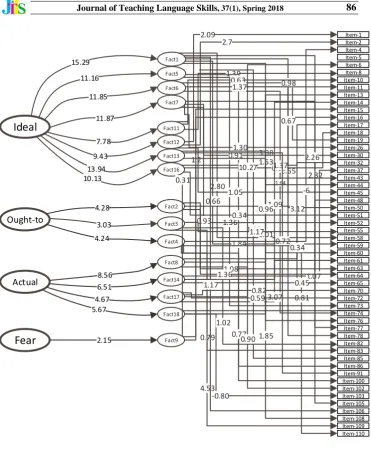
To see whether the extracted 16 factors load on 4 factors (Four types of selves) constituting the L2 Self, second-order confirmatory factor analysis was run. In other words, the primary purpose behind this attempt was to see whether all factors within each dimension tap on one main factor altogether. All statistical analyses used so far were carried out using SPSS but to run CFA which is a technique related to SEM family, LISREL, the results of which are presented in Figure 1 below, was used.
Sociopolitical identity 44,76,91 Job satisfaction 17,18,51
Ought-to Self- image Teaching efficacy 63,64,65 55,82,83 Career identity 4,100,109,110
Actual
Fact1 Fact5 Fact6 Fact7 Fact11 Fact12 Fact13 Fact16 Fact2 Fact3 Fact4 Fact8 Fact14 Fact17 Fact18 Fact9 Ideal
Item‐1
Item‐6 Item‐8 Item‐10 Item‐11
Fear
Actual
Ought‐to
15.29 11.16 11.85 11.87 7.78 9.43 13.94 10.13 4.28 3.03 4.24
Item‐4 Item‐2
Item‐5
Item‐13 Item‐14 Item‐15 Item‐16 Item‐17 Item‐18 Item‐19 Item‐26 Item‐30 Item‐32 Item‐37 Item‐43 Item‐44 Item‐45 Item‐48 Item‐50 Item‐51 Item‐52 Item‐55 Item‐58 Item‐59 Item‐60 Item‐61
Item‐65 1.39
Item‐70 Item‐72 Item‐73 Item‐74 Item‐76 Item‐77 Item‐78 Item‐82 Item‐83 Item‐85 Item‐86 Item‐91 Item‐100 Item‐102 Item‐103
Item‐108 Item‐109 Item‐105
Item‐110 8.56 6.51 4.67 5.67 2.15 2.80 0.66 3.08 0.65 2.32 1.36 1.30 1.84 1.2 0.31 ‐0.80 0.98 0.67 1.64 0.86 0.63 1.37 1.30 0.91 0.93 2.26 1.37 0.34 2.09 2.7 1.05 1.53 1.01 0.72 3.12 1.17 1.02 0.79 0.77 4.53 0.81 ‐6 0.90 1.85 0.34 1.09 1.07 0.45 0.82 10.27 3.07 0.59 0.96
Item‐106 1.17
Item‐63 Item‐64 1.08
1.36
Figure 1.
Schematic Representation of the Recursive Model of the L2 self
Figure 1 shows the schematic representation of the recursive model of the L2 self of EFL teachers. Path coefficients are also put on the pathways from each latent variable to other latent or observable variables. The results of the second-order confirmatory factor analysis
factors 2, 3, 4 loaded on the ought-to self, factors 8, 14, 17, 18 loaded on
the actual self, and only factor 9 was related to the fourth main factor of
the L2-self, that is, the feared self.
Discussion and Conclusion
This study was an attempt made with the purpose of exploring the values constituting the possible selves of EFL teachers. As the new model of teacher identity developed in this study indicates, the participants of the study put positive self-image development at the heart of their identity goals, which is in line with the findings of the study conducted by Hiver (2013) on a group of Korean EFL teachers. He found out that every participant in the study had a well-defined ideal language-teacher-self, mainly containing the positive future self-images they liked to possess. The findings of this study also revealed that the obligations which teachers are more concerned about fulfilling primarily relate to gaining a positive self-image by becoming a perfect moral and academic model. Hsu's (2009) study showed that EFL teachers in Japan face confounding obligations from a variety of sources which, in turn, shape their professional identity and classroom practice. What is interesting is that, from teachers' perspectives, career-related goals and values are also among the expectations language learners have developed about their teachers.
interface between their educational ideals, beliefs, social situation and the broader social and policy context.
The findings of the present study suggest that more attention needs to be paid to raising awareness of the process of self/identity development of EFL teachers, although further research is needed to determine what form and content that might take and have. This study also gives a more detailed picture of each of the four dimensions of L2-self-development and can be seen as more profoundly describing what being a language teacher entails as well as presenting a more realistic picture of what becoming and being an EFL teacher looks like. As a conclusion, it can be claimed that, as a language teacher, one has to be conscious about the different expectations and duties that being a teacher requires. Moreover, the findings of this study indicate that, EFL teachers need to know more about the relationship between the development of particular aspirations and pedagogical practices; what worries and fears might threaten their profession; and finally how the gap between the aspirations and expectations might be either motivating or detrimental. By acknowledging the responsibilities of an educator, a language teacher, a culture teacher and other possible duties inside and outside the school at an early stage, one reduces the amount of conflict arising from the discrepancies between actual and ideal selves as well as the conflicts between ought-to selves and ideal selves. Tajeddin and Teimournezhad (2014) suggest that identity awareness should be incorporated in content on cultural awareness in teacher education programs.
The presence of the sense of self-efficacy within ideal, ought-to, and actual selves suggests that it is one of the integral constituents of the possible selves of an EFL teacher. The four sources of self-efficacy beliefs (Bandura, 1994) are the identity goals that teachers develop about different aspects of their profession. For example, Bandura (1977) has described mastery experiences as the most potent source of information on which efficacy is based. What teachers do in the classroom and how they are affected by contextual cues can be approached more systematically if a comprehensive exploration of their different selves is done (Kubanyiova, 2009).
combinatory patterns, but, according to the findings of the present study, two constant factors which should be developed and promoted in these well-articulated selves in almost all contexts are language teacher self-efficacy and concern about students' achievement. It is essential for EFL teachers to carry out their responsibilities professionally and develop the goals of their profession into their self and identity.
The study is theoretically justified on the ground that its findings would also contribute to language teacher education. The construction of language teacher selves that influences professional decisions and actions is an important issue which deserves thorough investigation to avoid the risk of wasting human and financial resources. By applying the two theories it would become evident how EFL teachers envision the complicated processes of English language learning and teaching, the barriers and fears, the different expectations, and also the functionality of different self-regulatory strategies to cope with them.
From a micro-perspective, specific teacher education programs (pre-service as well as in-service) will need to incorporate into their syllabuses particular mechanisms for promoting a relevant ideal and ought-to L2 selves and also preventing the development of the feared L2 self. In keeping with the findings of language teacher cognition research, the results of this study prove that dissonance appraisal is essential for triggering the process of conceptual change. If language teachers do not perceive a discrepancy between who they are (their actual selves) and who they want to become (their ideal selves), their ideal self is unlikely to impel them to self-regulatory action.
References
Acheson, K., Taylor, J., & Luna, K. (2016). The burnout spiral: The
emotion labor of five rural U.S. foreign language teachers. Modern
Language Journal, 100, 522–537.
Antonek, J., McCormick, D., & Donato, R. (1997). The student teacher portfolio as autobiography: Developing a professional identity.
Modern Language Journal, 81(1), 15-27.
Beijaard, D., Verloop, N., & Vermunt, J. (2000). Teachers’ perceptions
of professional identity. Teachers and Teaching: Theory and
Practice, 1, 281-294.
Benesch, S. (2017). Emotions in English language teaching: Exploring
teachers’ emotion labor. New York: Routledge/Taylor & Francis.
Bernat, E (2008): Beyond beliefs: Psycho-cognitive, sociocultural and emergent ecological approaches to learner perceptions in foreign
language acquisition. The Asian EFL Journal, 10(3), 7–27.
Berzonsky, M. (1989). Identity style: Conceptualization and
measurement. Journal of Adolescent Research, 4, 268-282.
Canagarajah, S. (2016). TESOL as a professional community: A
half-century of pedagogy, research, and theory. TESOL Quarterly, 50,
7–41.
Cross, R. (2010). Language teaching as sociocultural activity: Rethinking
language teacher practice. Modern Language Journal, 94, 434–
452.
Dastgoshadeh, A., & Ghafar Samar, R. (2013). Possible selves theory: A new framework for language teacher self and identity research.
IJLLALW, 5(1), 144-155.
Day, C., Kington, A., Stobart, G. & Sammons, P. (2005). The personal and professional selves of teachers: Stable and unstable identities.
British Educational Research Journal, 32(4), 601-616.
Day, C. &Leithwood, K. (2007). Successful principal leadership in times of change: An international perspective. Dordrecht, UK: Springer.
De Bot, K. (2012) Timescales in second language development. Dutch
Journal of Applied Linguistics 1, 143–149.
Dornyei, Z. & Taguchi, T. (2010). Questionnaires in Second Language Research: Construction, Administration, and Processing. New Jersey: Lawrence Erlbaum Associates, Inc., Publishers.
Dörnyei, Z. (2005). The Psychology of the language learner. Individual
differences in second language acquisition. Mahwah, NJ:
Dörnyei, Z. (2009). The L2 Motivational Self System. In Z. Dörnyei &
E. Ushioda (Eds.), Motivation, language identity, and the L2 self.
(pp.9-42). Clevedon: Multilingual Matters.
Dörnyei, Z. (2010). Researching motivation: From integrativeness to the
ideal L2 self. In S. Hunston & D. Oakey (Eds.), Introducing
applied linguistics: Concepts and skills. (pp. 74-83). London:
Routledge.
Dornyei, Z. & Chan, L. (2013) Motivation and vision: An analysis of future L2 self-images, sensory styles, and imagery capacity across
two target languages. Language Learning 63, 437–462.
Dörnyei, Z. & Ushioda, E. (Eds.) (2009). Motivation, language identity,
and the L2 self. Clevedon: Multilingual Matters.
Dörnyei, Z., & Ushioda, E. (2011). Teaching and researching:
Motivation (Second ed.). Harlow: Longman Pearson.
Dunkel, C. (2000). Possible selves as a mechanism for identity
exploration. Journal of Adolescence, 23, 519-529.
Goodson, I., & Cole, A. (1994). Exploring the teacher’s professional
knowledge: Constructing identity and community. Teacher
Education Quarterly, 21(1), 85-105.
Grotevant, H. D. (1987). Toward a process model of identity formation.
Journal of Adolescent Research, 2, 203–222.
Higgins, E.T. (1987). Self-discrepancy: A theory relating self and affect.
Psychological Review, 94, 319-340.
Johnston, B. (2008). Values in English language teaching. Mahwah, NJ:
Lawrence Erlbaum.
Kumazawa, M. (2013). Gaps too large: Four novice EFL teachers'
self-concept and motivation. Teaching and Teacher Education: An
International Journal of Research and Studies, 33, 44-55.
Larsen-Freeman, D. & Cameron, L. (2008) Complex Systems and
Applied Linguistics. Oxford: Oxford University Press.
Leary, M. R. (2007). Motivational and emotional aspects of the self.
Annual review of Psychology, 58, 317-344.
Kubanyiova, P. (2009). Possible selves of language teachers and teacher
development. In Z. Dörnyei & E. Ushioda (Eds.), Motivation,
language identity, and the L2 self (pp.314-332). Clevedon:
Multilingual Matters.
Markus, H., & Nurius, P. (1986). Possible selves. American Psychologist,
Markus, H., & Nurius, P. (1987). Possible selves: The interface between motivation and the self-concept. In K. Yardley & T. Honess (Eds.),
Self and identity: Psychosocial perspectives (pp. 157-172).
Chichester: John Wiley and Sons.
Markus, H., &Ruvolo, A. (1989). Possible selves: Personalized
representations of goals. In L. A. Pervin (Ed.), Goal concepts in
personality and social psychology. (pp. 211-241). Hillsdale, NJ:
Lawrence Erlbaum.
Leary, M. R. (2007). Motivational and emotional aspects of the self.
Annual review of Psychology,58, 317-344.
Oppenheim, A. N. (1992). Questionnaire Design, Interviewing and
Attitude Measurement. London: Continuum.
Reis, D. S. (2015). Making sense of emotions in NNESTs’ professional identities and agency. In Y. L. Cheung, S. B. Said, & K. Park
(Eds.), Advances and current trends in language teacher identity
research (pp. 31–43). New York: Routledge/Taylor & Francis.
Tajeddin, Z., & Teimournezhad, S. (2014). Exploring the hidden agenda in the representation of culture in international & localized ELT
textbooks. The language Learning Journal, 42(1), 1-14.
Warren, C. A. B. (2002). Qualitative Interviewing. In J. F. Gubrium, & J.
A. Holstein. (Eds.), Handbook of Interview Research: Context and
Appendix
In the Name of God
This survey is conducted to better understand what has shaped the different L2 selves of EFL teachers. This is not a test so there are no "right" or "wrong" answers and you don't even have to write your name on it. I am interested in your personal opinion. Please give your answers sincerely as only this will guarantee the success of the investigation. Thank you very much for your help.
I would like you to tell me how much you agree or disagree with the following statements by simply circling a number from 1 to 6. Please do not leave out any of items.
Strongly
disagree Disagree
Slightly disagree
Slightly
agree Strongly Agree agree
1 2 3 4 5 6
(Ex.) If you slightly agree with the following statement, write this: I like skiing very much. 1 2 3 4 5 6
1. I would like to have a good command of the
target language. 1 2 3 4 5 6
2. I would like to have the courage to express
myself in L2. 1 2 3 4 5 6
3. I am expected to seek opportunities for self‐
development and career advancement. 1 2 3 4 5 6
4. I am a competent language teacher. 1 2 3 4 5 6 5. The Iranian government does not give enough
importance to learning English. 1 2 3 4 5 6
6. I would like to make my cultural outcomes and
achievements global. 1 2 3 4 5 6
7. I would like to understand and tolerate cultural
differences. 1 2 3 4 5 6
8. I would like to help my students appreciate
cultural differences. 1 2 3 4 5 6
9. I am a successful language teacher. 1 2 3 4 5 6 10. I am autonomous enough to use more applicable
methods and materials. 1 2 3 4 5 6
11. I think that, for me, there is a danger of becoming
a fossilized teacher. 1 2 3 4 5 6
12. I think that there is a danger of losing my interest
13. I would like to gain dignity, respect, and
appreciation. 1 2 3 4 5 6
14. I would like to get inner satisfaction from my job. 1 2 3 4 5 6 15. I would like to retain and develop my first
language.
1 2 3 4 5 6
16. I would like to help my students master the
different language skills.
1 2 3 4 5 6
17. I would like to use a variety of assessment
strategies. 1 2 3 4 5 6
18. I help my students to think critically. 1 2 3 4 5 6 19. Currently, lack of opportunities to use the
language for communicative purposes has demotivated me. 1 2 3 4 5 6
20. I fear not gaining autonomy to make appropriate
changes in different aspects of my job. 1 2 3 4 5 6
21. I would like to become an effective citizen. 1 2 3 4 5 6
22. I would like to be considered as a model in
language use. 1 2 3 4 5 6
23. I am not provided with effective teacher
development programs. 1 2 3 4 5 6
24. It is a value to me to be considered as a legitimate
speaker of the target language. 1 2 3 4 5 6
25. I would like to have a reliable source of income. 1 2 3 4 5 6
26. I would like to motivate my students. 1 2 3 4 5 6
27. I am expected to help my students master the
language as proficiently as possible. 1 2 3 4 5 6
28. I would like to become a reflective teacher. 1 2 3 4 5 6 29. I would like to be provided with effective teacher
development programs. 1 2 3 4 5 6
30. I would like to do my job professionally. 1 2 3 4 5 6
31. I ask and help my students to evaluate English
media such as movies, videos, and music. 1 2 3 4 5 6
32. I am expected to be a perfect moral model. 1 2 3 4 5 6
33. I am expected to be a knowledgeable and
competent teacher. 1 2 3 4 5 6
34. I am expected to be a perfect academic model. 1 2 3 4 5 6 35. I do not encourage my students to major in the
English language. 1 2 3 4 5 6
36. I tell my students that English language is an instrument for social, educational, and economic success in society.
37. Developing my “self” (self-development) through
my career is one of my aspirations. 1 2 3 4 5 6
38. I would like to help my students develop a
positive attitude toward the English language. 1 2 3 4 5 6
39. I would like to teach local and global values. 1 2 3 4 5 6 40. Helping my students develop their own voice is a
value to me. 1 2 3 4 5 6
41. I would like to use modern technologies in my
profession. 1 2 3 4 5 6
42. I am expected to foster reflection and self
evaluation. 1 2 3 4 5 6
43. I am required to discover and accommodate the
individual differences among my students.
1 2 3 4 5 6
44. I can imagine myself becoming an authority in
the field. 1 2 3 4 5 6
45. Being a successful morality guide is a value to
me. 1 2 3 4 5 6
46. I would like to experience positive changes in the
policies of English language teaching in Iran. 1 2 3 4 5 6
47. I am expected to develop a scientific orientation
to English language teaching. 1 2 3 4 5 6
48. I do my best to motivate my students. 1 2 3 4 5 6 49. In my context, I am more capable of teaching than
a native English language teacher. 1 2 3 4 5 6
50. I would like to develop a scientific orientation to
English language teaching.
1 2 3 4 5 6
51. I can imagine myself gaining autonomy to make
changes in different aspects of my job. 1 2 3 4 5 6
52. I use a variety of assessment strategies. 1 2 3 4 5 6 53. I am expected to do my job professionally. 1 2 3 4 5 6
54. I am expected to use modern technologies in my
job. 1 2 3 4 5 6
-Please provide the following information by ticking (√) in the box or
writing your response in the space.
Gender: Male Female Age: _Teaching experience (in years):
______
Degree:
Diploma □ Associate Diploma □ Bachelor of Arts □ Master of Arts □
PhD □ Others □ (please specify) __________
Major:
English literature □ English Translation □ English Teaching □
Non-English-related □ (please specify) __________
Professional responsibility (you may check more than one option):
University Professor □ Teacher Educator □ Teacher □ ELT
University Student □
Current average hours of teaching per week (if you are engaged in teaching): __________
Context of teaching (you may check more than one option): Private
Sector □ Public Sector □
Name of the city/province in which you are currently working: _______