37(4), Winter 2019, pp. 71-108- ISSN: 2008-8191
DOI: 10.22099/jtls.2019.34651.2730
The Integration of Explicit Instruction and Implicit Meaning-Focused Experience for L2 Vocabulary
Development: The Comparative Effect of Time Sequence
AliMalmir ∗ Qutibaa M Yousof **
Abstract
The combination of implicit meaning-focused input and explicit instruction has been suggested by recent research as very effective for learning L2 vocabulary; however, the time sequence for such juxtaposition has not been adequately examined through empirical studies. Therefore, this study sought to find the optimal time for combining explicit and implicit L2 vocabulary instruction using an explanatory mixed-method design. A convenience sample of 62 upper-intermediate EFL learners from three intact classes participated in this study. The Test of Academic Word List (Version A) that assesses Coxhead’s (2000) Academic Word List (AWL) was administered as a pertest. The reading book, Focus on Vocabulary 2, that has been developed based on the AWL was used for giving meaning-forced input. The target words were explicitly pre-taught in Class A (n=22), taught concurrent with encountering them in the reading text in Class B (n=20), and post-taught in Class C (n=22). Version B of the AWL Test was used as the posttest and after a 14-day retention interval (RI) as the delayed posttest. Then, 25% of the learners were orally interviewed about their attitudes toward the treatment they received. Quantitative data analysis using one-way ANCOVA revealed that explicit teaching during the reading was the optimal time and could help learners significantly do better on the immediate and delayed post-tests followed by pre-teaching. Qualitative analysis also verified
Received: 21/08/2019 Accepted: 26/10/2019
∗ Assistant Professor, Imam Khomeini International University - Email:
[email protected], Corresponding author
the obtained quantitative results. The findings of this study imply that explicit vocabulary teaching during the reading should be practiced by EFL teachers/learners for fostering vocabulary development.
Keywords: Explicit teaching, Implicit teaching, Vocabulary development,
Vocabulary retention, Meaning-focused experience
Possessing an adequate depth and breadth of vocabulary has always been a central competency and a lingering concern in acquiring a foreign or second language (L2). As Alderson (2005) appropriately pointed out, L2 capability “is to a large extent a function of vocabulary size” (p. 88). Because of its essential centrality in the structure of all the main language skills, González Fernández and Schmitt (2017) considered L2 vocabulary as the most ubiquitous language ingredient. As cited by Nation (2008), during the past century, teaching vocabulary to L2 learners has witnessed many twists and turns and different theoretical perspectives have employed different pedagogical practices in this regard.
The well-known dichotomy between direct or implicit vs. indirect or implicit teaching of vocabulary is one of these widely discussed stances in the exiting literature (Nation, 2010). According to Schmitt (2014), no unanimous consensus has been agreed about the combination, sequence, or effectiveness of the two aforementioned standpoints among the experts. Explicit vocabulary teaching means to acquire L2 words by focusing on them through various types of activities. In other words, when L2 learners’ purpose is to learn lexical knowledge rather than other kinds of input, vocabulary is said to be taught explicitly (Thornbury, 2015); however, indirect or implicit vocabulary learning occurs when L2 learner has focused on reading, listening or other language skills and the words are acquired peripherally (Takač, 2008).
but the content (Schmitt, 2010). Based on this view, as argued by Arndt and Woore (2018), both direct (explicit) and indirect (implicit) vocabulary instructions are intentional. For this reason, incidental learning has also been described as a by-product of communicative language tasks (Hulstijn, 2001) in the real world interactions through the use of the target L2.
A meticulous walkthrough of the vocabulary studies from 1990s to 2018 reveals that most studies have supported a more superior effect for direct or explicit instruction (e.g. Hennebry, et al., 2017; Laufer, 2006; Schmitt, 2008; Sonbul & Schmitt, 2009) whereas another group of studies advocates the more efficient role of indirect or implicit instruction (e.g. Alcón, 2007; Hulstijn, 2001; Pellicer-Sanchez, & Schmitt, 2010; Vidal, 2011; Webb, 2008) for L2 vocabulary development and retention. However, as suggested by van Zeeland and Schmitt (2013), it seems the two perspectives should not be separated rather they can be considered as complementary and none of them can be excluded at the expense of the other.
optimal time for explicit instruction of vocabulary before, during, or after the meaning-focused experience (intensive reading) for acquiring and retaining academic core words among Iranian upper-intermediate EFL learners in a principled way.
Literature Review
As aforementioned, a balanced combination of explicit (direct) and implicit (indirect) teaching of L2 vocabulary is the most favorable stance emerged from the long-debated dichotomous explicit-implicit instruction and was embraced by some renowned experts of this domain (e.g. Elgort et al., 2016; Hennebry, et al., 2017; Marulis & Neuman, 2010; Nation, 2008, 2013; Schmitt & McCarthy, 1997; van Zeeland & Schmitt, 2013). Regarding this effective coalescence, Schmitt and McCarthy (1997) held that “we believe we should not be thinking in terms of better/worse or either/or, but rather we should see the two methods as complementary” (p. 3). Marulis and Neuman (2010) asserted that merging explicit and implicit vocabulary instruction can help L2 learners in two ways; first, it provides a learning model for acquiring the words in a meaningful context that, in turn, fosters the mastery of the words beyond a shallow partial learning and secondly, it provides meaningful contextualized practice that facilitates far rigorous internalization and retention.
future meaning retrieval. Schmitt (2014) holds that a balanced mixture of the explicit and implicit approaches maximizes the high-lexical capacities suggested by lexical quality hypothesis than other conditions where solely one of the two above-mentioned instructional trends. The efficiency of mixing explicit and implicit instruction on learning L2 vocabulary is also supported by instance-based framework of word learning (Bolger et al., 2008; Reichle & Perfetti, 2003) based on which the initial learning of a target word that is achieved in the first encounter established important episodic traces that are reinforced by later encounters with the word in other texts.
This view is increasingly getting more momentum from both theory and research and as Hennebry, et al. (2017) highlighted, incorporating explicit vocabulary-teaching strategies into the orthodox implicit meaning-focused instruction not only provokes better vocabulary learning but also broadens our theoretical understanding of the underlying cognitive and psycholinguistic processes inherent to vocabulary acquisition. According to Laufer (2017), learning vocabulary-through-input approach is not adequately effective per se rather it needs to be complemented by explicit word-focused instruction to assist L2 learners to deal with the daunting task of vocabulary learning. Nation (2015) also commented that the enormity of the breadth and depth of L2 vocabulary is a tremendous task face by language learners that cannot be overcome through either extensive reading/listening or intensive direct instruction; rather, we should provide the learners with a well-adjusted combination of the two trends to achieve effectual receptive and productive vocabulary development. However, one overarching question remains untouched: how should we juxtapose the two and why?
remained in the realm of theoretical speculations. A review of the existing literature on this issue indicates that comparatively, little empirical research has been conducted on the most fruitful and efficacious sequence for integrating explicit vocabulary teaching with the meaning-focused implicit experience, i.e. reading, listening and watching as well. Only a few studies have sought to investigate the time factor in the relationship between explicit and implicit vocabulary instruction (e.g. Alamri & Rogers, 2018; Hennebry, et al., 2017; Paribakht & Wesche, 1997; Sonbul & Schmitt, 2009). Moreover, these studies have only focused on one of the possible time sequences, i.e. explicit pre- or post-teaching of the target L2 words accompanied by meaning-focused input, for the combined delivery of implicit and explicit vocabulary instruction.
methodological shortcomings witnessed in Paribakht and Wesche’s (1997) research.
In an experimental study, Sonbul and Schmitt (2009) examined the effectiveness of explicit vocabulary teaching after reading a text including the intended target words (read-plus condition) in comparison with only implicit learning through reading (read-only condition). The direct teaching of target words was done by giving their meanings via L2 definitions and synonyms. These L2 definitions were written on the board and orally repeated by learners. The researchers found that explicit vocabulary instruction after the reading experience could help learners do better on form-recall, meaning-recall, and recognition tests. Of course, the reported gains for the meaning recall test were fairly modest because the participants in the read-plus and read-only groups could only recall 19% and 7% of the initially learned words. Sonbul and Schmitt’s (2009) study also suffered from some methodological setbacks such as the small sample size, the gender of the participants, word selection and the used vocabulary measures. The participants were limited to female ESP learners and the classification of the 20 selected words into read-only and read-plus conditions was based on the word difficulty and lower frequency, i.e. more difficult and less frequent ones were more taught in the read-plus group which makes the results of the study biased and the authors did not justify this procedure.
instruction. Hennebry, et al.’s (2017) study, however, had its own shortcomings including the target word selection criteria and treatment conditions. The target words were not selected systematically through a robust procedure from well-established and valid word lists and no information has been provided about the nature of the selected words from the listening files that were utilized in the administered treatments. Moreover, the study only considered the post-listening instruction as the most frequently given type of explicit vocabulary instruction in two simple conditions while it could more conditions and better treatments.
Alamri and Rodgers (2018) compared the effects of visual versus written explicit instruction of L2 vocabulary before and after the meaning-focused-experience implemented through reading or listening tasks on 88 EFL learners’ vocabulary development and retention. There were six experimental and two control groups in the study that were taught 69 academic words selected from a textbook written for technology, engineering, and applied sciences. The results of this study revealed positive significant effects for pre- meaning-focused experience activities on both learning and recalling the target words through visual explicit instruction. The obtained gain scores for both immediate and delayed posttests showed significant growth compared with pretest scores for the experimental group who received direct visual vocabulary-teaching tasks before the meaning-focused input. Despite their innovative research design, Alamri and Rodgers (2018) mostly investigated the effect of their various types explicit instruction on the acquisition and retention of concrete words that only shape a small bulk of L2 vocabulary and have somehow excluded the larger portion of abstract words which their mastery as pointed out by Schmitt (2019) pose a more perplexing challenge for both learners and teachers. Moreover
L2 words into the meaning-focused input and the paucity of research about this issue motivated the current study. Specifically, the following research questions were framed in the present research attempt:
1. Does explicit teaching of vocabulary before, during, and after the meaning-focused experience have any significant effect on Iranian EFL learners’ vocabulary development?
2. Does explicit teaching of vocabulary before, during, and after the meaning-focused experience have any significant effect on Iranian EFL learners’ vocabulary retention?
3. What are the target participants’ attitudes about the effectiveness of explicit teaching of vocabulary before, during, and after meaning-focused experience for EFL vocabulary development? 4. What is the most effective time for explicit teaching of vocabulary:
before, after or during the meaning-focused experience? Method
The present study attempted to examine the optimal time for explicit L2 vocabulary instruction accompanied by implicit meaning-focused input through an explanatory mixed-method design. The larger quantitate phase was implemented through a pre-, post- and delayed posttest quasi-experimentation using three intact classes selected based on convenience sampling. This first phase was followed by a smaller qualitative study carried out via oral interviews. The details for the adopted design will be inspected in this section.
Participants
years. Based on their previous semester report cards and results of two placement tests administered by the institute, the participants were upper-intermediate EFL learners. Their first language was mostly Persian and in some cases other languages like Turkish and Kurdish. The selected classes were randomly assigned to three study conditions (henceforth Classes A, B, and C). However, a total of 62 learners ended up participating in all sessions, 22 in Class A and 20 in each of the other two classes. There was no control group receiving only indirect (implicit) vocabulary teaching in the study for two reasons: first, the researchers did not have access to more intact classes and second, more significant impact of direct (explicit) instruction on L2 vocabulary development and retention compared with implicit instruction has empirically established by the ample previous research as sketched in the reviewed literature. Accordingly, the comparison was not the focus of this study. The learners who participated in the qualitative phase were 25 percent of the study participants (5 learners from each class) who volunteered to attend semi-structured oral interviews.
Instruments
This study used two types of instruments: Test of the Academic Word List (Tests A & B) and semi-structured oral interviews.
three times (2003, 2006, 2012). The reliability of the test has been reported with indices above .80 by many researchers (e.g. Beglar & Nation, 2007; Coxhead, Nation, & Sim, 2015; Nguyen & Nation, 2011). Besides, this test has high content validity for the purposes of the current study because it estimates the receptive vocabulary knowledge for the reading book, i.e. Focus on Vocabulary 2. Version A test was used as the pretest; however, version B was given as the posttest a day after the treatments finished and two weeks later as the delayed posttest (after a fourteen-days retention interval). It took from 30 to 50 minutes for the learners to complete these tests.
Semi-structured oral interview. Twenty-five percent of participants form each group was randomly selected for the small qualitative phase of the current study and they were orally interviewed by the lead researcher. They were asked two questions about the type of explicit vocabulary teaching and their attitudes and preferences in this regard. Their answers were audio-recorded with their permission and later were transcribed using MAXQDA software (2018 version) to find patterns in their answers. No time limit was imposed and the learners provided open-ended lengthy answers to the point they desired; however, they generally lasted from 15 minutes to half an hour (average time M=20.4). The oral interviews were conducted in face-to-face encounters between one of the researchers (the lead researcher) and the honorable interviewees. The two questions posed were as follows:
1) What are your attitudes towards direct (explicit) vocabulary
teaching you received before/during/after the reading experience?
2) Could it help you notice, learn, memorize and recall the target
words effectively? How and why?
Materials
natural science, literature, social sciences, psychology, business, linguistics, and different genres such as movies, newspapers, novels and so on. According to Coxhead and Nation (2017), Focus on Vocabulary 2 accompanied by a 2000-word basic vocabulary aids the learners to understand more than 86% of all English words encountered in academic reading texts. The book has been written by Schmitt, Schmitt, and Mann (2011) in seven units, each including three main chapters and a strategy-review chapter. Each chapter provides a series of exercises on word meanings, word families, comprehension of input, output improvement, reading and vocabulary skills, and collocations. The whole book, hence, has 28 chapters in 272 pages. The current study used the second edition of the book published by Longman. According to the authors, the readability and cognitive difficulty of the texts are appropriate for intermediate and upper-intermediate EFL/ESL learners.
Procedure
treatments were given to students for 20 one-hour sessions twice a week during the summer semester.
After the treatments, Version B of the AWL Test was given to the students as the posttest to check their core academic vocabulary improvement. The same test was administered 14 days later as the delayed posttest to check learners’ retention of the mastered words. The chosen retention interval (RI) was determined based on the research-based criteria for the time distance for the available intersession interval (ISI) set by Rohrer and Pashler (2007) and other significant studies in this regard (e.g. Serrano & Huang, 2018; Suzuki, 2017; Toppino & Gerbier, 2014). The most frequently accepted and adopted norm was that the ratio of intersession interval to retention interval should be 25% (ISI/RI ratio =25%). There were two ISIs in this study: one from Monday to Thursday (3 days) and another one from Thursday to Monday through Friday (4 days). In the current study, the average ratio of 3.5-day ISI to the 14-day equals 25%. According to Serrano and Huang (2018), giving a posttest before or after this optimal time either exaggerates or underestimates the true effect of the given treatments.
After gathering the quantitative data, a smaller qualitative phase was launched during which 25% of the participants in each group (5 learners) were randomly selected for the oral interviews and their attitudes were elicited about the type of the treatments they received for explicit L2 vocabulary instruction as implemented in the quantitative phase of the study. These oral semi-structured interviews were audiotaped and transcribed using MAXQDA software (2018 version) for further qualitative inquiry.
Data Analysis
collected in the first phase of the study were inferentially analyzed using a one-way analysis of covariance (one-way ANCOVA) for answering each of the first two questions. According to Tabachnick and Fidell (2013), this statistical technique assumes a lack of univariate and multivariate outliers, normality of subgroups’ distributions, homogeneity of variances, reliable measurement of the covariate prior to the treatments, and linearity and homogeneity of regression slopes. Preliminary checks showed that all these requirements were met and no meddlesome violations were observed.
In order to answer the third question, i.e. to analyze the data extracted from the oral interviews, descriptions and qualitative interpretations were utilized. Two raters analyzed and coded the qualitative data: the lead researcher and a colleague who are both university professors at two high-ranking Iranian state universities. MAXQDA software (2018 version) was used by the two raters to codify the transcriptions of the oral interviews (this software was purchased or freely downloaded for a 14-day trial from https://www.maxqda.com/). Then, the MAXQDA Intercoder Agreement Function was run to calculate the intercoder reliability which is a necessity for content analysis in qualitative inquiry. The calculated average percentage agreement turned out to be 90.22%, indicating a high agreement as mentioned by qualitative research literature (e.g Gwet, 2014; Lombard, Snyder-Duch, & Bracken, 2002) between the codifications done by the two independent raters. The final conclusions and interpretations (research question 4) were made based on combining the results of the quantitative and qualitative analyses.
Results
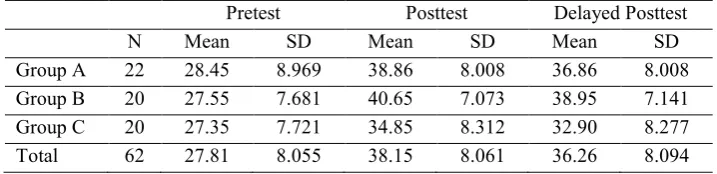
used instruments. Mean scores and SD values for performances of all three study groups on the AWL pre-, post-, and delayed posttests are presented in Table 1.
Table 1.
Means and SDs for Three Groups’ Scores on The AWL Pre-, Post-, and Delayed Posttests
Pretest Posttest Delayed Posttest
N Mean SD Mean SD Mean SD
Group A 22 28.45 8.969 38.86 8.008 36.86 8.008 Group B 20 27.55 7.681 40.65 7.073 38.95 7.141 Group C 20 27.35 7.721 34.85 8.312 32.90 8.277 Total 62 27.81 8.055 38.15 8.061 36.26 8.094
As shown in this table, learners’ AWL mean scores were very close on the pretest; however, a noticeable increase was observed from the pre- to posttest across all the groups. The mean scores slightly decreased after a 14-day ISI on the delayed posttest. The highest post- (M=40.65,
SD=7.07) and delayed posttest (M=38.95, SD=7.14) scores were obtained by Group B learners, followed by mean scores of Group A learners’ post- (M=38.86, SD=8) and delayed posttest (M=36.86, SD=8) mean scores. The lowest mean scores on the immediate (M=34.85, SD=8.31) and delayed (M=32.90, SD=8.27) posttests belonged to Group C.
Research Question One
The application of the Levene’s test (F (2, 59) = 1.527, p=.226 > .05) revealed that the assumption of homogeneity of variances was retained. Furthermore, the ANOVA test of linearity for the relationship between pre- and posttest scores (F (1, 35) = 370.816, p < .05) demonstrated that there was a linear relationship between the dependent variable and the covariate.
ANOVA Test of Linearity for the Relationship between Pre- and Posttest Scores
SS df MS F p
Pretest * Posttest
Between Groups
(Combined) 3648.594 26 140.331 15.891 .000 Linearity 3274.660 1 3274.660 370.816 .000 Deviation from
Linearity 373.934 25 14.957 1.694 .074
Within Groups 309.083 35 8.831
Total 3957.677 61
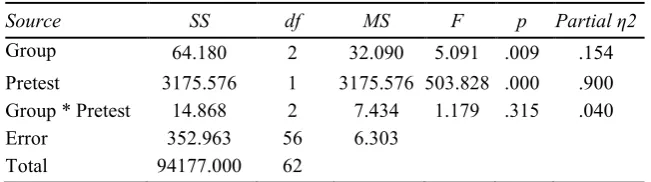
One-way ANCOVA also assumes that the linear relationship between the dependent variable and the covariate, i.e. the homogeneity of the regression slopes, should be the same across the groups. The non-significant interaction between the covariate and the independent variable (three types of treatments) (F (2, 56) = 1.179, p=.315 > .05, partial η2 = .040, representing a weak effect size) shown in Table 3 indicated that the assumption of homogeneity of regression slopes was met.
Table 3.
Testing Homogeneity of Regression Slopes for Posttest Scores by Different Groups
Source SS df MS F p Partial η2
Group 64.180 2 32.090 5.091 .009 .154
Pretest 3175.576 1 3175.576 503.828 .000 .900 Group * Pretest 14.868 2 7.434 1.179 .315 .040
Error 352.963 56 6.303
Total 94177.000 62
Table 4.
Estimated Marginal Means for Vocabulary Posttest Scores by Study Groups
Group Mean Std. Error
95% Confidence Interval
Lower Bound Upper Bound
Group A 38.276a .538 37.200 39.352
Group B 40.883a .563 39.755 42.010
Control C 35.264a .563 34.136 36.392
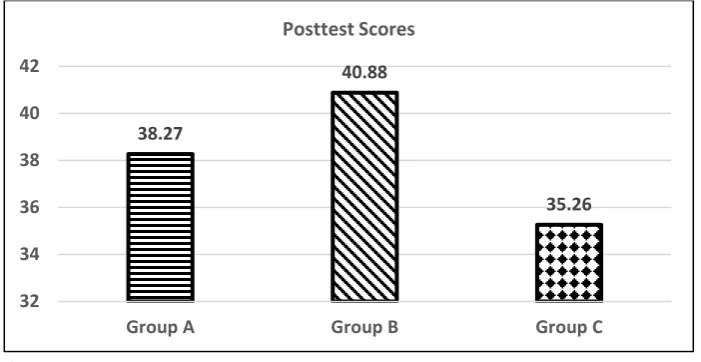
The following figure provides a vivid picture of the differences between the mean scores obtained by different groups after dethatching the effect of the covariate:
Figure 1.
Posttest scores by three study groups
Table 5 displays the main results of the one-way ANCOVA based on which (F (2, 58) = 24.931, p < .05, partial η2 = .462 representing a large effect size), it can be concluded that there were significant differences between the three groups’ means on the posttest of vocabulary after controlling for the effect of the pretest.
38.27
40.88
35.26
32 34 36 38 40 42
Group A Group B Group C
Table 5.
ANCOVA Results for the Posttest Scores Obtained by Study Groups
Source SS df MS F p Partial η2
Pretest 3241.861 1 3241.861 511.182 .000 .898 Group 316.225 2 158.113 24.931 .000 .462
Error 367.830 58 6.342
Total 94177.000 62
It should also be noted that the significant F-value associated with the covariate (pretest) (F = 511.182.57, p < .05, partial η2 = .898) indicated that the pretest was correctly chosen as a covariate, i.e. it had a significant role in this model and could explain about 89.8 percent of the variation in the posttest scores. Post-hoc comparison tests (Table 6) were employed in order to compare the groups two by two to locate the exact place of the differences.
Table 6.
Pairwise Comparisons for Posttest Scores by Study Groups
(I) Group (J) Group Mean Difference (I-J) p
Group A Group B -2.607* .001
Group C 3.012* .000
Group B Group C 5.619* .000
The pairwise comparisons indicated that Group A that received explicit vocabulary teaching before meaning-focused experience (adjusted
M = 38.27) significantly outperformed Group C (adjusted M=35.26) on the posttest of vocabulary (Mean Difference = 3.012, p < .05). Moreover, Group B (adjusted M = 40.88) significantly outperformed group C (MD = 5.619, p < .05) and Group A on the vocabulary posttest (MD = 2.607, p < .05).
Research Question Two
retention. Running Levene’s test revealed that the assumption of homogeneity of variances was not violated (F (2, 59) = 1.269, p= .289> .05). ANOVA Test of Linearity made it clear (F (1, 34) = 438.398, p < .05) that there was a linear relationship between the dependent variable and the covariate.
Table 7.
ANOVA Test of Linearity for the Relationship between Pretest and Delayed Posttest Scores
SS df MS F p
Pretest * Delayed Posttest
Between Groups
(Combined) 3702.761 27 137.139 18.291 .000 Linearity 3286.912 1 3286.912 438.398 .000 Deviation from
Linearity 415.848 26 15.994 2.133 .019
Within Groups 254.917 34 7.498
Total 3957.677 61
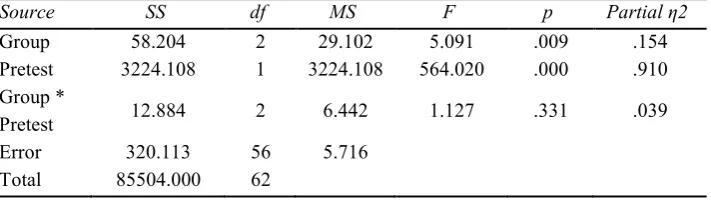
As displayed in Table 8, there was not a statistically significant interaction between the pretest scores and the three groups posttest scores (F (2, 56) = 1.127, p=.331 > .05, partial η2 = .039, representative of a small effect size). Therefore, it was concluded that the assumption of homogeneity of regression slopes was retained.
Table 8.
Testing Homogeneity of Regression Slopes for Delayed Posttest Scores by Different Groups
Source SS df MS F p Partial η2
Group 58.204 2 29.102 5.091 .009 .154
Pretest 3224.108 1 3224.108 564.020 .000 .910 Group *
Pretest 12.884 2 6.442 1.127 .331 .039
Error 320.113 56 5.716
The next table displays the descriptive statistics for the estimated marginal means at the delayed posttest for the study groups after detaching the covariate effect.
Table 9.
Estimated Marginal Means for Vocabulary Delayed Posttest Scores by Study Groups
Group Mean Std. Error
95% Confidence Interval
Lower Bound Upper Bound
Group A 36.272 .511 35.248 37.296
Group B 39.184 .536 38.111 40.257
Group C 33.317 .536 32.244 34.390
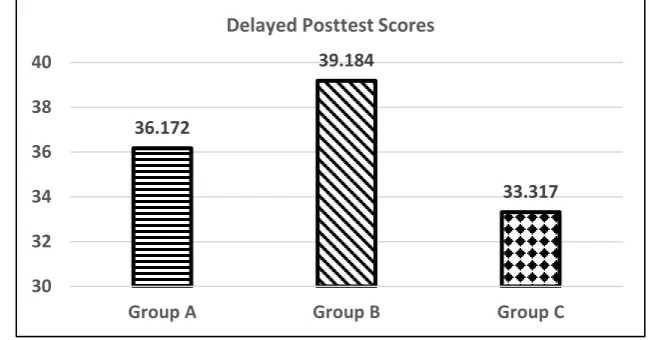
According to Table 9, learners who received direct vocabulary teaching during their meaning-focused experience (M = 39.18) had the highest mean score, followed by participants who received their special treatments before (M=36.27) and after (M=33.31) the meaning-focused experience. Furthermore, the mean scores have somehow decreased form the posttest to the delayed posttest for about two scores. Figure 2 clearly illustrates the differences between the mean scores gained by the three groups on the delayed posttest after removing the covariate effect:
Figure 2.
Delayed posttest mean scores by three study groups
36.172
39.184
33.317
30 32 34 36 38 40
Group A Group B Group C
Another one-way ANCOVA (Table 10) was applied to examine the effect of time of explicit vocabulary teaching on EFL learners’ vocabulary retention, revealing that there were statistically significant differences among the three groups’ performances on the delayed posttest (F (2, 58) = 29.979, p < .05, partial η2 = .508, indicative of a large effect size) after removing the effect of the covariate (pretest scores).
Table 10.
ANCOVA for the Delayed Posttest Scores Obtained by Study Groups
Source SS df MS F p Partial η2
Pretest 3284.344 1 3284.344 572.054 .000 .908 Group 344.242 2 172.121 29.979 .000 .508
Error 332.997 58 5.741
Total 85504.000 62
Moreover, the covariate could significantly explain about 90% of the variance for the participants’ scores on the delayed posttest (F (1, 56) = 572.054, p < .05, partial η2 = .908). Post-hoc comparison tests (Table 11) were run to pinpoint the exact location of the differences as follows:
Table 11.
Pairwise Comparisons for the Delayed Posttest Scores by Study Groups
(I) Group (J) Group Mean Difference (I-J) p
Group A Group B -2.912* .000
Group C 2.956* .000
Group B Group C 5.867* .000
The pairwise comparisons showed that learners in Group B (adjusted
M = 39.18) significantly excelled group C (adjusted M=33.31) on the delayed posttest (MD = 5.867, p < .05) and Group A learners (adjusted
M=36.27) on the same test (MD = 2.912, p < .05). Additionally, Group A significantly did better than Group C on the delayed posttest (MD = 2.956,
during the meaning-focused experience for both vocabulary development and retention was significantly more effective than the other two times (pre- and post-teaching times). Moreover, receiving explicit vocabulary instruction prior to the meaning-focused experience could better increase learners’ vocabulary growth and retention compared with getting this instruction after such experience.
Research Question Three
The oral interviews were analyzed, transcribed, codified, and categorized using MAXQDA software. Some major themes were extracted from the qualitative data analysis. First, learners who received explicit vocabulary teaching concurrent with the reading experience expressed more positive attitudes. Group B participants who received explicit vocabulary teaching during the meaning-focused experience of reading expressed more positive attitudes toward the usefulness of the received treatment. Second, it was deciphered that receiving explicit instruction of new words concurrent with encountering the target words in reading texts could help learners guess the meaning of the word based on the contextual clues and this, in turn, could help them feel more motivated to gain vocabulary knowledge about the word through explicit on-the-spot activities. Mahshid, one of the participants, for example, said that:
when I receive extra information about the word that I have come across, I can learn the word better especially if I can do some exercises using that word while its use in context is in front of my eyes.
when I first notice the word in a sentence in a broader context of a paragraph or a text, I will try to guess the meaning of the word, of course, if I do not know the meaning. Then, I try to remember the word and other surrounding words. All these unique features help me to learn and feel more capability for learning. My willingness to learn and sharpened curiosity absorb the teacher’s extra information and finally when I am engaged in doing some exercises such as fill-in-the-blanks and sentence writing, I really internalize the word.
Another emerged theme was about the drawbacks of concurrent vocabulary explicit instruction accompanied by reading passages. All participants advocated the explicit teaching of new words through various exercises during the meaning-focused experience; nonetheless, they disagreed that such explicit activities should come after reading the sentence or the short paragraphs including the sentence within which the target word was embedded. The reasons put forward in their support of such treatment included the strong mnemonic aspect, more complete cognitive chain, and motivating nature of the double treatment they received. Regarding these advantages of explicit vocabulary teaching activities during the meaning-focused experience, Sarina, one of the learners in Group B, enthusiastically mentioned that:
when I see a new word in the context, first of all, I try to guess its meeting and then I am eager to know more about it and do some exercises and when I treat the words in this way I feel motivated, interested, and active during reading the passages. Moreover, I feel more willing to give and take information about the word.
direct pre-teaching of English vocabulary during the educational semester increased my comprehension of the meanings of the words in the related reading passages we read subsequently.
With regard to the effectiveness of the explicit vocabulary preaching, it was observed that these activities helped Group A learners memorize the words more easily when encountered again in the unit. For instance, Parisa (all the names of Persian pseudonyms used for ethical issues and confidentiality), told that:
pre-teaching of words could help me remember the meaning, spelling, and part of speech of a target word better after I came across them in the texts. I also think such pre-teaching exercises could help me recall the meanings of those words that I learned during the term.
Another additional pattern located in the qualitative data was spotted for Group B learners; four of the students expressed that pre-teaching of vocabulary motivated them in better ways and prepared their minds for greater learning. Only one of the oral interviewees in this class was not satisfied with the received treatment, however. She commented that:
explicit pre-teaching of new words is not helpful because it is done before having any idea about the meanings of the words in the context of the target text. I think isolating the words and taking them out of their contexts is not as useful as it may seem, at least it was not helpful for me (Parnian).
when our teacher said we are going to do some exercises about the new words of the unit, I was puzzled a little since I felt I did not notice them at all. Thus, in my opinion, it is much better to introduce the words during reading and then do some activities after reading the text has finished.
Regarding the deeper learning of the words, three participants unanimously agreed that post-teaching tasks and exercises could solidify learning, memorizing, and recalling of the meanings and forms of those words. Nima, for example, uttered that:
post-teaching tasks and exercises increase my comprehension of the meanings of the words that I have already seen in the reading passages and help me memorize and remember the words in better ways.
Finally, it was unraveled that post-teaching tasks had their own drawbacks. For example, two of the participants in Class C expressed concerns about the effectiveness of post-teaching activities arguing that they either did not like them or at least these activities did not suit their learning styles.
As understood from their answers in the oral interviews, participants who received explicit vocabulary-teaching concurrent with reading texts had more positive attitudes and more motivating feelings for noticing, intaking and retaining the target words. Furthermore, learners who were pre-taught the intended vocabulary had slightly more positive views and opinions about the best time for direct vocabulary teaching in comparison with those learners (Group C) who received the post-teaching of L2 words.
Research Question Four
Plano Clark, 2010). Creswell (2014), for instance, has suggested that reporting explanatory sequential mixed study results “follows the form of first reporting the quantitative, first-phase results and then the qualitative, second phase results. However, this design then employs a third form of interpretation: how the qualitative findings help to explain the quantitative results” (p. 274).
In the current study, results of the larger quantitative phase showed that explicit vocabulary teaching during reading texts could help learners do more significantly better than those who received pre- or post- teaching direct vocabulary instruction on the immediate and delayed posters. Furthermore, learners who were pre-taught vocabulary outperformed those participants who received post-teaching instruction on the post- and delayed posttests. The results of the qualitative phase also revealed that participants had more positive attitudes about the concurrency of explicit and implicit vocabulary learning for L2 vocabulary development and retention. They also showed slightly more positive attitudes and views about pre-teaching of L2 words compared with post-teaching. Therefore, the results of the two phases of the study converge and this conclusion can be drawn that the optimal time for explicit vocabulary development and retention accompanied by meaning-focused input is its incorporation during the meaning-focused experience.
Discussion
quantitative analysis and qualitative descriptions given by the participatory EFL learners.
The superiority of explicit vocabulary-teaching during the meaning-focused experience can be attributed to the prominent features of the combination of explicit and implicit instruction cited in the current literature (e.g. Elgort et al., 016; Nation, 2013; Schmitt, 2019) such as the stronger associations between form and meaning provided by rich contextual clues, the simultaneous interaction between the learner, the text and other players in the scene of learning, i.e the teachers and peers who could provide scaffolding and feedback. The findings of the current study are strongly supported by existing theories and literature about L2 vocabulary development. A meticulous review of the previous research has culminated to this point: L2 vocabulary acquisition is exponentially facilitated when meaning-focused experience and contextual learning are accompanied by deliberate or direct elaborations (Elgort et al., 2016; Laufer, 2005; Schmitt, 2008). For example, having elaborated on the challenges of contextual indirect word learning through meaningful input, Elgort et al. (2016) found that “deliberate learning procedures may be particularly beneficial for English language learners whose L1 is not alphabetic” (p. 648).
direct teaching of new words through further elaboration can obviate the need for more encounters or at least dramatically decrease the number of these encounters.
Results of the present study can also be justified in the light of Involvement Load Hypothesis based on which the extra practice with novel L2 vocabulary through the different elaboration procedures and direct exercises increases the learners’ involvement with learning the word (Ko, 1995; Schmitt, 2008) that enhance L2 learners’ cognitive involvement with the word that, in turn, pave the way for more vocabulary learning. According to Laufer and Hulstijn’s (2001) Involvement Load Hypothesis, such involvement is facilitative for lexical knowledge absorption in an L2. In addition, when L2 words are taught or learned through input, instruction, and involvement (3Is as mentioned by Laufer, 2017), they are better ingrained in the mind and more easily retrieved. Simultaneous explicit instruction of the new words during reading a text provides the 3Is to an acceptable extent.
By reviewing the existing literature on the use of direct elaboration and meaning-focused input for L2 vocabulary, it is understood that researchers mainly investigated the post-reading (e.g. Hill & Laufer; Mondria, 2003; Paribakht & Wesche, 1997; Sonbul & Schmitt, 2009; Zimmerman, 1997) or post-listening (e.g. Hennebry, et al., 2017) tasks and elaborations and reported significant effects compared with implicit conditions; however, comparative studies on the pre-, concurrent, and post-teaching of L2 words to date are handful. Therefore, the first finding of the study can not be directly compared or contrasted with earlier empirical studies.
accompanied by explicit teaching of L2 vocabulary could significantly help learners acquire and retain the target words better than only implicit instruction. More importantly, the study results revealed that pre-reading and listening dialogues could help learners significantly do better on both learning (immediate protest scores) and recalling (delayed post-test scores) of the target words through visual explicit instruction than those counterparts who received pre- and post-teaching of written-only dialogues.
Concerning the second finding about the more significant role of pre- rather than post-teaching activities on L2 vocabulary development and retention, it can be argued that as mentioned by Nation (2013), previous encounters with lexical items can trigger the subsequent noticing of these items in the upcoming input and can lead to more lexical intake as supported by Schmidt’s (1990) Noticing Hypothesis. Providing learners with direct vocabulary teaching before coming upon those words in oral (listening) or written (reading) input is, in fact, an input enhancement activity that has verified its effectiveness based on lexical form-focused instruction (FFI) as empirically supported by numerous studies (e.g. Hill & Laufer, 2003; Laufer, 2006; Sharwood Smith & Truscott, 2014; Shintani, 2013).
Conclusion and Implications
learning and recalling the target L2 words for the direct post-teaching has proved its efficiency and consolidation impact based on ample research evidence as outlined in the literature review.
The findings of this study have some pedagogical implications for EFL learners, teachers, and syllabus designers. Teachers, for example, are recommended to teach the new words explicitly while they are encountered in the meaning-focused input (provided either through reading or/and listening). Teachers are also recommended to use some explicit pre-teaching activities for the target words that are presented in the successive reading passages. Learners should also pay meticulous attention to the arrangement of the explicit strategies and techniques for vocabulary learning and they should give more weight to the strategies and practices that are used amidst the meaning-focused experience or a priori. Of course, this study does not offer that both teachers and learners should avoid using post-reading explicit instruction for the target words since such activities have robust consolidation effects as mentioned by Laufer (2017). The third group of beneficiaries for the implications of the present study includes syllabus designers and those who are involved in instructional materials development. Syllabus designers and material developers should try to include explicit vocabulary activities and tasks that can be done concurrently with the meaning-focused experience that is mainly delivered through reading and to a lesser extent through listening materials. These activities and tasks should have a considerable variety to help a larger range of students with different cognitive and learning styles learn and retain the words. Though in fewer numbers, explicit vocabulary teaching activities also need to be included as the warm-up or introduction to the main reading passages. Moreover, the syllabus designers are advised not to forget to develop coursebooks or instructional contents that use explicit post-teaching tasks right after the meaning-focused experience to reinforce the power of the initial learning of the words and to lengthen the retention span of the target L2 words.
therefore, researchers had to accept some inevitable limitations and impose some delimitations as follows. The researcher did not have access to a large sample, the randomization of learners was not possible, the proficiency level could not be guaranteed by administrating standardized tests, and the gender of the learner was not controlled. Accordingly, future studies can be done through larger samples with more robust methodological procedures to consider factors such as age, gender, proficiency level, learning styles and strategies to further verify the results achieved in this study. Moreover, this study administered one immediate posttest; thus, further research can be launched with more elaborate designs to check vocabulary knowledge gains gradually by giving numerous immediate posttests.
References
Alamri, K., & Rogers, V. (2018). The effectiveness of different explicit vocabulary-teaching strategies on learners’ retention of technical and academic words. The Language Learning Journal, 46(5), 622– 633,
Alcón, E. (2007). Incidental focus on form, noticing and vocabulary learning in the EFL classroom. International Journal of English Studies, 7(2), 41–60.
Alderson, J. C. (2005). Diagnosing foreign language proficiency. London: Continuum.
Arndt, H. L., & Woore. R. (2018). Vocabulary learning from watching YouTube videos and reading blog posts. Language Learning & Technology, 22(1), 124–142.
Bernard, H. R. (2013). Social research methods (2nd ed.). Thousand Oaks,
CA: Sage.
Bolger, D. J., Balass, M., Landen, E., & Perfetti, C. A. (2008). Contextual variation and definitions in learning the meaning of words.
Discourse Processes, 45(2), 122–59.
Coxhead, A. (2000). A new academic word list. TESOL Quarterly, 34(2), 213–238.
Coxhead, A., Nation, I. S. P., & Sim, D. (2015). Vocabulary size and native speaker secondary school students. New Zealand Journal of
Educational Studies, 50(1), 121–135.
Creswell, J. W. (2012). Educational research: Planning, conducting, and evaluating quantitative and qualitative research (4th Ed.). Upper
Saddle River, NJ: Merrill.
Creswell, J. W. (2014). Qualitative inquiry and research design: Choosing
among five approaches (4th ed.). Thousand Oaks, CA: Sage.
Elgort, I., Candry, S., Boutorwick, T. J., Eyckmans, J., & Brysbaert, M. (2016). Contextual word learning with form-focused and meaning-focused elaboration. Applied Linguistics, 39(5), 646–667.
Ellis, R. (2009). Implicit and explicit learning, knowledge and instruction. In R. Ellis (Ed.), Knowledge in second language learning, testing and teaching (pp. 3–26). Bristol: Multilingual Matters.
Ellis, R. (2015). Understanding second language acquisition (2nd Ed.).
Oxford: Oxford University Press.
González Fernández, B., & Schmitt, N. (2017). Vocabulary acquisition. In S. Loewen, & M. Sato (Eds.), Routledge handbook of instructed SLA
(pp. 280–298). New York: Routledge.
Gwet, K. L. (2014). Handbook of inter-rater reliability (4th Ed.).
Gaithersburg, MD.: Advanced Analytics, LLC.
Hennebry, M., Rogers, V., Macaro, E., & Murphy, V. (2017). Direct teaching of vocabulary after listening: Is it worth the effort and what method is best? The Language Learning Journal, 45(3), 282–300. Hill, M., & Laufer, B. (2003). Type of task, time-on-task and electronic
dictionaries in incidental vocabulary acquisition. International
Review of Applied Linguistics in Language Teaching (IRAL), 41(2),
87–106.
Hulstijn, J. H. (2001). Intentional and incidental second-language vocabulary learning: A reappraisal of elaboration, rehearsal, and automaticity. In P. Robinson (Ed.), Cognition and second language
instruction (pp. 258–286). Cambridge: Cambridge University Press.
Laufer, B. (2005). Focus on form in second language vocabulary learning. In S. Foster-Cohen, M. P. García Mayo, & J. Cenoz (Eds.),
EUROSLA Yearbook 5 (pp. 223–250). Amsterdam: John Benjamins.
Laufer, B. (2006). Comparing focus on form and focus on forms in second-language vocabulary learning. Canadian Modern Language Review, 63(1), 149–66.
Laufer, B. (2017). From word parts to full texts: Searching for effective methods of vocabulary learning. Language Teaching Research, 21(1), 5–11.
Laufer, B., & Hulstijn, J.H. (2001). Incidental vocabulary acquisition in a second language: The construct of task-induced involvement.
Applied Linguistics, 22(1), 1–26.
Lombard, M., Snyder-Duch, J., & Bracken, C. C. (2002). Content analysis in mass communication: Assessment and reporting of intercoder reliability. Human Communication Research, 28(4), 587–604. Marulis, L. M., & Neuman, S. B. (2010). The effects of vocabulary
intervention on young children's word learning: A meta-analysis.
Review Of Educational Research, 80(3), 300–335.
McCarthy, M., & O’Dell, F. (2016). Academic vocabulary in use:
Vocabulary reference and practice, self-study and classroom use.
Cambridge: Cambridge University Press.
Mitchell, R., & Myles, F. (2004). Second language learning theories (2nd
Ed.). London: Hodder Arnold.
Mondria, J. (2003). The effects of inferring, verifying, and memorizing on the retention of L2 word meanings: An experimental comparison of the meaning-inferred method and the meaning-given method.
Studies in Second Language Acquisition, 25(4), 473–99.
Morgan, D. (1998). The focus group guidebook. Thousand Oaks, CA: Sage.
Nation, I. S. P. (2008). Teaching vocabulary: Strategies and techniques. Boston: Heinle.
Nation, I. S. P. (2010). Researching vocabulary: A vocabulary research
manual. London: Palgrave Macmillan.
Nation, I. S. P. (2013). Learning vocabulary in another language (2nd Ed.).
Cambridge, England: Cambridge University Press.
Nation, I. S. P. (2015). Principles guiding vocabulary learning through extensive reading. Reading in a Foreign Language, 27(1), 136–145. Nation, I. S. P. (2016). Making and using word lists for language learning
and testing. Amsterdam, The Netherlands: John Benjamins.
Paribakht, T. S., & Wesche, M. (1997). Vocabulary enhancement activities and reading for meaning in second language vocabulary development. In J. Coady, & T. Huckin (Eds.), Second language
vocabulary acquisition (pp. 174–199). Cambridge: Cambridge
University Press.
Plano Clark, V. L. (2010). The adoption and practice of mixed methods: U.S. trends in federally funded health-related research. Qualitative Inquiry, 16(4), 428–440.
Pellicer-Sanchez, A., & Schmitt, N. (2010). Incidental vocabulary acquisition from an authentic novel: Do things fall apart? Language Learning & Technology, 17(2), 75–99.
Perfetti, C. A. (2007). Reading ability: Lexical quality to comprehension.
Scientific Studies of Reading, 11(4), 357–83.
Perfetti, C. A., & L. Hart. (2002). The lexical quality hypothesis. In L. Vehoeven, C. Elbro, & P. Reitsma (Eds.), Precursors of functional
literacy (pp. 189–213). New York: Benjamins.
Reichle, E. D., & Perfetti, C. A. (2003). Morphology in word identification: A word experience model that accounts for morpheme frequency effects. Scientific Studies of Reading, 7(3), 219–37. Rohrer, D., & Pashler, H. (2007). Increasing retention without increasing
study time. Psychological Science, 16(4), 183–186.
Schmitt, D., Schmitt, N., & Mann, D. (2011). Focus on vocabulary (Book
2): Bridging vocabulary. New York: Longman.
Schmitt, N. (2008). Instructed second language vocabulary learning.
Language Teaching Research, 12(3), 329–363.
Schmitt, N. (2010). Researching vocabulary: A vocabulary research
manual. Basingstoke: Palgrave MacMillan.
Schmitt, N., & McCarthy, M. (1997). Introduction. In N. Schmitt, & M. McCarthy (Eds.), Vocabulary: Description, acquisition, and
Schmitt, N. (2014). Size and depth of vocabulary knowledge: What the Research Shows. Language Learning, 64(4), 913–951.
Schmitt, N. (2019). Understanding vocabulary acquisition, instruction, and assessment: A research agenda. Language Teaching, 52(2), 261– 274.
Serrano, R. (2011). The time factor in EFL practice. Language Learning, 61(1), 117–145.
Serrano, R., & Huang, H. U. (2018). Learning vocabulary through assisted repeated reading: How much time should there be between repetitions of the same text? TESOL Quarterly, 52(4), 971–994. Sharwood Smith, M., & Truscott, J. (2014). Explaining input
enhancement: A MOGUL perspective. International Review of
Applied Linguistics in Language Teaching, 52(3), 253–81.
Shintani, N. (2013). The effect of focus on form and focus on forms instruction on the acquisition of productive knowledge of L2 vocabulary by young beginning-level learners. TESOL Quarterly, 47(1), 36–62.
Smithson, J. (2000). Using and analyzing focus groups: Limitations and possibilities. International Journal of Social Research Methodology,
3(2), 103–19.
Sonbul, S., & Schmitt, N. (2009). Direct teaching of vocabulary after reading: Is it worth the effort? ELT Journal, 64(3), 253–60.
Stæhr, L. S. (2008). Vocabulary size and the skills of listening, reading, and writing. The Language Learning Journal, 36(2), 139–152. Suzuki, Y. (2017). The optimal distribution of practice for the acquisition
of L2 morphology: A conceptual replication and extension.
Language Learning, 67(4), 512–545.
Tabachnick, B.G., & Fidell, L.S. (2013). Using multivariate statistics (6th
ed.). Boston: Pearson Inc.
Takač, V. P. (2008). Vocabulary learning strategies and foreign language acquisition. Clevedon: Multilingual Matters.
Thornbury, S. (2015). How to teach vocabulary. Harlow: Pearson Educated Limited.
Vidal, K. (2011). A comparison of the effects of reading and listening on incidental vocabulary acquisition. Language Learning, 61(1), 219– 258.
van Zeeland, H., & Schmitt, N. (2013). Lexical coverage in L1 and L2 listening comprehension: The same or different from reading comprehension? Applied Linguistics, 34(4), 457–479.
Webb, S. (2008). The effects of context on incidental vocabulary learning.
Reading in a Foreign Language, 20(2), 232–245.