Volume 5
Article 6
2016
Full Issue (Spring 2016)
Camila Gabaldon
Western Oregon University, [email protected]
Follow this and additional works at:
https://digitalcommons.wou.edu/pure
Part of the
Arts and Humanities Commons,
Life Sciences Commons, and the
Social and
Behavioral Sciences Commons
This Article is brought to you for free and open access by the Student Scholarship at Digital Commons@WOU. It has been accepted for inclusion in PURE Insights by an authorized editor of Digital Commons@WOU. For more information, please [email protected].
Recommended Citation
Table of Contents
Editor’s Notes ... 2
Cover Art Description ... 3
“Drugs was My Solution -- My Problem was Life”: Heroin Addiction and the Life
Course Perspective ... 4
Directional Preference in
Drosophila melanogaster
... 12
Prehistoric Incentives to High Altitude Settlement in Wyoming’s Wind River Range
... 20
Charlton Heston’s Rhetoric on Political Correctness, Use of Ideographs, and
Editor’s Notes
I didn't have a theme in mind when the call for papers for this issue went out, but as submissions came in, I
was pleasantly surprised find that one emerged anyway. Each piece in this issue examines some aspect of
finding direction. Articles include explorations of how fruit flies find their way, how recovering addicts paths led
them to and from drug addiction, where prehistoric civilizations sought resources to survive, and, finally, walk
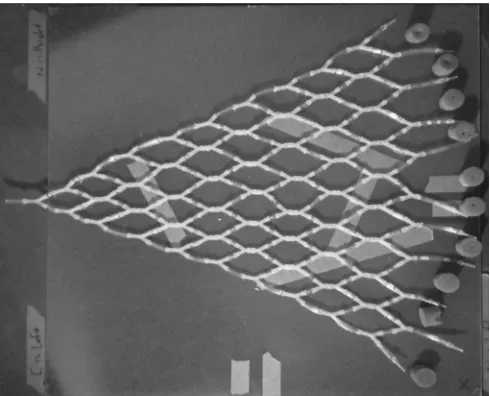
us through the nuances of rhetoric. Jen Bracy's amazing cover art is the perfect lead into this issue, with its
images evoking thoughts of journeys, discoveries, and adventure.
Each year I am amazed by the quality of submissions we receive. This is due entirely to the hard work of the
students and faculty who authored, reviewed, and sponsored these pieces. Thank you to all of you for your
amazing work. I hope you enjoy reading this issue as much as I have.
Camila Gabaldón,
Cover Art: Wanderlust
Jen Bracy,
Western Oregon University
“Drugs was My Solution -- My Problem was Life”:
Heroin Addiction and the Life Course Perspective
Kayli Fisher, Department of Psychology, Western Oregon University
Margaret Manoogian, Department of Gerontology, Western Oregon University
Stephanie Hoover, Department of Psychology, Western Oregon University
Faculty Sponsors: Dr. Margaret Manoogian and Dr. Stephanie Hoover
Heroin and other opiate dependencies affect individual users, interpersonal relationships, and communities. The purpose of this qualitative study was to better understand the life course paths of individuals who have been through addiction, treatment, and are currently in recovery. In-depth interviews were conducted with five participants in recovery to learn their retrospective account of how early and current life experiences shaped their addiction, treatment, and recovery. Participant narratives suggest that early childhood experiences, specifically parental abuse and social rejection, combined with
substance abuse as a model for coping, influenced the development of addiction. Participants’ expressed the importance of social support and self-awareness during and after treatment to sustain their recovery.
Keywords: heroin addiction, recovery, family relationships, life course perspective
Heroin addiction harms not only the user but also the greater community. Issues of employment, financial resources, and unlawful behavior influence the local economy and community as a whole (Mark, Woody, Juday, & Kleber, 2001). Experts estimate the annual economic cost of heroin addiction to be over $21.9 billion in the United States (Mark et al., 2001). Law
enforcement, treatment services, and DHS (Department of Human Services) typically interact with people with heroin addiction. Others in the community may not see specific behaviors as symptoms of a disorder—which is, in this case, addiction—but rather as a series of choices that are completely within the individual’s control (Fulton, 1999). As a result of this, addicts perceive high levels of stigma against them, even when they are in recovery and actively engaged in treatment (Luoma et al., 2007). The goal of this study was to illuminate the perspective and experience of individuals who identify as recovering heroin addicts. Specifically, we sought their retrospective accounts of the role of early and current life experiences in shaping their risk for addiction, treatment, and
recovery.
Heroin addiction is a disorder (American Psychiatric Association, 2013). Multiple uses require continued use and increased dosage to avoid withdrawal symptoms (Van Zyl, 2009). Substance abuse corresponds with increased spending and drug-seeking behaviors that can have negative personal and interpersonal consequences (Cheng, Lu, Han, Gonzalez-Vallejo, & Sui, 2012; Higgs, Jordens, Maher, & Dunlop, 2009; Simmons & Singer,
2006). The National Survey of Drug Use and Health (NSDUH, 2011) determined that 1.6% of the population had used heroin in their lifetime, and individuals aged twelve and older who had used in the past month was just over 0.1%. It is estimated that the total number of heroin users per year in the United States is 560,000, and the number of frequent users is approximately 338,000. Many researchers agree that the prevalence of heroin use is likely higher than these estimates because of inaccurate reporting (Mark et al., 2001). Longitudinal research on long-term success of opiate and heroin recovery is scarce. However, one study from Australia suggested that, depending on the form of addiction intervention, long-term success rates for those in treatment can range from 52-63% (Ross et al., 2004). Despite low prevalence rates, heroin’s highly addictive potential is especially dangerous (Cheng et al., 2012; Vaillant, 1988; Van Zyl, 2007). Withdrawal symptoms of heroin are so extreme that the individuals may use to avoid enduring multiple days of nausea, muscle/ bone aches, sweating, and insomnia (“National Drug Strategy,” 2013).
changes within social contexts (Connidis, 2011). Specifically, the life course perspective focuses on pathways through the lifespan, age-related roles, transitions, and trajectories over time (Hser, Longshore, & Anglin, 2007). Additionally, the life course perspective provides an understanding of how the individual, family unit, and community changes interact and influence the other.
A life course perspective is an appropriate lens for investigating substance dependence because of the known role of early life experiences, family, and
environment in addiction (Hser et al., 2007). In terms of family, individuals whose parents modeled substance use may be more likely to repeat that behavior, having learned this specific coping method instead of healthier alternatives (Hedges, 2007; Hser et al., 2007). In addition, individuals may be more likely to develop drug dependence because of genetic factors that make them more susceptible to addiction (Hawkins, Catalano, & Miller, 2007). In terms of childhood experiences, Van Gundy and Rebellon (2010) found that adolescence-specific stressors and high stress environments corresponded with potential future substance abuse. Early marijuana use alone did not explain later
substance abuse. The life course perspective helps to illuminate how modeled substance use in the home and traumatic or stressful events may increase risk for addiction.
In this study, qualitative methods were employed to aid our understanding of the heroin user’s perspective of addiction, treatment, and recovery within their social context. The research questions investigated in the current study were: a) How do adults with heroin addiction perceive the role of earlier and current life experiences in shaping their addiction and recovery?; and b) How do adults with heroin addictions experience and evaluate their family, peer, and community
relationships over time?
Method
Scholars have recognized the importance of qualitative methods in understanding individuals who struggle with addiction (Neale, Allen, & Coombes, 2005). This exploratory qualitative study examined the
experiences of post-treatment, long-term recovery individuals with a history of heroin or other opioid addiction. Recruitment was conducted after university Institutional Review Board approval. The criteria for participation in the study included participants who: a) were 18 years of age or older, b) experienced a history of heroin or other opioid addiction, and c) completed at least one year of ongoing recovery time. Identification of
participants occurred with the help of a community administrator of a treatment agency in Oregon who agreed to assist in recruiting participants who met the study’s criteria. Five participants expressed interest in participating in the study, and their names were forwarded to the first author. This convenience sample strategy resulted in participants who were comfortable sharing their narratives and were affiliated with the targeted treatment agency
All agency-identified participants were contacted by the first author to determine interest and orient the participant to the study. After informed consent procedures, participants were interviewed about their childhood and personal history, addiction history, recovery experiences, and continued abstinence. Interviews were conducted at the participating treatment agency. The semi-structured protocol included
demographic and open-ended questions. Participants were asked questions regarding their family of origin, school experiences, first exposure to drugs and alcohol, addiction and recovery processes, as well as current social support resources. Examples of specific questions included: How was your relationship with your parents growing up?; As you think back on your childhood, are there experiences that you feel contributed to your addiction?; and Please tell me the story of your recovery process? Interviews ranged from 45 minutes to an hour in length, and participants were free to discuss the elements of their addiction story that they found to be most relevant, although certain elements such as family history and peer relationships were actively probed as per the interview protocol.
All recorded interviews were transcribed verbatim, and each transcript was read several times by the first and second authors and later discussed during research meetings. A coding system (Berg, 2008) was developed for analysis. Nineteen major codes (i.e. school history, parental influence on addiction) and 49 subcodes (i.e. performance in school, influences involving mother) were used to analyze the transcribed interviews. Pseudonyms were used in the analysis and presentation of the data. Many aspects of the methods contributed to the rigor of the study, including immersion in the data, supervision by an experienced qualitative researcher (second author), and notes of analytical hunches prior to the coding process (Morrow & Smith, 2000).
Participants
Five individuals were interviewed for this study and
reported heroin (n = 4) or prescription opiate addiction (n
= 1). Four men and one woman were recruited, with
ages ranging from 33-55 years (M = 39.60, SD = 8.76).
as Hispanic. Time of sobriety ranged from 2-10 years (M
= 6.60, SD = 3.44). All participants earned a GED (n = 4)
or completed high school (n = 1), and all participants
attended a minimum of two years of college courses.
Results
Participants described in detail their childhood experiences, addiction history, and their treatment and recovery journeys. In the following section, we highlight four themes that emerged from participant narratives. First, participants identified the family influences that occurred earlier in life that they felt contributed to their addictions. Second, participants referred to experiences outside of their families of origin, citing peer influences— bullying, pressure, and acceptance as factors that deepened their drug use. Third, participants shared common experiences regarding drug use and what contributed to their most recent successful transition to recovery. Finally, participants emphasized the
importance of giving back to the community and forging new pathways once recovery was achieved. Working in settings to help others who struggle with addictions gave meaning to personal journeys.
“I Felt Very Abandoned”: Early Childhood Context The most noteworthy factors that appeared to contribute to addiction later in life focused mainly on childhood experiences, specifically those relating to participants’ family of origin.
Early exposure to drugs and alcohol. One commonality across all five interviews was the presence of parental substance abuse in participants’ homes during childhood. Each participant had at least one parental figure who they described as having a
substance abuse problem, and three participants noted substance use in more than one parental figure in the home. Alcoholism was the most common expression of parental addiction and was present in at least one parent or step-parent across all interviews. The presence of alcohol underscored a home environment that commonly was viewed as unsafe and unpredictable. As one
participant shared, his early family life was “volatile— very, especially when alcohol was added to the mix.” Another participant explained, “As a kid I saw nothing wrong with it [alcohol abuse]. As I got older, I could definitely see some problems, and they pretty much all revolved around my dad’s drinking and his anger.”
Three participants indicated an understanding of the biological nature of addiction as contributive to their disease, sharing a generational perspective on alcohol and drug abuse. For instance, Samuel attributed his father’s alcoholism as a genetic factor in the
development of his addiction. He noted, “So I’m pretty
sure I was born an alcoholic, at least the mindset, the disease of alcoholism.”
Childhood stress and trauma. Whereas three participants acknowledged the genetic nature of their disease of addiction, everyone attributed their later dependence to the various types of abuse they had witnessed and personally experienced in their childhood homes including physical abuse, emotional abuse, sexual abuse, and family violence. A similarity across interviews was the presence of parental abuse during childhood perpetrated against both the participant and other family members. One participant shared that his household was marked by verbal and emotional abuse, while the other four participants also described physical abuse in their homes. For instance, Gary explained his household after his mother remarried by describing that he and his sister were frequently abused by their stepfather. He stated that there were many experiences of “a lot of verbal and physical abuse to myself and my sister. Horrific physical abuse to my mother.” Sexual abuse was noted by one participant. This participant, Jessica, described the abuse perpetrated by her stepfather, in addition to the sexual abuse at the hands of her biological father when she was sent to live with him later in her teenage years:
It was with my stepfather. It was emotional, physical, sexual. It was, I mean, any of the abuses. Financial, like I had, at 13 years old, I had to work in the bean fields and babysit for my own school money to buy school clothes. He wouldn’t let my mom buy me anything…He separated us from our family, especially me.
School experiences. In addition to the childhood experiences in the home that were noted by participants to be influential in the development of their later drug dependence, social rejection during childhood and early adolescence was another common element. This included experiences as the target of bullying, as well as feelings of social anxiety and not fitting in. Marco
explained the trajectory of bullying and how it led to other outcomes that influenced his choices to engage in drugs:
than because I didn’t fit in and I wasn’t up to par with knowing how to do stuff. So then I just acted out behaviorally. By me acting out behaviorally, they started kicking me out. So I thought, well, cool. Now, I don’t gotta go.
As Marco explained, these experiences often led to poor academic performances, which tended to further
exacerbate participants’ desire to disengage from their education. All participants described eventually assimilating into a peer group where they found
acceptance and friendship, although often among peers that were involved in drugs and alcohol.
First experimentation with drugs and alcohol. Peer groups tended to encourage and reinforce substance use and other delinquent behavior such as fighting and stealing. Each participant was asked to discuss a first experience of inebriation under the influence of illicit substances. All participants described their first use as a part of their social environment, whether a friend offered them drugs or alcohol or the group set out to consume them together. Daniel
discussed how he found that his initial experiences with alcohol finally allowed him the social confidence he felt had been missing. He stated that after his freshmen year in high school, “I started drinking more and more and it just, it made me more sociable. I could get over the internal fear of talking with other people and I seemed to fit in and I had fun.” Jessica described her first use beyond marijuana and alcohol with her peer group:
I was sixteen years old and I did my first line and I fell in love with it. And that’s all I wanted to do. I loved how it made me feel. I didn’t care, I was invincible. No one could hurt me anymore. And these people did that. And they liked me, and I wanted to be part of that.
None of the participants, however, began with heroin or other opiates but rather eventually used them. Given the circumstances of their home and school environments, participants shared that drug use became a means of coping with those things that felt out of their control and damaging to their well-being.
“I Went to Jail for That”: Key Elements of Dependence-Related Experiences
Alcohol typically was the most common substance of first use, as well as the one on which most participants developed a dependence either in addition or prior to their addiction to heroin. As Dave explained, “I’ve been exposed to alcohol since I was young. I probably had my first sip around, I don’t know, age 8 or 9. Maybe 10.”
Marijuana and hallucinogenic drugs also were typical first-use substances as highlighted by one participant when he explained, “We were experimenting. I think I used marijuana the first time at age ten or eleven.” Each participant’s addiction to substances progressed until he or she began habitually using heroin, or in one case, prescription opiates. Most participants also continued their dependence on alcohol or other drugs in addition to their heroin use.
A number of strategies were employed to obtain heroin and other opiates across participants. Gary, who mainly used prescription opiates, had learned to manipulate doctors and hospitals into giving him
morphine and prescribing him medication. He described his elaborate understanding of the nature of
communication between hospitals in the area: which doctors would contact doctors in other areas about his attempts to obtain medication; which ones were suspicious; and which ones still believed his claims of unendurable pain:
If I was on vacation in Central Oregon, and I could get away from the campsite for a little bit, I’d drop in to the emergency room at the hospital … I knew which hospitals gave what, and I knew that the urgent care at [Hospital A] and [Hospital B] did not communicate. And I knew which days, which doctors were on rotation, and I just knew how it worked. And they had a very poor system. I capitalized on it, and by design it was for people to be honest, and I was not.
He also stole bottles of unused medication from friends and family, preferring that to stealing from strangers or contacting drug dealers.
Other participants shared that they did what it took to have enough money to pay drug dealers. These
strategies included prostitution, bank robbery, burglaries, drug dealing, and stealing (“boosting”) large appliances from department stores to sell later. Marco discussed taxing other drug dealers as one of the major distributors in the area. He shared:
In California, you have to pay taxes to local gangs. . . Not anyone can sell drugs. So,
sometimes I would just tell people, “Hey, if you’re going to sell, if you don’t want me to rob you, then you gotta give me this much every single week.”
thrown out of school for, uh, for selling LSD in school. I went to jail for that. That was the first experience with that.” Two participants were in and out of the penal system until their final stint in treatment.
The nature of participants’ relationships with their family, peers, and communities immediately prior to treatment were similar across interviews. At the time of active addiction, the only participant who still had a close relationship with a parent had engaged in drug use with both his mother and wife, and had journeyed with them through dependence and recovery. Four participants, however, described their relationships with siblings, parents, and extended family members as “nonexistent.” A typical response from participants regarding
relationships with family members during drug dependence included words such as “distance” and “neglect.” Reflecting on this period, Daniel shared, “If my dad was a little more involved with my life, I think I might have made better choices.”
Participants also highlighted how their drug dependence experiences affected their abilities to find and maintain employment, parent children, and engage in socially-accepted activities. One participant lost his job and marriage due to a relapse after a ten-year period of sobriety. Three participants had their children taken by DHS before entering rehabilitation services. Three participants were living in poverty, and the other two participants were supporting themselves by selling illicit substances. Participants particularly shared difficulties in obtaining and maintaining employment. There was a sense that participants knew they were capable of more, but because of incarceration, pre-employment drug-testing, or having previously been fired for drug-related reasons, they were often simply unable to find work that could stimulate or challenge them. Marco described his frustration with the kind of employment that was available to him:
I had no work history and I had a whole bunch of criminal history. So, the jobs that I could get were all general labor jobs that left me unfulfilled emotionally and spiritually and mentally. Just, it wasn’t a challenge for me. It was completely grunt work.
“Somebody Made You Go”: Steps to Recovery Across participant narratives, there also were common influences identified that shaped their motivation to enter treatment and engage in recovery. Although there were experiences of poverty, loss of relationships, and a sense of alienation from one’s community, each participant was motivated by an
external force, whether that was family members, friends, or a community resource, such as DHS or a parole officer. As Gary put it:
In some way or another, somebody made you go. Because, nobody ever wakes up one day in their addiction and raises their hand and volunteers to go to treatment. You go to treatment for a variety of reasons. One is, you got nowhere else to go, or some external force has applied motivation to you, whether it be your family, or the legal system, or your doctor, or whatever. Nobody wakes up one day and says, “I want to go to treatment.” They do not.
Although external support was found to be substantial in the accounts of treatment experiences, there was a general consensus that ultimately the success of treatment was up to the individual in
treatment. Dave is now a treatment counselor after going through his own journey of addiction and treatment. His work allowed him to provide significant insight into the likelihood of successful treatment and recovery:
But really, it’s on the guy coming through the door, ultimately. If that person has hit a point where they’ve hit their bottom, they surrender. They don’t wanna fight anymore, and they’re really coming genuinely from that place. Anybody can be successful at that.
The most notable similarity among participants that
contributed to treatment successwas the presence and
impact of the support they received from peers in treatment and support groups. Each participant mentioned the importance of the bonds formed with people they met in treatment who understood where they had been and what they were currently experiencing. Participants discussed how treatment peers were always willing to help, whether that was lending a supportive ear, providing childcare, or helping the participant move. When asked to describe their current peer support, it was clear that participants’ post-treatment peer relationships provided more meaning than their peer groups during addiction. Jessica met her best friend in treatment, and like the other participants, continues her friendships with her recovery peers. She discussed the significance of her current friendships on her treatment and continued recovery:
Another important factor in recovery was family support, both during and after treatment. As stated previously, family relationships were generally described at an all-time low just prior to entering treatment. Healthy family members had for the most part “written off” their substance-dependent child or sibling prior to the participant seeking treatment. Participants reported, however, that at least one family member was
supportive throughout the treatment process, and that family relationships overall had vastly improved since their recovery. Families of participants, especially their parents, tended to provide childcare as the main expression of support. In one case, the participant’s family now sought support from him, and viewed him as one of the more stable members of his family. Although most participants were not especially close with their parents post-treatment, all of them reported having made amends to the point of civility at minimum. Dave, whose relationship with his father was volatile as a child and adolescent, described the nature of their connection today:
My father’s still on the East Coast. We don’t talk a great deal. But I think we’ve gotten to a place where we’ve moved past our resentments and at least communicate…We communicate openly. There’s no animosity. [chuckles] Sort of the antagonistic nature of that relationship has disappeared.
Participants also indicated a new level of awareness of themselves and the nature of their substance use and addiction. One of the key parts of treatment was working with counselors and support groups to begin talking about the emotions and traumas that are covered up or forgotten from childhoods. Because of this, participants were able to articulate low feelings of self-worth and esteem prior to and during addiction, as well as their relationship to heroin and the other drugs they had used. They were able to reflect on the destructive nature of their dependence, and how their poor emotional well-being had both contributed to and been harmed by their addiction. Marco described the emotional effects of using heroin:
Drugs make you feel more of whatever it is you’re in the mood for feeling. So if you’re feeling like, that person is cute. Or that person is really nice. It’s like, “Oh my god, I’ve never seen anyone so gorgeous in my life.”…But if you’re feeling sad, or you’re feeling like someone let you down, you’re like manic-depressive, crying. Or you’re full of rage and anger and you’re putting your hands on people. ‘Cause you’re just so frustrated…So, it left whatever relationships I had
there at the end—is hurt relationships, untrusting relationships, unhealthy relationships.
The numbing nature of heroin and other opiates was mentioned as something that participants often felt the need to chase in order to escape the emotional pain they experienced at the time. Gary described his addiction as a disease and its relationship to his emotional state prior to treatment and recovery:
[Addiction] has everything to do with your behavior, and your thought processes, and the way that you perceive the world around you, and your inability to reconcile your emotional
condition with your outside environment. And it creates a condition that you cannot stand how you feel. So your condition is that you develop this dependence on changing how you feel.
Marco described the emotional component of his relationship with drugs at the beginning of the development of his dependence. His initial drug use, which consisted of alcohol and marijuana, occurred at age eleven. Prior to this experience, he grew up with his parents who were separated and witnessed drug abuse, criminal activity, and physical violence in the home directed toward himself and others.
And drugs was not my problem. Drugs was my solution. My problem was life. I was always filled with fear. I always felt insecure. I was scared all the time. I had anxiety going on, ‘cause I never knew what was going to happen next. But when I drank, and I smoked that weed, and I had that girl that night, I felt I could accomplish anything in the world. It was like I was Superman.
They knew that their individual histories had set them on a path to addiction, and at the same time had taken responsibility for their actions, including those that led them to treatment and sustained recovery.
“Giving Back”: Interfacing with Communities after Treatment
Participants in this study were employees at a treatment agency, so the nature of their employment would indicate that they would likely feel positively connected to their communities as they worked with community partners in serving their clients. That is, in fact, what the interviews suggested. Participants
balance their perceptions about how the community treated them prior to treatment with an awareness of their state and behaviors amidst their addiction. However, there was a sense of the desire to use their experiences to work to improve a system that they felt had both failed them and saved their lives. As described above, Marco was seeking ways to give back to his community by potentially entering politics. He also shared his life course trajectory that led to his current commitment to community engagement. Marco developed his addiction in early adolescence and described extensive experience with both negative and positive feelings toward his interactions with community resources throughout his lifetime. He now used his past experiences with addiction to make a difference in his work within the treatment agency. He illustrated his commitment by sharing his past history and how that helped him to better connect with clients:
It was in-home robbery, but they knocked it down to burglary. I was 11 years old. And from that time, I had kept on getting in trouble. I was never offered alcohol and drug treatment until I was 24 years old. That’s my experience with ‘em… When I work with the kids—there’s kids that are 16, 17, no foster homes or group homes would take them, and they’re homeless. And when they say, “I don’t know where I’m going to get my next meal,” I say, “I remember that. That sucks.” And they say, “You don’t—you never did that.” And I said, “Oh, really? So, you never had to do this, this, and this?” And they’re like, “Oh shit, you do know.” Right? So now it’s a strength. It’s a gift.
Discussion
The aim of this study was to understand participants’ perspectives of (a) how early life experiences and development influenced later addiction and recovery, and (b) how experiences shaped relationships with family, peers, and communities over time. The life course perspective helps underscore the significance of early-life experiences and trauma in the choices and behaviors of the individual later in life (Hser et al., 2007).
This study showed how participants believed early childhood experiences and family of origin shaped susceptibility to addiction. A few of the individuals in this study’s sample suggested the possibility that they were born with the “disease of addiction,” and that viewing their situation in that way has allowed them to
understand and control their behavior. Regardless of the biological inheritance, children who experienced family substance abuse as a model for coping strategies were
more likely to abuse drugs than those who did not (Hawkins et al., 1992). Further, research suggested that familiarity with substance use as coping, combined with traumatic early-childhood experiences at the hands of a caregiver, increased the individual’s susceptibility to substance dependence later in life (Hawkins et al., 1992; Hser et al., 2007). In this sample, participants reported similar risk factors and also believed that those factors did indeed contribute to their later addiction.
Those who lack healthy support and coping methods in the home typically need resources in their social environment. Unfortunately, when participants were instead met with bullying and/or perceptions of social rejection, participants reported that feelings of loneliness and rejection were exacerbated. Participants in this study had the common characteristic of eventually assimilating into peer groups that introduced and encouraged drug use. Participants saw how the
combined effect of finally finding the emotional support of a peer group as well as the introduction of substances contributed to their addiction, which is consistent with existing research (Dishion, McCord, & Poulin, 1999).
Another common theme among participants was the phenomenon of “liking it instantly,” during the initial use of heroin or their first experience with drugs in general. With a childhood and adolescence filled with rejection, stress, and trauma, these individuals had finally found something that instantly and consistently brought feelings of happiness and freedom from worry. The nature of addiction requires increased doses to induce intoxication, and a base dose will simply allow them to achieve their new state of “normal.”
Because of the extreme addictiveness of heroin, the onset of increased tolerance, withdrawal symptoms, and negative interpersonal consequences may be rapid (“National Drug Strategy,” 2013). For this study, the interpersonal consequences were that any family and friend relationships not related to drug use were no longer pursued. Marco’s previous comments about the nature of his relationships during addiction lend
important insight into this phenomenon. For this study’s sample, any emotional energy invested in existing relationships tended to be volatile, while any new peer connections were mainly formed in the drug community, further reinforcing the lifestyle of the user. As their dependence progressed, the user described how they became increasingly emotionally distant. Poverty, crime, arrests, and time spent in prison all were consequences experienced by participants that can lead to high community costs (Mark et al., 2001).
individual social support systems, including peers, family, and the community (Havassy, Hall, &
Wasserman, 1991; Hser et al., 2007). For participants, the friendships held at the beginning of treatment ultimately were abandoned, as they were developed within the drug community, and deemed detrimental to positive treatment and recovery outcomes. Instead, new friendships were formed in treatment and support groups like Alcoholics Anonymous (AA) and Narcotics
Anonymous (NA) with peers who were able to relate to what participants were going through and hoping to change. Participants expressed that the ability to support one another in this endeavor and continue that support after treatment helped strengthen the friendship and reinforce sobriety.
Participants experienced family relationships as changing over time. Initially, they were volatile, which decreased over time as the individual continued in his or her dependence and isolated from family, and then improved upon treatment and recovery. However, participants lamented that issues surrounding family relationships were not easily overcome, even with successful treatment and improvements in participants’ health and lifestyle afterward. Often, these relationships, especially those with parents, were what contributed to the development of addiction. 12-Step programs often expect that individuals make amends with family members (“Step 9,” 2014), which participants believed helped them create a new sense of civility in the parent-child relationship.
Substance-dependent individuals who can find a way to contribute to their communities upon completion of treatment, like those in this sample, may report gaining a different sense of meaning, purpose, and worth through these helping activities. Participants were all using their past addiction and recovery experiences to help others struggling with drug addiction. Given the role of social support systems in recovery (Havassy et al., 1991), contributing to the community may also play a role in the continuation of one’s sobriety. As indicated in these narratives, keeping up one’s sense of self-worth and self-esteem through activities that give back to the community may be instrumental in continued recovery.
Future research should consider the need for prevention efforts during childhood and adolescence. This study presented various early risk factors for later-life development of substance dependence: parental substance abuse; physical, emotional, or sexual abuse; and isolation and/or rejection from peers. With school programs to identify these factors in children, better support can be offered outside of the home. Future research should also consider comprehensive support
for the family unit of children identified with these risk factors. It is likely that parents of these at-risk children have similar backgrounds of the participants presented in this study. If they are receptive to learning new coping techniques and seeking their own treatment for any substance abuse, a family treatment plan may be effective in improving the health of the entire family unit. Lastly, future research should examine the individual differences of those in treatment and recovery. It is important to understand the common and unique characteristics of heroin addiction and recovery.
A major limitation of this study was how the sample was drawn. These participants were staff members at one treatment agency. A more diverse sample of participants—specifically some who are not currently employed at a recovery agency—would help to better understand community relationships after treatment. It may be that the role of community contributions is unique to this sample, and it may not generalize to the recovery population as a whole. Another limitation was the developing expertise of the first author in interviewing participants. For instance, the first interview contained the least amount of data for analysis, and subsequent interviews were lengthened. Pilot interviews may be needed to help novice researchers improve interview skills.
The goal of this study was to understand heroin addiction by examining the personal narratives of those who had lived through it and are now well into their recovery. It is important to understand that participants reflected that their experiences of significant trauma combined with substance abuse as a model for coping, were influential in the development of later-life addiction. Participants experienced the trajectories of their
relationships with friends, family, and communities as tied directly to their stage of addiction. In other words, the deeper they went into dependence, the more relationships suffered. Conversely, the longer they sustained recovery, their own well-being and
relationships improved. Continued investigations are needed to understand how the life course perspective may further our understanding of risks for and recovery from drug dependence.
References
American Psychiatric Association. (2013). Diagnostic and statistical manual of mental disorders (5th ed.). Arlington, VA: American Psychiatric Publishing.
Berg, B. (2008). Qualitative research methods for the social sciences (7th ed.). New York: Pearson.
patients: No sign effect, weaker magnitude effect, and the relationship with inhibitory control. Experimental and Clinical Psychopharmacology, 20, 400-409. doi: 10.1037/a0029657
Connidis, I. A. (2001). Family ties & aging. Thousand Oaks, CA: Sage Publications.
Dishion, T., Mccord, J., & Poulin, F. (1999). When interventions harm: Peer groups and problem behavior. American Psychologist,54, 755-764. doi: 10.1037/0003-066X.54.9.755
Fulton, R. (1999). The stigma of substance use: A review of the literature. A report submitted to the committee on stigma and addiction at the Centre for Addiction and Mental Health.
Havassy, B. E., Hall, S. M., Wasserman, D. A. (1991). Social support and relapse: Commonalities among alcoholics, opiate users, and cigarette smokers. Addictive Behaviors, 16, 235-246. doi:10.1016/0306-4603(91)90016-B Hawkins, J., Catalano, R., & Miller, J. (1992). Risk and
protective factors for alcohol and other drug problems in adolescence and early adulthood: Implications for substance abuse prevention. Psychological Bulletin,112, 64-105.
Hedges, K. E. (2012). A family affair: Contextual accounts from addicted youth growing up in substance using families.
Journal of Youth Studies, 15, 257-272. doi: 10.1080/13676261.2011.635194
Higgs, P., Jordens, J., Maher, L., & Dunlop, A. (2009). Vietnamese-Australian heroin users’ perspectives on the role of the family in treatment. Drugs: Education, Prevention, and Policy, 16, 409-421. doi: 10.1080/09687630802063623
Hser, Y., Longshore, D., & Anglin, M. (2007). The life course perspective on drug use: A conceptual framework for understanding drug use trajectories. Evaluation Review, 31, 515-547. doi: 10.1177/0193841X07307316
Luoma, J. B., Twohig, M. P., Waltz, T., Hayes, S. C., Roget, N., Padilla, M., & Fisher, G. (2007). An investigation of stigma in individuals receiving treatment for substance abuse and stigma for those in treatment. Addictive Behaviors, 32,
1331-1346. doi:10.1016/j.addbeh.2006.09.008
Mark, T. L., Woody, G., Juday, T., & Kleber, H. D. (2001). The economic cost of heroin addiction in the United
States. Drug and Alcohol Dependence, 61, 195-206. doi: 10.1016/S0376-8716(00)00162-9
Morrow, S. L., & Smith, M. L. (2000). Qualitative research for counseling psychology. In S. D. Brown & R. W. Lent (Eds.), Handbook of Counseling Psychology (3rd ed., pp. 199-230). New York: Wiley.
National Drug Strategy (2013). Guidelines for the management of heroin withdrawal. Retrieved September 23, 2014 from http://www.nationaldrugstrategy.gov.au/internet/drugstrate
gy/publishing.nsf/Content/9011C92D2F6E1FC5CA2575B4 001353B6/$File/bupren4.pdf
Neale, J., Allen, D., & Coombes, L. (2005). Qualitative research methods within the addictions. Addiction, 100,
1584–1593. doi: 10.1111/j.1360-0443.2005.01230.x Ross, J., Teesson, M., Darke, S., Lynskey, M., Ali, R., Ritter, A.
& Cooke, R. (2004). Twelve month outcomes of treatment for heroin dependence: Findings from the Australian treatment outcome student. Sydney: National Drug and Alcohol Research Centre.
Simmons, J., & Singer, M. (2006). I love you... and heroin: Care and collusion among drug-using couples. Substance Abuse Treatment, Prevention, and Policy, 1, doi:
10.1186/1747-597X-1-7
Step 9. (2014, January 1). Retrieved September 25, 2014 from http://www.aa.org/assets/en_US/en_step9.pdf
Substance Abuse and Mental Health Services Administration. (2011). Results from the 2011 National Survey on Drug Use and Health: Summary of National Findings. Retrieved September 21, 2014 from
http://www.samhsa.gov/data/nsduh/2k11results/nsduhresu lts 2011.pdf
Vaillant, G. (1988). What can long-term follow-up teach us about relapse and prevention of relapse in
addiction? British Journal of Addiction, 83, 1147-1157. doi: 10.1111/j.1360-0443.1988.tb03021.x
Van Zyl, J.I. (2007). The meaning of heroin addiction: A phenomenological study. (Master’s Thesis). University of South Africa. Retrieved from
Directional Preference in
Drosophila melanogaster
Taylor James, Department of Biology, Western Oregon University
Michael Baltzley, Department of Biology, Western Oregon University
Eli Zachary, Department of Biology, Western Oregon University
Spicie Davis, Department of Biology, Western Oregon University
Kristin Latham, Department of Biology, Western Oregon University
Faculty Sponsors: Dr. Michael Baltzley and Dr. Kristin Latham
Diverse organisms have been shown to use the Earth’s magnetic field for orientation and navigation, but the mechanisms underlying magnetoreception are still poorly understood. Recent research on
magnetoreception has focused on the fruit fly Drosophila melanogaster primarily because of its role as a model organism for understanding the genetic mechanisms underlying behavioral traits. While current research suggests that Drosophila might be able to detect and orient to magnetic fields, different studies offer contradictory results. In this study, we used a Y-maze and selective breeding to attempt to create a population of fruit flies that display a robust magnetic orientation behavior. We used a Y-maze where each fly made 10 choices of whether to go north or south. Of flies that exited the maze, we selected the top 20% of flies from each run to produce the next generation. This protocol was repeated for 12 generations. Our data shows that wild-type Drosophila have no innate north or south preference, nor an innate east or west preference. Additionally, after 12 generations of selection, we have so far been unable to create populations of fruit flies with a magnetic orientation behavior. Further research includes continued selection on our current populations of flies as well as experimental design modifications that could possibly detect a more subtle magnetic orientation behavior.
Keywords: Drosophila melanogaster, magnetoreception, directional preference
Introduction
The use of the Earth’s magnetic field for orientation was first described in birds and helped explain their ability to migrate and navigate long distances (Kramer, 1953). Research has since shown that the use of the Earth’s magnetic field for orientation and navigation is quite widespread in the animal kingdom, and includes almost every class of vertebrates and many
invertebrates (Wiltschko and Wiltschko, 1995).
Moreover, magnetic field orientation has been found not only in organisms that undergo long distance migrations crossing many miles, but also organisms that do not move long distances such as the eastern red-spotted newt Notophthalmus viridescens (Phillips and Borland, 1992), the mole rat Cryptomys hottentotus (Burda et al., 1990), and the leafcutter ant Atta columbica (Banks and Srygley, 2003). However, despite the prevalence of magnetic orientation in animals, the mechanisms underlying this ability are still poorly understood (Gegear
et al., 2008).
Currently, the two prevailing hypotheses regarding magnetoreception in animals are the magnetite model
and the radical pair model. The magnetite model proposes that there are permanently magnetic microscopic particles that are associated with specific sensory neurons, allowing for orientation (Gegear et al., 2008). The radical pair model is light-dependent and involves unpaired electrons whose spins are affected by magnetic fields (Philips and Sayeed, 1993). Evidence that animals use one of these systems does not mean that other animals do not use the other system. In fact, there is evidence that both light-dependent
magnetoreception and magnetite-based
magnetoreception are both used by individuals of certain species. For example, experimental evidence indicates that the mealworm Tenebrio molitor (Arendse, 1978; Vacha and Soukopova, 2004) and the monarch butterfly
Danaus plexippus (Perez et al., 1999; Guerra et al., 2014) each have light-based and magnetite-based magnetoreception.
Several studies have suggested that the fruit fly
magnetic orientation ability of Drosophila is particularly exciting because the fruit fly is an exceptionally useful genetic model for the study of behaviors (Sokolowski et al., 1984). If it is shown that Drosophila do in fact use magnetotaxis to orient and navigate, we will be able to further understand the genetic mechanisms behind this ability and apply it to other, more complex organisms, including mammals.
Thus far, the evidence that Drosophila use Earth-strength magnetic fields to orient is suggestive, but different studies have shown conflicting results. For example, adult female fruit flies were shown to orient using Earth-strength magnetic fields in one study (Gegear et al.,2008), but not in another (Phillips and Sayeed, 1993). Similarly, Drosophila larvae were shown to have innate directional preferences in one study (Painter et al., 2013), but not in another (Dommer et al., 2008). We predict that if Drosophila have the ability to orient using Earth-strength magnetic fields, we should be able to create robust lines of flies with predictable directional preferences using a selective breeding protocol.
Methods
To test directional preferences in Drosophila, we designed a sequential Y-maze, similar to a maze that was previously used to study phototaxis in Drosophila
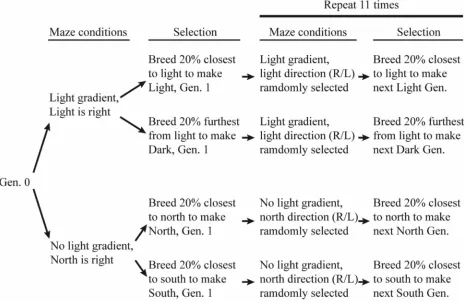
(Hadler, 1964). We first ran a wild-caught population of flies through the maze to determine if flies had an innate preference for north or south. We then selectively bred the flies to create one population of north-selected flies and a second population of south-selected flies. As a positive control, we also performed an experiment to test the phototaxic orientation behavior of wild-caught and selectively bred flies. While we plan to continue our experiment for 15 generations, we have preliminary results for our experiment after 12 generations.
Our wild population of Drosophila (Generation 0), was collected from a composting site in Monmouth, OR, USA. This generation was kept and proliferated in the lab for all Generation 0 experiments. Flies were maintained in a 12h:12h light:dark cycle at 25°C on standard dextrose medium supplemented with 0.1% Nipagen to inhibit mold.
The ambient magnetic field in the room where we conducted the experiments was 42 µT, as measured with the iPhone app Magnetometer by Kory Hearn Software. The normal strength of the magnetic field in Monmouth, OR, is approximately 52 µT (NOAA National Centers for Environmental Information). In order to select flies with a specific directional preference, we designed a maze that would require the flies to make a choice
between two directions. This was accomplished through a progressive Y-maze (Figure 1), where each fly made 10 sequential choices to go right or left based on available environmental cues. Thus, each vial was assigned a number for data collection purposes, zero being the resulting vial when the fly made zero choices to go towards the given cue for that week. The
environmental cues available were either North vs. South, West vs. East, or Light vs. Dark.
The Y-maze was made out of plastic tubing with an outer diameter of 3/16” and connecting 3/16” aquatic air filter connectors. Standard plastic pipette tips were cut and inserted into the Y-connectors to prevent flies from back-tracking once a decision was made. The beginning and ends of the maze were fitted with foam stoppers punctured by the plastic pipettes. These foam stoppers allowed connection to collection vials that would hold flies after each trial until they were counted. The
collection vials were filled with food to encourage flies to finish the maze and maintain the flies until counting. The beginning vial did not contain any food and was covered with aluminum foil to block light and encourage flies to leave the starting vial.
For our north vs. south experimental flies, we set up the maze so that choosing north or south was the same as a right or left choice (Figure 2). Which direction was north or south was determined randomly for each week of experimental runs. If the week was a “right” week, we
turned the maze so that by going right the flies were going north. If the week was a “left” week, we turned the maze so that by going right the flies were going south. Two 40 W desk lamps, directed upward, were used to create the ambient light for each run. A fluorescent plastic light diffuser sheet was placed over top of the maze to ensure a smooth light gradient. We also
performed a trial where the Generation 0 flies made east vs. west choices, rather than north vs. south.
In our positive experimental control, we used a similar protocol as described above except that we added a light gradient. To ensure a smooth light gradient a fluorescent plastic light diffuser sheet was placed in front of the light. The light was produced via a 40 W desk lamp with a flexible neck to allow for proper directing of the light.
After each run through the maze, we anesthetized the flies with CO2 and counted the number of flies in each vial. Each successive generation was created by taking the top 20% of the flies collected from each run through the maze. For example, for a trial with the “North” population of flies where the north-most vial was vial 10, if 100 flies completed the maze with 2 flies in vial
10 and 30 flies in vial 9, we bred the 2 flies from vial 10 and 18 of the 30 flies from vial 9. The same procedure was used for the “South”, “Light”, and “Dark” populations of flies. The researchers setting up the experiment and collecting the flies were blind to which population of flies were being used in a given trial. In between runs, we allowed 2-3 weeks for breeding of each generation. During off-weeks when flies were breeding, the maze was cleaned with tap water and allowed to air dry until the next use.
To determine whether our wild-caught flies had an innate preference for light or dark and north or south, we performed 4 initial trials with Generation 0 flies: 1) the right side of the maze was light and the left side was dark; 2) the right side of the maze was north; 3) the left side of the maze was north; 4) the right side of the maze was west. Generation 12 also consisted of 4 trials: one trial each for the Light flies, the Dark flies, the North flies, and the South flies. For the Light and Dark trials, light was on the right side of the maze. For the North and South trials, north was on the right side of the maze. We compared the results of these eight trials using an ANOVA with post-hoc t-tests in Microsoft Excel (Microsoft Corporation, Redmond, WA).
Fruit flies are known to recognize each other and regulate their behavior accordingly (Yurkovic et al., 2006; Krupp et al., 2008). As flies move through our maze, they are likely to interact. Therefore, each fly completing the maze is not an independent data point. To address this pseudoreplication, for the Generation 12 North and South flies we performed a second experiment with both populations. After the flies completed the maze, we again collected the top 20% of flies. However, rather than breeding these flies, we ran the flies through the maze a second time. If the top 20% of flies had a directional preference, they should show that directional preference again on the 2nd run through the maze. If the top 20% were determined stochastically, they should show no directional preference on the 2nd run. Results were compared using unpaired t-tests in Microsoft Excel.Fruit flies are known to recognize each other and regulate their behavior accordingly (Yurkovic et al., 2006; Krupp et al., 2008). As flies move through our maze, they are likely to interact. Therefore, each fly completing the maze is not an independent data point. To address this pseudoreplication, for the Generation 12 North and South flies we performed a second experiment with both populations. After the flies completed the maze, we again collected the top 20% of flies. However, rather than breeding these flies, we ran the flies through the maze a second time. If the top 20% of flies had a directional preference, they should show that directional
preference again on the 2nd run through the maze. If the top 20% were determined stochastically, they should show no directional preference on the 2nd run. Results were compared using unpaired t-tests in Microsoft Excel.
Results
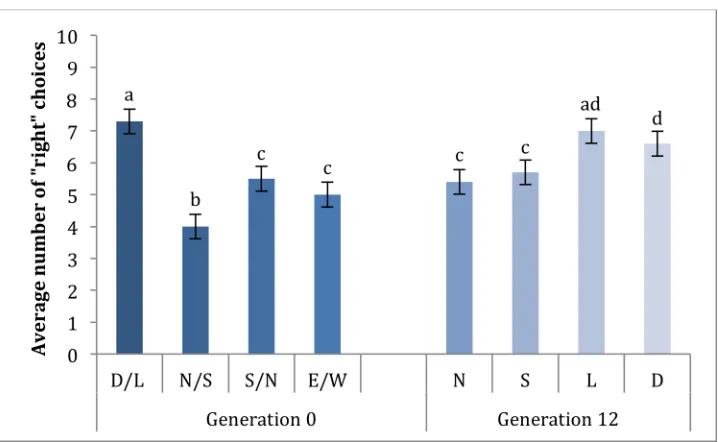
We found the maze conditions had a significant effect on the distribution of flies in the collection vials (Figure 3; ANOVA: F7, 614 = 19.07; p < 0.001). The flies in
the generation 0 Light/Dark trial had a mean vial number of 7.3 ± 0.2 (± S.E.M.), which was significantly different from all other Generation 0 trials (t-tests: north to the right: p < 0.001; north to the left: p < 0.001; west to the right: p < 0.001). In generation 0, the distribution of flies from the maze where north was to the left (4.0 ± 0.2) had a significantly different distribution compared to flies from the maze where north was to the right (5.5 ± 0.3; t-test: p < 0.001) and compared to flies from the maze where west was to the right (5.0 ± 0.3; t-test: p = 0.016).
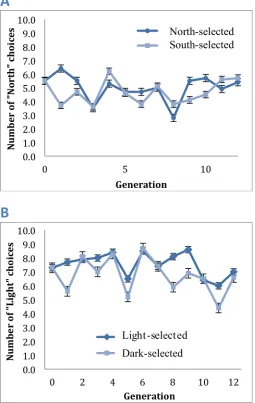
There was not an obvious change in orientation behavior due to selective breeding for our Light, North or South populations; however there does appear to be a change in behavior for our Dark population (Figure 3; Figure 4). After 12 generations of selection, the Light flies did not have a different distribution (7.0 ± 0.2) from the Generation 0 flies (t-test: p < 0.24). The Dark flies (6.6 ± 0.3) were significantly different from the
Generation 0 flies (t-test: p = 0.019). The North flies (5.4
Figure 3: Average number of choices toward the right side of the maze for the original population of flies (Generation 0), and flies after 12 rounds of selection (Generation 12). D/L represents the dark vs. light trial with the light side of the maze toward the right (n = 98). N/S represents the north vs. south trial with south to the right (n = 47). S/N represents the north vs. south trial with north to the right (n = 66). E/W represented the east vs. west trial with west to the right (n = 46). For Generation 12, N represents north-selected flies (n = 91), S represents south-selected flies (n = 155), L represents light-selected flies (n = 58), and D represents dark-selected flies (n = 61). For north vs. south trials, north was to the right. For light vs. dark trials, light was to the right. Bars with similar letters are not significantly different (post-hoc t-tests; p < 0.05). Error bars represent standard error of the mean.
A
B
Figure 4: The average number of (A) “North” or (B) “Light” choices made by each generation of flies after artificial breeding for each direction preference. Error bars represent standard error of the mean.
± 0.2) were not different from the Generation 0 flies when North was to the right (t-test: p = 0.90). The South flies (5.7 ± 0.2) were also not different from the
Generation 0 flies when North was to the right (t-test: p = 0.36).
The overall distribution of Generation 12 flies, both south-selected and north-selected, did not appear to be a normal distribution (Figure 5). For example, if the flies had a normal distribution with an average of 5.5, we would expect that vials 5 and 6 would have the most flies, and the numbers of flies in each vial would
decrease as the vial number increased. However, for the South Generation 12 flies, 19% of flies were found in vial 7, 7% were in vial 8, and 16% were in vial 9. Similarly, in
trial with North Generation 12 flies, 6% of flies were found in vial 6 and 14% were in vial 7.
We performed an additional experiment with the generation 12 North and South flies where we ran the flies through the maze, collected the top 20% of flies, and then ran them through the maze again. For the North flies, the average distribution on the original run through the maze (n = 308; 5.6 ± 0.1) was not different from the average distribution when the top 20% of flies were re-run through the maze (n = 53; 5.1 ± 0.3; t-test: p = 0.15). Similarly, for the South flies, the average
distribution for the original run (n = 95; 4.0 ± 0.2) was not different from the average distribution when the top 20% were re-run through the maze (n = 17; 4.1 ± 0.4; t-test: p = 0.94).
Discussion
Our two trials of north vs. south with Generation 0 flies were significantly different from the light vs. dark trial with Generation 0, consistent with previous findings that flies have an innate phototaxic behavior (Hadler, 1964). However, while previous research saw a significant separation between Light and Dark populations of flies by Generation 10 (Hadler, 1964), after 12 generations we have only seen a significant difference in the Dark population compared to our wild-caught population. The difference may be due to the fact that in Hadler (1964) the original wild-caught flies scored an average of 8.2 out of 15, whereas our wild-caught flies scored an average of 7.3 out of 10. The wild-caught flies in Hadler (1964) were 0.7 choices away from the center photo-score and our flies were 2.3 choices from the center photo-score. Using these innately stronger phototaxic flies may have led to a ceiling effect for our light-selected flies and may be contributing to our slow separation of populations.
Our initial trials with the wild-caught Drosophila are suggestive that the flies may have an innate directional preference for north over south. The distribution of flies in the trial when north was to the right was significantly different than the distribution of flies when north was to the left (Figure 3). However, two additional sets of experimental data do not support this initial finding. First, after 12 generations of selection, the North population and the South population of flies showed no difference in their orientation behavior. Second, when we re-ran the top 20% of the Generation 12 North flies and the top 20% of the Generation 12 South flies through the maze a second time, there was no significant difference between the directional preferences of the entire population of generation 12 flies and the top 20% of Generation 12 flies for either the North or South populations.
Our future plans include breeding the flies through 15 generations of selection, then performing multiple replicates of the Generation 0 and Generation 15 flies. Because our flies are in the maze together, each fly should not be considered an independent data point. Indeed, the distribution of our flies in the maze show clumping of flies in certain vials (Figure 5), indicating that the flies are interacting as they run through the maze. Performing replicates with the Generation 0 and Generation 15 flies will allow us to treat each group of flies that run through the maze as independent data points.
We also plan to begin a new round of breeding, using wild-caught Generation 0 flies, with a Faraday cage around our maze. If flies use cryptochrome to detect magnetic fields, we may have failed to observe orientation behavior because of ambient radio frequency fields (Phillips and Sayeed, 1993). We chose to run our initial experiments without a Faraday cage because a Faraday cage will not affect magnetite-based
magnetoreception. Evidence suggests that at least eight genera of arthropods use magnetite to detect magnetic fields, while evidence for using light-based
magnetoreception has only been found in 4 genera (Arendse, 1978; Leucht, 1984; Anderson and Vander Meer, 1993; Collett and Baron, 1994; Chittka et al., 1999; Perez et al., 1999; Vacha and Soukopova, 2004; Camlitepe et al., 2005; Gegear et al., 2008; Guerra et al., 2014; Riveros et al., 2014). Of the four genera that appear to use light-based magnetoreception, all except
Drosophila use both magnetite and a light-based mechanism. If we can selectively breed north-seeking
Drosophila with a Faraday cage, but cannot successfully breed them without a Faraday cage, this would be further evidence that Drosophila, unlike all other
arthropods tested so far, have only light-based magnetoreception.
If we ultimately confirm that Drosophila do indeed have a magnetic orientation behavior, the method of using a Y-maze coupled with selective breeding that we describe here should facilitate our understanding of the genetic basis of magnetic orientation behavior. For example, since the demonstration that Drosophila have innate positive phototaxis behavior (Hadler, 1964), subsequent genetic analysis has shown that the genes regulating photonegative behavior in Drosophila reside in the X chromosome and that genes for photopositive behavior are largely autosomal (Markow 1975). The use of a Y-maze by Hadler (1964), along with selective breeding, allowed for further exploration of the actual genetic basis for their behavior. Our goal is similar: to not only supplement the data that demonstrate magnetic orientation behavior in Drosophila, but to ultimately generate a strain of flies that can be used to find the genetic basis for magnetic orientation in Drosophila. Overall, we hope this will lead to further understanding of the genetic basis for migration behavior and orientation in a wide variety of organisms.
References
Anderson JB, Vander Meer RK (1993) Magnetic orientation in the fire ant, Solenopsis invicta. Naturwissenschaften 80: 568-570.
Arendse MC (1978) Magnetic field detection is distinct from light detection in the invertebrates Tenebrio and Talitrus. Nature 274: 357-362.
Banks AN, Srygley RB (2003) Orientation by magnetic field in leaf-cutter ants, Atta colombica (Hymenoptera: Formicidae) Ethology. 109: 835-846.
Burda H, Marhold S, Westenberger T, Wiltschko R, Wiltschko W (1990) Magnetic compass in the subterranean rodent Cryptomyshottentotus (Bathyergidae) Experientia 46: 528–530.
Camlitepe Y, Aksoy V, Uren N, Yilma A, Becenen I (2005) An experimental analysis on the magnetic field sensitivity of the black-meadow ant Formica pratensis Retzius (Hymenoptera: Formicidae). Acta Biol Hung 56: 215-224.
Chittka L, Williams NM, Rasmussen H, Thomson, JD (1999) Navigation without vision: bumblebee orientation in complete darkness. P Roy Soc Lon B Bio 266:45-50.
Collett TS, Baron J (1994) Biological compasses and the coordinate frame of landmark memories in honeybees. Nature 368: 137-140.
Dommer DH, Gazzolo PJ, Painter MS, Phillips JB (2008) Magnetic compass orientation by larval Drosophila
Fedele G, Green EW, Rosato E, Kyriacou CP (2014) An electromagnetic field disrupts negative geotaxis in Drosophila
via a CRY-dependent pathway. Nature Communications 5: 4391.
Gegear RJ, Casselman A, Waddell S, Reppert SM (2008) Cryptochrome mediates light-dependent magnetosensitivity in
Drosophila. Nature 454: 1014–1018.
Guerra PA, Gegear RJ, Reppert SM (2014) A magnetic compass aids monarch butterfly migration. Nature
Communications 5: 4164-4171.
Hadler NM (1964) Genetic influence on phototaxis in
Drosophila melanogaster. Biol Bull 126: 264–273. Kramer, G (1953) Wird die Sonnenhohe bei der Heimfindeorientierung verwertet? J. Ornithol. 94: 201–219.
Krupp JJ, Kent C, Billeter JC, Azanchi R, So AK, Schonfeld JA, Smith BP, Lucas C, Levine JD (2008) Social experience modifies pheromone expression and mating behavior in male Drosophila melanogaster. Curr Biol 18:1373– 1383.
Leucht T (1984) Responses to light under varying magnetic conditions in the honeybee, Apis mellifica. J Comp Physiol A 154: 865-870.
Markow, TA (1975) A genetic analysis of phototactic behavior in Drosophila melanogaster. I. Selection in the presence of inversions. Genetics 79: 527–534
Marley R, Giachello CNG, Scrutton NS, Baines RA, Jones AR (2014) Cryptochrome-dependent magnetic field effect on seizure response in Drosophila larvae. Sci Rep 4: 5799.
NOAA National Centers for Environmental Information. Computer Earth’s Magnetic Field Values.
https://www.ngdc.noaa.gov/geomag/magfield.shtml.
Painter MS, Dommer DH, Altizer WW, Muheim R, Phillips JB (2013) Spontaneous magnetic orientation in larval
Drosophila shares properties with learned magnetic compass responses in adult flies and mice. J Exp Biol 216: 1307-1316.
Perez SM, Taylor OR, Jander R (1999) The effect of a strong magnetic field on monarch butterfly (Danaus plexippus) migratory behavior. Naturwissenschaften 86: 140-143.
Phillips JB, Sayeed O (1993) Wavelength-dependent effects of light on magnetic compass orientation in Drosophila melanogaster. J Comp Physiol A 172: 303-308.
Phillips JB, Borland SC (1992) Behavioral evidence for the use of a light-dependent magnetoreception mechanism by a vertebrate. Nature 359: 142–144.
Riveros AJ, Esquivel DMS, Wajnberg E, Srygley RB (2014) Do leaf-cutter ants Atta colombica obtain their magnetic sensors from soil? Behav Ecol Sociobiol 68: 55-62.
Sokolowski MB, Kent C, Wong J (1984) Drosophila larval foraging behaviour: developmental stages. Animal Behavior 32: 645–651.
Vacha M, Soukopova H (2004) Magnetic orientation in the mealworm beetle Tenebrio and the effect of light. J Exp Biol 207: 1241-1248.
Wiltschko R, Wiltschko W (1995) Magnetic Orientation in Animals. Springer, Berlin, Heidelberg, New York.
Wiltschko W, Wiltschko R (2005) Magnetic orientation and magnetoreception in birds and other animals. J Comp Physiol A 191: 675-693.
Yurkovic A, Wang O, Basu AC, Kravitz EA (2006) Learning and memory associated with aggression in
Prehistoric Incentives to High Altitude Settlement in Wyoming’s Wind
River Range
Cody Peak
, Department of Anthropology,
Western Oregon University
Villages in Wyoming’s Wind River Range (inhabited ca. 4000-420 BP) exhibit patterning that indicates reliance on specific lithic resources, white bark pine, and traditional game. These villages were occupied in the warmer months as part of a seasonal migration pattern that was enhanced and accommodated by an early onset of the Medieval Warming Period in the region. The resources that motivated the settlement of these mountains conflict with preconceptions of scarcity in the alpine and sub-alpine environments. This research seeks to inform future assessments of a locality’s potential to hold significant
archaeological sites.
Keywords: prehistoric settlements, Wyoming, Altitude
Introduction
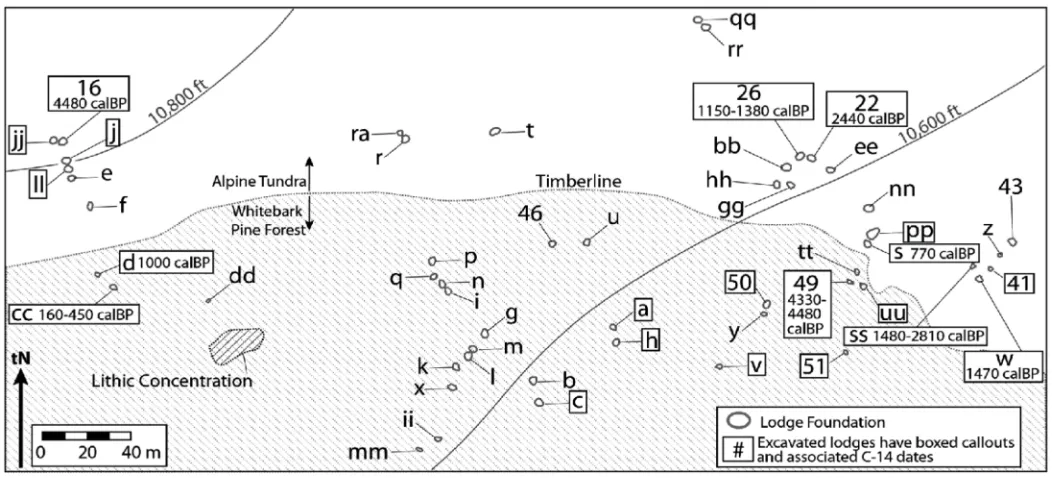
In the frost-capped mountains of Wyoming’s Wind River Range archaeologists have uncovered a series of nineteen villages at the lower limits of the alpine
ecotone, in excess of 10,000 feet above sea level (Fig. 1). The 2003 to 2011 discoveries of these villages (Stirn 2014:524) and subsequent research by archaeologists directed by Matthew Stirn has provoked the curiosity of many, prompting high-altitude tourist expeditions that frequent the Wind River Range with questions. The distance that modern society has put between ourselves and the environment seems to have granted the
mountains a level of both mystery and romance that colors our perspective. The widespread question from naturally intrigued parties is “why here?”
In answering this question there are two schools of thought, the generally opposed concepts of push vs. pull. Motivations for alpine settlement can easily be assumed to be the result of a push resulting from low-land scarcities. Drought and lack of traditional game, for example, are common stimuli for migration. This
assumption is also influenced by the previously
mentioned mystery of the mountains and their perceived marginal capacity to sustain a significant population. Contrary to these assumptions, the high elevation and landscape of the Wind River Range provided
tremendous benefits that pulled the Shoshone ancestors to occupy the Wind River villages.
Sites
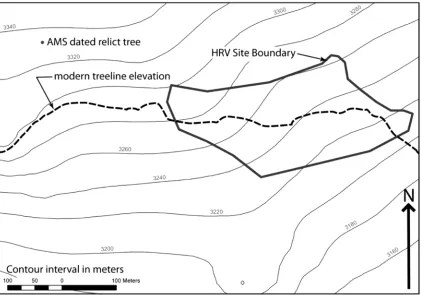
Of the Wind River villages, the best documented site is High Rise Village discovered in 2006 (Morgan et al. 2012:40), containing over seventy cut and fill lodge pads. The impressive assemblage of artifacts bears
traits typical of the Numic Mountain Shoshone (Stirn 2014:524). This expansive site covers an impressive nineteen acres, extending from above into the modern tree line on a 23° south facing slope,