Journal of Education and Training Studies Vol. 3, No. 3; May 2015 ISSN 2324-805X E-ISSN 2324-8068 Published by Redfame Publishing URL: http://jets.redfame.com
Alternative Framework in “Body Coordination” Topic: A Progress Report
for Interior of Malaysia
Davy Seligin1, Mohd. Zaki Ishak2, Jominin Goropos3 1School of Education and Cognitive of Science, Asia e-University, Malaysia2School of Education & Social Development, University Malaysia Sabah, Malaysia 3Sandakan East Sabah Malaysia College Community, Malaysia
Correspondence: Davy Seligin, School of Education and Cognitive of Science, Asia e-University, Malaysia
Received: October 20, 2014 Accepted: January 4, 2015 Online Published: March 24, 2015 doi:10.11114/jets.v3i3.562 URL: http://dx.doi.org/10.11114/jets.v3i3.562
Abstract
This preliminary study was conducted in interior of Malaysia. The study employed the Body Coordination Two Tier Concept Test to assess students’ understandings of body coordination topic. The test consisted of 14 questions as two tier question style. The students needed to select the answer and write down the justifications of each answer. Interview was conducted with six students to get in-depth opinion about Body Coordination.
Keywords: alternative framework, misconception, body coordination
1. Introduction
Students came to school with various interpretations which may directly or indirectly contribute to understanding of Body Coordination (BC) topic. They cannot be considered as empty containers 'blank slates' which can be loaded by academic knowledge but they have rich experience, knowledge and their own beliefs about the phenomena that occur in nature (Zurida, Syarifah & Mohd. Ali, 2006).
BC is part of the general science curriculum in upper secondary schools and it is taught to students in Form Four who are 16 years old. Based on Malaysia Curriculum Development Centre (CDC, 2005), BC is discussed under ‘Maintenance and Continuity of Life’ as in (Appendix 1) but for this article purposes, discussion is limited only to subtopics body coordination, human nervous system, nervous coordination, human brain, hormonal coordination and coordination between the nervous system and the endocrine system. According to Yin (2003) and Stake (1995), placing the boundaries on study can prevent the data explosion from occurring.
Some studies also suggested that the BC as motor coordination plays an important role in the social, emotional and activities related to academics (Wijnroks & van Veldhoven, 2003).
Location of study in Malaysia Sabah can be traced via Maps Google Earth (Appendix 2). 1.1 Aim of Study
The aim of this paper was to explore students’ understanding of BC. 1.2 Research Question
What is the level of students’ understanding of body coordination topics?
2. Literature Review
Nussbaum and Novick, 1982). Davy (2012) suggested the concluded that AF all other mistakes concept can be simplified and categorized into two levels as shown in Table 1.
Table 1. Types of mistakes of AF and their level
Concept Mistakes Level
alternative conception, concept difficulty , misconceptions, naive belief, personal conception, existing knowledge, student perception, student preconception, student representatives, student view, student view.
1
alternative framework, concept framework, alternative multi explanation. 2 Source: Davy (2012)
Studies of BC involving the entire limb of the human body showed that the human body is a fascinating subject for discussion by the expertise of each individual scholars.
Figure 1. Kinematics of Human Hand Source: (Siena di University, ItaliU.O. & Milan U.O, 2004)
Study of (Pozzo, Stapley & Papaxanthis, 2002) found that an increase in body posture barriers significantly affect the trajectory (movement) hand and arm. The independent variable equilibrium and kinematic trajectory end points analyzed during the reach things done. Previous studies (Pozzo et al., 1998) on the grip and take up (Kerlirzin et al., 1999) shows a correlation between BC in the balance of the body and curved hand movements.
According to Mustafa (2007), the level of understanding of students is classified into three categories as in Table 2. Table 2. Category of Students understanding
Category Description Example
Category 1 responses showed no evidence of student understanding
‘I do not know ..’
Category 2 students' responses showed AF / misconceptions ‘glands located at the foot’
Category 3 students have a full understanding ‘the example of
drug is cocaine’ Source: Mustapa (2007)
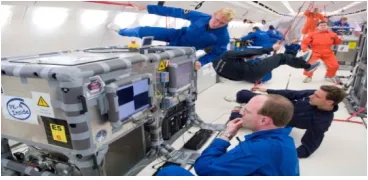
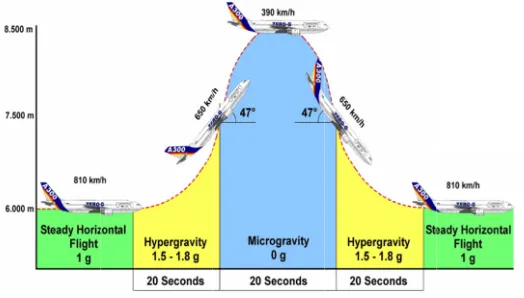
BC studies were made in the field of aviation (aviation). For example, in situation of gravity during a parabolic flight (0 gravity, g) and normal gravity conditions (1 g) which focuses on how the central nervous system is maintained in parts of the body being studied (Jerome, Paul & Thierry, 2005). BC in parabolic flights applied in flight simulation short-term scientific and technology to investigate microgravity and reduction, instrumental test before into space, verifies the operation and experimental procedures and to train astronauts for future flights. Figure 2 shows the lab parabolic flights simulation and Figure 3 shows the degree of stability of height versus time during parabolic flights.
Journal of Educ
Source: Christ
3. Method an
We administe understanding report that an own autonomy Two tier quest analysed them the students b Purposive sam 14 questions o to the real site topic only. We there even in t
4. Validity an
To validate th was 389. Diff ready to run i validity. The government to
5. Data Colle
Data was coll are selected i female aged s In this study w in BC topic w pragmatism. W circumstances 6. Findings Student marki students’ answ
cation and Train
toph, (2011)
nd Sampling
ered the Body g, include the n alternative f
y to interpret tion were pion m based on typ
ased on their p mpling was use only should be e. We removed e considered th the students, c
nd Reliability
he BCTTCT w ficulty level su in field. BCTT grammar was o empowermen
ction
ected for two w n this study t ixteen years ol we preferred th within its con We considered s as in the testi
ing can be see wer, we detecte
ning Studies
y Coordinatio related scien framework too
a natural phen neered by Hasl
es of understan performance. ed in our stud e included in B d the six questi his method app ontact, environ
we administered ubjective ques TCC was chec s checked and nt the credibili
weeks. First d then students a
ld from one sc he phenomeno ntext using a d used the prag ing and evalua
en in Table 3, ed and categor
Figure 3
on Two Tier nce concept an
ols is approp nomenon. Fir lam and Treag anding level by
dy. After discus BCTTCT. Sam
ion from fiftee propriate to co nment, school
d of pilot study stionwas 0.55. cked by two u d verified by ity the languag
day, in groupin answer the BC chool continued ology design to variety of dat gmatism becau tion of data, nu
descriptive an ized all studen
. Parabolic Fli
Concept Test nd any AF w priate to desc rst version of gust (1987) to y Mustafa (200
ssion and expl mple of BCTTC
en to twenty b ollect informati
or interview is
y to 54 studen Based on An university profe
Dewan Bahas ge in Malaysia
g session, we CTTCT. Seco d with in depth o facilitate exp ta sources and use mostly stud umbering aspe
nalyse, mean s nts answer as f
ight
(BCTTCT) t within student
cribe the fram BCTTCT con detect misconc 07). We sought
lanation in sup CT, see Appen
ecause our stu ion from stude s capable of de
nts in other sch nthony (2000), fessors and one
sa dan Pustak .
introduced and nd day, 6 sele h interview ses ploration of a d strategy. Re dies focused o ect is indispens
student 1.71 an followed in Tab
to examine an s because Dr mework of stu
nsists 20 quest ception among t the teacher in
pervision proc ndix 3. Second udy will concen
ents that is usef elivering data t
hool in Malays BCTTCT is m e associate pro ka (DBP). DB
d explained to ected students ssion.
multi concept esearch Paradi on qualitative r
sable.
nd average 1.6 ble 4.
Vol. 3, No
nd detect the river and Easle udent opinion tions 2 level (t g students and n the school to
cess, we sugge d phase is initia ntrate and rela ful to review w to the research
sia. All studen medium diffic ofessor to incr P is solely M
respondents w s three male a
and experienc igm employed research, but in
62. After evalu o. 3; 2015
student y (1978) of their wo-tier). then we o identify sted that al survey ate to BC what was hers. nts marks culty and rease the Malaysian why they nd three
ce of AF d here is
n certain
Table 3. Student Marks
Students Students 1 Student 2 Student 3 Student 4 Student 5 Student 6
Question (S1) (S2) (S3) (S4) (S5) (S6)
1 √ √ √
2 √ √ √
3 √
4 √
5 √ √ √
6 √ √ √ √
7 √ √ √
8 √
9 √
10 √ √
11 √ √ √
12 √ √
13 √
14 √ √ √ √
Table 4.
Category Description Students
Category 1 responses showed no evidence of student understanding S1: Q3, Q7, Q8, Q10, Q11, Q12.
S2: Q1, Q4, Q9, Q13. S3: Q4, Q7, Q10, Q12, Q13. S4: Q1, Q2, Q6, Q8, Q10, Q11.
S5: Q3, Q4, Q5, Q8, Q12. S6: Q2, Q3, Q4, Q5, Q7, Q10,
Q12, Q13. Category 2 students' responses showed AF / misconceptions S1: Q4, Q5, Q9.
S2: Q3, Q4, Q11. S3: Q2, Q8, Q9. S4: Q3, Q9.
S5: Q1, Q9, Q10, Q13 S6: Q6, Q11. Category 3 students have a fully understanding Other than above
7. Discussions
Student marking can be seen in Table 3, descriptive analyse, mean student 1.71 and average 1.62. After evaluating the students’ answer, we detected and categorized all students answer as indicated in Table 4. 40.96 percent student answered we categorized 1, 20.48 percent student answered category 2 and 38.55 student answered. Finding shows that students in interior of Malaysia still have the AF and misconception about BC. The data confirm the view that children do not come to primary science lessons as a 'tabula rasa' but come with rich knowledge about their physical world based on their everyday experience, as Vosniadou and Ionnades (1999) proposed. There are several ways that students develop conceptions, AF and misconceptions. Some of the sources of misconceptions include everyday observations, religious or mythical teachings, science teaching that does not adequately challenge students’ misconceptions, and vernacular misconceptions (Smolleck & Hershberger, 2011).
Terusan Sugut Secondary School are fewer secondary schools in Malaysia situated in the island. Next visit to these school, we will conduct the full research with other school. This preliminary data will provide the important data to researcher before going to site again for collecting data from students and their surroundings.
8. Conclusion
We should listen what student says. Don’t blame students when their answer is wrong or bad. Teachers should be creative, and employ diverse methods of teaching and learning in the classroom to engage and attract students.
Because of this research only progress report, that why this study tends to discuss more generally here. This progress may suite for research context only, maybe not suitable to apply in other place. Researcher still ongoing process to complete the findings include the other school again in Malaysia.
Acknowledgments
Journal of Education and Training Studies Vol. 3, No. 3; 2015
References
Anthony, J. N. (2000). Educational Assessment of Student: Third Edition.
Christoph, (2011). http://siliconroadpartners.com/author/christoph/. (Retrieved by 24th February 2014).
Curriculum Development Centre. (2005). Integrated Curriculum for Secondary School. Science form 4. Ministry of Education Malaysia.
Davy, S. (2012). Alternative Framework, Attitudes towards Science and Problem Learning: A Pilot Study. International Organization of Scientific Research. 2( 2), 28-41.
Davy, S., & Jominin, G. (2013). Misconception or Alternative Framework: Which One? Macrotheme International Conference Paris Business and Social Science, 20-21.
Driver, R., & Easley, J. (1978). Pupils and paradigms: A review of literature related to concept development in adolescent science students. Studies in Science Education, 5, 61-84. http://dx.doi.org/10.1080/03057267808559857.
Haslam, F., & Treagust, D. F. (1987). Diagnosing secondary students’ misconceptions of photosynthesis and respiration in plants using a two-tier multiple choice instrument. Journal of Biology Education. 21 (3), 203-211.
http://www.esa.int/spaceinimages/Images/2008/11/Day2ofthe49thESAParabolicFlightCampaignThePK4plasmacry stalexperimentbeingpreparedforflighttotheISS. (Retrieved by 24hb February 2014).
Jerome, P., P, S., & Thierry, P. (2005). Human whole-body reaching in normal gravity and microgravity reveals a strong temporal coordination between postural and focal task components. Experimental Brain Research, 165(1), 84-96. http://dx.doi.org/10.1007/s00221-005-2283-0
Kerlirzin, Y., Pozzo, T., Dietrich, G., & Vieilledent, S. (1999). Effects of kinematics constraints on hand trajectory during whole-body lifting tasks. Neurosci Lett, 277, 41-44. http://dx.doi.org/10.1016/ S0304-3940(99)00843-5. Sabitha, M., (2005). KAEDAH PENYELIDIKAN SAINS SOSIAL. Prentice Hall Pearson Malaysia Sdn. Bhd.
Mustafa, C. (2007). Alternative Views Of The Solar System Among Turkish Students. Review of Education. 53, 39-53. Nussbaum, J., & Novick, S., (1982). Alternative Framework, Conceptual Conflict And Accomodation: Toward A Principled Teaching Strategy. Elsevier Scientific Publishing Company, Amsterdam. Instructional Science, 183-200. Pamela, B., & Susan, J. (2009). Qualitative Case Study Methodology: Study Design and Implementation for Novice
Researchers.
Pozzo, T., McIntyre, J., Cheron, G., & Papaxanthis, C. (1998) Hand trajectory formation during whole body reaching movements in man. Neurosci Lett , 240, 159–162. http://dx.doi.org/10.1016/S0304-3940(97)00943-9.
Pozzo, T., Stapley, P. J., & Papaxanthis, C. (2002). The coordination between equilibrium and focal components of whole body pointing movements in man. Experimental Brain Research, 144, 343-350. http://dx.doi.org/10.1007/s00221-002-1052-6 PMid:12021816.
Read, J. R. (2004). Children’s Misconceptions and Conceptual Change in Science Education. http://acell.chem.usyd.edu.au/Conceptual-Change.cfm (Retrieved 20th January 2015).
Siena, U. O., & Milan, U. O. (2004). http://www-lar.deis.unibo.it/aida/B-mod-unisi-en.htm.
Smolleck, L., & Hershberger, V. (2011). Playing with Science: An Investigation of Young Children’s Science Conceptions and Misconceptions. Current Issues in Education, 14(1). http://cie.asu.edu/ojs/index.php/cieatasu/article/view/.
Stake, R. E. (1995). The art of case study research. Thousand Oaks, CA: Sage.
Vosniadou, S., & Ionnides, C. (1998) From conceptual development to science education: a psychological point of view. International Journal of Science Education, 20(10), 1213-1230. http://dx.doi.org/10.1080/0950069980201004 Wijnroks, L., & Van Veldhoven, N. (2003). Individual differences in postural control and cognitive development in
preterm infants. Infant Behavior and Development, 26(1), 14-26.
http://dx.doi.org/10.1016/S0163-6383(02)00166-2.
Yin, R. K. (2003). Case Study Research: Design and Methods (Third Edition). Sage Publications.
Appendices: Appendix 1
No. Title:
Body Coordination 1 Body Coordination 2 Human Nervous System 3 Nervous Coordination 4 Proprioceptors 5 The Human Brain 6 Hormonal Coordination
7 Coordination Between the Nervous System and the Endocrine System
Source: CDC (2005) Appendix 2
Appendix 3
Body Coordination Two Tier Concept Test
Test item 1: Mark [/] two types of coordination of the human body. i) Coordination Nervous.
ii) The Endocrine System. iii) Coordination Chemistry.
Because:
a) Less organ systems work together to make the response. b) Serve as a centre of reflex action.
c) organ system can work at the appropriate time and rate for make the response. d) Is the path of impulses between the brain and peripheral nerves.
e) Control of voluntary actions in human behaviour.
f) Other answers: ...
Test item 2: What is the importance of coordination of the body? a) Detection of the stimulus.
b) Perform response.
c) Coordinate the activities of the body. d) Coordinate and harmonize the body response.
Because: ... ...
Test item 3: Central nervous system is the central receiver and the interpretation of nerve impulses from the receptors and sense organs.
Journal of Education and Training Studies Vol. 3, No. 3; 2015
Because:
a) Sent to the brain for interpretation.
b) Submitted to the parts of the body for storage.
c) The impulse which has been interpreted to be sent to the organ concerned to perform involuntary response.
d) Autonomic nerve stretches from the blood vessels, organs and glands in the body to the spinal cord. e) The impulse which has been interpreted by the brain will be sent to a particular
organ to carry out the response.
g) Other answers:...
Test item 4: Cranial nerve and spinal cord are two groups that make up the spinal peripheral nerves. (Please tick (/) in one box below)
true false Where is cranial nerve in the human body?
a) In the lymph b) In the brain
c) In the heart d) In the stomach
e) At the foot f) In the arms
g) Other answers: ... ...
Test item 5 and 6 is based on Figure 1
Test item 5: Figure 1 shows a crossing impulses in the nervous system to a stimulus.
X Neurons Motor Neurons
Receptor Effectors
Figure 1 Name the X neuron Figure 1.
Neurons X: ... ...
Because:
a) Route CNS X is to the spinal cord to the brain and back to the effector for action. b) X Neurons carry impulses to the brain to be interpreted without a nerve cord.
c) Neurons carry impulses directly to X without going through the spinal cord synapse. d) Carry impulses from the CNS X receptor to the spinal cord.
e) Neurons carry impulses from X to the spinal cord motor neurons. f) Other answers:
...
Test item 6: Figure 1 shows a crossing impulses in the nervous system to stimulus.
X Neurons Motor Neurons
Receptor Effectors
Spinal Cord
Figure 1
Name the action in Figure 1
(Please tick (/) in one box below)
Reflex Action Controlled Action
Because:
...
Test item 7: Mark [/] two types of coordination of the human body. i) Coordination Nervous.
ii) The Endocrine System. iii) Coordination Chemistry.
Because:
a) Less organ systems work together to make the response. b) Serve as a centre of reflex action.
c) Organ system can work at the appropriate time and rate for make the response. d) Is the path of impulses between the brain and peripheral nerves.
e) Control of voluntary actions in human behaviour.
f) Other answers:...
Test item 8:
Figure 2 In your opinion, what is the name of biology in Figure 2?
... ...
Because: ...
Test item 9:
Figure 3
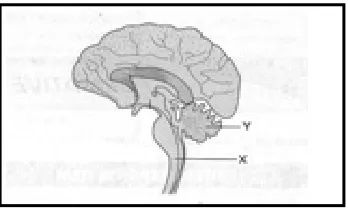
The part labelled X and Y in Figure 3 is I) Cerebral
Journal of Education and Training Studies Vol. 3, No. 3; 2015
III) The Cerebellum A) 1 and II.
B) II and III only. C) III only. D) I and III.
Because:
a) X is used to control memory, thought, position, and voluntary actions, Y is used to control movement, balance and posture.
b) X is used to control memory, thought, position, and voluntary actions, Y is used to control involuntary actions. c) X is used to control movement, balance and posture, Y is used to control the memory.
d) X is used to control involuntary actions and Y functions for control movement, balance and posture. e) X is used to control movement, balance and posture, Y is used to control involuntary actions.
f) X is used to control movement, balance and posture, and Y is used to control memory, thought and action control.
g) Other answers: ...
Test item 10: Write the part of the brain that controls involuntary actions and an example of involuntary action activities in Figure 4.
Foreign Regulatory Actions
Foreign Regulatory Actions Part Brain
An Example of Activity
Figure 4
Test item 11: The biology in Figure 5 below is called pancreas. (Please tick (/) in one box below) True False
Figure 5
Because:
a) Functional secretes the hormone adrenaline. b) Functional secrete hydrochloric acid is weak.
c) Functional secretes the hormone insulin to control the content salt in the body. d) Functional secretes gastric juice
Test item 12: The biology in Figure 6 below is called pancreas. (Please tick (/) in one box below) True False
Figure 6
Because:
a) Its located behind the heart.
b) The position is located below and behind the stomach. c) The position is located below and in front of the stomach. d) The position is located above and behind the stomach. e) The position is located above and in front of the stomach.
f) Other answers:...
Test item 13: The X in Figure 7 shows the position of the thyroid glands. (Please tick (/) in one box below) True False
Figure 7
Because:
a) Produce hormones to control the growth process.
b) Secrete adrenaline to increase the pulse, respiration, blood pressure and glucose levels during an emergency. c) Creating a control testoran men, including the production of sperm.
d) To produce oestrogen and progesterone that regulate female organs, including the menstrual cycle. e) Other answers:...
Test Item 14: Figure 8 shows a picture of a balance between Nerves coordination and Hormones coordination.
Figure 8
Journal of Educ
Give one simi
This work is l
cation and Train
ilarity and one
icensed under
ning Studies
difference bet
Similarity
Difference
a Creative Co
tween nerve C
es
ommons Attrib
Coordination an
ution 3.0 Licen
nd Hormone C
nse.
Coordination.