3TATIC%LECTRICITY 0DUVKDOO&DYHQGLVK,QWHUQDWLRQDO63WH/WG
ϒ&IGURE
9QTMUJGGV$
3TATIC%LECTRICITY
"UILDYOURUNDERSTANDING
ÌÌi«ÌÊÌ iÊvÜ}ʵÕiÃÌÃÊÊÞÕÀÊÜÊÀÊÊ>Ê}ÀÕ«ÊÃiÌÌ}°
£°Ê >®Ê ÊV`ÕVÌ}Êë iÀi]ÊÜ V ÊÃÊi}>ÌÛiÞÊV >À}i`]Ê >}ÃÊÛiÀÌV>ÞÊÊ>ÊÃÕ>Ì}Ê Ì Ài>`°Ê7 iÊ>Ê>À}iÊi}>ÌÛiÞÊV >À}i`ÊV`ÕVÌÀÊÃÊLÀÕ} ÌÊi>À]ÊÌ iÊë iÀiÊÃÊ `iyiVÌi`Ê>ÃÊà ÜÊÊ}ÕÀiʣȰ£ä°
Ê Ý«>ÊÌ iÊ`iyiVÌÊvÊÌ iÊë iÀiÊÕÃ}ÊÌ iÊVVi«ÌÊvÊiiVÌÀVÊwi`°
L®Ê À>ÜÊÌ iÊiiVÌÀVÊwi`ÊiÃÊvÊÌ iÊV >À}iÃÊÊÌ iÊ`>}À>ÃÊLiÜ°
®
&ORTOPIC
%LECTRIC&IELD
>1RWHWRWHDFKHUV6WXGHQWVVKRXOGGUDZWKHÀHOGOLQHVVLPLODUWRWKRVHLQWKHWH[WERRN6HFWLRQ $UURZVVKRXOGEHFOHDUO\LQGLFDWHGDQGWKHQXPEHURIÀHOGOLQHVVKRXOGEHVXIÀFLHQWWR LOOXVWUDWHWKHHOHFWULFÀHOGDURXQGWKHFKDUJHV@
6LQFH WKH QHJDWLYHO\ FKDUJHG FRQGXFWLQJ VSKHUH PRYHV ZLWKRXW SK\VLFDO FRQWDFW WKLV FDQ EH H[SODLQHGE\WKHFRQFHSWRIDQHOHFWULFÀHOGEHLQJVHWXSE\WKHODUJHQHJDWLYHO\FKDUJHGFRQGXFWRU $V WKH OLJKW VSKHUH OLHV ZLWKLQ WKH LQÁXHQFH RI WKH ÀHOG LW H[SHULHQFHV DQ HOHFWULF IRUFH WKDW
UHSHOVLWDZD\
0-Physics Matters Workbook Volume 2 59 © 2007 Marshall Cavendish International (S) Pte Ltd
(ii)
(iii)
(iv)
(v)
+ –
+ +
– – – – – – – – –
+ + + + + + + + +
Check your understanding
!"
Can you describe an electric field as a region in which an electric charge experiences a force?!
Can you draw the electric field of an isolated point charge?–
J72PHYS WB_SE_Vol 2 • 16.indd 59
60 Static Electricity © 2007 Marshall Cavendish International (S) Pte Ltd
+ + + + + + + + cloud
water droplet
droplet 2 –+
droplet 1
– – – – – – – – ground –
+
!Figure 16.11
Challenge yourself!
Attempt the following questions on your own. You are advised to spend no more than the time indicated.
1. Stormclouds contain electric charges. Water droplets that are carried up by air currents will become charged. Figure 16.11 shows a positively charged cloud and two droplets of water.
(a) Draw lines of force to show the electric fi eld between the cloud and the ground. You may ignore the water droplets.
(b) Figure 16.11 shows the charge distribution on the two droplets when they are in the electric fi eld between the cloud and the ground. Droplet 1 moves upwards and briefl y touches droplet 2.
(i) Explain what happens to the charges on the two droplets.
(ii) Having touched, the droplets now separate. State what charges will now be found on droplet 1 and on droplet 2.
Droplet 1
Droplet 2
(Nov01/P2/Q6a, b) Positive
Negative
The negative charge (electron) at the top end of droplet 1 will move to neutralize the
positive charge at the bottom end of droplet 2.
J72PHYS WB_SE_Vol 2 • 16.indd 60
Physics Matters Workbook Volume 2 61
© 2007 Marshall Cavendish International (S) Pte Ltd
2. Electrostatic charges can be placed on objects by friction.
(a) State the name of the charged particle that is transferred from one object to another in this process.
(b) Figure 16.12 shows petrol (gasoline) being pumped into a can. Electrostatic charges are seen building up on the petrol and the pipe.
(i) Explain why this is dangerous.
(ii) State what can be done to stop the electrostatic charges from building up in this way.
(Jun03/P2/Q5)
+
petrol pipe
+ +
+ + + – – –
– – – – – – –
!Figure 16.12
Electron
The build-up of charges may cause a spark which would ignite the petrol and cause a fi re
or explosion.
The pipe could be earthed by connecting it to a metal chain that leads to the ground.
J72PHYS WB_SE_Vol 2 • 16.indd 61
62 Static Electricity © 2007 Marshall Cavendish International (S) Pte Ltd
!Figure 16.13
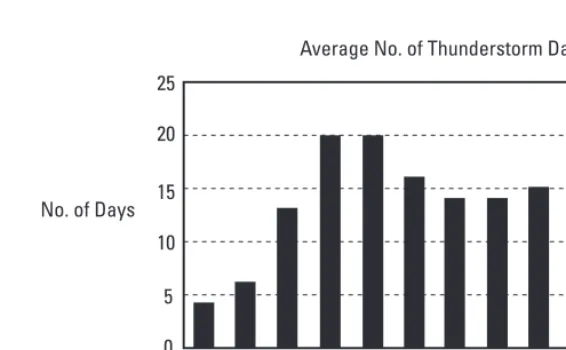
3. Singapore has one of the highest rates of lightning activity in the world. On average, 171 thunderstorm days (days when thunder is heard) are recorded annually by the Meteorological Services Division of the National Environment Agency, Singapore.
Figure 16.13 shows the monthly distribution of the number of thunder days.
(a) If you are planning a soccer tournament in an open fi eld, which months should you choose to reduce the risk of being struck by lightning?
(b) Storm clouds contain electric charges. Water droplets that are carried up by air currents will become charged. When the accumulation of electric charges is great enough to overcome the insulating properties of air, a lightning strike occurs.
(i) Figure 16.13 indicates that there are thunderstorm days throughout the whole year. How does the high moisture content of the air in Singapore all year round help to explain why clouds here become charged easily?
No. of Days 25
20
15
10
5
0
Jan Feb Mar Apr MayJun Jul Aug Sep Oct Nov Dec Average No. of Thunderstorm Days
Month
January and February, because there is a low chance (less than 20%) of encountering thunderstorms
and lightning hazards.
As there are many water molecules in the air, they become charged by friction when they
rub against air molecules. Thus, when they form clouds, the accumulated charge of the water
molecules causes the clouds to be highly charged.
J72PHYS WB_SE_Vol 2 • 16.indd 62
Physics Matters Workbook Volume 2 63
© 2007 Marshall Cavendish International (S) Pte Ltd
(ii) Describe the type(s) of charge movement between the charges in the storm cloud
and the charges on the tip of a lightning conductor on the ground.
(c) Would the likelihood of being struck by lightning be greater in a built-up area or a non-built-up area? Why?
During a lightning strike, a stream of negative charges (electrons) in the bottom of the cloud fl ows
down towards a high point (in this case, the lightning conductor) where the positive charges have
clustered due to induction. This massive fl ow of negative charge is seen as a fl ash of lightning.
There is a greater likelihood of being struck by lightning in a non-built-up area as there are no
buildings or other tall structures which typically have lightning conductors.
J72PHYS WB_SE_Vol 2 • 16.indd 63