an Islamic perspective
Dani Muhtada
Universitas Negeri Semarang (UNNES), Indonesia E-mail: [email protected]
Abstract
Workforce diversity is an inevitable phenomenon of the day. Diversity manage-ment is then developed in response to this reality. The discourse has been widely implemented in many western countries and some other countries across the world. Yet, it does not sound loudly in the Muslim countries. The objective of this paper is to discover Islamic perspective of workforce diversity management. The results show that pluralism and multiculturalism values are strongly promoted in Islamic teaching. Although, some conceptual problems regarding conservative views on diversity might constrain diversity workforce management, but a strate-gic solution to this issue is not impossible. This paper basically favors the idea of implementing the Lewin-Schein change model (i.e., unfreezing – change [mov-ing] – refreezing) for managing diversity in the Muslim society context but with a more focus given to the substantive aspects of diversity management (i.e., elabo-rating Islamic values on diversity). The role of such qualified Islamic scholars is crucial in this regard.
tersebut masih kurang mendapatkan perhatian. Paper ini bertujuan untuk menawarkan konsep manajemen keragaman di tempat kerja dalam perspektif Islam. Paper ini menggarisbawahi bahwa multikulturalisme sesungguhnya memiliki tempat yang signifikan dala ajaran Islam. Kendati ada ada persoalan konseptual berkaitan pandangan-pandangan konservatif tentang pluralism dan mulrikulturalisme, yang nota bene dapat menghambat efektivitas manajemen keragaman di dunia Islam, namun persoalan ini bukan tidak dapat dipecahkan. Paper ini berpendapat bahwa framework yang ditawarkan oleh Lewin-Schein tentang pengelolaan keragaman dapat diadaptasi dalam konteks dunia Islam dengan mengelaborasi konsep-konsep ajaran Islam tentang keragaman.
Keywords: Workforce; Diversity; Management; Islam;
Multiculturalism
Introduction
Managing diversity is a response to workforce diversity, which is an inevitable reality in many workplaces across the world. Having developed in the US,1 this discourse has widely traveled to many western and some African countries such as Zimbabwe and South Africa.2 Yet, it does not loudly sound in Muslim countries. As diversity management is closely related to personal differences including religion and beliefs, it is then interesting to discover what religions say about diversity management. This paper is intended to discuss an Islamic perspective of workforce diversity management. The result of this
1See Erwan Bellard and Charles-Clemens Rûling. “Importing diversity management: Corporate
discourses in France and Germany”, (2001), 1, retrieved on March 23, 2007, http:// www.hec.unige.ch/recherches_publications/cahiers/2001/2001.13.pdf; Deborah Jones, Judith
Pringle and Deborah Shepherd, “’Managing diversity’ meets Aotearoa/New Zealand”, Personnel
Review, Volume 29, Number 3 (2000), 361; Gillian A. Maxwell, “Minority report: Taking the initiative
in managing diversity at BBC Scotland”, Employee Relations, Volume 26, Number 1/2 (2004), 181.
2See Linda Human, “Managing workforce diversity: A Critique and example from South Africa,
International Journal of Manpower, Vol. 17, Number 4/5 (1996), 46-64; Parshotam Dass and Barbara Parker, “Strategies for managing human resource diversity: From resistance to
study can be a starting point to arrange the practice and the develop-ment of diversity managedevelop-ment in Muslim communities. To begin with, workforce diversity management as a discourse is discussed. The paper then explores the concepts of diversity management from the Islamic perspective along with some potential challenges. A strategic suggestion to develop workforce diversity management in the Muslim society context will be presented afterwards.
Workforce diversity management: a discourse
Traditionally, the definition of “diversity” was focused on racial and gender differences.3 Today, this term has been defined in a various ways. Friday and Friday,4 quoting Williams and O’Reilly, say that it refers to “any attribute that happens to be salient to an individual that makes him/her perceive that he/she is different from another individual”. Wilson, as is quoted by Hayes,5 provides a similar definition saying that diversity is “any characteristic that helps shape a person’s attitudes, behavior, perspective and interpretation of what is normal”. Bagshaw6 extends the definition to include “embracing the rich tapestry of skills, experience and ideas that come from the varying backgrounds that society offers today”. This corresponds to Wentling and Palma-Rivas’s definition,7 saying that it ranges from a narrow to
3Bayonne Z Grant and Brian H. Kleiner, “Managing diversity in the workplace”, Equal
Oppor-tunities International, Volume 16, Number 3 (1997), 26.
4Earnest Friday and Shawnta S. Friday, “Managing diversity using a strategic planned change
approach”, The Journal of Management Development, Volume 22, Number 9/10, (2003), 862.
5Victor Hayes. “Beyond employment equity: the business case for diversity”, Ivey Business
Journal, Volume 64, Number 1 (Sept/Oct, 1999), 45-46.
6Mike Bagshaw, “Is diversity divisive? A Positive training approach”, Industrial and
Commer-cial Training, Volume 36, Number 4 (2004), 154.
7Rose Mary Wentling and Nilda Palma-Rivas, “Current status and future trends of diversity
initiatives in the workplace: diversity experts’ perspective”, Human Resource Development
broader definitions. According to them, the narrow definition of diver-sity includes characteristics such as race, gender, ethnicity, age, na-tional origin, and disability, while the broader definition encompasses sexual and affectional orientation, values, education, language, physi-cal appearance, marital status, lifestyle, beliefs, and personality and any background characteristic (e.g., economic status, geographic ori-gin, and tenure with the organization).
Such diversity becomes a reality of the workplace throughout the globe of the day, so that developing diversity management is highly required. Managing diversity is about valuing employees as individuals.8 It is about transforming organizational culture to recognize the hetero-geneity of employees.9 It does not only embrace the range of indi-vidual characteristics that differentiate employees, but also implement policies and managerial skills that maximize every worker’s contribu-tions to the organizational purposes.10 It also means the planned and systematic commitment of organizations to recruit, retain, reward, and promote their heterogeneous employees.11 Sometimes, the phrase “working with diversity” is preferred than “managing diversity” as it encourages employees to be more “respectful, curious, patient, and
8Dianah Worman, “Managing diversity: Linking theory and practice to business performance”,
(2005), 4, retrieved on March 23, 2007, http://www.cipd.co.uk/NR/rdonlyres/D4D2D911-FC8A-4FD2-A814-B80A55A60B87/0/mandivlink0405.pdf
9Naomi J. Caiden and Gerald E. Caiden, “Strategies for meeting the challenges of diversity
management in the civil service”, 11, paper presented in United Nations Expert Group Meeting on
Managing Diversity in the Civil Service, May 3rd-4th, 2001, New York, retrieved May 1, 2007, http:/ /unpan1.un.org/intradoc/groups/public/documents/UN/UNPAN000565.pdf
10Rose Mary Wentling and Nilda Palma-Rivas, “Current status and future trends of diversity
initiatives in the workplace: diversity experts’ perspective”, Human Resource Development
Quar-terly, Volume 9, Number 3 (Fall, 1998), 236.
11Gillian A. Maxwell, “Minority report: Taking the initiative in managing diversity at BBC
Scot-land”, Employee Relations, Volume 26, Number 1/2 (2004), 183; Nigel Basett-Jones, “The
willing to learn”.12
An effective diversity management will make “good business sense” such as creating more respectful work and environment, transferring new perspectives, and improving problem-solving by embracing differ-ent ideas.13 This can also promote greater creativity and innovation,14 improve professional relationship in an inclusive atmosphere, and re-lease fear from employees so that they can develop their personal and professional capabilities.15 However, if diversity is not managed well, organizations could suffer from several disadvantages. These include communication breakdowns, interpersonal conflicts, group malfunction-ing, less-integrated, and higher turnover.16
Adopting Wilson’s theory of the equity continuum, Hayes17 catego-rizes six levels of organization (from level 0 to 5) in dealing with workforce diversity. An organization at level “zero” has thought about equitable employment status, but it does not have any diversity management policy. An organization at level “one” performs equity policies just to avoid legal consequences. An organization at level “two” has a desire
12Rose Mary Wentling and Nilda Palma-Rivas, “Current status and future trends of diversity
initiatives in the workplace: diversity experts’ perspective”, Human Resource Development
Quar-terly, Volume 9, Number 3 (Fall, 1998), 236.
13Dianah Worman, “Managing diversity: Linking theory and practice to business performance”,
(2005), 4, retrieved on March 23, 2007, http://www.cipd.co.uk/NR/rdonlyres/D4D2D911-FC8A-4FD2-A814-B80A55A60B87/0/mandivlink0405.pdf
14Earnest Friday and Shawnta S. Friday, “Managing diversity using a strategic planned change
approach”, The Journal of Management Development, Volume 22, Number 9/10, (2003), 864.
15Paul Armstrong, “’Managing’ diversity in the workplace: Representation of difference in the
office”, p. 3, paper presented at the 35th Annual SCUTREA Conference July 5 – July 7 2005,
University of Sussex, England, UK.
16Nancy R. Aries, “Managing diversity: The Differing perceptions of managers, line workers,
and patients”, Health Care Management Review, Volume 29, Number 3 (Jul – Sep 2004), 173;
Earnest Friday and Shawnta S. Friday, “Managing diversity using a strategic planned change
approach”, The Journal of Management Development, Volume 22, Number 9/10, (2003), 864.
17Victor Hayes. “Beyond employment equity: the business case for diversity”, Ivey Business
to “lend a hand” to the disadvantaged employees because of a sense of altruism. An organization at level “three” implements diversity pro-grams because of “business reasons” such as improving customer service or organization performance. An organization at level “four” is motivated to realize equity and takes steps to make it happen. It trains its employees to build a work environment that recognizes diver-sity. Such an organization is in transition to be one at level “five”, which has created a culture that values heterogeneity and provided an inclu-sive work environment for all employees.
Figure 1 The equity continuum
0
1
2
3
4
5
Notes:
Level 0 = Think about equitable employment status Level 1 = Legislative fairness
Level 2 = Altruism
Level 3 = Business reasons Level 4 = Transition
Level 5 = Equitable employment status
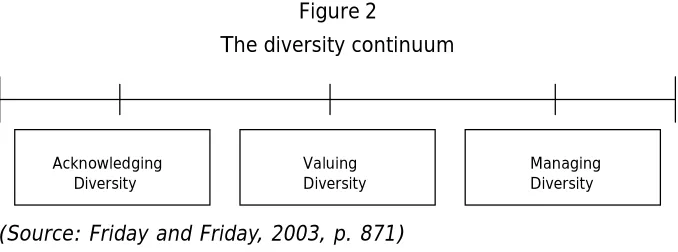
A similar framework called “the diversity continuum” is introduced by Friday and Friday.18 This framework indicates three potential states in dealing with diversity, namely acknowledging diversity, valuing diversity, and managing diversity. Acknowledging diversity refers to recognizing the existence of individual differences. Valuing diversity refers to appre-ciating and respecting the significance of diversity. Managing diversity refers to a set of actions to manage individual differences such as planning, organizing, and leading, which is intended to achieve the organization’s strategic purposes.
Figure 2
The diversity continuum
Acknowledging Valuing Managing
Diversity Diversity Diversity
(Source: Friday and Friday, 2003, p. 871)
Wentling and Palma Rivas’ study19 indicates four popular strategies for managing diversity: (1) training and education programs; (2) organizational policies; (3) mentoring programs; and (4) career development programs. Training and education programs, which are the most popular strategy of diversity management, are favored to
18Earnest Friday and Shawnta S. Friday, “Managing diversity using a strategic planned change
approach”, The Journal of Management Development, Volume 22, Number 9/10, (2003),
865-871.
19Rose Mary Wentling and Nilda Palma-Rivas, “Current status and future trends of diversity
initiatives in the workplace: diversity experts’ perspective”, Human Resource Development
help employees understand diversity in the workplace and to provide them with skills needed for working in diverse work teams. Developing organizational policies aim at promoting fairness and equity for all employees. Mentoring program is considered important in particular for minority employees, by which they will be assisted to understand the organizations’ standards and to improve their performances. Career development programs are chosen to create a fair and equitable environment so that trust, loyalty, and commitment among all employees are developed.
In spite of becoming the most favorite strategy, some experts do not see training and education as an effective strategy for managing workforce diversity. Quoting several studies, Combs20 indicates that this strategy does not promote a positive diversity climate very much. This may suspend discriminatory behaviors in short-term, yet generate more trouble in the long-term. Instead of diversity training, he suggests focusing more on leadership behavior and philosophy towards a diverse and pluralistic workplace. Similarly, Bagshaw21 recommends managers to start from themselves how to acknowledge the nature of diversity and to learn how to work creatively with tensions within the heterogeneous groups. It is believed that senior management’s active participation is crucial, as their attitudes will influence the other managers and employees at the lower levels.22 In this regard, Grant and Kleiner consider diversity training important, but it should address
20Gwendolyn M. Combs, “Meeting the Leadership Challenge of A Diverse and Pluralistic
Work-place: Implications of Self-Efficacy for Diversity Training”, Journal of Leadership & Organizational
Studies, Volume 8, Number 4, (Spring, 2002), 2-3.
21Mike Bagshaw, “Is diversity divisive? A Positive training approach”, Industrial and
Commer-cial Training, Volume 36, Number 4 (2004), 157.
22Nancy R. Aries, “Managing diversity: The Differing perceptions of managers, line workers,
the managers that are already in the organization as well as the future managers before they enter into management.23
Sadri and Tran24 propose the improvements of supervisor-subordi-nate communication in dealing with workforce diversity. They believe this can promote integration and equality in the workplace. This can be done through two ways: a short-term strategy (i.e., managing personal growth process [MPG]) and a long-term strategy [i.e., mentoring]). The MPG process involves four stages: (1) pre-workshop assignment, in which employees and their managers autonomously specify the employees’ job responsibilities, influential skills and personal competencies; (2) workshop, in which employees clarify what they have produced in the previous phase and compare them with those of their managers. At the end, they are expected to generate a develop-mental plan that draws particular actions; (3) development discussion, in which employees and their managers analyze the development plan. In such an honest and open discussion, the manager act as coach, not as judge; and (4) continued feedback, in which employees and the manager meet regularly to discuss progress and plan for the next development. Mentoring, which is a familiar relationship between a se-nior (the mentor) and a more juse-nior member of organization (the protégés), enables the protégés to make a better transition from out-sider to inout-sider more easily. As some mentors can be tyrannical and selfish and they can block the protégé’s potential, Sadri and Tran25 sug-gest to match between the mentor and the protégés so they can trust
23Bayonne Z Grant and Brian H. Kleiner, “Managing diversity in the workplace”, Equal
Oppor-tunities International, Volume 16, Number 3 (1997), 28.
24Golnaz Sadri and Hoa Tran, “Managing your diverse workforce through improved
communi-cation”, The Journal of Management Development; Volume 21, Number 3/4 (2002).
25Golnaz Sadri and Hoa Tran, “Managing your diverse workforce through improved
and respect each others to work together in a successful relationship. Friday and Friday26 critique organizations that have implemented various diversity initiatives but fail to manage workforce diversity. Ac-cording to them, this is because the organizations did not align these initiatives with their long-term objectives. Managing diversity, to them, is about “organizing and directing the inputs of all organizational mem-bers (including diverse individuals) to ensure the organization’s strate-gic goals are met”. They suggest the organizations to arrange a planned change approach that is strategically aligned with the organizations’ strategic positioning and long-term objectives. Referring to the theory of the diversity continuum, the idea is to advance the organizations from the passive phases of acknowledging and valuing diversity to the active phase of managing diversity.
To successfully transform an organization from the passive to the active station of the diversity continuum, Friday and Friday27 propose the Lewin-Schein change model that involves three phases (i.e., un-freezing – change [moving] – reun-freezing), all of which need to be addressed successfully. At the first phase, the current culture of the organization and its members needs to be unfrozen. This means that they have to be willing to move from the current stage to the next desired stage. At this stage, the organization needs to articulate a planned change-corporate strategy that is aligned with the organization’s strategic positioning. This strategic alignment is necessary to reinforce resource allocation in order to support the planned change-corporate diversity strategy. Once the planned change-corporate diversity
strat-26Earnest Friday and Shawnta S. Friday, “Managing diversity using a strategic planned change
approach”, The Journal of Management Development, Volume 22, Number 9/10, (2003),
864-868.
27Earnest Friday and Shawnta S. Friday, “Managing diversity using a strategic planned change
egy is devised, the organization should execute the second phase (i.e., moving to systematically managing diversity). This encompasses eight consecutive steps of the managing diversity process: exposure, experience, knowledge, understanding, appreciate, respect, modify attitudes and behavior, and healthy interaction (see figure 3). These sequential steps require a paradigm shift of the organization and its members. Diversity training can facilitate the organization and its members to shift their paradigm towards diversity. The third phase (i.e., refreezing the systemic management of diversity) is a process of “cementation” of newly embraced attitudes, behaviors and skills for healthy interrelationship. The aim is to keep the organization and its members from reverting back to the previous stations. At the individual level, this can be done through systemic and continuous training and day-to-day interactions. At the organizational level, this is achieved through adjusted policies, procedures, and systems.
Compared to the other mentioned strategies, the Lewin-Schein change model has a number of advantages. The model offers a strong procedure that makes it possible to suspend discriminatory behaviors and to promote a positive diversity climate in a long-term. Hence, this is the answer to the common failure of diversity training in promoting effective diversity management in a long-term as is indicated by Combs.28 This model may also elaborate Sadri and Tran’s suggestion29 to improve supervisor-subordinate communication (i.e., through the MPG and mentoring), which is significant to maintain positive diversity climate in the organization.
28 Gwendolyn M. Combs, “Meeting the Leadership Challenge of A Diverse and Pluralistic
Workplace: Implications of Self-Efficacy for Diversity Training”, Journal of Leadership &
Organiza-tional Studies, Volume 8, Number 4, (Spring, 2002), 2-3.
29Golnaz Sadri and Hoa Tran, “Managing your diverse workforce through improved
Unfortunately, although this model is strong in technical aspects of diversity management, the Lewin-Schein change model has a little con-cern over the substantive aspects (e.g., philosophical and paradig-matic matters) of diversity management. In fact, managing diversity is about the idea of valuing diversity, which is closely related to the philosophical and paradigmatic dimensions of human beings. This model also pays no attention to the significance of context consideration in developing diversity management. Such a consideration is crucial be-cause how human beings see others is strongly influenced by their contexts (e.g., sociological, cultural, political, etc.).
This paper is in position to fulfill such a lack of the Lewin-Schein change model, focusing on how this strategy can be implemented in the Muslim society context. An attention to paradigmatic aspects of diversity management in this particular context is important since di-versity problems might occur due to the failures of an individual Muslim in understanding Islamic teachings on diversity, as will be shown in this paper later on.
Islamic perspective on diversity and pluralism
The concepts of diversity and multiculturalism can be easily found in several verses of the Holy Quran and the Prophet’s tradition (Sunnah). For example, the very basic concept of human beings diversity can be seen in the Quran 5: 48, which says, “To each among you have we prescribed a law and an open way. If God had so willed, He would have made you a single people, but (His plan is) to test you in what He hath
given you: so strive as in a race in all virtues.” The term “each among
The words “test you” and “a race in all virtues” imply that God wants the diversity make human beings work better.
Even though human kinds are created in diversity, the concept of unity and brotherhood are crucial. The diversity of human beings should not lead to disharmony. The Quran (4: 1) says, “O mankind! Rever-ence your Guardian-Lord, who created you from a single sole, created, of like nature, His mate, and from them twain scattered (like seeds)
countless men and women”. This verse reminds human beings that
they have been created of a single sole, so that they should respect each other. The same message of brotherhood is repeated in the Quran (49: 13), which says that all human beings are descended from the same parents.
The Quran also recognizes racial, lingual, and national diversities. The differences of race and language are illustrated as the signs of God. The Quran (30: 22) says, “And of His signs are the creation of the heavens and the earth and the diversity of your tongues and
colors. Surely there are signs in this for the learned.” It is implied in the
verse that human beings need to respect diversity and learn from it. The difference of national identity is recognized in the verse (49: 13), which says, “O mankind! We created you from a single (pair) of a male and a female, and made you into nations and tribes, that ye may know each other (not that ye may despise (each other). Verily the most honoured of you in the sight of God is (he who is) the most
righteous of you.” This verse teaches human beings that diversity
-and have faith, they will enter Heaven, -and not the least injustice will
be done to them”. Another verse (3: 195) states, “And their Lord hath
accepted of them, and answered them: “Never will I suffer to be lost
the work of any of you, be he male or female”. Similar verses can be
seen in the Quran (16: 97; and 33: 35). These verses indicate that all human beings, male or female, are the same before God.
Finally, the Quran also highlights the recognition of freedom of religion, which indicates the importance of religious pluralism. It is stated in the Quran (2: 256), “Let there be no compulsion in religion: Truth stands out clear from error: whoever rejects evil and believes in God hath grasped the most trustworthy hand-hold that never breaks. And
God heareth and knoweth all things”. The Quran (3: 64) suggests
Muslims to invite other religious communities to emphasize similarities among them instead of differences. It is stated, “Say: “O People of
the Book (i.e., Jews and Christians)! Come to common terms as
be-tween us and you: That we worship none but God; that we associate no partners with Him; that we erect not, from among ourselves, Lords
and patrons other than God.” Moreover, the Quran (22: 40) strongly
emphasizes respecting and protecting all religious places, saying, “Did not God check one set of people by means of another, there would surely have been pulled down monasteries, churches, synagogues, and mosques, in which the name of God is commemorated in
abun-dant measure.” This verse indicates that no single place of worship is
into 22 tribes of Arabs and Jews.30 Given such a plural society, the Medina Charter underlined the equal status and rights between Mus-lims and non-MusMus-lims and gave them an equal chance to say in gov-ernmental matters.31
In the last sermon of h}ajj al-wada>’, Muhammad highlighted the equal position of human beings and promoted no discrimination against race. He said:
“All mankind is from Adam and Eve. An Arab has no superiority over a non-Arab, nor does a non-Arab have any superiority over an Arab; white has no superiority over black, nor does a black have any superiority over white; [none have superiority over another] except by piety and good action. Learn that every Muslim is a brother to every Muslim and that the Muslims constitute one
broth-erhood. Nothing shall be legitimate to a Muslim which belongs to a
fellow Muslim unless it was given freely and willingly. Do not, there-fore, do injustice to yourselves”.32
The practice of acknowledging and managing diversity can also be traced in the history of Islamic governance. For example, ‘Umar ibn al-Khaþþab, one of the Prophet’s great companions and the second Caliph (634-644 AD) appointed al-Shifa’ bin ‘Abdillah as a market super-visor in Medina.33 The Islamic dynasty of Umayyad (661-750 AD) employed a number of non-Muslims in diplomacy, finance and public
30Yetkin Yildirim, “Peace and Conflict Resolution Concepts in the Medina Charter”, (2005),
retrieved June 1, 2007, http://www.interfaithathens.org/article/art10171.asp
31Hamka Haq, “Indonesian non-Muslims are not Dhimmi”, (2001), retrieved on 3 June, http:/
/islamlib.com/en/page.php?page=article&id=560; Hidayat Nur Wahid, “Islam, Democracy and
Political Parties”, p. 3, a paper presented in the International Conference on Beyond Elections:
Islam and Political Parties in Southeast Asia, held in Jakarta on 6 -9 September 2005, retrieved June 1, 2007, http://www.cdiw.org/pages/followup/nur_wahid.pdf.
32Amatullah Abdullah, “Prophet Muhammad’s last sermon: a Final admonition”, (2007),
re-trieved June 1, 2007, http://www.islamreligion.com/articles/523/
33M.H. Al Khayat, Woman in Islam and Her Role in Human Development, (2003), 13, Regional
administration.34 The Ottoman dynasty (1281-1923) also reportedly placed non-Muslims in key positions of governance. Among of them were Yakub Mahallesi who served as the prime minister and Hekim Yakub who was a physician that a whole quarter of Istanbul was named after him.35 The Islamic history also notes a number of queens ruling Islamic dynasties.36 Among of them are the famous 13th century Mamluk queens Radhia of Delhi and Shajarat al-Dur of Egypt. Muslims in Maldives had been ruled by queens for forty years (1347 – 1388). Muslims in Indonesia had 34 queens ruling the Islamic dynasty of Aceh for about four centuries (1500s – 1900s), four of them were succeeded each other as queens between 1641 and 1699. These examples confirm the practices of managing diversity, which is in accordance with the basic teachings of Islam on diversity, pluralism and multiculturalism.
Potential challenges
As mentioned above, the Islamic values of diversity and the practice of managing diversity in the Islamic history indicate that Muslims should not have barrier in implementing diversity management. However, some conservative Muslims might still find it difficult to deal with diversity management in connection to women and non-Muslims leadership. Such Muslims believe that a male Muslim should be a leader in any circumstances. This belief is resulted from conservative interpretation of some Islamic texts such as the Quran (4: 34), which produce the conventional conceptual frameworks of leadership.
34M. Mohamad, “The role of Islamic civilization in fostering inter-religious understanding”, a
seminar paper presented in Malaysia on May 25, 1999.
35Nushin Arabzadah, “Multiculturalism in medieval Islam”, (2004), retrieved on May 29, 2007,
http://www.opendemocracy.net/arts-multiculturalism/article_2263.jsp
36Sanusi Lamido Sanusi, “Women and political leadership in Muslim thought”, (2001), retrieved
In the case of female leadership, conservative Muslims37 argue that a woman should not be a leader. They mainly base their argument on the Quran (4: 34), which says, “Men are the protectors and maintainers of women, because God has given the one more (strength) than the
other, and because they support them from their means.” The terms
“protectors and maintainers”, which are the translation of a single Ara-bic word “qawwa>m”, have been used to justify male leadership. They argue that this is a clear indication that female leadership is not ac-knowledged in Islamic teachings.
Some contemporary Muslim scholars38 reject this interpretation. They argue that the verse is not talking about leadership in general, but about the Islamic family law. This is indicated from the words “…and
because they support them from their means”, which implies that
husbands are responsible for the economic responsibility of household in Islam. They question why the meaning of “qawwa>m” in this verse must be conceived as “protectors and maintainers” whereas the same word in two other Quranic verses (4: 135 and 5: 8) is conceived as “commitment to stand up for something”. This verse (4: 34) must not justify the absolute male leadership and domination in any circumstances as this more corresponds to several verses (e.g., 3: 35 and 195; 4: 124; 16: 97) indicating gender equity in the Islamic perspective.
37Muhammad Hussayn Tabatþaba’i, Tafsi>r al-Mi>za>n, Vol. 4, , Beirut: Mu’assasah al-‘Alami>,
1991, 351; Abu Abdullah Muhammad Ibn Ahmad Al-Qurtubi, al-Jami’ li Ah}kam al-Qur’a>n Vol 4,
Cairo: Da>r al-Ka>tib al-‘Arabi>, 1967, 169; Moulana M. Karolia, “Female leadership in Islam”, (2005),
retrieved on March 26, 2007, http://www.islamsa.org.za/library/female_leadership_in_islam.htm.
38Syafiq Hasyim, Hal-hal yang Tak Terpikirkan : Tentang Isu-Isu Keperempuanan dalam Islam,
Mizan, Bandung, Indonesia, (2001); Yunahar Ilyas, Feminisme dalam kajian tafsir al-Qur’an:
In the case of non-Muslim leadership, conservative Muslims argue that Muslims must not take non-Muslims as their leaders.39 They base their arguments on the Quran (5: 51), which says:
“O ye who believe! Take not the Jews and the Christians for your friends and protectors: They are but friends and protectors to each other. And he amongst you that turns to them (for friendship) is of them. Verily Allah guideth not a people unjust.”
This conservative view has been critiqued by many modern Islamic scholars because it does not take into account the context of the text. Al-Qardhawi,40 for example, says that the verse’s command is not unconditional. This verse is only applicable to those who are hostile to Islam and engage in war against Muslims. It is revealed in relation to the pagans who declared war against some Arabian simply because they converted to Islam. With this type of people, alliance and friend-ship are prohibited. This point of view is supported by the other verses of the Quran (e.g., 3: 118-9; 58: 22; 60: 1). Generalizing the Quran (5: 51) to all non-Muslims is out of the context. In fact, in the same chapter of the Quran (60: 7), Muslims are encouraged to build a better understanding and improve relationships with those kinds of unfriendly people, so that they can create a more peaceful life in the future.
Organizations should take into account these problematic concepts in managing workforce diversity in the Islamic context. It is impossible for them to gain positive aspects of diversity management if employ-ees under their management have internal problems in connection with
39Ramli A. Wahid, “Kriteria pemimpin ideal dalam Islam, Waspada, 15 April 2005, retrieved on
March 27, 2007, http://www.waspada.co.id/serba_waspada/mimbar_jumat/artikel.php? article_id=60491
40Yusuf Al-Qardawi, “Amicabledealings with non-Muslims”, IslamOnline, April 18 2006,
their fundamental beliefs. Therefore, as Robinson-Easley41 suggests, it is crucial to identify and understand the culture and climate of the organization as the first step in managing diversity.
The role of Islamic scholars
Pluralism and multiculturalism values in Islamic teachings can be a significant capital to start and develop diversity management in the Muslim community context. Although some problems might occur in relation to the conservative Islamic views on gender and non-Muslims, a strategic solution to solve these problems is not impossible. One of the potential strategies is the Lewin-Schein change model as suggested by Friday and Friday42, which encompasses three phases: unfreezing, change (moving), and refreezing phases.
At the unfreezing phase, the organization and its members should have enough motivation to change their current paradigm and culture towards diversity. As motivation might vary among organizational mem-bers, it is crucial to start this stage by identifying and understanding their perspectives on diversity. Referring to Wilson’s theory of equity continuum, as is previously discussed, Muslim’ response to workforce diversity can be classified into five levels. Level “one” is a Muslim who is reluctant to pluralism and multiculturalism. This type of people is coun-terproductive to diversity management, as he or she cannot collabo-rate in diverse work teams. It is crucial to identify the reasons under-pinning such a behavior. This could be resulted from their beliefs or from their personal experiences. Level “two” is a Muslim who has no feeling of pluralism or anti-pluralism. Such a person cares a little (if not
41Christopher Ann Robinson-Easley, “Developing, valuing and managing diversity in the new
millennium”, Organization Development Journal, Volume 19, Number 4, (Winter, 2001), 40.
42Earnest Friday and Shawnta S. Friday, “Managing diversity using a strategic planned change
nothing) about the issue. He or she does not oppose diversity man-agement but has no contribution to support diversity manman-agement. Level “three” is a Muslim who acknowledges and respects diversity. Yet, he or she is not aware of the benefits of diversity for organization management. Level “four” is a Muslim who acknowledges and values diversity and thinks about the benefits of diversity in the workplace. Unfortunately, such a person does not take any step toward diversity management. Level “five” is a Muslim who completely acknowledges and values diversity, knows its benefits, and makes pro-active steps to realize them in the workplace. Such a Muslim is an expensive resource for the organization as he or she has pro-actively use diversity to gain organizational goals and targets.
Figure 3
Pluralism continuum: Islamic context
1
2
3
4
5
Notes:
Level 1 = anti-pluralism and multiculturalism Level 2 = no feeling toward diversity Level 3 = acknowledging diversity Level 4 = valuing diversity
Level 5 = full contributor of diversity management
diver-sity). To accomplish the first state (i.e., unfreezing), all members of the organization need to reach level 3, which reflects their readiness to move from their present state to the desired state of the diversity continuum.43 Organizational members that have not reached the level 3 are given special treatment (e.g., training, mentoring, coaching) de-pending on the level of their responses towards diversity.
Since the treatment is directed to Muslim people and may be closely related to their principle of beliefs, then the involvement of Islamic scholars is significant. The scholars can help to identify the levels of responses and they can know exactly how to deal with Muslims’ be-lieves regarding diversity. At this point, selecting right scholars is crucial. The organization needs to select those who understand Islamic values of pluralism and multiculturalism and are familiar with human resource managerial skills. This is a required qualification of Islamic scholars for diversity management. If the organization could not find such scholars, it should at least get Islamic scholars that have transfor-mative paradigms towards diversity and gathers them with diversity management experts. Otherwise, the involvement of Islamic scholars would contribute nothing; if not even destruct the process of managing diversity.
Within this unfreezing phase, as is previously mentioned, the organi-zation needs to devise a planned change-corporate strategy that is aligned with the organization’s strategic positioning.44 Here, the partici-pation of such qualified Islamic scholars (i.e., having knowledge on Islamic values on diversity as well as mastering human resource
mana-43Earnest Friday and Shawnta S. Friday, “Managing diversity using a strategic planned change
approach”, The Journal of Management Development, Volume 22, Number 9/10, (2003), 871.
44Earnest Friday and Shawnta S. Friday, “Managing diversity using a strategic planned change
gerial skills) is significant. Together with diversity management experts, they can analyze the most relevant linkages between the diversity initiatives and the organization’s general strategic positioning, policies, procedures, systems, and diversity.
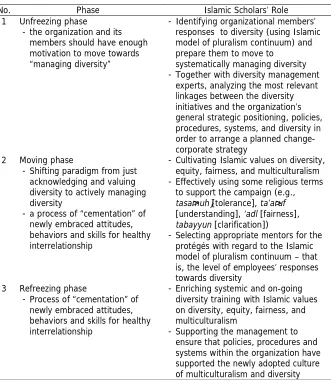
Once the current state is unfrozen, the second phase (i.e., the move towards systematically managing diversity) is taken. This is a phase to shift people’s paradigm from just acknowledging and valuing diversity to actively participate in managing diversity. This is a time for the organization to cultivate Islamic values on equity, fairness, multiculturalism and diversity. Some religious terms derived from the Holy Quran can be adapted to promote these values. Words such as
tasa>muh} (tolerance), ta‘a>ruf (understanding), ‘adl (fairness) and
tabayyun (clarification) can be effective means to cultivate such
val-ues, especially for employees that are familiar with the words. If the organization is successful in cultivating the values, it will not only lead the organizational members to reach organizational goals, but also lead them to practice their religious teachings.
Mentoring is another important issue to consider in cultivating these values. As suggested by Sadri and Tran,45 mentoring aims at helping the new organizational members’ make an easy transition from out-sider to inout-sider. Therefore, selecting the right mentor (i.e., senior mem-ber) for the right protégé (junior memmem-ber) is very crucial. If the orga-nization selects a wrong person as a mentor, it will miss the mission of mentorship. This becomes more crucial when the mentorship is in-tended to alleviate the negative influence of conservative Islamic be-liefs towards diversity. Accordingly, the involvement of Islamic scholars in selecting the mentor is also significant here.
45Golnaz Sadri and Hoa Tran, “Managing your diverse workforce through improved
The third phase (i.e., refreezing the systemic management of di-versity) is put in place once the organization has successfully managed workforce diversity. This is to maintain the healthy interaction among organizational members and to protect them from returning back to the previous state. In the context of Muslim society, the systemic and on-going training enriched with Islamic values on diversity should be one of the techniques of managing diversity. At the organizational level, the management should ensure that policies, procedures and systems within the organization have supported the newly adopted culture of multiculturalism and diversity. This must include the proce-dures of recruitment and induction whereby new members of the or-ganization are introduced to the culture of oror-ganization.
Conclusion
Table 4
The role of Islamic scholars in managing diversity in the Muslim society context
No. Phase Islamic Scholars’ Role
1 Unfreezing phase
- the organization and its members should have enough motivation to move towards “managing diversity”
- Identifying organizational members’ responses to diversity (using Islamic model of pluralism continuum) and prepare them to move to
systematically managing diversity
- Together with diversity management
experts, analyzing the most relevant linkages between the diversity initiatives and the organization’s general strategic positioning, policies, procedures, systems, and diversity in order to arrange a planned change-corporate strategy
2 Moving phase
- Shifting paradigm from just acknowledging and valuing diversity to actively managing diversity
- a process of “cementation” of newly embraced attitudes, behaviors and skills for healthy interrelationship
- Cultivating Islamic values on diversity, equity, fairness, and multiculturalism
- Effectively using some religious terms to support the campaign (e.g., tasa>muh}[tolerance], ta’a>ruf [understanding], ‘adl [fairness], tabayyun [clarification])
- Selecting appropriate mentors for the protégés with regard to the Islamic model of pluralism continuum – that is, the level of employees’ responses towards diversity
3 Refreezing phase
- Process of “cementation” of newly embraced attitudes, behaviors and skills for healthy interrelationship
- Enriching systemic and on-going
diversity training with Islamic values on diversity, equity, fairness, and multiculturalism
- Supporting the management to
ensure that policies, procedures and systems within the organization have supported the newly adopted culture of multiculturalism and diversity
focus given to the substantive aspects of diversity management (i.e., elaborating Islamic values on diversity). In this regard, it highlights the crucial role of such qualified Islamic scholars (i.e., mastering Islamic values on diversity as well as human resource management skills) in developing workforce diversity management in the Muslim society con-text. Such scholars’ role can be explained as follows: First, at the unfreezing phase, they can help to identify the levels of Muslim em-ployees’ responses towards diversity. They can also collaborate with diversity management experts in analyzing the most relevant linkages between the diversity initiatives and the organization’s general strategic positioning, policies, procedures, systems, and diversity. Second, at the moving phase, they can help to cultivate Islamic values on equity, fairness, multiculturalism and diversity. Some religious terms such as
tasa>muh} (tolerance), ta‘a>ruf (understanding), ‘adl (fairness) and
tabayyun (clarification) can be effectively used to promote the desired
values. Their roles in selecting the right mentor for the right protégé is also crucial, in particular when the mentorship is intended to alleviate the negative influence of conservative Islamic beliefs towards diversity. Third, at the refreezing stage, they can contribute in the systemic and on-going training enriched with Islamic values on diversity, which is very important in maintaining the healthy interaction among members of the organization.
Bibliography
Abdullah, Amatullah, “Prophet Muhammad’s last sermon: a Final ad-monition”, retrieved 1 June 2007., http://www.islamreligion.com/ articles/523/
www.islamonline.net/English/In_Depth/ShariahAndHumanity/Ar-ticles/2006/04/01.shtml
Al-Qurthubi, Abu Abdullah Muhammad Ibn Ahmad, al-Ja>mi’ li Ah}ka>m al-Qur’a>n, vol 4. Cairo: Da>r al-Ka>tib al-‘Arabi>, 1967.
Ali, Abdullah Yusuf. The Holy Quran: Text, Translation & Commentary, vol. 1 & 2, Sh. Muhammad Ashraf, Lahore, Pakistan, 1973. (online version of the translation is http://transliteration.org/quran/ WebSite_CD/MixYuwsuf/Fram2E.htm)
Arabzadah, Nuhsin, “Multiculturalism in medieval Islam”, retrieved on 29 May, 2004, http://www.opendemocracy.net/arts-multiculturalism/article_2263.jsp
Aries, Nancy R., “Managing diversity: The Differing perceptions of man-agers, line workers, and patients”, Health Care Management Re-view, Volume 29, Number 3 (July-Sept 2004): ABI/INFORM Glo-bal, retrieved on 23 March 2007, http://proquest.umi.com/ pq dwe b? ind ex= 35& di d=6 763 750 61 &Sr chM ode =1 &si d= 8&Fmt=6&VInst=PROD&VType= PQD&RQT=309&VName= PQD&TS=1151370638&clientId=20831
Armstrong, Paul, “Managing’ diversity in the workplace: Representation of difference in the office”, paper presented at the 35th Annual SCUTREA Conference July 5-7, 2005., University of Sussex, En-gland, UK, retrieved on 23 March 2007, http://www.leeds.ac.uk/ educol/documents/142023.htm
Bagshaw, Mike, “Is diversity divisive? A Positive training approach”,
Industrial and Commercial Training, Volume 36, Number 4 (2004);
P R O D & V T y p e = P Q D & R Q T = 3 0 9 & V N a m e = PQD&TS=1151370735&clientId=20831
Basett-Jones, Nigel, “The Paradox of diversity management, creativity and innovation”, 2005, retrieved on 22 March 2007, http:// www.blackwell-synergy.com/doi/abs/10.1111/j.1467-8691.00337.x
Bellard, Erwan & Rûling, Charles-Clemens, “Importing diversity man-agement: Corporate discourses in France and Germany”, 2001, retrieved on 23 March 2007, http://www.hec.unige.ch/ recherches_publications/cahiers/2001/2001.13.pdf
Caiden, Naomi J. & Caiden, Gerald E., “Strategies for meeting the challenges of diversity management in the civil service”, paper presented in United Nations Expert Group Meeting on Managing
Diversity in the Civil Service, 3-4 May, 2001, New York, retrieved 1
May 2007, http://unpan1.un.org/intradoc/groups/public/docu-ments/UN/UNPAN000565.pdf
Combs, Gwendolyn M, “Meeting the Leadership Challenge of A Diverse and Pluralistic Workplace: Implications of Self-Efficacy for Diversity Training”, Journal of Leadership & Organizational Studies; Volume 8, Number 4, (Spring 2002), 1-16.
Dass, P. & Parker, B., “Strategies for managing human resource diver-sity: From resistence to learning”, the Academy of Management
Exececutive, Volume 13, Number 2 (May 1999): 68-80; ABI/
INFORM Global, pp. 68-80, retrieved on 23 March 2007,http:// proquest.umi.com/pqdweb?index=145&did= 41938299& S r c h M o d e = 1 & s i d = 4 & F m t = 6 & V I n s t = P R O D & V Ty p e = PQD&RQT=309&VName= PQD&TS=1151465301&clientId=20831
Development, Volume 22, Number 9/10 (2003): 863-880; ABI/ INFORM Global, pp. 863-880, retrieved 22 March 2007, http:// p r o q u e s t . u m i . c o m / p q d w e b ? i n d e x = 4 7 & d i d = 1017920691&SrchMode=1&sid= 8&Fmt=6&VInst=PROD&VType= PQD&RQT=309&VName=PQD&TS=1151371316&clientId=20831
Grant, Bayonne Z. & Kleiner, Brian H., “Managing diversity in the work-place”, Equal Opportunities International, Volume 16, Number 3, (1997), 26-32.
Hasyim, Syafiq. Hal-hal yang Tak Terpikirkan: Tentang Isu-Isu
Keperempuanan dalam Islam. Bandung: Mizan, 2001.
Haq, Hamka, “Indonesian non-Muslims are not Dhimmi”, retrieved on 3 June, 2001, http://islamlib.com/en/page.php?page= article&id=560
Hayes, Victor, “Beyond employment equity: the business case for di-versity”, Ivey Business Journal, Volume 64, Number 1 (Sept/Oct 1999): 44-50.
Human, Linda, “Managing workforce diversity: A Critique and example from South Africa, International Journal of Manpower, Volume 17, Number 4/5 (1996): 46-64.
Ilyas, Yunahar. Feminisme dalam kajian tafsir al-Quran: Klasik dan
Kontemporer. Yogyakarta: Pustaka Pelajar, 1997.
Jones, Deborah, Pringle, Judith, and Shepherd, Deborah, “Managing diversity’ meets Aotearoa/New Zealand”, Personnel Review, Vol-ume 29, Number 3 (2000): 364-380.
Al-Khayat, M. H. Woman in Islam and Her Role in Human
Develop-ment. Cairo: Regional Office for the Eastern Mediterranean-World
Health Organization, 2003. retrieved on 3 June 2007, http:// www.emro.who.int/cbi/PDF/Women_Islam.pdf
Kodir, Faqihuddin Abdul, “Tafsir humanis atas kepemimpinan”, 2004, retrieved 29 April 2007, http://islamlib.com/id/index.php? page=article&id=577
Maxwell, Gillian A., “Minority report: Taking the initiative in managing diversity at BBC Scotland”, Employee Relations, Volume 26, Num-ber 1/2 (2004): 182-202.
Mohamad, M., “The role of Islamic civilization in fostering inter-religious understanding”, a seminar paper presented in Malaysia on 25 May, 1999, retrieved on 1 June 2007, http://www.pmo.gov.my/ WebNotesApp/PastPM.nsf/acfe72124fbea2e148256e72001d223e/ afdbe219d776dcdf4825677c00388bb1?OpenDocument
Muhlis, I., “Tafsir atas kepemimpinan perempuan”, Suara Merdeka, 9 Juni 2004, retrieved on 27 March 2007, http://www.suara merdeka.com/harian/0406/09/opi3.htm
Robinson-Easley, Christopher Ann, “Developing, valuing and managing diversity in the new millennium”, Organization Development Jour-nal, Volume 19, Number 4, (Winter , 2001): 38-50.
Sadri, Golnaz and Tran, Hoa, “Managing your diverse workforce through improved communication”, The Journal of Management Develop-ment, Volume 21, Number 3/4 (2002): 227-237.
Al-Thabathþaba’i. Muhammad Husayn. Tafsi>r al-Mi>za>n. Vol. 4, Beirut: Mu’assasah al-‘Alami>, 1991.
Wahid, Hidayat Nur, “Islam, Democracy and Political Parties”, a paper presented in the International Conference on Beyond Elections:
Islam and Political Parties in Southeast Asia, held in Jakarta on 6
-9 September 2005a, retrieved 1 June 2007, http://www.cdiw.org/ pages/followup/nur_wahid.pdf
Wahid, Ramli A., “Kriteria pemimpin ideal dalam Islam, Waspada, 15 April 2005b, retrieved on 27 March 2007, http://www.waspada. co.id/serba_waspada/mimbar_jumat/artikel.php?article_id=60491
Wentling, Rose Mary and Palma-Rivas, Nilda, “Current status and fu-ture trends of diversity initiatives in the workplace: diversity ex-perts’ perspective”, Human Resource Development Quarterly, Vol-ume 9, Number 3 (Fall 1998): 235-253.
Worman, Dianah, “Managing diversity: Linking theory and practice to business performance”, 2005, retrieved on 23 March 2007, http:/ /www.cipd.co.uk/NR/rdonlyres/D4D2D911-FC8A-4FD2-A814-B80A55A60B87/0/mandivlink0405.pdf