Vol. 8, No. 1 (2014)
http://www.eludamos.org
Digital Seriality as Structure and Process
Dominik Maeder and Daniela Wentz
Eludamos Vol. 8, No. 1 (2014) pp. 129-149
Copyright © by Dominik Maeder and Daniela Wentz DOMINIK MAEDER AND DANIELA WENTZ
Introduction: Digital Seriality as Structure and Process
The web is foremost a form: an idealized structure of decentralized and delinearized connections between sets of data, stored on an open multitude of physical devices dispersed around the entirety of the globe. Despite its (in principle) distributed and networked technical nature, the web is accessed through a relatively small number of websites and services such as Google, Facebook, Twitter, Yahoo!, Wordpress, and their respective affiliates. These companies centralize and monetize access to, and the flow of, web data. For an overwhelming majority of private and business Internet users, these companies’ various services are crucial to the everyday experience of the web. Bypassing all these services—for instance in an effort to escape government surveillance—is still theoretically possible; however, it requires an advanced level of technological understanding and awareness. The web as an ordinary and everyday medium (or set of media) thus becomes effective, operational, and convenient only through the interfaces of a few predominant search engines and social networking, video sharing, and (micro)blogging websites—the web’s “citadels” (Warnke 2012).
In other words, while it is technically a complex, decentralized, and non-linear networked structure, the web becomes phenomenal, i.e. visible and open to navigational user practices, only in so far as it is made accessible by a small number of web interfaces operated by an even smaller number of companies and corporations (cf. Warnke 2012, pp.132-134). Since these interfaces format most of the world’s experience of the web, it is imperative that we pay close attention to their formal properties. With regard to a theory of interfaces, such as that developed by Lev Manovich (2001), we will argue that web interfaces in principle, and contemporary examples of video sharing websites such as YouTube in particular, can be described as operative forms of seriality rather than as webs or networks. More precisely, we will show that YouTube’s interface performs, enables, and fosters operations of serialization, operations which occur neither inside nor outside of images, but in the in-between space of the interface. These forms of digital seriality can be located, for instance, in the publishing strategies of video-game based walkthrough videos, so-called Let’s Plays, which closely resemble and emulate serial television programming.While these procedures of weaving complex (narrative) nets through serialization in television have received a great deal of scholarly attention over the course of the past decade (cf. Mittell 2006, Nannicelli 2009, Piepiorka 2012), seriality as a key feature of web-based forms has largely been neglected and left undertheorized. Manovich’s disregard of television in its entirety, and of seriality as a spatial-temporal procedure in particular, serves here as a case in point.
important locations where what one might call “viral seriality” takes place or has its origins. Videos are called viral when they gain a very high degree of popularity, often on a global scale, through extensive and rapid online viewing and sharing, mostly in the form of user-based distribution via video-sharing websites and social media.
Virality is based on speed and decentralization—a spatial distribution in time—which, more or less opposed to the regulated seriality of Youtube as a platform, has to be described as a process that is out-of-control: Videos spread via networked distribution in ways that can neither be foreseen nor determined, much less controlled (cf. Burgess 2007).
Viral videos can be described not only as fodder for today’s media and network culture, but might—and will in this paper—be approached also as revealing the basic traits of the media ecology of which they are an essential part (cf. Parikka 2005, Goriunova 2013, Sampson 2012). As such, viral videos have to be understood not as discrete entities or as mere messages or content. Rather, they are complex, autopoietic processes which, together with memes of all sorts, and also malicious software like viruses and worms, lie at the heart of the vividness and maintenance of network culture as such. Olga Goriunova describes memes very aptly as “techno-aesthetic processes of becoming,” as “a behavior, or rather a system of human-technological performances. A meme grows out of a variety of websites, agents and ecologies, meshing to build networks promoting its emergence” (Goriunova 2013, our translation). While, as Limor Shifman writes, “memes and digital culture seem like a match made in heaven,” it is interesting—especially in the context of this special issue on digital seriality—that all the aforementioned phenomena are based on serial processuality, on coupling, doubling, replication, repetition, imitation, and more or less independent distribution (Shifman 2014; for the virus cf. Parikka 2005, 2007). Memes, as we aim to show, are paradigmatic examples for digital seriality across multiple dimensions, not only with respect to their sprawling distribution processes.
Our aim, in the following, is not to describe the entirety of networks in terms of seriality, yet we do argue that serial operations and procedures play a distinct and significant role in the workings of Internet memes and digital interfaces generally.
The Seriality of Interfaces
Within the space of a mere decade, YouTube has become synonymous with watching videos online; indeed, the platform plays such a crucial role in people’s access to visual material on the web that its interface may already have become a naturalized form of organizing and displaying web videos.
actuate, and govern actual navigational practices. Rather than being mere containers for the distribution of content or neutral placeholders for user-driven practices of “prosuming,” interfaces have to be conceived as the basal forms through which practices of sharing, “produsing,” and mashing up are put into effect, shaped, and regulated. It is precisely this scholarly “neglect of the substantial role a site’s interface plays in manoeuvring individual users and communities” (van Dijck 2009, p. 45) which we aim at starting to overcome in this section.
In his seminal work on The Language of New Media, Lev Manovich (2001) provides an account of new media that focuses on the aesthetic forms of digital media and makes a strong case for the importance of visual interfaces. In this context, he aims at outlining the affiliations of new with “old” media by analyzing the ways media as diverse as print, cinema, and computers represent and construct space and time in making databases accessible and enabling narratives. Strangely enough, new media’s immediate predecessor, television, plays only a minor role (if at all) in his analyses. Drawing upon television’s strong affiliation with modes and forms of seriality, we may eliminate this blind sport and emend Manovich’s analysis of database and narrative, which he asserts to be “natural enemies” (2001, p. 225).
Manovich’s strong claim regarding the natural enmity of database and narrative— which is a claim about the relation between the structure of gathered data and the navigational practices by which it is accessed—derives from what he describes as a semiotic reversal: While the syntagmatic, i.e. the linear cause-and-effect dimension of signs, is presented in praesentia in the material sequence of spoken phonemes, written graphemes, or the moving images of film, the paradigmatic, i.e. the non-linear differential dimension of signs, remains in absentia, available only through virtual comparisons between potential phonemes and graphemes or images. In computer-based media, on the other hand, these paradigmatic and syntagmatic functions of signification are transposed, according to Manovich (p. 230): here, the paradigmatic dimension of signs, the inventory of potential elements of signification, is displayed on the screen and thus present, while syntagmatic sequences, linear combinations of signs, remain subject to the navigational practices of individual users and are thus relegated to the realm of the virtual. “Database (the paradigm) is given material existence, while narrative (the syntagm) is dematerialized. Paradigm is privileged, syntagm is downplayed. Paradigm is real; syntagm virtual” (p. 231).
Drawing upon this marginal notion of seriality, Stephanie Boluk argues that seriality is the missing link in Manovich’s discussion of database and narrative. As seriality works both spatially (e.g. a series of paintings on a wall of a gallery) and temporally (e.g. a series of events over time), it operates on both sides of the distinction between paradigm and syntagm and may thus be located on the levels of database and narrative alike: “Digital media and specifically, a database aesthetic, subsumes these multiple, perhaps even contradictory uses of seriality under its regime of production” (Boluk 2009). Seriality may then be analyzed not only as a function of computer code, but as an aesthetic feature of the organizational forms in which databases are presented and, therefore, as an intrinsic feature of web interfaces.
This neglect of seriality in Manovich’s discussion coincides with a media-historical blind-spot: jumping directly from the cinema of the early twentieth to the digital media of the late twentieth century, Manovich quite stunningly skips the defining medium of the twentieth century altogether: television. This is all the more surprising when taking into account television’s technological status as a point of transition between “old” media, i.e. the storage-based, chemical-optical media of photography and film, and transmission-based, fully electronical “new” media. Anticipating the clickable operational images of computer screens and the selection device of the mouse, television’s images can already be qualified as switchable images, as images which enable operations of selection embedded in a supplementary device, the remote control (cf. Engell 2004, 2013). In turn, TV viewers’ navigational practices have also relied heavily upon (printed) lists and tables of television schedules, which are nowadays integrated into fully digital guides and menus on the TV screen itself. Most significantly, however, both on the levels of programming and of aesthetic forms, television has adopted a mode of monitoring the multitude and heterogeneity of televised worlds (Cavell 1982), a mode that enables collecting and assembling images of different times, places, and media while at the same time converting these images into narrative forms. The epistemological and aesthetic procedure which television brings into play—and the key term which Manovich’s discussion of old and new media is missing—is, of course, seriality.
By employing lists, tables, drop-down-menus, and so forth, web interfaces do indeed strongly favor paradigmatic forms of representation, yet rarely—if ever—do we encounter “pure” paradigms. Google’s search bar, for instance, refrains from any paradigmatic visualization at all, the reason being that if Google aims at making the entirety of the web searchable, any visualization would require an immense amount of processing and necessarily lead to an excess of visibility. Search results appear in the form of a list, which again does not encompass the entirety of link results in a random fashion, but sorts them according to the company’s algorithm (PageRank), which promises to display the most relevant results1 at the top of the list and limits the number of results displayed on one page to a predefined number of just ten.
the research object itself. In any case, the first chapter of a book somehow prepares the reader for reading the second one. Obviously, this does not hold true for search results, whose order is based on similitude, which is brought into a structured and selectable top-down sequence by Google’s algorithm. PageRank calculates a document’s relevancy by evaluating its degree of interconnectedness, thereby modeling a random user’s likelihood of stumbling upon a website (cf. Page, Brin, Motwani, and Winograd 1999). This automated link-topological procedure (cf. Röhle 2010, pp. 121-128) conceives the web as an aggregation of possible sequential paths, which may be mathematically converged, evaluated, and brought into a sequential order—the search list.
The list (like tables, registers, clouds, and so forth) thus cannot be conceived as a representation of purely paradigmatic dimensions of signification, which could be located on the level of a new media ontology (cf. Manovich 2001). Rather, lists and other distributed forms of presentation are the primary tools through which paradigms are constructed, but they only become effective when we regard and use them as such. Yet lists additionally enable, in contrast to spatial forms such as tag clouds, a unidirectional, summary form of reading, thereby allowing for a seamless screen flow as users are accustomed to not browsing through the whole menu of results but quickly choosing one of the first options. Entirely personalized search engines such as StumbleUpon, in consequence, go so far as to eliminate lists from their interface, instead rerouting a user directly to another page, thereby valuing screen flow above selectivity. By constructing a menu of selectable options across the screen and at the same time bringing these options into a top-down sequence for generating screen flow, lists have arguably become such a privileged form for web interfaces precisely because they do not represent the web. By reproducing existing paths through the web and allowing for non-linear operations of following up, they may rather be described as forms of serialization. This becomes more evident when we take a closer look at the organizational forms of YouTube.
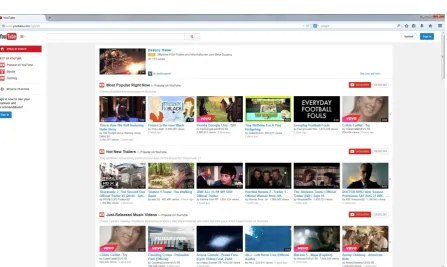
Figure 1: "Default" US YouTube start screen, 07/11/2014, http://www.youtube.com/?gl=US
If we wish to describe this interface in language, i.e. in a linear, text-based form, we already encounter a methodological problem: The site’s design makes any assumption regarding an obligatory starting point seem arbitrary. Rather than being organized around a central point of entry, such as is the case with Google’s search engine, we are here exposed to a spatial arrangement consisting of rows of identical-sized images and a column of navigation buttons, as well as a small header including the logo and search bar. In its spatial organization, this display clearly lends itself to the representation of databases, for it mimics tabular forms for the two-dimensional representation of separate data entries. The strict flatness of this operational image levels the potential hierarchy of top-down and left-right preferences for users accustomed to specific script cultures, making any image equally likely to be clicked upon.
236-237). These recommendation systems arguably play a key role in the experiences of watching YouTube, for they are, again by default, present throughout every part of the interface, most prominently featured as a top-down list on the right-hand side column next to the actual video player. (cf. Figure 2)
Figure 2: YouTube’s paths of recommendation, 07/11/2014, http://www.youtube.com/watch?v=rvsuYssoTw0
In the case of YouTube, by way of contrast, flow has to be located on the level of interface and therefore between images. Since videos are produced and uploaded by users completely independently of one other, in principle they remain stand-alone images which may or may not be selected by users. Yet at the same time they are assembled on the very same screen and thus necessarily interact with other videos (and their users) through metadata, either through formalized tags and keywords or by belonging to paths of usage.3
William Uricchio has accounted for this transition between televisual and digital flow as "a shift from flow as default to flow as a condition that requires active selection" (Uricchio 2009, p. 33). More precisely, however, this shift has to be located on the level of serialized images: while serialization in television takes place either within or outside of images, YouTube’s seriality occurs on the level of the interface itself, and therefore between images. As images which allow for operations of selecting, as well as pausing, rewinding or forwarding, YouTube’s videos also shift and redistribute agency to the user. Unlike watching television, "database-watching," as Lovink (2007, p. 10) calls it, requires constant exertion of user agency, so the trajectories across the database, which the interface defines, aim precisely at upholding the user’s agency. On YouTube, seriality is therefore not a process belonging to the realm of imagery, but a metadata-driven movement across a database, which the interface enables and aims to actuate in cooperation with the user. YouTube can thus be characterized as an agent for the production of serialized agency that occurs between images.
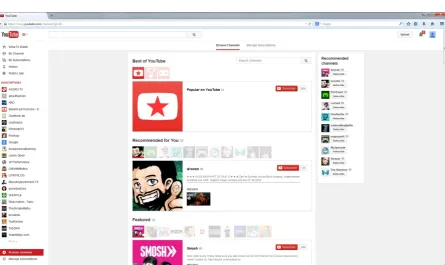
Figure 3: YouTube’s left-hand side interface column provides an additional layer of navigation after creating an account and more or less randomly subscribing to
recommended channels.
Subscribing to specific "channels" thereby not only mimics the logics of cable and pay TV, but it also enables seriality to become a feature of the images themselves, most pertinently in the emergence of Let’s Play videos as a distinct YouTube genre with video uploads scheduled to appear regularly on specific weekdays, thus enabling Let’s Players to produce distinct series. As a database within a database, a YouTube channel aggregates the content of individual producers or uploaders and allows for the organization of videos in producer-generated playlists, as well as allowing subscribers to receive automated notifications of new videos. By shifting agency towards producers/uploaders, YouTube’s channel system has led to a large number of users being able to monetize their activities through YouTube‘s partner program. This allows for longstanding series to be produced, which may take the form of episodic series (e.g. introductory Let‘s Plays for different games) or long-form serials (e.g. complete playthroughs of Triple-A games) and thus for seriality to become a defining feature of these camera-less images. This shift of agency in turn also reintroduces problems akin to television‘s scheduled programming: Let’s players frequently apologize for uploading “too late,” for cancelling unpopular series, or for being unable to produce new videos due to vacations or other commitments.
In addition to these interface-based forms of seriality, YouTube also hosts a different kind of seriality, in which agency is not so much located in formal operations of the interface, but in the self-directing processes of producing, transforming, and sharing images which have come to be known as “memes.” It is to these that we turn now.
The Seriality of Memes
In the “ecology of practices” (Stengers 2010) which is the web, viral and memetic seriality plays a crucial role as both a form of mediated, image-based communication and as a self-reflexive means of analysis of the networked culture of which it is an essential part. Memes are digital and processual objects with an agency of their own. Whereas viral images or videos are based on a form of seriality familiar to us from industrial mass production—i.e. a continual production of more of the same—a meme can be defined differently: not as a discrete part of a series but as itself always already a series of different digital items that share only a certain set of characteristics—like form, content, or aesthetics—and thus refer to each other in a relatively closed formal system.4 Hence, a viral video can be a part of a meme, but its viral spread alone does not make it a meme. Thus, what differentiates memes from viral images or videos is the handling of the “original” content throughout the serialized process. Memetic processes are not only about liking, simple copying and sharing, they are especially about transformation. Although the term meme was originally used to describe mechanisms of mere replication—as in evolutionary biologist Richard Dawkins’s seminal use of it to describe small units of culture or distinct contents of consciousness spreading through communication and thus contributing to cultural evolution—more recent understandings of memes especially emphasize the oftentimes user-based transformation of “primary” content in the production of parodies, remixes, mash-ups, re-enactments, remakes (Dawkins 1976, Fuller 2007, Goriunova 2013, Shifman 2014).
is beyond the scope of this paper to give an exhaustive list of these genres, but a short look at three of the most common (still) image-based meme genres—viz. the extremely easy-to-produce image macros, Photoshop memes, and photo fads— should suffice to illustrate this level of inter-serial proliferation.
Image macros, probably the most prevalent meme genre, can be described very simply as photographs with large, white text superimposed upon them. This multimodal genre can be divided into multiple subgenres like the notorious lolcats, the so-called “advice animals,” or stock-character macros like “The High Expectations Asian Father” or “The Successful Black Man.” Most of them share the same visual style, with images of the animals or stock characters presented in front of a color-wheel background (cf. Figure 4).
Figure 4: High Expectations Asian Father
The animal archetypes and human stereotypes that constitute the main body of this meme-subgenre are as such already the sedimented results of frequent, repeated recurrences in diverse cultural forms—serial figures which can be used either to affirm or undermine the historically consolidated underlying stereotype.6
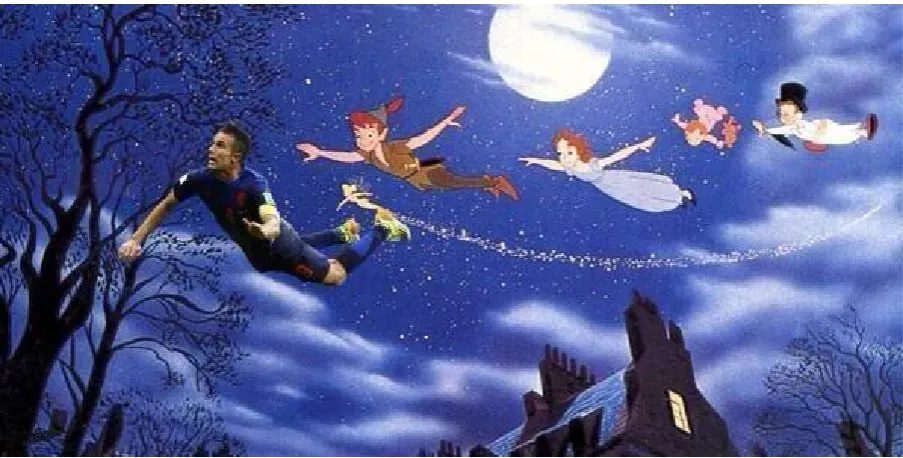
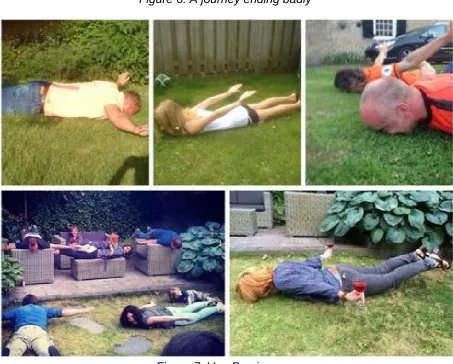
At the time of writing this article, during the 2014 Soccer World Cup, a meme called “VanPersieing” has originated from soccer game footage.7 This meme illustrates genre-seriality and genre-intertextuality on at least three different levels. Based on Dutch national football player Robin van Persie’s goal against Spain with a flying header during the World Cup group match on June 13, 2014, this image proliferated widely and quickly as both a Photoshop meme and as a so-called photo fad, the third genre term discussed here, which describes staged photos capturing the subject posing in a very specific manner (e.g. in the “planking” pose, which requires that the subject lie head down on the ground, hands touching the side of his or her body, often in unusual locations). As a Photoshop meme, the soccer player appeared flying with the casts of the movies Peter Pan (Clyde Geronimi, Wilfred Jackson, Hamilton Luske 1953) or Gravity (Alfonso Cuarón 2013), was shown alongside superheroes, or was portrayed as the next step in human evolution, for example. One of the viral images shows him among salmon swimming upstream in a river, straight into the gaping mouth of a brown bear. This iteration of the meme references another popular meme genre, the so-called demotivaters or demotivational posters. As a genre, the latter are parodies of motivational posters, which, in their simplest form, combine postcard-like images with banal optimism and comical pessimism.8 The common salmon-and-bear picture combines the title “ambition” with the phrase “the journey of a thousand miles sometimes ends very, very badly.”9 Van Persie’s flight further inspired people to upload pictures of themselves in a Van Persie-like pose. As this pose is overtly reminiscent of the aforementioned planking pose, itself an extremely popular memetic photo fad genre, the “VanPerseing” almost seems to be a meme about memeing itself (cf. Figure 5-7).
Figure 6: A journey ending badly
Figure 7: Van Persie pose
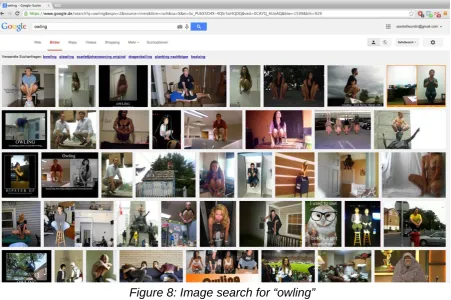
people posing like an owl and staring blankly into space, and by googling the number 241543903—well—find out for yourself (cf. Figure 8).
Figure 8: Image search for “owling”
The sheer quantity and juxtaposition of the similar creates veritable atlases of exalted “pathos formulas” (Warburg) without a history. It may at first sight seem eccentric, even forced, to relate the results of a Google image search for these meaningless actions or poses to Aby Warburg’s famed Mnemosyne project, in which he pinned photographs and visual tropes to black boards and related them to each other in his Mnemosyne project in terms of an “afterlife of the antique” (Warnke and Brink 2000). But, as a matter of fact, these apparently disparate image collections not only share striking similarities concerning their style and the role seriality plays as an analytical and representational tool for the memetic—or, in the case of Warburg, mnemonic— project, but they also have in common a conspicuous interest in poses and gestures (for the epistemology of seriality in Warburg’s atlas, cf. Wentz 2014).
guy trying to jump from a trampoline into a swimming pool but missing, a toddler falling asleep whilst in the middle of eating: the list, of course, is endless.
This obsession with the division of bodily movements, actions, and gestures into discrete parts is, of course, neither an invention made possible by gifs, nor is it especially new. Rather, it makes us think, almost unavoidably, of the analytical preoccupations of late 19th and early 20th century sciences such as physiology and physiognomy, criminology, ergonomics, and the photographic and proto-cinematic image techniques that enabled them. Etienne Jules Marey’s physiological and chronophotographic studies, Eadweard Muybridge’s photographic experiments for his encyclopedic atlas project on human and animal motion, Alphonse Bertillon’s taxonomic image series of body parts and the so-called “signaletic registration system” of criminals, Frederick Taylor’s and Frank and Gillian Gilbreth’s time and motion studies for business efficiency: They all share an analytical focus on movement, especially gesture (cf. Levitt 2002, Wentz 2014), breaking images down into their smallest possible segments and creating series from the resulting images. Watching Van Persie fly and fly again or Ryan Gosling smoking that cigarette ad infinitum are highly reminiscent of Muybridge’s series of women jumping over stools or dancing, horses galloping, men playing tennis or “Walking and Turning Around Rapidly with a Satchel in one Hand, a Cane in the Other”10—especially when such movements and gestures were brought back to life as looped animations with the help of the zoopraxiscope (cf. also Manovich 1995).
So what does this interest in the gesture have to say about network culture and digitized media? According to Giorgio Agamben, the gesture, which for him is the cinematic element par excellence, fulfills a media-philosophical role in that it “is the exhibition of mediality: it is the process of making a means visible as such. It allows the emergence of being-in-a-medium of human beings and thus it opens the ethical dimension for them” (Agamben 2000, p. 57). The gesture thus reflects pure potentiality and the mediacy of every meaning or message. In the gesture “nothing is being produced or acted, but rather something is being endured and supported” (1995, p. 56). Especially when images are repeated, the gesture is freed within them (Agamben 2008; see also Noys 2004; Hagman 2012). This becomes especially clear when the gesture, as in the gif, becomes decontextualized and disconnected from its original source. The gif frees the gesture from its context, e.g. its place in the causal chain of events in a movie; it thus replaces narrative telos with radical openness. Likewise referring to Agamben’s notion of the gesture, media scholar Hampus Hagman identifies the gif’s potential within the media ecology of networks precisely in terms of the form’s pure mediality: “This is what the gif does: it shows movement as pure support; as the medium that carries actions and events. It is not a matter of communicating a particular content, but of showing movement as a medium of communicability as such. In itself, it is pure becoming and process, and this is key to understanding its success as an item of networked circulation. Through its decontextualized status as pure medium, it is free to enter into many different contexts” (Hagman 2012, n.pag.).
notorious clichés also far beyond the borders of Internet culture. Ultimately, as viral videos, images and memes of all sorts disclose the logics and characteristics of their media ecology by means of their own logic and functioning; simply by force of co-evolution, they are not only well-nigh paradigmatic reflections of their technological conditions and their media milieu, but they seem also to be the media that reveal most directly, via their own serial traits, that the notion of seriality as such has to be reckoned among the most basic characteristics of contemporary networked, digital media.
Digital Seriality and Television
So far, we have described two distinct modes of digital seriality. The first mode, which we located on the level of web interfaces, concerns the web as a structure of interconnected websites, as well as the organizational forms through which the operational images of web interfaces establish, manage, and regulate these connections. The second mode of digital seriality plays out on the processual level of viral autopoiesis, which is characteristic for memes as gesture-images in constant transformational becoming. While we have separated these two dimensions of digital seriality for analytical purposes, they should not be regarded as mutually exclusive, for they in fact presuppose each other. The purpose of interfaces is precisely the stimulation of image-processes such as memes, while the popularity of memes has likewise spawned new platforms dedicated to the accumulation and proliferation of memes.
At the same time, contemporary long-form multi-serial narratives have come to be classified as "network narratives" themselves, i.e. as aesthetic forms which take the shape of webs precisely through increased serialization. Evoking the epistemological realm of drug addiction, for instance, The Wire (HBO, 2002-2008) traces the viral spawning of the drug trade over the districts, social milieus and institutions of Baltimore by way of an ever-expanding narrative that accumulates a vast cast of major and minor characters. This serial expansion in turn necessitates means of orientation and navigation such as pinboards, charts and tables, which closely resemble the spatial forms of orientation that are provided by digital interfaces (as well as Warburg’s juxtaposition of “pathos formulas” in his Mnemosyne atlas).
There are thus multiple intersections and attendant processes of imitation and adaptation between televisual and digital seriality; as a result, the television series still has to be considered as a central hinge in the transition to a digital media regime and is of great relevance even there where its serial forms have become almost completely independent from their media of origin. The rise of network narratives in contemporary television series and the increasing serialization of digital, web-based media could thus be understood as a process of co-evolution, in which old and new media do not collide, but mutually influence each other. Just as the web has become an ineluctable condition for the development and analysis of contemporary television, seriality has to be thought of as key characteristic of aesthetic forms and processes in digital network media.
References
Adelmann, R. (2012) “There is no correct way to use the system.” Das doppelte Subjekt in Datenbanklogiken. In Böhme, S., Nohr, R.F., and Wiemer, S. (eds.) Sortieren, Sammeln, Suchen, Spielen. Die Datenbank als mediale Praxis. Münster: LIT, pp. 253-268.
Agamben, G. (2000) Notes on Gesture, In Agamben, G. Means Without End: Notes on Politics. Minneapolis and London: University of Minnesota Press, pp. 48-59.
Agamben, G. (2008) Difference and Repetition: On Guy Debord’s Films. In Leighton, T. (ed.). Art and the Moving Image: A Critical Reader. Tate Publishing, pp. 328-333.
Beil, B., Engell, L., Schröter, J., Schwaab, H. and Wentz, D. (2012) Die Serie.
Einleitung in den Schwerpunkt. ZfM, Zeitschrift für Medienwissenschaft, Vol. 7 (2), Special Issue: Die Serie, pp. 10-16.
Boluk, S. (2009) Seriality, the Literary and Database in Homestar Runner: Some Old Issues in New Media. Proceedings of the Digital Arts and Culture Conference 2009, after media: embodiment and context. Available at:
http://escholarship.org/uc/item/07z9459z [Accessed: July 18, 2014].
Burgess, J. (2007) ‘All Your Chocolate Rain Are Belong to Us?’ Viral Video, YouTube and the Dynamics of Participatory Culture. In Lovink and Niederer, pp. 101-109.
Cavell, S. (1982)The Fact of Television. Daedalus. Journal of the American Acedemy of Arts and Sciences, Vol. 111 (4), pp. 75-96.
Chamberlain, D. (2011) Scripted Spaces: Television Interfaces and the Non-Places of Asynchronous Entertainment. In Bennett, J., and Strange, N. (eds.)
Television as Digital Media. Durham and London: Duke University Press, pp. 230-254.
Dawkins, R. (1976) The Selfish Gene. New York City: Oxford University Press.
de Certeau, M. (1988) Kunst des Handelns. Berlin: Merve.
Denson, S. and Jahn-Sudmann, A. (2013) Digital Seriality: On the Serial Aesthetics and Practice of Digital Games. Eludamos. Journal for Computer Game Culture, Vol. 7 (1), pp. 1-32. Available at:
http://www.eludamos.org/index.php/eludamos/article/view/vol7no1-1/7-1-1-html [Accessed: July 18, 2014].
Engell, L. (2004) Vom Bild zur Zahl, oder: Wie die Stellen ihre Objekte verließen. In Engell, L., and Neitzel, B. (eds.) Das Gesicht der Welt. Medien in der digitalen Kultur. München: Fink, pp. 185-201.
Engell, L. (2013) The tactile and the index: From the remote control to the hand-held computer, some speculative reflections on the bodies of the will. Necsus, European Journal of Media Studies, Vol. 2 (2), pp. 323-336.
Fuller, M. (2007) Media ecologies: materialist energies in art and technoculture. Cambridge, Mass. and London, England: The MIT Press.
Goriunova, O. (2013) Die Kraft der digitalen Ästhetik. Über Meme, Hacking und Individuation. ZfM, Zeitschrift für Medienwissenschaft, no. 8, special issue „Medienästhetik“, pp. 70-87.
Hagman, H. (2012) The Digital Gesture: Rediscovering Cinematic Movement through Gifs. Refractory, Vol. 21, Special Issue: Digital Cartography: Screening Space. Available at: http://refractory.unimelb.edu.au/2012/12/29/hagman/6/9
[Accessed: July 18, 2014].
Hayles, N.K. (2012) How We Think. Digital Media and Contemporary Technologies. Chicago and London: The University of Chicago Press.
Levitt, D. (2002) Image as Gesture. The Saint in Chrome Dioxide. Spectator, Vol. 21(2)., Special Issue: The Act: Gesture of Film, Video and Digital Media, pp. 23 - 39. Available at: http://cinema.usc.edu/archivedassets/098/15860.pdf
Lewe, C. (2014) “Look at all the fucks I don’t give!” GIF-Animationen bringen die Provokation zurück in die Sozialen Medien", DIE EPILOG, Vol. 3, pp. 74-79
Loving, G. (2007) The Art of Watching Databases: Introduction to the Video Vortex Reader. In Lovink and Niederer, pp. 9-12.
Lovink, G. and Niederer, S. (2007) (eds.) The Video Vortex Reader. Responses to YouTube. Amsterdam: Institute of Network Cultures.
Lowood, H. (2011) Perfect Capture: Three Takes on Machinima, Replay and the History of Virtual Worlds. Journal of Visual Culture, Vol. 10 (1), pp. 113-124.
MacKenzie, A. (2006) Cutting Code. Software and Sociality. New York: Peter Lang.
Manovich, L. (2001) The Language of New Media. Cambridge and London: The MIT Press.
Milner, R. (2013) Hacking the Social: Internet Memes, Identity Antagonism and the Logic of Lulz. The Fibreculture Journal. Digital Media, Networks,
Transdisciplinary Critique. Issue 22: Trolls and the Negative Space of the Internet,
http://twentytwo.fibreculturejournal.org/fcj-156-hacking-the-social-internet-memes-identity-antagonism-and-the-logic-of-lulz/ [Accessed: July 18,
2014].
Mittell, J. (2006) Narrative Complexity in Contemporary American Television. The Velvet Light Trap, Vol. 58, pp. 29-40.
Murray, S. (2008) Digital Images, Photo-Sharing, and Our Shifting Notions of Everyday Aesthetics. Journal of Visual Culture, Vol.7 (2), pp. 147-163.
Muybridge, E. (1979) Muybridge’s Complete Human and Animal Locomotion. All 781 Plates from the 1887 Animal Locomotion. Vol I-III, New York: Dover.
Nannicelli, T. (2009) It's all connected. Televisual Narrative Complexity. In Potter, T., and Marshall, C.W. (eds.) The Wire. Urban Decay and American Television. New York and London: Continuum, pp. 190-202.
Noys, B. (2004) Gestural Cinema?: Giorgio Agamben on Film. Film-Philosophy. Vol. 8 (22), n.pag. Available at: http://www.film-philosophy.com/vol8-2004/n22noys
[Accessed: July 22, 2014].
Page, L., Brin, S., Motwani, R., and Winograd, T. (1999) The PageRank Citation Ranking: Bringing Order to the Web. Technical Report. Stanford InfoLab. Available at: http://ilpubs.stanford.edu:8090/422/1/1999-66.pdf [Accessed: July 22, 2014].
Parikka, J. (2005) The Universal Viral Machine. Bits, Parasites and the Media Ecology of Network Culture. CTheory.net. Available at:
http://www.ctheory.net/articles.aspx?id=500 [Accessed: July 22, 2014].
Piepiorka, C. (2012) You're Supposed to Be Confused! (Dis)Orienting Narrative Mazes in Televisual Complex Narrations. In Eckel, J., Leiendecker, B., Olek, D., and Piepiorka, C. (eds.) (Dis)Orienting Media and Narrative Mazes. Bielefeld: Transcript, pp. 183-203.
Röhle, T. (2010) Der Google-Komplex. Über Macht im Zeitalter des Internets. Bielefeld: Transcript.
Sampson, T. (2012) Virality. Contagion Theory in the Age of Networks. Minneapolis and London: University of Minnesota Press.
Shifman, L. (2014) Memes in digital culture. Cambridge, Mass. and London, England: The MIT Press.
Snickars, P. and Vonderau, P. (eds.) (2009) The YouTube Reader. Stockholm: National Library of Sweden.
Stengers, I. (2010/ 2011) Cosmopolitics I, II. University of Minnesota Press.
Uricchio, W. (2009) The Future of a Medium Once Known as Television. In: Snickars and Vonderau, pp. 24-39.
van Dijck, J. (2009) Users like you? Theorizing agency in user-generated content. Media, Culture & Society, Vol. 31 (1), pp. 41-53.
Warburg, A. (2000) Gesammelte Schriften (Studienausgabe) II, 1: Der Bilderatlas Mnemosyne. Ed. by Warnke, M. and Brink, C. Berlin: Akademie Verlag.
Warnke, M. (2012) Datenbanken als Zitadellen des Web 2.0. In Böhme, S., Nohr, R.F., and Wiemer, S. (eds.) Sortieren, Sammeln, Suchen, Spielen. Die Datenbank als mediale Praxis. Münster: LIT, pp. 122-136.
Wentz, D. (2014) Bilderfolgen. Diagrammatologie der Fernsehserie. Diss. Bauhaus-University Weimar.
Williams, R. (1974) Television. Technology and cultural form. London and New York: Routledge.
Winkler, H. (1992) Bilder, Stereotypen und Zeichen. Versuch, zwischen zwei sehr unterschiedlichen Theorietraditionen eine Brücke zu schlagen. Beiträge zur Film- und Fernsehwissenschaft, Vol. 41, Berlin: Vistas, pp. 142-169.
Notes
1
For a discussion of “relevancy” as a criterion for search engines, cf. Röhle 2010, pp. 106-143.
2
3
Of course, the same holds true for digital TV interfaces (cf. Adelmann 2012).
4
For the basic difference between these two forms of seriality, cf. Beil, Engell, Schröter, Schwaab, and Wentz (2012).
5
On the intra- and inter-seriality of digital games, see also Denson and Jahn-Sudmann (2013).
6
For the relation between seriality and stereotypes, cf. Winkler (1992). For a detailed analysis of the race and gender issues of stock character memes, cf. Milner (2013).
7
http://knowyourmeme.com/memes/vanpersieing.
8
http://knowyourmeme.com/memes/demotivational-posters.
9
http://www.despair.com/ambition.html. Witnessing the defeat of the Dutch Team
in the semi final on July 9th, the image almost becomes prophetic.
10