Journal of Applied Linguistics and Language Research Volume 4, Issue 3, 2017, pp. 119-130
Available online at www.jallr.com ISSN: 2376-760X
* Correspondence: Tayebe Sarlak, Email: t.sarlak94 gmail.com © 2017 Journal of Applied Linguistics and Language Research
The Effect of Project Based Learning (PBL) on the Components
of Speaking Ability of Iranian EFL Beginner Learners
Esmail Zare-Behtash
Associate Professor, Chabahar Maritime University, Iran
Tayebe Sarlak *
Chabahar Maritime University, Iran
Abstract
The most challenge of language learners is speaking ability. A learner is supposed to be a good speaker if he or she use proper vocabulary in the well-organized sentences and utter it in correct pronunciation and appropriate fluency. Consequently, the best teaching method is one which helps language learners to speak more comprehensibly. PBL is a communicative approach which is supposed to improve speaking ability in terms of its five components (vocabulary, grammar, fluency, pronunciation, and organization). The present research tries to examine the influence of PBL on Iranian EFL beginners of Chabahar Islamic Azad University. Forty-five participants took part in the research that lasted about 13 weeks. The instruction involved the experimental group who experienced PBL and the control group who undergone traditional teaching method. The pretest and the posttest were administered to both groups. The result of comparison through t-tests demonstrated the effectiveness of PBL to promote elementary EFL learners’ speaking ability in terms of its five components.
Keywords: PBL, pronunciation, vocabulary, grammar, fluency, organization
INTRODUCTION
cause speaking incomprehensibility. Learning speaking ability occurs through either explicit or implicit learning. Explicit learning is the most famous form of learning a foreign language. A lot of researchers attempted to develop a teaching method to help learners to learn speaking. Project-based learning (PBL) is a teaching method applicable to improve speaking skill. Some previous research approved the effect of PBL on the learning a language. Learning speaking ability occurs through either explicit or implicit learning. Explicit learning is the most famous form of learning a foreign language. A lot of researchers attempted to develop a teaching method to help learners to learn speaking. Project-based learning (PBL) is a teaching method applicable to improve speaking skill. Some previous research approved the effect of PBL on the learning a language. Zare-Behtash, Khoshsima, & Sarlak (2016) demonstrated the effect of PW on speaking ability of elementary adult EFL. Balagiu, Marutelu, Patasan, and Zechia (2014) applied project work to develop their learners’ poor speaking ability. They claimed that the reason of poor speaking is difficulty in emotional control. PBL increased autonomy to alleviate this problem. The findings of the research determined that PBL increased learners' speaking skill. Another research on PBL was done by De Saint Lege and Mulla (2014). De Saint Lege and Mulla studied language progress by developing the projects. They claimed tasks improved the learners’ knowledge of grammar (vocabulary and syntax) as well as their speaking skill.
Another team of researchers (Griva, Semoglou, & Geladari, 2010) dealt with game as a project in English as foreign language learning in Greek. According to the pre-test, the post-test, observation, and structured interviews, this group of the researchers concluded the impacts of the project in a game-based approach. The results certified improving learners’ communicative competence as well as fun in elementary schools. In 2011, Gonzalez-Alriols, Serrano, Llano-Ponte, and Labidi recognized the lack of learners’ performance skills (e.g. collaborative skill, communicative competence, time management, problem solving, and autonomy). Their study proposed PBL as an effective teaching method to help the learners.
At the same year, the researchers tried to find an approach to equip employees with language skills and work place skills (e.g. responsibility, team working, organizational skills, critical thinking, communicative skills, and self-management, etc.…) (Musa, Mufti, Abdul Latif, & Mohamed Amin, 2011). They recommended PBL method which meet the employers’ needs (ibid). This approach engaged learners in the cooperative activities in order to increase the learners’ confidence, independence, and negotiation and so on. The results illustrated that majority of learners’ agree with the project work. They were able to acquire language skills as well as being familiar with their strength and weakness in workplace skills.
learners verified that the team project increased their communicative competence and self-confidence.
In Indonesia, Maulany (2013) conducted a survey to indicate the impacts of PBL on speaking capability in a primary school. Through these tests Maulany examined five aspects of speaking ability. Analyzing results of interview confirmed three effects: 1. increasing of learners’ total score, 2. Enhancing number of the learners with high grade, and 3. Improving learners’ comprehension and vocabulary.
METHODOLOGY
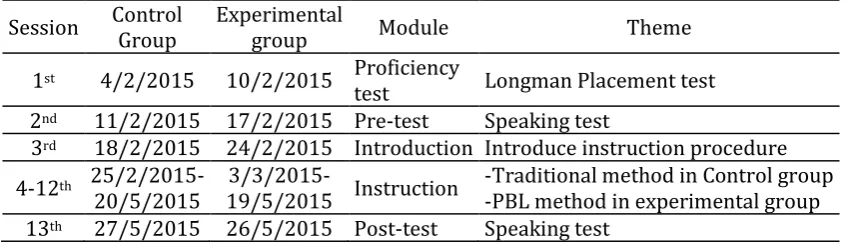
The study was conducted among 45 elementary EFL adult Iranians. The research questions dealt with the effect of PBL on the components of the speaking skill (pronunciation, vocabulary, grammar, fluency, and organization). The researcher attempted to evaluate changes in speaking ability, dependent variables, via instruments such as pre-test and post-test after and before using PBL, the independent variable. The research context was Islamic Azad University of Chabahar (IAUC). This study was held from 4th February 2015 to 27th may 2015 in the second semester of the academic year in IAUC. The course in both groups took 13 sessions from 4th February 2015 to 27th may 2015 in the second semester of academic year in CIAU. The treatment was PBL method to teach certain topics of the course’s book called Khatesefid (2010). The experiment included five stages named proficiency test, pre-test, introduction meeting, treatment, and post-test. The first three sessions were devoted to proficiency test, pre-test, and introduction meeting. These three stages were involved in the course session. The fourth stage of the course was the instruction which continued from the fourth to the twelfth sessions. The teacher used conventional teaching method for control group through ten sessions whereas the teacher of the experimental group employed PBL for the experimental group in similar number of time to the control group. Post-test, the last stage of instruction was held in the thirteenth session. The above mentioned instruction appears in Table 1.
Table 1.Course Schedule (by the researcher)
Session Control Group Experimental group Module Theme
1st 4/2/2015 10/2/2015 Proficiency
test Longman Placement test
2nd 11/2/2015 17/2/2015 Pre-test Speaking test
3rd 18/2/2015 24/2/2015 Introduction Introduce instruction procedure
4-12th
25/2/2015-20/5/2015
3/3/2015-19/5/2015 Instruction
-Traditional method in Control group -PBL method in experimental group
13th 27/5/2015 26/5/2015 Post-test Speaking test
front of the class. The teacher called the learners one by one to read the textbook and translate it in Persian. The teacher checked the learners’ pronunciation errors. The teacher taught the syntax deductively in Persian. Learners replied and the teacher corrected immediately them if they made errors.
The experimental group was exposed to the treatment (project-based learning). The base of PBL method in the present study was that the teams of learners developed a project each week. The experimental group involved 25 learners. The group formation was based on criterion-based selection. The teacher assigned four to five members to each group. Six groups attended in the projects. The groups developed one project in each session.
A between-groups design was adopted in order to address the effect of PBL on the components of the speaking ability. Both the pre-test and the post-test were administered to the control and the experimental groups. To evaluate the homogeneity of learners’ speaking ability, a speaking examination as pretest was applied in the second session. It was a two-part exam. In first part of this test, the researcher asked learners some questions to gather demographic information about subjects. The questions were simple and comprehensible for elementary learners. It provided information about participants such as their age, academic major, home town, and mother tongue. It helped the researcher to comprehend the general characteristics of participants. It assisted the researcher to be sure of homogeneity in demographic variables, too. The second section of the examination consisted of pictures which learners were expected to speak about them for five minutes. The pictures were selected according to common topics of their book. At the end of the course, another speaking test was administered.
Speaking score ranged from zero (minimum mark, if they cannot speak) to 20 (maximum mark) according to Speaking Scoring Criteria by Phillips, 2007. It examined five components of English language. Philip described each criterion concretely and practically. The speaking test was supposed to score for pronunciation, grammar (refers to syntax rules), vocabulary, fluency, and organization.
Pronunciation: There were four levels to mark pronunciation level including pronouncing the word correctly, with minor errors, with a number of errors, and at the lowest level pronouncing the word completely incorrect. The raters rate them from four to one respectively.
Grammar: rating criterion gave four for using complex syntax rules correctly; three for applying simple rules properly, two for using both complex and simple rules with a few problems, one for applying simple rules with some problems.
Fluency: The learner’s speech is generally fluent. The learner’s speech is generally fluent, with minor problems. There are problems in their speech which cause their fluency to become decreased. The learner has problems with fluency that make the responses difficult to understand.
Organization: The learners’ response is well organized and developed. The learners’ response is organized basically and is not thoroughly developed. The learners’ response is clearly organized and is incomplete or contains some inaccurate points. The learners’ response is not planned and is only minimally on the topic.
A check list was helpful to obtain consistent scores. It helped the current raters to evaluate the intended features of learners’ speaking performance. Following the above line, the present researcher made a check list and gave it to the raters to rate learners’ speaking performance (Table 2). This check list included three portions. The first section devoted to the rater’s name. In the second section, it asked raters to complete demographic information of each learner. The third section involved description of the speaking criterion involving five criteria. The researcher used numbers as representative for each level. So, the evaluators should circle numbers. Of course, to save space and make small check list, the description of each scale was provided in a separate paper for raters. In addition, the researcher added a section to the checklist and asked examiners to leave their comments for each learner’s performance. A section of check list involved a sub-section for those learners who did not speak. Raters assessed each examinee in a separate check list in order to eliminate the effect of assessment of other learners on the evaluation of another learner.
Table 2. Check list for English speaking rating (adopted by the researcher)
Rater’s name:
Learner’s name: ……… Sex: ………... Major: ……… Age: ……… Job: ……… Language: ……… Time duration of exam: ……… Hometown: ………..
Pronunciation 4 3 2 1
Grammar 4 3 2 1
Vocabulary 4 3 2 1
Fluency 4 3 2 1
Organization 4 3 2 1
The learner either says nothing or fails to answer the question. 0
Comments:………. ……….………
performance. The goal of the discussion was to evaluate the speaking performance similarly. The researcher used inter-rater reliability to examine the consistency of rating. Inter-rater reliability was calculated about 0.97.
Then, the research compared the results of the pre- and post-tests of each group separately by using paired sample t-test to find out the progress of each group through the instruction. Then, she used the independent t-test of the control group and the experimental group of the pre-test to determine their homogeneity before the instruction. Afterward, the research compared findings of the post-tests of both groups by applying the independent sample t-test to indicate differences of using PBL against the conventional teaching method on the speaking improvement. The purpose of the last computation was to demonstrate whether PBL is helpful to improve the speaking ability of the EFL learners or not.
RESULTS
Among diverse techniques to analyze data, independent sample t-test and paired sample t-test were selected for data analysis by Statistical Package for Social Science 20th (SPSS 20th). Collectively, there were five types of data: 1) the pre-test of the control group, 2) the pre-test of the experimental group, 3) the post-test of the control group, and 4) the post-test of the control group. Then, inter-rater reliability of scores was calculated. The paired sample t-test was used for comparing two groups of data of one group of participants to establish the learners' speaking improvement. This technique compared two types of obtained data: 1) the pre- and post-test of the control group, 2) the pre- and post-test of the experimental group. On the other hand, the independent sample t-test was applied for comparing data of two different groups. There were two kinds of data which were analyzed by the independent sample t-test: 1) the pre-test of the control and experimental group, and 2) the post-test of the control and experimental groups. Through the independent t-test, the researcher tried to compare the obtained data of all components of speaking ability in the pre-test of both research groups to find out if both control and experimental groups used the components homogeneously before implementing the treatment.
Table 3 presents the results of the independent samples t-test of the pre-test scores for each speaking component.
Component 1, Fluency: Value of Sig. (2-tailed) equals 0.94 which is larger than 0.05; consequently all learners' level of fluency are nearly equal. Thus, there was no significant difference between levels of fluency of both groups at the early stage of the instruction.
Component 3, Organization: Sig. value related to the scores of organization of speaking is 0.91 > 0.05. The researcher concluded that the learners of both groups organized their speech in similar manner. Low difference between means indicates low differences among pre-test scores of all participants in terms of organization.
Component 4, Pronunciation: Sig (2-tailed) equals 0.57 and mean difference equals 0.13. As a result, there is no significant difference for both groups' pronunciations in the pre-test.
Component 5, Vocabulary: value of Sig (2-tailed) and the mean differences of vocabulary scores are 0.96 and 0.01 respectively. Accordingly, it is likely to deduce the level of both groups' vocabulary knowledge before embarking into instruction is similar. The researcher concluded that all learners started the course with similar level of vocabulary, pronunciation, grammar, fluency, and organization in their speech.
Table 3. Independent t-test between pre-test scores of both groups in terms of speaking
components
Levene's Test for Equality of
Variances
t-test for Equality of Means
F Sig. t df Sig.
(2-tailed) Mean Differe nce Std. Error Differe nce 95% Confidence Interval of the
Difference
Lower Upper Lower Upper Lower Upper Lower Upper Lower
fluenc y
Equal variances
assumed .168 .684 .068 43 .946 .02000 .29273
-.57034 .6103
Equal variances
not assumed .068
40.20
5 .946 .02000 .29389
-.57389 .6138 9 gram mar Equal variances
assumed .177 .676 .184 43 .854 .04000 .21682
-.39725
.4772 5
Equal variances
not assumed .182
38.92
8 .856 .04000 .21920
-.40339 .4833 9 vocab ulary Equal variances
assumed .788 .380 -.043 43 .966
-.01000 .23511
-.48414
.4641 4
Equal variances not assumed -.041 35.334 .967 .01000 - .24175 .50061 - .48061
organ izatio n
Equal variances
assumed .532 .470 .112 43 .911 .03000 .26790
-.51027
.5702 7
Equal variances not assumed .109 35.988 .914 .03000 .27465 .52703 - .58703
pronu nciati on
Equal variances
assumed .784 .381 .571 43 .571 .13000 .22779
-.32937
.5893 7
Now, the research wants to assess which components are developed through instruction of both groups. Then, the researcher applied paired sample t-test to compare the components' mean score in the pre-test and the post-test of each group. Table 4 involves paired sample t-test for each speaking component (fluency, grammar, organization, pronunciation, and vocabulary) for control group. The significance values of fluency, grammar, and vocabulary equal 0.01, 0.05, and 0.00 respectively which are less than p-value (=0.05). Thus, the scores of fluency, grammar, and vocabulary increase significantly through the traditional instruction. The significance value of organization is 0.13 and of pronunciation is 0.09. As a result, there are no significant differences between organization and pronunciation in the pre-test and the post-test of the control group. The statistic results show that the traditional instruction has effect on fluency, grammar, and vocabulary and no effect on organization and pronunciation.
Table 4.Paired sample t-tests of all components of speaking for the control group
Paired Differences t df Sig.
(2-tailed)
Mean
Std. Deviatio
n
Std. Error Mean
95% Confidence Interval of the
Difference
Mean Std. Devia
tion
Std. Error Mean
Pair 1 fluency -.525 .81878 .183 -.9082 -.1418 -2.87 19 .010
Pair 2 grammar -.250 .55012 .123 -.5074 .0075 -2.03 19 .056
Pair 3 vocabulary -.675 .76563 .171 -1.033 -.317 -3.94 19 .001
Pair 4 organization -.275 .78598 .176 -.6428 .0928 -1.56 19 .134
Pair 5 pronunciation -.250 .63867 .143 -.5489 .0489 -1.75 19 .096
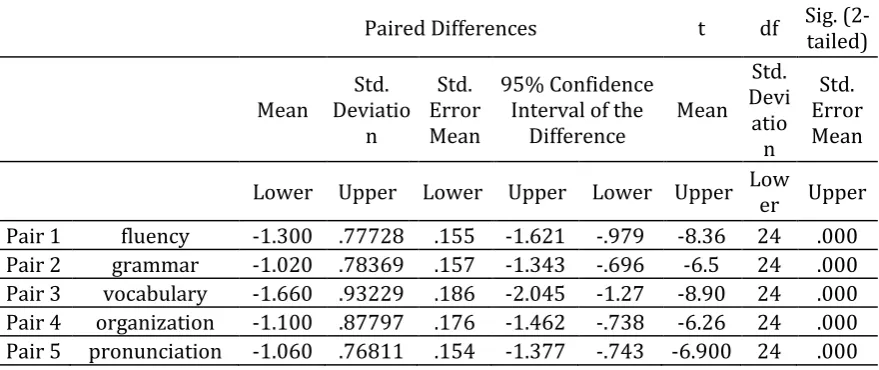
To examine the development of speaking components scores for experimental group, the researcher applied paired sample t-test. Table 5 presents the significant value of scores for each speaking component is 0.00<p-value 0.05. Therefore, it can be concluded that scores of speaking components have increased after employing PBL in the experimental group. The mean of the components are displayed in the second column of the Table 5.
Table 5Paired sample t-tests of speaking components for the experimental group
Paired Differences t df Sig.
(2-tailed)
Mean
Std. Deviatio
n
Std. Error Mean
95% Confidence Interval of the
Difference
Mean Std. Devi atio n
Std. Error Mean
Lower Upper Lower Upper Lower Upper Low
er Upper
Pair 1 fluency -1.300 .77728 .155 -1.621 -.979 -8.36 24 .000
Pair 2 grammar -1.020 .78369 .157 -1.343 -.696 -6.5 24 .000
Pair 3 vocabulary -1.660 .93229 .186 -2.045 -1.27 -8.90 24 .000
Pair 4 organization -1.100 .87797 .176 -1.462 -.738 -6.26 24 .000
After computing the progress of all speaking components for the control group and the experimental group through the instruction, the researcher compared scores of the components for the post-tests of both groups by computing independent t-test. Table 6 indicates the results.
Component 1, Fluency: mean difference is 0.79 and the value of the Sig. (2-tailed) is 0.00<0.05. Therefore, there is significant difference between the scores of the fluency of the control group and the experimental group. In other words, PBL increase fluency of speaking ability.
Component 2, Grammar: mean difference is 0.81 and the value of the Sig. (2-tailed) is 0.00<0.05. Therefore, there is significant difference between the post-test scores of the grammar of the control group and the experimental group. In other words, PBL drastically affected on scores of grammar of speaking ability.
Component 3, Organization: mean difference is 0.85 and the value of the Sig. (2-tailed) is 0.00<0.05. Therefore, there is significant difference between the scores of organization of the control group and the experimental group. In other words, PBL affected organization of speaking skill.
Component 4, Pronunciation: mean difference is 0.94 and the value of the Sig. (2-tailed) is 0.00<0.05. Therefore, there is a significant difference between the scores of the components of the control group and the experimental group. In other words, PBL affected pronunciation of speaking skill.
Component 5, Vocabulary: mean difference is 0.97 and the value of the Sig. (2-tailed) is 0.00<0.05. Therefore, there is a significant difference between the vocabulary scores of the control group and the experimental group. In other words, PBL affected vocabulary of speaking components. As a result, the control group and the experimental groups are significantly different. Based on the above lines, the findings revealed that PBL significantly improved all components of speaking ability.
Table 6.Independent t-tests for speaking components of the control and experimental
groups' performances in the post-test
Levene's Test for Equality of
Variances
t-test for Equality of Means
F Sig. t df Sig.
(2-tailed)
Mean Differen
ce
Std. Error Differen
ce
95% Confidence Interval of the
Difference
Lowe
r Upper
Lowe
r Upper
Lowe
r Upper
Lowe
r Upper
Lowe r
fluenc y
Equal variances
assumed .009 .926 2.7 43 .009 .79500 .29214 .206 1.3842
Equal variances
gram mar
Equal variances
assumed .477 .494 3.2 43 .002 .81000 .25020 .305 1.3146
Equal variances
not assumed 3.2 37.2 .003 .81000 .25504 .293 1.3267
vocab ulary
Equal variances
assumed 1.169 .286 3.4 43 .002 .97500 .29020 .390 1.5602
Equal variances
not assumed 3.5 42.8 .001 .97500 .28084 .408 1.5414
organi zation
Equal variances
assumed 1.553 .219 3.8 43 .000 .85500 .22449 .402 1.3077
Equal variances
not assumed 3.9 42.9 .000 .85500 .22014 .411 1.2990
pronu nciatio
n
Equal variances
assumed .339 .563 3.6 43 .001 .94000 .25864 .418 1.4616
Equal variances
not assumed 3.6 38.2 .001 .94000 .26248 .409 1.4713
DISCUSSION
Speaking FL is considered as a chief factor of successful learning. Willing and need to speak English cause the teacher to be interested to apply a teaching method which enables EFL learners to speak English. A suitable teaching speaking method is one that EFL learners have opportunity to practice speaking. The teacher planned PBL implementation to provide an active interacting opportunity for all learners. Based on aforementioned merits of PBL, it can be assume as a progressive teaching method. Consequently the present research takes into account the PBL method to achieve a desired level of the speaking ability. The findings of these comparisons demonstrated differences and similarities of two research groups in order to illustrate the impact of PBL method.
Data analysis shows that the improvement of scores of speaking components for the experimental group is larger than the control groups'. PBL provides the learners to learn of their peer. On the other hand, in peer group there is no superior or inferior relation (such as relation between the teacher and student); therefore, students ask their friends without any anxiety and they practice English more than the conventional method. As a result, they correct their errors (self-correction and peer-correction), while the teacher does not correct them. Then, they make more grammatical sentences. Also, the students received feedback when they make ungrammatical structures. Then they correct themselves. In addition when their fellow students use language, the learners learn the right form of language in use. The students learn more vocabulary when they use vocabulary in the text rather than when they try to memorize them separately.
could speak more fluently and comprehensibility. Besides they used more vocabulary in their speaking with correct grammar. This work determined that PBL leads to progress the speaking ability if the teachers diagnose the needs of learners correctly.
CONCLUSION
Speaking FL is considered as a chief factor of successful language learning. Willing and need to speak English cause the teacher to be interested to apply a teaching method which enables EFL students to speak English.
PBL reinforced students to be more active when PBL provide students with group work. Moreover, self-assessment and peer-assessment are available in PBL. Thus, students correct their own mistake in a friendly environment. Based on aforementioned merits of PBL, it is a progressive teaching method.
A suitable teaching speaking method is one that EFL students have opportunity to practice speaking. A speaking drill is required interaction between two speakers. Then, teaching speaking should provide more chance to practice speaking through interaction among the language students. Subsequently, their speaking ability will be progressed to desired level. Observations showed that experimental group was more eager to the instruction than control group. Applying PBL suggests support to the earlier research that a cooperative method guides students to develop their oral skill.
The implication of the study entails EFL learners. PBL permits learners knowledge activation through group work activities. These kinds of activities increase students' opportunities to interact in real life situation and in a very friendly environment. In addition, group work activities provide learners feedback which causes self-evaluating. Moreover, the findings recommend to neophyte teachers to adopt this course of action into their lesson plan. Textbook writers and the researchers are next groups who receive advantage from the findings of the research to include appropriate activities and tasks as tools which promote learners' speaking abilities. Further research is required to investigate the effectiveness of PBL in English for specific purposes courses.
ACKNOWLEDGEMENTS
I would like to take this opportunity to thank Mr. Saeed, Professor of TEFL at Chabhar Maritime University and Islamic Azad University of Chabahar (IAUC), and Mrs. Rabani, the Head of the College of Translation at IAUC, who helped me to conduct my research at IAUC. I wish to thank my dear friends, Miss Bos’hagh, an English teacher at Shokuh Institute, and Miss Amiri Samani, MA TEFL student, for warmly and patiently rating students’ performance in the pre-test and the post-test.
REFERENCES
De Saint Lege, D., & Mullan, K. (2014). "A Good All- Round French Work Out" Or " a Massive Stress": Perception of Group Work Among Tertiary Learners of French. System,
44, 115-126.
Balagiu, A., Marutelu, l., Patasan, M., & Zechia, D. (2014). Group Project for English Language Evaluation. Procedia Social and Behavioral Science, 112, 986-990.
González Alriols, M., Serrano, L., Llano-Ponte, R., & Labidi, J. (2012). Evaluation of the Biomass Fractionation Capability of the Ultrafiltration Permeate: a Learning Project for Chemical Engineering Students. 7, 241–e246.
Gorjian, B. (2012). Teaching Vocabulary through Web-Based Language Learning (WBLL) Approach. procedia technology, 334-339.
Götz, S. (2013). Fluency in native and nonnative English speech. Amsterdam: John Benjamins.
Grigore, A.-M., Neacsu, L., & Paraschir, F. (2011). Functional Acquisition by Project Work in the Mother Tongue Class: Three Case Study. Procedia- Social and Behavioral Science,
11, 22-26.
Maulany, D. B. (2013). The Use of Project Based Learning in Improving the Students' Speaking Skills (A Classroom Action Research at One of Primary Schools in Bandung).
Journal of English and Education 2013, 1(1), 30-42, 1(1), 30-42.
Musa, F., Mufti, N., Abdul Latif, R., & Mohamed Amin, M. (2011). Project Based Learning: Promoting Meaningful Language Learning for Workplace Skills. Procedia Social and
Behavioral Science, 18, 187-195.
Rahman, M. M. (2010). Teaching Oral Communication Skills: a Task-based Approach.
ESP World, Issue 1 (27), Volume 9, 2010, http://www.esp-world.info, 9(1 (27)).
Shokri, N. M. (2010). Team Project Facilitate Language Learning. Procedia Social and
Behavioral Science, 7, 555-564.
Simon, S. (2014). Enhancing the English Oral Communication Skills of the 1st Year Students of the Bachelor’s Degree Program “Communication and Public Relations".
Procedia - Social and Behavioral Sciences, 116, 2481-2484.
Zare-Behtash, E., Khoshsima, H., & Sarlak, T. (2016). The Effect of Project Work on the Speaking Ability of Iranian EFL beginner Students. Journal of Applied Linguistics and