Issues
ISSN: 2146-4138
available at http: www.econjournals.com
International Journal of Economics and Financial Issues, 2016, 6(S1) 180-186.
Special Issue for “Theory and Practice of Organizational and Economic Problems of Territorial Development and the Effectiveness of Social and Economic Systems”
The Control Actions Structure Optimization in the Process of the
Regions Housing and Communal Services Development
Asiyat K. Dorgushaova
1, Vladimir I. Zarubin
2*, Saida K. Kuizheva
3, Tatiana A. Ovsyannikova
4,
Elena N. Klochko
51Federal State Educational Institution of Higher Education “Maikop State Technological University,” Maikop, Russia, 2Federal State
Educational Institution of Higher Education “Maikop State Technological University,” Maikop, Russia, 3Federal State Educational
Institution of Higher Education “Maikop State Technological University,” Maikop, Russia, 4Federal State Educational Institution of
Higher Education “Maikop State Technological University,” Maikop, Russia, 5Southern Institute of Management, Krasnodar, Russia. *Email: [email protected]
ABSTRACT
The purpose of the present research is to find areas of organizational and economic mechanisms that enhance the efficiency of regional utilities. A systematic approach to the analysis of the organizational and economic mechanism of housing in the region, provides a systematic, comprehensive and effective investigation. Strategic imperatives in the management of regional utilities are defined taking into account the crisis tendencies in the process of its development. Case utilities management is seen as the realization of the objectives of its development in different scenario conditions. With the help of mathematical modeling methods and parameters are determined by the structure of the control actions. The article proposes a methodology for calculating the article options strategy utilities management in the region, the results of modeling the trajectory of housing and communal services of the republic of Adygea.
Keywords: Housing and Communal Services of the Region, Organizational and Economic Mechanism, Management System, The Trajectory of the Development Process
JEL Classifications: L51, O18, R58
1. INTRODUCTION
Under the organizational and economic mechanism of housing management and communal services is meant multilevel hierarchical system of interconnected elements and how they interact, harmonize economic relations between states, utilities, homeowners and society in general. The object of the control, in this case, acts as a complex industry, and the functioning of the engineering infrastructure of various buildings in the settlements, creating convenience and comfort of residence and presence in it of people by providing them with a wide range of services including social infrastructure facilities to serve the residents.
Today, organizational and economic mechanism of housing development management and communal sphere is necessary to
focus on maximum utilization as economic instruments, and to meet the needs and interests of the population in the sphere of housing and communal services. It is clear that such a mechanism should be indicative, the main levers that are the economic and legal. First, direct economic leverage in the form of financing of specific areas, programs, projects and activities and indirect levers, acts as a regulator of taxes, credits, payments, tariffs, etc.
2. LITERATURE REVIEW
population and authorities, etc. In this context it is necessary to admit the fact of existence of process of modernization of the housing and communal services complex of the region. In scientific publications the concept “modernization” is put in compliance to the term “reforming.” If to proceed from the prerequisite of unambiguity of these concepts, modernization of the housing and communal services complex is realized, at least, two last decades (Belyakova and Batukova, 2010; Poberezhnikov, 1999; Fadeyeva, 2011).
The standard concept of modernization in science it isn’t created now. However, the review of scientific publications allows to consider modernization, as synthesis of the sociological, economic and political theories describing process of so-called modernization or change in a broad sense of social and economic systems (Kleyner, 2004; Huntington, 1996; Eyzenshtadt Revolyution Highway and Transformation of Societies, 1999). The specified changes are immanent for all types of social and economic systems, and for the housing and communal services complex in particular. As any system is in development, modernization as process of evolutionary changes, has permanent character. Fully it belongs and to housing and communal services of the region.
Process of changes of housing and communal services, as well as any other social and economic system, can be implemented at various role structural characteristic. It is about extent of participation of the state in the course of modernization of housing and communal services. As extreme positions can be considered situations of carrying out changes under complete control of the state and full elimination of the state from management of modernization. Certainly, the first position can be realized only in the conditions of planned, directive economy. The second is the extremely liberal and assumes full implementation of modernization changes by means of market and social mechanisms. It is obvious that combination of these approaches, as well as positioning of the state in this process is reached by means of the organizational and economic mechanism of functioning of modern housing and communal services.
3. RESEARCH METHODOLOGY
As is known, the management of any complex system (eg, regional ZHHK) can be implemented in two main conceptual approaches to management: Mechanistic and organistic. The first requires a highly structured system of the organization management, while the implementation of the organistic management concept is less structured. The mechanistic approach to Russia in the pre-reform period had a predominant nature. It was accompanied by the implementation of a centralized housing management model and communal services of the region and the administrative units (districts, cities, settlements, etc.). The process of managing the operation of the regional utilities ensured concentration and centralization of the financial allocation, technical, material and other resources. All management processes are concentrated in a single governing body that implements all the control functions. This allowed the region to solve complex problems in this area with the concerted action of all subsystems for the operation of public utilities.
Reform of the national economy entailed and conceptual changes in the system of sectorial utilities management in the region, and specifically in the housing and communal services. There was a change of the organization conception control from the mechanistic to organistic one, in which there is an opportunity to choose from a wide variety of governance models. The collection of housing management models and communal services is a decentralized array of independent in varying degrees of economic entities related to the industry. This independence is manifested not only in their organizational and legal status, but also in the material, financial information sense. Thus, there is a need for an effective monitoring system, since to generate control actions necessary information about the status of each subsystem utilities. Essentially, we are talking about the implementation of the network model concept for regional utilities. All business entities, which are elements of a regional housing and regional and local authorities should control function not only in a single information space, but also to have a common information base, based on a single institutional framework (Marks and Hadzhirokov, 2014).
The effectiveness of housing and communal services in the region due to its system characteristic is largely dependent on the effective interaction of economic entities in the sphere of territorial administration and, in fact, the population, the needs of which directed the operation of public utilities. It is helpful to take into account the mixed motivations of economic agents in the implementation of housing and communal services. The regional space set of entities that implement this type of services is quite diverse: Management companies, supplier enterprises, condominiums, population, etc., It is obvious that their relationship can be built into a variety of organizational and economic management of the construction, which in varying degrees, and satisfy business entities and bodies of territorial administration.
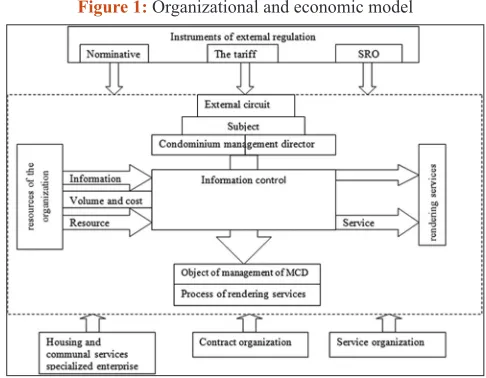
Subject-organizational structure and management of the basic elements of housing and communal services in the context of organistic management concepts are reflected in the well-known organizational and economic model (Zelentsov et al., 2012) (Figure 1).
In the given model as subjects are allocated: Housing and communal services specialized enterprise, contract, service, and supplier organizations. As the subject management the managing organization and condominium is considered. The last are combined with subject and object of management in a uniform contour. As internal, it is offered to consider information contour. Instruments of external regulation (standard and legal, tariff and SRO) and the subjects of managing realizing process of rendering housing services are considered in model, as the providing regulating impacts on an external contour. This model mostly reflects structural essence of housing management and communal services of the region. Zelentsov. I created this model, as the instrument of research of “levers” (Zelentsov et al., 2012) on under control object - an apartment house…. It should be noted that a lack of this model is insufficient specification of instruments of external regulation (they are divided into the aggregated groups: Standard and legal, tariff and SRO), and also there is no visualization of external and internal interrelations. In particular, instruments of external regulation influence not only object of management of MCD, but also the housing and communal services specialized enterprise, which are in environment, the contract and service organizations.
However, this model does not take into account the organizational, legal and economic characteristics of inter-subjective relations that occur in the operation of regional utilities. Thus, the characteristics of the property in the management of housing facilities is the most important factor is reflected in the functioning of all public utilities.
In some countries (Ireland for example) there is no private ownership in the management of water supply and sanitation. The complex task of implementing these functions solves the state. In Germany and the Nordic countries there are such, but only limited share of the companies serving the water management facilities owned by private business (in Germany not more than 25% of the objects). At the same time, there is another - a form of concession realization of water supply functions and diversion. These water supply objects are transferred for a limited period of concession the most efficient operators. The infrastructure of these facilities remain the property of the state. All questions are to improve the functioning of water management complex specified in the contract between the tenant companies and the state. Of course, there are countries (e.g. UK), where construction water supply systems are in full private ownership.
Given model may detailed into account the characteristics of ownership of economic entities: Supplier organizations, specialized enterprises, contractors and service organizations. Organizational-economic model of utilities management in the region can be presented in the context of the functional separation of the residential complex owners (organizations acting on behalf of owners, management organizations and housing and public utilities and communal organizations). For example, Bobrovskaya (Bobrovskaya, 2014) in this context implements the comparative analysis of utilities management models. According to her study, foreign models include the provision of services, spectrum and regulation of troubled housing sector, which are implemented with the direct participation of state and municipal authorities. The state and municipalities defend the rights of the HCS consumers,
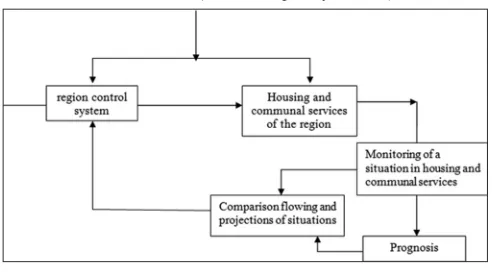
form the regulatory model for the commercial contractors operation and service organizations, and ensure compliance with quality standards of public services. “Centralized systems can offer standards and consistent quality across the organization.” (Johnson, 2012). In this case, the model of utilities management with the systems approach is represented as an object management system to control the deviations (Figure 2).
In accordance with the classical definition of this type of management, control actions are generated and implemented based on the received signals on systems deviations from the developed plans, standards and regulations. “In this situation the model of public administration, and its emphasis on the rule of law and the administration of public services, dominated” (Osborne, 2005). In this case, a prerequisite for management efficiency is the formation of the modern subsystem monitoring the situation in the (regional utilities) (Zarubin and Tkhakushinov, 2014). At the same time, it requires a sound system of standards and a clear, concorded by all business entities involved in housing, regulatory framework. Fully this assumption is never usually considered usually in the system’s control.
In Russia, due to the modern conditions, in contrast to the above model (management of housing and communal services in the deviation) number of functions implemented by the state, regions and municipalities is significantly narrowed. In particular, the majority of questions on the implementation of HCS addresses the consumer of these services, ie population. Consumer rights, though enshrined by Housing Code (base.garant.ru), and other regulations, are still advocated by the users of utility services themselves. Rules and regulations of commercial operation, contract service organizations, and state or region (including the municipalities) are not always defined or not defined at all. In addition, the state and the regions do not fully realize the guarantee function of the quality standards implementation essential for the public services. Modern conceptual model of management utilities represented in the form of a system of decentralized regulation of public utilities.
It should be noted that at the present stage of economic entities operating in the housing sector, most regions have institutional independence and realize their own goals. These goals cannot be declared openly, but in any case, they are present in the modern world. While implementing this model, there is a combination of several functional subsystems utilities (heating systems, electricity, region-gas, water-channel and others). These subsystems have their
own information base, and structural and functional characteristics that are common to all decentralized systems.
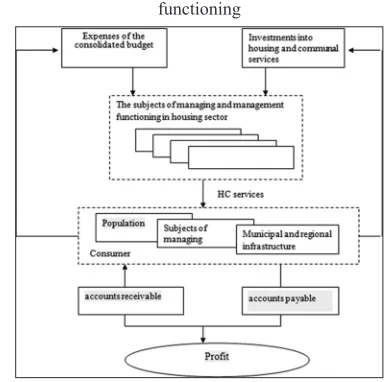
Model decentralized system of public utilities is shown in Figure 3. There should be noted the presence in the utilities system of such important properties as dissipated services and their distribution in time. That is, during the implementation of supplying consumers with heat, energy, water, etc., the part of these services remains taken by the consumer or scatters, and only some part of them returns. The presence of these features makes the possibility of formalizing a utilities model, for example, using the tools of the Korteweg-de Vries (Dyomina et al., 2013; Kuizheva, 2013). The precondition of use of these tools are as follows:
1. Housing and communal services in the region is a geographically distributed system. Business entities implement the services of a certain type, distributed in time and space.
2. The volume of services produced is divided into a part of the consumer and the remaining part to go back. In step transmission services, such as from the manufacturer to the consumer, and in the opposite direction are losses incurred services.
3. The total volume of services produced consists of functionally independent volumes of services produced by the individual producers. Consumption of services are interdependent. 4. The fee for the services received from the consumer through
financial institutions sent directly to the business entity, to carry out its activities in the housing sector.
In essence, the process model of the “production of housing services - customer” is the first outline a general model of housing and communal services in the region (Figure 3).
Obviously, for the development of regulatory control actions the instrument is clearly insufficient due to the limited range of tasks that can be solved by using the above approach. Tools based on the Korteweg-de Vries equation allows solving the following problem aggregated process of regulation of regional utilities:
• Optimization of the production process of regional housing and communal services;
• Determination of the loss of services at different stages of their production and transmission;
• Analysis of the performance of business entities operating in the sphere of housing and communal services;
• Analysis of the quality of housing and communal services, etc.
For a more complete analysis of the functioning of the housing and the development of regulatory decisions it is useful to form the number of regression models describing different processes of implementation and production services of regional utilities. Regression models of housing and communal services functioning, relating to the second functional circuit common model of housing in the region can be obtained at the established structure-function relationship study of factors.
I. Process contour; II. Functional contour; III. Meso-economic contour.
Figure 4 shows the economic model of the modern utilities functioning. The target block unit is separated as ‘profits.’
Conditions for the forming such a model are as follows:
1. Business entities have a certain autonomy. In this case, it may be implemented as a full-length market model with an objective function to maximize profit, and public-private form of functioning of the regional utilities with a more complex structure of the objective function. It is obvious that this will change the place of the regional budget housing fund. In one case, it will be assigned to a control system of the region, in the other - shared between companies operating in the housing sector.
2. The main elements of the model adopted by those that may be described by quantitative data in accordance with the existing statistical framework for Housing and Utilities of the Russian Federation and Adygeya in particular.
Profit as a target function or its component, will be implemented with any model of the functioning of public utilities. What is the rate of profit? Who should define it?
It is obvious that for the different subjects of managing functioning in housing sector, this norm will be various. Largely its size will depend on a share of property of the region in the acting subjects
Figure 3: Three-loop model of housing and communal services functioning
of managing. From as far as the region or municipality can provide or lobby the priorities in process of housing management and communal services of development, so the population and community in general will be satisfied with its functioning.
The main financial performance reflecting the main tendencies of housing and communal services of Adygea for formation of regression models is given in Table 1.
The presented statistical data allowed creating the number of the regression models allowing receiving an objective assessment of the main financial performance trends of regional housing and communal services development (Table 2). This set of models may be obtained for different areas of the industry and for different entities.
It causes a natural interest in the last table of the considered dependence. In accordance with its parameters, profits business entities the lower, the greater the spending budget to provide housing and communal infrastructure. This dependence does not contradict the other depending on “profit - the volume of housing and utility payments.” It is obvious that profit cannot have this rate of decline, especially since this trend is inherent in both the pre-crisis period and the post-crisis stage of development of regional utilities.
The low profitability index of companies operating in the area under study, could be evidence of poor performance and the presence of specific corruption phenomena.
The third circuit model presented meso-economic interdisciplinary model, the analysis of which allows you to explore the economic sectors of the relationship of the regional utilities and the main components of the regional economic system: Final consumption, gross capital formation, foreign trade component.
Thus, studies carried out in this section of the thesis, allowed to form a three-loop design model of regional housing and communal services that complement and develop well-known models of Granberg, Zhikhareva, Aghajanian. They integrate a processing, functional and meso circuits that can meet the challenges of regional regulation of public utilities, taking into account the whole range of structural, process, functional and economic relationships.
Presentation of utilities` development process in order to study the functional efficiency of the organizational and economic mechanism of housing in the region can be realized based on two conceptual approaches: The traditional, based on expert evaluation of the results of targeted development and scenario, involving an analytical study of the utilities development alternative paths set. The first approach
involves the formation of an expert predicted priority target set. Then, using mathematical modeling methods and parameters determined by the structure of the control actions. This can be a situation where it is not possible to implement the control, because the available resources do not always fully meet the target set formed (for example, required substantial investment, no need of human resources, etc.). Obviously, this will require the revision of the target values, leading to their possible imbalance. In this context, the approach to the analysis of options for the structure of control actions in the process of regional utilities seems more promising scenario. As the main method of calculation there may be used the autoregressive one, the basic relationship is represented by the following expression:
x x
x
a a a
a a a
n t n n 1 2 1
11 12 1
21 22 2
... ... ... ... ... ... = + .... ... ...
a a a
x x
x
n1 n2 nn n t
1 2 ⋅
According to the author’s approach, the whole set of indicators, reflecting the state of the housing sector in the region can be divided into the basic indicators of the state of system components utilities: The population, the technological sphere, economic and institutional areas to which and implemented control actions.
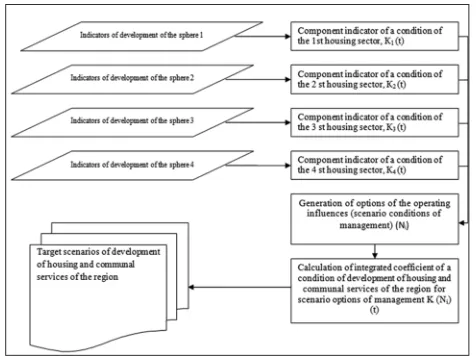
Method of calculation options for the structure of control actions of regional utilities represented by the following sequence of steps: • Collecting information on the state of regional housing and
communal services;
• Partition of the indicators set on the individual components of the regional utilities;
• Standardization of indicators` values of housing and communal services;
• Calculation of component status indicator (average of the normalized values by year);
• The generation of options for the control actions structure; • Calculating the integral index of the state of the selected
component utilities in the region, depending on the version control;
• Rendering calculations.
Aggregated algorithm for calculating the strategic trajectory of regional utilities is shown in Figure 5.
The proposed algorithm of the options analysis for the control actions structure in housing of the region allows us to investigate alternative control strategies depending on changes in the parameters of the target industries.
Table 1: The main financial performance of housing and communal services of Adygea (in actually operating prices; millions of rubles) (Housing and Consumer Services of the Population in Russia, 2013)
Financial indicator 2000 2003 2005 2010 2011 2012 2013 2014
Investments into dwellings 138.3 350.2 648.9 3732.4 2666.9 1856.8 2350 1980
Expenses of the consolidated budget 185.5 437.6 615.3 1373.5 969,3 1466.9 1630 1480
Accounts payable 267 429 187 20 13 3 3 3
Accounts receivable 456 220 167 27 18 3 3 4
Profit 19 17 1 4 2.4 0.1 0.5 0.5
Fixed assets, billion rubles. 30350 28497 24691.4 18534 9389 2686 2500 2600
Table 2: Regression models of regional housing and communal services of RA
Functional
dependence Model type approximation Reliability of R2
The volume of housing-and-municipal payments-time
y=1E-198e0.2304x 0.9386
Profit - the volume of housing-and-municipal payments
y=11938x−1.2974 0.5892
Profit - time y=1.0018x2-10.878x+30.13 0.8366
Expenses of the consolidated budget - time
y=100.09x-200023 0.8917
Profit-expenses of the
consolidated budget y=2E-05x
2-0.0472x+28.255 0.7792
Table 3: Scenario options of structure of the operating influences in the organizational economic mechanism of development of housing and communal services of the region
Housing sector Management structure
Inertial Institutional Technological Technological 2 Economic Social
Institutional 1 1.1 1 1 1 1
Technological 1 1 1.1 1.3 1 1
Economic 1 1 1 1 1.1 1
Social 1 1 1 1 1 1.1
Figure 5: The aggregated algorithm of definition of the operating influences structure in the organizational and economic mechanism of
regional housing and communal services
Figure 6: Results of modeling of trajectories of development of housing and communal services of the Republic of Adygea at various
scenarios of management
Various (scenario) options for the structure of control actions of organizational and economic mechanism of housing and communal services can be set target-oriented management process. In particular, in the present study we have investigated the following structural options for control actions:
• Inertial management;
• Management of the institutional sphere; • Management of technology areas; • Management of the economic sphere; • Management of the social sphere.
It is assumed that the main target emphasis in the management aims at the state specific areas of functioning utilities. The states of other areas, which are interconnected functional dependencies, are changed in accordance with them. Therefore, in the thesis examined the set of trajectories of development in accordance with the following scenario of the control (Table 3).
Simulation of trajectories (Figure 6) at different options for the structure of control actions leads to the conclusion that any drastic changes in the trajectory of housing development due to the 10% change of the various operation fields objectives of public utilities, is not observed here.
Refraction downward trend of utilities in the region occurs when the target changes in the technological field of housing in the range of integral indicator of the state of 1.2-1.3. It should be noted that in this embodiment, the structure of control actions, technological sphere indicators into being the target. This does not mean that the indicators showing the status of other areas and the existing diversity of intra-relations do not change.
4. CONCLUDING REMARKS
1. Termination of the budget subsidizing utilities. The solution to this problem is the transfer of budget funds to support the housing and communal services at the disposal of citizens. This procedure is already used in many regions of the country.
Improving the efficiency of budget spending can be the replacement of budgetary subsidies to enterprises for investment programs aimed at the development and modernization of housing and financed by the budget (capital repairs of housing stock and municipal infrastructure). This approach helps to reduce the growth of tariffs and ensuring control over the targeted use of funds.
2. The restructuring and liquidation of indebtedness utilities. The reasons for the debts of the municipal utilities are: • Low defaults for the provision of grants, subsidies and
incentives;
• Unbalanced tariff policy, in connection with the same tariffs housing services.
3. Creation of an effective tariff regulation system. Problems related to tariffs and agreements can be solved by legal regulation. Politics artificial containment of tariff regulation is absolutely futile since totally irrational reduces costs and is not the cause of the institutional reforms effectiveness. 4. Creating a legal environment for interaction between
government and business in the utilities. For the procedure of reforming the housing and utilities, it is necessary to create real economic relations in the industry, to develop business in the region and create real economic performance. The solution to this problem should be partnerships between business and government. The authorities will ensure the reliability and availability of housing services, and business - to increase their efficiency. This approach makes the most attractive sphere of housing and communal services for investors.
If utilities infrastructure facilities are in the municipal property, the local authorities are responsible for the sustenance of settlements. The most preferred option is to transfer to private business management and commercial risk housing sector, and infrastructure projects remain in municipal ownership;
5. Business development housing management based on object-related management and sustainable resource use. There is a need for highly qualified specialists in the management of apartment buildings.
Formation of economic motivation for resource conservation is the most important task of contributing to the development of housing and communal services. To solve it, it is necessary to form the contractual framework and distribution of responsibilities between local authorities and private businesses.
The development strategy of the region’s utilities in theoretical and practical sense should include a set of tools: Special programs
and events. Such instruments should contribute to improving the quality of housing services and the achievement of the target values of the indicators contained in the concept of strategy.
REFERENCES
Belyakova, G.Y., Batukova, L.R. (2010), To a question of modernization of social and economic systems: Theoretical bases and role of a state. Problem of Modern Economy, 4(36), 35-41.
Bobrovskaya, N.I. (2014), Komparativny the analysis of housing management models and communal services in Russia and the western countries. The Priority Scientific Directions: From the Theory to Practice, 12, 77-85.
Dyomina, T.I., Kuizheva, S.K., Palandzhyants, L.Z. (2013), Algebraic methods of integration of the differential equations in private derivatives. Monograph. Maikop: Kucherenko V.O.
Eyzenshtadt Revolyution Highway and Transformation of Societies. (1999), Comparative Studying of Civilizations. Moscow: Aspect Press.
Fadeyeva, N.S. (2011), Modernization of housing and communal services of Russia. In: Fadeyev, M., Gladkikh, A., editors. Topical Issues of Economy and Management. T.II. Moscow: RIOR.
Housing and Consumer Services of the Population in Russia. (2013), Stat. sb./Rosstat. Moscow. p325.
Housing Code of the Russian Federation. Available from: http://www. base.garant.ru.
Huntington, S. (1996), The Clash of Civilizations and the Remaking of World Order. London: Touchstone Books.
Johnson, M.P. (2012), In: Privett, N.A., editor. International Series in Operations Research and Management Science. Operations Management in Community-Based Nonprofit Organizations, Department of Public Policy and Public Affairs University of Massachusetts Boston, Boston, MA 02125-3393, USA.
Kleyner, G.B. (2004), Evolution and Modernization of the Theory of the Enterprise. Economic Transformation and Economic Theory. 5th International Symposium on Evolutionary Economy. Moscow: IE
Russian Academy of Sciences.
Kuizheva, S.K. (2013), About Some Differential Equations in the Private Derivatives Generated by the Switching Linear Differential Operators. Nalchik: News of KBNTs Russian Academy of Sciences.
Marks, V.I., Hadzhirokov, R.M. (2014), System approach to the analysis of spatial and branch structure of regional economy. New Technologies, 1, 72-77.
Osborne, P. (2005), In: Stephen, O.P., Brown, K., editors. Managing Change and Innovation in Public Service Organizations. New York, NY: Madison Ave.
Poberezhnikov, I.V. (1999), Modernization Prospect: Teoretiko-Methodological and Disciplinary Approaches. Third Ural Historical and Pedagogical Readings. Yekaterinburg.
Zarubin, V.I., Tkhakushinov, E.K. (2014), Management of innovation development system of regional economic: Project approach. World Applied Sciences Journal, 30(2), 191-194.