Volume 5, Issue 3, 2018, pp. 31-45 Available online at www.jallr.com ISSN: 2376-760X
* Correspondence: Jafar Entezari, Email: entezari65 yahoo.com © 2018 Journal of Applied Linguistics and Language Research
Role of Pretask planning Time in EFL Learners’ Spoken
Performance: The Case of Error-Repair, Appropriacy-Repair,
and Different Information- Repair
Jafar Entezari *
PhD Candidate of TEFL, Islamic Azad University, Shahreza branch, Iran
Mohammad Reza Talebinezhad
Associate Professor, Islamic Azad University, Shahreza branch, Iran
Abstract
This study was an attempt to investigate the effect of pretask planning time on repair in oral performance among Iranian intermediate EFL Learners. 60 male and female EFL learners whose level of proficiency was determined through administering an Oxford Placement Test (OPT) participated in this study. They were divided into 3 groups: 1) group with no pretask planning time, 2) group with five minute pretask planning time, and 3) group with ten minute pretask planning time. The instrument utilized in this study was an oral test through which different types of repairs were identified and further analyzed. A number of chi-square tests were performed to determine whether there were significant differences in three kinds of repairs: error-repair, appropriacy-repair, and information- repair in EFL learners’ performance in the three groups. The results revealed that groups with time for pretask planning have fewer repairs than the group with no time, but there was no significant difference in groups with different pretask planning time. The outcome of this study can be used by curriculum developers and English language teachers to consider the importance of a pretask planning in a task-based syllabus.
Keywords: Repair, Error-repair, Appropriacy-repair, Different information-repair
INTRODUCTION
Speaking is a skill which was evaluated and considered to be crucial to many EFL learners who are attending in language classes. In addition, fluency in speech production is an automated procedural ability, and fluent speech is natural and effortless necessitating not much concentration and attempt (Schmidt, 1992). Therefore, fluency in speaking was always an important fact which was the focus of many studies in language teaching.
speakers can monitor and repair their own speech, and this is a fact that speakers monitor what they are saying and how they are saying it. When they make a mistake or express something inappropriately, they may interrupt themselves and make a repair.
Postma (2000) points out that self-repair is a common event in both conversations and monologues (cited in Yun, 2007). Also, there are so many cases they correct themselves or change the whole idea, this is the subject under the umbrella term self-repair behaviors. According to the definition which is given for the term “repair” in Longman Dictionary of Language Teaching and Applied Linguistics, in a conversational analysis, repair is a term for ways errors, unintended forms, or misunderstandings are corrected by speakers or others during conversation (Richard & Schmidt, 2002). Therefore, long with fluency in speaking self-repair is a fact which is important and in this investigation, it was considered to be studied.
Postma (2000) also argues that “self-repairs imply the existence of specialized control devices or monitors verifying the correctness of ongoing activity and response output” (cited in Yun, 2007, p. 25). These monitors work on-line, that is during the course of activity within a limited time and employ multiple sources of information. Also, Kormos (1999) pointed out that it is the analysis of self-repair mechanisms that can provide us with the most direct information about the psychological and linguistic processes at work in first language and second language speech production and communication. So far, researchers have attempted to give similar descriptions despite different names employed (e.g. Kormos 1999; Oomen & Postma 2001; 2002; Postma 2000). Postma (2000) defined that self-repair is the correction of errors without external prompting, frequently within a short span of time from the moment of error occurrence. As Kormos (1999) argues, self-corrections are overt manifestations of the monitoring processes, while Oomen and Postma (2001) believe “speech monitoring is the process by which speakers check the correctness and appropriateness of their speech” (p. 104), or they (2002) refer to the process of on-line checking the well-formedness of one’s own speech as self-monitoring. This leads us to the crucial fact that self-correction and self-repair are important factors in self-monitoring.
During last decades, lots of studies have been conducted to see the effect of tasks and their role in language classes, and this is a trend taken from communicative language teaching. But in performing a task, EFL learners are supposed to have fluency and accuracy in their production. So two aspects of acceptability and grammaticality of their utterances were evaluated at the end of a task to correct EFL learners’ production. The point on which the present study focuses, is that these oral productions may vary as the techniques which teachers use to ask EFL learners in doing the so called tasks differ. So, the idea is that EFL learners can have time before doing a task to prepare themselves for what they are going to say. And considering these theories and proved statements inspired the present researcher to conduct a study to investigate the effect of time as preparation on different repairs in EFL learners’ oral production.
language, accuracy, in which the performer tries to make as few errors as possible, and fluency, the rate of speech production; Since speaking and writing are seen as complex and multi-faceted phenomenon involving a series of interrelated stages, attention to one aspect of production is likely to be at the expense of the other. Depending on the situation, an L2 learner’s attention might be focused on one of the three aspects of performance while jeopardizing the other two. For example, L2 learners who are more concerned with the correctness of what is said might not pay much attention to how something is said or vice versa. Therefore, L2 learners, especially those at lower levels of proficiency, find it difficult to attend to meaning and form at the same time. L2 learners’ problems in production may be lessened if they are given time to plan before they produce an L2 utterance or composition. When learners are given the opportunity to plan the linguistic and propositional content of an upcoming task, they can make up for the drawbacks in their language production, and as a result the quality of the linguistic output is improved. In relation to providing learners with opportunities for planning, a number of studies have investigated the impact of planning on language production over the last past decade (e.g. Ellis, 1987; Ghavamnia, Tavakoli & Esteki, 2012; Mehnert, 1998; Ortega, 1999). Considering these basic definitions and explanations, the self-repair analysis would be related closely to complexity, accuracy, and fluency and as EFL learners are producing utterances they would have their corrections spontaneously.
Self-repairs (alterations or corrections in one’s spontaneous speech) have been the subject of investigation in psycholinguistic and conversational analytic studies. Through the study of self-repairs, in the former discipline, researchers have mainly tried to find out the mechanism of language production (Van Hest, 1996), while in the latter, the concern has generally been with the investigation of the use of language in a social setting (Schegloff, 1990), or with the explication of ‘syntax-for-conversation’ (Schegloff, 1979). Generally speaking, in psycholinguistic studies, researchers have been concerned with the study of the features of the trajectory of repair from error detection to error correction, while in conversation analysis the focus has been on the study of repair in the organization of talk/conversation (Bada, 2010; Jasperson, 2003; Rieger, 2003; Schegloff, 1977; Macbeth, 2004). In many studies, planning has been considered as a kind of reflection that is associated with other reflective processes like inferencing and decision making (Hayes & Gradwohle Nash, 1996). However, planning is believed to be different from other reflective processes because it happens in a different environment from the task itself. Despite, a number of studies that have investigated the effects of planning on speaking production (Ahmadian & Tavakoli, 2011), few studies have undertaken the effects of different types of planning on EFL learners’ error-repair. Therefore, in this study the researcher attempted to find the effect of three different pretask planning time on EFL learners’ speaking performance in terms of three different repairs, namely error-repair, appropriacy-repair, and different information repair.
1. What is the effect of pretask planning time on Iranian intermediate EFL learners’ oral production in terms of error-repair?
2. What is the effect of pretask planning time on Iranian intermediate EFL learners’ oral production in terms of appropriacy-repair?
3. What is the effect of pretask planning time on Iranian intermediate EFL learners’ oral production in terms of information- repair?
METHOD
This study conducted in a descriptive and qualitative approach. In this study, the researcher attempted to conduct the study under the following title: The Role of Pretask planning Time in EFL Learners’ Spoken Performance: The Case of Error-Repair, Appropriacy-Repair, and Different Information-Repair. The independent variable was pretask planning time; with respect to this variable pre-tsk planning has been operationalized as minimal pretask planning and time provided pretask planning. In minimal pretask planning, participants are not given any official pretask planning time. However, one can assume that they would still plan to some extent insofar, as Crooks (1988, p. 3) cited, “it is generally accepted that human beings’ complex intentional behavior which is not genetically programmed often involves a plan (De Lisi, 1987; Johannsen & Rouse, 1983; Schank & Abelson, 1977)”. The time provided in pretask planning was one in which the participants were given two certain times to plan, 5 and 10 minutes, before their L2 oral production. Out of 100 EFL learners studying English at the intermediate level classes of a language institute in Esfahan who were selected through availability sampling, 60 intermediate male and female Iranian EFL learners aged 14-23 were chosen.
In order to make sure in objective terms that the learners were truly at the same level with regard to their English proficiency, an Oxford Placement Test was given to them. After obtaining the proficiency test results, 60 participants who met homogeneity criterion were selected whose grades on the placement test were between 28 and 34 and were assigned to three groups; first one with no time of pretask planning, second one with five minute pretask planning, and third group with 10 minute pretask planning time (20 participants in each).
The first step of the study was to be sure that all participants are at the same level of proficiency. To do so, an OPT were conducted and the participants were assigned into three groups to be interviewed. As the ultimate goal of the present research was to investigate the effect of pretask planning time on the number of three different repairs, each of these groups had a different time as pretask planning time. Three different planning time were considered to answer the tasks and conditions which were prepared for their interview, also each participant in these groups had 10 minutes to answer the questions; these conditions can also be conceptualized in terms of memory demands (Ishikawa, 2007). The +/- Here-and-Now conditions are delineated by distinctive memory demands through the access to or absence of context support. This bears on how information is processed in the mind, as in light of the absence of visual support (- Here-and-Now), learners have to commit the plotline to memory; subsequently, they have to make an effort to retrieve the needed information from memory, and cohere the information into a unified narrative (Farahani & Meraji, 2011). What the researcher tried to find had been the effect of time on the number of repairs which could consequently be influenced. Three allocated times for each group to answer the questions were no time, five minutes, and 10 minutes. The answers were recorded and the number of errors were counted.
RESULTS
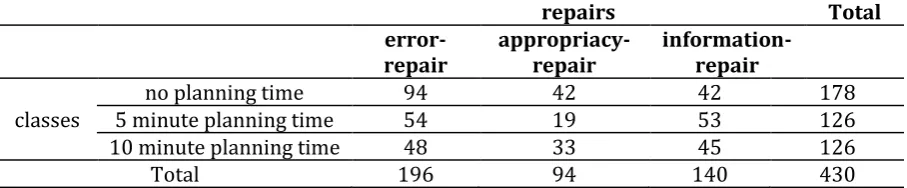
The main concern of the present study was the effect of pre-planning task time on three different repairs. Therefore, in this part as the first result, a brief report of the descriptive statistics (frequency count) used for calculation in SPSS is presented in Table 1.
Table 1. Frequencies of Three Different Repairs in Three Different Groups of the Study
repairs Total
error-repair appropriacy-repair information- repair
classes
no planning time 94 42 42 178
5 minute planning time 54 19 53 126
10 minute planning time 48 33 45 126
Total 196 94 140 430
As it is shown in the above table, among 430 repairs occurred during EFL learners’ oral production, 196 of them were error-repairs, 94 of them were appropriacy-repairs, and the rest 140 were information-repairs.
Figure 1. Frequency of Repairs in Group with No Pretask Planning Time
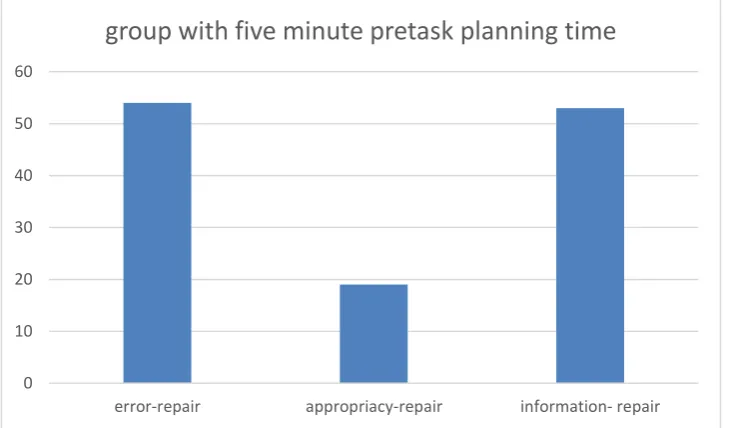
The second group in which repairs were observed in its participants’ language production was the group with five minute pretask planning time. As the results showed, 54 error-repairs, 19 appropriacy-repairs, and 53 information-repair occurred in this group oral production. This is also graphically shown in Figure 2.
Figure 2. Frequency of Repairs in Group with Five Minute Pretask Planning Time
The third and last group of participants were given 10 minutes as the pretask planning time. The number of repairs are 48 error-repairs, 33 appropriacy-repairs, and 45 information-repairs. This is illustrated in the figure below (3).
0 10 20 30 40 50 60 70 80 90 100
error-repair appropriacy-repair information- repair
group with no pretask planning time
0 10 20 30 40 50 60
error-repair appropriacy-repair information- repair
Figure 3. Frequency of Repairs in Group with Ten Minute Pretask Planning Time
Comparison of Groups
In order to compare the repairs occurred in different groups, three Chi-Square were used to analyze the collected data. Each is presented in a separated section below.
Group with No Pretask Planning Time vs. Group with Five Minute Pretask Planning Time
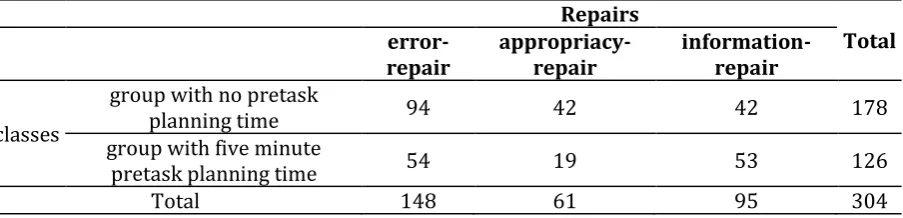
The first comparison was between the group with no pretask planning time and the group with five minute pretask planning time. The result of this comparison through Chi-Square is shown in following Tables (2 & 3).
Table 2. Occurred Repairs in Group with No Pretask Planning Time vs. Group with Five Minute Pretask Planning Time
Repairs
Total
error-repair
appropriacy-repair
information- repair
classes
group with no pretask
planning time 94 42 42 178
group with five minute
pretask planning time 54 19 53 126
Total 148 61 95 304
As Table 2 shows, out of 304 repairs, 178 ones were in oral performance of participants of group with no pretask planning time and 126 repairs were group with five minute pretask planning time.
Table 3. Chi-Square Analysis between Groups with No Pretask Planning Time and Five Minute Pretask Planning Time
Chi-Square Tests
Value df Asymp. Sig. (2-sided) Pearson Chi-Square 12.219a 2 .002
Likelihood Ratio 12.175 2 .002
Linear-by-Linear Association 7.724 1 .005 N of Valid Cases 304
a. 0 cells (.0%) have expected count less than 5. The minimum expected count is 25.28. 0
10 20 30 40 50 60
error-repair appropriacy-repair information- repair
The result of this comparison is shown in Table 3; it indicates that the difference between these two groups were significant (p<0.05).
Group with No Pretask Planning Time vs. Group with Ten Minute Pretask Planning Time
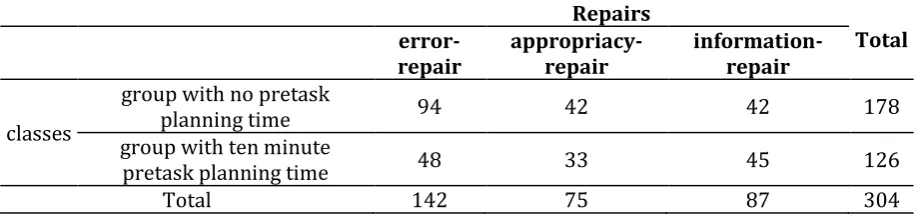
The next comparison was between the group with no pretask planning time and the group with ten minute pretask planning time. The result of this comparison through Chi-Square is shown in following tables (4 &5).
Table 4. Occurred Repairs in Group with No Pretask Planning Time vs. Group with Ten Minute Pretask Planning Time
Repairs
Total
error-repair appropriacy-repair information- repair
classes
group with no pretask
planning time 94 42 42 178
group with ten minute
pretask planning time 48 33 45 126
Total 142 75 87 304
As it is shown in Table 4, out of 304 repairs, 178 ones were in oral performance of participants of group with no pretask planning time and 126 repairs were group with ten minute pretask planning time.
Table 5. Chi-Square between Groups with No Pretask Planning Time and Ten Minute Pretask Planning Time
Chi-Square Tests
Value df Asymp. Sig. (2-sided)
Pearson Chi-Square 7.407a 2 .025
Likelihood Ratio 7.421 2 .024
Linear-by-Linear Association 7.348 1 .007
N of Valid Cases 304
a. 0 cells (.0%) have expected count less than 5. The minimum expected count is 31.09.
As it is shown in Table 5, the result of the analysis by Chi-Square shows that these two groups are significantly different (p<0.05).
Group with five minute Pretask Planning Time vs. Group with Ten Minute Pretask Planning Time
Table 6. Five Minute Pretask Planning Time vs. Ten Minute Pretask Planning Time Repair
repairs
Total error-repair appropriacy-repair information- repair
classes
group with five minute pretask
planning time 54 19 53 126
group with ten minute pretask
planning time 48 33 45 126
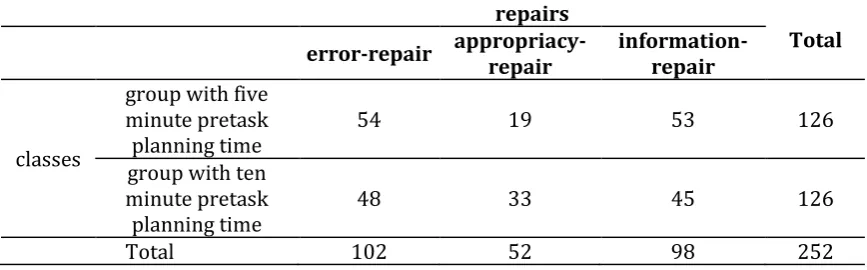
Total 102 52 98 252
As it is shown in Table 6, out of 252 repairs, 126 ones were in oral performance of participants of group with five pretask planning time and 126 repairs were group with ten minute pretask planning time; the number of occurred repairs are surprisingly the same but the number of them in each repair is different.
Table 7. Chi-Square between Groups with Five Minute and Ten Minute Pretask Planning Time
Chi-Square Tests
Value df Asymp. Sig. (2-sided) Pearson Chi-Square 4.775a 2 .092
Likelihood Ratio 4.823 2 .090
Linear-by-Linear Association .020 1 .888 N of Valid Cases 252
a. 0 cells (.0%) have expected count less than 5. The minimum expected count is 26.00.
As it is shown in Table 7, the result of the analysis by Chi-Square shows that these two groups with time for pretask planning are not significantly different (p>0.05).
Comparison of Each Repair in Three Groups
In this part the each repair is compared in three groups with different times for pretask planning time by the use of bar-graphs and brief explanation of each.
Error-Repair
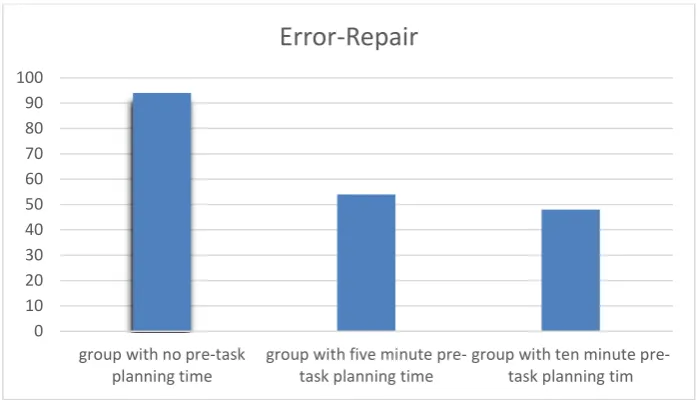
Figure 4. The Frequency of Error-Repair in each Group
As it is shown in this graph the number of error-repairs which were occurred in group with no pretask planning time is higher than that of groups with five and ten minute pretask planning time. Also the number of this repair in each group was 94 ones for group with no pretask planning time, 54 ones for group with five minute planning time and 48 ones for group with ten minute pretask planning time. This shows that as the length of time extended the number this error became fewer in oral performance of EFL learners.
Appropriacy-Repair
The next repair which has been observed during the oral performance of participants in each group was “appropriacy-Repair”. The following bar-graph shows this repair in each group (5).
Figure 5. The Frequency of Appropriacy-Repair in each Group
As it is shown in this table, again the group with no pretask planning time had more occurred repairs(42) of appropriacy-repair than the other two groups with time. But the number of this two groups with time for pretask planning time differ in an opposite
0 10 20 30 40 50 60 70 80 90 100
group with no pre-task planning time
group with five minute pre-task planning time
group with ten minute pre-task planning tim
Error-Repair
0 5 10 15 20 25 30 35 40 45
group with no pre-task planning time
group with five minute pre-task planning time
direction. In other word, the group with ten minute pretask planning time had 33 of this repair while the group with five minutes had just 19 of this repair.
Information -Repair
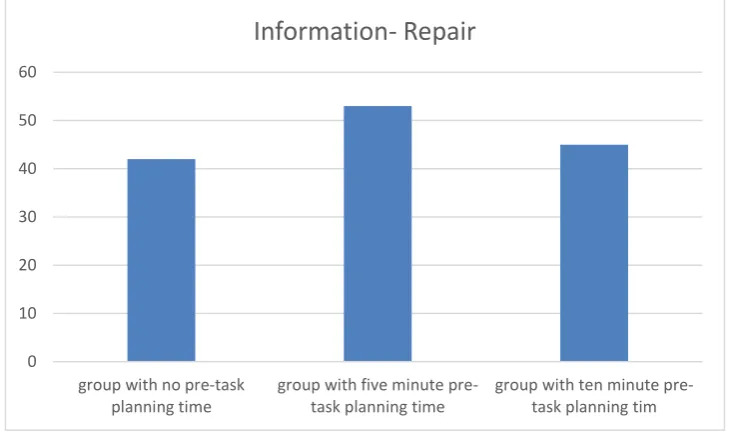
The last repair which has been observed while participants’ oral performance was information-repair. This repair is also shown in the bar-graph (Figure 6).
Figure 6. The Frequency of Appropriacy-Repair in each Group
As this bar-graph shows, there is not that much difference between the numbers of occurred information-repairs in this three groups. Out of 140 information-repair, 42 repairs occurred in group with no time, 53 repairs occurred in group with five minute, and 45 repairs occurred in group with ten minute pretask panning time. This result shows that the timing of pretask planning does not influence this repair in oral performance of EFL learners.
The study at hand tried to test the hypotheses empirically, so the following questions were the foci in the current study: The first hypothesis suggested that pretask planning time has no effect on Iranian intermediate EFL learners’ oral production in terms of error-repair.
The results reject this null hypothesis, and it was found that the learners in the group with no time for pretask planning were significantly different in their error-repair from the groups with pretask planning time. Also the number of error-repair in group with five minute pretask planning time and the one with ten minutes was not significantly different, the number of error-repairs in group with ten minute time were more than the other, though.
Having examined our first hypothesis, we also found that pretask planning time does make a difference in error-repair, because the group with more pretask planning time were found to have less error-repair in their oral performance. Thus, our findings are in line with other studies that have reported the pretask planning and its effect on oral performance of learners. This result is in line with Rouhi and Marefat (2006) where
0 10 20 30 40 50 60
group with no pre-task planning time
group with five minute pre-task planning time
planning groups significantly generated more accurate production compared to the no-planning group.
According to the second null hypothesis, it was said that pretask planning time has no effect on Iranian intermediate EFL learners’ oral production in terms of appropriacy-repair and it was rejected. The result of the statistical analysis showed that although, the difference between the group with no time and the other two groups is significant. On the other hand the length of time was not influential in this matter. The finding of this part opposed to Yun’s (2007) who concluded that it can be drawn from this result is that the sensitivity of the monitor is directed more toward lexical errors than the completeness and appropriacy of conceptual content at the stage when the organization of the prepositional content is almost completed. Accordingly, the result is in line with these findings also lend support to the study conducted by Yuan and Ellis (2004) and the positive effect of pretask planning time proved.
According to the third null hypothesis, it was said that pretask planning time has no effect on Iranian intermediate EFL learners’ oral production in terms of information- repair and it was not rejected. Even this repair occurred fewer time in the group with no pretask planning time. The evident show that the information-repair is a kind of repair in which timing beforehand cannot be an influential factor. These findings also lend support to the study conducted by Gilabert (2007) who said reducing planning time does not seem to direct learners’ attention to some language features.
CONCLUSION
The following conclusions can be drawn from the investigation made in the present study on the effects pretask planning time on Iranian EFL learners’ self-repair of error, appropriacy, and information.
time. This can be in line with Levelt’s statement that speakers are not capable of attending to all aspects of their speech and that they behave selectively when it comes to self-monitoring and effectuating self-repair behavior (1989).
Therefore, the Iranian learners can take benefit of the pretask planning to enhance their accuracy and fluency in mastering English as a foreign language through the use of computer and internet. Those language institutes and universities which are equipped with such methods can use such experiences to develop their strategies for a better oral performance as the vital skill in language learning. Meanwhile the people in charge of the ministry of research and science and ministry of education can arrange their policies in a way so that the educational centers make use of such findings to have better design in task-based instructions and to have preplanned time to develop EFL learners’ performance.
REFERENCES
Ahmadian, J. & Tavakoli, M. (2011). The effects of simultaneous use of careful online planning and task repetition on accuracy, complexity and fluency in EFL learners’ oral production, Language Teaching Research, 15, 1, 35-59.
Bada, E. (2010). Repetitions as vocalized fillers and self-repairs in English and French interlanguages. J. Pragmatics, 42(6), 1680-1688.
De Lisi, R. (1987). A cognitive developmental model of planning. In S. L. Friedman, E. K. Schoinick & R. R. Cocking (Eds.), Blueprints for thinking. (pp.79-109). Cambridge: Cambridge University press.
Ellis, R. (2005). Planning and task-based performance: theory and research. In Ellis, R. (Ed.) Planning and task performance in a second language. Amsterdam: John Benjamins.
Ellis, R. (2006). The Methodology of Task-Based Teaching. Asian EFL Journal, 8(3), 79-101.
Ghavamnia, M., & Tavakoli, M. (2012). The effect of pretask and online planning conditions on complexity, accuracy, and fluency on EFL learners’ written production, Porta Linguarum, 20, 31-43.
Gilabert, R. (2007). The simultaneous manipulation of task complexity along planning time and [+/- Here-and-Now]: Effects on L2 oral production. In M. Del Pilar Garcia-Mayo (Ed.), investigating tasks in formal language learning (pp. 44-68). Clevedon, Avon: Multilingual Matters.
Hayes, J. & Gradwohl Nash, J. (1996). On the nature of planning in writing. In C. Levy and S. Ransdell (Eds.).The science of writing. Mahwah NJ: Lawrence Erlbaum.
Johannsen, G. & Rouse, W. B. (1983). Studies of planning behavior of aircraft pilots in normal,
Abnormal & emergency situations. IEEE transactions on systems, man, and cybernetics SMC-13, 3, 267-278.
Kormos, J. (1999). Monitoring and self-repair in L2. Language Learning, 49, 303–342. Levelt, W. (1989). Speaking From intention to articulation. Cambridge, MA: MIT Press. Macbeth, D. (2004). The relevance of repair for classroom correction. Lang. Soc., 33,
703-736.
Mehnert, U. (1998). The effects of different lengths of time for planning on second language performance. Snuiies in Second Language Acquisition, 20, 83-108.
Mojavezi, A. & Ahmadian, M. J. (2013). Working memory capacity and self-repair behavior in first and second language oral production, J Psycholinguist Res, 289-297.
Oomen, C. C. E., & Postma, A. (2001). Effects of time pressure on mechanisms of speech production and self-monitoring and self-repair. Journal of Psycholinguistic Research, 30(163), 184.
Ortega, L. (1999). Planning and focus on form in L2 oral performance. Studies in Second Language Acquisition, 21, 109-148.
Postma, A. (2000). Detection of errors during speech production: a review of speech monitoring models. Cognition, 77, 97-131.
Richards, J. C., & Schmidt, R. (2002). Dictionary of language and applied linguistics (3rd
ed.). England: A Pearson Education Book.
Rieger, C. L., (2003). Repetitions as Self-repair Strategies in English and German Conversations. J. Pragmatics, 35(1), 47-69.
Rouhi, A., & Marefat, H. (2006). Planning time effect on fluency, complexity and accuracy of l2 production. Pazhuhesh, 27, 123 – 142.
Schank, R. & Abelson, C. (1977). Scripts, plans, goals and understanding. Hillsdale, NJ:
Erlbaum.
Schegloff, E. A. (1979). The relevance of repair to syntax or conversation. In T. Givon (Ed.) Syntax and Semantics, 12: Discourse and Syntax (p. 261-268). New York: Academic Press.
Schegloff, E. A., Jefferson, G. & Sacks, H. (1990). The preference for self-correction in the organization of repair in conversation. In G. Psathas, (Ed.). Interaction Competence
(pp. 31-61) Washington DC: International Institute for Ethnomethodology and Conversation Analysis and University Press of America.
Schmidt, R. (1992). New conceptualizations of practice: Common principles in three paradigms suggest new principles for training. Psychological Science, 3, 207-217. Seyyedi, K., Ismail, S. A. M. M., Orang, M., & Sharifi Nejad, M. (2013). The effect of pretask
planning time on L2 learners’ narrative writing performance, English Language Teaching, 6(12), 1-10.
Skehan, P. (2009). Modeling second language performance: Integrating complexity, accuracy, fluency, and lexis, Applied Linguistics, 30, 3, 510-532.
Van Hest, E. (1996). Self-repair in L1 and L2 production. Tilburg, Netherlands: Tilburg University Press.