Mixed Methods Research on the Nexus
Between Mathematics and Science
Yoshitaka Nakakojia,b, Rachel Wilsona, and Leon Poladianb
Corresponding author: [email protected]
aFaculty of Education and Social Work, The University of Sydney, Sydney, NSW 2006, Australia bSchool of Mathematics and Statistics, The University of Sydney, Sydney NSW 2006, Australia
Keywords:higher education, mixed methods, naturalistic inquiry, mathematics service courses, transfer of mathematical learning
International Journal of Innovation in Science and Mathematics Education, 22(6), 61-76, 2014.
Abstract
The importance of mathematics within STEM education is uncontested and yet there remains a paucity of studies examining the relationship, or nexus, between mathematics and science at university level. In Australia, growing concern over levels of participation and standards in mathematics and science education makes such
research imperative. In this paper we present the methodology for a multi-phase mixed methods research project examining the relationship between mathematics and science at one Australian university. The methods include: (i) correlation between mathematics and other disciplinary attainments, (ii) measurement of the transferability of
undergraduates’ learning, (iii) exploring factors associated with the transfer; and (iv) both students’ and experts’
views on the relationship between mathematics and science; and the teaching and learning factors that facilitate or hinder transfer. Importantly, this naturalistic study draws on secondary data and interviews to explore this relationship as it exists within normal university activity; transfer, for example, is observed in students’ performance in university exams. We report on initial analysis of the sample for the project: by outlining student participation in first year mathematics study in relation to various factors, thus highlighting gender and socioeconomic gaps; and by examining the high school mathematics preparation in relation to students’ pass rates in STEM degrees.
Introduction
Mathematics -the unshaken Foundation of Sciences, and the plentiful Fountain of Advantage to human affairs. (Isaac Barrow, 1630-1677)
The centrality of mathematics to science and modern society is indisputable. Since the twentieth century, the advancement of science and technologies transformed modern societies in the developed countries, including Australia (Rubinstein, 2009). To maintain and grow modern society prosperously provision of well-qualified scientists and engineers is essential (Office of the Chief Scientist, 2012) and mathematics is the vital foundation for all these sciences and technologies across diverse disciplines, including biology, economics, finance and medicine (Rubinstein, 2009; The mathematical sciences in 2025,2013).
The interdisciplinary nature of applied mathematics is critically important as exchanges
between mathematics and other disciplines lead to the advancement of both of them.
Consequently mathematics education needs to consider the implications of this interdisciplinarity in terms of effective teaching and learning (The mathematical sciences in 2025, 2013). In the research introduced here, this nexus between mathematics and science
In Australia there is a serious crisis in mathematics and science education (Rubinstein, 2009); in terms of school and university participation rates (Barrington, 2006; Wilson, Mack, & Walsh, 2013), stagnant and declining performance in assessments (Ainley & Gebhardt, 2013), and transition between university and industries (Australian Industry Group, 2013). University science academics are concerned by their students’ poor mathematical preparedness and high failure rates in their first year (Rylands & Coady, 2009). Australia, however, is not alone, concern over similar trends in mathematical and science education is also reported in the UK (Hawkes & Savage, 2000; Koenig, 2011), Ireland (Hourigan &
O’Donoghue, 2007) and Canada (Kajander & Lovric, 2005).
The decline in Australian participation rates for secondary mathematics and science courses is an important issue. There is a longitudinal trend that the proportion of Year 12 students enrolling in intermediate or advanced mathematics courses have reduced from27.2% in 1995 to 19.4% in 2012 and from 14.1% in 1995 to 9.4% in 2012 respectively across Australia (Barrington, 2006, 2013). In New South Wales (NSW), a drop in the proportion of high school students who completed at least one mathematics and at least one science HSC course is evident, particularly among females (Wilson, Mack & Walsh, 2013).
University graduates with sufficient STEM skills are essential for further economic development and global competitiveness (Australian Industry Group, 2013) and strong
performance in both mathematics and science at school and university is needed for STEM jobs. Students in the top quartile for mathematics at 15 years are more than twice as likely as their lower attaining peers to work in a STEM career post formal education (Anlezark, Lim, Semo & Nguyen, 2008, p.6). Particularly strong performance in mathematics is therefore needed for the labour supply to STEM industries. Almost half of those working in STEM careers are from the highest mathematics achievement quartile, but only one in five of these students end working in a STEM career (Anlezark et al., 2008, p.5). Thus, there are imperatives to promote both mathematical attainment and its application in science, IT and engineering so that Australia can grow industry and economy in these fields.
Much of tertiary mathematics education is devoted to developing the abilities of non
-mathematics specialist students in applying -mathematics to their other areas of study. This ability is known as the transferability of mathematics. Demonstration of this ability is an important learning outcome in tertiary education. In Australia, the Science Learning and Teaching Academic Standards Statement defines the Threshold Learning Outcomes for
Science, which science graduates are expected to achieve in their degrees (Jones & Yates, 2011). The Threshold Learning Outcomes include the use of mathematics and statistics as
tools for science inquiry and problem solving. University science students are required to be
able to deal with numerical data, algorithms and mathematical modeling (Belward, Matthews, Rylands, Coady, Adams & Simbag, 2011). More generally, according to the Australian
Qualification Framework (2011), a feature of learning outcomes of any Bachelor degree is to
“demonstrate the application of knowledge and skills … to adapt knowledge and skills in
diverse contexts” (Australian Qualifications Framework Council, 2011, p.16). Despite its importance, little research has been conducted to investigate the transferability of mathematics in the context of higher education (Roberts, Sharma, Britton & New, 2007). Therefore, this study will address that gap by examining the relationships between
mathematics and science in university learning, including the transfer of learning from mathematics to other STEM study.
by: (i) investigating correlation between mathematics and other disciplinary attainments, (ii) quantitative measurement of the transferability of undergraduate students’ learning, (iii)
exploring factors associated with the development of transferability; including student
background and prior learning; and (iv) seeking both students’ and experts’ views on the relationship between mathematics and science and what teaching and learning factors facilitate or hinder transfer. In this paper, we present the research methodology for this large project and also present some preliminary findings describing the student cohort and the impact of their prior learning in high school.
Important considerations in the mathematics-science nexus
It is not within the scope of this paper to cover all the literature relevant to the project, but we briefly highlight here four research areas relevant to the project methodology. These are: the socioeconomic backgrounds and prior learning that students bring to university; how the relationship between mathematics and science can be explored in terms of correlation; how this relationship can be conceived of in terms of transfer of learning; and finally (4) how students and academics describe the relationship between mathematics and science. These
central considerations and literature relating to them are introduced below.
Student background and prior learning
To research the relationship between mathematics and science at university it is important to consider the educational background that students’ bring to university. Educational research has demonstrated the importance of prior learning in students’ academic performance. In longitudinal study of students’ attainment, prior learning at entry to university had compounding effects upon attainment throughout the students’ course of study (Martin,
Wilson, Liem & Ginns, 2013). A small literature specifically examines transition between
high school mathematics and university (see Clark and Lovric for review of this work, 2008,
2009) and some studies have explored this within individual Australian universities (Jennings, 2009; Rylands & Coady, 2009; Varsavsky, 2010).
Furthermore gender (McNabb, Pal & Sloane, 2002; Wintre, Dilouya, Pancer, Pratt, Birnie-Lefcovitch, Polivy & Adams, 2011), age (Cassidy, 2012; Pellizzari & Billari, 2012),
international student status (Grayson, 2011) and SES (Frempong, Ma & Mensah, 2012;
Winne & Nesbit, 2010) are well established as key factors in student attainment at university. In the presented research project we account for these socio-educational factors and also
examine high school mathematics course choices and the attainment, in performance bands,
that these students bring as prior learning to university mathematics and science courses.
Correlation approaches
Correlation is a useful tool to examine the relationship between two cognate areas like mathematics and science; however we mustn’t forget the old adage that “correlation does not
equal causation” and claims made from correlational studies are limited in terms of examining causal relationships. That stated, we can say that mathematics and science attainment are highly related. In a US study, mathematics is considered as the best predictor of academic performance across STEM subjects (Sadler & Tai, 2007). For example, in terms of statistically significant factors to explain academic performance in biology, high-school
biology is the strongest predictor, but mathematics is also a strong predictor. Biology
context of an elite university in Australia.
Transfer of Mathematical Learning
Transfer of learning, one of the central issues in education, is the application of prior learning to similar or different situations. In this study transfer will be examined in terms of tertiary
mathematical learning. Roberts, Sharma and colleagues (2007) attempted to quantitatively measure the university students’ transferability of mathematics, using a Transfer Index;
however, there were some methodological limitations, such as use of volunteers and sample representativeness. The project outlined here will use matched exam questions to measure the transferability of mathematics within a naturalistic setting. In addition, students’ thinking processes will be examined in depth, using the think-aloud protocol (Gulacar & Fynewever,
2010; Bannert & Mengelkamp, 2008). Using this protocol students are asked to verbalise what they are thinking when they tackle the questions. This will allow the researchers to investigate the thinking processes involved in using mathematics to solve other disciplinary problems.
Asking questions about teaching and learning
To understand the applied relationship between mathematics and science, research needs to
examine individuals’ understandings of this nexus. Research on teaching and learning
processes in general has utilised expert panels (Delphi studies) (Okoli & Pawlowski, 2004;
Osborne, Collins, Ratcliffe, Millar & Duschl, 2003) and interviews of learners themselves to
gain insight (Marton & Saljo, 1976; Akyol & Garrison, 2011). Furthermore, the “Think Aloud Protocols”, allow for detailed analysis of these processes (Gulacar & Fynewever, 2010;
Bannert & Mengelkamp, 2008). It is unusual for these types of research to be integrated with
larger correlational studies. Literature on mixed methodology however makes a strong case
for integrating these approaches (Leech & Onwuegbuzie, 2009; Tashakkori & Creswell, 2007) and these approaches will be integrated in our comprehensive study of mathematics and science at one university.
Methodology
Overview of research design
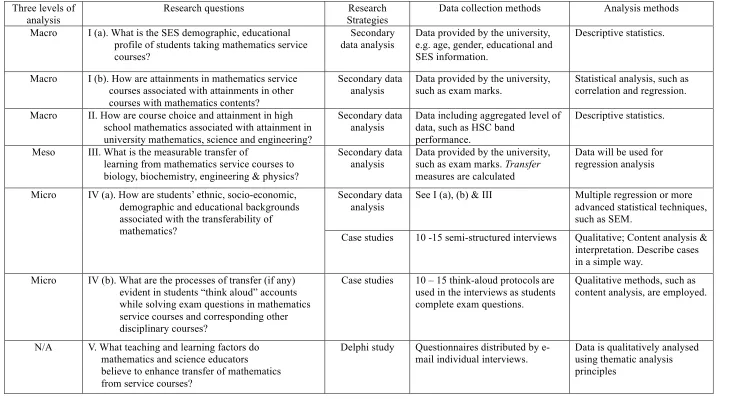
In the mathematics-science nexus project mixed methods, naturalistic inquiry is conducted by employing three research strategies: secondary data analysis, case studies and Delphi study.
These strategies are used to address five research questions, see Table 1.
Secondary data analysis is the primary strategy used in this project. The analysis utilises data
(student attainment data and transfer measures calculated from exam data) to investigate: correlation between mathematics and science attainment; and transferability of mathematics
to science; and how these two are influenced by the educational and socio-economic
backgrounds of students. In addition, case studies will be embedded in secondary data
analysis to examine students’ understanding of the relationship between transferability of mathematics; and to explore the process involved with transfer and the impact of prior
learning and socio-cultural backgrounds of students in greater depth. Furthermore, experts’ views on the nexus between mathematics and science and teaching and learning factors enhancing transfer of mathematics are also explored through a Delphi, or expert panel, study.
Methodologically the project has two key features that overarch the detail provided in Table
1. First, it is mixed methods. A major advantage of employing three research methodologies
various angles; this can lead to fuller understanding transfer, than can be gained by using only single research strategy. The popularity of mixed methods has been increased in social and
behavioural research (Tashakkori & Teddlie, 1998) and has emerged in mathematics
education (Hart, Smith, Swars & Smith, 2009). In fact, many studies in social, behavioural and health sciences are labeled as mixed methods; however, the meaning of mixed methods
can be interpreted in different ways: (i) two different research questions corresponding to
qualitative and quantitative approaches; (ii) two different types of data; (iii) two different
sampling methods, data collection methods or data analysis methods (Tashakkori & Creswell,
2007). In the broad sense, if a study has one of the above features, it can be called mixed
methods study; however the research proposed here is mixed in that is has all of these
features.
Second, the project adopts a naturalistic inquiry research paradigm (Lincoln & Guba, 1985). Little naturalistic research has been done on transfer and conventional studies on transfer
depend heavily on experimental research and have difficulties in defining and demonstrating transfer. By adopting a naturalistic inquiry approach we address this gap and transfer is
defined operationally in relation to mathematics performance in science exams (where the curriculum is shared between mathematics and science units of study). The natural setting is important in terms of spontaneous transfer and occurrence of transfer in the long term. The project pragmatically explores transferwithin the naturalistic context of the university; not as an abstract concept defined and measured in a laboratory.
Naturalistic inquiry can be conducted not only in qualitative research paradigms, but also in
mixed methods research. Lincoln and Guba (1985) note that, in addition to using qualitative
data, “there are many opportunities for the naturalistic investigator to utilize quantitative data
– probably more than are appreciated” (pp.198-199). Moreover, “both qualitative and
quantitative methods may be used appropriately with any research paradigm” (Guba & Lincoln, 1994, p.105). Furthermore, “within each paradigm, mixed methodologies (strategies) may make perfectly good sense” (Guba & Lincoln, 2005, p.200). There are fourteen features of operational naturalistic inquiry (Lincoln & Guba, 1985) and this study is
characterised by these features; using secondary data analysis of university exams, where
transfer is expected to be evident, and integrating this with qualitative research strategies and methods (see supplementary material Table 1).
Project context and research sample
This study focuses on university students studying in STEM degrees: including biochemistry,
biology, engineering and physics because they learn mathematical skills and knowledge and need to apply those skills and knowledge to their own disciplines in the following years.
Australia has 795,000 undergraduate students, across more than thirty universities
(Department of Industry, Innovation, Science, Research, and Tertiary Education, 2012). Three important features of this population are: (i) slightly more female students than male, (ii) mature age students in addition to recent school leavers and (iii) the ratio of international
students is approximately 27% (Department of Industry, Innovation, Science, Research, and
Table 1: The mathematics and science nexus: research questions and methods
Three levels of
analysis
Research questions Research
Strategies
Data collection methods Analysis methods
Macro I (a). What is the SES demographic, educational
profile of students taking mathematics service
courses?
Secondary
data analysis
Data provided by the university,
e.g. age, gender, educational and
SES information.
Descriptive statistics.
Macro I (b). How are attainments in mathematics service
courses associated with attainments in other courses with mathematics contents?
Secondary data
analysis
Data provided by the university, such as exam marks.
Statistical analysis, such as correlation and regression.
Macro II. How are course choice and attainment in high
school mathematics associated with attainment in university mathematics, science and engineering?
Secondary data
analysis
Data including aggregated level of
data, such as HSC band
performance.
Descriptive statistics.
Meso III. What is the measurable transfer of
learning from mathematics service courses to
biology, biochemistry, engineering & physics?
Secondary data
analysis
Data provided by the university, such as exam marks. Transfer
measures are calculated
Data will be used for
regression analysis
Micro IV (a). How are students’ ethnic, socio-economic, demographic and educational backgrounds associated with the transferability of
mathematics?
Secondary data
analysis
See I (a), (b) & III Multiple regression or more advanced statistical techniques, such as SEM.
Case studies 10 -15 semi-structured interviews Qualitative; Content analysis &
interpretation. Describe cases in a simple way.
Micro IV (b). What are the processes of transfer (if any)
evident in students “think aloud” accounts
while solving exam questions in mathematics
service courses and corresponding other
disciplinary courses?
Case studies 10 – 15 think-aloud protocols are used in the interviews as students
complete exam questions.
Qualitative methods, such as
content analysis, are employed.
N/A V. What teaching and learning factors do
mathematics and science educators believe to enhance transfer of mathematics
from service courses?
Delphi study Questionnaires distributed by
e-mail individual interviews.
Data is qualitatively analysed using thematic analysis
The University of Sydney has approximately 33,000 undergraduate students and is ranked as one of top universities in Australia (Planning and Information Office, University of Sydney,
2012b). Students entering the university rank highly on the Australian Tertiary Admission Rank (ATAR), for example, 83 for Bachelor of Science and above 87 for Engineering in 2012
(University of Sydney, 2012). In addition, the number of female students is greater than male
and the proportion of international students is approximately 20% (Planning and Information Office, University of Sydney, 2012a, 2012b). All students in undergraduate programs in Engineering and Science are required to study first year mathematics units of study (UOS), in this paper these courses are referred to as ‘service courses’.
First year Mathematics service UOS and corresponding science UOS
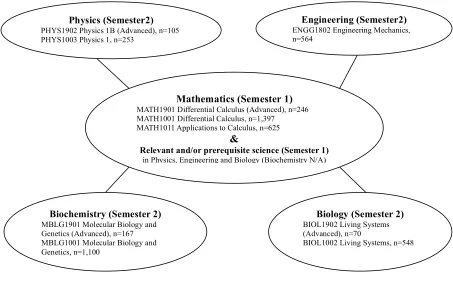
The research project examines all students enrolled in mathematics UOS and corresponding
UOS in other disciplines as shown in Figure 1. There are three focus mathematics service
courses examined in this study. MATH1011 is a fundamental level of mathematics service
courses provided by the School of Mathematics and Statistics (School of Mathematics and Statistics, 2012). Students who only studied intermediate HSC Mathematics, 2 Unit Mathematics, are generally expected to enrol in this course (School of Mathematics and
Statistics, 2012). In addition, MATH1001 is a normal level of mathematics service courses
offered for students studying advanced HSC Mathematics, Extension 1 or equivalent, and
MATH1901 is an advanced service course which is designed for students studying HSC advanced Mathematics Extension 2 (School of Mathematics and Statistics, 2012). Enrolment numbers for these units are included in Figure 1.
UOS in other disciplines, see also Figure 1, are classified into three categories, according to
the extent of cognation between mathematics and other disciplines. The three groups of
disciplinary areas are (i) highly cognate disciplines, such as engineering and physics, in
which transfer is very likely to happen (ii) a moderately cognate discipline, such as
biochemistry, in which transfer may happen because the subject uses mathematics to some extent, and (iii) a distantly cognate discipline, such as biology, in which transfer is less likely
to happen as the disciplinary area is less mathematical. The project examines mathematics
within all three of these groups in order to provide a comprehensive examination of the
mathematics-science nexus. Using the mixed methods the research will examine the
relationship between first year, first semester mathematics and first year, second semester
science and engineering. First year, first semester science/engineering performance will also been included in the analysis.
The project conducts three levels of analysis, integrating both quantitative and qualitative analyses. First, at the macro level, the association of students’ academic attainment between mathematics service courses and corresponding coursesin other disciplines is explored using
correlation and regression. A meso level analysis is designed to quantitatively measure
transferability of mathematics, which involves identifying relevant transfer tasks in the exam
questions and looking at its performance and learning processes involving cognition and far
transfer. At the third, micro level, think-aloud protocols on exam questions are qualitatively
analysed in case studies and this analysis focuses on specific components of exam questions
Figure 1: Relevant first year STEM UOS
In this paper we report on preliminary findings for questions 1(a) and 2, see Table 1, by
providing a demographic profile of students taking first year mathematics service courses and examining how course choice and attainment in high school mathematics is associated with
attainment in university mathematics, science and engineering.
Results and Discussion
Profile of First Year Mathematics students
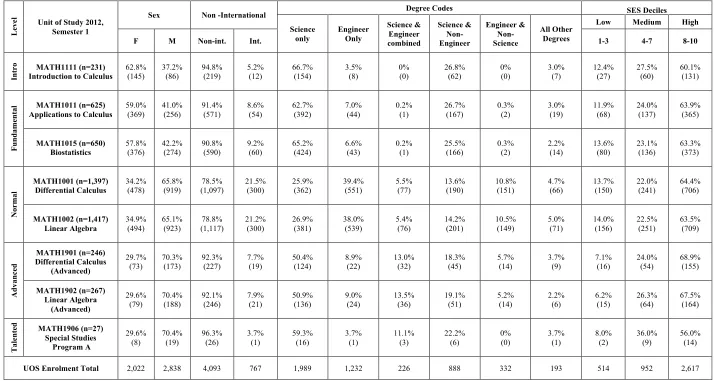
The profile of students taking mathematics service units is summarized in Table 2. Units are
categorized by the level of mathematics involved and this is related to the required preparation in secondary school mathematics. The Introductoryunit requires no mathematics preparation; while fundamental requires at least ‘Mathematics’ (regular standard mathematics, previously ‘2 unit’ mathematics); normal requires ‘Mathematics’ plus
‘Extension 1’; while advanced mathematics requires ‘Extension 1 and 2’ and talented programs identify very high achievers. Within each level similar patterns are observed for
gender ratios, international student numbers, and socio-economic background. However there
are notable differences when comparing between the levels.
Gender disparities exist at all levels. Higher proportions of female students are seen in the
lower level units; in the introductory unit females account for 63% of the classes, in
advanced and talented units less than 30% are female. This is consistent with recent reports of lower female participation in the NSW HSC mathematics (Mack & Walsh, 2013).
Mathematics (Semester 1)
MATH1901 Differential Calculus (Advanced), n=246
MATH1001 Differential Calculus, n=1,397
MATH1011 Applications to Calculus, n=625 &
Relevant and/or prerequisite science (Semester 1)
in Physics, Engineering and Biology (Biochemistry N/A)
Physics(Semester2)
PHYS1902 Physics 1B (Advanced), n=105 PHYS1003 Physics 1, n=253
Biochemistry(Semester 2)
MBLG1901 Molecular Biology and Genetics (Advanced), n=167
MBLG1001 Molecular Biology and
Genetics, n=1,100
Biology(Semester 2) BIOL1902 Living Systems (Advanced), n=70
BIOL1002 Living Systems, n=548
Table 2: Summary of background information of students in first year mathematics units
Le
ve
l
Unit of Study 2012, Semester 1
Sex Non -International Degree Codes SES Deciles
Science only Engineer Only Science & Engineer combined Science & Non- Engineer Engineer & Non- Science All Other Degrees
Low Medium High
F M Non-int. Int. 1-3 4-7 8-10
In
tro MATH1111 (n=231) Introduction to Calculus
62.8% (145) 37.2% (86) 94.8% (219) 5.2% (12) 66.7% (154) 3.5% (8) 0% (0) 26.8% (62) 0% (0) 3.0% (7) 12.4% (27) 27.5% (60) 60.1% (131) Funda m ent
al Applications to Calculus MATH1011 (n=625) 59.0% (369) 41.0% (256) 91.4% (571) 8.6% (54) 62.7% (392) 7.0% (44) 0.2% (1) 26.7% (167) 0.3% (2) 3.0% (19) 11.9% (68) 24.0% (137) 63.9% (365)
MATH1015 (n=650)
Biostatistics 57.8% (376) 42.2% (274) 90.8% (590) 9.2% (60) 65.2% (424) 6.6% (43) 0.2% (1) 25.5% (166) 0.3% (2) 2.2% (14) 13.6% (80) 23.1% (136) 63.3% (373)
No rm al MATH1001 (n=1,397) Differential Calculus 34.2% (478) 65.8% (919) 78.5% (1,097) 21.5% (300) 25.9% (362) 39.4% (551) 5.5% (77) 13.6% (190) 10.8% (151) 4.7% (66) 13.7% (150) 22.0% (241) 64.4% (706) MATH1002 (n=1,417) Linear Algebra 34.9% (494) 65.1% (923) 78.8% (1,117) 21.2% (300) 26.9% (381) 38.0% (539) 5.4% (76) 14.2% (201) 10.5% (149) 5.0% (71) 14.0% (156) 22.5% (251) 63.5% (709) Ad va n ce d MATH1901 (n=246) Differential Calculus (Advanced) 29.7%
(73) 70.3% (173) 92.3% (227) 7.7% (19) 50.4% (124) 8.9% (22) 13.0% (32) 18.3% (45) 5.7% (14) 3.7% (9) 7.1% (16) 24.0% (54) 68.9% (155)
MATH1902 (n=267) Linear Algebra (Advanced) 29.6% (79) 70.4% (188) 92.1% (246) 7.9% (21) 50.9% (136) 9.0% (24) 13.5% (36) 19.1% (51) 5.2% (14) 2.2% (6) 6.2% (15) 26.3% (64) 67.5% (164) Ta le n te
d MATH1906 (n=27) Special Studies Program A 29.6% (8) 70.4% (19) 96.3% (26) 3.7% (1) 59.3% (16) 3.7% (1) 11.1% (3) 22.2% (6) 0% (0) 3.7% (1) 8.0% (2) 36.0% (9) 56.0% (14)
UOS Enrolment Total 2,022 2,838 4,093 767 1,989 1,232 226 888 332 193 514 952 2,617
Note: Socio-Economic Indexes for Areas (SEIFA), Australia 2011, was calculated for only non-international students as no post-codes are available for international students. There was also some missing postcode data
The proportions of international students, the majority of which are Chinese, also show some
trends. Most international students attend the normal level mathematics units, with low
proportions in the introductory and fundamentalscourses. This may reflect better high school
mathematics preparation among international cohorts (Wilson, 2013) and participation in
normal mathematics courses is roughly consistent with the proportion of international
students across this particular institution (approximately 25%). However, international
students are also underrepresented in the advanced and talented programs; this is surprising
given literature reporting high levels of advanced mathematics attainment among Chinese
students (Mullis, Martin & Foy, 2008; OECD, 2010, p.131) who form the dominant group among international students at this university.
A total of 61 different degrees were taken by students in these courses, including 24 combined degrees and five double degrees. Engineering students formed the largest group in normal units of study. Psychology and Biology science students formed the largest group in the introductory and fundamental units. This is concerning as these courses are designed for
students with no or minimal mathematics study at high school. Although mathematics units
are assumed knowledge for both engineering and science degrees, this data suggests that
science students are polarized with high proportions in the lower level courses but also high
proportions of science students in the most advanced levels, while engineering students are concentrated in the normallevel courses. Small numbers of students from business, arts and
social science degrees completed mathematics units; almost all of these students are
undertaking double degrees or combined-degrees.
Despite efforts to increase socio-demographic diversity at this university, around 64% of local students taking first year mathematics came from relatively high socio-economic areas; students from low SES backgrounds were unlikely to complete mathematics service units. Across all the units between 37 and 47% of students are from the highest decile of SES
classification; this means that studying mathematics at this university is a pursuit of the most elite sector of society.
High school preparation for university Mathematics
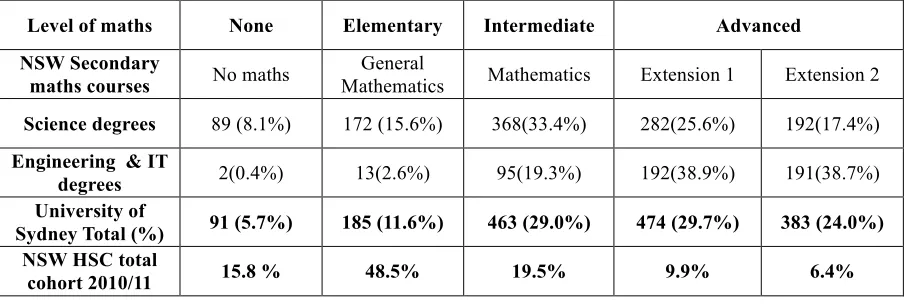
The University of Sydney cohort’s participation in New South Wales (NSW) High School Certificate (HSC) mathematics courses is shown in Table 3. This data relates only to the
university students who completed their HSC in the two years preceding 2012. Under the
Privacy and Personal Information Protect Act 1998, the NSW Board of Studies is unable to
provide individual data that could potentially identify individual students, thus for HSC data
were not able to provide whole distributions or conduct correlation analysis, but must rely on summative statistics.
In table 3 the university cohort is compared to the state participation rates for 2012, including students who do not go on to university, and those who go on to study STEM and non-STEM degrees at other universities. It is not surprising that the University of Sydney STEM cohort show higher levels of mathematics study at HSC. However it is surprising that, even at an elite university, five per cent of the university STEM students arrive with no mathematics
background and that nearly 12 per cent have only elementary mathematics preparation, without calculus. Insufficient mathematical background of students is a critical issue in
university STEM education because mathematics is viewed as a foundation of STEM
Table 3: University of Sydney 2012 enrolment in STEM degrees by the highest level of
secondary mathematics in NSW HSC 2010/2011
Level of maths None Elementary Intermediate Advanced
NSW Secondary
maths courses No maths
General
Mathematics Mathematics Extension 1 Extension 2
Science degrees 89 (8.1%) 172 (15.6%) 368(33.4%) 282(25.6%) 192(17.4%)
Engineering & IT
degrees 2(0.4%) 13(2.6%) 95(19.3%) 192(38.9%) 191(38.7%)
University of
Sydney Total (%) 91 (5.7%) 185 (11.6%) 463 (29.0%) 474 (29.7%) 383 (24.0%)
NSW HSC total
cohort 2010/11 15.8 % 48.5% 19.5% 9.9% 6.4%
There is no requirement for NSW HSC students to study mathematics and those who do may
choose their course in relation to a balance between workload and maximising their
university entry score –and the assumed prior knowledge required for their university degree may only be an additional consideration. A survey of NSW mathematics teachers suggests
that many capable students are taking lower level mathematics courses due to a lack of
university prerequisites to study in science degrees (Mathematical Association of New South Wales, 2014). The results also reflect the trend of declining the enrolment in NSW secondary
calculus courses (Mathematical Association of New South Wales, 2014).
First year university pass rate in STEM degrees
Figure 2 shows the percentage pass rate for first year students in Science and Engineering and IT degrees (data is in supplementary material Table 3). The pass rate reflects the proportion of
students passing all their UOS in first year, some of these UOS may be from faculties other
than science, engineering and IT. Nevertheless a pattern emerges where HSC mathematics
subject choice and attainment bands (1 is the lowest attainment) are positively related to the student pass rate. This pattern is strongest in mathematics courses with calculus (2U mathematics ‘intermediate’, and Ext 1 and Ext2 ‘advanced’ courses); these courses show a
steeper gradient in relation to school mathematics and university pass rate. Looking at no mathematics and the elementary mathematics course, the pass rates were less than 40%
regardless of the band. The highest pass rate of the highest band in the intermediate and
Figure 2: Percent who passed all units of study in 2012 by the highest level of NSW
2010/2011 HSC mathematics course and band
Conclusion
In this paper we have outlined a mixed methodology approach to exploring the relationship between mathematics and science learning at one university. The research project is naturally constrained by its focus on an elite, single institution that is not representative of Australian universities, but may provide a model for similar research in other universities. The science– mathematics nexus is a large and complex topic and therefore we have also had to limit our focus to specific cohorts within first year units of study in order to drill down into the pragmatics of what mathematics learning is transferred and what factors and processes are involved. Within a mixed method design, however, we have been able to design a naturalistic study with strong ecological validity which examines important factors like prior learning, individual background factors, and includes ways to assess transfer and examine the learning processes involved.
(non-calculus) mathematics. These high school study choices are related to university pass rates; as both the level of mathematics study and the attainment within the course are predictive of overall pass rates for first year university.
Thus analysis of our research cohort has identified several issues relevant to STEM policy– both institutional and more general. In this university the gender gap remains; while almost as many females study mathematics as males, they do so at lower levels. Similarly low SES students are constrained to low participation and lower levels of mathematics study. As part of broader mathematics and STEM strategy, universities may have to consider ways in which they can make advanced mathematics more accessible to these groups.
This study has demonstrated how students’ high school mathematics course choice and attainment levels are predictive of overall pass rates in first year STEM degrees. Yet, such is the current crisis in high school participation in mathematics, even in an elite university, like the University of Sydney, more than 270 students in STEM degrees (17%) came to university without mathematics or with only elementary mathematics. This may in part, be due to the 2001 removal of the NSW HSC requirement to study at least one mathematics or science subject. It may also be due to the deregulation of university entry, market forces and pressures upon universities to increase STEM enrolment numbers despite falling demand, which meant that retention of pre-requisites was difficult. As a result there has been a rise in students with poor mathematics background, for these students the relationship between mathematics learning and other study in science, engineering or IT is likely to be fraught with difficulty – they may strategise to choose subjects where a strong mathematical background is less critical, they may take bridging courses which offer partial remediation. However, a greater alignment between secondary school and university policies might avert these difficulties. There are two policy levers to pull here: one, lift the participation and attainment through requirements in secondary school; or two, limit university entry to those with adequate preparation (through prerequisites).
Later analyses in the proposed project will provide insight into the amount of transfer of mathematics learning from first year mathematics to performance in science assessments. Detailed qualitative data will also explore the contexts and processes relevant to transfer of mathematics. This work, documenting the current state of the mathematics science nexus at university is needed if we are to nurture STEM education and the possibilities it holds for national advancement.
Acknowledgements
This study is partially funded by 2013 NSW IER research grant.
References
Ainley, J., & Gebhardt, E. (2013). Measure for measure: a review of outcomes of school education in Australia.
Akyol, Z., & Garrison, D. R. (2011). Understanding cognitive presence in an online and blended community of inquiry: Assessing outcomes and processes for deep approaches to learning. British Journal of Educational Technology, 42(2), 233-250.
Anlezark, A., Lim, P., Semo, R. & Nguyen, N. (2008). From STEM to leaf: Where are Australia’s science, mathematics, engineering and technology (STEM) students heading? NCVER. Retrieved May 1, 2014, from
http://www.innovation.gov.au/skills/ResourcesAndPublications/Documents/STEMtoLeafAustSciTechEngi nMathHeading.pdf
Australian Industry Group. (2013). Lifting our science, technology, engineering and maths (STEM) skills.
http://www.aigroup.com.au/portal/binary/com.epicentric.contentmanagement.servlet.ContentDeliveryServl
et/LIVE_CONTENT/Publications/Reports/2013/Ai_Group_Skills_Survey_2012
-STEM_FINAL_PRINTED.pdf.
Australian Qualifications Framework Council. (2011). Australian qualifications framework (First edition). South Australia: Australian Qualifications Framework Council. Retrieved May 1, 2014, from http://www.aqf.edu.au/PoliciesPublications/tabid/196/D efault.aspx.
Bannert, M. & Mengelkamp, C. (2008). Assessment of metacognitive skills by means of instruction to think aloud and reflect when prompted. Does the verbalisation method affect learning? Metacognition Learning,
3, 39-58.
Barrington, F. (2006). Participation in Year 12 mathematics across Australia 1995-2004. Australian Mathematical Sciences Institute. Retrieved May 1, 2014, from
http://www.amsi.org.au/index.php/publications-mainmenu/78-publications/education/249-participation-in
-year-12-mathematics-across-australia-1995-2004.
Barrington, F. (2013). Update on Year 12 mathematics student numbers. Australian Mathematical Sciences
Institute. Retrieved May 1, 2014, from
http://www.amsi.org.au/index.php/publications-mainmenu/78-publications/education/1150-year-12 -mathematics-student-numbers-2003-2012.
Belward, S., Matthews, K, Rylands, L., Coady, C., Adams, P. & Simbag, V. (2011). A study of the Australian
tertiary sector’s portrayed view of the relevance of quantitative skills in science. In J. Clark, B. Kissane, J. Mousley, T. Spencer, and S. Thornton (Eds.), Mathematics: Traditions and [New] Practices (pp. 107-114).
Cassidy, S. (2012). Exploring individual differences as determining factors in student academic achievement in higher education. Studies in Higher Education, 37(7), 793-810.
Clark, M., & Lovric, M. (2008). Suggestion for a theoretical model for secondary-tertiary transition in mathematics. Mathematics Education Research Journal, 20(2), 25-37.
Clark, M. & Lovric, M. (2009). Understanding secondary-tertiary transition in mathematics. International Journal of Mathematical Education in Science and Technology, 40(6), 755-776.
Department of Industry, Innovation, Science, Research and Tertiary Education (2012). Student 2011 Full Year: Students: Selected Higher Education Statistics – 2011 Full Year Students Summary tables.Retrieved May 1, 2014, from
http://www.deewr.gov.au/HigherEducation/Publications/HEStatistics/Publications/Documents/2011/11Su
mmaryTables.xls.
Frempong, G., Ma, X. & Mensah, J. (2012). Access to postsecondary education: can schools compensate for
socioeconomic disadvantage? Higher Education, 63, 19-32.
Grayson, J. P. (2011). Cultural capital and academic achievement of first generation domestic and international students in Canadian universities. British Educational Research Journal, 37(4), 605-630.
Guba, E. G. & Lincoln, Y. S. (1994). Competing paradigms in qualitative research. In N. K. Denzin & Y. S.
Lincoln (Eds.), Handbook of qualitative research (pp.105-117). Thousand Oaks, CA: Sage.
Guba, E. G. & Lincoln, Y. S. (2005). Paradigmatic controversies, contradictions and emerging confluence. In N.
K. Denzin & Y.S. Lincoln (Eds.), The Sage handbook of qualitative research (3rd ed., pp.191-215).
Thousand Oak, CA: Sage.
Gulacar, O. & Fynewever, H. (2010). A research methodology for studying what makes some problems difficult
to solve, International Journal of Science Education, 32(16), 2167-2184.
Hart, L., C., Smith, S. Z., Swars, S. L. & Smith, M. E. (2009). An examination of research methods in mathematics education (1995-2005). Journal of Mixed Methods Research, 3(1), 26-41.
Hawkes, T. & Savage, M. (2000). Measuring the mathematics problem. Retrieved May 1, 2014, from
http://www.engc.org.uk/ecukdocuments/internet/document%20library/Measuring%20the%20Mathematic %20Problems.pdf.
Hourigan, M. & O’Donoghue, J. (2007). Mathematical under-preparedness: the influence of the pre-tertiary
mathematics experience on students’ ability to make a successful transition to tertiary level mathematics courses in Ireland. International Journal of Mathematical Education in Science and Technology, 38(4),
461-476.
Jennings, M. (2009). Issues in bridging between senior secondary and first year university mathematics. In
Proceedings of the 32nd Annual Conference of the Mathematics Education Research Group of Australasia. MERGA32 (pp. 273-280).
Jones, S. & Yates, B. (2011). Science Learning and Teaching Academic Standards Statement. Sydney: Australian
Learning and Teaching Council. Retrieved May1, 2014, from
http://www.olt.gov.au/resources?text=Threshold+Learning+Outomes+for+Science%E3%80%80. Kajander, A. & Lovric, M. (2005). Transition from secondary to tertiary mathematics : McMaster University
experience. International Journal of Mathematical Education in Science and technology, 36(2-3), 149
Koenig, J. (2011). A survey of the mathematics landscape within bioscience undergraduate and postgraduate UK higher education. Leeds, UK: UK Centre for Bioscience, Higher Education Academy.
Leech, N. L., & Onwuegbuzie, A. J. (2009). A typology of mixed methods research designs. Quality & Quantity,
43(2), 265-275.
Lincoln, Y. S. & Guba, E. G. (1985). Naturalistic inquiry. London: Sage.
Mack, J. & Walsh, B. (2013) Mathematics and Science Combinations: NSW HSC 2001-2011 by Gender. Technical paper. Retrieved May 1, 2014, from http://www.maths.usyd.edu.au/u/SMS/MWW2013.pdf.
McNabb, R., Pal, S., & Sloane, P. (2002). Gender differences in educational attainment: The case of university students in England and Wales. Economica, 69(275), 481-503.
Martin, A. J., Wilson, R., Liem, G. A. D., & Ginns, P. (2013). Academic Momentum at University/College: Exploring the Roles of Prior Learning, Life Experience, and Ongoing Performance in Academic Achievement Across Time. The Journal of Higher Education, 84(5), 640-674.
Marton, F. & Saljo, R. (1976). On qualitative differences in learning: I—outcome and process. British Journal of Educational Psychology,46, 4–11.
Mathematical Association of New South Wales. (2014). Mathematics education in NSW: A level playing field for
all?RetrievedMay 1, 2014,from http://www.MANSW_2013_Survey_Report_FINAL_Feb13.pdf. Mullis, I., Martin, M, & Foy, P. (2008). TIMSS 2007 International Mathematics Report: Findings from IEA’s
international mathematics and science study at the fourth and eighth grades. Massachusetts: Centre for the Study of Teaching, Evaluation and Educational Policy, Boston College.
Nakakoji, Y. & Wilson, R. (2014). Tertiary educators' perspectives of the nexus between maths and science. Proceedings of the Mathematics Education Society of Japan Spring Meeting (pp. 202–204). Tokyo, 15-17
March 2014.
OECD (2010), PISA 2009 Results: What Students Know and Can Do – Student Performance in Reading, Mathematics and Science (Volume I). Retrieved May 1, 2014, from
http://dx.doi.org/10.1787/9789264091450-en
Office of the Chief Scientist. (2012). Mathematics, engineering & science in the national interest. Retrieved May 1, 2014, from http://www.chief scientist.gov.au/2012/05/mes-report/
Okoli, C. & Pawlowski, S. D. (2004). The Delphi method as a research tool: an example, design considerations and applications. Information & Management, 42, 15-29.
Osborne, J., Collins, S., Ratcliffe, M., Millar, R. & Duschl, R. (2003). What “ideas-about-science” should be taught in school science? A Delphi study of the expert community. Journal of Research in Science Teaching, 40(7), 692-720.
Pellizzari, M., & Billari, F. C. (2012). The younger, the better? Age-related differences in academic performance at university. Journal of Population Economics, 25(2), 697-739.
Planning and Information Office, the University of Sydney (2012a). International enrolments 2010 by Faculty
of registration/program, level & gender.Retrieved May 1, 2014from
http://sydney.edu.au/staff/planning/statistics/enrol/intnl_fac.php
Planning and Information Office, the University of Sydney (2012b). Total student Enrolments 2012: All levels
enrolments by level, attendance type & gender. Retrieved May 1, 2014, from
http://sydney.edu.au/staff/planning/statistics/enrol/enrol.php?ci=3&type=lvl&yr=2012
Roberts, A.L., Sharma, M.D., Britton, S. & New, P.B. (2007). An index to measure the ability of first year
science students to transfer mathematics. International Journal of Mathematical Education in Science and
Technology, 38(4), 429-448.
Rubinstein, H. (2009). A national strategy for mathematical sciences in Australia. Retrieved May 1, 2014, from
http://www.amsi.org.au/images/stories/downloads/pdfs/general-outreach/National_Maths_Strategy.pdf Rylands, L.J. & Coady, C. (2009). Performance of students with weak mathematics in first-year mathematics
and science. International Journal of Mathematical Education in Science and Technology, 40(6), 741-753.
Sadler, P. M. & Tai, R. H. (2007). The two high-school pillars supporting college science. Science, 317(5837),
457-458.
School of Mathematics and Statistics (2012). Junior Mathematics and Statistics 2012 Handbook. Sydney: University of Sydney.
Tashakkori, A. & Creswell, J. W. (2007). The new era of mixed methods. Journal of Mixed Methods Research, 1(1), 3-7.
Tashakkori, A. & Teddlie, C. (1998). Mixed methodology combining qualitative and quantitative approaches.
USA: Sage
The mathematical sciences in 2025. (2013). The mathematical sciences in 2025, National Academies Press.
Retrieved May 1, 2014, from http://www.nap.edu/catalog.php?record_id=15269
University of Sydney, (2012). 2012ATAR, IB and OP cut-offs UAC. Retrieved May 1, 2014, from
http://sydney.edu.au/future_students/domestic/undergraduate/atar-ib-op-cut-offs.shtml
university with a weak mathematics background. International Journal ofMathematical Education in Science and Technology, 41(8), 1037-1049.
Wilson, R. (2013). Make maths mandatory and we'll improve our education rankings, The Conversation. DOI: Retrieved May 1, 2014, from
http://theconversation.com/make-maths-mandatory-and-well-improve-our-international-education
-rankings-11663.
Wilson, R., Mack, J. & Walsh, B. (2013). Stagnation, decline and gender disparity in participation in NSW HSC
mathematics and science combinations. Proceedings of the Australian Conference on Science and
Mathematics Education, Australian National University (pp.199-204), Canberra, 19th -21stSe2013. Winne, P. H. & Nesbit, J. C. (2010). The psychology of academic achievement. Annual Review of Psychology,
61, 653-678.