Development of passive evaporative cooling systems for tomatoes
Part 1: construction material characterization
Okanlawon
Sunday Adewale
1, Abel Olajide Olorunnisola
2* (1.Department of Agricultural & Environmental Engineering, University of Ibadan, Nigeria;2. Department of Wood Products Engineering, University of Ibadan, Nigeria)
Abstract: The management of large volumes of agroforestry residues constitutes one of the global environmental challenges today. These residues tend to accumulate in the environment, resulting in water, air and land pollution. In response to rising costs associated with waste disposal and increasing environmental demands, the sustainable conversion of wastes into useful products is becoming increasingly important. In the same vein, the quality and shelf life of tomatoes are compromised within a few days if not properly stored and preserved. Although, a number of researchers have worked extensively on the development of evaporative cooling systems in an effort to tackle this menace, finding durable construction materials remains a challenge. The broad objective of this study, therefore, was to develop passive evaporative coolers for tomatoes, using cement and clay-bonded composites from eggshell and sawdust as fabrication materials. In phase one of the study herein reported, relevant engineering properties of laterite-sawdust, cement-sawdust and cement-eggshell ash-sawdust at mixing ratios of 9:1, 4:1 and 16:4:5 respectively were investigated, with laterite alone and concrete serving as the controls. The results obtained showed a significant reduction (p<0.05) in density (36.1%-46.8% for clay-bonded and 53.5%-54.8% for cement-bonded samples), a significant increase in porosity (p<0.05), and a significant decrease in thermal conductivity of the composite materials as a result of the sawdust and egg shell ash incorporation. There were, however, slight increase in moisture absorption and decrease impact energy absorption capacity of the composite materials. These minor issues notwithstanding, sawdust and burnt egg shell are considered to be suitable potential construction materials for the fabrication of evaporative coolers for tomatoes.
Keywords: agro-forestry residues, composites, evaporative cooler, tomatoes
Citation: Okanlawon, S. A., and A. O. Olorunnisola. 2017. Development of passive evaporative cooling systems for tomatoes Part 1: construction material characterization. Agricultural Engineering International: CIGR Journal, 19(1): 178–186.
1 Introduction
Fruits and vegetables are important food items that are widely consumed because they form an essential part of a balanced diet. They are important sources of minerals and vitamins especially vitamin A and vitamin C. They also provide carbohydrates and protein, which are needed for normal healthy growth (Adetuyi et al., 2008,
Olusunde et al., 2009). Specifically, tomato
(Lycopersicon esculenium) is known for its rich vitamins,
Received date: 2016-06-25 Accepted date: 2016-11-24
* Corresponding author: Abel Olajide Olorunnisola,
Department of Wood Products Engineering, University of Ibadan, Nigeria. Email: [email protected]. Tel: +234 803 472 4945.
high concentration of moisture and low fat. It is highly perishable due to excess moisture present in it especially at harvest time. It is therefore important that tomato is preserved in season when available in order to ensure constant supply throughout the year with the nutritional value still retained and to reduce spoilage (Olosunde, 2006). Kader (1999) estimated the extent of post-harvest losses in fresh tomatoes at 5% to 28% in developed countries and 20% to 50% developing countries.
it is susceptible to chilling injury (Olusunde et al., 2009). Besides, the epileptic power supply and low income of farmers in the rural communities make refrigeration expensive. Hence, there is a need for the development of low cost storage systems based on the principle of evaporative cooling for storage of fruits and vegetables, which are simple, and relatively efficient. As noted by Obura et al. (2015), ‘for any technology to be successful at the grassroot level in Africa, it must: have no power grid sources, be easily duplicated by farmers with readily available materials, be on an appropriate scale in operation and economics for individual farmer/family or village Saving and Credit Co-operative (SACCO), have more than one use (year-round utility), be inexpensive and efficient and preserve organoleptic properties of the food’.
An evaporative cooler is a facility used for the close control of space temperature and humidity in order to restrict to a minimum, the chemical, bio-chemical and physiological changes in fruits and vegetables. This it achieves by lowering the storage temperature while increasing the relative humidity. Evaporative coolers are easy to operate, efficient and affordable, most especially for peasant farmers in developing countries who may find other methods of preservation quite expensive and unaffordable (Vala et al., 2014). As noted by Deoraj et al. (2015), evaporative coolers can be easily constructed using locally available materials. They can be easily maintained compared to refrigerated systems, and they are environmentally friendly. Although, a number of researchers including Ndirika and Asota (1994), Dzivama (2000), Anyanwu (2004), Olosunde (2006), Olosunde et al. (2009), Taye and Olorunisola (2011), Liberty et al., (2013), and Deoraj et al. (2015) have worked on evaporative cooling systems for the preservation of agricultural products including tomatoes, one of the challenges yet to be fully tackled, as noted by Ndukwu and Manuwa (2014), is finding durable construction materials. The use of evaporative cooling systems fabricated with cement and clay are mostly adapted to the tropical environment (Anyanwu, 2004, Chinenye, 2011, Ndukwu, 2011). Such coolers are usually heavy and difficult to transport. Besides, cement-based coolers may
be too expensive for the peasant farmers. There is therefore the need for relatively light-weight materials of construction which are durable; workable, relatively cheap, and that can be used practically in every environment.
Large volumes of agroforestry residues constitute one of the global environmental problems today, particularly in Africa. These residues tend to accumulate in water bodies, air and land, resulting in environmental pollution. Since an effective evaporative cooling system should be made of a porous material, one way of adding value to these residues is by using them in porous cement and clay-bonded composites for the production of evaporative coolers. As noted by Ganiron (2014), sawdust concrete is light in weight and has satisfactory heat insulation and fire resisting values. Aramide (2011) also confirmed that the porosity and insulation value of clay could be enhanced with sawdust incorporation. During the last two decades, the use of agroforestry residues in such composites for construction purposes has gained momentum (Olorunnisola, 2007; 2009). However, the application has not yet been extended to the construction of evaporative coolers.
The aim of this study was to investigate selected physico-mechanical and thermal properties of clay- and cement-bonded composite materials that could be used to fabricate evaporative coolers for tomatoes. It is expected that the evaporative coolers subsequently produced with such materials would be effective in providing suitable environmental conditions for the preservation of tomatoes.
2 Materials and methods
2.1 Collection and pre-processing ofmaterials
Lateritic clay was collected within the premises of the Faculty of Technology, University of Ibadan. It was sun-dried for three days, pulverized, sieved with a 600 μm sieve and then stored in an air-tight polythene bag to prevent moisture absorption. Before use, the clay was subjected to sieve analysis and Atterberg limit tests in accordance with the American Association of State Highway Transportation Officers (AASHTO 1986) and
manufactured Portland cement of 32.5 N strength grade was procured and kept in air-tight polythene bag throughout the period of use.
Chicken eggshells were collected from a local fast-food centre in Ibadan. They were sun dried for five days, crushed, ground, burnt into ashes at temperature of approximately 600°C and then sieved using 600 μm sieves. Material passing through 600 μm sieve was used for partial cement replacement while the material retained was discarded. The carbonization of the eggshells which has relatively low CO2 emission and no
negative effect on the properties of the calcium oxide content, was done to ensure that all pathogens in the egg shell were eliminated. Afara (Termilania superba) wood sawdust was obtained from a local sawmill. It was sieved using 850 μm sieves; subjected to aqueous pre-treatment to reduce cement inhibition by soaking in cold water for 24 hours and then sun-dried for three days. Sieve analysis followed by moisture content, bulk density, and specific gravity determination were then carried out on the laterite, Portland cement, egg-shell ash and sawdust. River bed sand obtained from a flowing river was washed and sun-dried for two days. Clean portable water free of contaminants either dissolved or in suspension was used to prepare the composites at various mixing ratios.
2.2 Mix proportioning of raw materials, production
and testing of the composites
The term proportioning in this context refers to the estimation of different quantities of materials used in the production of each composite as well as water required for the matrix. The composites materials formed were:
i) 100 % Laterite (Control 1, tagged L) ii) Laterite-sawdust (LS)
iii) 100% Concrete prepared at Sand: Cement ratio 1:3 (Control 2, tagged CR)
iv) Cement-sawdust (CS) and
v) Cement-Eggshell Ash-Sawdust (CES)
The materials matrices and their corresponding ratios were as follows:
a. LS ( three matrices were made as follows): i. L : S = 85% : 15% (17 : 3)
ii. L : S = 90% : 10% (9 : 1)
iii. L : S = 95% : 5% (19 :1) b. CS → C : S = 4 : 1
c. CES → C : E : S = 16 : 4 : 5
Water/cement ratio adopted was 0.5 and
water/Laterite ratio was 0.25.
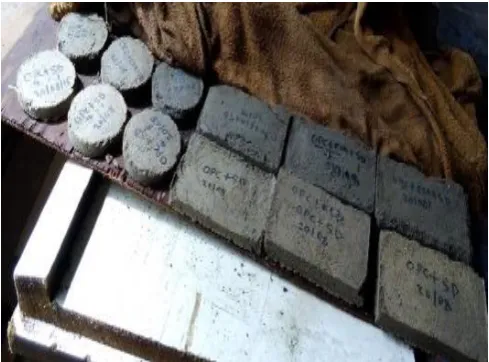
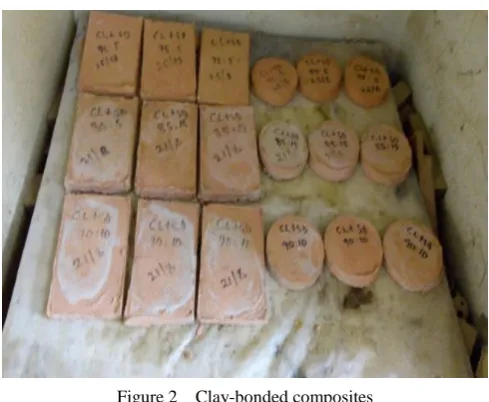
The materials were first properly mixed manually before the addition of water. For the purpose of experimental tests, a number of 150 mm×100 mm×20 mm rectangular and circular (50 mm diameter) moulds were used. Sufficient quantity of matrix material prepared as described was placed in each mould and then compacted. A total of 60 rectangular and 15 circular samples were moulded. The rectangular samples were used for water absorption, thickness swelling, impact strength, porosity and moisture content tests; while the circular samples were used for thermal conductivity tests. There was the tendency for the material mixture to stick to the sides of the molds and cause breaking during extrusion. This problem was taken care of by properly oiling the interior surfaces of the moulds. The samples when extruded were cured as shown in Figures 1 and 2 under different conditions. The Cement-Eggshell Ash-Sawdust and Cement-Sawdust composite samples were wet-cured for 28 days in line with the procedure adopted by Olorunnisola (2007) for cement bonded composites. The laterite samples were air cured under cool atmospheric air in line with the well established procedures for curing clay materials as reported by Hassan (2006). Care was taken to ensure that the samples were not disturbed during curing and that demoulding was cautiously done to ensure that there was no breakage.
Figure 2 Clay-bonded composites
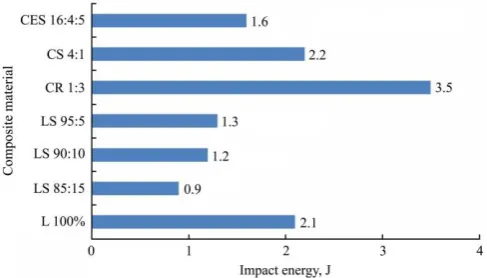
The moisture content, density, water absorption, and thickness swelling of the composites were then determined in accordance with ISO8335 (1987). For impact energy test, the specimens were cut into 148 mm × 97 mm × 16 mm and were in turn placed under a hammer of 3.5 kg, which was dropped at various heights. The height of hammer fall in meters that resulted in the failure of the sample was recorded for each sample. The impact load energy was determined using Equation (1).
I=work done by dropping hammer on specimen= force×height of fall=mgh (1) where, I = impact energy, J; m= mass of hammer, 3.5 kg;
g = acceleration due to gravity of hammer, 9.8 m s-2; h =
Hammer height of fall, m.
The apparent porosity was determined in line with the procedure reported by Folaranmi (2009). For the thermal conductivity test, a specially designed apparatus was used. It consisted of a cylindrical container, an upper (hot) plate and a lower (cold) plate, all made of mild steel, a thermostat, voltage regulator and a digital temperature probe. The hot plate was 90 mm in diameter and 30 mm thick. The lower plate had a diameter of 90 mm and a thickness of 9 mm. The upper plate was heated electrically and this was controlled using a variable voltage regulator. The thermal conductivity apparatus was calibrated using samples of known thermal conductivity values. The heat source was adjusted to maintain a temperature range of 61°C-64°C. At the steady state condition, the temperature difference was recorded and used in calculating the thermal conductivity of the
samples using Equation (2).
qL K
A T
(2)
where, K is thermal conductivity, W m-1 K-1; q israte of
heat supply, W; L is Thickness of material, m; A is surface area of the material, m2; ΔT is temperature
difference, K.
The test results obtained were subjected to descriptive and inferential statistical analyses, including two-way analysis of variance at 5% level of significance.
3 Results and discussion
3.1 Soil analysis and classification
Table 1 shows the results of the analysis carried out on the laterite. Based on the combined results of the liquid limit and the particle size analysis, the soil was classified as A-7-5 and CH according to AASHTO (1986) and the Universal Soil Classification System respectively. The liquid limit, plastic limit and plasticity index values were 56.28%, 53.6% and 3.19% respectively. These indices indicated that the soil had relatively high crumbling resistance and moderate water requirement. The soil was slightly acidic with a pH value of 6.5, reddish brown in color and had specific gravity of 2.83.
Table 1 Basic properties of the Laterite
Properties Index AASHTO classification A-7-5 USCS classification CH
MDD, Mg m-3 1.44
OMC, % 25.28 Liquid limit, % 56.79 Plastic limit, % 53.6 Plasticity index, % 3.19 Specific gravity 2.83 Natural moisture content, % 3.24 % passing BS. No. 200 sieve 3.44
pH 6.5
Color Reddish brown
3.2 Physical properties of composite production
materials
value. The higher specific gravity of the Portland cement compared to eggshell ash could be as a result of the higher Fe203 and MgO contents in the former than in the
latter (Charoenvai et al., 2005; Akhil et al., 2015). The moisture contents of the materials ranged from 0.9% to 7.1% with the Portland cement expectedly having the lowest moisture content while the sawdust had the highest moisture content.
Table 2 Physical properties of composite production materials
Properties Laterite Egg shell ash Portland cement Sawdust Specific gravity 2.83 0.85 3.15 0.45
Particle size 600 μm 600 μm Not determined 1.18 mm Bulk density, g cm-3 0.82 0.70 0.61 0.13
Moisture content (%)
at 105°C 5.68 0.99 0.90 7.09
3.3 Moisture content of the clay- and cement-bonded
composites
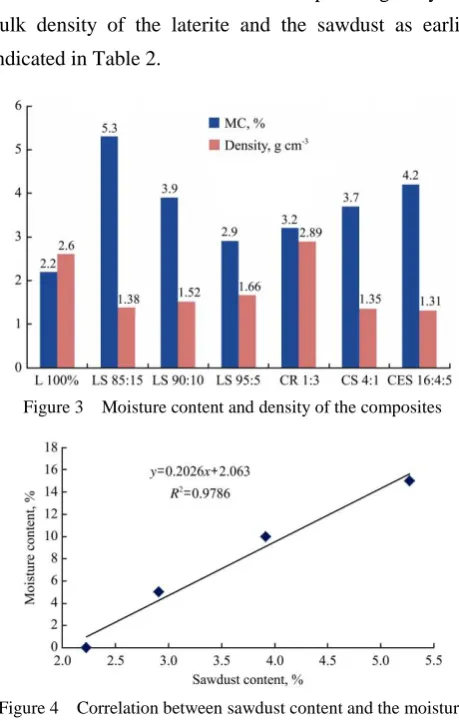
The mean values of the moisture contents of the composites and the controls are shown in Figure 3. The values ranged from 2.2% to 5.3% for the clay- bonded composites, and from 3.2 to 4.2% for the cement-bonded composites. The clay-bonded composite blended with 15% sawdust had the highest moisture content of 5.3% while pure laterite had the lowest moisture content of 2.2%. The respective moisture contents of the cement-eggshell-ash and cement-sawdust composites were 4.2% and 3.7%, compared to 3.2% that was recorded for the pure concrete. The relatively higher moisture content of the cement-eggshell-ash and cement-sawdust composites compared to the pure concrete is an indication that the sawdust and eggshell ash were hygroscopic. Analysis of variance showed that the observed effects of sawdust and eggshell ash incorporation in the laterite and cement matrices on the moisture contents of the composites were significant (p<0.05). A strong correlation (Figure 4) was also observed between sawdust addition and the moisture content of the clay-bonded composites.
3.4 The density of clay- and cement-bonded
composites
As shown in Figure 3, the mean densities of the composites and the controls ranged between 1.38 and 2.60 g cm-3 for clay-bonded; and between 1.31 and
2.98 g cm-3 for the cement-bonded composites. Expectedly,
the density of the clay-bonded composites decreased as sawdust content increased from 5 to 15%. The density of the pure laterite was 2.60 g cm-3. With 5% sawdust
addition the value dropped to 1.66 g cm-3 which is
equivalent to 36.1% reduction; at 10% sawdust addition, the value further dropped to 1.52 g cm-3,representing a
41.5% reduction in density; and at 15% sawdust addition the value dropped to 1.38 g cm-3 representing a 46.8%
reduction in density. The reason for the drop in density is attributable to the differences in the specific gravity and bulk density of the laterite and the sawdust as earlier indicated in Table 2.
Figure 3 Moisture content and density of the composites
Figure 4 Correlation between sawdust content and the moisture content of the clay-bonded composites
contained the same proportion (by mass) of sawdust, the proportion of Portland cement in them was different. In egg shell ash-cement composite, Portland cement was replaced with 20% eggshell ash, resulting in a slight reduction in density which was not unconnected with the lower specific gravity of the eggshell ash compared to the Portland cement. Analysis of variance showed that the observed effects of sawdust and eggshell ash incorporation in the laterite and cement matrices on the densities of the composites were significant (p<0.05). These results suggest that the addition of sawdust and eggshell ash will generally reduce the weight of an evaporative cooling structure. The further reduction in composite density due to partial replacement Portland cement with egg shell ash is an indication of the possibility of reduction in cost of evaporative cooler production as well as enhanced portability.
3.5 Water absorption and thickness swelling of the
composites
The Water Absorption (WA) and Thickness Swelling (TS) of the clay-bonded composites could not be investigated as the samples disintegrated after 45 minutes in water. This could probably be caused by the weak binding force between the clay and the sawdust. However, the mean values for the WA and TS of the cement-bonded composites are also shown in Figure 5. It can be seen that the incorporation of sawdust and eggshell ash resulted in increases in WA and TS. There are no standard limits yet for WA of cement-bonded composites. However, the WA values obtained were generally low. Also, the TS of the sawdust-cement composite was slightly higher perhaps due to the fibrous and hygroscopic nature of the sawdust, while that of the egg shell ash-cement composite fell within the acceptable limit of 2% stipulated in ISO 8335 (1987). These are clear indications that the composites were dimensionally stable.
The relatively lower WA and TS of the eggshell ash may be due to better adhesion between the cement and the ash, reducing the formation of agglomerates which can result into pore spaces in the system. Furthermore, burning of eggshell at about 600°C results in a decrease
in the number of free hydroxyl groups on the surface and hence, a reduction in its water absorption capacity (Siti et al., 2009). Therefore, partially replacement of Portland cement with egg shell ash should further enhance the dimensional stability of the composite material.
Figure 5 Water absorption and thickness swelling of the cement-bonded composites
3.6 Apparent porosity
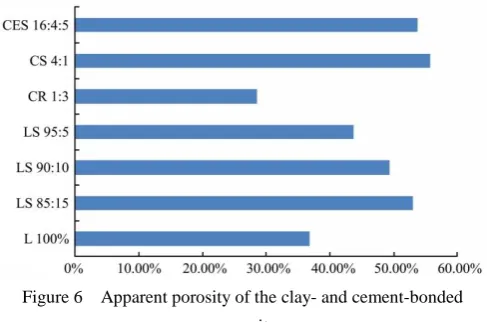
Porosity is the ability of a material to be pervious to gases and liquids. The mean Apparent Porosity (AP) values obtained are shown in Figure 6.
Figure 6 Apparent porosity of the clay- and cement-bonded composites
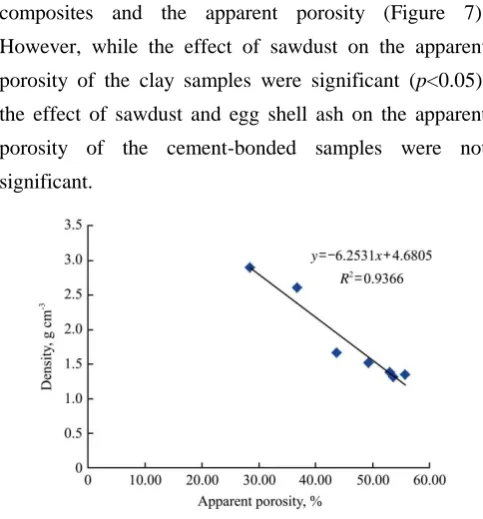
For the clay-bonded composites the values ranged between 43.7% and 53.0%, increasing with the increase in sawdust content. The apparent porosities of the three laterite-sawdust samples were above the indicated limit of 20% for materials suitable for use as refractory and
storage material (Hassan et al., 2014). The
composites and the apparent porosity (Figure 7). However, while the effect of sawdust on the apparent porosity of the clay samples were significant (p<0.05), the effect of sawdust and egg shell ash on the apparent porosity of the cement-bonded samples were not significant.
Figure 7 Correlation between density and apparent porosity of the clay- and cement-bonded composites
3.7 Thermal conductivity
The thermal conductivity values of the composites measured in dry state are shown in Figure 8. As should be expected, the addition of sawdust and egg shell ash into the matrices generally reduced the thermal conductivity of the composites. The values decreased from 0.98 W m-1 K-1 to 0.59 W m-1 K-1 for the
clay-bonded composite specimens corresponding to decrease of up to 40%; and from 1.18 to 0.64 W m-1 K-1
for the cement-bonded composites, representing a percentage reduction of up to 46%. As would be expected, there were strong correlations between the density and thermal conductivity, and between thermal conductivity and apparent porosity of the composites as illustrated in Figures 9 and 10.
Figure 8 Thermal conductivity of the clay- and cement-bonded composites
Figure 9 Correlation between density and thermal conductivity of clay-bonded composites
Figure 10 Correlation between apparent porosity and thermal conductivity of the clay-bonded composites
Also, the sawdust appears to be a better insulating material than the egg shell ash. Also the thermal conductivities of clay-bonded composites were generally lower than those of the cement-bonded composites. What this implies is that clay-bonded sawdust composite, with the lower the thermal conductivity could be a more suitable material for evaporative cooler construction.
3.8 Impact energy
Figure 11 Impact energy of the clay- and cement-bonded composites
4 Conclusions
Sawdust and chicken eggshell, typically regarded as waste materials in Nigeria and many developing countries, have been tested for their suitability as potential construction materials for the fabrication of evaporative coolers for tomatoes. The results obtained suggest that the addition of both materials to laterite and concrete will generally reduce the weight, thermal conductivity and the cost of production while increasing the apparent porosity of the evaporative cooler without compromising its dimensional stability. Results of further investigations on the performance of prototype evaporative coolers fabricated with the tested materials will be reported in the Part 2 of this article.
References
AASHTO. 1986. Standard Specifications for Transportation Materials and Method of Testing and Sampling. Washington D.C., U.S.A: American Association of State Highway and Transportation Officials.
Adetuyi, F. O., T. A. Ayileye, and I. B. O. Dada. 2008. Comparative study of quality changes in shea butter coated pawpaw Carica papaya fruit during Storage. Pakistan Journal of Nutrition 7(5): 658–662.
Akhil, S. M., and V. R. Kumar. 2015. Experimental study on concrete by partial replacement of fine aggregate with fly ash and egg shell powder. International Journal and Magazine of Engineering, Technology, Management and Research, 2(2): 214–220.
Anyanwu, E. E. 2004. Design and measured performance of a porous evaporative cooler for preservation of fruits and vegetables. Energy Conversion and Management 45: 2187–2195.
Aramide, F. O. 2011. Production and characterisation of porous
insulating fired bricks from ifon clay with varied sawdust admixture. Journal of Minerals Characterization and Engineering, 11(10): 970–975.
Charoevai, S., J. Khedari, J. Hirunlabh, M. Danquenet, and D. Quanard. 2005. Impact of rice husk ash on the performance of Durian fibre-based construction materials. In International Conference on Durability of Building Materials and components, 9. Lyon, France, 17-20 April.
Chinenye, N. M. 2011. Development of clay evaporative cooler for fruits and vegetables preservation. Agricultural Engineering International: CIGR Journal, 13(1): 1–6.
Deoraj,S.,E. I. Ekwue, and R. Birch. 2015. An evaporative cooler for the storage of fresh fruits and vegetables. The West Indian Journal of Engineering, 38(1): 86–95
Dzivama, A. U. 2000. Performance evaluation of an active cooling system for the storage of fruits and vegetables. Ph.D. Thesis. Ibadan: University of Ibadan.
Folaranmi, J. 2009. Effect of additives on the thermal conductivity of clay. Leonardo Journal of Sciences, 8(14): 74–77.
Ganiron, T. J. 2014. Effect of sawdust as fine aggregate in concrete mixture for building construction. International Journal of Advanced Science and Technology, 63: 73–82.
Hassan, S. D. 2006. Civil Engineering Materials and Their Testing,
124. New Delhi, India: Narosa publishing house.
ISO. 1987. International standard for cement-bonded particle boards of Portland or equivalent cement reinforced with fibrous wood particles: ISO 8335, first edition, 1987-11-15. Kader, A. A. 1999. Fruit maturity, ripening and quality
relationships. In Proceedings of International Symposium on Effect of Pre-and Post-Harvest Factors on Storage of Fruits, ed. L. Michalczuk, 203-208. ACTA Horticulture 485, ISHS. Liberty, J. T., B. O. Ugwuishiwu, S. A. Pukuma, and C. E. ODO.
2013. Principles and application of evaporative cooling systems for fruits and vegetables preservation. International Journal of Current Engineering and Technology, 3(3): 1000–1006.
Ndirika, V. I. D., and C. N. Asota. 1994. An evaporative cooling system for rural storage of fresh tomato. Journal of Agricultural Engineering Technology, 2: 56–66.
Ndukwu, M. C., and S. I. Manuwa. 2014. Review of research and application of evaporative cooling in preservation of fresh agricultural produce. International Journal of Agricultural and Biological Engineering, 7(5): 85–91.
Ndukwu, M. C. 2011. Development of clay evaporative cooler for fruits and vegetables preservation. Agricultural Engineering International: CIGR Journal 13(1): 1–8.
Obura, J. M., N. Banadda, J. Wanyama, and N. Kiggundu. 2015. A critical review of selected appropriate traditional evaporative cooling as postharvest technologies in Eastern Africa.
345–354.
Olorunnisola, A. O. 2007. Effect of particle geometry and chemical accelerator on strength properties of rattan-cement composites.
African Journal of Science and Technology, 8(1): 22–27. Olorunnisola, A. O. 2009. Effects of husk particle size and calcium
chloride on strength and sorption properties of coconut husk–cement composites. Industrial Crops and Products, 29 (2-3): 495–501.
Olosunde, W. A. 2006. Performance evaluation of Absorbent materials in the Evaporative cooling system for the storage of fruit and vegetable M.Sc. Project Report, Department of Agricultural and Environmental Engineering, University of Ibadan, Ibadan.
Olosunde, W. A., Igbeka, J. C. and T. O. Olurin 2009. Performance evaluation of absorbent materials in evaporative cooling system for the storage of fruits and vegetables. International Journal of Food Engineering, 5(3): 1–15.
Siti, S., and A. G. Supri. 2009. LDPE-Isophthalic acid-modified egg shell powder composites (LDPE/ESP). Journal of Physical Science, 20(1): 87–98.
Taye, S. M., and P. F. Olorunisola. 2011. Development of an evaporative cooling system for the preservation of fresh vegetables. African Journal of Food Science, 5(4): 255–266. Vala, K. V., F. Saiyed, and D. C. Joshi. 2014. Evaporative cooled